REVIEW 3 major objections 4 minor 64 references
A Generalized Frank-Bilby Equation for Interfaces in Crystalline Materials
T0 review · 3 major / 4 minor · reviewed 2026-08-02 · deepseek-v4-flash
Pith's one-line read This paper derives a generalized Frank-Bilby equation that tracks both Burgers-vector and step-height content of interfacial line defects, and argues that for most crystalline interfaces the resulting quantized equation BN^T=T∥ predicts the
desk verdict The generalized Frank-Bilby equation is a genuine extension that puts Burgers and step content on the same footing, but the paper's predictive promise is undercut by non-unique reference-state selection, and its own Au-Pd example contradicts the stated heuristic. read the letter →
The pith
A machine-rendered reading of the paper's core claim, the machinery that carries it, and where it could break.
The reading
What carries the argument
The load-bearing object is the extended incompatibility tensor T = (JF^{-1}K ; n_R^T), where JF^{-1}K is the jump in inverse deformation gradients between the two crystals and n_R is the reference-interface normal. Stacking the step-height equation below the Burgers-vector equation turns the interface into a four-component 'Burgers-step' space, and quantizing with the CSL/DSC lattice yields the matrix equation BN^T = T∥. N carries the physical network: each column η^(m) points normal to a disconnection array, with magnitude equal to the reciprocal spacing. The rank structure of B and T∥ decides whether the network is uniquely determined, underdetermined, or impossible with the chosen modes.
What would settle it
For a given interface, compare the predicted disconnection spacings and line directions for two different reference states (e.g., Au-Pd twist interface with Σ=1:1 vs Σ=9:10). If neither matches electron microscopy observations, or if the observed network requires a disconnection reaction outside the DSC set, the 'geometry alone' claim fails.
Extended reading notes
Core claim
The central claim is that a complete geometric description of an interface requires both a Burgers vector and a step height, and that both are governed by one linear equation. The generalized Frank-Bilby equation (GFBE) reads b(p) = T p for every in-plane probe vector p, where b = (b, h) is the extended Burgers-step vector and T = (JF^{-1}K ; n_R^T) is the incompatibility tensor built from the jump in inverse deformation gradients and the reference-interface normal. Quantizing on the CSL/DSC lattice gives the qGFBE: BN^T = T∥, with B listing admissible disconnection modes and N containing the reciprocal spacing vectors of the unknown arrays. When the rank condition rank([B T∥]) = rank(B) = M
Load-bearing premise
The method assumes a real interface can be represented as a coherent reference terrace decorated only by quantized DSC disconnections, with a reference state chosen by a heuristic (close-packed CSL plane, minimal mismatch and inclination) and, in underdetermined cases, by an additional selection rule; the paper itself concedes that disconnection reactions (e.g., honeycomb twist networks) fall outside this description.
Editorial extensions
If this is right
- For any interface where the rank condition holds, the disconnection network—line spacings, line directions, Burgers vectors, and step heights—is uniquely determined by lattice mismatch, reference normal, and the admissible CSL/DSC modes, with no energy calculation.
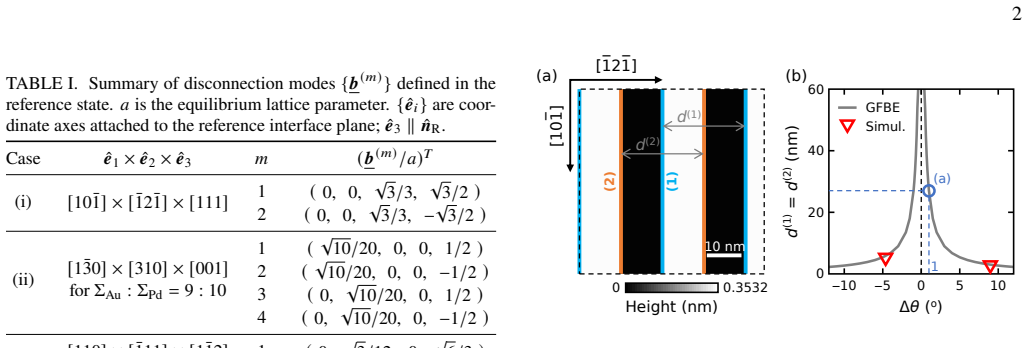
- The misoriented coherent twin boundary prediction reduces to Frank's formula, d = a/(√3 sin(Δθ/2)), and agrees with atomistic simulations for Ni.
- Twist heterophase Au-Pd interfaces require four sets of disconnections with finite step heights at higher-order coincidence orientations (e.g., ΣAu:ΣPd = 9:10), content that the classical FBE cannot represent; the predicted network energy measure Q has no cusp at coherent misorientations.
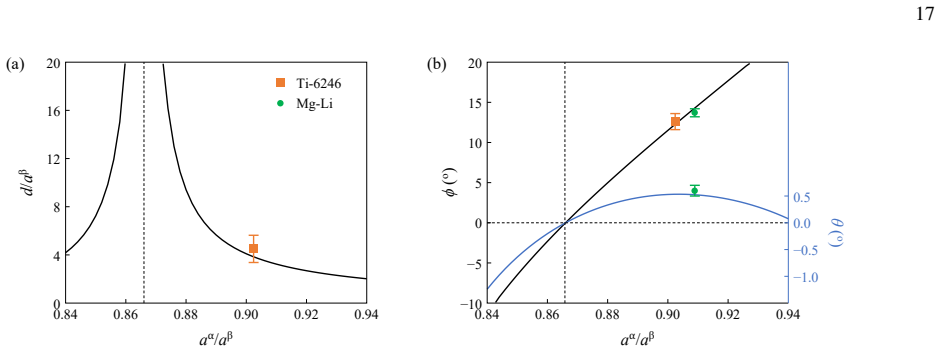
- For the martensite habit plane, the qGFBE predictions coincide with the phenomenological theory of martensite crystallography but additionally give the disconnection network and remain valid when no invariant plane exists.
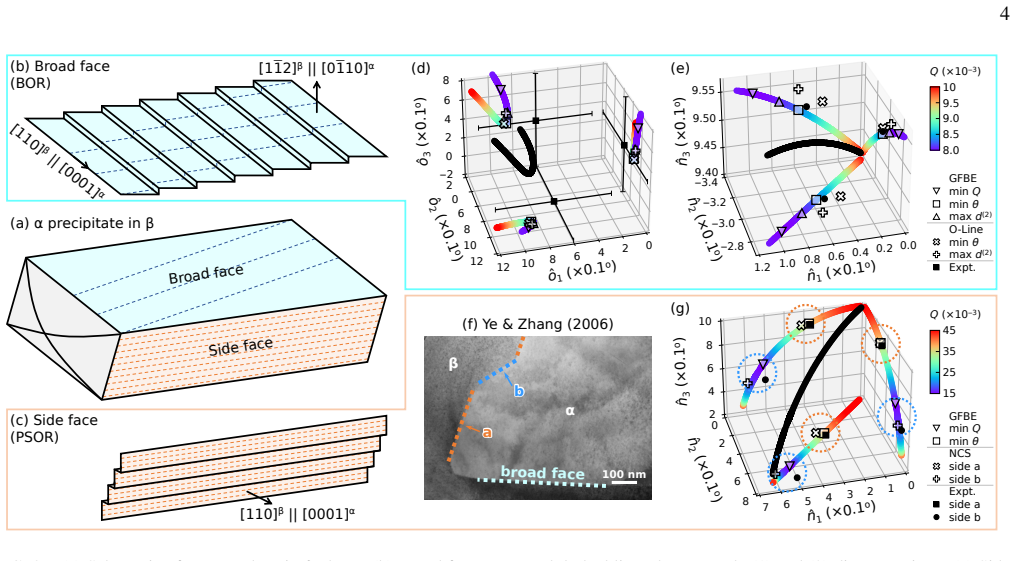
- The broad and side faces of martensite nuclei are underdetermined by geometry alone, yielding one-dimensional solution manifolds; the paper's selection criteria (min Q, min deviation from the Burgers orientation relationship, max mode-2 spacing) identify different experimentally observed facets.
- The method explicitly does not describe interfaces with disconnection reactions, such as the honeycomb dislocation networks observed in twist grain boundaries.
Reading between the lines
- If the GFBE is right that geometry fixes the network, then the reference state is not a mathematical convenience but a physical property of the interface; the Au-Pd case, where different reference choices predict different arrays, offers a way to infer which coincidence-site construction a real interface adopts by comparing measured spacings with predictions.
- The step-height balance could be embedded as a conservation law in phase-field or continuum models, so that the predicted disconnection network serves as an initial condition or constraint for relaxations that include energy and kinetics—potentially extending the method to the honeycomb networks the paper excludes.
- For underdetermined martensite cases, the one-dimensional solution manifolds imply that observable habit-plane data can be read as a selection experiment: measuring which facet forms effectively identifies whether the system minimizes the disconnection-energy measure Q, the deviation from the Burgers orientation relationship, or the mode-2 spacing.
Signed reviews
Editorial analysis
A structured set of objections, weighed in public.
Referee Report
Summary. The paper derives a generalized Frank-Bilby equation (GFBE) that augments the classical Burgers-vector balance b(p)=JF^{-1}K p with a step-height balance h(p)=n_R·p, giving a 4-vector incompatibility tensor T. Quantization via DSC disconnection modes yields BN^T=T_∥ (Eq. 6), which determines line directions and spacings of disconnection arrays. Applications are presented to misoriented Σ3 twin boundaries (recovering Frank's formula), Au-Pd (001) twist interfaces (recovering the Jesser-Kuhlmann-Wilsdorf result and predicting four-set disconnection networks), and α/β martensite broad and side faces (matching PTMC and experiments). The stated aim is to predict interface structure from lattice geometry, reference state, and DSC modes without invoking energy or kinetics.
Significance. The step-height generalization is a natural and potentially important extension of the Frank-Bilby formalism. The compact 4D formulation unifies dislocation and step content and, as shown, reduces to several known geometric theories (Frank's formula, Jesser-Kuhlmann-Wilsdorf, PTMC) in appropriate limits. The agreement with atomistic simulations (CTB case) and with experiments (Au-Pd, martensite) is encouraging evidence that the core derivation is correct. The paper also provides closed-form analytical predictions and a clear linear-algebra procedure for the quantized problem, which should be useful to the interface community if the caveats below are properly addressed.
major comments (3)
- [Sec. IV B and C (Eqs. 92–93, Fig. 3)] The qGFBE solution for the broad face is a one-dimensional manifold, and the paper selects a point using min Q, min θ, or max d^(2) — criteria not derived from the GFBE. Different criteria give different geometries (Figs. 3d, e, g). This directly conflicts with the abstract/introduction claim that interface structure is predicted 'without invoking energetic or kinetic information,' since Q is an energy measure. The authors should either derive a selection rule from the geometric framework or explicitly restate the contribution as providing necessary geometric conditions, with a separate physical criterion needed to close the problem.
- [Sec. III, reference-state construction (p. 2, Figs. 2c–e)] The reference state is non-unique, and the stated heuristic (close-packed CSL plane, minimal norm of JF^{-1}K, minimal inclination) is not formulated as a well-defined algorithm over the infinite set of possible coincidence references. Predictions depend quantitatively on the chosen reference (color-coded curves in Fig. 2), and the manuscript does not specify how the minimization is carried out or why the chosen reference is the one realized experimentally. This is load-bearing for the claimed predictive power. Please clarify the selection procedure and its uniqueness, or present the GFBE as conditional on a reference state chosen by external physical arguments.
- [Final paragraph, Sec. IV C] The paper acknowledges that the GFBE excludes disconnection reactions and assumes a coherent CSL/DSC terrace reference. This is a substantial domain restriction for real interfaces. Since the title and abstract promise a general framework, the limitations should be stated more prominently and the practical conditions under which reactions are negligible should be identified. As written, the scope is narrower than the abstract suggests.
minor comments (4)
- [Eq. (4) and Table I] The notation ΣAu:ΣPd is used for heterophase coincidence ratios; a brief definition in the main text would help readers not familiar with this convention.
- [Sec. II (CTB case)] The relative position of the two disconnection sets is stated to be undetermined by qGFBE and 'minimizing the elastic energy suggests d(1)/2.' This is an example of the energy-dependence issue; it would be useful to state explicitly that such a determination is outside the geometric framework.
- [Eq. (65)] The expression for ω(1) contains an arctangent with a denominator that can approach zero; specifying the branch or giving an equivalent principal-value expression would improve clarity.
- [General] The subscripts 'Au' and 'Pd' in Eq. (69) are defined in the text but the notation ¯a_Au is introduced abruptly; a sentence defining all barred lattice parameters would help.
Circularity Check
No significant circularity: the GFBE/qGFBE derivation is self-contained; acknowledged reference-state and selection-rule choices are correctness concerns, not circular reductions.
full rationale
The paper's derivation chain is not circular. The GFBE is obtained from the standard Burgers-circuit closure failure for the displacement jump and a separate, analogous step-height circuit for the reference normal; the qGFBE BN^T = T_parallel is then a linear-algebra consequence of representing the total Burgers-step content as a sum over quantized CSL/DSC disconnection modes. No interfacial parameters are fitted to the benchmark data: lattice parameters are literature values, disconnection modes are enumerated by the independent Smith-normal bicrystallography algorithm of Admal et al., and the benchmark references (atomistic simulations, experimental Au-Pd observations, PTMC, TM, O-line, NCS) are external to this paper. The reductions to Frank's formula and to the Jesser-Kuhlmann-Wilsdorf result are genuine limit checks, not renamings. The paper explicitly acknowledges that reference-state construction is not unique and that the broad-face and side-face cases are underdetermined, requiring additional criteria (min Q, min theta, max d^(2)) or a parallelism assumption. Choosing among these criteria after comparing with experiment is model selection and weakens the strength of the predictive claim, but it is not a circular reduction: the solution manifolds are real consequences of the qGFBE, and the auxiliary criteria are not encoded in the equation itself. Similarly, the Au-Pd reference-state heuristic may not select the experimentally favored reference, but that is an over-claim or correctness risk, not equivalence-by-construction. Self-citations in the paper are background citations to the authors' earlier structural-unit and grain-boundary-kinetics work and are not load-bearing for the GFBE derivation. No quoted step exhibits a fitted parameter renamed as a prediction or an equation equal to its input by construction.
Assumptions & free parameters
free parameters (1)
- Reference-state construction for Au-Pd (Sigma_Au:Sigma_Pd ratio and arithmetic-mean common length bar_l) =
1:1 or 9:10; bar_l=(l_Au+l_Pd)/2
assumptions (7)
- standard math Standard continuum dislocation kinematics: Burgers vector content is closure failure; Nye tensor alpha = curl beta^p, with plastic distortion jump across the interface giving b(p) = JF^-1K p.
- domain assumption Elastic deformation gradients are equal across the interface (Fe+ = Fe-) when relating the plastic-distortion jump to JF^-1K.
- domain assumption Step-height content is represented by a scalar order parameter theta with jump JthetaK, and h(p) = n_R·p follows from curl(-theta n_R/JthetaK).
- domain assumption Admissible interface defects are exactly the DSC/CSL disconnection modes; the interface is a coherent reference terraced by such disconnections.
- ad hoc to paper Non-unique reference state is fixed by heuristic rules: close-packed CSL plane, minimal norm of JF^-1K, and minimal inclination angle.
- ad hoc to paper In underdetermined cases, a point on the solution manifold is selected by minimizing Q, minimizing deviation from the Burgers orientation relationship, or maximizing d^(2).
- domain assumption One-mode habit-plane analysis neglects lattice mismatch along [110]beta || [0001]alpha (Omega_1 = 1) to ensure an invariant line exists.
Cite this review
Pith. "Pith review of A Generalized Frank-Bilby Equation for Interfaces in Crystalline Materials." pith.science (2026). https://pith.science/paper/T2MIGJHZ
@misc{pith2026260711176,
  author       = {Pith},
  title        = {Pith review of: A Generalized Frank-Bilby Equation for Interfaces in Crystalline Materials},
  year         = {2026},
  howpublished = {\url{https://pith.science/paper/T2MIGJHZ}},
  note         = {Machine review of arXiv:2607.11176}
}
read the original abstract
The classical Frank-Bilby equation (FBE) is commonly used to predict the structure of interfaces in crystalline materials in terms of interfacial dislocation networks. However, in general, the line defects in interfaces are disconnections, possessing both dislocation and step character, which are not captured by the classical FBE. As a result, the FBE cannot fully describe the structure of most interfaces of practical interest. To address this issue, we derive a generalized Frank-Bilby equation (GFBE) that explicitly incorporates both dislocation and step components of interfacial defects. We demonstrate its application to several representative interface systems.
Figures


Figures from the paper (21 more)






Reference graph
Works this paper leans on
-
[1]
a” and “b
α, we next consider both mode-(1) and (2) disconnec- tions (TableI), consistent with experimental observations [41]. Again, the interface inclination and misorientation are al- lowed to vary. The compatibility condition rank ( [ B T∥ ]) = rank(B) = 2 defines a one-dimensional solution manifold in S2 × SO(3), i.e., a curve in the five-dimensional interface...
2006
-
[2]
A. P . Sutton and R. W. Balluffi, Interfaces in Crystalline Mate- rials (Oxford University Press, 1995)
1995
-
[3]
Hirth and J
J. Hirth and J. Lothe, Theory of dislocations (John Wiley & Sons, 1982)
1982
-
[4]
J. Han, V . Vitek, and D. J. Srolovitz, The grain-boundary struc- tural unit model redux, Acta Materialia 133, 186 (2017)
2017
-
[5]
J. Han, S. L. Thomas, and D. J. Srolovitz, Grain-boundary ki- netics: A unified approach, Progress in Materials Science 98, 386 (2018)
2018
-
[6]
F. C. Frank, in Report of the Symposium on the Plastic Defor- mation of Crystalline Solids (Carnegie Institute of Technology, Pittsburgh, 1950) p. 150
1950
-
[7]
B. A. Bilby, T ypes of dislocation source, in Report of Bristol Conference on Defects in Crystalline Solids (The Physical So- ciety, London, 1955) pp. 124–133
1955
-
[8]
B. A. Bilby, R. Bullough, and E. Smith, Continuous distribu- tions of dislocations: a new application of the methods of non- Riemannian geometry,Proceedings of the Royal Society of Lon- don A 231, 263 (1955)
1955
Show all 64 references
-
[9]
A. J. Vattré and M. J. Demkowicz, Determining the Burgers vec- tors and elastic strain energies of interface dislocation arrays using anisotropic elasticity theory, Acta Materialia 61, 5172 (2013)
2013
-
[10]
J. B. Y ang, Y . Nagai, Z. G. Y ang, and M. Hasegawa, Quantiza- tion of the Frank-Bilby equation for misfit dislocation arrays in interfaces, Acta Materialia 57, 4874 (2009)
2009
-
[11]
Sangghaleh and M
A. Sangghaleh and M. J. Demkowicz, AIDA: A tool for exhaus- tive enumeration of solutions to the quantized Frank-Bilby equa- tion, Computational Materials Science 145, 35 (2018)
2018
-
[12]
Hirth, Dislocations, steps and disconnections at interfaces, Journal of Physics and Chemistry of Solids 55, 985 (1994)
J. Hirth, Dislocations, steps and disconnections at interfaces, Journal of Physics and Chemistry of Solids 55, 985 (1994)
1994
-
[13]
J. P . Hirth, R. C. Pond, R. G. Hoagland, X. Y . Liu, and J. Wang, Interface defects, reference spaces and the Frank-Bilby equation, Progress in Materials Science 58, 749 (2013)
2013
-
[14]
disconnection
Here, “disconnection” is used in a general sense to include all translational-symmetry-derived interfacial line defects. Interfa- cial dislocations and pure steps correspond to disconnections with zero step height and zero Burgers vector, respectively
-
[15]
D. B. Gordon and R. B. Sills, Self-consistent solution of the Frank-Bilby equation for interfaces containing disconnections, Journal of the Mechanics and Physics of Solids 193, 105845 (2024)
2024
-
[16]
Bollmann, Crystal defects and crystalline interfaces (Springer Berlin, Heidelberg, 1970)
W. Bollmann, Crystal defects and crystalline interfaces (Springer Berlin, Heidelberg, 1970)
1970
-
[17]
Zhang and G
W.-Z. Zhang and G. R. Purdy, O-lattice analyses of interfa- cial misfit. II. Systems containing invariant lines, Philosophical Magazine A 68, 291 (1993)
1993
-
[18]
Qiu, M.-X
D. Qiu, M.-X. Zhang, P . M. Kelly, and T. Furuhara, Crystallog- raphy of surface precipitates associated with shape change in a Ti-5.26wt.% Cr alloy, Acta Materialia 61, 7624 (2013)
2013
-
[19]
Zhang, J.- Y
Y .-S. Zhang, J.- Y . Zhang, and W.-Z. Zhang, A study of crys- tallography of 𝛼 precipitates in a Ti-8 wt% Fe alloy, Materials Characterization 178, 111193 (2021)
2021
-
[20]
Nye, Some geometrical relations in dislocated crystals, Acta Metallurgica 1, 153 (1953)
J. Nye, Some geometrical relations in dislocated crystals, Acta Metallurgica 1, 153 (1953)
1953
-
[21]
See Supplemental Material at http://aps.org... for deriva- tions of GFBE and qGFBE, and detailed analyses of misoriented coherent twin boundaries, twist heterophase interfaces, and the interfaces involved in martensite transformations
-
[22]
Sutton, V
A. Sutton, V . Vitek, and J. Christian, On the structure of tilt grain boundaries in cubic metals I. Symmetrical tilt boundaries, Philosophical Transactions of the Royal Society of London A 309, 1 (1983)
1983
-
[23]
Schwartz, V
D. Schwartz, V . Vitek, and A. Sutton, Atomic structure of (001) twist boundaries in f.c.c metals structural unit model,Philosoph- ical Magazine A 51, 499 (1985)
1985
-
[24]
N. C. Admal, T. Ahmed, E. Martinez, and G. Po, Interface dislo- cations and grain boundary disconnections using Smith normal bicrystallography, Acta Materialia 240, 118340 (2022)
2022
-
[25]
C. J. O’Brien, D. L. Medlin, and S. M. Foiles, Misoriented grain boundaries vicinal to the (111) ⟨ 1¯10⟩ twin in nickel Part I: ther- modynamics & temperature-dependent structure, Philosophical Magazine 96, 1285 (2016)
2016
-
[26]
Marquis and D
E. Marquis and D. Medlin, Structural duality of 1/3⟨111⟩ twin- boundary disconnections, Philosophical Magazine Letters 85, 387 (2005)
2005
-
[27]
Hwang, D
M. Hwang, D. Laughlin, and I. Bernstein, Interphase interfaces of Au-Ag and Au-Pd, Acta Metallurgica 28, 621 (1980)
1980
-
[28]
Balluffi, A
R. Balluffi, A. Brokman, and A. King, CSL/DSC Lattice model for general crystalcrystal boundaries and their line defects, Acta Metallurgica 30, 1453 (1982)
1982
-
[29]
R. C. Ecob and B. Ralph, Geometrical model for the energy of semicoherent interphase interfaces, Proceedings of the National Academy of Sciences 77, 1749 (1980)
1980
-
[30]
A. J. Vattré, N. Abdolrahim, K. Kolluri, and M. J. Demkowicz, Computational design of patterned interfaces using reduced or- der models, Scientific Reports 4, 6231 (2014)
2014
-
[31]
Y e and W.-Z
F. Y e and W.-Z. Zhang, Dislocation structure of non-habit plane of 𝛼 precipitates in a Ti-7.26 wt.% Cr alloy, Acta Materialia 54, 871 (2006)
2006
-
[32]
Y e, W.-Z
F. Y e, W.-Z. Zhang, and D. Qiu, Near-coincidence-sites model- ing of the edge facet dislocation structures of 𝛼 precipitates in a Ti-7.26 wt.% Cr alloy, Acta Materialia 54, 5377 (2006)
2006
-
[33]
Furuhara, J
T. Furuhara, J. Howe, and H. Aaronson, Interphase boundary structures of intragranular proeutectoid 𝛼 plates in a hypoeu- tectoid Ti-Cr alloy, Acta Metallurgica et Materialia 39, 2873 (1991)
1991
-
[34]
Miyano, K
N. Miyano, K. Ameyama, and G. C. Weatherly, HRTEM ob- servation and atomic modeling of 𝛼/𝛽 interphase boundary in a Ti-22V-4Al alloy, Materials Transactions 43, 1547 (2002)
2002
-
[35]
Zhang, F.-Z
J.- Y . Zhang, F.-Z. Dai, Z.-P . Sun, and W.-Z. Zhang, Struc- tures and energetics of semicoherent interfaces of precipitates in hcp/bcc systems: A molecular dynamics study, Journal of Materials Science and Technology 67, 50 (2021)
2021
-
[36]
R. C. Pond, S. Celotto, and J. P . Hirth, A comparison of the phenomenological theory of martensitic transformations with a model based on interfacial defects, Acta Materialia 51, 5385 (2003)
2003
-
[37]
A. K. Ackerman, V . A. Vorontsov, I. Bantounas, Y . Zheng, Y . Chang, T. McAuliffe, W. A. Clark, H. L. Fraser, B. Gault, 6 D. Rugg, and D. Dye, Interface characteristics in an 𝛼 + 𝛽 tita- nium alloy, Physical Review Materials 4, 013602 (2020)
2020
-
[38]
Wechsler, D
M. Wechsler, D. Lieberman, and T. Read, On the theory of the formation of martensite, Transactions AIME , 1503 (1953)
1953
-
[39]
Bowles and J
J. Bowles and J. Mackenzie, The crystallography of martensite transformations I, Acta Metallurgica 2, 129 (1954)
1954
-
[40]
Pond and J
R. Pond and J. Hirth, Defects at surfaces and interfaces (Aca- demic Press, 1994) pp. 287–365
1994
-
[41]
M. Kral, B. Muddle, and J. Nie, Crystallography of the bcc/hcp transformation in a Mg-8Li alloy, Materials Science and Engi- neering: A 460-461, 227 (2007)
2007
-
[42]
Zheng, R
Y . Zheng, R. E. Williams, G. B. Viswanathan, W. A. Clark, and H. L. Fraser, Determination of the structure of α-β interfaces in metastable β-Ti alloys, Acta Materialia 150, 25 (2018)
2018
-
[43]
min 𝜃 maximizes compatibility with the misorientation on other facets of the 𝛼 nucleus
𝑄 provides a crude measure of the disconnection-network en- ergy. min 𝜃 maximizes compatibility with the misorientation on other facets of the 𝛼 nucleus. max 𝑑 (2) applies when mode-(2) disconnections dominate the energy
-
[44]
Pitsch and A
W . Pitsch and A. Schrader, Die ausscheidungsform des 𝜖- karbids im ferrit und im martensit beim anlassen, Archiv fur das Eisenhuttenwesen 29, 715 (1958)
1958
-
[45]
Dahmen, Orientation relationships in precipitation systems, Acta Metallurgica 30, 63 (1982)
U. Dahmen, Orientation relationships in precipitation systems, Acta Metallurgica 30, 63 (1982)
1982
-
[46]
C. Shen, J. Li, and Y . Wang, Predicting structure and energy of dislocations and grain boundaries, Acta Materialia 74, 125 (2014)
2014
-
[47]
Xiang, H
Y . Xiang, H. Wei, P . Ming, and W. E, A generalized Peierls– Nabarro model for curved dislocations and core structures of dislocation loops in Al and Cu, Acta Materialia 56, 1447 (2008). SUPPLEMENTAL MATERIAL A Generalized Frank-Bilby Equation for Interfaces in Crystalline Ma...
2008
-
[48]
Step height density vector and the total step height equation 5
-
[49]
+” lattice of NS is deformed to P 1A1O in RS, while the segment OA2P in the “−
The generalized Frank-Bilby equation 6 D. The quantized generalized Frank-Bilby equation 6 II. Misoriented coherent twin boundaries 8 A. Grain boundaries with arbitrary geometrical parameters 8 B. Symmetric tilt boundaries as deviations from Σ3 coherent twin boundaries 9 III. ...
-
[50]
By analogy, the step height content arises from the incompatibility of an additional scalar order parameter, denoted by 𝜗
Step height density vector and the total step height equation Previously, we showed that the Burgers vector content arises from incompatibility in the deformation gradient F across an interface. By analogy, the step height content arises from the incompatibility of an addition...
-
[51]
Burgers-step
The generalized Frank-Bilby equation A general interface containing disconnections should possess both Burgers vector content and step height content. To describe the disconnection content in a general interface, we simply combine Eq. ( 24) and Eq. (33). The total “Burgers-ste...
-
[52]
11 (a) Δθ = 2.2o (b) Δθ = 4.5o FIG
Since the two modes have the same density and the same spacing, the paired disconnections may be regarded as an array of pure edge dislocations with spacing 𝑑 = 𝑑 (1) = 𝑑 (2) = 𝑏/(2 sin(Δ𝜃/2)); this is precisely Frank’s formula for the spacing of an array of edge dislocations ...
-
[53]
Solving the qGFBE with Eq
(¯𝑙′/¯𝑙). Solving the qGFBE with Eq. (61) and Eq. (69) gives the unique solution: N = 3 √ 5 ¯𝑙 © « 𝑐 𝑐 −𝑠 −𝑠 𝑠 𝑠 𝑐 𝑐 0 0 0 0 ª® ¬ . (70) Modes (1) and (2) form two arrays with the same density and the same line direction, while modes (3) and (4) form another pair of arrays or...
-
[54]
− 1 Ω−1 3 [(1 − cos 𝜃) ˆ𝑜2 ˆ𝑜3 − sin 𝜃 ˆ𝑜1] − √ 3 3 Ω−1 1 [(1 − cos 𝜃) ˆ𝑜1 ˆ𝑜2 + sin 𝜃 ˆ𝑜3] Ω−1 3 cos 𝜃 + ( 1 − cos 𝜃) ˆ𝑜2 3 − 1 − √ 3 3 Ω−1 1 [(1 − cos 𝜃) ˆ𝑜1 ˆ𝑜3 − sin 𝜃 ˆ𝑜2] ª®®® ¬ , (90) 𝒗 (2) ( ˆ𝒐, 𝜃) = © « 4 √ 3 3 Ω−1 1 (cos 𝜃 + ( 1 − cos 𝜃) ˆ𝑜2
-
[55]
− 1 − 4 √ 2Ω−1 2 [(1 − cos 𝜃) ˆ𝑜1 ˆ𝑜2 − sin 𝜃 ˆ𝑜3] 4 √ 3 3 Ω−1 1 [(1 − cos 𝜃) ˆ𝑜1 ˆ𝑜2 + sin 𝜃 ˆ𝑜3] − 4 √ 2 Ω−1 2 (cos 𝜃 + ( 1 − cos 𝜃) ˆ𝑜2
-
[56]
(91) The condition for the existence of a qGFBE solution can be summarized as 8>>>> < >>>>: 𝒗 (1) ( ˆ𝒐, 𝜃) = 𝜆 (1) ˆ𝒏 𝒗 (2) ( ˆ𝒐, 𝜃) = 𝜆 (2) ˆ𝒏 ˆ𝒐 · ˆ𝒐 = 1 ˆ𝒏 · ˆ𝒏 = 1
− 1 4 √ 3 3 Ω−1 1 [(1 − cos 𝜃) ˆ𝑜1 ˆ𝑜3 − sin 𝜃 ˆ𝑜2] − 4 √ 2Ω−1 2 [(1 − cos 𝜃) ˆ𝑜2 ˆ𝑜3 + sin 𝜃 ˆ𝑜1] + 1 ª®®® ¬ . (91) The condition for the existence of a qGFBE solution can be summarized as 8>>>> < >>>>: 𝒗 (1) ( ˆ𝒐, 𝜃) = 𝜆 (1) ˆ𝒏 𝒗 (2) ( ˆ𝒐, 𝜃) = 𝜆 (2) ˆ𝒏 ˆ𝒐 · ˆ𝒐 = 1 ˆ𝒏 · ˆ𝒏 =...
-
[57]
F. C. Frank, in Report of the Symposium on the Plastic Deformation of Crystalline Solids (Carnegie Institute of Technology, Pittsburgh,
-
[58]
B. A. Bilby, Types of dislocation source, inReport of Bristol Conference on Defects in Crystalline Solids (The Physical Society, London,
-
[59]
N. C. Admal, T. Ahmed, E. Martinez, and G. Po, Interface dislocations and grain boundary disconnections using Smith normal bicrystal- lography, Acta Materialia 240, 118340 (2022)
2022
-
[60]
Marquis and D
E. Marquis and D. Medlin, Structural duality of1/3⟨111⟩ twin-boundary disconnections, Philosophical Magazine Letters 85, 387 (2005)
2005
-
[61]
Hwang, D
M. Hwang, D. Laughlin, and I. Bernstein, Interphase interfaces of Au-Ag and Au-Pd,Acta Metallurgica 28, 621 (1980)
1980
-
[62]
W. A. Jesser and D. Kuhlmann-Wilsdorf, The geometry and energy of a twist boundary between crystals with unequal lattice parameters, physica status solidi (b)21, 533 (1967)
1967
-
[63]
A. K. Ackerman, V. A. Vorontsov, I. Bantounas, Y. Zheng, Y. Chang, T. McAuliffe, W. A. Clark, H. L. Fraser, B. Gault, D. Rugg, and D. Dye, Interface characteristics in an𝛼 + 𝛽 titanium alloy,Physical Review Materials4, 013602 (2020)
2020
-
[64]
M. Kral, B. Muddle, and J. Nie, Crystallography of the bcc/hcp transformation in a Mg-8Li alloy,Materials Science and Engineering: A 460-461, 227 (2007)
2007
Reviewed August 2, 2026 · model on record in the stance chip above.
Discussion (0). Continue with ORCID to comment.