REVIEW 2 major objections 6 minor 51 references
Impact of Electronic Energy Dissipation on Primary Radiation Damage Formation in Silicon
T0 review · 2 major / 6 minor · reviewed 2026-07-14 · grok-4.5
Pith's one-line read The functional form of ion–electron coupling decides how many defects, and how they cluster, in silicon radiation cascades—and that effect itself depends on which atomic potential is used.
desk verdict Solid comparative cascade study: coupling form and potential jointly set Si primary-damage metrics; the fixed low-T Ce/κe choice mutes feedback by construction but does not sink the main result. read the letter →
The pith
A machine-rendered reading of the paper's core claim, the machinery that carries it, and where it could break.
The reading
What carries the argument
The threshold-free unified two-temperature model (UTTM) that couples atoms to a local electronic density via either a quadratic or a four-density coupling function, both fitted to real-time TDDFT stopping powers.
What would settle it
Repeat the same 20 keV cascade suite with electronic heat capacity and conductivity allowed to rise with electronic temperature; if the ranking of defect yields and recombination efficiencies between the two coupling functions then reverses or collapses, the present conclusions are parameter-dependent rather than general.
Extended reading notes
Core claim
Within a unified two-temperature molecular-dynamics framework, the functional form of the local-density ion–electron coupling controls defect production efficiency, clustering, and recombination in silicon cascades; the same coupling can raise or lower recombination efficiency depending on whether the Stillinger–Weber or Tersoff/ZBL potential is used, because the two potentials generate different cascade morphologies and different spatial correlations between vacancies and interstitials.
Load-bearing premise
Electronic heat capacity and conductivity are held fixed at their low-temperature values even in voxels that become strongly heated, so energy feedback from electrons to the lattice is largely muted by construction.
Editorial extensions
If this is right
- Primary-damage databases used for silicon detector lifetime models must quote both the coupling function and the interatomic potential, not merely the PKA energy.
- Friction-only electronic-stopping models with arbitrary kinetic-energy cut-offs will continue to scatter widely in predicted Frenkel-pair numbers.
- The four-density coupling’s closer match to SRIM in the ballistic phase suggests it should be preferred for high-energy cascade statistics until a better TDDFT-fitted form appears.
- Cascade morphology (compact amorphous pockets versus elongated crystalline defect strings) is co-determined by electronic dissipation and the short-range repulsion of the chosen potential.
Reading between the lines
- If the same density-based couplings were applied to germanium or silicon carbide, the potential-dependent recombination crossover observed here would likely reappear wherever cascade compactness differs strongly between empirical potentials.
- Device-level rate-theory models that currently ingest MD defect yields as fixed input may need an additional “coupling-form” uncertainty band once electronic effects are treated at this fidelity.
- A natural next experiment is to re-run the identical PKA set with a machine-learned potential known to reproduce DFT defect formation energies; any residual coupling-form effect would then isolate the electronic contribution more cleanly.
Signed reviews
Editorial analysis
A structured set of objections, weighed in public.
Referee Report
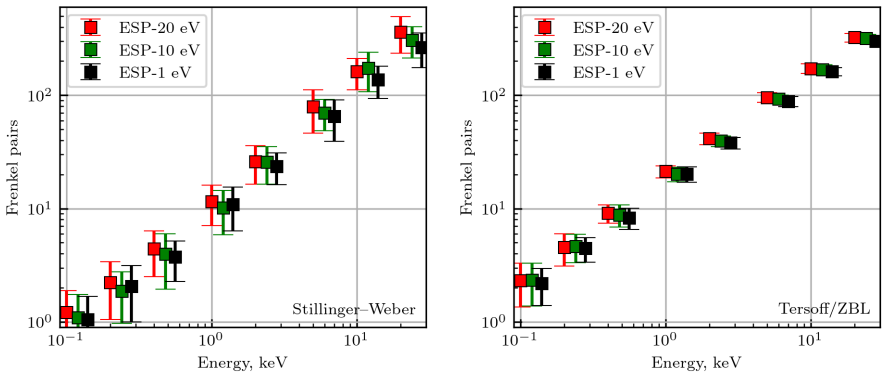
Summary. The manuscript studies primary radiation damage in diamond-structure silicon with two-temperature MD (LAMMPS + USER-EPH), comparing a quadratic local-density coupling function and a four-density coupling function fitted to rt-TDDFT trajectories. Cascades are run for PKA energies 0.1–20 keV with Stillinger–Weber and T3/ZBL potentials, both fixed and variable electronic temperature, and against friction-based electronic-stopping (ESP) baselines with several kinetic-energy cut-offs. Residual defects are quantified by Wigner–Seitz and coordination analysis; clustering and recombination efficiency R = 1 − Nsurv/Nmax are reported. The central claim is that the functional form of the ion–electron coupling controls defect production, clustering and recombination more strongly than electronic-temperature feedback under the chosen parameters, and that the effect of coupling on cooling-phase recombination further depends on the interatomic potential (compact amorphous-like SW cascades versus more extended T3/ZBL clusters).
Significance. If the trends hold under more realistic electronic transport, the work supplies a concrete, transferable demonstration that threshold-free density-dependent couplings are not interchangeable for cascade predictions in Si, and that electronic and atomic models must be co-validated. Strengths include transparent methods (cell sizes, adaptive timesteps, explicit cut-offs, PCA cluster lengths), systematic cross-checks against SRIM/ESP friction baselines and against TDDFT-motivated energy-loss curves, and the explicit potential-dependent recombination analysis (Figs. 7–11). The four-density coupling’s closer agreement with SRIM in the ballistic regime is a useful external benchmark. The results are of direct interest for radiation-damage modelling of Si detectors and for the broader community using UTTM-style electronic stopping.
major comments (2)
- Simulation details and §3.1 (Figs. 2–3, 6): Ce and κe are fixed at the low-temperature values 5×10⁻⁶ eV K⁻¹ Å⁻³ and 5×10⁻³ eV K⁻¹ Å⁻¹ ps⁻¹ for every voxel throughout the cascade. Under these coefficients the electronic subsystem cannot store or transport heat efficiently once Te rises, so bidirectional energy return is suppressed by construction. The near-identity of fixed-Te and variable-Te FP counts therefore does not demonstrate that feedback is physically unimportant; it only shows that feedback is unimportant when transport coefficients remain cold. The ranking of the two coupling functions and the potential-dependent recombination trends rest on this untested electronic-transport regime. At least a limited sensitivity study (temperature-dependent Ce/κe, or literature high-Te values) is needed before the claim that “coupling form … [has] a stronger influence … than the subsequent fe
- §3.1–3.2 and Conclusions: the four-density coupling is presented as more physically consistent because its ballistic energy losses track SRIM and because it was fitted including close-collision trajectories. SRIM, however, is an empirical average over straight-path, intact-lattice conditions and is not a first-principles ground truth for disordered cascade cores. The paper should state more carefully that SRIM agreement is a useful consistency check rather than decisive validation, and should quantify how much of the defect-number difference survives when both couplings are constrained to the same integrated Se (or when only the high-density core region of the four-density function is varied).
minor comments (6)
- Section numbering is inconsistent: the text states “Section 2 describes … Section 2 presents and discusses the results. Section 4 summarizes…” (Introduction, final paragraph). Renumber Results as §3 and Conclusions as §4 consistently.
- Fig. 1 caption and body: “Xin ESP-Xstands” and similar missing spaces/typos appear in several figure captions and in the abstract (“threshold-free approach”). A careful proof-read is needed.
- Table 1 and Simulation details: electronic voxel side length is given as “≈25 Å”; the precise value used and the resulting number of electronic voxels relative to the atomic cell should be stated for reproducibility.
- Fig. 4 and Fig. 5: the gray ESP bands are helpful, but the number of independent cascades averaged for each PKA energy (especially 100 keV) is not stated; adding N and error bars (or standard error) would strengthen the comparison.
- Recombination efficiency R is defined with coordination defects (Eq. 1) while surviving damage is also reported as Frenkel pairs (WS). A short note on how the two defect definitions correlate would avoid ambiguity when comparing R across potentials.
- References [38] and [39] are listed as “Research data” and “Submitted”; if still unpublished at acceptance, a brief statement of availability (or deposition) would help readers reproduce the four-density function.
Circularity Check
Mild self-citation for four-density fidelity claim; cascade defect comparisons themselves are independent simulations against external SRIM benchmarks.
-
self citation load bearing
[§3.1 (energy-loss comparison and transferability paragraph)]
"Comparison of the electronic stopping power predicted by MD simulations using the four-density and quadratic coupling functions shows that the four-density coupling function is in better agreement with the TDDFT predictions [39]. This suggests that the four-density formulation provides a more accurate description of energy transfer between moving atoms and the electronic subsystem for the complex trajectories involved in the cascade event. ... the four-density coupling function was fitted using trajectories with close collision approaches, which improves its transferability to cascade conditio"
The claim that four-density is the more physically faithful coupling (used to interpret which form better represents reality) rests on better agreement with TDDFT data reported in the authors' own overlapping-author work [39], where that same function was constructed by fitting to those TDDFT trajectories. The 'better agreement' is therefore partly by construction of the prior fit rather than an independent external validation; the self-citation is load-bearing for the ranking of the two forms.
full rationale
The paper's load-bearing results (differences in surviving FPs, peak coordination defects, clustering fractions, and recombination efficiency R between the quadratic and four-density couplings, plus the SW vs T3/ZBL dependence of those differences) are generated by direct UTTM-MD runs; the defect counts are not fitted quantities. Both coupling functions were previously fitted to rt-TDDFT stopping along selected trajectories; they are then applied unchanged to cascades and compared to independent SRIM electronic-loss curves in the ballistic phase. That application is a genuine transfer test, not a tautology. The sole mild circularity is the self-citation chain used to declare the four-density form 'more accurate' and 'more transferable': agreement with TDDFT is partly by construction of the fit performed in the authors' own prior/submitted work, and the paper leans on that citation when ranking the two forms. No self-definitional loop exists (X is not defined as Y), no cascade observable is renamed as a prediction of its own fit, and no uniqueness theorem is imported. The fixed low-T Ce/κe choice mutes bidirectional feedback under the stated conditions, but the paper explicitly qualifies the form-vs-feedback ranking with those conditions and does not present the null fixed/variable-Te result as a parameter-free derivation. Hence the circularity score remains low (2).
Assumptions & free parameters
free parameters (7)
- Electronic heat capacity Ce =
5e-6 eV/K/ų
- Electronic thermal conductivity κe =
5e-3 eV/K/Å/ps
- Electronic voxel side length =
~25 Å
- Wigner–Seitz / coordination cutoff radius =
2.85 Å
- Cluster neighbor cutoff r_cl =
~10.8 Å
- Quadratic coupling parameters (a,b,c,ρf) =
(0.041ρ)/(1+e^{10(ρ−0.3)}) eV·ps/Ų
- Four-density coupling region parameters
assumptions (6)
- domain assumption Classical MD with semi-empirical potentials (SW, T3/ZBL) adequately represents atomic forces during keV cascades in Si for primary-damage statistics.
- domain assumption A single local-density-dependent coupling captures both electronic stopping and electron–phonon coupling without a velocity or time threshold (Caro–Victoria / UTTM).
- domain assumption Coupling functions fitted to a small set of rt-TDDFT trajectories transfer to the diverse, disordered trajectories of a full cascade.
- domain assumption SRIM electronic stopping along straight paths in intact material is a valid reference for ballistic-phase energy loss in cascades.
- domain assumption Wigner–Seitz occupancy and four-fold coordination cutoffs correctly identify residual radiation defects relevant to long-term evolution.
- ad hoc to paper Low-T Ce and κe remain appropriate when local electronic temperature rises during the cascade.
Cite this review
Pith. "Pith review of Impact of Electronic Energy Dissipation on Primary Radiation Damage Formation in Silicon." pith.science (2026). https://pith.science/paper/6XWKH6P6
@misc{pith2026260711253,
  author       = {Pith},
  title        = {Pith review of: Impact of Electronic Energy Dissipation on Primary Radiation Damage Formation in Silicon},
  year         = {2026},
  howpublished = {\url{https://pith.science/paper/6XWKH6P6}},
  note         = {Machine review of arXiv:2607.11253}
}
read the original abstract
In this work, we investigate the role of ion-electron coupling in simulations of radiation damage formation in silicon using molecular dynamics simulations within a two-temperature model. We explore predictions of a threshold-free approach to the coupling that accounts for both the electronic stopping and electron-phonon coupling using a local electron density-based formalism. We compare two different coupling functions across a range of primary knock-on atom energies using two interatomic potentials. Our results demonstrate that the functional form of the ion-electron coupling plays a critical role in determining defect production efficiency, clustering, and recombination, and must therefore be carefully considered for accurate modeling of radiation damage formation. Furthermore, we find that the impact of the coupling in particular on the recombination of defects during the cooling phase of the cascade depends on the choice of interatomic potential, emphasizing the importance of physically grounded descriptions for both electronic effects and atom-atom interactions for reliable radiation damage predictions.
Figures


Figures from the paper (7 more)


Reference graph
Works this paper leans on
-
[1]
Caturla, T
M.J. Caturla, T. Diaz de la Rubia, and George H. Gilmer. Disordering and defect production in silicon by kev ion irradiation studied by molecular dynamics.Nuclear Instruments and Methods in Physics Research Section B: Beam Interactions with Materials and Atoms, 106(1-4):1–8, 1995
1995
-
[2]
Caturla, T
M.-J. Caturla, T. D´ ıaz de la Rubia, L. A. Marqu´ es, and G. H. Gilmer. Ion-beam processing of silicon at kev energies: A molecular-dynamics study.Physical Review B, 54(23):16683–16695, 1996
1996
-
[3]
Averback and T
R.S. Averback and T. Diaz De La Rubia. Displacement damage in irradiated metals and semiconductors. pages 281–402, 1998
1998
-
[4]
Stock, G.H
D.M. Stock, G.H. Gilmer, M. Jara´ ız, and T. Diaz de la Rubia. Point defect accumulation in silicon irradiated by energetic particles: A molecular dynamics simulation.Nuclear Instruments and Methods in Physics Research Section B: Beam Interactions with Materials and Atoms, 102(1-4):207–210, 1995
1995
-
[5]
G. Otto, G. Hobler, and K. G¨ artner. Defect characterization of low-energy recoil events in silicon using classical molecular dynamics simulation.Nuclear Instruments and Methods in Physics Research Section B: Beam Interactions with Materials and Atoms, 202:114–119, 2003
2003
-
[6]
J. Nord, K. Nordlund, and J. Keinonen. Amorphization mechanism and defect structures in ion-beam-amorphized si, ge, and gaas.Physical Review B, 65(16):165329, 2002. 11
2002
-
[7]
Effect of the interatomic si-si-potential on vacancy production during ion implantation of si.Physica Scripta, T54:34–37, 1994
K Nordlund, J Keinonen, and A Kuronen. Effect of the interatomic si-si-potential on vacancy production during ion implantation of si.Physica Scripta, T54:34–37, 1994
1994
-
[8]
Nordlund, M
K. Nordlund, M. Ghaly, R. S. Averback, M. Caturla, T. Diaz de la Rubia, and J. Tarus. Defect production in collision cascades in elemental semiconductors and fcc metals.Phys. Rev. B, 57:7556–7570, Apr 1998
1998
Show all 51 references
-
[9]
Sayed, J.H
M. Sayed, J.H. Jefferson, A.B. Walker, and A.G. Cullis. Molecular dynamics simulations of implantation damage and recovery in semiconductors.Nuclear Instruments and Methods in Physics Research Section B: Beam Interactions with Materials and Atoms, 102(1- 4):218–222, 1995
1995
-
[10]
C. D. Denton, V. M. Konoplev, A. Gras-Mart´ ı, and J. J. Jim´ enez-Rodr´ ıguez. Annealing of radiation damage in si. a molecular dynamics study.Radiation Effects and Defects in Solids, 141(1-4):129–140, 1997
1997
-
[11]
Maria Jose Caturla, Tomas Diaz de la Rubia, and George H. Gilmer. Recrystallization of a planar amorphous-crystalline interface in silicon by low energy recoils: A molecular dynamics study.Journal of Applied Physics, 77(7):3121–3125, 1995
1995
-
[12]
S. T. Chavan, P. S. Bhave, V. N. Bhoraskar, and D. Kanjilal. Damage induced by 90 mev silicon ions in crystalline silicon.Journal of Applied Physics, 78(4):2328–2332, 1995
1995
-
[13]
Toulemonde, J
M. Toulemonde, J. Dural, G. Nouet, P. Mary, J. F. Hamet, M. F. Beaufort, J. C. Desoyer, C. Blanchard, and J. Auleytner. High energy heavy ion irradiation of silicon.Physica Status Solidi (a), 114(2):467–473, 1989
1989
-
[14]
Levalois, P
M. Levalois, P. Bogdanski, and M. Toulemonde. Induced damage by high energy heavy ion irradiation at the ganil accelerator in semiconductor materials. Nuclear Instruments and Methods in Physics Research Section B: Beam Interactions with Materials and Atoms, 63(1–2):14–20, 1992
1992
-
[15]
Canut, N
B. Canut, N. Bonardi, S.M.M. Ramos, and S. Della-Negra. Latent tracks formation in silicon single crystals irradiated with fullerenes in the electronic regime.Nuclear Instruments and Methods in Physics Research Section B: Beam Interactions with Materials and Atoms, 146(1–4):29...
1998
-
[16]
A Dunlop, G Jaskierowicz, and S Della-Negra. Latent track formation in silicon irradiated by 30 mev fullerenes.Nuclear Instruments and Methods in Physics Research Section B: Beam Interactions with Materials and Atoms, 146(1–4):302–308, 1998
1998
-
[17]
Amekura, M
H. Amekura, M. Toulemonde, K. Narumi, R. Li, A. Chiba, Y. Hirano, K. Yamada, S. Yamamoto, N. Ishikawa, N. Okubo, and Y. Saitoh. Ion tracks in silicon formed by much lower energy deposition than the track formation threshold.Scientific Reports, 11(1), 2021
2021
-
[18]
Mihai, D
M.D. Mihai, D. Iancu, E. Zarkadoula, R.A. Florin, Y. Tong, Y. Zhang, W.J. Weber, and G. Veli¸ sa. Athermal annealing of pre-existing defects in crystalline silicon.Acta Materialia, 261:119379, December 2023
2023
-
[19]
Mihai, P
M.D. Mihai, P. Ionescu, D. Pantelica, H. Petrascu, D. Craciun, V. Craciun, F. Vasiliu, B.S. Vasile, and I. Mercioniu. Annealing of preexisting defects in silicon single crystals by ion irradiation.Nuclear Instruments and Methods in Physics Research Section B: Beam Interactions...
2019
-
[20]
How good is damped molecular dynamics as a method to simulate radiation damage in metals?New Journal of Physics, 11(1):013004, January 2009
J le Page, D R Mason, C P Race, and W M C Foulkes. How good is damped molecular dynamics as a method to simulate radiation damage in metals?New Journal of Physics, 11(1):013004, January 2009
2009
-
[21]
Bj¨ orkas and K
C. Bj¨ orkas and K. Nordlund. Assessment of the relation between ion beam mixing, electron–phonon coupling and damage production in fe.Nuclear Instruments and Methods in Physics Research Section B: Beam Interactions with Materials and Atoms, 267(10):1830–1836, 2009
2009
-
[22]
A. E. Sand, S. L. Dudarev, and K. Nordlund. High-energy collision cascades in tungsten: Dislocation loops structure and clustering scaling laws.EPL (Europhysics Letters), 103(4):46003, 2013. 12
2013
-
[23]
Sand and K
A.E. Sand and K. Nordlund. On the lower energy limit of electronic stopping in simulated collision cascades in ni, pd and pt.Journal of Nuclear Materials, 456:99–105, 2015
2015
-
[24]
Kim, M-A
S.-J. Kim, M-A. Nicolet, R. S. Averback, and D. Peak. Low-temperature ion-beam mixing in metals.Physical Review B, 37(1):38–49, 1988
1988
-
[25]
Eva Zarkadoula, German Samolyuk, Haizhou Xue, Hongbin Bei, and William J. Weber. Effects of two-temperature model on cascade evolution in ni and nife.Scripta Materialia, 124:6–10, 2016
2016
-
[26]
Including the effects of electronic stopping and electron–ion interactions in radiation damage simulations
D M Duffy and A M Rutherford. Including the effects of electronic stopping and electron–ion interactions in radiation damage simulations. Journal of Physics: Condensed Matter, 19(1):016207, dec 2006
2006
-
[27]
Caro and M
A. Caro and M. Victoria. Ion-electron interaction in molecular-dynamics cascades. Physical Review A, 40(5):2287–2291, sep 1989
1989
-
[28]
Eva Zarkadoula, German Samolyuk, and William J. Weber. Effects of the electron- phonon coupling activation in collision cascades.Journal of Nuclear Materials, 490:317–322, 2017
2017
-
[29]
Thomas Jarrin, Antoine Jay, Anne H´ emeryck, and Nicolas Richard. Parametric study of the two-temperature model for molecular dynamics simulations of collisions cascades in si and ge.Nuclear Instruments and Methods in Physics Research Section B: Beam Interactions with Material...
2020
-
[30]
Effects of atom–electron energy exchange on radiation damage in zirconium.Nuclear Materials and Energy, 24:100787, 2020
Zhibing Zhou, Baoqin Fu, Kun Zhang, Qing Hou, Jiechao Cui, Lu Wu, and Rongjian Pan. Effects of atom–electron energy exchange on radiation damage in zirconium.Nuclear Materials and Energy, 24:100787, 2020
2020
-
[31]
A modified two temperature molecular dynamics (2t-md) model for cascades.Journal of Physics: Condensed Matter, 36(33):335901, 2024
Andr´ es Rojano, R J Hunt, J-P Crocombette, and S T Murphy. A modified two temperature molecular dynamics (2t-md) model for cascades.Journal of Physics: Condensed Matter, 36(33):335901, 2024
2024
-
[32]
A. Tamm, M. Caro, A. Caro, G. Samolyuk, M. Klintenberg, and A. A. Correa. Langevin dynamics with spatial correlations as a model for electron-phonon coupling.Physical Review Letters, 120:185501, May 2018
2018
-
[33]
Role of electrons in collision cascades in solids
A.Tamm, M.Caro, A.Caro, andA.A.Correa. Role of electrons in collision cascades in solids. ii. molecular dynamics.Physical Review B, 99(17):174302, 2019
2019
-
[34]
https://github.com/llnl/user-eph
-
[35]
A. P. Thompson, H. M. Aktulga, R. Berger, D. S. Bolintineanu, W. M. Brown, P. S. Crozier, P. J. in ’t Veld, A. Kohlmeyer, S. G. Moore, T. D. Nguyen, R. Shan, M. J. Stevens, J. Tranchida, C. Trott, and S. J. Plimpton. LAMMPS - a flexible simulation tool for particle-based mater...
2022
-
[36]
https://lammps.sandia.gov/index.html
-
[37]
Thomas Jarrin, Nicolas Richard, Johannes Teunissen, Fabiana Da Pieve, and Anne H´ emeryck. Integration of electronic effects into molecular dynamics simulations of collision cascades in silicon from first- principles calculations.Physical Review B, 104(19):195203, nov 2021
2021
-
[38]
Nunez and A.E
R. Nunez and A.E. Sand. Research data: Electronic stopping power parametrization for elemental semiconductor self-projectiles
-
[39]
Kiely, Artur Tamm, and Andrea E
Rafael Nunez-Palacio, Glen P. Kiely, Artur Tamm, and Andrea E. Sand. Trajectory- dependent electronic stopping in simulations of self-ion ranges in elementalsemiconductors. Submitted to npj Computational Materials
-
[40]
Stillinger and Thomas A
Frank H. Stillinger and Thomas A. Weber. Computer simulation of local order in condensed phases of silicon.Physical Review B, 31:5262–5271, Apr 1985
1985
-
[41]
Devanathan, T
R. Devanathan, T. Diaz de la Rubia, and W.J. Weber. Displacement threshold energies inβ- sic.Journal of Nuclear Materials, 253(1):47– 52, 1998
1998
-
[42]
A unified formulation of the constant temperature molecular dynamics methods.The Journal of Chemical Physics, 81(1):511–519, July 1984
Shuichi Nos´ e. A unified formulation of the constant temperature molecular dynamics methods.The Journal of Chemical Physics, 81(1):511–519, July 1984
1984
-
[43]
William G. Hoover. Canonical dynamics: Equilibrium phase-space distributions. Physical Review A, 31(3):1695–1697, 1985. 13
1985
-
[44]
Martyna, Douglas J
Glenn J. Martyna, Douglas J. Tobias, and Michael L. Klein. Constant pressure molecular dynamics algorithms.The Journal of Chemical Physics, 101(5):4177–4189, September 1994
1994
-
[45]
J. F. Ziegler. Srim-2013 software package, www.srim.org
2013
-
[46]
Nordlund
K. Nordlund. Molecular dynamics simulation of ion ranges in the 1–100 kev energy range. Computational Materials Science, 3(4):448– 456, 1995
1995
-
[47]
Nordlund, and M
H.Hemani, A.Majalee, U.Bhardwaj, A.Arya, K. Nordlund, and M. Warrier. Inclusion and validation of electronic stopping in the open source lammps code. 2020
2020
-
[48]
Alexander Stukowski. Visualization and analysis of atomistic simulation data with ovito - the open visualization tool.Modelling and Simulation in Materials Science and Engineering, 18(1):015012, dec 2009
2009
-
[49]
Urbassek
Hartmut Hensel and Herbert M. Urbassek. Implantation and damage under low-energy si self-bombardment.Phys. Rev. B, 57:4756– 4763, Feb 1998
1998
-
[50]
Lohmann, R
S. Lohmann, R. Holeˇ n´ ak, and D. Primetzhofer. Trajectory-dependent electronic excitations by light and heavy ions around and below the bohr velocity.Physical Review A, 102(6):062803, dec 2020
2020
-
[51]
Caro, and Andrea E
Uttiyoarnab Saha, Ali Hamedani, Miguel A. Caro, and Andrea E. Sand. Improved capabilities of the turbogap code for radiation induced cascade simulations: An illustration with silicon.Computational Materials Science, 267:114560, March 2026. 14
2026
Reviewed July 14, 2026 · model on record in the stance chip above.
Discussion (0). Continue with ORCID to comment.