REVIEW 2 major objections 2 minor
PAC Studio Machine Learning: Human-in-the-Loop Analysis of TDPAC Spectra
T0 review · 2 major / 2 minor · reviewed 2026-08-04 · deepseek-v4-flash
Pith's one-line read A human-in-the-loop machine-learning tool makes ill-conditioned PAC spectra analysis faster and more transparent by suggesting starting points and screening site-count models while leaving final judgment to the expert.
desk verdict A genuinely useful, honestly scoped software paper whose main unresolved question is whether the ML transfer to real TDPAC spectra works; that is exactly what peer review should check. read the letter →
The pith
A machine-rendered reading of the paper's core claim, the machinery that carries it, and where it could break.
The reading
What carries the argument
The Hamiltonian-based forward PAC model is the load-bearing component: it generates the synthetic spectra used to train the ML predictors, and it defines the parameter space (site count, interaction type, hyperfine parameters, damping) the predictors must invert. The machine-learning predictors are trained on these libraries and are used to propose initialization regions and screen site-count model families before a conventional nonlinear least-squares refinement.
What would settle it
Take a set of PAC spectra from a well-characterized material with a known site structure, fit each spectrum with and without ML seeding, and compare whether the ML-seeded fits converge to the known parameters more often and faster than random starts; if they do not, the transfer from synthetic training data fails.
Extended reading notes
Core claim
The paper presents PAC Studio ML, a Python desktop environment in which a Hamiltonian-based forward PAC model generates synthetic training libraries; one-, two-, and three-site machine-learning predictors suggest site counts and initial parameter values; and ML-seeded nonlinear least-squares refinement completes the fit under expert supervision. The central claim is that this human-in-the-loop design accelerates parameter exploration, makes site-count comparisons transparent, and improves reproducibility, while leaving final model choice and physics interpretation to the analyst. The paper demonstrates proof of operation with held-out synthetic tests and selected BiFeO3 workflows as software
Load-bearing premise
The ML predictors are trained exclusively on synthetic spectra from the tool's own forward model, so they will only guide real measurements well if that simulator faithfully captures real PAC noise and physics.
Editorial extensions
If this is right
- Analysts can use ML-seeded initializations to reduce manual parameter-space exploration before nonlinear least-squares refinement.
- Auto-sites screening gives a principled, documented comparison of one-, two-, and three-site model families before the expert chooses.
- Model-card and diagnostic reporting makes PAC fits reproducible and auditable, addressing a known weakness of manual fitting.
- Direct-ML parameter prediction reveals which hyperfine parameters are recoverable and which are not, guiding expectations in difficult inverse problems.
Reading between the lines
- The same library-generation-plus-ML-seeding pattern could transfer to other ill-conditioned inverse problems in condensed-matter spectroscopy whenever a reliable forward simulator exists.
- A natural extension is active learning: use the model-card uncertainty to decide which new synthetic or experimental data would most improve the predictors.
- The biggest risk not resolved by this paper is simulator realism; a benchmark against experimental PAC spectra would be the decisive next evaluation.
Signed reviews
Editorial analysis
A structured set of objections, weighed in public.
Referee Report
Summary. This software paper introduces PAC Studio ML, a human-in-the-loop Python desktop environment for TDPAC spectral analysis. The tool combines a Hamiltonian-based forward model, user-defined synthetic training libraries, feature extraction, one-/two-/three-site ML predictors, Auto-sites model-family screening, ML-seeded nonlinear least-squares refinement, visualization, benchmarking, diagnostics, and model-card reporting. The stated purpose is to support, not replace, expert PAC analysis by accelerating parameter exploration, suggesting initialization regions, comparing site-count hypotheses, and improving reproducibility. The authors report held-out synthetic tests as proof of operation and present selected BiFeO3 examples as software case studies, explicitly disclaiming that these constitute a complete experimental validation corpus.
Significance. If the software performs as claimed, it would address a real bottleneck in TDPAC analysis, where ill-conditioned inverse problems make site-count and parameter estimation difficult. The open, extensible design and the emphasis on human-in-the-loop control are commendable. The explicit acknowledgment that the BiFeO3 examples are not experimental validation is intellectually honest. However, the significance of the central claim—that PAC Studio ML 'improves workflow speed and diagnostic transparency'—depends on whether the ML predictors generalize to real experimental spectra. Since the only quantitative evidence is internal to the tool's own forward model, the practical significance is currently conditional.
major comments (2)
- [Abstract, 'Held-out synthetic tests'] The proof of operation rests entirely on held-out synthetic tests in which both training and test spectra are generated by the same Hamiltonian-based forward model. This evaluates internal consistency—whether the ML pipeline can invert the simulator—but not whether the predictors transfer to experimental PAC data. Real data include detector response, finite time resolution, background, and site disorder that may not be captured by the idealized forward model. Since the abstract's closing claim is that the tool 'improves workflow speed and diagnostic transparency' in practical PAC analysis, this transfer gap is load-bearing. Please either provide an external benchmark (e.g., a small set of experimental spectra with known solutions) or explicitly reframe the claim as 'has the potential to improve workflow speed on synthetic data, pending experimental validation.'
- [Abstract, 'Selected BiFeO3 examples'] The abstract correctly states that the BiFeO3 examples are 'software case studies, not as a complete experimental validation corpus.' I appreciate this honesty, but this sentence also means the examples do not test the representativeness of the synthetic training libraries. Consequently, the manuscript currently offers no evidence that the ML-seeded initializations and Auto-sites screening produce reliable guidance on experimental spectra. The authors should add a dedicated 'Limitations and validation scope' paragraph (or equivalent) that states explicitly what the synthetic tests can and cannot establish, and what would be needed to validate transfer.
minor comments (2)
- [Abstract, 'Human-in-the-Loop'] The human-in-the-loop concept is stated but not elaborated. It would help to specify which steps require user intervention (e.g., accepting/rejecting Auto-sites suggestions, constraining physical parameters, adjudicating competing models) and how the diagnostics support that interaction.
- [Abstract, 'unequal recoverability'] The phrase 'unequal recoverability of PAC parameters' is interesting but vague. A brief explanation of which parameters are well-recovered versus ill-conditioned, and how the ML uncertainty diagnostics reflect this, would strengthen the abstract.
Circularity Check
No circular derivation found; the held-out synthetic tests are an internal benchmark, not a fitted input renamed as a prediction.
full rationale
The abstract makes a modest software-tool claim and explicitly avoids asserting experimental validation. The ML predictors are trained on user-defined synthetic libraries generated by the paper's own Hamiltonian-based forward PAC model and then evaluated on held-out synthetic spectra from the same model. This is a standard train/test split for assessing whether the learned mapping can generalize to unseen examples from the same simulator. It is not a case where a parameter is fitted to a subset and then a closely related quantity is reported as a prediction; the held-out spectra are not used in training. Nor is there any equation-level identity between an input and an output claim: the abstract contains no derivation chain that reduces to its own assumptions. The BiFeO3 examples are explicitly described as 'software case studies, not as a complete experimental validation corpus,' so the paper does not claim to have validated transfer to real experimental data. The identified weakness — that synthetic libraries may not represent real experimental spectra — is an external-validity and distribution-shift concern, not circularity. No load-bearing self-citation or imported uniqueness theorem appears in the abstract. Under the given rules, an honest non-finding is appropriate.
Assumptions & free parameters
free parameters (1)
- ML predictor weights, architecture hyperparameters, and Auto-sites screening thresholds =
not disclosed in abstract
assumptions (3)
- domain assumption The Hamiltonian-based forward PAC model adequately describes the physics of TDPAC spectra (site interactions, hyperfine parameters, damping).
- ad hoc to paper Synthetic training libraries are representative of experimental spectra (noise, site multiplicity, parameter ranges).
- standard math ML predictors trained on the forward model's output can generalize within the parameter space (interpolation between training samples is meaningful).
Cite this review
Pith. "Pith review of PAC Studio Machine Learning: Human-in-the-Loop Analysis of TDPAC Spectra." pith.science (2026). https://pith.science/paper/RH4JSXAB
@misc{pith2026260711298,
  author       = {Pith},
  title        = {Pith review of: PAC Studio Machine Learning: Human-in-the-Loop Analysis of TDPAC Spectra},
  year         = {2026},
  howpublished = {\url{https://pith.science/paper/RH4JSXAB}},
  note         = {Machine review of arXiv:2607.11298}
}
read the original abstract
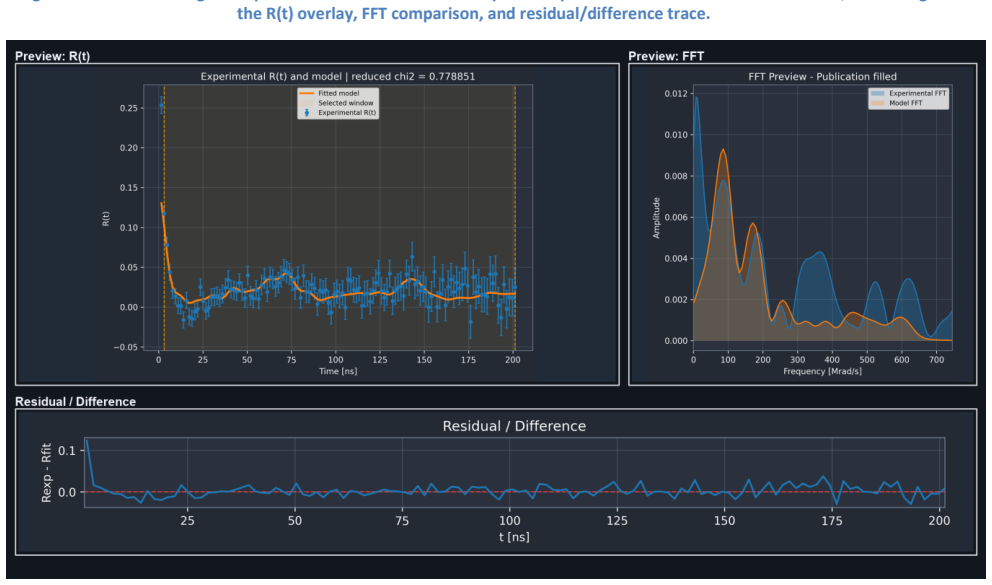
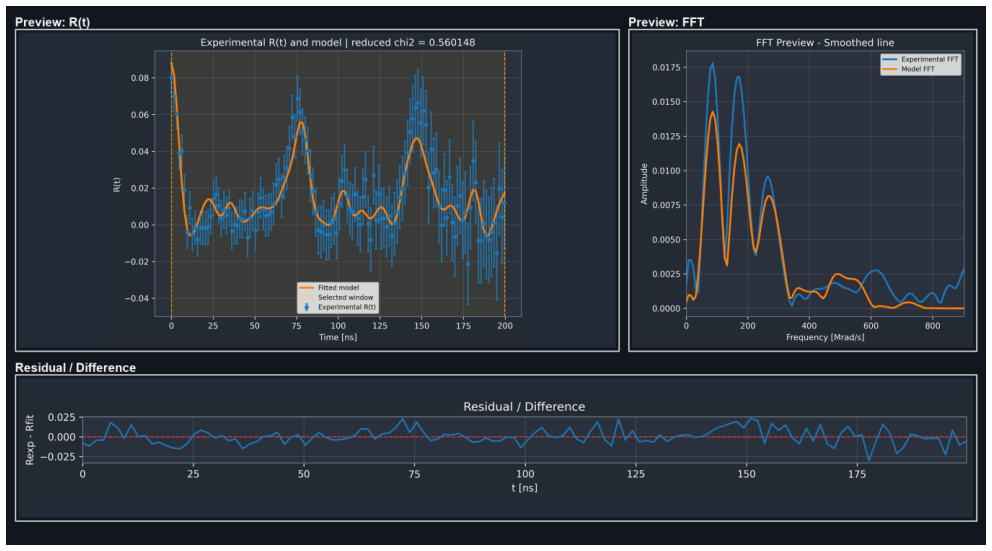
Time-differential perturbed angular correlation (TDPAC or PAC) analysis is an ill-conditioned inverse problem in which site count, interaction type, correlated hyperfine parameters, damping, and initialization choices can produce competing numerical solutions. This software paper presents PAC Studio ML, a human-in-the-loop Python desktop environment for physics-informed inverse analysis of PAC spectra. The software integrates a Hamiltonian-based forward PAC model, user-defined synthetic training libraries, feature extraction, one-, two-, and three-site machine-learning predictors, direct parameter prediction, Auto sites model-family screening, ML-seeded nonlinear least-squares refinement, visualization, benchmarking, diagnostics, model-card reporting, and export tools. The ML component is designed to support, not replace, conventional fitting and expert interpretation by accelerating parameter exploration, suggesting plausible initialization regions, comparing site-count hypotheses, and improving reproducibility. Held-out synthetic tests demonstrate proof of operation and illustrate the unequal recoverability of PAC parameters in difficult inverse problems. Selected BiFeO3 examples demonstrate conventional, direct-ML, ML-seeded, and Auto sites workflows as software case studies, not as a complete experimental validation corpus. PAC Studio ML is therefore positioned as a supporting tool for expert PAC analysis: it improves workflow speed and diagnostic transparency while final model choice, physical constraints, and materials interpretation remain the responsibility of the researcher.
Figures


Figures from the paper (16 more)




Reviewed August 4, 2026 · model on record in the stance chip above.
Discussion (0). Continue with ORCID to comment.