REVIEW 2 major objections 4 minor 52 references
From diffusion to transmission via EDP-convergence: a paradigmatic multiscale limit
T0 review · 2 major / 4 minor · reviewed 2026-07-14 · grok-4.5
Pith's one-line read A multiscale diffusion limit yields a unique membrane kinetic relation that inherits free energy and mobility from the microscale.
desk verdict First rigorous EDP-convergence for the membrane limit, cleanly recovering Marcelin–De Donder kinetics from Otto’s quadratic structure under stated power-law assumptions. read the letter →
The pith
A machine-rendered reading of the paper's core claim, the machinery that carries it, and where it could break.
The reading
What carries the argument
EDP-convergence of the dissipation functionals D_ε (equivalently their rescaled versions bD_ε) together with the cell problem that defines the membrane potential M(v_-,v_+,κ) by minimizing the local flux-and-slope integrand subject to fixed boundary densities; the reduction theory of BER functions then identifies R_mb and its dual from M.
What would settle it
Construct a recovery sequence for a free-energy/mobility pair that violates the stronger concavity condition (2.11) but satisfies the weaker homeomorphism condition (2.12), and check whether the limsup inequality for bD_ε still holds; failure would show the technical restriction is essential.
Extended reading notes
Core claim
Under stated growth and concavity assumptions on free energy E and mobility m, the family of gradient systems for the thin-layer diffusion problem EDP-converges to a limiting gradient system whose dual dissipation consists of the usual bulk terms plus a membrane potential R_mb given by a cell problem that minimizes a quadratic flux-plus-slope functional over density profiles connecting the two sides of the membrane. For power-law mobility and Boltzmann entropy this R_mb recovers Marcelin–De Donder exponential kinetics.
Load-bearing premise
Both the mobility and a related second-derivative expression built from the free energy must be concave; this is used to keep the dissipation functionals convex so that recovery sequences can be built by temporal averaging.
Editorial extensions
If this is right
- The effective kinetic relation for the membrane is uniquely determined by EDP-convergence and generally non-quadratic even when every microscopic dissipation is quadratic.
- Microscopic free-energy properties (e.g., logarithmic Boltzmann statistics) reappear as exponential growth of the macroscopic kinetic relation.
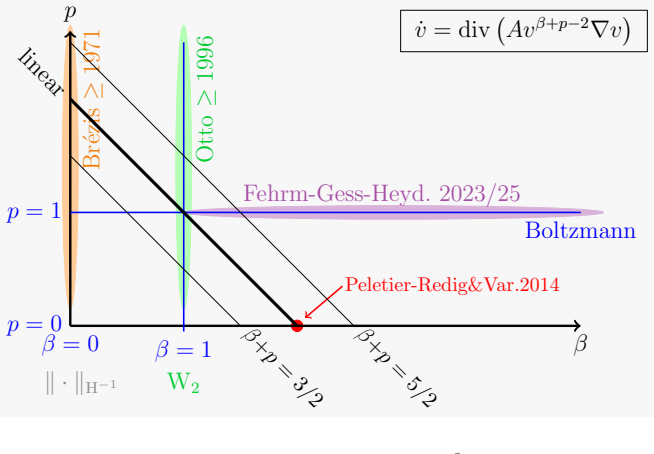
- For power-law mobility m(v)=v^β and energy exponent p the membrane potential depends on β and p separately, while the transmission condition of the PDE depends only on the product α=β+p-1.
- The same cell-problem construction supplies the kinetic relation for any free energy and mobility satisfying the stated growth and concavity assumptions, not merely power laws.
Reading between the lines
- The same EDP-plus-cell-problem strategy should produce effective jump kinetics for thin absorbing or reacting layers once the reaction term is included in the dissipation potential.
- In higher dimensions the membrane cell problem decouples pointwise on the surface, suggesting that the one-dimensional kinetic relation carries over locally after localization.
- Quadratic membrane potentials obtained by ad-hoc fitting are physically justified only when the microscopic mobility is constant; otherwise the exponential or power-law forms derived here are the consistent choices.
Editorial analysis
A structured set of objections, weighed in public.
Referee Report
Summary. The paper studies EDP-convergence of Otto-type gradient structures for nonlinear diffusion on an interval whose mobility is scaled by ε in a thin central layer, so that the PDE limit is a membrane transmission problem. Under assumptions (2.10) and the concavity conditions (2.11)/(2.12) on free energy E and mobility m, the dissipation functionals D_ε Γ-converge (conditioned on bounded energy) to a limit D_0 whose dual dissipation R_eff consists of the bulk Otto terms plus a membrane potential R_mb defined by the cell problem (1.8). The effective kinetic relation is uniquely extracted from this Γ-limit; for power-law mobility and Boltzmann entropy it recovers the Marcelin–De Donder form. The argument proceeds by rescaling the layer, obtaining a priori estimates and compactness (Prop. 3.4), a liminf via convexification and measure-theoretic lower semicontinuity (Props. 4.1–4.2), a recovery sequence under the stronger concavity (2.11) (§5), and identification of R_mb via NESS/BER reduction (§6).
Significance. The work supplies a rigorous, uniquely determined effective gradient structure for a paradigmatic multiscale membrane limit, going beyond mere PDE convergence. The migration of microscopic energetics into a non-quadratic (even exponential) membrane kinetic relation is a clean illustration of the power of EDP-convergence and of the NESS/BER calculus. Explicit formulae for power-law structures, including the recovery of Marcelin–De Donder kinetics from Otto’s linear Onsager structure, are of independent interest for reaction-diffusion and large-deviation modelling. The technical machinery (scaled continuity equation, convexification for the membrane liminf, recovery under Jensen) is carefully developed and should be reusable for related singular limits.
major comments (2)
- [Thm. 2.6(B), §5, condition (2.11)] The full EDP-convergence statement (Thm. 2.3 / Cor. 2.4) relies on the stronger concavity (2.11) solely for the Γ-limsup recovery sequence in Thm. 2.6(B) and §5 (Jensen + temporal mollification). The authors themselves flag (2.11) as technical and conjecture that the weaker homeomorphism condition (2.12) already used for the liminf suffices. Either a sketch of how the recovery can be adapted under (2.12), or an explicit restriction of the main theorem to the range where (2.11) holds (e.g. the parallelogram of Prop. 2.2), would make the load-bearing hypothesis transparent.
- [Cor. 2.7, inequality (2.29)] Corollary 2.7 (convergence of EDB solutions) assumes the chain-rule inequality (2.29) for the limiting system without proof. The authors note that convexity of E and D_0 should allow temporal smoothing, but the argument is left open. Since the corollary is presented as a consequence of EDP-convergence, either a short proof (or reference to a forthcoming companion) or a clear statement that (2.29) is an additional hypothesis would remove the remaining gap.
minor comments (4)
- [Fig. 2.1, Prop. 2.2] Figure 2.1 and the statement of Prop. 2.2 would be clearer if the closed parallelogram corresponding to (2.11) were drawn explicitly and the boundary cases β=0,1 and 2p+β=3,4 were labelled.
- [§2.2] The notation switch between unscaled (v,J,D) and scaled (u,Q,bD) quantities is generally careful, but a short table or a sentence at the beginning of §2.2 listing the principal correspondences would help the reader.
- [Eq. (1.11)] In (1.11) and later appearances of C and C^*, a brief reminder that C is the Legendre transform of the cosh-type function C^* would avoid hunting through the text.
- [Introduction, passim] A few typographical slips remain (e.g. “let to the beautiful connections”, “At first sight.” with a period, occasional missing spaces around ±). A final copy-edit pass is recommended.
Circularity Check
No significant circularity: the effective membrane potential is uniquely extracted from a self-contained Γ-limit of dissipation functionals under stated assumptions on E and m; self-citations supply technical tools (EDP definition, NESS/BER reduction) rather than the target result.
-
self citation load bearing
[Section 2.4 (definition of EDP-convergence) and Corollary 2.4; also Section 6.1–6.2 (BER reduction)]
"The simplest form of EDP-convergence of the family (Q,E_ε,R_ε) to the limiting gradient system (Q,E_0,R_eff) is defined via the Γ-convergence E_ε Γ⇀ E_0 on Q and D_ε ΓE⇀ D_0 on L1([0,T];Q) and D_0 is defined via E_0 and R_eff as in (1.6), see [DFM19, MMP21] for precise definitions. ... We emphasize that ... the effective dissipation potential is uniquely determined by this procedure"
The uniqueness claim for R_eff is imported from the authors' own prior definition of EDP-convergence. This is only mildly load-bearing: the paper still proves the concrete Γ-limit of D_ε independently, so the citation supplies the abstract uniqueness wrapper rather than the content of R_mb itself. Score contribution is therefore minimal (1).
full rationale
The paper's central claim is the EDP-convergence (P(D),E,R_ε) → (P(D),E,R_eff) of Theorem 2.3 / Corollary 2.4, with R_eff uniquely determined by the Γ-limit D_0 of the dissipation functionals (explicitly via the bulk integrals plus the cell-problem functional M of (1.8)/(2.26)). The Γ-liminf (Props. 4.1–4.2) and Γ-limsup (Section 5, under the stronger concavity (2.11)) are proved from first principles via a priori estimates, weak* lower semi-continuity after convexification by ψ, and recovery sequences using Jensen on the convex functional; no parameters are fitted and no external data enter. The identification that D_0 = ∫(R_eff + R*_eff) (and the explicit dual pair R_mb, R*_mb) uses the authors' prior NESS/BER theory (Section 6, citing [Mie23b, Mie25]), but this is an interpretive reduction of an already-established Γ-limit, not a load-bearing premise that forces the form of R_mb. Explicit formulae for power-law cases (including Marcelin–De Donder for p=1) are direct calculations from the cell problem (Section 6.4–6.5). Self-citations to the EDP framework ([LM*17, DFM19, MMP21]) define the notion of convergence but do not substitute for the proofs of the liminf/limsup. The unproved chain-rule (2.29) affects only the optional solution-convergence Corollary 2.7. No self-definitional loop, fitted-input-as-prediction, or ansatz-smuggling appears; the derivation is self-contained against its own hypotheses.
Assumptions & free parameters
assumptions (4)
- domain assumption E strictly convex, superlinear, C^{2} on (0,∞) with growth E(u) ≥ c_E u^{q_E} – 1/c_E; m continuous, positive for u>0; integrability of √m E'' near 0 (assumptions (2.10))
- ad hoc to paper Existence of a homeomorphism ψ such that n_ψ = m∘ψ and g_ψ are concave and w ≤ C(1+H(ψ(w)))^{2} (condition (2.12))
- ad hoc to paper Both m and g_id = (E'')^{2}/m are concave (condition (2.11))
- domain assumption Chain-rule inequality for the limiting dissipation functional D_0 (assumed for Corollary 2.7)
Cite this review
Pith. "Pith review of From diffusion to transmission via EDP-convergence: a paradigmatic multiscale limit." pith.science (2026). https://pith.science/paper/JWA3HVTR
@misc{pith2026260711478,
  author       = {Pith},
  title        = {Pith review of: From diffusion to transmission via EDP-convergence: a paradigmatic multiscale limit},
  year         = {2026},
  howpublished = {\url{https://pith.science/paper/JWA3HVTR}},
  note         = {Machine review of arXiv:2607.11478}
}
read the original abstract
We consider nonlinear diffusion equations on an interval where the diffusion coefficient in a small region near the center is scaled such that it approximates a transmission condition at a membrane. While the limiting behavior of the solutions is well-understood, we study the convergence in the sense of the energy-dissipation principle (EDP) of associated gradient structures given in terms of a free energy and a dissipation potential. EDP-convergence provides a uniquely specified limiting gradient structure that reformulates the transmission condition in terms of an effective kinetic relation for the membrane, which relates the jump of the chemical potential and the flux through the membrane. We show how \AAA properties of the chosen free energy and the mobility of small-scale diffusion migrate to the effective kinetic relation. A surprising result is that starting from the linear Onsager relation of Otto's gradient structure for the linear diffusion equation, one obtains an exponentially growing kinetic relation, the so-called Marcelin-De Donder kinetic.
Figures

Reference graph
Works this paper leans on
-
[1]
urich, Birkh\
L. Ambrosio, N. Gigli, and G. Savar \'e , Gradient flows in metric spaces and in the space of probability measures, Lectures in Mathematics ETH Z\"urich, Birkh\"auser Verlag, Basel, 2005
2005
-
[2]
Arnrich, A
S. Arnrich, A. Mielke, M. A. Peletier, G. Savar\'e, and M. Veneroni: Passing to the limit in a W asserstein gradient flow: from diffusion to reaction . Calc. Var. Part. Diff. Eqns. 44 (2012) 419--454
2012
-
[3]
Benamou and Y
J.-D. Benamou and Y. Brenier: A computational fluid mechanics solution to the M onge- K antorovich mass transfer problem . Numer. Math. 84:3 (2000) 375--393
2000
-
[4]
Bodineau and B
T. Bodineau and B. Derrida: Current fluctuations in non-equilibrium diffusive systems: an additivity principle. Phys. Review Letters 92:18 (2004) 1--4, Revision 30 Oct 2018 arXiv:0402305v1
2004
-
[5]
H. Br \'e zis, Monotonicity methods in Hilbert spaces and some applications to nonlinear partial differential equations , Contribution to Nonlinear Functional Analysis, Madison, 1971, Proc. Sympos. Univ.\ Wisconsin , pp. 101--156
1971
-
[6]
E. A. Carlen and J. Maas: An analog of the 2- W asserstein metric in non-commutative probability under which the Fermionic Fokker-Planck equation is gradient flow for the entropy . Commun. Math. Phys. 331:3 (2014) 887--926
2014
-
[7]
: Gradient flow and entropy inequalities for quantum Markov semigroups with detailed balance . J. Funct. Analysis 273:5 (2017) 1810--1869
2017
-
[8]
Ciavolella, N
G. Ciavolella, N. David, and A. Poulain: Effective interface conditions for a porous medium type problem. Interfaces Free Bound. 26:2 (2024) 161--188
2024
Show all 52 references
-
[9]
M. A. J. Chaplain, C. Giverso, T. Lorenzi, and L. Preziosi: Derivation and application of effective interface conditions for continuum mechanical models of cell invasion through thin membranes. SIAM J. Appl. Math. 79:5 (2019) 2011--2031
2019
-
[10]
S.-N. Chow, W. Huang, Y. Li, and H. Zhou: Fokker- P lanck equations for a free energy functional or M arkov process on a graph . Arch. Rational Mech. Anal. 203:3 (2012) 969--1008
2012
-
[11]
Dembo and O
A. Dembo and O. Zeitouni, Large deviations techniques and applications, 2 ed., Springer, New York, 1987
1987
-
[12]
Dondl, T
P. Dondl, T. Frenzel, and A. Mielke: A gradient system with a wiggly energy and relaxed EDP -convergence . ESAIM Control Optim. Calc. Var. 25 (2019) 68/1--45
2019
-
[13]
Erbar and J
M. Erbar and J. Maas: Gradient flow structures for discrete porous medium equations. Discr. Cont. Dynam. Systems Ser. A 34:4 (2014) 1355--1374
2014
-
[14]
Fehrman and B
B. Fehrman and B. Gess: Non-equilibrium large deviations and parabolic-hyperbolic PDE with irregular drift . Invent. Math. 234:2 (2023) 573--636
2023
-
[15]
Feinberg: On chemical kinetics of a certain class
M. Feinberg: On chemical kinetics of a certain class. Arch. Rational Mech. Anal. 46 (1972) 1--41
1972
-
[16]
Fonseca and G
I. Fonseca and G. Leoni, Modern methods in the calculus of variations: L^p spaces , Springer, 2007
2007
-
[17]
at zu Berlin, Mathematisch-Naturwissenschaftliche Fakult\
T. Frenzel, On the derivation of effective gradient systems via EDP -convergence , Ph.D. thesis, Humboldt-Universit\"at zu Berlin, Mathematisch-Naturwissenschaftliche Fakult\"at, 2019, doi 10.18452/21391
2019 doi
-
[18]
Frenzel and M
T. Frenzel and M. Liero: Effective diffusion in thin structures via generalized gradient systems and EDP -convergence . Discr. Cont. Dynam. Systems Ser. S 14:1 (2021) 395--425
2021
-
[19]
Gess and D
B. Gess and D. Heydecker: The porous medium equation: large deviations and gradient flow with degenerate and unbounded diffusion. Comm. Pure Appl. Math. (2025)
2025
-
[20]
Glitzky and A
A. Glitzky and A. Mielke: A gradient structure for systems coupling reaction-diffusion effects in bulk and interfaces. Z. angew. Math. Phys. (ZAMP) 64 (2013) 29--52
2013
-
[21]
M. Gahn, M. Neuss-Radu , and P. Knabner: Derivation of effective transmission conditions for domains separated by a membrane for different scaling of membrane diffusivity. Discr. Cont. Dynam. Systems Ser. S 10:4 (2017) 773--797
2017
-
[22]
Grmela: Multiscale equilibrium and nonequilibrium thermodynamics in chemical engineering
M. Grmela: Multiscale equilibrium and nonequilibrium thermodynamics in chemical engineering. Adv. Chem. Eng. 39 (2010) 75--128
2010
-
[23]
Heinze, A
G. Heinze, A. Mielke, and A. Stephan: Discrete-to-continuum limit for nonlinear reaction-diffusion systems via EDP convergence for gradient systems . Submitted (2025) , WIAS Preprint 3194, arXiv:2504.06837
2025 arXiv
-
[24]
Heinze, J.-F
G. Heinze, J.-F. Pietschmann, and A. Schlichting: Gradient flows on metric graphs with reservoirs: Microscopic derivation and multiscale limits. Preprint (2024) , arXiv:2412.16775
2024 arXiv
-
[25]
Jordan, D
R. Jordan, D. Kinderlehrer, and F. Otto: The variational formulation of the F okker- P lanck equation . SIAM J. Math. Analysis 29:1 (1998) 1--17
1998
-
[26]
L \'e onard: Large deviations for long range interacting particle systems with jumps
C. L \'e onard: Large deviations for long range interacting particle systems with jumps. Annalles Inst. H. Poincar\'e sec.\,B 31:2 (1995) 289--323
1995
-
[27]
Liero, A
M. Liero, A. Mielke, M. A. Peletier, and D. R. M. Renger: On microscopic origins of generalized gradient structures. Discr. Cont. Dynam. Systems Ser. S 10:1 (2017) 1--35
2017
-
[28]
Maas: Gradient flows of the entropy for finite M arkov chains
J. Maas: Gradient flows of the entropy for finite M arkov chains . J. Funct. Anal. 261 (2011) 2250--2292
2011
-
[29]
Marcelin: Contribution a l'\'etude de la cin\'etique physico-chimique
R. Marcelin: Contribution a l'\'etude de la cin\'etique physico-chimique. Annales de Physique III (1915) 120--231
1915
-
[30]
Mielke: A gradient structure for reaction-diffusion systems and for energy-drift-diffusion systems
A. Mielke: A gradient structure for reaction-diffusion systems and for energy-drift-diffusion systems. Nonlinearity 24 (2011) 1329--1346
2011
-
[31]
: Geodesic convexity of the relative entropy in reversible Markov chains . Calc. Var. Part. Diff. Eqns. 48:1 (2013) 1--31
2013
-
[32]
: Thermomechanical modeling of energy-reaction-diffusion systems, including bulk-interface interactions. Discr. Cont. Dynam. Systems Ser. S 6:2 (2013) 479--499
2013
-
[33]
Muntean, J
, On evolutionary -convergence for gradient systems (Ch.\,3) , Macroscopic and Large Scale Phenomena: Coarse Graining, Mean Field Limits and Ergodicity (A. Muntean, J. Rademacher, and A. Zagaris, eds.), Lecture Notes in Applied Math. Mechanics Vol.\,3, Springer, 2016, Proc. of...
2016
-
[34]
, An introduction to the analysis of gradient systems, WIAS Preprint 3022, arXiv:2306.05026, 2023, (Script of a lecture course 2022/23, 100\,pp.)
2023 arXiv
-
[35]
: Non-equilibrium steady states as saddle points and EDP -convergence for slow-fast gradient systems . J. Math. Physics 64:123502 (2023) 1--27
2023
-
[36]
In preparation (2025)
: Port gradient systems, non-equilibrium steady states, and Prigogine 's principle of minimal dissipation . In preparation (2025)
2025
-
[37]
Mittnenzweig and A
M. Mittnenzweig and A. Mielke: An entropic gradient structure for Lindblad equations and couplings of quantum systems to macroscopic models . J. Stat. Physics 167:2 (2017) 205--233
2017
-
[38]
Mielke and J
A. Mielke and J. Naumann: On the existence of global-in-time weak solutions and scaling laws for Kolmogorov 's two-equation model of turbulence . Z.\ angew.\ Math.\ Mech. (ZAMM) 102:9 (2022) e202000019/1--31
2022
-
[39]
Mielke, A
A. Mielke, A. Montefusco, and M. A. Peletier: Exploring families of energy-dissipation landscapes via tilting --- three types of EDP convergence . Contin. Mech. Thermodyn. 33 (2021) 611--637
2021
-
[40]
Matthes, A
D. Matthes, A. Mielke, and J. Zimmer: A new approach to the chain rule for some doubly-nonlinear diffusion equations with p -Laplacian . In preparation (2026)
2026
-
[41]
Moussa: Some variants of the classical Aubin--Lions lemma
A. Moussa: Some variants of the classical Aubin--Lions lemma . J. Evol. Eqns. 16:1 (2016) 65--93
2016
-
[42]
Mielke, R
A. Mielke, R. I. A. Patterson, M. A. Peletier, and D. R. M. Renger: Non-equilibrium thermodynamical principles for chemical reactions with mass-action kinetics. SIAM J. Appl. Math. 77:4 (2017) 1562--1585
2017
-
[43]
Mielke, M
A. Mielke, M. A. Peletier, and A. Stephan: EDP -convergence for nonlinear fast-slow reaction systems with detailed balance . Nonlinearity 34:8 (2021) 5762--5798
2021
-
[44]
Mielke, A
A. Mielke, A. Schlichting, and A. Stephan: Derivation of the fourth-order DLSS equation with nonlinear mobility via chemical reactions . Submitted (2025) , arXiv:2510.07149, WIAS Preprint 3221
2025 arXiv
-
[45]
Neuss-Radu and W
M. Neuss-Radu and W. J \"a ger: Effective transmission conditions for reaction-diffusion processes in domains separated by an interface. SIAM J. Math. Analysis 39:3 (2007) 687--720
2007
-
[46]
Otto, Double degenerate diffusion equations as steepest descent, Preprint no.\ 480, SFB 256, University of Bonn, 1996
F. Otto, Double degenerate diffusion equations as steepest descent, Preprint no.\ 480, SFB 256, University of Bonn, 1996
1996
-
[47]
: The geometry of dissipative evolution equations: the porous medium equation. Comm. Partial Diff. Eqns. 26 (2001) 101--174
2001
-
[48]
M. A. Peletier and A. Schlichting: Cosh gradient systems and tilting. Nonlinear Analysis 231:113094 (2023) 1--113
2023
-
[49]
M. A. Peletier, F. Redig, and K. Vafayi: Large deviations in stochastic heat-conduction processes provide a gradient-flow structure for heat conduction. J. Math. Physics 55 (2014) 093301/19
2014
-
[50]
Rossi and G
R. Rossi and G. Savar\'e: Tightness, integral equicontinuity and compactness for evolution problems in Banach spaces . Ann. Scoula Norm. Sup. Pisa Cl. Sci (5) 2:2 (2003) 395--431
2003
-
[51]
Sandier and S
E. Sandier and S. Serfaty: Gamma-convergence of gradient flows with applications to G inzburg- L andau . Comm. Pure Appl. Math. LVII (2004) 1627--1672
2004
-
[52]
Stephan: EDP-convergence for a linear reaction-diffusion system with fast reversible reaction
A. Stephan: EDP-convergence for a linear reaction-diffusion system with fast reversible reaction . Calc. Var. Part. Diff. Eqns. 60:6 (2021) 226/35\,pp
2021
Reviewed July 14, 2026 · model on record in the stance chip above.
Discussion (0). Continue with ORCID to comment.