REVIEW 2 major objections 5 minor 87 references
Superdiffusion of cosmic rays near accelerators leaves a measurable imprint on gamma-ray morphology that telescopes can use to tell it apart from ordinary diffusion.
Reviewed by Pith at T0; open to challenge. T0 means a machine referee read the full paper against a public rubric. the ladder, T0–T4 →
T0 review · grok-4.5
2026-07-14 05:15 UTC pith:JDWPEUWM
load-bearing objection Clean Green’s-function calculation of superdiffusive CR transport near sources; the asymptotic morphologies (flat for impulsive, ~r^{α-3} for continuous) are correctly derived and potentially distinguishable by IACTs if the pure-superdiffusion idealization holds out to ~100 pc. the 2 major comments →
Superdiffusion of cosmic rays in the vicinity of their accelerators and the resulting γ-ray emission
The pith
A machine-rendered reading of the paper's core claim, the machinery that carries it, and where it could break.
Core claim
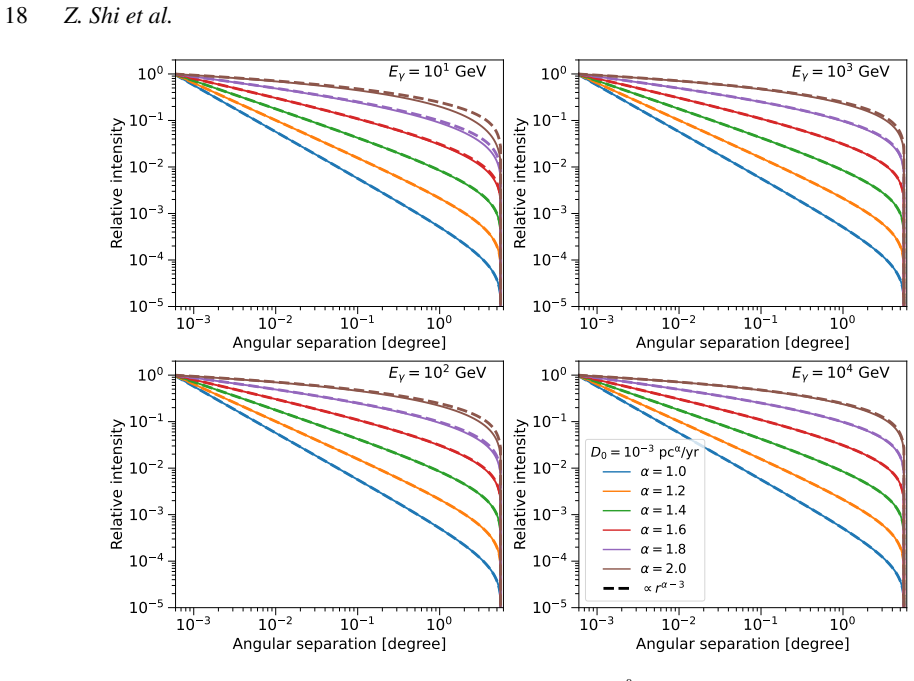
When cosmic-ray transport near accelerators is superdiffusive rather than normally diffusive, the resulting gamma-ray morphology within roughly 100 pc is measurably different: impulsive sources produce nearly flat intensity cores with power-law or Gaussian tails, while continuous sources produce radial profiles that track r^{alpha-3} (with possible deviations for electrons at high energy). Imaging air Cherenkov telescopes already have, or will soon have, the angular resolution needed to distinguish these patterns from ordinary diffusion.
What carries the argument
The fractional Laplacian operator (-Delta)^{alpha/2} that appears in the cosmic-ray transport equation; its Green’s function yields the radial kernels g_3^{(alpha)}(r) whose asymptotic forms (flat core plus power-law tail for alpha < 2, Gaussian for alpha = 2) set the spatial distributions of both particles and gamma rays.
Load-bearing premise
The calculation assumes that cosmic-ray transport remains purely superdiffusive all the way out to 100 parsecs, with no return to ordinary diffusion on those scales.
What would settle it
High-resolution gamma-ray surface-brightness profiles of a known young massive star cluster or supernova remnant, measured inside ~100 pc at several energies above 100 GeV; if the observed radial indices match alpha = 2 (1/r or flat) rather than the predicted alpha-dependent slopes, superdiffusion is ruled out on those scales.
If this is right
- Gamma-ray maps of young massive clusters that currently look consistent with 1/r can be re-examined for alpha-dependent deviations.
- The same morphology test can be applied separately to hadronic and leptonic components once multi-wavelength data isolate them.
- Next-generation Cherenkov arrays with arc-minute resolution become direct probes of the microscopic transport regime rather than mere detectors of emission.
- If dense molecular clouds sit near the accelerator, their illuminated gamma-ray brightness will further amplify the radial contrast predicted by alpha.
Where Pith is reading between the lines
- A confirmed alpha < 2 would imply that magnetic mirroring and intermittent turbulence dominate scattering near sources, linking microphysical MHD results to macroscopic gamma-ray morphology.
- The same fractional formalism could be used to re-interpret the TeV halo around Geminga or other middle-aged pulsars without invoking ad-hoc diffusion-coefficient breaks.
- If future data force a return to alpha = 2, the result would tighten the lower bound on the length scale at which Gaussianization sets in.
Editorial analysis
A structured set of objections, weighed in public.
Referee Report
Summary. The paper solves the fractional transport equation for cosmic rays (CRs) near accelerators, with the fractional Laplacian of order α/2 (0 < α ≤ 2) and continuous energy losses. Using the Green’s function (Eq. 6) built from g_3^(α), it derives CR proton and electron spectra and radial profiles for impulsive and stationary injection over a grid of α and D_0. For impulsive injection the density is spatially flat inside the diffusion length r_d = [D(p)t]^{1/α} and falls as a power-law (or Gaussian) tail outside; for stationary injection the proton density asymptotes to r^{α-3} when r ≪ r_d. The resulting π^0-decay, IC and bremsstrahlung γ-ray fluxes and line-of-sight intensity profiles within a 100 pc volume are computed with Naima. The central claim is that these morphologies are distinguishable from normal diffusion (α = 2) by present and next-generation IACTs.
Significance. If the pure-superdiffusion idealization holds on ~100 pc scales, the work supplies concrete, falsifiable morphological templates (flat cores for impulsive sources; projected r^{α-3} profiles for continuous injectors) that can be compared directly with H.E.S.S., CTA, ASTRI and LACT data. The analytic asymptotics (Table 1), the explicit Green’s function, and the systematic scan over α and D_0 make the predictions transparent and reusable. The paper therefore offers a practical observational test of anomalous CR transport near accelerators, a topic of growing interest given recent MHD-turbulence and Lévy-flight results.
major comments (2)
- The distinguishability claim rests on the idealization, stated in the Introduction, that transport remains purely superdiffusive out to ~100 pc with no “Gaussianization” (Liang & Oh 2025). While the paper is explicit about this assumption, the claim that present/next-generation IACTs can distinguish superdiffusion would be substantially stronger if the authors quantified how a transition to normal diffusion inside the emission volume would degrade the morphological contrast (e.g., by showing a few hybrid profiles). Without that estimate the observational conclusion remains conditional on an untested scale.
- All γ-ray calculations assume homogeneous gas density and radiation fields (Sec. 3, Eqs. 19–20). Real molecular clouds or stellar-wind cavities produce strong density contrasts that can dominate the observed morphology. A short demonstration that the α-dependent radial signatures survive when a dense cloud is placed at a few tens of pc would make the IACT-distinguishability statement more robust; otherwise the claim is limited to idealized uniform media.
minor comments (5)
- Abstract and several figure captions contain awkward English (“behaves a constant radial profile”, “tends to being proportional”). A light language edit would improve readability.
- Fig. 2 caption and surrounding text give the small-r and large-r asymptotics of g_3^(α); it would help the reader if the same asymptotic expressions were collected once in the main text near Eq. (8).
- The nuclear-enhancement factor ε_M = 1.8 is adopted without a short justification or reference range; a sentence citing Mori (2009) or Kachelriess et al. (2014) would suffice.
- In Figs. 9–16 the line styles for hadronic vs leptonic components are not always identical across panels; a uniform legend would reduce visual confusion.
- Table 1 is useful but appears only after the summary; moving it earlier (or repeating the key rows in Sec. 2) would make the asymptotic results easier to locate.
Circularity Check
No circularity: asymptotic CR and γ-ray profiles are derived from the fractional transport equation and source terms without fitting data or load-bearing self-citation.
full rationale
The paper solves the fractional diffusion equation (Eq. 1) with the fractional Laplacian, obtains the Green’s function (Eq. 6) via Fourier transform, and evaluates the known integral representation of g_3^(α) (Eq. 8; asymptotic forms for r ≪ 1 and r ≫ 1, including the Cauchy and Gaussian limits). Impulsive (Eq. 11–12) and stationary (Eq. 13–18) solutions follow by convolution with the chosen source terms; the asymptotic radial profiles (constant for impulsive injection when r ≪ r_d; ∝ r^{α−3} for stationary protons when r ≪ r_d) are direct consequences of those integrals, not of any fitted observable. γ-ray fluxes and line-of-sight intensities (Eqs. 19–23) are computed from the CR distributions with Naima under homogeneous gas/ISRF assumptions. Free parameters (α, D_0, s = 2.2, K_ep, W_p or ṘW_p) are scanned openly; no observational data set is fitted and then re-presented as a prediction. Self-citations (e.g., Wang et al. 2021 on Geminga) are contextual only and do not underwrite the uniqueness or form of the present solutions. The idealization of pure superdiffusion out to ~100 pc is stated explicitly and does not create an internal definitional loop. The derivation is therefore self-contained against its own mathematical inputs.
Axiom & Free-Parameter Ledger
free parameters (7)
- superdiffusion index α
- diffusion normalization D0
- diffusion energy index δ
- injection spectral index s
- total proton energy / power Wp or Ẇp
- electron-to-proton ratio Kep
- ambient density nH, B-field, ISRF components
axioms (4)
- domain assumption CR transport is described by the fractional diffusion equation ∂N/∂t + D(-Δ)^{α/2} N - ∂[b(p)N]/∂p = Q with 0 < α ≤ 2.
- domain assumption The interstellar medium within 100 pc of the accelerator is spatially homogeneous in density and diffusion coefficient.
- ad hoc to paper No transition from superdiffusion to normal diffusion occurs inside the 100-pc emission volume.
- domain assumption Energy losses of protons are negligible compared with the age and diffusion time; electron losses are pure synchrotron + IC (Klein-Nishina treated).
read the original abstract
We study the distribution of cosmic rays (CRs) in the vicinity of their accelerators, assuming that the transport of CRs in the interstellar medium surrounding the accelerators is described by the superdiffusion, beyond the normal diffusion. We find that the superdiffusivity, which is characterized by the superdiffusion parameter $\alpha$, impacts significantly the distribution of CRs. For impulsive injection, the CR distribution behaves a constant radial profile, except with a power-law tail for $\alpha < 2$ or a Gaussian tail for $\alpha=2$ at large distance, $r$, from the accelerators. For stationary injection, the radial profile of CR protons tends to being proportional to $r^{\alpha - 3}$, while that of CR electrons can deviate from the $r^{\alpha - 3}$ profile, due to their severe energy losses. We also compute the $\gamma$-ray emission, produced by the interactions of CRs with ambient gas and radiation fields, within 100 pc regions around the accelerators. We find that by investigating the $\gamma$-ray morphology, we can distinguish the superdiffusion from the normal diffusion with present and next-generation imaging air Cherenkov telescopes.
Figures



Reference graph
Works this paper leans on
-
[1]
Reviews of Modern Physics , keywords =
The interstellar environment of our galaxy. Reviews of Modern Physics , keywords =. doi:10.1103/RevModPhys.73.1031 , archivePrefix =. astro-ph/0106359 , primaryClass =
-
[2]
Annual Review of Astronomy and Astrophysics , year = 2015, month = aug, volume =
The Nine Lives of Cosmic Rays in Galaxies. Annual Review of Astronomy and Astrophysics , year = 2015, month = aug, volume =. doi:10.1146/annurev-astro-082214-122457 , adsurl =
-
[3]
The Astrophysical Journal , keywords =
A New Estimate of the Local Interstellar Energy Density and Ionization Rate of Galactic Cosmic Cosmic Rays. The Astrophysical Journal , keywords =. doi:10.1086/306222 , adsurl =
-
[4]
Galactic winds. I. Cosmic ray and wave-driven winds from the galaxy. Astronomy & Astrophysics , keywords =
-
[5]
A Cosmic-ray-dominated Interstellar Medium in Ultra Luminous Infrared Galaxies: New Initial Conditions for Star Formation. The Astrophysical Journal , keywords =. doi:10.1088/0004-637X/720/1/226 , archivePrefix =. 1009.1134 , primaryClass =
work page internal anchor Pith review Pith/arXiv arXiv doi:10.1088/0004-637x/720/1/226
-
[6]
The Astronomy and Astrophysics Review , keywords =
Cosmic ray feedback in galaxies and galaxy clusters. The Astronomy and Astrophysics Review , keywords =. doi:10.1007/s00159-023-00149-2 , archivePrefix =. 2306.03141 , primaryClass =
-
[7]
Astrophysics of cosmic rays
-
[8]
Cosmic-Ray Propagation. I. Charged Particles in a Random Magnetic Field. The Astrophysical Journal , year = 1966, month = nov, volume =. doi:10.1086/148912 , adsurl =
doi:10.1086/148912 1966
-
[9]
The Astrophysical Journal , year = 1969, month = may, volume =
The Effect of Wave-Particle Interactions on the Propagation of Cosmic Rays. The Astrophysical Journal , year = 1969, month = may, volume =. doi:10.1086/149981 , adsurl =
doi:10.1086/149981 1969
-
[10]
The Astrophysical Journal , year = 1971, month = dec, volume =
Cosmic Rays in the Galaxy: Convection or Diffusion?. The Astrophysical Journal , year = 1971, month = dec, volume =. doi:10.1086/151210 , adsurl =
doi:10.1086/151210 1971
-
[11]
Cosmic-Ray Transport and Acceleration. I. Derivation of the Kinetic Equation and Application to Cosmic Rays in Static Cold Media. The Astrophysical Journal , keywords =. doi:10.1086/167009 , adsurl =
-
[12]
Reviews of Modern Physics , year = 1943, month = jan, volume =
Stochastic Problems in Physics and Astronomy. Reviews of Modern Physics , year = 1943, month = jan, volume =. doi:10.1103/RevModPhys.15.1 , adsurl =
-
[13]
The Astrophysical Journal , keywords =
Electron Density Power Spectrum in the Local Interstellar Medium. The Astrophysical Journal , keywords =. doi:10.1086/175515 , adsurl =
-
[14]
Annual Review of Astronomy & Astrophysics , year = 2005, month = sep, volume =
The Three-Phase Interstellar Medium Revisited. Annual Review of Astronomy & Astrophysics , year = 2005, month = sep, volume =. doi:10.1146/annurev.astro.43.072103.150615 , adsurl =
Pith/arXiv arXiv doi:10.1146/annurev.astro.43.072103.150615 2005
-
[15]
Annual Review of Astronomy & Astrophysics , keywords =
Interstellar Turbulence I: Observations and Processes. Annual Review of Astronomy & Astrophysics , keywords =. doi:10.1146/annurev.astro.41.011802.094859 , archivePrefix =. astro-ph/0404451 , primaryClass =
-
[16]
Annual Review of Astronomy & Astrophysics , keywords =
Interstellar Turbulence II: Implications and Effects. Annual Review of Astronomy & Astrophysics , keywords =. doi:10.1146/annurev.astro.42.120403.143327 , archivePrefix =. astro-ph/0404452 , primaryClass =
-
[17]
Magnetic Fields in Diffuse Media , year = 2015, editor =
The Intermittency of ISM Turbulence: What Do the Observations Tell Us?. Magnetic Fields in Diffuse Media , year = 2015, editor =. doi:10.1007/978-3-662-44625-6_9 , adsurl =
-
[18]
The Astrophysical Journal Letters , keywords =
Signatures of Intermittency and Fine-scale Turbulence in the Very Local Interstellar Medium. The Astrophysical Journal Letters , keywords =. doi:10.3847/2041-8213/ab9df5 , adsurl =
-
[19]
Reconciling cosmic-ray transport theory with phenomenological models motivated by Milky-Way data
Reconciling cosmic ray transport theory with phenomenological models motivated by Milky-Way data. Monthly Notices of the Royal Astronomical Society , keywords =. doi:10.1093/mnras/stac1240 , archivePrefix =. 2109.10977 , primaryClass =
work page internal anchor Pith review Pith/arXiv arXiv doi:10.1093/mnras/stac1240
-
[20]
Galactic Cosmic-ray Scattering due to Intermittent Structures
Galactic cosmic-ray scattering due to intermittent structures. Monthly Notices of the Royal Astronomical Society , keywords =. doi:10.1093/mnras/stae276 , archivePrefix =. 2308.06316 , primaryClass =
work page internal anchor Pith review Pith/arXiv arXiv doi:10.1093/mnras/stae276
-
[21]
Space Science Reviews , keywords =
Open Issues in Non-Gaussian Transport and Acceleration of Charged Energetic Particles in Space and Astrophysical Plasmas. Space Science Reviews , keywords =. doi:10.1007/s11214-025-01203-4 , adsurl =
-
[22]
Monthly Notices of the Royal Astronomical Society , keywords =
Standard self-confinement and extrinsic turbulence models for cosmic ray transport are fundamentally incompatible with observations. Monthly Notices of the Royal Astronomical Society , keywords =. doi:10.1093/mnras/stac2909 , archivePrefix =. 2112.02153 , primaryClass =
-
[23]
Damping of MHD turbulence in partially ionized plasma: implications for cosmic ray propagation
Damping of Magnetohydrodynamic Turbulence in Partially Ionized Plasma: Implications for Cosmic Ray Propagation. The Astrophysical Journal , keywords =. doi:10.3847/0004-637X/826/2/166 , archivePrefix =. 1506.05585 , primaryClass =
work page internal anchor Pith review Pith/arXiv arXiv doi:10.3847/0004-637x/826/2/166
-
[24]
The Astrophysical Journal , keywords =
Diffusion of Cosmic Rays in MHD Turbulence with Magnetic Mirrors. The Astrophysical Journal , keywords =. doi:10.3847/1538-4357/ac2de9 , archivePrefix =. 2106.08362 , primaryClass =
-
[25]
The Astrophysical Journal Letters , keywords =
Numerical Testing of Mirror Diffusion of Cosmic Rays. The Astrophysical Journal Letters , keywords =. doi:10.3847/2041-8213/ad0fe5 , archivePrefix =. 2311.18001 , primaryClass =
-
[26]
Physics Uspekhi , year = 2013, month = nov, volume =
Fractional phenomenology of cosmic ray anomalous diffusion. Physics Uspekhi , year = 2013, month = nov, volume =. doi:10.3367/UFNe.0183.201311b.1175 , adsurl =
-
[27]
Astronomy & Astrophysics , keywords =
Fractional Parker equation for the transport of cosmic rays: steady-state solutions. Astronomy & Astrophysics , keywords =. doi:10.1051/0004-6361/201731179 , adsurl =
-
[28]
Monthly Notices of the Royal Astronomical Society , keywords =
L \'e vy flights and leaky boxes: anomalous diffusion of cosmic rays. Monthly Notices of the Royal Astronomical Society , keywords =. doi:10.1093/mnras/staf1474 , archivePrefix =. 2503.10747 , primaryClass =
-
[29]
Cosmic Rays in the Inner Galaxy and the Diffusion Properties of the Interstellar Medium
Cosmic rays in the inner galaxy and the diffusion properties of the interstellar medium. Astroparticle Physics , keywords =. doi:10.1016/j.astropartphys.2012.12.003 , archivePrefix =. 1212.2760 , primaryClass =
work page internal anchor Pith review Pith/arXiv arXiv doi:10.1016/j.astropartphys.2012.12.003 2012
-
[30]
Physical Review D , keywords =
Test of the superdiffusion model in the interstellar medium around the Geminga pulsar. Physical Review D , keywords =. doi:10.1103/PhysRevD.103.063035 , archivePrefix =. 2101.01438 , primaryClass =
-
[31]
Astronomy & Astrophysics , keywords =
Superdiffusion of energetic particles at shocks: A fractional diffusion and L \'e vy flight model of spatial transport. Astronomy & Astrophysics , keywords =. doi:10.1051/0004-6361/202449334 , adsurl =
-
[32]
Superdiffusion of energetic particles at shocks: A L\'evy Flight model for acceleration
Superdiffusion of energetic particles at shocks: A L \'e vy flight model for acceleration. Astronomy & Astrophysics , keywords =. doi:10.1051/0004-6361/202451765 , archivePrefix =. 2408.03638 , primaryClass =
work page internal anchor Pith review Pith/arXiv arXiv doi:10.1051/0004-6361/202451765
-
[33]
The gamma-ray visibility of supernova remnants. A test of cosmic ray origin. Astronomy and Astrophysics , keywords =. doi:10.48550/arXiv.astro-ph/9305037 , archivePrefix =. astro-ph/9305037 , primaryClass =
-
[34]
Acceleration of petaelectronvolt protons in the Galactic Centre. Nature , keywords =. doi:10.1038/nature17147 , archivePrefix =. 1603.07730 , primaryClass =
-
[35]
Science with the Cherenkov Telescope Array. doi:10.1142/10986 , adsurl =
-
[36]
ASTRI Mini-Array Core Science at the Observatorio del Teide
ASTRI Mini-Array core science at the Observatorio del Teide. Journal of High Energy Astrophysics , keywords =. doi:10.1016/j.jheap.2022.05.005 , archivePrefix =. 2208.03177 , primaryClass =
work page internal anchor Pith review Pith/arXiv arXiv doi:10.1016/j.jheap.2022.05.005 2022
-
[37]
Nuclear Instruments and Methods in Physics Research A , keywords =
LACT: Status and future plans. Nuclear Instruments and Methods in Physics Research A , keywords =. doi:10.1016/j.nima.2026.171373 , adsurl =
-
[38]
Physics Uspekhi , year = 2003, month = aug, volume =
REVIEWS OF TOPICAL PROBLEMS: Self-similar anomalous diffusion and Levy-stable laws. Physics Uspekhi , year = 2003, month = aug, volume =. doi:10.1070/PU2003v046n08ABEH001324 , adsurl =
-
[39]
Ten equivalent definitions of the fractional laplace operator , title =
Mateusz Kwaśnicki , pages =. Ten equivalent definitions of the fractional laplace operator , title =. Fractional Calculus and Applied Analysis , doi =. 2017 , lastchecked =
2017
-
[40]
Cosmic Ray Astrophysics
-
[41]
Very high energy cosmic gamma radiation : a crucial window on the extreme Universe. doi:10.1142/4657 , adsurl =
-
[42]
Physical Review D , keywords =
Parametrization of gamma-ray production cross sections for p p interactions in a broad proton energy range from the kinematic threshold to PeV energies. Physical Review D , keywords =. doi:10.1103/PhysRevD.90.123014 , archivePrefix =. 1406.7369 , primaryClass =
-
[43]
Astronomy & Astrophysic , keywords =
Cosmic-ray ionisation in circumstellar discs. Astronomy & Astrophysic , keywords =. doi:10.1051/0004-6361/201732202 , archivePrefix =. 1803.09348 , primaryClass =
-
[44]
The Astrophysical Journal , keywords =
Propagation of Cosmic-Ray Nucleons in the Galaxy. The Astrophysical Journal , keywords =. doi:10.1086/306470 , archivePrefix =. astro-ph/9807150 , primaryClass =
-
[45]
Astronomy & Astrophysics , keywords =
Galactic electrons and positrons at the Earth: new estimate of the primary and secondary fluxes. Astronomy & Astrophysics , keywords =. doi:10.1051/0004-6361/201014225 , archivePrefix =. 1002.1910 , primaryClass =
-
[46]
Chinese Physics Letters , keywords =
Klein-Nishina Effect and the Cosmic Ray Electron Spectrum. Chinese Physics Letters , keywords =. doi:10.1088/0256-307X/38/3/039801 , archivePrefix =. 2007.15601 , primaryClass =
-
[47]
Soviet Astronomy , year = 1959, month = feb, volume =
The Distribution of Relativistic Electrons in the Galaxy and the Spectrum of Synchrotron Radio Emission. Soviet Astronomy , year = 1959, month = feb, volume =
1959
-
[48]
Vladimir V. Uchaikin and Vladimir M. Zolotarev , publisher =. Chance and Stability , title =. 1999 , lastchecked =. doi:doi:10.1515/9783110935974 , isbn =
-
[49]
Physics Reports , year = 2000, month = dec, volume =
The random walk's guide to anomalous diffusion: a fractional dynamics approach. Physics Reports , year = 2000, month = dec, volume =. doi:10.1016/S0370-1573(00)00070-3 , adsurl =
-
[50]
Chechkin, Aleksei V. and Gonchar, Vsevolod Y. and Klafter, Joseph and Metzler, Ralf , publisher =. Fundamentals of Lévy Flight Processes , booktitle =. doi:https://doi.org/10.1002/0470037148.ch9 , url =. https://onlinelibrary.wiley.com/doi/pdf/10.1002/0470037148.ch9 , year =
-
[51]
Physics Uspekhi , year = 2023, month = mar, volume =
Nonlocal (fractional-differential) model of cosmic ray transport in the interstellar medium. Physics Uspekhi , year = 2023, month = mar, volume =. doi:10.3367/UFNe.2021.12.039118 , adsurl =
-
[52]
Physical Review D , keywords =
Electrons and positrons in the galactic cosmic rays. Physical Review D , keywords =. doi:10.1103/PhysRevD.52.3265 , adsurl =
-
[53]
Physical Review D , keywords =
Pulsars versus dark matter interpretation of ATIC/PAMELA. Physical Review D , keywords =. doi:10.1103/PhysRevD.80.063005 , archivePrefix =. 0903.1310 , primaryClass =
-
[54]
Journal of Cosmology and Astroparticle Physics , keywords =
Understanding hadronic gamma-ray emission from supernova remnants. Journal of Cosmology and Astroparticle Physics , keywords =. doi:10.1088/1475-7516/2011/05/026 , archivePrefix =. 1103.2624 , primaryClass =
-
[55]
International Journal of Modern Physics D , keywords =
The origin of Galactic cosmic rays: Challenges to the standard paradigm. International Journal of Modern Physics D , keywords =. doi:10.1142/S0218271819300222 , archivePrefix =. 1903.11584 , primaryClass =
-
[56]
The Astronomy and Astrophysics Review , keywords =
The origin of galactic cosmic rays. The Astronomy and Astrophysics Review , keywords =. doi:10.1007/s00159-013-0070-7 , archivePrefix =. 1311.7346 , primaryClass =
-
[57]
The population of Galactic supernova remnants in the TeV range
The population of Galactic supernova remnants in the TeV range. Astronomy & Astrophysics , keywords =. doi:10.1051/0004-6361/202449779 , archivePrefix =. 2404.18595 , primaryClass =
work page internal anchor Pith review Pith/arXiv arXiv doi:10.1051/0004-6361/202449779
-
[58]
Hadronic versus leptonic origin of gamma-ray emission from supernova remnants
Hadronic versus Leptonic Origin of Gamma-Ray Emission from Supernova Remnants. The Astrophysical Journal , keywords =. doi:10.3847/1538-4357/ace699 , archivePrefix =. 2301.10257 , primaryClass =
work page internal anchor Pith review Pith/arXiv arXiv doi:10.3847/1538-4357/ace699
-
[59]
Astronomy & Astrophysics , keywords =
Strong evidence for hadron acceleration in Tycho's supernova remnant. Astronomy & Astrophysics , keywords =. doi:10.1051/0004-6361/201117855 , archivePrefix =. 1105.6342 , primaryClass =
-
[60]
Detection of the Characteristic Pion-Decay Signature in Supernova Remnants. Science , keywords =. doi:10.1126/science.1231160 , archivePrefix =. 1302.3307 , primaryClass =
-
[61]
Astronomy and Astrophysics , keywords =
On the emissivity of ^0 -decay gamma radiation in the vicinity of accelerators of galactic cosmic rays. Astronomy and Astrophysics , keywords =
-
[62]
Nuclear Physics B Proceedings Supplements , year = 2001, month = apr, volume =
The ``knee'' in the primary cosmic ray spectrum as consequence of the anomalous diffusion of the particles in the fractal interstellar medium. Nuclear Physics B Proceedings Supplements , year = 2001, month = apr, volume =. doi:10.1016/S0920-5632(01)01280-4 , adsurl =
-
[63]
Nuclear Instruments and Methods in Physics Research B , year = 2003, month = jan, volume =
Anomalous diffusion equation: Application to cosmic ray transport. Nuclear Instruments and Methods in Physics Research B , year = 2003, month = jan, volume =. doi:10.1016/S0168-583X(02)01362-9 , adsurl =
-
[64]
Where are the Pevatrons that Form the Knee in the Spectrum of the Cosmic Ray Nucleon Component around 4 PeV?. Physics of Atomic Nuclei , keywords =. doi:10.1134/S1063778824010307 , archivePrefix =. 2309.07421 , primaryClass =
work page internal anchor Pith review Pith/arXiv arXiv doi:10.1134/s1063778824010307
-
[65]
Annual Review of Nuclear and Particle Science , keywords =
Cosmic-Ray Propagation and Interactions in the Galaxy. Annual Review of Nuclear and Particle Science , keywords =. doi:10.1146/annurev.nucl.57.090506.123011 , archivePrefix =. astro-ph/0701517 , primaryClass =
-
[66]
The Astrophysical Journal , keywords =
Testing Cosmic-Ray Propagation Scenarios with AMS-02 and Voyager Data. The Astrophysical Journal , keywords =. doi:10.3847/1538-4357/ad1ce8 , archivePrefix =. 2401.06242 , primaryClass =
-
[67]
Journal of Korean Astronomical Society , keywords =
The Contribution of Stellar Winds to Cosmic Ray Production. Journal of Korean Astronomical Society , keywords =. doi:10.5303/JKAS.2018.51.2.37 , archivePrefix =. 1804.07486 , primaryClass =
-
[68]
Massive stars as major factories of Galactic cosmic rays. Nature Astronomy , keywords =. doi:10.1038/s41550-019-0724-0 , archivePrefix =. 1804.02331 , primaryClass =
-
[69]
The contribution of winds from star clusters to the Galactic cosmic-ray population. Nature Astronomy , keywords =. doi:10.1038/s41550-023-02168-6 , archivePrefix =. 2407.07509 , primaryClass =
-
[70]
National Science Review , keywords =
Ultrahigh-Energy Gamma-ray Emission Associated with Black Hole-Jet Systems. National Science Review , keywords =. doi:10.1093/nsr/nwaf496 , archivePrefix =. 2410.08988 , primaryClass =
-
[71]
The Astrophysical Journal Letters , keywords =
Galactic Superaccreting X-Ray Binaries as Super-PeVatron Accelerators. The Astrophysical Journal Letters , keywords =. doi:10.3847/2041-8213/adf3a4 , archivePrefix =. 2507.21048 , primaryClass =
-
[72]
34th International Cosmic Ray Conference (ICRC2015) , year = 2015, series =
Naima: a Python package for inference of particle distribution properties from nonthermal spectra. 34th International Cosmic Ray Conference (ICRC2015) , year = 2015, series =. doi:10.22323/1.236.0922 , archivePrefix =. 1509.03319 , primaryClass =
-
[73]
The Astrophysical Journal , keywords =
Radio to Gamma-Ray Emission from Shell-Type Supernova Remnants: Predictions from Nonlinear Shock Acceleration Models. The Astrophysical Journal , keywords =. doi:10.1086/306829 , archivePrefix =. astro-ph/9810158 , primaryClass =
-
[74]
The Astrophysical Journal , keywords =
Simple Analytical Approximations for Treatment of Inverse Compton Scattering of Relativistic Electrons in the Blackbody Radiation Field. The Astrophysical Journal , keywords =. doi:10.1088/0004-637X/783/2/100 , archivePrefix =. 1310.7971 , primaryClass =
-
[75]
Nuclear enhancement factor in calculation of Galactic diffuse gamma-rays: A new estimate with DPMJET-3. Astroparticle Physics , keywords =. doi:10.1016/j.astropartphys.2009.03.004 , archivePrefix =. 0903.3260 , primaryClass =
work page internal anchor Pith review Pith/arXiv arXiv doi:10.1016/j.astropartphys.2009.03.004 2009
-
[76]
The Astrophysical Journal , keywords =
Nuclear Enhancement of the Photon Yield in Cosmic Ray Interactions. The Astrophysical Journal , keywords =. doi:10.1088/0004-637X/789/2/136 , archivePrefix =. 1406.0035 , primaryClass =
-
[77]
Cosmic gamma rays
Stecker, Floyd William. Cosmic gamma rays. 1971
1971
-
[78]
Physical Review D , keywords =
Galactic cosmic rays after the AMS-02 observations. Physical Review D , keywords =. doi:10.1103/PhysRevD.99.103023 , archivePrefix =. 1904.10220 , primaryClass =
-
[79]
The Astrophysical Journal , keywords =
Evidence of Superdiffusive Transport of Electrons Accelerated at Interplanetary Shocks. The Astrophysical Journal , keywords =. doi:10.1086/525523 , adsurl =
-
[80]
The Astrophysical Journal Letters , keywords =
Ion Superdiffusion at the Solar Wind Termination Shock. The Astrophysical Journal Letters , keywords =. doi:10.1088/0004-637X/693/2/L118 , adsurl =
discussion (0)
Sign in with ORCID, Apple, or X to comment. Anyone can read and Pith papers without signing in.