REVIEW 5 minor 18 references
An open-source RFSoC testbed delivers up to 1 GHz bandwidth for DPD benchmarking and cuts PA distortion by 23 dB NMSE.
Reviewed by Pith at T0; open to challenge. T0 means a machine referee read the full paper against a public rubric. the ladder, T0–T4 →
T0 review · grok-4.5
2026-07-14 04:23 UTC pith:6ZP6YG6A
load-bearing objection Solid open RFSoC DPD testbed that actually ships the bits and shows dual-Nyquist live results; the contribution is infrastructure, not a new algorithm.
OwnDPDLab: A Flexible Open-Source Testbed for Wideband DPD Algorithm Benchmarking
The pith
A machine-rendered reading of the paper's core claim, the machinery that carries it, and where it could break.
Core claim
OwnDPDLab, built on the RFSoC 4x2, supplies a flexible, low-cost, open-source DPD testbed that supports full control of center frequency, sampling mode, DAC output power and ADC attenuation at up to 983 MHz bandwidth, and can linearize a laboratory PA driven by a 196.608 MHz 256-QAM OFDM signal to achieve up to 23 dB NMSE and 11 dB ACLR improvement in the first Nyquist zone.
What carries the argument
The RFSoC-based architecture with super-sampling-rate (SSR=4) replay engine, mixed-mode DAC, inverse-sinc compensation, digital stepped attenuator, and client-side maximum-length-sequence cross-correlation for sub-sample synchronization; this combination supplies the controllable wideband loop needed to train and validate DPD models online.
Load-bearing premise
The client-side MLS synchronization and internal clock-domain buffers must produce sample-accurate, distortion-free alignment so that the reported NMSE and ACLR numbers are limited only by the DPD models themselves.
What would settle it
Repeat the identical 196 MHz OFDM experiment on the same PA while deliberately inserting a known sub-sample timing offset or disabling the inverse-sinc filter; if the published NMSE/ACLR gains collapse, residual alignment or analog artifacts dominate the result.
Editorial analysis
A structured set of objections, weighed in public.
Referee Report
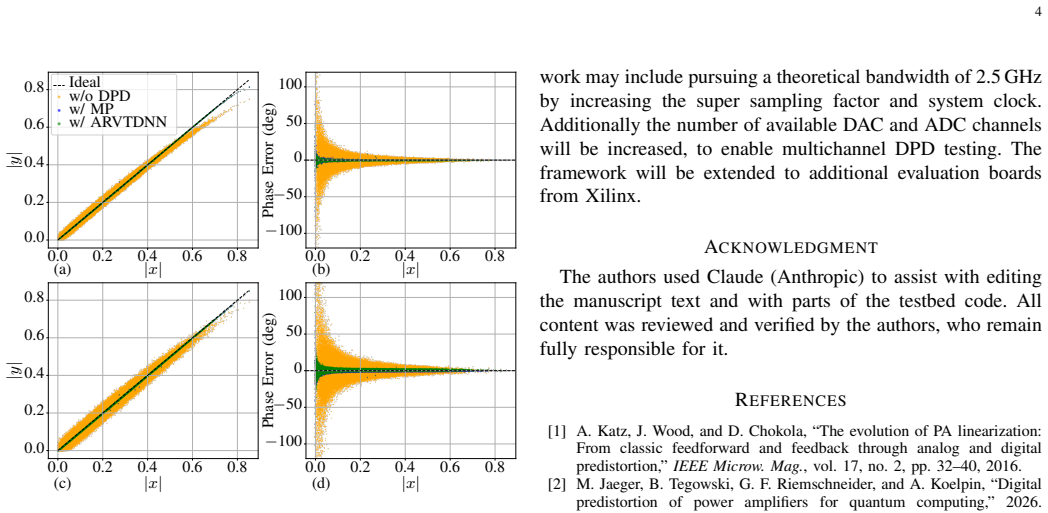
Summary. The manuscript presents OwnDPDLab, an open-source DPD testbed built on the RFSoC 4x2 that provides up to 983.04 MHz instantaneous bandwidth with user control of center frequency, sampling mode (including dual Nyquist zones), DAC variable output power, and ADC digital stepped attenuation. Architecture details cover a URAM-based cyclic replay engine at SSR=4, CDC FIFOs, DMA capture, inverse-sinc pre-equalization, and client-side MLS cross-correlation for sub-sample synchronization (Eq. 1). Capability is demonstrated by linearizing a Mini-Circuits ZHL-42 PA with a 196.608 MHz 256-QAM OFDM waveform using both a memory polynomial and an ARVTDNN, in the first (900 MHz) and second (3915.2 MHz) Nyquist zones. Measured spectra (Fig. 2), AM-AM/PM characteristics (Fig. 3), and Table III report NMSE improvements up to ~23 dB and ACLR improvements up to ~11 dB, with the full client/PS/PL code released on GitHub.
Significance. Wideband DPD validation hardware remains expensive or inflexible; an affordable, fully open RFSoC-based platform that reaches nearly 1 GHz bandwidth and supports dual Nyquist-zone operation fills a genuine gap for academic and quantum-computing groups. The public release of bitstream, PS, and client code, together with a concrete dual-model, dual-zone demonstration, makes the contribution immediately usable and reproducible. While the experimental scope is limited to a single PA and signal class, the systems result itself is solid and of clear practical value to the DPD and microwave-engineering communities.
minor comments (5)
- Table I lists OpenDPD instantaneous bandwidth as “– (offline)”; a short clarifying footnote would help readers understand the comparison axis.
- Section II, Eq. (1): the upsampling factor I used for the MLS cross-correlation is never stated; adding the value (or a typical range) would improve reproducibility of the synchronization step.
- Fig. 2 caption and surrounding text note a discrete spurious tone from clock feedthrough; a brief quantitative remark on its power relative to the ACLR floor would help readers judge residual hardware artifacts.
- Table III reports single-point metrics without uncertainty; even a short statement that results were verified on multiple captures would strengthen confidence.
- A few minor typographical issues remain (e.g., “Nyquist zone” capitalization consistency, “inband” vs. “in-band”).
Circularity Check
No significant circularity: experimental systems demonstration with independently measured metrics
full rationale
OwnDPDLab is an open-source RFSoC-based hardware testbed paper. Its central claims are architectural (983.04 MHz bandwidth, controllable VOP/DSA/Nyquist zone, SSR=4 replay engine, MLS synchronization via Eq. 1) and experimental (measured NMSE/ACLR/EVM improvements when applying standard MP and ARVTDNN models to a laboratory PA). The DPD models are classical (memory polynomial of Ghannouchi/Hammi; ARVTDNN of Wang et al.) whose coefficients/parameters are estimated by ordinary least-squares or hyperparameter search on recorded I/O data; the resulting predistorted waveforms are then re-applied to the physical PA and the metrics of Table III / Figs. 2-3 are obtained by direct measurement. Nothing is defined in terms of a quantity that is later presented as a prediction, no uniqueness theorem is imported from the authors' prior work, and the self-citations ([2],[4],[5]) are merely contextual references to related quantum-computing applications of DPD; they do not close any logical loop that forces the reported linearization numbers. The paper is therefore self-contained against external benchmarks and exhibits no circularity of the kinds enumerated in the analyzer specification.
Axiom & Free-Parameter Ledger
free parameters (3)
- MP nonlinearity order K and memory depth L =
zone1: 5,9; zone2: 3,8
- ARVTDNN architecture (hidden sizes, K', L', activation) =
zone1: [128,64], K'=5,L'=9; zone2: [64], K'=3,L'=8
- DAC VOP and ADC DSA settings =
VOP 2/4.5 dBm, DSA 8 dB
axioms (3)
- domain assumption Standard RFSoC RFDC sampling, DUC/DDC and inverse-sinc compensation behave as documented by the vendor for the chosen 4.9152 GSPS rate and mixed-mode operation.
- domain assumption Memory-polynomial and ARVTDNN models of the cited forms are adequate inverse models for the mild nonlinearity of the ZHL-42 under the chosen drive levels.
- ad hoc to paper MLS cyclic cross-correlation (Eq. 1) yields sub-sample delay estimates accurate enough that residual timing error does not dominate the reported NMSE.
invented entities (1)
-
OwnDPDLab (URAM-based replay engine + CDC-FIFO + DMA data path on RFSoC 4x2)
independent evidence
read the original abstract
5G and Beyond-5G standards require digital predistortion (DPD) algorithms to operate on increased signal bandwidths. Wideband laboratory test hardware is cost-intensive, and openly available solutions lack flexibility. The OwnDPDLab provides a highly flexible, affordable, open-source, and openly accessible system. It is based on the RFSoC 4x2 and supports full control of center frequency, sampling mode, output power, and input attenuation at a signal bandwidth of up to 1 GHz. The system's capability is demonstrated by linearizing a laboratory power amplifier using a 196.608 MHz orthogonal frequency division multiplexing (OFDM) signal with 256-QAM modulation using both a memory polynomial and an augmented real-valued time-delay neural network in the first and second Nyquist zone. The system achieves a normalized mean squared error improvement of up to 23 dB and an adjacent channel leakage ratio improvement of up to 11 dB, using DPD.
Figures


Reference graph
Works this paper leans on
-
[1]
The evolution of PA linearization: From classic feedforward and feedback through analog and digital predistortion,
A. Katz, J. Wood, and D. Chokola, “The evolution of PA linearization: From classic feedforward and feedback through analog and digital predistortion,”IEEE Microw. Mag., vol. 17, no. 2, pp. 32–40, 2016
2016
-
[2]
Digital predistortion of power amplifiers for quantum computing,
M. Jaeger, B. Tegowski, G. F. Riemschneider, and A. Koelpin, “Digital predistortion of power amplifiers for quantum computing,” 2026. [Online]. Available: https://doi.org/10.48550/arXiv.2601.06524
-
[3]
Digital predistortion for flux control of tunable superconducting qubits,
D. Venkateswaranet al., “Digital predistortion for flux control of tunable superconducting qubits,”arXiv preprint arXiv:2604.15895, 2026
Pith/arXiv arXiv 2026
-
[4]
Design of a microwave frontend for a trapped ion quantum computer,
M. Jaeger, G. F. Riemschneider, N. Weiß, B. Tegowski, and A. Koelpin, “Design of a microwave frontend for a trapped ion quantum computer,” inProc. 2025 16th Ger . Microw. Conf. (GeMiC), 2025, pp. 152–155
2025
-
[5]
Feedback-receiver-based compensation of nonlinearities in trapped ion qubit gate signaling,
M. Baecker, M. Jaeger, B. Tegowski, G. F. Riemschneider, and A. Koelpin, “Feedback-receiver-based compensation of nonlinearities in trapped ion qubit gate signaling,” in2026 17th Ger . Microw. Conf. (GeMiC), 2026, pp. 326–329
2026
-
[6]
A generalized memory polynomial model for digital predistortion of RF power am- plifiers,
D. Morgan, Z. Ma, J. Kim, M. Zierdt, and J. Pastalan, “A generalized memory polynomial model for digital predistortion of RF power am- plifiers,”IEEE Trans. Signal Process., vol. 54, no. 10, pp. 3852–3860, 2006
2006
-
[7]
Behavioral modeling and predistor- tion,
F. M. Ghannouchi and O. Hammi, “Behavioral modeling and predistor- tion,”IEEE Microw. Mag., vol. 10, no. 7, pp. 52–64, 2009
2009
-
[8]
Augmented real-valued time-delay neural network for compensation of distortions and impairments in wireless transmitters,
D. Wang, M. Aziz, M. Helaoui, and F. M. Ghannouchi, “Augmented real-valued time-delay neural network for compensation of distortions and impairments in wireless transmitters,”IEEE Trans. Neural Netw. Learn. Syst., vol. 30, no. 1, pp. 242–254, 2019
2019
-
[9]
Residual neural networks for digital predistortion,
Y . Wu, U. Gustavsson, A. G. i. Amat, and H. Wymeersch, “Residual neural networks for digital predistortion,” inGlob. Commun. Conf. (GLOBECOM), 2020, pp. 01–06
2020
-
[10]
Residual RNN models with pruning for digital predistortion of RF power amplifiers,
Z. He and F. Tong, “Residual RNN models with pruning for digital predistortion of RF power amplifiers,”IEEE Trans. V eh. Technol., vol. 71, no. 9, pp. 9735–9750, 2022
2022
-
[11]
Weblab: A web-based setup for PA digital predistortion and characterization,
P. N. Landin, S. Gustafsson, C. Fager, and T. Eriksson, “Weblab: A web-based setup for PA digital predistortion and characterization,”IEEE Microw. Mag., vol. 16, no. 1, pp. 138–140, 2015
2015
-
[12]
Opendpd: An open-source end-to-end learning & bench- marking framework for wideband power amplifier modeling and digital pre-distortion,
Y . Wu, G. D. Singh, M. Beikmirza, L. C. N. de Vreede, M. Alavi, and C. Gao, “Opendpd: An open-source end-to-end learning & bench- marking framework for wideband power amplifier modeling and digital pre-distortion,” in2024 IEEE International Symposium on Circuits and Systems (ISCAS), 2024, pp. 1–5
2024
-
[13]
Keysight Technologies,M5000 Series High-Performance PXI System, Keysight Technologies, Santa Rosa, CA, USA, Feb. 2026
2026
-
[14]
National Instruments,PXIe-5842 User Manual, National Instruments (NI), an Emerson company, Feb. 2026
2026
-
[15]
USRP X440 Product Page,
Ettus Research, “USRP X440 Product Page,” [Online]. Available: https: //www.ettus.com/all-products/usrp-x440/, 2026, accessed: 2026
2026
-
[16]
Ultra-wideband SDR architecture for AMD RFSoCs and PYNQ based GNU Radio blocks,
M. ˇSiauˇciulis, L. H. Crockett, and R. W. Stewart, “Ultra-wideband SDR architecture for AMD RFSoCs and PYNQ based GNU Radio blocks,” Proceed. of the GNU Rad. Conf., vol. 8, no. 1, 2023. [17]RFSoC 4x2 Reference Manual, Revision A3, Real Digital, 2023. [Online]. Available: https://www.realdigital.org/hardware/rfsoc-4x2
2023
-
[17]
Optuna: A next-generation hyperparameter optimization framework,
T. Akiba, S. Sano, T. Yanase, T. Ohta, and M. Koyama, “Optuna: A next-generation hyperparameter optimization framework,” 2019. [Online]. Available: https://arxiv.org/abs/1907.10902
Pith/arXiv arXiv 2019
-
[18]
OwnDPDLab: A Flexible Open-Source Testbed for Wide- band DPD Algorithm Benchmarking on RFSoC,
M. Jaeger, “OwnDPDLab: A Flexible Open-Source Testbed for Wide- band DPD Algorithm Benchmarking on RFSoC,” 2026, gitHub Repos- itory. https://github.com/MarvinJaegerIng/OwnDPDLab
2026
discussion (0)
Sign in with ORCID, Apple, or X to comment. Anyone can read and Pith papers without signing in.