REVIEW 2 major objections 5 minor 147 references
SIC lets each LEO satellite beam serve three users at once with only a modest throughput trade-off and finite SIR variance.
Reviewed by Pith at T0; open to challenge. T0 means a machine referee read the full paper against a public rubric. the ladder, T0–T4 →
SIC lets a narrow-beam LEO uplink serve three effective UEs per cell with finite SIR variance and only a 0.2 bit/s/Hz throughput penalty versus single-user service.
T0 review reviewed 2026-07-14 challenge →
load-bearing objection Clean first derivation of PD(0,θ) order statistics for narrow-beam LEO uplink SIC; the multi-UE fairness claim is backed by formulas and spherical MC, with the moment-matched fading approx as the main soft spot. the 2 major comments →
Stochastic Analysis of Successive Interference Cancellation in a Narrow-Beam LEO Uplink
The pith
A machine-rendered reading of the paper's core claim, the machinery that carries it, and where it could break.
The reading
Core claim
Under the mixture-exponential shadowing model the ordered STIR process at a typical LEO beam is Poisson–Dirichlet PD(0, κ̃υ). Consequently the SIC coverage probability of the k-th strongest user admits an explicit multi-dimensional integral over the joint density of the first k order statistics; evaluating that integral for κ̃υ log 2 = 3 shows that three users can be served simultaneously with total throughput only 0.2 bit/s/Hz below the single-user baseline while the strongest-user SIR variance remains finite.
What carries the argument
The Poisson–Dirichlet density of the ordered STIR process (Proposition 2), obtained because the Laplace transform of total received power is that of a gamma random variable with shape κ̃υ; all subsequent SIC coverage formulas are obtained by integrating this density over the successive-decoding region.
Load-bearing premise
The two-tier log-normal shadowing of 3GPP is replaced by a one-parameter mixture-exponential distribution whose parameter is fixed solely by matching the first two moments of received power.
What would settle it
Re-run the Monte-Carlo campaign of Section IV with the original two-tier log-normal mixture (instead of the moment-matched exponential) and check whether the third-user SIC coverage at −7 dB still improves by roughly an order of magnitude and whether total throughput remains near 0.7 bit/s/Hz.
Editorial analysis
A structured set of objections, weighed in public.
Referee Report
Summary. The paper studies SIR order statistics and successive interference cancellation (SIC) for the uplink of a typical narrow-beam LEO satellite base station. UEs form a homogeneous PPP; the receive beam is Gaussian. Urban shadowing is taken from a two-tier Gaussian mixture (3GPP parameters) and approximated by a mixture-exponential distribution whose single free parameter υ is fixed by matching the first two moments. Under this model the total received power is gamma-distributed, the STIR process is Poisson–Dirichlet PD(0,κυ̃), and closed-form factorial-moment densities together with the joint PDF of the ordered STIRs are obtained. Coverage probabilities for the three strongest UEs with and without perfect SIC, as well as the aggregate bandwidth-normalized throughput, are then evaluated. Analytic curves for κυ = n = 3 are shown to lie inside Monte-Carlo envelopes generated on a spherical Earth with the original Gaussian-mixture shadowing; the results indicate that SIC raises third-UE coverage at θ = −7 dB by roughly 900 % while total throughput falls only from ≈0.9 to ≈0.7 bit/s/Hz and keeps SIR variance finite.
Significance. If the quantitative claims hold, the work supplies the first stochastic-geometry treatment of SIC order statistics that is specific to narrow-beam LEO uplinks and that correctly identifies the underlying gamma-process / PD(0,·) structure (distinct from the terrestrial PD(α,0) case). The explicit Laplace transform of interference, the factorial-moment densities, and the SIC coverage integral are immediately usable design formulae. The concrete trade-off—finite SIR variance and multi-UE service at a modest aggregate-throughput cost—is a falsifiable prediction that is already checked against spherical Monte-Carlo with 3GPP shadowing parameters. The derivation chain from the PPP mapping theorem through moment-matched fading to the gamma/PD objects is rigorous and transparent.
major comments (2)
- [§II.B.2 / Eqs. (4)–(5)] §II.B.2, Eqs. (4)–(5) and subsequent use in (12), Prop. 2 and Prop. 3: all analytic objects (Laplace transform of I, PD densities, SIC coverage integrals) are exact only under the mixture-exponential approximation that matches the first two moments of the 3GPP Gaussian mixture. Although Figs. 3–4 show that the final coverage curves fall inside the spherical Monte-Carlo bands that employ the true mixture, a direct comparison of the Laplace transform (or of the empirical CCDF of total interference I) under both fading models would quantify residual approximation error beyond mean/variance matching and would make the central numerical claims more robust.
- [§III.C / Prop. 3] §III.C, Prop. 3 and Eq. (26): the reported 900 % coverage gain and the 0.7 bit/s/Hz throughput rest on the assumption of perfect successive cancellation. The paper notes that imperfect cancellation is “straightforward” to include, yet no residual-interference factor or sensitivity plot is provided. Because the fairness/throughput trade-off is the main design takeaway, even a simple one-parameter residual model (or a lower bound) would strengthen the claim that the multi-UE operating point remains attractive under realistic SIC.
minor comments (5)
- [Table I] Table I lists σ^{2}_LoS = 42 [dB] and σ^{2}_NLoS = 62 [dB], while the text correctly states σ_LoS = 4 dB and σ_NLoS = 6 dB. The table entries are almost certainly typesetting artefacts for 4^{2} and 6^{2}; they should be corrected to avoid confusion.
- [Throughout] Notation for the effective-UE product is inconsistent: κυ, κ v, κ̃υ and κ̃v appear interchangeably. A single symbol (e.g. κυ) should be fixed throughout the text, equations and figure captions.
- [Abstract] The abstract states that the analysis uses a “Gaussian mixture shadowing model”, yet the closed-form results rely on the mixture-exponential approximation. A short clarifying phrase would align the abstract with §II.B.
- [§IV] Throughput values T3 ≈ 0.7 and T1 ≈ 0.9 bit/s/Hz are obtained by trapezoidal integration of the curves in Fig. 4. Reporting the numerical quadrature tolerance or supplying a short script would improve reproducibility.
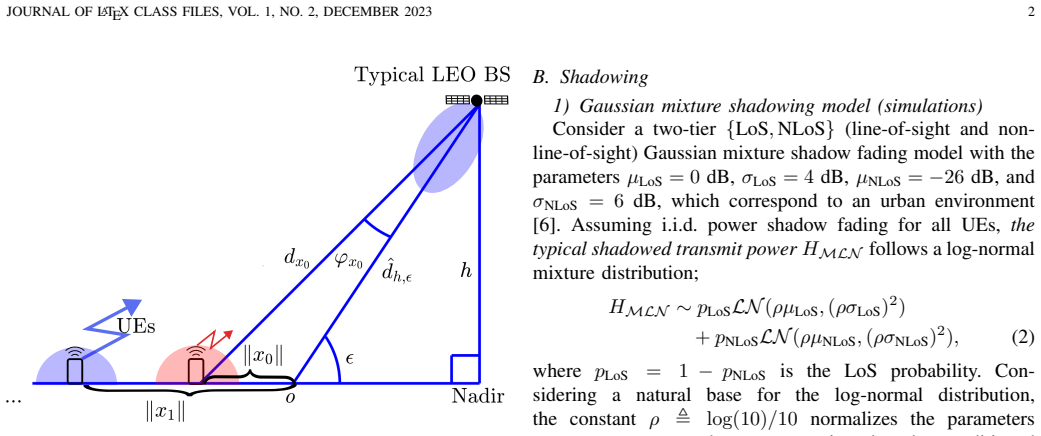
- [Fig. 1] Figure 1 caption and the surrounding text refer to a “projection into the line”; a brief sentence explaining that the figure is only schematic (the actual process lives on R^{2}) would help readers unfamiliar with the mapping.
Circularity Check
Minor non-load-bearing self-citations to authors' prior planar geometry paper; core Laplace/PD/SIC derivations are independent of those citations and of any fitted targets.
specific steps
-
self citation load bearing
[Prop. 1 proof; also §II, Eq. (26)]
"Please refer to [5, Lemma 1] for throughout explanation of the geometric interpretation of κ. ... see analogous derivation in [5, Eq. (36)]"
Authors cite their own prior paper [5] for the geometric meaning of κ and for the form of the throughput integral. The density itself is re-derived from first principles in the present Prop. 1, and the SIC coverage expressions do not depend on any unverified claim unique to [5]; the citations are therefore minor and non-load-bearing.
full rationale
The derivation chain is self-contained: PPP mapping yields the GP intensity (Prop. 1, re-derived in full), mixture-exponential CCDF is obtained by explicit two-moment matching to the external 3GPP Gaussian-mixture parameters (Eqs. 4-5), Laplace transform of total interference is then gamma (Eq. 12), STIR factorial-moment densities follow from the classical Poisson-Dirichlet PD(0,κ̃υ) characterization (Prop. 2, citing independent literature [8,9]), and SIC coverage/throughput integrals are obtained by direct integration of the resulting joint order-statistic PDF (Prop. 3, Eq. 26). No parameter is fitted to the coverage or throughput curves that are later reported; κυ = n = 3 is a design choice that fixes beamwidth, and the final numerical claims are cross-checked against spherical Monte-Carlo that uses the original (non-approximated) Gaussian mixture. The only self-citations ([5]) supply geometric background for κ and an analogous throughput integral; both quantities are re-derived or re-stated here, so the citations are not load-bearing for the SIC claims. Consequently there is no self-definitional loop, no fitted-input-as-prediction, and no uniqueness theorem imported from the authors.
Axiom & Free-Parameter Ledger
free parameters (4)
- υ (fraction of effective UEs)
- n = κυ = 3
- τ = −7 dB
- shadowing means/variances (µLoS=0, σLoS=4 dB, µNLoS=−26 dB, σNLoS=6 dB)
axioms (4)
- domain assumption UEs form a homogeneous Poisson point process of intensity λ on the plane (or sphere).
- domain assumption Spatial path-loss and antenna-gain factors cancel in the SIR for all relevant UEs inside a narrow beam.
- domain assumption Successive interference cancellation is perfect (residual interference after cancellation is zero).
- standard math The total received power under mixture-exponential fading is gamma-distributed with shape κ̃υ.
Cite this review
Pith. "Pith review of Stochastic Analysis of Successive Interference Cancellation in a Narrow-Beam LEO Uplink." pith.science (2026). https://pith.science/paper/46Y3EOPW
@misc{pith2026260711620,
  author       = {Pith},
  title        = {Pith review of: Stochastic Analysis of Successive Interference Cancellation in a Narrow-Beam LEO Uplink},
  year         = {2026},
  howpublished = {\url{https://pith.science/paper/46Y3EOPW}},
  note         = {Machine review of arXiv:2607.11620}
}
read the original abstract
We investigate SIR distributions and order statistics of user equipments (UEs) at a typical low Earth orbit satellite base station (LEO BS) with narrow Gaussian antenna beams in the uplink. We analyze SIR distributions for the three strongest UEs under successive interference cancellation (SIC), using a Gaussian mixture shadowing model. The UEs are distributed on Earth according to a Poisson point process (PPP). We show that SIC enables each LEO BS to serve multiple UEs per beam cell, achieving simultaneously a good average network throughput and user fairness.
Figures


Reference graph
Works this paper leans on
-
[1]
Błaszczyszyn and H
B. Błaszczyszyn and H. P. Keeler, ``Studying the SINR process of the typical user in poisson networks using its factorial moment measures,'' IEEE Transactions on Information Theory, vol. 61, no. 12, pp. 6774--6794, 2015
2015
-
[2]
Priya Indraganti and S
S. Priya Indraganti and S. Vappangi, ``Performance analysis of energy efficient cooperative SWIPT NOMA -assisted cognitive satellite-terrestrial networks,'' IEEE Access, vol. 13, pp. 116\,632--116\,642, 2025
2025
-
[3]
B. A. Homssi and A. Al-Hourani, ``Modeling uplink coverage performance in hybrid satellite-terrestrial networks,'' IEEE Communications Letters, vol. 25, no. 10, pp. 3239--3243, 2021
2021
-
[4]
Al Homssi and A
B. Al Homssi and A. Al-Hourani, ``Optimal beamwidth and altitude for maximal uplink coverage in satellite networks,'' IEEE Wireless Communications Letters, vol. 11, no. 4, pp. 771--775, 2022
2022
-
[5]
Angervuori, M
I. Angervuori, M. Haenggi, and R. Wichman, ``Meta distribution of the SIR in a narrow-beam LEO uplink,'' IEEE Transactions on Communications, vol. 73, no. 9, pp. 8260--8273, 2025
2025
-
[6]
Rep., 2020
3GPP, ``Study on new radio ( NR ) to support non-terrestrial networks (release 15), TR 38.811,'' 3GPP, Tech. Rep., 2020
2020
-
[7]
Błaszczyszyn, M
B. Błaszczyszyn, M. Haenggi, P. Keeler, and S. Mukherjee, eng Stochastic Geometry Analysis of Cellular Networks . 1em plus 0.5em minus 0.4em Cambridge University Press, 2018
2018
-
[8]
Pitman and M
J. Pitman and M. Yor, ``The two-parameter poisson-dirichlet distribution derived from a stable subordinator,'' The Annals of Probability, pp. 855--900, 1997
1997
-
[9]
Handa, ``The two-parameter P oisson— D irichlet point process,'' Bernoulli, vol
K. Handa, ``The two-parameter P oisson— D irichlet point process,'' Bernoulli, vol. 15, no. 4, pp. 1082--1116, 2009. [Online]. Available: http://www.jstor.org/stable/20680193
arXiv 2009
-
[10]
Solutions for
3GPP , institution =. Solutions for
-
[11]
Study on New Radio (
3GPP , institution =. Study on New Radio (
-
[12]
and Vere-Jones, D
Daley, D.J. and Vere-Jones, D. An introduction to the theory of point processes. Elementary Theory and Methods. 2003
2003
-
[13]
Daley, D. J. and Vere-Jones, D. , address =. An introduction to the theory of point processes. 2 , year =. An introduction to the theory of point processes. 2, General theory and structure , edition =
-
[14]
and Blaszczyszyn, B
Baccelli, F. and Blaszczyszyn, B. Stochastic Geometry and Wireless Networks. Theory. 2009
2009
-
[15]
and Blaszczyszyn, B
Baccelli, F. and Blaszczyszyn, B. Stochastic Geometry and Wireless Networks. Applications. 2009
2009
-
[16]
and Whitt, W
Abate, J. and Whitt, W. Numerical Inversion of Laplace Transforms of Probability Distributions. ORSA Journal on Computing. 1995
1995
-
[17]
International Telecommunication Union Recommendation. Analytical method for determining the statistics of interference between non-geostationary-satellite orbit FSS systems and other non-geostationary-satellite orbit FSS systems or geostationary-satellite orbit FSS networks. 2001
2001
-
[18]
Reference radiation patterns for fixed wireless system antennas for use in coordination studies and interference assessment in the frequency range from 100 MHz to 86 GHz, Rec ITU-R F.699-8. 2018
2018
-
[19]
Propagation data required for the design systems in the land mobile-satellite service
International Telecommunication Union Recommendation. Propagation data required for the design systems in the land mobile-satellite service. 2019
2019
-
[20]
Introduction to the theory and application of the Laplace transform
Doetsch, G. Introduction to the theory and application of the Laplace transform. 1974
1974
-
[21]
and Baccelli, F
Andrews, J.G. and Baccelli, F. and Ganti, R.K. A Tractable Approach to Coverage and Rate in Cellular Networks. IEEE Transactions on Communications. 2011
2011
-
[23]
User selection for multi-beam satellite channels: A stochastic geometry perspective , year=
Sellathurai, Mathini and Vuppala, Satyanarayana and Ratnarajah, Tharmalingam , booktitle=. User selection for multi-beam satellite channels: A stochastic geometry perspective , year=
-
[24]
Downlink Coverage and Rate Analysis of Low Earth Orbit Satellite Constellations Using Stochastic Geometry , year=
Okati, Niloofar and Riihonen, Taneli and Korpi, Dani and Angervuori, Ilari and Wichman, Risto , journal=. Downlink Coverage and Rate Analysis of Low Earth Orbit Satellite Constellations Using Stochastic Geometry , year=
-
[25]
Stochastic Analysis of Satellite Broadband by Mega-Constellations with Inclined
Okati, Niloofar and Riihonen, Taneli , booktitle=. Stochastic Analysis of Satellite Broadband by Mega-Constellations with Inclined. 2020 , volume=
2020
-
[26]
and Bhatt, M
Singh, R. and Bhatt, M. Engineering mathematics. 2010
2010
-
[27]
Vincent , journal=
Di, Boya and Song, Lingyang and Li, Yonghui and Poor, H. Vincent , journal=. Ultra-Dense. 2019 , volume=
2019
-
[28]
Space X V -Band non-Geostationary Satellite System
Mihai Albulet. Space X V -Band non-Geostationary Satellite System. 2017
2017
-
[29]
The Chebyshev - Markov inequalities
Wang, Xinyun and Haenggi, Martin. The Chebyshev - Markov inequalities. 2022
2022
-
[30]
and Chiu, Sung Nok
Stoyan, Dietrich. and Chiu, Sung Nok. and Kendall, W. S. and Mecke, Joseph. , address =. Stochastic geometry and its applications , year =. Stochastic Geometry and its Applications , edition =
-
[31]
A Statistical Estimation of 5G Massive MIMO’s Exposure using Stochastic Geometry , year=
Hajj, Maarouf Al and Wang, Shanshan and Doncker, Philippe de and Oestges, Claude and Wiart, Joe , booktitle=. A Statistical Estimation of 5G Massive MIMO’s Exposure using Stochastic Geometry , year=
-
[32]
Uplink Power Control and Ergodic Rate Characterization in FD Cellular Networks: A Stochastic Geometry Approach , year=
Randrianantenaina, Itsikiantsoa and ElSawy, Hesham and Dahrouj, Hayssam and Kaneko, Megumi and Alouini, Mohamed-Slim , journal=. Uplink Power Control and Ergodic Rate Characterization in FD Cellular Networks: A Stochastic Geometry Approach , year=
-
[33]
Stochastic Geometry Interference Analysis of Radar Network Performance , year=
Munari, Andrea and Simić, Ljiljana and Petrova, Marina , journal=. Stochastic Geometry Interference Analysis of Radar Network Performance , year=
-
[34]
and Corazza, G.E
Vatalaro, F. and Corazza, G.E. and Caini, C. and Ferrarelli, C. , journal=. Analysis of. 1995 , volume=
1995
-
[35]
Theoretical and Simulation-based Analysis of Terrestrial Interference to
Yastrebova, Anastasia and Angervuori, Ilari and Okati, Niloofar and Vehkaperä, Mikko and Höyhtyä, Marko and Wichman, Risto and Riihonen, Taneli , booktitle=. Theoretical and Simulation-based Analysis of Terrestrial Interference to. 2020 , volume=
2020
-
[36]
and Cygan, D
Lutz, E. and Cygan, D. and Dippold, M. and Dolainsky, F. and Papke, W. , journal=. The land mobile satellite communication channel-recording, statistics, and channel model , year=
-
[37]
2017 , volume=
Huo, Yiming and Dong, Xiaodai and Xu, Wei , journal=. 2017 , volume=
2017
-
[38]
Supplemental Information Regarding Earth Stations
Space X. Supplemental Information Regarding Earth Stations. 2021
2021
-
[39]
REPORT AND ORDER AND FURTHER NOTICE OF PROPOSED RULEMAKING
Federal Communications Commission. REPORT AND ORDER AND FURTHER NOTICE OF PROPOSED RULEMAKING. 2016
2016
-
[40]
Modeling Uplink Coverage Performance in Hybrid Satellite-Terrestrial Networks , year=
Homssi, Bassel Al and Al-Hourani, Akram , journal=. Modeling Uplink Coverage Performance in Hybrid Satellite-Terrestrial Networks , year=
-
[41]
Díaz-Francés, Eloísa and Rubio, Francisco J. On the existence of a normal approximation to the distribution of the ratio of two independent normal random variables. Statistical Papers. 2013. doi:10.1007/s00362-012-0429-2
-
[42]
Uplink Interference Characterization and Coverage Analysis of Modern LEO and VLEO Networks: A Stochastic Geometry Approach
Angervuori, Ilari and Okati, Niloofar and Riihonen, Taneli and Wichman, Risto. Uplink Interference Characterization and Coverage Analysis of Modern LEO and VLEO Networks: A Stochastic Geometry Approach. IEEE Transactions on Communications. 2022
2022
-
[43]
and Andrews, Jeffrey G
Gulati, Kapil and Evans, Brian L. and Andrews, Jeffrey G. and Tinsley, Keith R. , journal=. Statistics of Co-Channel Interference in a Field of. 2010 , volume=
2010
-
[44]
, journal=
Xueshi Yang and Petropulu, A.P. , journal=. Co-channel interference modeling and analysis in a. 2003 , volume=
2003
-
[45]
and Hatzinakos, D
Ilow, J. and Hatzinakos, D. , journal=. Analytic alpha-stable noise modeling in a. 1998 , volume=
1998
-
[46]
Stable Non-
Samorodnitsky, Gennady and Taqqu, Murad S , year=. Stable Non-
-
[47]
Statistical-Physical Models of Electromagnetic Interference , year=
Middleton, David , journal=. Statistical-Physical Models of Electromagnetic Interference , year=
-
[48]
and Kountouris, Marios and Bai, Tianyang , journal=
Heath, Robert W. and Kountouris, Marios and Bai, Tianyang , journal=. Modeling Heterogeneous Network Interference Using. 2013 , volume=
2013
-
[49]
and Tinsley, Keith R
Gulati, Kapil and Evans, Brian L. and Tinsley, Keith R. , booktitle=. Statistical modeling of co-channel interference in a field of. 2010 , volume=
2010
-
[50]
and Liu, Youjian and Brown, Timothy X
Madhusudhanan, Prasanna and Restrepo, Juan G. and Liu, Youjian and Brown, Timothy X. , booktitle=. Carrier to Interference Ratio Analysis for the Shotgun Cellular System , year=
-
[51]
Nanosatellite-
Babich, Fulvio and Comisso, Massimiliano and Cuttin, Alessandro and Marchese, Mario and Patrone, Fabio , journal=. Nanosatellite-. 2020 , volume=
2020
-
[52]
Terrestrial-satellite integration in dynamic 5G backhaul networks , year=
Artiga, Xavier and Nunez-Martinez, Jose and Perez-Neira, Ana and Vela, Gorka Juan Lendrino and Garcia, Juan Mario Fare and Ziaragkas, Georgios , booktitle=. Terrestrial-satellite integration in dynamic 5G backhaul networks , year=
-
[53]
Coexistence of
Kim, Seungmo and Visotsky, Eugene and Moorut, Prakash and Bechta, Kamil and Ghosh, Amitava and Dietrich, Carl , journal=. Coexistence of. 2017 , volume=
2017
-
[54]
Propagation data required for the design systems in the land mobile-satellite service. 2019
2019
-
[55]
1976 , publisher=
Statistical-physical Models of Man-made and Natural Radio Noise: Part II, First Order Probability Models of the Envelope and Phase , author=. 1976 , publisher=
1976
-
[56]
A Closed-Form Approximation of the
Ilari Angervuori and R Wichman , booktitle=. A Closed-Form Approximation of the. 2022 , volume=
2022
-
[57]
Stochastic Geometry-Based Analysis of Cache-Enabled Hybrid Satellite-Aerial-Terrestrial Networks With Non-Orthogonal Multiple Access , year=
Zhang, Xiaokai and Zhang, Bangning and An, Kang and Zheng, Gan and Chatzinotas, Symeon and Guo, Daoxing , journal=. Stochastic Geometry-Based Analysis of Cache-Enabled Hybrid Satellite-Aerial-Terrestrial Networks With Non-Orthogonal Multiple Access , year=
-
[58]
Downlink and Uplink Low Earth Orbit Satellite Backhaul for Airborne Networks , year=
Okati, Niloofar and Riihonen, Taneli , booktitle=. Downlink and Uplink Low Earth Orbit Satellite Backhaul for Airborne Networks , year=
-
[59]
SpaceX non-Geostationary Satellite System
Mihai Albulet. SpaceX non-Geostationary Satellite System. 2018
2018
-
[60]
, address =
Feller, William. , address =. An introduction to probability theory and its applications. Volume 2. , year =. An introduction to probability theory and its applications. Volume 2. , edition =
-
[61]
, biburl =
Snyder, John P. , biburl =. Map projections -- A working manual , url =
-
[62]
2001 , institution =
2001
-
[63]
Jameson,G. J. O. , year=. The incomplete gamma functions , journal=
-
[64]
Handbook of mathematical functions with formulas, graphs, and mathematical tables , year =
-
[65]
, address =
Haenggi, Martin. , address =. Stochastic geometry for wireless networks , year =. Stochastic geometry for wireless networks , isbn =
-
[66]
Foundations and Trends® in Networking , title =. 2009 , volume =. doi:10.1561/1300000015 , issn =
-
[67]
2018 , title =
Błaszczyszyn, Bartłomiej and Haenggi, Martin and Keeler, Paul and Mukherjee, Sayandev , keywords =. 2018 , title =
2018
-
[68]
An Analytic Approach for Modeling Uplink Performance of Mega Constellations , year=
Jia, Haoge and Jiang, Chunxiao and Kuang, Linling and Lu, Jianhua , journal=. An Analytic Approach for Modeling Uplink Performance of Mega Constellations , year=
-
[69]
Meta Distributions—Part 1: Definition and Examples , year=
Haenggi, Martin , journal=. Meta Distributions—Part 1: Definition and Examples , year=
-
[70]
The Meta Distribution of the
Haenggi, Martin , journal=. The Meta Distribution of the. 2016 , volume=
2016
-
[71]
and Dhillon, Harpreet S
Novlan, Thomas D. and Dhillon, Harpreet S. and Andrews, Jeffrey G. , journal=. Analytical Modeling of Uplink Cellular Networks , year=
-
[72]
Meta Distribution of the
Tang, Xiaoxuan and Xu, Xiaodong and Haenggi, Martin , journal=. Meta Distribution of the. 2020 , volume=
2020
-
[73]
and Popescu, Dimitrie C
Popescu, Otilia and Harris, Jason S. and Popescu, Dimitrie C. , booktitle=. Designing the communication sub-system for nanosatellite CubeSat missions: Operational and implementation perspectives , year=
-
[74]
The Meta Distribution of the
Wang, Yuanjie and Haenggi, Martin and Tan, Zhenhui , journal=. The Meta Distribution of the. 2018 , volume=
2018
-
[75]
2019 , volume=
Wang, Yuanjie and Haenggi, Martin and Tan, Zhenhui , journal=. 2019 , volume=
2019
-
[76]
2013 , title =
Foss, Sergey and Korshunov, Dmitry and Zachary, Stan , keywords =. 2013 , title =
2013
-
[77]
and Alouini, Mohamed-Slim , journal=
Matracia, Maurilio and Kishk, Mustafa A. and Alouini, Mohamed-Slim , journal=. Aerial Base Stations for Global Connectivity: Is It a Feasible and Reliable Solution? , year=
-
[78]
Broadband Hybrid Satellite-Terrestrial Communication Systems Based on Cognitive Radio toward
Jia, Min and Gu, Xuemai and Guo, Qing and Xiang, Wei and Zhang, Naitong , journal=. Broadband Hybrid Satellite-Terrestrial Communication Systems Based on Cognitive Radio toward. 2016 , volume=
2016
-
[79]
and Folks, J
Cressie, Noel and Davis, Anne S. and Folks, J. Leroy and II, George E. Policello , keywords =. The American Statistician , pages =. 1981 , title =
1981
-
[80]
Fine-Grained Analysis on Downlink
Lin, Hongxin and Zhang, Cheng and Huang, Yongming and Zhao, Rui and Yang, Luxi , journal=. Fine-Grained Analysis on Downlink. 2021 , volume=
2021
-
[81]
and Alouini, Mohamed-Slim , journal=
Wang, Ruibo and Kishk, Mustafa A. and Alouini, Mohamed-Slim , journal=. Ultra-Dense. 2022 , volume=
2022
This paper was first reviewed by grok-4.5 on July 14, 2026.
discussion (0)
Sign in with ORCID, Apple, or X to comment. Anyone can read and Pith papers without signing in.