REVIEW 4 major objections 5 minor 3 references
Synthesis of the Elusive Bulk Iodide Double-Perovskite Semiconductor, Cs2AgBiI6: Microcrystals and Photoconductive Films
T0 review · 4 major / 5 minor · reviewed 2026-08-02 · deepseek-v4-flash
Pith's one-line read Bulk Cs2AgBiI6, a long-sought iodide double perovskite, has been synthesized for the first time via anhydrous vapor-phase anion exchange.
desk verdict Bulk phase-pure Cs2AgBiI6 is real and well evidenced; the moisture-catalysis explanation for prior failures is plausible but not fully pinned down. read the letter →
The pith
A machine-rendered reading of the paper's core claim, the machinery that carries it, and where it could break.
The reading
What carries the argument
The central mechanism is vapor-phase halide exchange using trimethylsilyl iodide (TMSI): the reaction TMSI(gas) + Br⁻(surface) → TMSBr(gas) + I⁻(surface) is essentially irreversible, so the overall conversion is limited by anion diffusion within the crystal lattice. The load-bearing precaution is dehydration of the bromide precursor, because trace water catalyzes decomposition by increasing cation mobility, which lowers the kinetic barrier to forming the thermodynamically favored phases Cs3Bi2I9 and CsAg2I3.
What would settle it
Deliberately hydrate a batch of phase-pure, N2-annealed Cs2AgBiBr6 powder with controlled amounts of water vapor, then perform the TMSI anion exchange under inert atmosphere. If the sample converts to phase-pure Cs2AgBiI6 despite the added water, the water-catalysis mechanism is wrong; if it decomposes, the claim is supported. A second test: expose two identical Cs2AgBiI6 samples to dry air and to air with high humidity at the same temperature, and confirm the humid sample decomposes faster while the dry sample remains stable.
Extended reading notes
Core claim
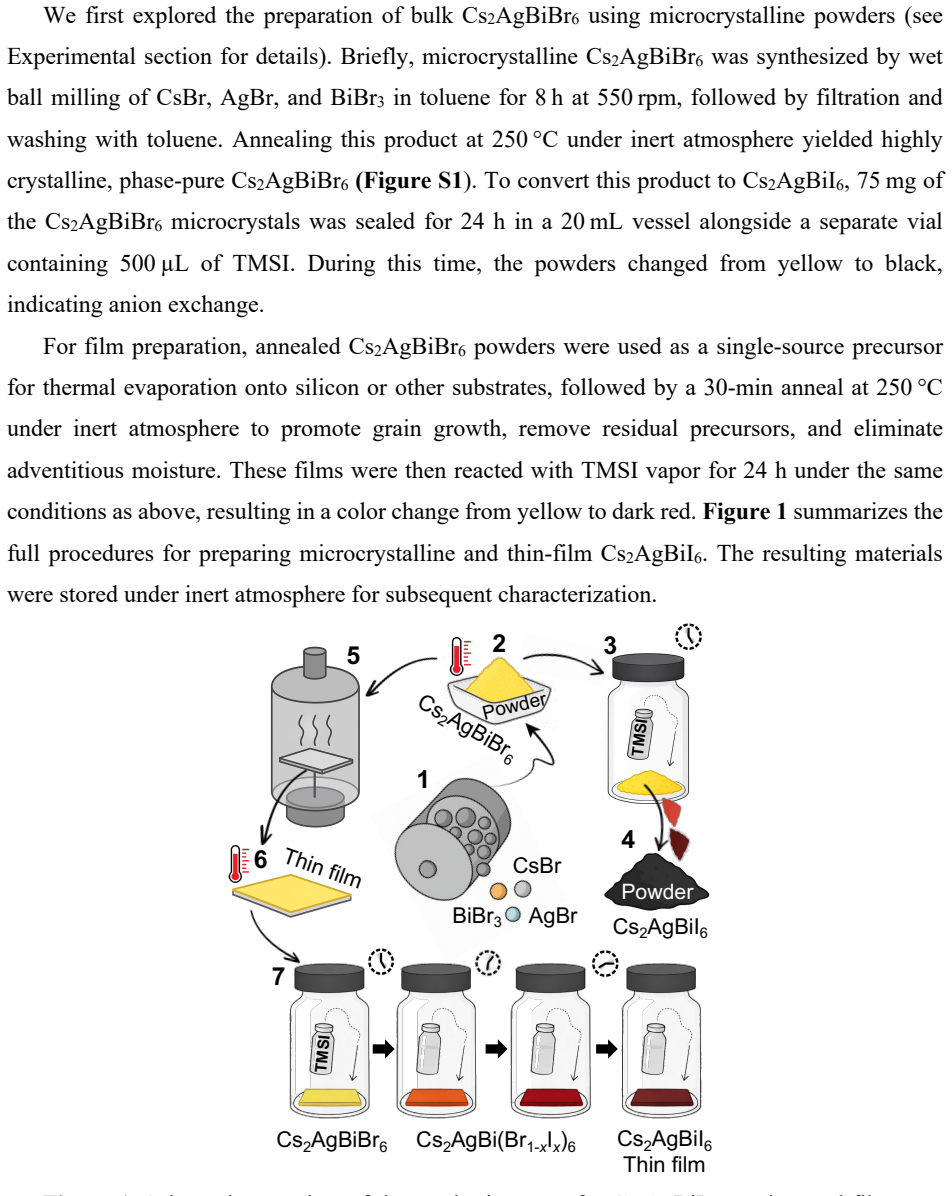
The paper demonstrates that bulk Cs2AgBiI6 can be prepared by vapor-phase anion exchange from phase-pure Cs2AgBiBr6, provided that the precursor is kept strictly anhydrous. The key experimental control is annealing the ball-milled Cs2AgBiBr6 under inert gas to remove surface-adsorbed water; without this step, exposure to TMSI vapor yields decomposition into Cs3Bi2I9 and CsAg2I3 instead of the desired elpasolite. The resulting bulk material is tetragonal (I4/m), shows no detectable Cs3Bi2I9 impurity (0.0 ± 0.5 wt% by XRD calibration), has an optical bandgap of 1.70 ± 0.05 eV, and emits at 1.03 eV. Microcrystalline powder is stable under nitrogen or dry air for months and up to ~70 °C, but dec
Load-bearing premise
The paper attributes the difference between success and failure entirely to surface-adsorbed water on the Cs2AgBiBr6 precursor, but the causal chain (water increases cation mobility and thereby catalyzes decomposition) is inferred from correlated experiments, not directly measured, and the mechanism is extrapolated to all earlier failed routes without testing each one.
Editorial extensions
If this is right
- Bulk Cs2AgBiI6 exists as a kinetically trapped metastable phase, not merely a nanoscale phenomenon, so its properties can now be measured in bulk form.
- The 1.70 eV bandgap and broadband visible absorption make bulk Cs2AgBiI6 a viable candidate as a lead-free top absorber for tandem solar cells.
- The moisture sensitivity explains why earlier mechanochemical, solution-phase, and solid-state routes failed: the common factor was exposure to trace water.
- Phase-pure Cs2AgBiI6 films can be made by evaporation of the bromide precursor followed by anion exchange, which is a scalable route to optoelectronic devices.
- The measured photoconductivity is the first demonstration of photocarrier generation and transport in any 3D iodide double perovskite, opening the door for defect-engineering studies.
Reading between the lines
- If the water-catalysis mechanism is correct, then other 'air-stable' bromide double perovskites may also fail in anion-exchange routes due to trace hydration, and similar anhydrous precautions could unlock other elusive iodide elpasolites.
- The success of the TMSI vapor route suggests that other metastable iodide perovskites, including mixed-cation or mixed-metal compositions, might be accessible by anion exchange from cheap bromide precursors rather than direct solid-state reaction.
- The stability threshold near 70 °C implies that device operation under sunlight could approach the decomposition limit, so thermal management or chemical stabilization (doping, surface passivation) would be needed for practical photovoltaics.
- The sub-gap photoresponse down to ~1.4 eV hints at defect-mediated absorption; if defects can be reduced, the responsivity and carrier lifetime may improve substantially.
Signed reviews
Editorial analysis
A structured set of objections, weighed in public.
Referee Report
Summary. This manuscript reports the first bulk synthesis of the three-dimensional iodide double perovskite Cs2AgBiI6, in both microcrystalline and thin-film forms, by vapor-phase trimethylsilyl iodide (TMSI) anion exchange from mechanochemically prepared, phase-pure Cs2AgBiBr6. The product is assigned to the tetragonal I4/m elpasolite structure by powder XRD with Rietveld refinement (Rw = 5.75%, chi-squared = 1.1), a calibrated Cs3Bi2I9 impurity floor of 0.0 ± 0.5 wt%, EDX/XPS showing no residual Br, and Raman spectroscopy. Optical measurements give an indirect bandgap of 1.70 ± 0.05 eV, broad visible absorption, and 1.03 eV near-infrared PL attributed to deep traps. The material is metastable: it is stable for months under inert or dry conditions and up to about 70 °C, decomposing to Cs3Bi2I9 and CsAg2I3 at higher temperatures or upon humid-air exposure. The authors attribute their synthetic success to exclusion of trace water from the Cs2AgBiBr6 precursor, propose that adsorbed water catalyzes decomposition by increasing cation mobility, and generalize this explanation to prior failed bulk syntheses. Films prepared by thermal evaporation and anion exchange show visible-light photoconductivity, representing the first optoelectronic measurement on this material.
Significance. The synthesis itself is a substantial advance: bulk Cs2AgBiI6 was a well-known synthetic gap, and the convergent characterization — quantitative impurity calibration with a 0.5 wt% detection threshold, a good Rietveld fit, and consistent XRD/EDX/XPS/Raman — supports the phase-purity and complete-exchange claims. The paper provides a reproducible route (ball milling, N2 annealing, TMSI vapor exchange) and the first optoelectronic measurements on this material class; the 1.70 eV gap and photoconductivity make it a credible Pb-free candidate for tandem absorbers. The moisture-causation hypothesis is falsifiable and, if confirmed by the controlled experiments suggested below, would explain prior failures. As presented, however, the causal mechanism is correlational and partially confounded, and the general explanation for prior elusiveness is broader than the evidence. The strength of the synthesis result is not in question; the mechanistic narrative needs hardening.
major comments (4)
- [Fig. 5 and Fig. S13] The N2-vs-air annealing comparison is not a single-variable test of the water hypothesis. Fig. S13 shows that air-annealed Cs2AgBiBr6 develops Cs3Bi2Br9 and AgBr even during subsequent inert storage, so the air-annealed precursor already contains incipient decomposition products before TMSI exposure; the failure of that sample (Fig. 5B) could stem from these pre-existing phases rather than from adsorbed water. The sentence 'We attribute the different reactivities shown in Figure 5 to the effects of surface hydration' (p. 13) is stronger than this experiment supports. A control using an intentionally partially decomposed but dehydrated precursor, or an air-annealed sample exchanged immediately without storage, would separate the two variables.
- [Figs. S14–S15 (p. 13)] The paper does not isolate water as the causative agent. Fig. S15 exposes N2-annealed films to ambient air for one week — not the 'brief exposure' asserted on p. 13 — and then holds them under static vacuum overnight; this experiment cannot exclude O2, CO2, or surface hydroxylation, and it does not show that the water uptake detected by FTIR on a 30-s timescale (Fig. S14) is itself sufficient to ruin the exchange. A controlled test is needed: exposure of N2-annealed precursor to water vapor in an otherwise pure N2 atmosphere (with a dry-O2 control) should reproduce the failure if the claim is correct. Without such a test, 'trace water is the critical factor' remains a correlation.
- [Fig. 6D; Conclusion] The proposed mechanism — adsorbed water 'catalyzes decomposition by increasing cation mobility' — is not measured. No experiment probes cation mobility or the decomposition barrier under controlled hydration, and the lowered-barrier diagram in Fig. 6D is schematic. The Conclusion repeats the causality unqualified ('This water-catalyzed decomposition provides a mechanistic explanation for the prior elusiveness of bulk Cs2AgBiI6'). The causal statement should be explicitly framed as a hypothesis, or supported by a direct measurement (e.g., ionic conductivity or isotope-tracer experiments under controlled humidity).
- [Conclusion; refs 34–39] The generalization of the water explanation to prior failed routes (refs 34–37: nanocrystal ligand chemistry, mechanochemical synthesis, solution-phase MAI exchange) is untested. Those routes differ in conditions (solvents, ligands, temperature), and at least one prior failure (solid-state reaction at 200–300 °C, ref 39) is independently accounted for by the thermal instability above ~70 °C demonstrated here. The text should either test, or explicitly restrict, the scope of the water explanation — e.g., by stating that it is established only for the TMSI vapor-exchange route.
minor comments (5)
- [SI Table S2] The text describes tri-exponential fits, but the 220–270 K rows list only two exponential components (A3/t3 blank). Specify the fitting model used at high temperature.
- [References, ref. 39] Ref. 39 (J. Am. Chem. Soc. 2026, 21, 22364) carries an implausible volume number for JACS; please verify the bibliographic data.
- [p. 4 and SI p. S6] t' = 4.18 is said to place the compound 'at the very edge of the predicted stability domain (t' < 4.18)'. Since 4.18 is not less than 4.18, state explicitly that the compound sits at/past the boundary, consistent with the metastability narrative.
- [p. 9, EDX/XPS analysis] 'Complete halide exchange with no detectable residual Br' — reporting a quantitative EDX/XPS detection limit for Br in the iodide matrix would make 'complete' quantitative.
- [Fig. S4, Rietveld refinement] The refined lattice parameters of bulk Cs2AgBiI6 should be stated in the main text or a table; the starting model is the authors' own nanocrystal structure (ref 34), and explicit agreement metrics would strengthen the bulk-vs-nanocrystal comparison.
Circularity Check
No significant circularity; the only self-referential element is use of the authors' prior nanocrystal structure as a reference pattern/Rietveld starting model, which is a standard use of prior data rather than a circular derivation.
full rationale
The paper's central claims are experimental: bulk Cs2AgBiI6 is prepared by TMSI-vapor anion exchange from phase-pure Cs2AgBiBr6, and its identity is established by XRD with Rietveld refinement, EDX/XPS, Raman, absorption, PL, and photoconductivity. The optical gap (1.70 ± 0.05 eV), PL energy/lifetime, and photoconductivity action spectra are direct measurements; no fitted parameter is relabeled as a prediction. The Cs3Bi2I9 impurity limit (0.0 ± 0.5 wt%) comes from an external calibration curve made from physical mixtures (Figure S3), not from the target data. The structural assignment uses a reference pattern and initial Rietveld model from the authors' prior nanocrystal work (ref 34: 'The diffraction profiles of the Cs2AgBiI6 powders and films both closely match the standard diffraction of the tetragonal (I4/m) elpasolite phase determined previously from Rietveld refinement of synchrotron XRD data,34'; and in Figure S4: 'An initial structural model of tetragonal Cs2AgBiI6 (I4/m) was adapted from nanocrystalline Cs2AgBiI6.34'). This is a self-citation, but it is not circular: the bulk diffraction data are newly measured, the Rietveld refinement is evaluated against those data (Rw = 5.75%, chi2 = 1.1), and the phase-purity conclusion is corroborated by EDX, XPS, and Raman analyses that do not depend on the prior model. The TMSI driving-force statement citing refs 32/34/38 is background chemistry, not a derivation of the target. The moisture-causation explanation ('We attribute the different reactivities shown in Figure 5 to the effects of surface hydration') is a causal hypothesis that is correlational and partly confounded by incipient decomposition products (Figure S13), but that is an evidentiary weakness in the explanatory section, not a case of the conclusion being equivalent to its inputs. Overall, no derivation chain reduces to its own inputs; the minor self-referential use of the prior structure warrants only a low score.
Assumptions & free parameters
free parameters (4)
- Indirect-gap Tauc bandgap of Cs2AgBiI6 =
1.70 +/- 0.05 eV
- XRD impurity calibration slope for Cs3Bi2I9 =
0.42 (R^2 = 0.99994)
- Tri-exponential PL decay parameters =
tau_avg ~10.7 us at 4 K; t1=2.3, t2=14.7, t3=126 us
- Photocurrent power-law exponent alpha =
0.47 (carbon electrodes), 0.95 (gold)
assumptions (5)
- domain assumption Bulk Cs2AgBiI6 matches the tetragonal I4/m structure previously refined from synchrotron data on 13 nm nanocrystals (ref 34).
- domain assumption TMSI-driven Br-to-I exchange is effectively irreversible and diffusion-limited (refs 32, 38), so 24 h exposure fully converts micrometer grains.
- standard math Kubelka-Munk F(R) is proportional to absorption, and Tauc slopes are read as indirect gaps for all three compounds.
- domain assumption EDX and XPS detection limits suffice to claim 'no residual Br' (complete exchange).
- ad hoc to paper Adsorbed water catalyzes decomposition by increasing cation mobility.
Cite this review
Pith. "Pith review of Synthesis of the Elusive Bulk Iodide Double-Perovskite Semiconductor, Cs2AgBiI6: Microcrystals and Photoconductive Films." pith.science (2026). https://pith.science/paper/OG53VBSK
@misc{pith2026260713180,
  author       = {Pith},
  title        = {Pith review of: Synthesis of the Elusive Bulk Iodide Double-Perovskite Semiconductor, Cs2AgBiI6: Microcrystals and Photoconductive Films},
  year         = {2026},
  howpublished = {\url{https://pith.science/paper/OG53VBSK}},
  note         = {Machine review of arXiv:2607.13180}
}
read the original abstract
Three-dimensional (3D) iodide double-perovskite (elpasolite) semiconductors have attracted interest as potential lead-free metal-halide absorber layers for solar applications. Although studied extensively by computational methods, they have remained largely inaccessible synthetically, consistent with their predicted thermodynamic instability. Here, we report the first synthesis of bulk Cs2AgBiI6, demonstrating both microcrystalline and thin-film forms. Microcrystalline powders of Cs2AgBiI6 were prepared via anion exchange from phase-pure Cs2AgBiBr6 microcrystals. The resulting iodide elpasolite shows broad absorption throughout the visible with a 1.70 +/- 0.05 eV optical bandgap and near-infrared photoluminescence centered at 1.03 eV. We identify the elimination of trace moisture in bulk Cs2AgBiBr6 as the critical factor enabling complete halide exchange and isolation of bulk Cs2AgBiI6 with phase purity. In inert atmosphere, microcrystalline Cs2AgBiI6 shows no decomposition when stored for months at room temperature or heated to ~70 {\deg}C, and it appears equally stable in dry air. Building upon these insights, we then demonstrate the preparation of phase-pure Cs2AgBiI6 films by flash thermal evaporation of Cs2AgBiBr6 followed by anion exchange. Photoconductivity measurements on such Cs2AgBiI6 films demonstrate photocarrier generation and transport, marking the first optoelectronic measurement on this elusive 3D iodide double perovskite.
Figures


Figures from the paper (3 more)


Reference graph
Works this paper leans on
-
[1]
Erste Iod-Elpasolithe, Cs2BIMIIII6 (BI = Li, Na). Z. Naturforsch 1980, 35, 394–396. (17) Kent, G. T.; Morgan, E.; Albanese, K. R.; Kallistova, A.; Brumberg, A.; Kautzsch, L.; Wu, G.; Vishnoi, P.; Seshadri, R.; Cheetham, A. K. Elusive Double Perovskite Iodides: Structural, Optical, and Magnetic Properties. Angew. Chem., Int. Ed. 2023, 62, e202306000. (18) ...
1980
-
[7]
(A, B) Photographs of Cs2AgBiBr6 and Cs2AgBiI6 films deposited onto fused silica substrates patterned with interdigitated gold electrodes (20 μm spacings). (C, D) Photographs of an analogous Cs2AgBiBr6 film deposited on fused silica patterned with glassy carbon electrodes (100 μm spacings), and of the same film after conversion to Cs2AgBiI6 by anion excha...
2017
-
[461]
!"√$(!#"!
25 Table of Contents artwork Supporting Information for: S1 Synthesis of the Elusive Bulk Iodide Double-Perovskite Semiconductor, Cs2AgBiI6: Microcrystals and Photoconductive Films Faris Horani, Nicolas Nguyen, Carmelita Ro-Mendez, Nicholas J. Adams, and Daniel R. Gamelin* Department of Chemistry, University of Washington, Seattle, Washington 98195-1700, ...
2019
Reviewed August 2, 2026 · model on record in the stance chip above.
Discussion (0). Continue with ORCID to comment.