REVIEW 3 major objections 6 minor 39 references
Resistivity in Dilute Cu-3d Alloys Governed by Disorder-Induced Band Broadening
T0 review · 3 major / 6 minor · reviewed 2026-08-02 · deepseek-v4-flash
Pith's one-line read Impurity resistance in dilute copper alloys is set by disorder-induced broadening of electron states in momentum space — measured by the full width at half maximum of the Bloch spectral function on the Σ line — rather than by the density of
desk verdict A solid KKR-CPA study with a genuinely useful correlation between Σ-line BSF broadening and computed resistivity, but the 'governed by' mechanistic claim rests on a selected k-point and needs a transport-weighted test before it is trusted. read the letter →
The pith
A machine-rendered reading of the paper's core claim, the machinery that carries it, and where it could break.
The reading
What carries the argument
The central object is the Bloch spectral function (BSF), the momentum- and energy-resolved spectral weight of electronic states in a disordered alloy as computed within the KKR-CPA. In a perfect crystal this weight is a delta function; with 1 at.% solute disorder it broadens into a Lorentzian-like peak whose full width at half maximum is proportional to the imaginary part of the self-energy, i.e., the scattering rate and inverse quasiparticle lifetime. The paper evaluates the BSF on the Fermi-surface arc in the Γ–X plane, fits the perpendicular profile at each point to a Lorentzian, and extracts the FWHM at the Σ-line crossing — the momentum direction along the nearest-neighbor ⟨110⟩ bond. T
What would settle it
Recompute the full resistivity for a fixed disordered-local-moment Cu-1%Fe potential while artificially setting the spectral broadening at the Σ-line crossing to its pure-copper value (or scaling it by a fixed factor), leaving broadening at all other Fermi-surface points untouched; if the resistivity does not change as predicted by the power law, the claim that this one spot governs resistivity is falsified.
Extended reading notes
Core claim
The central claim: the resistivity increase δρ in dilute Cu–3d alloys at ambient temperature is governed by disorder-induced band broadening in momentum space, measured by the FWHM of the Bloch spectral function at the Σ-line Fermi-surface crossing. δρ scales as a power law of this FWHM with a common exponent β ≈ 1.89 across DLM, ferromagnetic, and nonmagnetic states. The non-unity exponent encodes host Fermi-surface geometry (velocity weighting, curvature, k-dependent broadening in the Kubo-Greenwood integral), and the shared exponent shows the impurity's magnetic state does not change the dominant scattering channel. The correlation is specific to the Σ (⟨110⟩) direction and absent on Δ, i
Load-bearing premise
Everything rests on the idea that the blurring of electron states at one particular spot on copper's Fermi surface can stand in for the whole surface when computing resistance; if that spot is not representative once velocity, curvature, and k-dependent effects are included, the correlation collapses.
Editorial extensions
If this is right
- The FWHM of the BSF on the Σ line can be used as a cheap, physically transparent descriptor to rank 3d solutes by their resistivity impact in copper alloys.
- The breakdown of Linde's rule in Cu-3d alloys is explained as a momentum-space effect: scattering is dominated by nearest-neighbor (⟨110⟩) decoherence, not by valence difference or Fermi-level DOS.
- Room-temperature resistivity calculations for dilute magnetic alloys must use the disordered local moment description; nonmagnetic or ferromagnetic states produce inverted trends and can mislead high-throughput screening.
- The common exponent β ≈ 1.89 across DLM, FM, and NM states implies a universal scaling law for copper hosts, decoupled from the impurity's magnetic state, which could simplify alloy design rules.
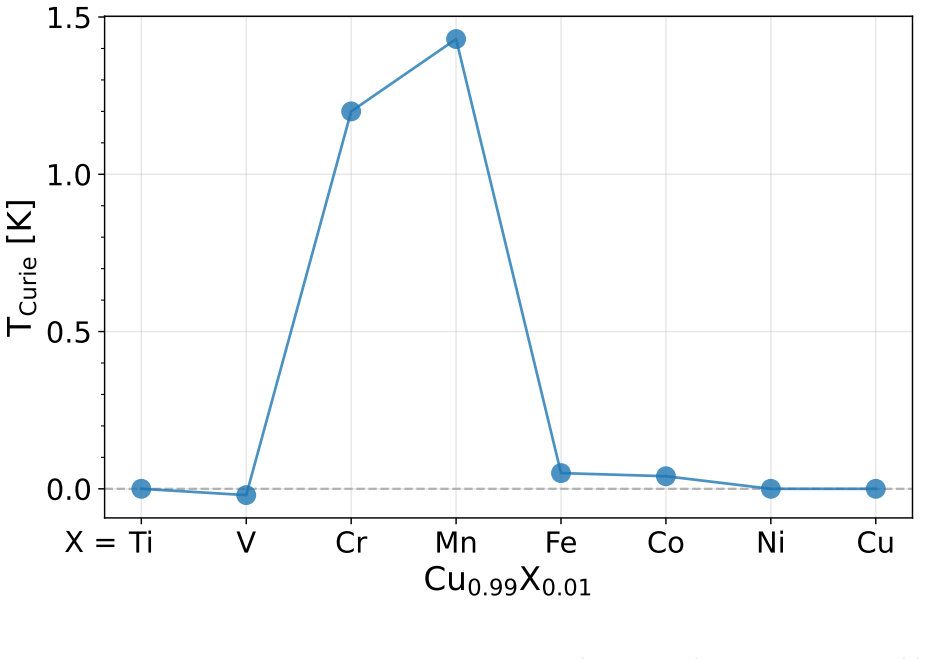
- Since Curie temperatures of all studied solutes are below 1.5 K, the DLM model is the correct ambient-temperature reference for these systems.
Reading between the lines
- If the exponent is set by the host Fermi-surface geometry rather than by the solute, the same single-point BSF-FWHM descriptor may transfer to other noble-metal hosts (Ag, Au) with a host-dependent exponent — a testable prediction.
- The anisotropy of the scattering (Σ vs Δ) suggests a directional signature: resistivity measurements on single-crystal dilute alloys along different crystallographic directions could directly probe this mechanism.
- The power-law relationship could be derived analytically from a weighted Fermi-surface average of the imaginary self-energy; if the derived exponent matches 1.89, the single-point descriptor becomes a rigorous reduction rather than a fit.
- For recycled-copper applications, the descriptor offers a practical way to rank tramp elements by their per-at.% resistivity penalty, though extension to multiple simultaneous solutes and finite concentrations still needs testing.
Editorial analysis
A structured set of objections, weighed in public.
Referee Report
Summary. The paper uses KKR-CPA with the Kubo–Greenwood formalism to compute the resistivity increase δρ per 1 at.% of 3d solutes (Ti–Ni) in Cu, in three magnetic states: paramagnetic DLM, ferromagnetic (FM), and nonmagnetic (NM). It reports that only the DLM state reproduces the room-temperature experimental element trends, that the solute d-state partial DOS at E_F is a poor descriptor (R²≈0.36), and that the FWHM of the Bloch spectral function at the Σ-line Fermi-surface crossing correlates strongly with δρ (R²≈0.97) with a common power-law exponent β≈1.89 across the three magnetic states. The authors conclude that the resistivity is governed by disorder-induced band broadening in momentum space along the nearest-neighbor ⟨110⟩ direction, offering a microscopic interpretation of the breakdown of Linde's rule.
Significance. If the central claim holds, the Σ-line BSF FWHM would be a computationally cheap and physically transparent descriptor for impurity resistivity in dilute Cu alloys, with direct relevance to alloy design and recycling. The study is valuable for its explicit comparison of DLM, FM, and NM states, its reproduction of the experimental trend in DLM, and its negative control showing that pDOS at E_F does not correlate. The calculations use standard, well-tested methodology and the reported correlation is strong. However, the mechanistic conclusion is currently an interpretation of a single high-symmetry-point correlation: the Kubo–Greenwood formula is a Fermi-surface integral, and the paper itself acknowledges that a single-point FWHM does not capture that integration measure. The exponent is fitted, not derived, and no transport-weighted test establishes that the Σ neighborhood dominates the integral. The significance is therefore conditional; the paper opens a promising direction but does not yet close the gap between correlation and causation.
major comments (3)
- [Sec. III.F / Fig. 9] The central claim that the Σ-line BSF FWHM 'governs' the Kubo–Greenwood resistivity is not tested against the transport-weighted Fermi-surface integral. As the paper itself states, 'The FWHM of the BSF evaluated at a single representative point on the Σ line therefore does not capture the full integration measure: the Fermi-surface curvature, the anisotropy of the velocity field, and the k-dependent variation of the spectral broadening all contribute.' The failure of the Δ-line FWHM to correlate is presented as evidence of nontriviality, but with a small number of high-symmetry points, selecting one that works can be post hoc. Please provide a direct test: compute the k-resolved integrand of the Kubo–Greenwood formula (or a velocity- and curvature-weighted average of the BSF broadening) and show that the Σ neighborhood indeed dominates, or select the representative point by a pre-specifi
- [Sec. III.F / Fig. 9, fitted exponent] The power-law exponent β=1.89 is obtained by fitting a common slope to log–log data; it is not derived from the Kubo–Greenwood integral or from an underlying scattering model. The explanation that the non-unity exponent encodes the host Fermi-surface geometry is plausible but unsupported; a single-point FWHM should first be shown to map onto the integrated transport scattering rate with a calculable exponent. I recommend adding a derivation or a numerical test in which the full k-dependent self-energy entering the Kubo–Greenwood formula is used to evaluate δρ and is then compared with the single-point FWHM scaling. As it stands, the 'common scaling' is an empirical fit, and the mechanistic language in the conclusion goes beyond what the analysis establishes.
- [Sec. III.E / III.F, choice of FWHM extraction] The FWHM is extracted from a Lorentzian fit in the direction perpendicular to the local tangent of the Fermi-surface arc in the Γ–X(100)–X(001) plane. The manuscript does not specify the fitting window, the number of k-points used, or the background model; nor does it show the quality of the Lorentzian fits for all elements and states. Since the correlation in Fig. 9 is the quantitative backbone of the paper, the robustness of the FWHM values against fitting details should be documented, for example in the Supplemental Material.
minor comments (6)
- [Sec. II] The sentence 'two distinct theoretical models for the paramagnetic state—DLM and NM—were compared' is inconsistent with the actual procedure, which also includes FM states. Rephrase to reflect the three magnetic configurations.
- [Fig. 2] The legend items 'Exp. (Linde)', 'Exp. (Komatsu)', etc., should be tied explicitly to reference numbers (Refs. [9], [10], [1], [11]) in the caption, and error bars or a statement about experimental uncertainty should be included if available.
- [Sec. III.A / Eq. (1)] The interpretation of a negative Curie temperature as 'suggesting an antiferromagnetic or other non-FM magnetic structure is more stable' is speculative: Eq. (1) is a mean-field expression for ferromagnetic order, so a negative value simply means the FM state is not stabilized. Soften the wording or provide additional total-energy calculations for other magnetic orderings.
- [Sec. III.E] The terminology 'FWHM along the BSF line' in Fig. 6 is potentially confusing: the text explains that the FWHM is measured perpendicular to the local tangent. Clarify in the caption and define the fitting direction quantitatively.
- [Fig. 8] For the pDOS correlation, the common-fit slope is reported with a large uncertainty (β=1.20±1.43) and negative individual R² for FM. This supports the negative conclusion, but the figure caption should state whether the same shared-slope fitting procedure was used as in Fig. 9, and the individual-state fit lines should be shown.
- [References] Ref. [23] is cited as an arXiv preprint (arXiv:2405.18709) for Kondo physics; consider citing the published version if available.
Circularity Check
No significant circularity: resistivity and BSF FWHM are distinct outputs of the same CPA calculation, and the paper's negative controls plus external benchmarks make the claimed correlation non-tautological.
full rationale
The central claim is that the impurity resistivity correlates with the FWHM of the Bloch spectral function on the Σ line, rather than with the solute d-state pDOS at the Fermi level. Both quantities are indeed outputs of the same KKR-CPA Green's function, so some built-in coupling is expected. However, the paper does not present the FWHM as a fitted substitute for the Kubo-Greenwood resistivity: the resistivity is computed directly from the Kubo-Greenwood formula with vertex corrections, while the BSF FWHM is a separate, local momentum-space quantity extracted from Lorentzian fits. The paper explicitly acknowledges the nontrivial relationship: 'the FWHM of the BSF and the Kubo-Greenwood resistivity are not trivially related, despite both being derived from the CPA Green's function' and further notes that the FWHM on the Δ line does not reproduce the correlation, serving as a negative control. The pDOS correlation is also poor (R² = 0.355 overall), so the central negative claim is not tautological. The fitted exponent β ≈ 1.89 is a post hoc fit, not an independent prediction, but the paper does not disguise it as one; it is presented as a scaling law. The self-citation to Ref. 11 is used only for lattice constants and experimental resistivity data, not as a load-bearing theoretical premise. The main weakness is that the Σ-line point may be selected post hoc, and the paper's own Sec. III.F admits that a single k-point 'does not capture the full integration measure.' That is an interpretive and generality concern, not circularity. External benchmarks strengthen independence: the DLM calculations reproduce room-temperature experimental trends, and the NM calculations agree with the low-temperature Mertig calculations. Overall, no circular step meeting the required standard is identified; the paper is largely self-contained against external data, and the correlation claim has independent content.
Assumptions & free parameters
free parameters (1)
- Power-law exponent β =
1.89 ± 0.20
assumptions (7)
- domain assumption The room-temperature paramagnetic state is correctly described by the disordered local moment picture for all solutes, with Kondo screening either negligible or already reflected in zero converged moments.
- domain assumption KKR-CPA with the single-site coherent potential approximation and vertex-corrected Kubo-Greenwood gives quantitatively reliable resistivities for 1 at.% alloys.
- ad hoc to paper The FWHM of the BSF at the Σ line is a sufficient proxy for the k-integrated scattering rate in the Kubo-Greenwood formula.
- domain assumption PBE-GGA exchange-correlation is accurate enough for these transport properties.
- domain assumption Matthiessen's rule holds so T=0 residual resistivity explains the 300 K resistivity increase.
- standard math The mean-field Curie temperature estimate in Eq. (1) correctly identifies the paramagnetic regime.
- domain assumption The lattice constant 3.6342 Å and Debye temperatures taken from Ref. 11 are valid for all Cu0.99X0.01 alloys.
Cite this review
Pith. "Pith review of Resistivity in Dilute Cu-3d Alloys Governed by Disorder-Induced Band Broadening." pith.science (2026). https://pith.science/paper/UVRQYBD4
@misc{pith2026260713419,
  author       = {Pith},
  title        = {Pith review of: Resistivity in Dilute Cu-3d Alloys Governed by Disorder-Induced Band Broadening},
  year         = {2026},
  howpublished = {\url{https://pith.science/paper/UVRQYBD4}},
  note         = {Machine review of arXiv:2607.13419}
}
read the original abstract
The mechanism governing the resistivity in dilute Cu-3d transition-metal alloys at ambient temperature -- the regime relevant to most practical applications and distinct from the low-temperature, Kondo-screened regime addressed by earlier theoretical work -- is investigated using first-principles calculations based on the Korringa--Kohn--Rostoker coherent potential approximation combined with the Kubo--Greenwood formalism. The paramagnetic state is described within the disordered local moment (DLM) framework, corresponding to a local-moment paramagnet rather than a Pauli paramagnet. We show that the experimentally observed resistivity trends are reproduced only within the DLM description, while nonmagnetic and ferromagnetic states fail to capture the correct element dependence. Contrary to conventional interpretations based on the density of states at the Fermi level, the resistivity exhibits a strong correlation with the full width at half maximum (FWHM) of the Bloch spectral function (BSF) on the Fermi surface. This correlation reflects the disorder-induced lifetime broadening of electronic states, directly related to the scattering rate that governs electrical resistivity. A common power-law scaling between resistivity and BSF broadening is identified across different magnetic states. These results demonstrate that the resistivity is governed by disorder-induced band broadening in momentum space rather than by local density-of-states effects, providing a unified microscopic interpretation of the breakdown of Linde's rule in Cu-based alloys.
Figures


Figures from the paper (6 more)


Reference graph
Works this paper leans on
-
[1]
J. R. Davis, ed.,ASM Specialty Handbook: Copper and Copper Alloys(ASM International, Materials Park, OH, 2001)
2001
-
[2]
Loibl and L
A. Loibl and L. A. Tercero Espinoza, Resour. Conserv. Recycl.169, 105462 (2021)
2021
-
[3]
Matthiessen and C
A. Matthiessen and C. Vogt, Philos. Trans. R. Soc. London154, 167 (1864)
-
[4]
Nordheim, Ann
L. Nordheim, Ann. Phys.9, 607 (1931)
1931
-
[5]
A. L. Norbury, Trans. Faraday Soc.16, 570 (1921)
1921
-
[6]
J. O. Linde, Ann. Phys.10, 52 (1931)
1931
-
[7]
K. Maki, Y. Ito, H. Matsunaga, and H. Mori, Scr. Mater.68, 777 (2013)
2013
-
[8]
Y. Ito, H. Matsunaga, H. Mori, and K. Maki, Mater. Trans.55, 1738 (2014)
2014
Show all 39 references
-
[9]
J. O. Linde, Helv. Phys. Acta41, 1007 (1968)
1968
-
[10]
Komatsu, J
S. Komatsu, J. Jpn. Res. Inst. Adv. Copper-base Mater. Tech.41, 1 (2002)
2002
-
[11]
Yamaguchi, T
K. Yamaguchi, T. Ishigaki, Y. Inoue, S. Arisawa, H. Matsunoshita, Y. Ito, H. Mori, K. Suehiro, K. Maki, K. Nagata, and M. Demura, Sci. Technol. Adv. Mater.: Methods3, 2250704 (2023)
2023
-
[12]
Korringa, Physica13, 392 (1947)
J. Korringa, Physica13, 392 (1947)
1947
-
[13]
Kohn and N
W. Kohn and N. Rostoker, Phys. Rev.94, 1111 (1954)
1954
-
[14]
Soven, Phys
P. Soven, Phys. Rev.156, 809 (1967)
1967
-
[15]
Akai and J
H. Akai and J. Kanamori, J. Phys. Soc. Jpn.51, 1176 (1982)
1982
-
[16]
P. R. Tulip, J. B. Staunton, S. Lowitzer, D. K¨ odderitzsch, and H. Ebert, Phys. Rev. B77, 165116 (2008)
2008
-
[17]
R. Kubo, J. Phys. Soc. Jpn.12, 570 (1957)
1957
-
[18]
D. A. Greenwood, Proc. Phys. Soc.71, 585 (1958). 19
1958
-
[19]
Mertig, E
I. Mertig, E. Mrosan, and R. Sch¨ opke, J. Phys. F: Met. Phys.12, 1689 (1982)
1982
-
[20]
Mertig, Rep
I. Mertig, Rep. Prog. Phys.62, 237 (1999)
1999
-
[21]
Kondo, Prog
J. Kondo, Prog. Theor. Phys.32, 37 (1964)
1964
-
[22]
D. J. Daybell and W. A. Steyert, Rev. Mod. Phys.40, 380 (1968)
1968
-
[23]
T. Zhu, L. Peng, H. Zhai, Z.-H. Cui, and G. K.-L. Chan, arXiv:2405.18709 (2024)
2024 arXiv
-
[24]
Oguchi, K
T. Oguchi, K. Terakura, and N. Hamada, J. Phys. F: Met. Phys.13, 145 (1983)
1983
-
[25]
B. L. Gyorffy, A. J. Pindor, J. Staunton, G. M. Stocks, and H. Winter, J. Phys. F: Met. Phys. 15, 1337 (1985)
1985
-
[26]
Gomi and T
H. Gomi and T. Yoshino, Front. Earth Sci.6, 217 (2018)
2018
-
[27]
G. Wang, E. I. Simakov, and D. Perez, Appl. Phys. Lett.120, 134101 (2022)
2022
-
[28]
Friedel, Can
J. Friedel, Can. J. Phys.34, 1190 (1956)
1956
-
[29]
J. S. Faulkner and G. M. Stocks, Phys. Rev. B21, 3222 (1980)
1980
-
[30]
Ebertet al., The Munich SPR-KKR package, version 7.7.3,http://ebert.cup
H. Ebertet al., The Munich SPR-KKR package, version 7.7.3,http://ebert.cup. uni-muenchen.de/SPRKKR
-
[31]
Ebert, D
H. Ebert, D. K¨ odderitzsch, and J. Min´ ar, Rep. Prog. Phys.74, 096501 (2011)
2011
-
[32]
Hohenberg and W
P. Hohenberg and W. Kohn, Phys. Rev.136, B864 (1964)
1964
-
[33]
Kohn and L
W. Kohn and L. J. Sham, Phys. Rev.140, A1133 (1965)
1965
-
[34]
J. P. Perdew, K. Burke, and M. Ernzerhof, Phys. Rev. Lett.77, 3865 (1996)
1996
-
[35]
K. Sato, P. H. Dederichs, and H. Katayama-Yoshida, Europhys. Lett.61, 403 (2003)
2003
-
[36]
Hellwege and J
K.-H. Hellwege and J. L. Olsen, eds.,Metals: Electronic Transport Phenomena, Landolt- B¨ ornstein, New Series, Group III, Vol. 15a (Springer, Berlin, 1982)
1982
-
[37]
Kurosaka, H
A. Kurosaka, H. Tominaga, T. Takayama, and H. Osanai, inAdvances in Cryogenic Engineer- ing Materials, An International Cryogenic Materials Conference Publication, Vol. 36, edited by R. P. Reed and F. R. Fickett (Springer, Boston, MA, 1990) pp. 749–754
1990
-
[38]
Li and T
R. Li and T. Hashimoto, inProceedings of the Twelfth International Cryogenic Engineering Conference, Vol. 1 (1988) pp. 414–417
1988
-
[39]
Mimura, Y
K. Mimura, Y. Ishikawa, M. Isshiki, and M. Kato, Mater. Trans., JIM38, 714 (1997). 20
1997
Reviewed August 2, 2026 · model on record in the stance chip above.
Discussion (0). Sign in to comment.