REVIEW 3 major objections 5 minor 52 references
Rotation topological states: theory and material realization
T0 review · 3 major / 5 minor · reviewed 2026-08-02 · deepseek-v4-flash
Pith's one-line read A material the standard toolkit calls trivial can still carry hidden topology, provided you sort its electron bands by rotation eigenvalue first: cesium chloride realizes this with double Weyl surface points.
desk verdict Clean parity-counting idea, plausible T-pairing argument, but the CsCl surface prediction rests on an unproven subspace bulk-boundary correspondence. read the letter →
The pith
A machine-rendered reading of the paper's core claim, the machinery that carries it, and where it could break.
The reading
What carries the argument
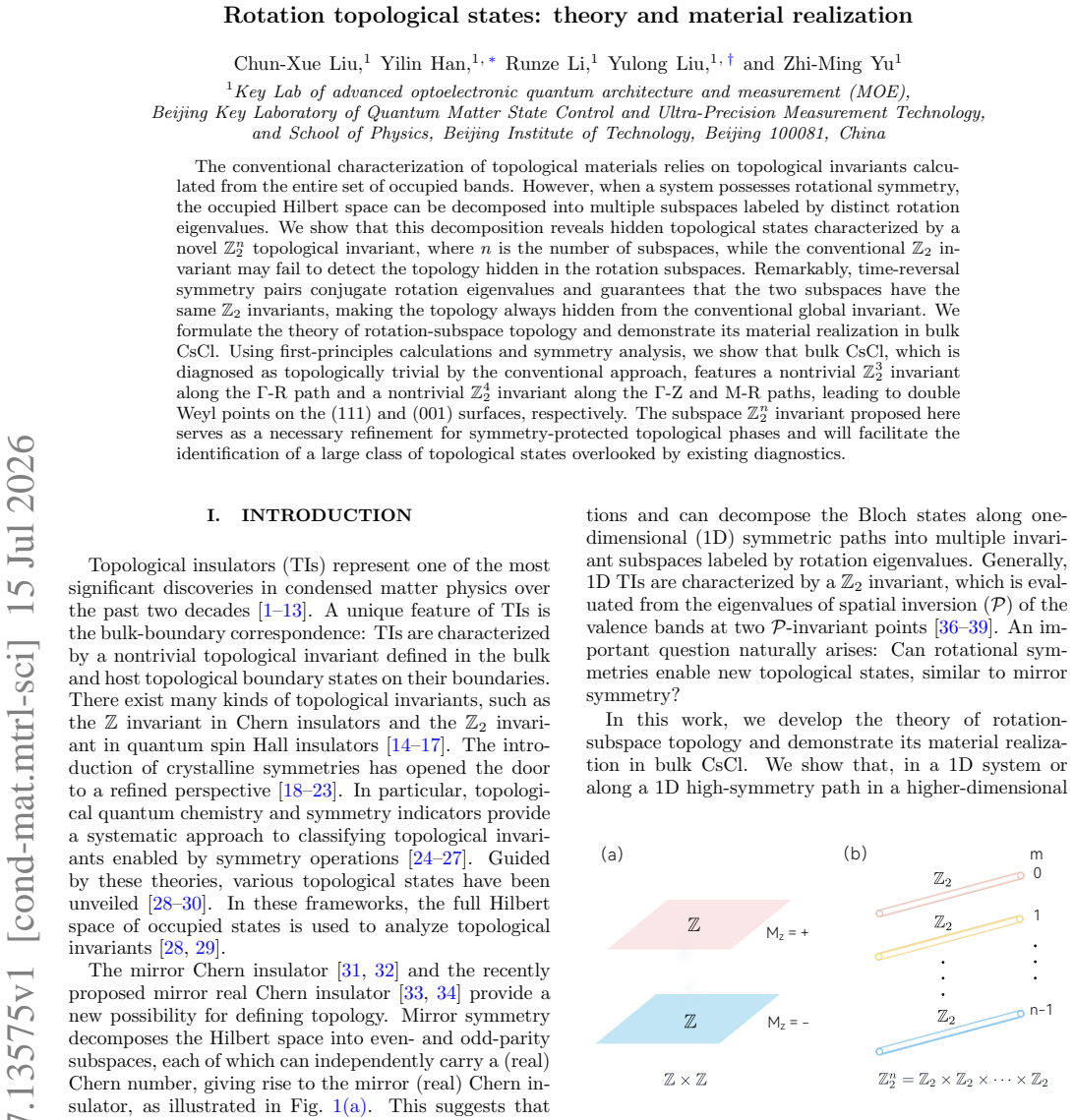
The key object is the subspace-resolved parity invariant: for the m-th rotation subspace on a 1D high-symmetry path, ν_m counts (mod 2) the number of valence-band states with negative inversion eigenvalue at the two P-invariant points of that path. Stacking these invariants for m = 0,1,…,n−1 gives the Z2^n classification. The load-bearing relation is the time-reversal pairing ν_m = ν_{n−m}, which forces nontrivial subspaces to come in pairs and makes the global invariant Σ_m ν_m mod 2 identically zero whenever any m ≠ 0, n/2 subspace is nontrivial. The subspace bulk-boundary correspondence then assigns one protected boundary state to each nontrivial subspace at the Cn-invariant surface point
What would settle it
Angle-resolved photoemission on cleaved CsCl (111) and (001) surfaces: absence of the predicted two-fold-degenerate quadratic surface states at Γ̄ and M̄ — or a tight-binding surface calculation including rotation-subspace coupling that gaps those states — would falsify the subspace bulk-boundary correspondence and the material prediction.
Extended reading notes
Core claim
The central claim is that rotation symmetry enables a refined, subspace-resolved topological classification that the conventional global Z2 invariant cannot see. Along a path invariant under an n-fold rotation, the occupied bands decompose into n subspaces labeled by rotation eigenvalues e^{2πim/n}; each subspace has its own Z2 invariant ν_m, computed from parity eigenvalues at the two P-invariant points of that path, so the overall classification is Z2^n. The global invariant is the product of the subspace invariants, i.e. ν_global = Σ_m ν_m mod 2, so any even number of nontrivial subspaces yields ν_global = 0. Time-reversal symmetry pairs the m and n−m subspaces and, because T preserves pa
Load-bearing premise
The subspace bulk-boundary correspondence — that each nontrivial 1D rotation-subspace invariant guarantees one protected boundary state even though the global invariant is trivial — is asserted rather than derived from a full classification; if inter-subspace coupling on the surface or level repulsion from nearby bulk bands destroys those modes, the predicted double Weyl points vanish.
Editorial extensions
If this is right
- Any rotation-symmetric insulator with an even number of nontrivial subspaces is systematically mislabeled trivial by standard Z2 and symmetry-indicator diagnostics, so existing topological-material catalogs may contain overlooked hidden-topology candidates.
- Within the paper's own argument, bulk CsCl is a concrete, experimentally synthesized material predicted to host surface double Weyl points at Γ̄ on (111) and at Γ̄ and M̄ on (001), observable by angle-resolved photoemission.
- The subspace bulk-boundary correspondence predicts that breaking the C3 or C4 rotation should lift the two-fold degeneracy at those surface points and gap the surface states, providing a direct symmetry test of the topological origin.
- The M̄ double Weyl point coexists with bulk bands but is stabilized by C4 eigenvalue separation, meaning surface states can be symmetry-isolated from bulk projections even when not inside the global gap.
- Because the construction works along any rotation-symmetric path, the framework applies broadly to crystals with C3, C4, C6, or other n-fold rotations, extending the mirror-subspace logic of mirror Chern insulators to a larger class of symmetries.
Reading between the lines
- The argument likely extends to spinful systems with spin-orbit coupling, where time-reversal still pairs conjugate rotation subspaces; the paper states this extension is straightforward but does not carry it out, so subspace-resolved screening of known 'trivial' insulators with heavy elements is a natural next step.
- The hidden topology here is 1D-in-character: each nontrivial path produces boundary states only at a single surface point rather than a full 3D bulk phase. This suggests the phenomenon is closer to weak or fragile topology than to a strong invariant, an interpretation the paper leaves open.
- High-throughput topological-materials databases built on global symmetry indicators cannot see this class, so a re-analysis of rotation-symmetric insulators with subspace-resolved parity counting could uncover many more double Weyl surface points, possibly relevant to surface catalysis due to the higher density of states of a quadratic degeneracy.
Signed reviews
Editorial analysis
A structured set of objections, weighed in public.
Referee Report
Summary. The paper proposes a rotation-subspace topological classification for band insulators. Along a C_n-invariant 1D path, the occupied Hilbert space decomposes into n subspaces labeled by rotation eigenvalues, and the paper assigns each subspace an independent Z_2 invariant ν_m computed from inversion parity eigenvalues at the two endpoints (Eq. 3). The conventional global Z_2 is then the sum of the subspace invariants modulo 2 (Eqs. 4–5). The central formal claim is that time-reversal symmetry forces ν_m = ν_{n-m} for m ≠ 0, n/2 (Eq. 6), so a nontrivial pair of T-related subspaces always cancels in the global invariant, making the topology invisible to conventional diagnostics. The paper further postulates a 'subspace bulk-boundary correspondence' (Sec. II.C): each nontrivial subspace contributes one protected boundary state at the C_n-invariant surface point, so T-paired nontrivial subspaces produce a doubly degenerate surface double Weyl point. This framework is applied to bulk CsCl (space group Pm-3m, No. 221). Using DFT without spin-orbit coupling, the authors find Z_2^3 = (0,1,1) along Γ-R under C_3 and Z_2^4 = (0,1,0,1) along Γ-Z and M-R under C_4, while the global Z_2 is trivial. Surface calculations for the (111) and (001) surfaces show quadratic surface band crossings at the expected surface points, which are identified as double Weyl points.
Significance. If the central claim holds, the paper identifies a genuine blind spot in standard global-invariant diagnostics: for any spinless system with C_n symmetry and time reversal, a T-paired pair of nontrivial rotation subspaces is invisible to the conventional Z_2 invariant. This is a clean and potentially widely applicable observation, and the proposed Z_2^n refinement is a natural extension of mirror Chern number logic. The specific prediction for CsCl—a known, simple, experimentally synthesized material—is falsifiable by ARPES, and the paper ships concrete first-principles surface spectra and k·p models. The strengths are the transparent parity-counting derivation of Eqs. (3)–(5), the T-pairing argument of Eq. (6), and the independent verification of surface states from the Wannier model. However, the material realization rests on an unproven subspace bulk-boundary correspondence and on ignoring spin-orbit coupling for a heavy element (Cs), so the significance is conditional on those gaps being filled.
major comments (3)
- [Sec. II.C] The subspace bulk-boundary correspondence is asserted, not derived. The paragraph states that 'the standard bulk-boundary correspondence naturally extends to the subspace level' and that each subspace with ν_m=1 contributes one protected boundary state at the surface point. This is the step that turns the parity product of Eq. (3) into the predicted double Weyl points. For an isolated 1D inversion-symmetric insulator, the parity product at the two P-invariant endpoints gives a Z_2 polarization/Zak phase; it does not by itself guarantee a bound state in the gap without additional conditions. Here the 1D path is only a submanifold of a 3D BZ, and the surface point receives Bloch states from a 2D set of momenta. A nontrivial line invariant therefore does not automatically force a surface eigenstate. The numerical slab spectra in Figs. 3(c) and 4(c) could be finite-size surface resonances. T
- [Sec. III.B, SOC neglect] The material realization is computed entirely without spin-orbit coupling, yet Cs is a heavy element (Z=55) and CsCl has significant core SOC. The paper states that 'the low-energy bands remain almost unchanged upon the inclusion of spin-orbit coupling' (Fig. 2d), but no subspace-resolved parity analysis with SOC is given. The spinless C_n eigenvalues and the T-pairing argument in Sec. II.B are extended to spinful systems only by a single sentence ('the extension ... is straightforward'), and the actual C_n eigenvalues for spinors (e.g., e^{iπm/n} with m half-integer) are not used. Since the central claim is a material prediction, the authors must show that the subspace invariants (ν_0, ν_1, ν_2) and (ν_0, ν_1, ν_2, ν_3) are stable when SOC is included, or at least provide the spinful version of the invariants for the specific paths in CsCl.
- [Sec. III.B.2, ¯M-point DWP] The paper itself concedes that the ¯M-point double Weyl point lies below E_F and coexists with the bulk continuum from the m=2 subspace. The subspace bulk-boundary correspondence is said to protect boundary states within the subspace gap, not the global gap. At ¯M, the m=2 bulk states project onto the same surface momentum, so the protection of the surface state against hybridization with these bulk states is not established; the claim that 'hybridization ... is forbidden by C_4 rotational symmetry' is only argued by the different C_4 eigenvalues of the surface and bulk states, but the surface state at ¯M may couple to bulk states with the same C_4 eigenvalue or to other surface resonances. This makes the predicted DWP at ¯M less decisive as evidence for the subspace BBC. The authors should either compute the thickness dependence of the ¯M feature, show that it remains a genuine surface
minor comments (5)
- [Eqs. (3)–(5)] The notation n_{k=0}^m and n_{k=π}^m is not defined precisely in the text; it should state that these are numbers of occupied valence states with negative inversion eigenvalue in the m-th rotation subspace at the two inversion-invariant momenta. Also, for spinful systems the rotation eigenvalues in Eq. (1) need the phase convention for spinors; please clarify.
- [Fig. 2] The panel labels in Fig. 2 are partially duplicated ('Energy (eV)' appears twice), and the color scales in Figs. 3(c,d) and 4(c,d) are not clearly labeled (units of k, color bar meaning). This makes the surface spectra hard to evaluate.
- [Sec. III.A] The Wannier-function construction is described only briefly. Please report the number of Wannier orbitals, the projection centers, and the maximal spread; this is needed to assess the accuracy of the surface-state calculation.
- [Sec. IV] The statement that 'any material with rotational symmetry can be analyzed within this framework' is too broad; the framework applies to a 1D C_n-invariant path with inversion at the endpoints, not to general rotational symmetry in 2D/3D. Please qualify.
- [References] The paper cites arXiv:2607.13575 as its own submission; this is fine for a preprint, but for a journal version the citation format should be updated. Also, Ref. [35] appears to be an unrelated paper on antiferroelectricity; please verify the citation intent.
Circularity Check
No construction-level circularity: the subspace invariants are computed from parity eigenvalues, the global invariant is a sum, and the surface DWP spectra are independent Wannier-based checks.
full rationale
The paper's derivation chain is self-contained and non-circular. The subspace Z2 invariants in Eq. (3) are computed directly from parity eigenvalues at P-invariant endpoints in each rotation subspace (Tables II and IV); the global invariant in Eqs. (4)-(5) is explicitly the sum of these subspace invariants, not an input. The claim that time-reversal pairs conjugate subspaces and forces equal invariants (Eq. (6)) follows from standard T transformation properties of rotation eigenvalues and parity, and is not imported from a self-citation. The k.p surface Hamiltonians in Eqs. (11) and (13) are constrained only by the symmetries C3/M110/T and C4/My/T with undetermined real coefficients, so they are not fitted to the observed DWPs. The surface DWPs themselves are obtained from separate slab calculations using the Wannier/TB model (WannierTools), i.e., an independent check from the same model, not the same quantity used as input. The paper does contain an asserted step: Sec. II.C states that the 'standard bulk-boundary correspondence naturally extends to the subspace level' and that each nontrivial subspace contributes a protected boundary state; this is not derived from a complete classification. Similarly, the paper itself notes that the M-point DWP on the (001) surface 'coexists with the bulk bands' and is protected in part by C4 symmetry. These are correctness/support limitations, not circularity: the prediction does not reduce by construction to a fitted parameter or to a self-referential citation. The references to prior work by the same group (e.g., Magnetickp [51] and the emergent-particles encyclopedia [52]) are used for standard packages/concepts and are not load-bearing for the claimed hidden topology. Therefore no circular step meeting the required evidentiary standard is present, and the score is 0.
Assumptions & free parameters
assumptions (6)
- standard math The Hamiltonian commutes with C_n along the high-symmetry path, so the occupied Hilbert space decomposes into n independent rotation subspaces [Eq. (2)].
- domain assumption At the P-invariant endpoints, T maps subspace m to n−m and preserves the inversion parity eigenvalue, giving ν_m = ν_{n−m} [Eq. (6)].
- domain assumption Each rotation subspace is a 1D inversion-symmetric insulator with a well-defined Z2 invariant from the parity formula Eq. (3).
- ad hoc to paper Subspace bulk-boundary correspondence: a nontrivial subspace Z2 contributes one protected boundary state at the corresponding surface point, even when the global Z2 is trivial.
- domain assumption PBE-DFT without spin-orbit coupling describes the low-energy band topology of CsCl.
- domain assumption The Wannier tight-binding model reproduces the DFT band structure and surface spectrum.
Cite this review
Pith. "Pith review of Rotation topological states: theory and material realization." pith.science (2026). https://pith.science/paper/GDVIE3FG
@misc{pith2026260713575,
  author       = {Pith},
  title        = {Pith review of: Rotation topological states: theory and material realization},
  year         = {2026},
  howpublished = {\url{https://pith.science/paper/GDVIE3FG}},
  note         = {Machine review of arXiv:2607.13575}
}
abstract
The conventional characterization of topological materials relies on topological invariants calculated from the entire set of occupied bands. However, when a system possesses rotational symmetry, the occupied Hilbert space can be decomposed into multiple subspaces labeled by distinct rotation eigenvalues. We show that this decomposition reveals hidden topological states characterized by a novel $\mathbb{Z}_2^n$ topological invariant, where $n$ is the number of subspaces, while the conventional $\mathbb{Z}_2$ invariant may fail to detect the topology hidden in the rotation subspaces. Remarkably, time-reversal symmetry pairs conjugate rotation eigenvalues and guarantees that the two subspaces have the same $\mathbb{Z}_2$ invariants, making the topology always hidden from the conventional global invariant. We formulate the theory of rotation-subspace topology and demonstrate its material realization in bulk CsCl. Using first-principles calculations and symmetry analysis, we show that bulk CsCl, which is diagnosed as topologically trivial by the conventional approach, features a nontrivial $\mathbb{Z}_2^3$ invariant along the $\Gamma$-R path and a nontrivial $\mathbb{Z}_2^4$ invariant along the $\Gamma$-Z and M-R paths, leading to double Weyl points on the (111) and (001) surfaces, respectively. The subspace $\mathbb{Z}_2^n$ invariant proposed here serves as a necessary refinement for symmetry-protected topological phases and will facilitate the identification of a large class of topological states overlooked by existing diagnostics.
Figures


Figures from the paper (1 more)

Reference graph
Works this paper leans on
-
[1]
M. Z. Hasan and C. L. Kane, Colloquium: Topological insulators, Rev. Mod. Phys.82, 3045 (2010)
2010
-
[2]
Qi and S.-C
X.-L. Qi and S.-C. Zhang, Topological insulators and su- perconductors, Rev. Mod. Phys.83, 1057 (2011)
2011
-
[3]
C.-K. Chiu, J. C. Y. Teo, A. P. Schnyder, and S. Ryu, Classification of topological quantum matter with sym- metries, Rev. Mod. Phys.88, 035005 (2016)
2016
-
[4]
B. Lv, T. Qian, and H. Ding, Angle-resolved photoemis- sion spectroscopy and its application to topological ma- terials, Nature Reviews Physics1, 609 (2019)
2019
-
[5]
B. A. Bernevig, T. L. Hughes, and S.-C. Zhang, Quantum spin hall effect and topological phase transition in hgte quantum wells, Science314, 1757 (2006)
2006
-
[6]
L. Fu, C. L. Kane, and E. J. Mele, Topological insulators in three dimensions, Phys. Rev. Lett.98, 106803 (2007)
2007
-
[7]
Zhang, C.-X
H. Zhang, C.-X. Liu, X.-L. Qi, X. Dai, Z. Fang, and S.- C. Zhang, Topological insulators in bi2se3, bi2te3 and sb2te3 with a single dirac cone on the surface, Nature Physics5, 438 (2009)
2009
-
[8]
J. E. Moore, The birth of topological insulators, Nature 464, 194 (2010)
2010
Show all 52 references
-
[9]
Y.-F. Zhao, R. Zhang, R. Mei, L.-J. Zhou, H. Yi, Y.-Q. Zhang, J. Yu, R. Xiao, K. Wang, N. Samarth, M. H. W. Chan, C.-X. Liu, and C.-Z. Chang, Tuning the chern number in quantum anomalous hall insulators, Nature 588, 419 (2020)
2020
-
[10]
Shumiya, M
N. Shumiya, M. S. Hossain, J.-X. Yin, Z. Wang, M. Litskevich, C. Yoon, Y. Li, Y. Yang, Y.-X. Jiang, G. Cheng, Y.-C. Lin, Q. Zhang, Z.-J. Cheng, T. A. Cochran, D. Multer, X. P. Yang, B. Casas, T.-R. Chang, T. Neupert, Z. Yuan, S. Jia, H. Lin, N. Yao, L. Bali- cas, F. Zhang, Y. ...
2022
-
[11]
T. Han, Z. Lu, Y. Yao, J. Yang, J. Seo, C. Yoon, K. Watanabe, T. Taniguchi, L. Fu, F. Zhang, and L. Ju, Large quantum anomalous hall effect in spin-orbit proximitized rhombohedral graphene, Science384, 647 (2024)
2024
-
[12]
Y. Han, C. Cui, X.-P. Li, T.-T. Zhang, Z. Zhang, Z.- M. Yu, and Y. Yao, Cornertronics in two-dimensional second-order topological insulators, Phys. Rev. Lett. 133, 176602 (2024)
2024
-
[13]
Cui, R.-W
C. Cui, R.-W. Zhang, Y. Qiu, Y. Han, Z.-M. Yu, and Y. Yao, Electric hall effect and quantum electric hall ef- fect, Phys. Rev. Lett.135, 116301 (2025)
2025
-
[14]
B. A. Bernevig and T. L. Hughes,Topological Insulators and Topological Superconductors(Princeton University Press, Princeton, 2013)
2013
-
[15]
Vanderbilt,Berry Phases in Electronic Structure Theory: Electric Polarization, Orbital Magnetization and Topological Insulators(Cambridge University Press, Cambridge, 2018)
D. Vanderbilt,Berry Phases in Electronic Structure Theory: Electric Polarization, Orbital Magnetization and Topological Insulators(Cambridge University Press, Cambridge, 2018)
2018
-
[16]
K¨ onig, S
M. K¨ onig, S. Wiedmann, C. Br¨ une, A. Roth, H. Buh- mann, L. W. Molenkamp, X. L. Qi, and S. C. Zhang, Quantum spin hall insulator state in hgte quantum wells, Science318, 766 (2007)
2007
-
[17]
B. A. Bernevig and S.-C. Zhang, Quantum spin hall ef- fect, Phys. Rev. Lett.96, 106802 (2006)
2006
-
[18]
Fu, Topological crystalline insulators, Phys
L. Fu, Topological crystalline insulators, Phys. Rev. Lett. 106, 106802 (2011)
2011
-
[19]
C. Fang, M. J. Gilbert, and B. A. Bernevig, Bulk topolog- ical invariants in noninteracting point group symmetric insulators, Phys. Rev. B86, 115112 (2012). 7
2012
-
[20]
Ando and L
Y. Ando and L. Fu, Topological crystalline insulators and topological superconductors: From concepts to materi- als, Annual Review of Condensed Matter Physics6, 361 (2015)
2015
-
[21]
Kruthoff, J
J. Kruthoff, J. de Boer, J. van Wezel, C. L. Kane, and R.-J. Slager, Topological classification of crystalline insu- lators through band structure combinatorics, Phys. Rev. X7, 041069 (2017)
2017
-
[22]
Z. Song, T. Zhang, and C. Fang, Diagnosis for nonmag- netic topological semimetals in the absence of spin-orbital coupling, Phys. Rev. X8, 031069 (2018)
2018
-
[23]
Fang and L
C. Fang and L. Fu, New classes of topological crystalline insulators having surface rotation anomaly, Science Ad- vances5, eaat2374 (2019)
2019
-
[24]
Bradlyn, L
B. Bradlyn, L. Elcoro, J. Cano, M. G. Vergniory, Z. Wang, C. Felser, M. I. Aroyo, and B. A. Bernevig, Topological quantum chemistry, Nature547, 298 (2017)
2017
-
[25]
Z. Song, T. Zhang, Z. Fang, and C. Fang, Quantitative mappings between symmetry and topology in solids, Na- ture Communications9, 3530 (2018)
2018
-
[26]
F. Tang, H. C. Po, A. Vishwanath, and X. Wan, Efficient topological materials discovery using symmetry indica- tors, Nature Physics15, 470 (2019)
2019
-
[27]
Elcoro, B
L. Elcoro, B. J. Wieder, Z. Song, Y. Xu, B. Bradlyn, and B. A. Bernevig, Magnetic topological quantum chemistry, Nature Communications12, 5965 (2021)
2021
-
[28]
M. G. Vergniory, L. Elcoro, C. Felser, N. Regnault, B. A. Bernevig, and Z. Wang, A complete catalogue of high- quality topological materials, Nature566, 480 (2019)
2019
-
[29]
Zhang, Y
T. Zhang, Y. Jiang, Z. Song, H. Huang, Y. He, Z. Fang, H. Weng, and C. Fang, Catalogue of topological elec- tronic materials, Nature566, 475 (2019)
2019
-
[30]
F. Tang, H. C. Po, A. Vishwanath, and X. Wan, Compre- hensive search for topological materials using symmetry indicators, Nature566, 486 (2019)
2019
-
[31]
J. C. Y. Teo, L. Fu, and C. L. Kane, Surface states and topological invariants in three-dimensional topolog- ical insulators: Application to Bi 1−xSbx, Phys. Rev. B 78, 045426 (2008)
2008
-
[32]
Zhang, C
R.-W. Zhang, C. Cui, Y. Wang, J. Duan, Z.-M. Yu, and Y. Yao, Quantized spin hall conductivity in altermagnetic fe2te2O with mirror-spin coupling, Phys. Rev. B113, L161115 (2026)
2026
-
[33]
J. Gong, Y. Wang, Y. Han, Z. Cheng, X. Wang, Z.-M. Yu, and Y. Yao, Hidden real topology and unusual magneto- electric responses in two-dimensional antiferromagnets, Advanced Materials36, 2402232 (2024)
2024
-
[34]
Y. Wang, C. Cui, R.-W. Zhang, X. Wang, Z.-M. Yu, G.- B. Liu, and Y. Yao, Mirror real chern insulator in two and three dimensions, Phys. Rev. B109, 195101 (2024)
2024
-
[35]
Wang, Z.-M
Y. Wang, Z.-M. Yu, C. Cui, Y. Han, T. He, W. Wu, R.-W. Zhang, S. A. Yang, and Y. Yao, Type-II antifer- roelectricity, Phys. Rev. Lett.136, 106402 (2026)
2026
-
[36]
Zak, Berry’s phase for energy bands in solids, Phys
J. Zak, Berry’s phase for energy bands in solids, Phys. Rev. Lett.62, 2747 (1989)
1989
-
[37]
Fu and C
L. Fu and C. L. Kane, Topological insulators with inver- sion symmetry, Phys. Rev. B76, 045302 (2007)
2007
-
[38]
T. L. Hughes, E. Prodan, and B. A. Bernevig, Inversion- symmetric topological insulators, Phys. Rev. B83, 245132 (2011)
2011
-
[39]
Alexandradinata, X
A. Alexandradinata, X. Dai, and B. A. Bernevig, Wilson- loop characterization of inversion-symmetric topological insulators, Phys. Rev. B89, 155114 (2014)
2014
-
[40]
Hohenberg and W
P. Hohenberg and W. Kohn, Inhomogeneous electron gas, Phys. Rev.136, B864 (1964)
1964
-
[41]
Kohn and L
W. Kohn and L. J. Sham, Self-consistent equations in- cluding exchange and correlation effects, Phys. Rev.140, A1133 (1965)
1965
-
[42]
Kresse and J
G. Kresse and J. Furthm¨ uller, Efficient iterative schemes for ab initio total-energy calculations using a plane-wave basis set, Phys. Rev. B54, 11169 (1996)
1996
-
[43]
J. P. Perdew, K. Burke, and M. Ernzerhof, Generalized gradient approximation made simple, Phys. Rev. Lett. 77, 3865 (1996)
1996
-
[44]
H. J. Monkhorst and J. D. Pack, Special points for brillouin-zone integrations, Phys. Rev. B13, 5188 (1976)
1976
-
[45]
Methfessel and A
M. Methfessel and A. T. Paxton, High-precision sampling for brillouin-zone integration in metals, Phys. Rev. B40, 3616 (1989)
1989
-
[46]
Marzari and D
N. Marzari and D. Vanderbilt, Maximally localized gen- eralized wannier functions for composite energy bands, Phys. Rev. B56, 12847 (1997)
1997
-
[47]
Souza, N
I. Souza, N. Marzari, and D. Vanderbilt, Maximally local- ized wannier functions for entangled energy bands, Phys. Rev. B65, 035109 (2001)
2001
-
[48]
A. A. Mostofi, J. R. Yates, Y.-S. Lee, I. Souza, D. Van- derbilt, and N. Marzari, wannier90: A tool for ob- taining maximally-localised wannier functions, Computer Physics Communications178, 685 (2008)
2008
-
[49]
Q. Wu, S. Zhang, H.-F. Song, M. Troyer, and A. A. Soluyanov, Wanniertools: An open-source software pack- age for novel topological materials, Computer Physics Communications224, 405 (2018)
2018
-
[50]
J. Gao, Q. Wu, C. Persson, and Z. Wang, Irvsp: To ob- tain irreducible representations of electronic states in the vasp, Computer Physics Communications261, 107760 (2021)
2021
-
[51]
Zhang, Z.-M
Z. Zhang, Z.-M. Yu, G.-B. Liu, Z. Li, S. A. Yang, and Y. Yao, Magnetickp: A package for quickly construct- ingk·pmodels of magnetic and non-magnetic crystals, Computer Physics Communications290, 108784 (2023)
2023
-
[52]
Z.-M. Yu, Z. Zhang, G.-B. Liu, W. Wu, X.-P. Li, R.-W. Zhang, S. A. Yang, and Y. Yao, Encyclopedia of emergent particles in three-dimensional crystals, Science Bulletin 67, 375 (2022)
2022
Reviewed August 2, 2026 · model on record in the stance chip above.
Discussion (0). Continue with ORCID to comment.