REVIEW 3 major objections 4 minor 99 references
A Boolean formula can be compiled into a d-DNNF circuit that exists across a cluster—each worker keeps its own fragments—and the same distributed circuit answers counting, sampling, and direct-access queries without ever being assembled in
Reviewed by Pith at T0; open to challenge. T0 means a machine referee read the full paper against a public rubric. the ladder, T0–T4 →
2026-08-02 04:35 UTC pith:W3VDEKXK
load-bearing objection The distributed compilation half is a solid, reproducible advance; the querying half is not actually tested in the regime that matters, so the abstract oversells. the 3 major comments →
A Distributed Framework for Compiling and Reasoning with d-DNNF
The pith
A machine-rendered reading of the paper's core claim, the machinery that carries it, and where it could break.
Core claim
The paper's central claim is that the communication overhead that has kept knowledge compilation single-node can be avoided by never moving circuit fragments. Each worker compiles its assigned cubes into d-DNNF fragments and persists them in a locally ordered list; the global circuit exists virtually as a deterministic OR gate over all those lists (Eq. 3). Because the cubes are pairwise inconsistent and cover the entire solution space, the reconstruction is correct, and because fragments remain local, the circuit can exceed the memory of any single node. The companion reasoner answers counting, direct access, and uniform sampling by broadcasting scalar questions, aggregating scalar answers,
What carries the argument
The key mechanism is the virtual circuit Δ = ∨_j ∨_{Σ∈L_j} Σ, a deterministic OR gate over ordered lists of local d-DNNF fragments. The Cube-and-Conquer decomposition of the formula into disjoint, exhaustive cubes is what makes this OR deterministic and correctness-preserving: every model belongs to exactly one fragment. This decomposition turns distributed compilation into a set of independent sequential compilations and reduces global reasoning to sums (counting), disjunctions (satisfiability), and index routing (direct access and uniform sampling) over the local lists.
Load-bearing premise
Uniform sampling relies on each worker's fragments covering a contiguous interval of the global model ordering; with dynamic dispatch, workers can receive non-contiguous cubes, so the routing step may not yield a uniform sample.
What would settle it
Compile a small formula with a known model set, deliberately dispatch cubes so one worker receives two non-adjacent cubes, then request a large batch of samples and compare the empirical distribution to the true uniform distribution; a significant mismatch would show the sampling guarantee fails.
If this is right
- Knowledge compilation can be scaled beyond the memory of any single machine by persisting fragments locally and never gathering the full circuit.
- The same distributed circuit supports the four standard queries—satisfiability, model counting, direct access, uniform sampling—in polynomial time, including under arbitrary conditioning.
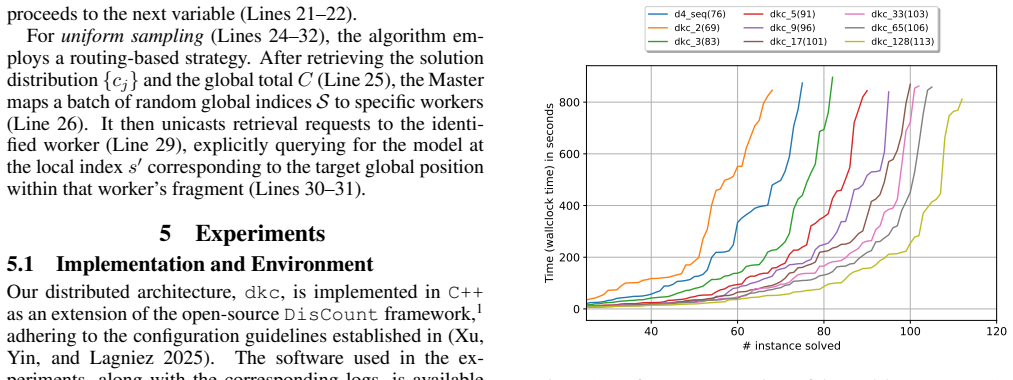
- With as few as two active workers, the distributed compiler overtakes the sequential baseline on the MC 2025 benchmark set, and with 127 workers it solves 113 instances versus 76.
- Query overhead dominates for lightweight, sub-second queries; the distributed reasoner is most beneficial when the compiled circuit is too large for one machine.
Where Pith is reading between the lines
- The uniform-sampling router assumes the models of each worker form a contiguous interval in the global order; making this assumption explicit and enforcing contiguity at cube-assignment time would turn a heuristic into a provable guarantee.
- The same virtual-circuit design—a deterministic root OR over locally stored fragments—should transplant to other compilation targets that support deterministic disjunction, such as BDDs or SDDs, giving them distributed query engines too.
- The direct-access price of one broadcast count per variable suggests a speculative prefetching protocol could cut the round-trip count; the paper lists this as future work, but a concrete bound on the resulting speedup is a natural next test.
Editorial analysis
A structured set of objections, weighed in public.
Referee Report
Summary. dkc is presented as the first distributed d-DNNF compiler. It uses Cube-and-Conquer to partition the input CNF into disjoint cubes; each worker compiles its assigned cube with d4, stores the fragment locally in an ordered list, and never ships the circuit to the Master. The global circuit is virtualized as a deterministic OR of the local fragments (Eq. 3). dreasoner then supports satisfiability, model counting, direct access, and uniform sampling, with or without conditioning, by broadcasting queries and aggregating scalar results; sampling routes a random global index to a worker via per-worker counts. Experiments on MC 2025 show that dkc with 127 workers solves 113 instances versus 76 for sequential d4. Query experiments on a subset of 200 tractable instances compare the 128-core reasoner with d4 and show mixed results, with communication overhead dominating small queries.
Significance. If the correctness and scope issues below are addressed, this is a valuable contribution. Extending Cube-and-Conquer from transient #SAT to persistent compilation avoids the circuit-fragment communication bottleneck, and the distributed query algorithms (especially counting and routing-based sampling) are natural and potentially impactful. The reported compilation scalability is substantial, and the release of code and logs is a concrete reproducibility strength. The main scientific claim about querying formulas beyond sequential reach, however, is not yet supported by the experiments as designed.
major comments (3)
- [§3.2, Eq. (3)] The equivalence ∆≡Ψ is asserted but not established for the fragment representation as described. If a worker compiles the §2.1-style conditioned formula, the literals of cube τ are replaced/simplified away, and the fragment does not entail τ. Then the OR of local fragments is generally not equivalent to Ψ over Var(Ψ). Example: Ψ=(a∨d)∧(¬b∨c), cubes {a} and {¬a}; the residual fragments are (¬b∨c) and d∧(¬b∨c), whose OR is (¬b∨c), which is not Ψ. To validate Eq. (3), each stored fragment must be compiled from the un-simplified conjunction Ψ∧τ over all variables, or each fragment must be paired/conjoined with its cube. The reasoner must also handle variables that are absent from a fragment but appear in a conditioning set γ. This issue is load-bearing for §4.
- [§5.3, Figure 4] The query evaluation is restricted to instances 'tractable for compilation' and to those solved by both d4 and dkc; 116 of 200 compile in under one second. No query timings or memory data are given for the MC 2025 instances that dkc_128 solves but d4_seq does not (37 instances). The abstract's claim that the architecture enables 'compilation and querying of complex formulas that remain beyond the reach of state-of-the-art sequential compilers' is therefore supported only for compilation. Add query experiments on at least a few dkc-only instances, with per-worker circuit sizes and peak memory, or narrow the claim.
- [§5.2, Figures 1–3] No memory measurements are reported. The motivation for the distributed representation is overcoming the single-node memory wall, yet the paper gives no per-worker fragment sizes, no aggregate virtual-circuit size, and no instance where d4_seq hits the 32 GiB limit while dkc completes. Without these, the 'beyond the reach' narrative rests on solve counts alone. Report memory data for the solved instances, particularly the dkc-only ones.
minor comments (4)
- [§4.2 / Algorithm 2] The uniform-sampling routing is correct without assuming global lexicographic contiguity of a worker's models; a uniform global index s mapped to a local index in any fixed local enumeration is uniform because each model occurs exactly once in the union of local enumerations. Please state this argument and remove the misleading emphasis on 'owns' the s-th solution and on strict order being 'crucial' for direct access.
- [§5.3] The random selection of 200 instances needs a seed and a precise procedure for reproducibility.
- [Algorithm 2, line 25] #SAT(∆∧γ) is defined as a scalar in Eq. (5); the sampling path also needs per-worker partial counts {c_j}. Specify that workers return these counts.
- [Abstract, passim] Formatting artifacts such as 'proposedkc' and 'introducedreasoner' should be fixed.
Circularity Check
No significant circularity: core correctness argument is self-contained; self-citations provide prior tools, not load-bearing premises.
full rationale
The derivation chain is not circular. Equation (3) constructs the virtual d-DNNF as the deterministic disjunction of independently compiled local fragments, and its correctness is justified directly from the Cube-and-Conquer properties of coverage and pairwise disjointness; no quantity is fitted from query data. The reasoning algorithms (Eqs. 4-5 and Algorithm 2) are standard reductions to local d-DNNF operations, and uniform sampling uses prefix sums as a fixed index-to-model bijection, so uniformity is preserved by construction. Self-citations such as DisCount, d4, and the JELIA 2025 query benchmark supply implementation scaffolding, a worker compiler, and a workload; they are not used as unverified uniqueness theorems or as smuggled ansatz. The main weakness, namely that query evaluation is only measured on instances tractable for both solvers and does not test the memory-exceeding regime, is an empirical scoping limitation, not a circular reduction.
Axiom & Free-Parameter Ledger
free parameters (1)
- nbCubes
axioms (3)
- domain assumption Cube-and-Conquer partition: cubes τ are pairwise disjoint and cover the solution space (Ψ ≡ ∨_τ (Ψ∧τ)).
- domain assumption d-DNNF fragments produced by d4 are correct and support conditioning and counting in linear time.
- ad hoc to paper Global lexicographic order of models can be recovered from per-worker counts and local indices.
Cite this review
Pith. "Pith review of A Distributed Framework for Compiling and Reasoning with d-DNNF." pith.science (2026). https://pith.science/paper/W3VDEKXK
@misc{pith2026260713642,
  author       = {Pith},
  title        = {Pith review of: A Distributed Framework for Compiling and Reasoning with d-DNNF},
  year         = {2026},
  howpublished = {\url{https://pith.science/paper/W3VDEKXK}},
  note         = {Machine review of arXiv:2607.13642}
}
read the original abstract
Knowledge Compilation (KC) is a powerful paradigm that enables efficient reasoning by transforming propositional formulas into tractable target languages, such as Deterministic, Decomposable Negation Normal Form (d-DNNF). However, as real-world problem instances grow in complexity, the offline compilation phase becomes a significant computational bottleneck, often exceeding the memory and temporal limits of single-node systems. While distributed computing has been successfully applied to model counting ($\#\mathsf{SAT}$), extending these techniques to knowledge compilation remains a challenge due to the difficulty of sharing partial circuit fragments across distributed nodes. In this paper, we propose dkc, the first distributed knowledge compiler designed for large-scale Decision-DNNF generation. Leveraging a Cube-and-Conquer strategy, dkc effectively partitions the search space into independent subproblems, mitigating the communication overhead typically associated with work-stealing architectures in circuit-based tasks. Recognizing that the utility of compilation lies in subsequent querying, we further introduce dreasoner, a distributed reasoning engine. dreasoner is capable of performing core inference tasks (including model counting, direct access, and uniform sampling) across a distributed d-DNNF structure, even under variable conditioning. Our experimental evaluation on benchmarks demonstrates that our distributed architecture scales effectively, enabling the compilation and querying of complex formulas that remain beyond the reach of state-of-the-art sequential compilers.
Figures


Reference graph
Works this paper leans on
-
[1]
Stephen A. Cook , editor =. The Complexity of Theorem-Proving Procedures , booktitle =. 1971 , url =. doi:10.1145/800157.805047 , timestamp =
arXiv 1971
-
[2]
The Thirteenth International Conference on Learning Representations,
Jaron Maene and Vincent Derkinderen and Pedro Zuidberg Dos Martires , title =. The Thirteenth International Conference on Learning Representations,. 2025 , url =
2025
-
[3]
Quentin Plazar and Mathieu Acher and Gilles Perrouin and Xavier Devroey and Maxime Cordy , title =. 12th. 2019 , url =. doi:10.1109/ICST.2019.00032 , timestamp =
arXiv 2019
-
[4]
Ruben Heradio and Hector Perez. Binary Decision Diagram Algorithms to Perform Hard Analysis Operations on Variability Models , booktitle =. 2016 , url =. doi:10.3233/978-1-61499-674-3-139 , timestamp =
-
[5]
CaDiCaL 2.0 , booktitle =
Armin Biere and Tobias Faller and Katalin Fazekas and Mathias Fleury and Nils Froleyks and Florian Pollitt , editor =. CaDiCaL 2.0 , booktitle =
-
[6]
Michael Hamann and Ben Strasser , title =
-
[7]
Definability for model counting , journal =
Jean. Definability for model counting , journal =
-
[8]
On Preprocessing Techniques and Their Impact on Propositional Model Counting , journal =
Jean. On Preprocessing Techniques and Their Impact on Propositional Model Counting , journal =
-
[9]
Chico Sundermann and Tobias He. Evaluating State-of-the-Art. Software Engineering 2024, Fachtagung des GI-Fachbereichs Softwaretechnik, Linz, Austria, February 26 - March 1, 2024 , series =. 2024 , url =. doi:10.18420/SW2024\_18 , timestamp =
-
[10]
Model Counting in Product Configuration , booktitle =
Andreas K. Model Counting in Product Configuration , booktitle =. 2010 , url =. doi:10.4204/EPTCS.29.5 , timestamp =
-
[11]
Anicet Bart and Fr. An Improved. 2016 , url =. doi:10.3233/978-1-61499-672-9-613 , timestamp =
-
[12]
Mark Chavira and Adnan Darwiche , title =. Artif. Intell. , volume =. 2008 , url =. doi:10.1016/J.ARTINT.2007.11.002 , timestamp =
-
[13]
Jeho Oh and Paul Gazzillo and Don S. Batory , editor =. Proceedings of the 23rd International Systems and Software Product Line Conference,. 2019 , url =. doi:10.1145/3336294.3342359 , timestamp =
arXiv 2019
-
[14]
Meel and Prateek Saxena , title =
Teodora Baluta and Zheng Leong Chua and Kuldeep S. Meel and Prateek Saxena , title =. 43rd. 2021 , url =. doi:10.1109/ICSE43902.2021.00039 , timestamp =
arXiv 2021
-
[15]
Alistair Sinclair and Mark Jerrum , title =. Inf. Comput. , volume =. 1989 , url =. doi:10.1016/0890-5401(89)90067-9 , timestamp =
-
[16]
Computing the jth solution of a first-order query , journal =
Guillaume Bagan and Arnaud Durand and Etienne Grandjean and Fr. Computing the jth solution of a first-order query , journal =. 2008 , url =. doi:10.1051/ITA:2007046 , timestamp =
-
[17]
Karl Bringmann and Nofar Carmeli and Stefan Mengel , title =. 2025 , url =. doi:10.1145/3707448 , timestamp =
doi:10.1145/3707448 2025
-
[18]
Gilles Audemard and Fr. On Tractable. Proceedings of the 17th International Conference on Principles of Knowledge Representation and Reasoning,. 2020 , url =. doi:10.24963/KR.2020/86 , timestamp =
-
[19]
Silviu Maniu and Pierre Senellart , editor =. Database Theory in Action: Making Provenance and Probabilistic Database Theory Work in Practice (Invited Talk) , booktitle =. 2025 , url =. doi:10.4230/LIPICS.ICDT.2025.33 , timestamp =
-
[20]
Pierre Senellart and Louis Jachiet and Silviu Maniu and Yann Ramusat , title =. Proc. 2018 , url =. doi:10.14778/3229863.3236253 , timestamp =
arXiv 2018
-
[21]
Green and Gregory Karvounarakis and Val Tannen , editor =
Todd J. Green and Gregory Karvounarakis and Val Tannen , editor =. Provenance semirings , booktitle =. 2007 , url =. doi:10.1145/1265530.1265535 , timestamp =
arXiv 2007
-
[22]
Reasoning on Feature Models: Compilation-Based vs. Direct Approaches
Pierre Bourhis and Laurence Duchien and J. Reasoning on Feature Models: Compilation-Based vs. Direct Approaches , journal =. 2023 , url =. doi:10.48550/ARXIV.2302.06867 , eprinttype =. 2302.06867 , timestamp =
work page internal anchor Pith review Pith/arXiv arXiv doi:10.48550/arxiv.2302.06867 2023
-
[23]
Efficient Slicing of Feature Models via Projected d-
Chico Sundermann and Jacob Loth and Thomas Th. Efficient Slicing of Feature Models via Projected d-. Proceedings of the 39th. 2024 , url =. doi:10.1145/3691620.3695594 , timestamp =
arXiv 2024
-
[24]
Chico Sundermann and Heiko Raab and Tobias He. Reusing d-. 2024 , url =. doi:10.1145/3680465 , timestamp =
doi:10.1145/3680465 2024
-
[25]
DeepProbLog: Neural Probabilistic Logic Programming , booktitle =
Robin Manhaeve and Sebastijan Dumancic and Angelika Kimmig and Thomas Demeester and Luc De Raedt , editor =. DeepProbLog: Neural Probabilistic Logic Programming , booktitle =. 2018 , url =
2018
-
[26]
Constraint-based Vehicle Configuration:
Jean. Constraint-based Vehicle Configuration:. 22nd. 2010 , url =. doi:10.1109/ICTAI.2010.19 , timestamp =
-
[27]
New Advances in Compiling
Adnan Darwiche , editor =. New Advances in Compiling. Proceedings of the 16th Eureopean Conference on Artificial Intelligence, ECAI'2004, including Prestigious Applicants of Intelligent Systems,. 2004 , timestamp =
2004
-
[28]
Eric Lehman and Yosinori Watanabe and Joel Grodstein and Heather Harkness , title =. 1997 , url =. doi:10.1109/43.644605 , timestamp =
-
[29]
Ganai , title =
Andreas Kuehlmann and Viresh Paruthi and Florian Krohm and Malay K. Ganai , title =
-
[30]
Enhancing Query Efficiency for
Jean. Enhancing Query Efficiency for. Logics in Artificial Intelligence - 19th European Conference,. 2025 , url =. doi:10.1007/978-3-032-04590-4\_9 , timestamp =
-
[31]
Chandra and Mark N
Manuel Blum and Ashok K. Chandra and Mark N. Wegman , title =. Inf. Process. Lett. , volume =
-
[32]
Testing Equivalence Probabilistically , author =
-
[33]
Vincent Derkinderen , title =. 36th. 2024 , url =. doi:10.1109/ICTAI62512.2024.00099 , timestamp =
arXiv 2024
-
[34]
2005 , url =
FRAIGs: A Unifying Representation for Logic Synthesis and Verification , author =. 2005 , url =
2005
-
[35]
Bounded Model Checking , booktitle =
Armin Biere , editor =. Bounded Model Checking , booktitle =. 2021 , url =. doi:10.3233/FAIA201002 , timestamp =
-
[36]
2012 , isbn =
Reinhard Diestel , title =. 2012 , isbn =
2012
-
[37]
Evguenii I. Goldberg and Mukul R. Prasad and Robert K. Brayton , editor =. Using. Proceedings of the Conference on Design, Automation and Test in Europe,. 2001 , url =. doi:10.1109/DATE.2001.915010 , timestamp =
arXiv 2001
-
[38]
Learning a Propagation Complete Formula , booktitle =
Ku. Learning a Propagation Complete Formula , booktitle =. 2022 , publisher =
2022
-
[39]
Parameterized Compilation Lower Bounds for Restricted
Stefan Mengel , year =. Parameterized Compilation Lower Bounds for Restricted. 1604.06715 , archiveprefix =
- [40]
-
[41]
Claude E. Shannon , title =. Bell Syst. Tech. J. , volume =. 1949 , url =. doi:10.1002/J.1538-7305.1949.TB03624.X , timestamp =
arXiv 1949
-
[42]
Knowledge Compilation for Model Counting: Affine Decision Trees , booktitle =
Fr. Knowledge Compilation for Model Counting: Affine Decision Trees , booktitle =. 2013 , url =
2013
-
[43]
Umut Oztok and Adnan Darwiche , editor =. On Compiling. Principles and Practice of Constraint Programming - 20th International Conference,. 2014 , url =. doi:10.1007/978-3-319-10428-7\_7 , timestamp =
-
[44]
Umut Oztok and Adnan Darwiche , editor =. CV-width:. 2014 , url =. doi:10.3233/978-1-61499-419-0-675 , timestamp =
-
[45]
Cliquewidth and Knowledge Compilation , booktitle =
Igor Razgon and Justyna Petke , editor =. Cliquewidth and Knowledge Compilation , booktitle =. 2013 , url =. doi:10.1007/978-3-642-39071-5\_25 , timestamp =
-
[46]
Adnan Darwiche , title =. J. Appl. Non Class. Logics , volume =. 2001 , url =. doi:10.3166/JANCL.11.11-34 , timestamp =
-
[47]
David A. Plaisted , editor =. History and Prospects for First-Order Automated Deduction , booktitle =. 2015 , url =. doi:10.1007/978-3-319-21401-6\_1 , timestamp =
-
[48]
Knowledge Compilation Meets Communication Complexity , booktitle =
Simone Bova and Florent Capelli and Stefan Mengel and Friedrich Slivovsky , editor =. Knowledge Compilation Meets Communication Complexity , booktitle =. 2016 , url =
2016
-
[49]
Paul Beame and Jerry Li and Sudeepa Roy and Dan Suciu , title =. 2017 , url =. doi:10.1145/2984632 , timestamp =
-
[50]
Florent Capelli , title =. 32nd Annual. 2017 , url =. doi:10.1109/LICS.2017.8005121 , timestamp =
arXiv 2017
-
[51]
Simone Bova and Florent Capelli and Stefan Mengel and Friedrich Slivovsky , editor =. On Compiling. Theory and Applications of Satisfiability Testing -. 2015 , url =. doi:10.1007/978-3-319-24318-4\_15 , timestamp =
-
[52]
Florent Capelli and Stefan Mengel , editor =. Tractable. 36th International Symposium on Theoretical Aspects of Computer Science,. 2019 , url =. doi:10.4230/LIPICS.STACS.2019.18 , timestamp =
-
[53]
Giuseppe Marra and Sebastijan Dumancic and Robin Manhaeve and Luc De Raedt , title =. Artif. Intell. , volume =. 2024 , url =. doi:10.1016/J.ARTINT.2023.104062 , timestamp =
arXiv 2024
-
[54]
Adnan Darwiche , title =. 38th Annual. 2023 , url =. doi:10.1109/LICS56636.2023.10175757 , timestamp =
arXiv 2023
-
[55]
Simone Bova and Florent Capelli and Stefan Mengel and Friedrich Slivovsky , title =. CoRR , volume =. 2014 , url =. 1411.1995 , timestamp =
Pith/arXiv arXiv 2014
-
[56]
Cooper and Nicholas Asher and Jo
Xuanxiang Huang and Yacine Izza and Alexey Ignatiev and Martin C. Cooper and Nicholas Asher and Jo. Efficient Explanations for Knowledge Compilation Languages , journal =. 2021 , url =. 2107.01654 , timestamp =
Pith/arXiv arXiv 2021
-
[57]
Semantic Loss Functions for Neuro-Symbolic Structured Prediction , booktitle =
Kareem Ahmed and Stefano Teso and Paolo Morettin and Luca Di Liello and Pierfrancesco Ardino and Jacopo Gobbi and Yitao Liang and Eric Wang and Kai. Semantic Loss Functions for Neuro-Symbolic Structured Prediction , booktitle =. 2023 , url =. doi:10.3233/FAIA230154 , timestamp =
-
[58]
Solving PP\(
Umut Oztok and Arthur Choi and Adnan Darwiche , editor =. Solving PP\(. Principles of Knowledge Representation and Reasoning: Proceedings of the Fifteenth International Conference,. 2016 , url =
2016
-
[59]
Adnan Darwiche , title =. Commun. 2010 , url =. doi:10.1145/1859204.1859227 , timestamp =
arXiv 2010
-
[60]
Leslie G. Valiant , title =. Theor. Comput. Sci. , volume =. 1979 , url =. doi:10.1016/0304-3975(79)90044-6 , timestamp =
-
[61]
Knowledge Compilation Languages as Proof Systems , booktitle =
Florent Capelli , editor =. Knowledge Compilation Languages as Proof Systems , booktitle =. 2019 , url =. doi:10.1007/978-3-030-24258-9\_6 , timestamp =
-
[62]
Florent Capelli and Jean. Certifying Top-Down Decision-. Thirty-Fifth. 2021 , url =. doi:10.1609/AAAI.V35I7.16776 , timestamp =
-
[63]
Certified Knowledge Compilation with Application to Formally Verified Model Counting
Randal E. Bryant and Wojciech Nawrocki and Jeremy Avigad and Marijn J. H. Heule , title =. CoRR , volume =. 2025 , url =. doi:10.48550/ARXIV.2501.12906 , eprinttype =. 2501.12906 , timestamp =
work page internal anchor Pith review Pith/arXiv arXiv doi:10.48550/arxiv.2501.12906 2025
-
[64]
Feng Lu and Li. A Circuit. 2003 Design, Automation and Test in Europe Conference and Exposition. 2003 , url =. doi:10.1109/DATE.2003.10018 , timestamp =
Pith/arXiv arXiv 2003
-
[65]
Seinosuke Toda , title =. 1991 , url =. doi:10.1137/0220053 , timestamp =
doi:10.1137/0220053 1991
-
[66]
2004 International Conference on Computer-Aided Design,
Andreas Kuehlmann , title =. 2004 International Conference on Computer-Aided Design,. 2004 , url =. doi:10.1109/ICCAD.2004.1382542 , timestamp =
Pith/arXiv arXiv 2004
-
[67]
Christian J. Muise and Sheila A. McIlraith and J. Christopher Beck and Eric I. Hsu , editor =. Dsharp: Fast. Advances in Artificial Intelligence - 25th Canadian Conference on Artificial Intelligence, Canadian. 2012 , url =. doi:10.1007/978-3-642-30353-1\_36 , timestamp =
-
[68]
Knowledge Compilation and More with
Rafael Kiesel and Thomas Eiter , editor =. Knowledge Compilation and More with. Proceedings of the 20th International Conference on Principles of Knowledge Representation and Reasoning,. 2023 , url =. doi:10.24963/KR.2023/40 , timestamp =
-
[69]
Neha Rungta , editor =. A Billion. Computer Aided Verification - 34th International Conference,. 2022 , url =. doi:10.1007/978-3-031-13185-1\_1 , timestamp =
-
[70]
2013 , eprint =
Lower Bounds for Exact Model Counting and Applications in Probabilistic Databases , author =. 2013 , eprint =
2013
-
[71]
Natural Proofs , journal =. 1997 , issn =. doi:https://doi.org/10.1006/jcss.1997.1494 , url =
arXiv 1997
-
[72]
2021 , eprint =
Learning with distributional inverters , author =. 2021 , eprint =
2021
-
[73]
Carmosino and Russell Impagliazzo and Valentine Kabanets and Antonina Kolokolova , editor =
Marco L. Carmosino and Russell Impagliazzo and Valentine Kabanets and Antonina Kolokolova , editor =. Learning Algorithms from Natural Proofs , booktitle =. 2016 , url =. doi:10.4230/LIPICS.CCC.2016.10 , timestamp =
-
[74]
Rahul Ilango and Bruno Loff and Igor C. Oliveira , editor =. NP-Hardness of Circuit Minimization for Multi-Output Functions , booktitle =. 2020 , url =. doi:10.4230/LIPICS.CCC.2020.22 , timestamp =
-
[75]
Rahul Ilango , title =. 64th. 2023 , url =. doi:10.1109/FOCS57990.2023.00048 , timestamp =
arXiv 2023
-
[76]
Universal search problems , year =
Leonid Anatolevich Levin , journal =. Universal search problems , year =
-
[77]
Scott , journal =
Norman R. Scott , journal =. A new approach to the design of switching circuits , year =
-
[78]
Ashenhurst , journal =
Robert L. Ashenhurst , journal =. The decomposition of switching functions , year =
-
[79]
On the Use of Partially Ordered Decision Graphs in Knowledge Compilation and Quantified Boolean Formulae , booktitle =
H. On the Use of Partially Ordered Decision Graphs in Knowledge Compilation and Quantified Boolean Formulae , booktitle =. 2006 , url =
2006
-
[80]
Improvements to Satisfiability-Based Boolean Function Bi-Decomposition , booktitle =
Huan Chen and Jo. Improvements to Satisfiability-Based Boolean Function Bi-Decomposition , booktitle =. 2011 , url =. doi:10.1007/978-3-642-32770-4\_4 , timestamp =
This paper was first reviewed by deepseek-v4-flash on August 2, 2026.
discussion (0)
Sign in with ORCID, Apple, or X to comment. Anyone can read and Pith papers without signing in.