REVIEW 51 references
Conditional Invertible Neural Networks for Data-Driven UAV Control: A 2-D Proof of Concept
T0 review · reviewed 2026-08-02 · deepseek-v4-flash
Pith's one-line read The paper claims that a conditional invertible neural network can learn the full conditional distribution p(u | s_t, c_t) from an INDI teacher and act as a probabilistic inverse-dynamics controller, reproducing the teacher's commands in ope
desk verdict A useful 2-D proof-of-concept for cINN-based probabilistic inverse-dynamics control with an honest failure analysis, but the 'mode' is mis-specified and the closed-loop 'matches INDI' framing overstates a bimodal result. read the letter →
The pith
A machine-rendered reading of the paper's core claim, the machinery that carries it, and where it could break.
The reading
What carries the argument
The central object is the conditional invertible neural network (cINN): a normalizing flow that maps motor commands u ∈ R^8 to Gaussian latents z ∼ N(0, I_8) through nine invertible blocks, each combining activation normalisation, rational-quadratic spline coupling, and a learned 8×8 invertible linear mixing. A three-layer MLP encoder computes a 256-dimensional context h from the state and command, with attitude angles sine–cosine encoded to avoid periodic discontinuities. The change-of-variables formula makes log p(u | s_t, c_t) tractable, so training minimises negative log-likelihood. At inference the mode is f_θ^{-1}(0; h) and uncertainty comes from sampling latents; the conditioning info
What would settle it
Retrain the same cINN on a dataset that deliberately oversamples aggressive velocity steps from non-zero pitch and fast direction reversals, then rerun the same 15 closed-loop scenarios; if the attitude-divergence and phase-lag failures persist, the data-coverage explanation is wrong and the conditioning vector or architecture is the bottleneck, while their disappearance would confirm coverage as the limiting factor.
Extended reading notes
Core claim
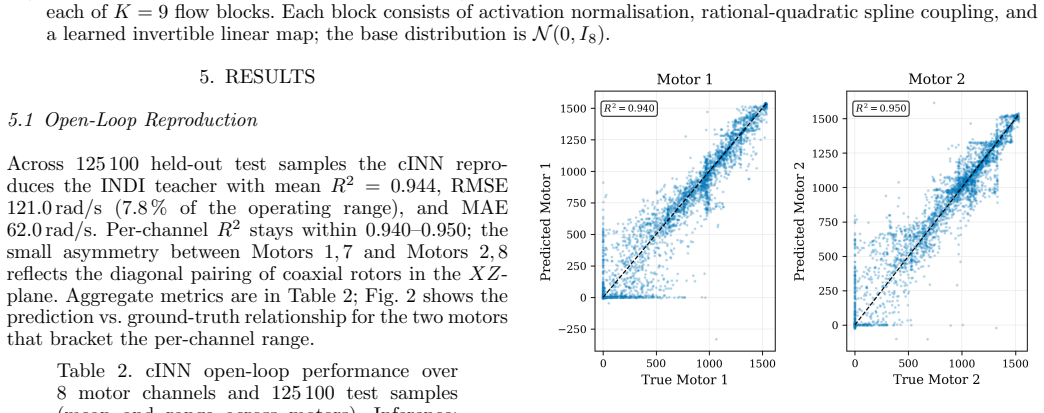
The central claim is that the conditional density p(u | s_t, c_t) is learnable from a teacher, and that the mode of that density is a viable deterministic control output while its dispersion is a meaningful uncertainty estimate. Using roughly 1.25 million state–command–motor tuples generated by an INDI controller, the cINN learns a bijection f_θ(u; h) from motor commands to Gaussian latents, with h produced by an encoder from the state and the command vector c_t = (v^cmd; e^pos; e^vel). In open-loop tests on 125,100 held-out samples, the mode reaches R² = 0.944 and RMSE about 7.8% of the operating range. In closed loop, the mean position RMSE is 9.7 m versus INDI's 9.5 m, and 47% of 15 scena
Load-bearing premise
The load-bearing premise is that the instantaneous vector c_t = (velocity command, position error, velocity error), with no rate or history information, fully determines the right motor command; this premise breaks under fast command reversals, exactly where the paper's own Scenario 1 shows phase lag.
Editorial extensions
If this is right
- A control law can be synthesized purely by imitating a teacher's state–command–motor tuples; no explicit dynamics model is needed at run time.
- The model's predictive log-probability is a runtime confidence signal, since samples it assigns low likelihood tend to be the ones with large prediction error (ρ = -0.60).
- Because the full conditional density is available, a safety wrapper can fall back to INDI whenever predicted confidence drops below a threshold, which the paper proposes as the most immediate route to safer deployment.
- Adding command derivatives or temporal context to c_t is the direct extension suggested by the phase-lag failure, while targeted generation of aggressive non-zero-pitch commands addresses the attitude-divergence failure.
- Closed-loop averages hide a bimodal performance distribution, so per-scenario diagnostics, not aggregate RMSE, are the right way to judge this class of learned controllers.
Reading between the lines
- If the data-coverage explanation is right, oversampling fast reference reversals and non-zero-pitch steps should shrink both failure modes without any architectural change; a negative result would instead point to the instantaneous conditioning vector being insufficient.
- The calibration gap (57.7% empirical at 68% nominal, 73.9% at 95%) means the reported uncertainty is useful as a ranking signal but not yet trustworthy as an absolute probability, which matters for any confidence threshold in a safety wrapper.
- At 47.5 ms per inference against a 10 ms control period, the closed-loop simulation relied on time abstraction; real-time deployment requires either faster flow evaluation or a distillation into an amortized sampler.
- Transferring to 6-DoF flight will likely amplify the coverage problem already visible in 2-D, so the data-generation strategy, not the flow architecture, is the riskiest part of the scale-up.
Signed reviews
Editorial analysis
A structured set of objections, weighed in public.
Circularity Check
No significant circularity: open-loop metrics are explicitly goodness-of-fit to the INDI teacher, and closed-loop evaluation is a genuine non-tautological test.
full rationale
The paper's central pipeline is supervised imitation: a cINN is trained on (s_t, c_t, u) tuples generated by an INDI teacher and then evaluated. This is not circular because the open-loop metrics (R^2=0.944, CRPS) are explicitly framed as 'reproduction' of the teacher's held-out commands, not as independent validation of true inverse dynamics. The closed-loop evaluation replaces INDI in the loop and compares against the plant in 15 held-out scenarios; this is a non-tautological test, and the reported failures (phase lag, attitude divergence) are honest, externally visible results rather than artifacts of the training objective. The only self-citations are to the authors' prior simulator RMT-CopterGym (Tappe et al., 2025; Kelm and Myschik, 2023). While the simulator is load-bearing as a testbed, it is a tool and not a theorem; no conclusion is forced by a self-citation chain. The post-hoc temperature is fitted on validation and applied to test, a standard calibration step rather than a fitted parameter renamed as a prediction. The reader-identified issue that f^{-1}(0;h) is not necessarily the mode of p(u|s_t,c_t) because Eq. (3) includes a Jacobian term is a potential correctness/misspecification concern, not a circularity: the prediction is not equivalent to its inputs by construction. Overall, no load-bearing step reduces to its own inputs.
Assumptions & free parameters
free parameters (4)
- post-hoc temperature T =
1.214
- spline tail bound B and bins K_s =
B=5.0, K_s=8
- flow blocks K and hidden width =
K=9, hidden=256
- latent samples N for uncertainty =
20
assumptions (5)
- domain assumption The Simulink/RMT-CopterGym plant model faithfully represents the planar X8 dynamics.
- domain assumption The INDI teacher is a valid expert whose motor commands are the right training target for inverse dynamics.
- domain assumption The instantaneous conditioning vector c_t = (v_cmd, e_pos, e_vel) is sufficient for the inverse-dynamics mapping.
- standard math RQ-spline coupling flows are universal density approximators, so the cINN can in principle represent the teacher's conditional distribution.
- domain assumption The simulator's attitude-safety break is a valid proxy for physical failure in closed-loop evaluation.
Cite this review
Pith. "Pith review of Conditional Invertible Neural Networks for Data-Driven UAV Control: A 2-D Proof of Concept." pith.science (2026). https://pith.science/paper/XLQM6XX3
@misc{pith2026260713703,
  author       = {Pith},
  title        = {Pith review of: Conditional Invertible Neural Networks for Data-Driven UAV Control: A 2-D Proof of Concept},
  year         = {2026},
  howpublished = {\url{https://pith.science/paper/XLQM6XX3}},
  note         = {Machine review of arXiv:2607.13703}
}
abstract
We investigate conditional invertible neural networks (cINNs) as probabilistic inverse-dynamics models for multirotor control. For a planar X8 coaxial multicopter, we learn $p(u \mid s_t, c_t)$ from an incremental nonlinear dynamic inversion (INDI) teacher using rational-quadratic spline coupling and invertible linear mixing. Open-loop reproduction reaches $R^2 = 0.944$, mean CRPS 0.0915, and log-probability-error correlation $\rho = -0.60$. Over 15 closed-loop scenarios, position RMSE matches INDI (9.7 vs. 9.5 m), with 47 percent tracking acceptably; failures separate into attitude divergence under aggressive steps and phase lag under high-frequency references, isolating command bandwidth and data coverage as dominant failure mechanisms.
Figures


Figures from the paper (1 more)

Reference graph
Works this paper leans on
-
[1]
Potato-Glow: Utilizing Glow for Vision-Based Anomaly Detection in an Industrial Context: A Comparative Benchmarking Approach
Wittke, Christian and Liebert, Artur and Friesen, Andrej and Flatt, Holger and Niggemann, Oliver. Potato-Glow: Utilizing Glow for Vision-Based Anomaly Detection in an Industrial Context: A Comparative Benchmarking Approach. Bildverarbeitung in der Automation. 2025
2025
-
[2]
Deutscher Luft- und Raumfahrtkongress 2023 , year =
Tappe, Mark and Wickers, Aaron and Kelm, Benjamin and Myschik, Stephan and Niggemann, Oliver , title =. Deutscher Luft- und Raumfahrtkongress 2023 , year =
2023
-
[3]
International Journal of Control, Automation and Systems , volume =
Chao, Haiyang and Cao, Yongcan and Chen, Yangquan , title =. International Journal of Control, Automation and Systems , volume =. 2010 , doi =
2010
-
[4]
Robotics and Autonomous Systems , volume =
Cheng, Guanya and others , title =. Robotics and Autonomous Systems , volume =. 2024 , doi =
2024
-
[5]
Journal of Imaging , volume =
Denker, Alexander and Schmidt, Maximilian and Leuschner, Johannes and Maass, Peter , title =. Journal of Imaging , volume =. 2021 , doi =
2021
-
[6]
Science Robotics , volume =
Foehn, Philipp and Romero, Angel and Scaramuzza, Davide , title =. Science Robotics , volume =. 2021 , doi =
2021
-
[7]
Applied Sciences , volume =
Ganga, Gokhan and Cetinsoy, Erdinc , title =. Applied Sciences , volume =. 2023 , doi =
2023
-
[8]
arXiv preprint arXiv:2301.04104 , year =
Hafner, Danijar and Pasukonis, Jurgis and Ba, Jimmy and Lillicrap, Timothy , title =. arXiv preprint arXiv:2301.04104 , year =
Show all 51 references
-
[9]
SciPost Physics , volume =
Heredge, Jamie and Sheridan, Simon and others , title =. SciPost Physics , volume =. 2024 , doi =
2024
-
[10]
Champion-level drone racing using deep reinforcement learning , journal =
Kaufmann, Elia and Bauersfeld, Leonard and Loquercio, Antonio and M. Champion-level drone racing using deep reinforcement learning , journal =. 2023 , doi =
2023
-
[11]
, title =
Kumar, Satvik and Yeo, Jaesik and Hudon, Veronica and Thostenson, Erik T. , title =. npj Computational Materials , volume =. 2021 , doi =
2021
-
[12]
Aerospace Science and Technology , volume =
Lopez-Sanchez, Ivan and Moreno-Valenzuela, Javier , title =. Aerospace Science and Technology , volume =. 2022 , doi =
2022
-
[13]
Annual Reviews in Control , volume =
Lopez-Sanchez, Ivan and Moreno-Valenzuela, Javier , title =. Annual Reviews in Control , volume =. 2023 , doi =
2023
-
[14]
and Saska, Martin , title =
Nascimento, Tiago P. and Saska, Martin , title =. Annual Reviews in Control , volume =. 2019 , doi =
2019
-
[15]
Cognitive Processing , volume =
Nguyen-Tuong, Duy and Peters, Jan , title =. Cognitive Processing , volume =. 2011 , doi =
2011
-
[16]
IEEE Transactions on Robotics , volume =
Romero, Angel and Sun, Sihao and Foehn, Philipp and Scaramuzza, Davide , title =. IEEE Transactions on Robotics , volume =. 2022 , doi =
2022
-
[17]
Reaching the limit in autonomous racing: Optimal control versus reinforcement learning , journal =
Song, Yunlong and Romero, Angel and M. Reaching the limit in autonomous racing: Optimal control versus reinforcement learning , journal =. 2023 , doi =
2023
-
[18]
IEEE Transactions on Systems, Man, and Cybernetics: Systems , volume =
Wen, Guoxing and Hao, Wen and Feng, Wei and Gao, Keming , title =. IEEE Transactions on Systems, Man, and Cybernetics: Systems , volume =. 2022 , doi =
2022
-
[19]
and Klessen, Ralf S
Ardizzone, Lynton and Kruse, Jakob and Wirkert, Sebastian and Rahner, Daniel and Pellegrini, Eric W. and Klessen, Ralf S. and Maier-Hein, Lena and Rother, Carsten and K. Analyzing Inverse Problems with Invertible Neural Networks , booktitle =
-
[20]
Proceedings of the American Control Conference , pages =
Dierks, Travis and Jagannathan, Sarangapani , title =. Proceedings of the American Control Conference , pages =. 2009 , doi =
2009
-
[21]
International Conference on Learning Representations , year =
Dinh, Laurent and Sohl-Dickstein, Jascha and Bengio, Samy , title =. International Conference on Learning Representations , year =
-
[22]
Advances in Neural Information Processing Systems , volume =
Durkan, Conor and Bekasov, Artur and Murray, Iain and Papamakarios, George , title =. Advances in Neural Information Processing Systems , volume =
-
[23]
and Dhariwal, Prafulla , title =
Kingma, Diederik P. and Dhariwal, Prafulla , title =. Advances in Neural Information Processing Systems , volume =
-
[24]
Invertible neural networks for uncertainty quantification in photoacoustic imaging , booktitle =
N. Invertible neural networks for uncertainty quantification in photoacoustic imaging , booktitle =. 2021 , publisher =
2021
-
[25]
Advances in Neural Information Processing Systems , volume =
Papamakarios, George and Pavlakou, Theo and Murray, Iain , title =. Advances in Neural Information Processing Systems , volume =
-
[26]
IEEE International Conference on Robotics and Automation , pages =
Rao, Siyuan and others , title =. IEEE International Conference on Robotics and Automation , pages =. 2023 , doi =
2023
-
[27]
Smeur, Ewoud J. J. and Chu, Qiping and de Croon, Guido C. H. E. , title =. Journal of Guidance, Control, and Dynamics , volume =. 2016 , doi =
2016
-
[28]
Deep drone acrobatics , booktitle =
Loquercio, Antonio and Kaufmann, Elia and Ranftl, Ren. Deep drone acrobatics , booktitle =. 2020 , doi =
2020
-
[29]
AIAA AVIATION 2023 Forum , year =
Kelm, Benjamin and Myschik, Stephan , title =. AIAA AVIATION 2023 Forum , year =
2023
-
[30]
Ardizzone, L., Kruse, J., Wirkert, S., Rahner, D., Pellegrini, E.W., Klessen, R.S., Maier-Hein, L., Rother, C., and K \"o the, U. (2019). Analyzing inverse problems with invertible neural networks. In International Conference on Learning Representations
2019
-
[31]
Chao, H., Cao, Y., and Chen, Y. (2010). Autopilots for small unmanned aerial vehicles: A survey. International Journal of Control, Automation and Systems, 8(1), 36--44. doi:10.1007/s12555-010-0105-z
2010 doi
-
[32]
Cheng, G. et al. (2024). Physics-informed neural network for quadrotor dynamical modeling. Robotics and Autonomous Systems, 171, 104569. doi:10.1016/j.robot.2023.104569
2024
-
[33]
Denker, A., Schmidt, M., Leuschner, J., and Maass, P. (2021). Conditional invertible neural networks for medical imaging. Journal of Imaging, 7(11), 243. doi:10.3390/jimaging7110243
2021 doi
-
[34]
and Jagannathan, S
Dierks, T. and Jagannathan, S. (2009). Neural network control of quadrotor UAV formations. In Proceedings of the American Control Conference, 2990--2996. doi:10.1109/ACC.2009.5160591
2009
-
[35]
Dinh, L., Sohl-Dickstein, J., and Bengio, S. (2017). Density estimation using Real-NVP . In International Conference on Learning Representations
2017
-
[36]
Durkan, C., Bekasov, A., Murray, I., and Papamakarios, G. (2019). Neural spline flows. In Advances in Neural Information Processing Systems, volume 32, 7509--7520
2019
-
[37]
Foehn, P., Romero, A., and Scaramuzza, D. (2021). Time-optimal planning for quadrotor waypoint flight. Science Robotics, 6(56), eabh1221. doi:10.1126/scirobotics.abh1221
2021 doi
-
[38]
Heredge, J., Sheridan, S., et al. (2024). Generative invertible quantum neural networks. SciPost Physics, 16, 146. doi:10.21468/SciPostPhys.16.6.146
2024 doi
-
[39]
Kaufmann, E., Bauersfeld, L., Loquercio, A., M \"u ller, M., Koltun, V., and Scaramuzza, D. (2023). Champion-level drone racing using deep reinforcement learning. Nature, 620(7976), 982--987. doi:10.1038/s41586-023-06419-4
2023 doi
-
[40]
and Myschik, S
Kelm, B. and Myschik, S. (2023). Model-based control reconfiguration of a multirotor UAV using online system identification by sparse regression ( SINDYc ). In AIAA AVIATION 2023 Forum. American Institute of Aeronautics and Astronautics. doi:10.2514/6.2023-4464
2023 doi
-
[41]
and Dhariwal, P
Kingma, D.P. and Dhariwal, P. (2018). Glow: Generative flow with invertible 1x1 convolutions. In Advances in Neural Information Processing Systems, volume 31
2018
-
[42]
Kumar, S., Yeo, J., Hudon, V., and Thostenson, E.T. (2021). Inverse design of two-dimensional materials with invertible neural networks. npj Computational Materials, 7, 186. doi:10.1038/s41524-021-00670-x
2021 doi
-
[43]
and Moreno-Valenzuela, J
Lopez-Sanchez, I. and Moreno-Valenzuela, J. (2023). PID control of quadrotor UAV s: A survey. Annual Reviews in Control, 56, 100900. doi:10.1016/j.arcontrol.2023.100900
2023
-
[44]
Loquercio, A., Kaufmann, E., Ranftl, R., M \"u ller, M., Koltun, V., and Scaramuzza, D. (2020). Deep drone acrobatics. In Robotics: Science and Systems (RSS). doi:10.15607/RSS.2020.XVI.040
2020 doi
-
[45]
o lke, J.H., Adler, T.J., Ardizzone, L., et al. (2021). Invertible neural networks for uncertainty quantification in photoacoustic imaging. In Bildverarbeitung f \
N \"o lke, J.H., Adler, T.J., Ardizzone, L., et al. (2021). Invertible neural networks for uncertainty quantification in photoacoustic imaging. In Bildverarbeitung f \"u r die Medizin 2021 , 330--335. Springer. doi:10.1007/978-3-658-33198-6\_80
2021 doi
-
[46]
Rao, S. et al. (2023). Inverse kinematics of tendon driven continuum robots using invertible neural network. In IEEE International Conference on Robotics and Automation, 1--6. doi:10.1109/ICRA48891.2023.10027047
2023
-
[47]
Romero, A., Sun, S., Foehn, P., and Scaramuzza, D. (2022). Model predictive contouring control for time-optimal quadrotor flight. IEEE Transactions on Robotics, 38(6), 3340--3356. doi:10.1109/TRO.2022.3165382
2022
-
[48]
Smeur, E.J.J., Chu, Q., and de Croon, G.C.H.E. (2016). Adaptive incremental nonlinear dynamic inversion for attitude control of micro air vehicles. Journal of Guidance, Control, and Dynamics, 39(3), 450--461. doi:10.2514/1.G001490
2016 doi
-
[49]
Song, Y., Romero, A., M \"u ller, M., Koltun, V., and Scaramuzza, D. (2023). Reaching the limit in autonomous racing: Optimal control versus reinforcement learning. Science Robotics, 8(82), eadg1462. doi:10.1126/scirobotics.adg1462
2023 doi
-
[50]
Tappe, M., Wickers, A., Kelm, B., Myschik, S., and Niggemann, O. (2025). Verwendung eines qualitativen systemmodells zum maschinellen lernens des flugverhaltens eines multicopters. In Deutscher Luft- und Raumfahrtkongress 2023. Deutsche Gesellschaft für Luft- und Raumfahrt - L...
2025 doi
-
[51]
Wittke, C., Liebert, A., Friesen, A., Flatt, H., and Niggemann, O. (2025). Potato-glow: Utilizing glow for vision-based anomaly detection in an industrial context: A comparative benchmarking approach. In V. Lohweg (ed.), Bildverarbeitung in der Automation, 15--28. Springer Ber...
2025
Reviewed August 2, 2026 · model on record in the stance chip above.
Discussion (0). Continue with ORCID to comment.