REVIEW 2 major objections 4 minor 37 references
Ultrafast altermagnetophononics
T0 review · 2 major / 4 minor · reviewed 2026-08-02 · deepseek-v4-flash
Pith's one-line read This paper establishes that driving the silent B1g phonon mode in the altermagnet alpha-MnTe with two-color terahertz light selectively breaks the spin-group symmetry protecting altermagnetism, producing a transient compensated ferrimagneti
desk verdict Solid symmetry-based mechanism for phonon control of altermagnets; the ultrafast simulation needs its parameters shown. read the letter →
The pith
A machine-rendered reading of the paper's core claim, the machinery that carries it, and where it could break.
The reading
What carries the argument
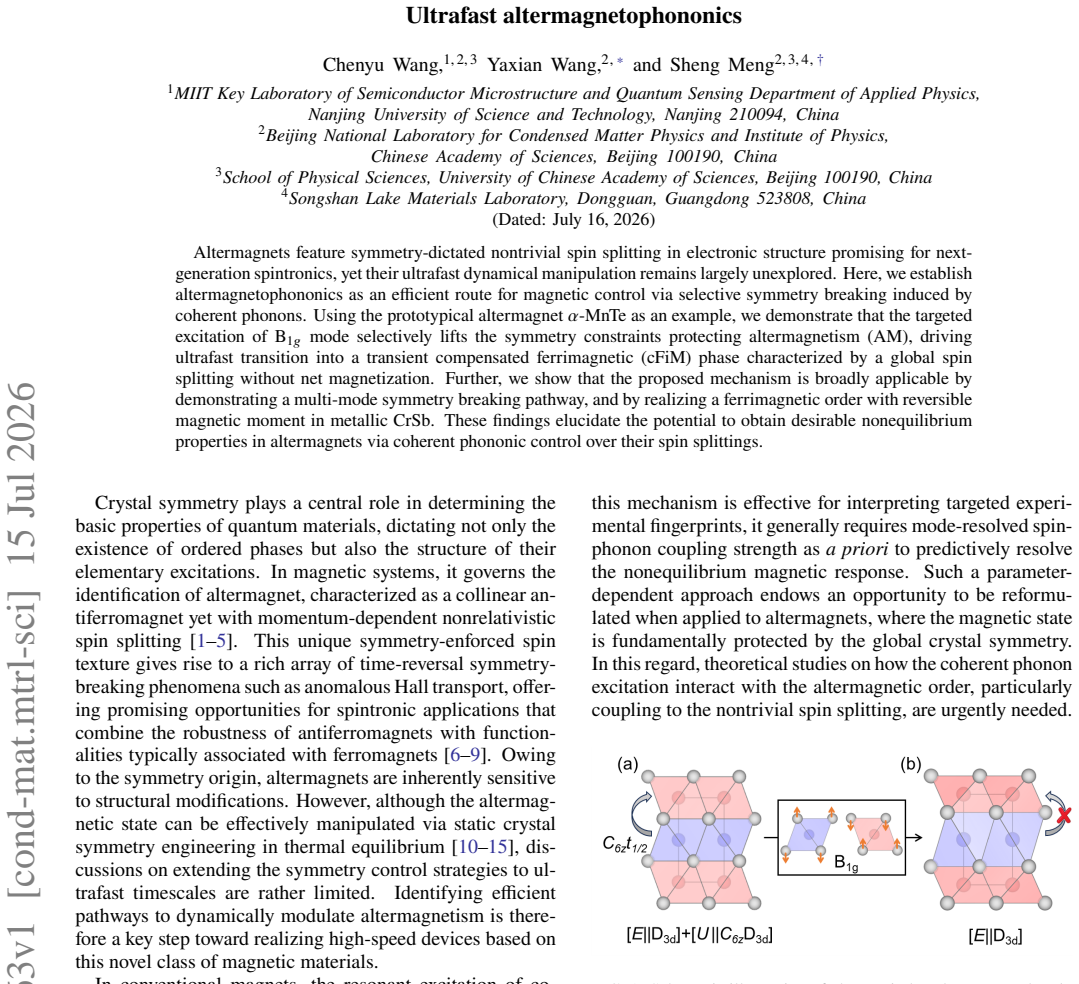
The load-bearing object is the B1g phonon of alpha-MnTe—a silent optical mode whose out-of-phase c-axis motion of Te atoms breaks the C6z rotations that connect the opposite-spin Mn sublattices. It is silent to both infrared and Raman processes, so the paper introduces a two-color terahertz sum-frequency excitation in which a Raman-active E2g phonon mediates the coupling: the interaction term gamma E1(omega1) E2(omega2) Q_E2g Q_B1g in the potential (Eq. 1) allows the silent mode to be driven by pulses at 1.37 THz and 5.00 THz. The effective work of this machinery is to translate a symmetry reduction (from [E||D3d]+[U||C6zD3d] to [E||D3d]) into a quantitative, experimentally addressable spin
What would settle it
Time-resolved angle-resolved photoemission on alpha-MnTe pumped by two-color THz pulses at ~1.37 THz and ~5.00 THz should reveal a zone-center spin splitting that grows with pump fluence, oscillates at the B1g frequency, and is absent when only the E2g mode is excited; a simultaneous measurement of the lattice displacement (e.g., via time-resolved X-ray diffraction) should confirm the ~0.1 Å√u amplitude threshold. Failure to see the splitting at achievable fluences would falsify the switching scenario while leaving the static symmetry argument intact.
Extended reading notes
Core claim
The central discovery is that a zone-center B1g phonon in alpha-MnTe acts as a symmetry-selective switch for altermagnetism. At equilibrium the spin group [E||D3d]+[U||C6zD3d] enforces the alternating spin-momentum texture, with spin degeneracy along nodal lines and at Gamma. The B1g displacement makes the two antiferromagnetic Mn sublattices crystallographically inequivalent, reducing the spin group to [E||D3d]; as a result the spin degeneracy is lifted across the whole Brillouin zone, including at Gamma, producing an approximately linear energy splitting reaching ~30 meV at a phonon amplitude of 0.1 Å√u. Because the valence bands are fully occupied, the global spin splitting does not yield
Load-bearing premise
The demonstration of coherent switching depends on the nonlinear coupling coefficient gamma and the damping being such that experimentally available two-color THz fields drive the B1g amplitude to ~0.1 Å√u (needed for ~30 meV splitting), but the paper does not give values for gamma, the Raman tensor, or damping.
Editorial extensions
If this is right
- If the predicted B1g-driven transition is real, alpha-MnTe becomes a material where the altermagnetic order can be turned into a compensated ferrimagnetic order by a sub-picosecond THz pulse, with no net magnetization but a global spin splitting detectable at Gamma.
- The linear scaling of the splitting with phonon amplitude means the magnetic state can be continuously tuned by pump fluence, up to tens of meV of zone-center spin splitting.
- The two-color sum-frequency route provides mode selectivity: the E2g mediator preserves the altermagnetic symmetry on its own, so the cFiM response is exclusively controlled by the B1g displacement, as the transient dynamics in Fig. 3(b) show.
- In metallic CrSb the same B1g distortion induces a net ferrimagnetic moment whose direction is reversed by flipping the sign of the lattice displacement, implying an all-optical, bi-stable magnetic switch.
- The multi-mode A2u+E1u pathway shows that infrared-active modes can also be used, with the relative phase of the two pulses controlling the sign of the induced spin splitting.
Reading between the lines
- The symmetry-based logic is likely transferable beyond the two demonstrated materials: any altermagnet in which a zone-center phonon breaks the spin-group operation R should show an analogous AM-to-cFiM (or AM-to-ferrimagnetic) transition, so a group-theoretic catalog of such phonons could rationalize ultrafast switching experiments without costly spin-phonon coupling calculations.
- Because the cFiM phase has a global spin splitting but zero magnetization, it may exhibit anomalous Hall or spin-charge conversion responses like an altermagnet, yet with the symmetries of a ferrimagnet; this suggests the transient state could be probed electrically rather than magnetically.
- A natural testable extension: the near-linear dependence of Delta E on Q implies that pump-probe photoemission at fixed fluence should show the splitting oscillating at the B1g frequency as the coherent phonon rings; a null result would point to damping or insufficient coupling.
- The two-color sum-frequency scheme could be adapted to other silent phonons by choosing a Raman-active mediator whose irreducible representation allows the cubic coupling, providing a general route to drive symmetry-lowering distortions in non-piezoelectric crystals.
Signed reviews
Editorial analysis
A structured set of objections, weighed in public.
Referee Report
Summary. This paper proposes a symmetry-driven mechanism, 'altermagnetophononics,' for ultrafast control of altermagnets. Using α-MnTe as the central example, the authors argue that a coherent B1g phonon distortion reduces the spin group from [E||D3d]+[U||C6zD3d] to [E||D3d], thereby lifting the symmetry protection of altermagnetic spin splitting. Static DFT at displaced geometries shows a zone-center splitting ΔE of about 30 meV at Q_B1g = 0.1 Å√u while maintaining zero net magnetization, i.e., a transition to a compensated ferrimagnetic (cFiM) phase. To excite the silent B1g mode, the authors propose a two-color THz sum-frequency scheme mediated by a Raman-active E2g phonon, governed by the coupling potential in Eq. (1), and they report numerical coherent dynamics in Fig. 3. The framework is extended to a multi-mode A2u+E1u pathway in MnTe and to metallic CrSb, where the induced ferrimagnetic moment is reversible with the sign of the B1g displacement.
Significance. If the results hold, the paper would establish a symmetry-based design principle for ultrafast magnetic control in altermagnets, with concrete experimental predictions that are falsifiable by ARPES (B1g-induced splitting at Γ), by magnetometry (zero net moment in MnTe, finite reversible moment in CrSb), and by time-resolved THz pump-probe experiments. The symmetry analysis is parameter-free and the static DFT results are first-principles, so the central mechanism does not rest on fitted parameters; indeed, there is no evidence of circularity, as the unspecified parameters in Eq. (1) are inputs, not fitted outputs. The main caveat is that the dynamical demonstration in Fig. 3 relies on unstated coupling and damping parameters, which is a missing-support issue for the ultrafast headline claim, not for the static symmetry argument.
major comments (2)
- [Eq. (1), Fig. 3(b)-(c)] The coherent-switching demonstration depends on the parameters in Eq. (1), but the nonlinear coupling coefficient γ, the Raman tensor R, and the damping terms entering the equations of motion are not given. The resonance conditions and the stated center frequencies imply Ω_E2g ≈ 2.74 THz and Ω_B1g ≈ 3.63 THz, but γ, R, the pulse envelopes, and the damping rate are absent. Q_max and ΔE_max in Fig. 3(c) scale with these inputs, so the sub-picosecond switching claim is not reproducible or assessable from the main text. Please provide these values (or a physically motivated range) and the explicit equations of motion, either in the main text or in a fully accessible SM.
- [Figs. 2 and 4, SM Secs. S2 and S4] The static DFT results that ground the quantitative predictions (e.g., ΔE ≈ 30 meV at Q_B1g = 0.1 Å√u in Fig. 2(f), and the CrSb magnetization in Fig. 4(b)) are deferred entirely to the SM without stating the functional, Hubbard U, pseudopotentials, k-mesh, or displacement definition in the main text. Because these numbers are used to argue experimental feasibility, the main text should at least state the computational parameters and the method of computing the net magnetization. Without this information the static predictions are not independently verifiable.
minor comments (4)
- [Eq. (1)] Define the units of Q_B1g, Q_E2g, Ω, R, and γ. The text uses Å√u for Q, but the energy scale of the potential and the order of magnitude of R and γ should be stated.
- [Fig. 3] Specify the pulse durations, envelopes, and peak field strengths; the caption should identify the units of the THz field axis.
- [Fig. 2(f)] Report the numerical values of the net magnetization M; the text says it vanishes, but the plot should quantify how close to zero it is.
- [Fig. 4(a)] The relationship between the relative phase of A2u and E1u modes and the sign of ΔE is described qualitatively; a short symmetry or perturbation argument would make this quantitative.
Circularity Check
No significant circularity: the central AM-to-cFiM claim rests on independent symmetry analysis and first-principles DFT, not on fitted outputs or self-citation.
full rationale
The paper's derivation chain is self-contained with respect to its central claim. Altermagnetism in α-MnTe is defined by the spin group [E||D3d]+[U||C6zD3d], and the paper shows that a B1g phonon displacement removes the C6z-related operations, reducing the spin group to [E||D3d] (Figs. 1–2). This is a direct group-theoretic argument, not a quantity fitted to reproduce a target. The resulting ΔE≈30 meV at Q_B1g=0.1 Å√u is obtained from DFT band-structure calculations on distorted lattices, i.e., a first-principles evaluation, not a fit to the predicted cFiM phase. Equation (1) introduces a nonlinear phonon coupling model with parameters (Ω, R, γ) that are inputs to the dynamics; no parameter is adjusted to force the predicted phase, and the ultrafast demonstration in Fig. 3 is a consequence of the model, not a re-derivation of it. The manuscript defers parameter values and additional analyses to the Supplemental Material (e.g., 'see SM Sec. S3 for details'), which makes the transient dynamics quantitatively non-reproducible from the main text alone; that is a completeness/reproducibility concern, not circularity. The references cited are external works on altermagnetism and sum-frequency phonon excitation, with no load-bearing self-citation chain. No prediction reduces by construction to an input, so the circularity score is 0.
Assumptions & free parameters
free parameters (4)
- nonlinear coupling coefficient gamma
- Raman tensor R for E2g mode
- phonon damping rates / lifetimes
- phonon frequencies Omega_B1g, Omega_E2g
assumptions (3)
- domain assumption The spin-group formalism for altermagnets (spin-space rotations U and real-space ops R) correctly describes the symmetry of MnTe and CrSb.
- domain assumption Coherent phonon displacement modifies the electronic structure instantaneously (adiabatic Born-Oppenheimer approximation for the lattice motion).
- domain assumption The DFT total energy and band structure at finite phonon amplitudes are accurate enough for the ~meV scale splittings.
Cite this review
Pith. "Pith review of Ultrafast altermagnetophononics." pith.science (2026). https://pith.science/paper/C6F3ZSG6
@misc{pith2026260713863,
  author       = {Pith},
  title        = {Pith review of: Ultrafast altermagnetophononics},
  year         = {2026},
  howpublished = {\url{https://pith.science/paper/C6F3ZSG6}},
  note         = {Machine review of arXiv:2607.13863}
}
abstract
Altermagnets feature symmetry-dictated nontrivial spin splitting in electronic structure promising for next-generation spintronics, yet their ultrafast dynamical manipulation remains largely unexplored. Here, we establish altermagnetophononics as an efficient route for magnetic control via selective symmetry breaking induced by coherent phonons. Using the prototypical altermagnet $\alpha$-MnTe as an example, we demonstrate that the targeted excitation of B$_{1g}$ mode selectively lifts the symmetry constraints protecting altermagnetism (AM), driving ultrafast transition into a transient compensated ferrimagnetic (cFiM) phase characterized by a global spin splitting without net magnetization. Further, we show that the proposed mechanism is broadly applicable by demonstrating a multi-mode symmetry breaking pathway, and by realizing a ferrimagnetic order with reversible magnetic moment in metallic CrSb. These findings elucidate the potential to obtain desirable nonequilibrium properties in altermagnets via coherent phononic control over their spin splittings.
Figures


Figures from the paper (1 more)

Reference graph
Works this paper leans on
-
[1]
ˇSmejkal, J
L. ˇSmejkal, J. Sinova, and T. Jungwirth, Phys. Rev. X12, 031042 (2022)
2022
-
[2]
ˇSmejkal, J
L. ˇSmejkal, J. Sinova, and T. Jungwirth, Phys. Rev. X12, 040501 (2022)
2022
-
[3]
ˇSmejkal, R
L. ˇSmejkal, R. Gonz ´alez-Hern´andez, T. Jungwirth, and J. Sinova, Sci. Adv.6, eaaz8809 (2020)
2020
-
[4]
P. A. McClarty and J. G. Rau, Phys. Rev. Lett.132, 176702 (2024)
2024
-
[5]
C. Song, H. Bai, Z. Zhou, L. Han, H. Reichlova, J. H. Dil, J. Liu, X. Chen, and F. Pan, Nat. Rev. Mater.10, 473 (2025)
2025
-
[6]
ˇSmejkal, A
L. ˇSmejkal, A. H. MacDonald, J. Sinova, S. Nakatsuji, and T. Jungwirth, Nat. Rev. Mater.7, 482 (2022)
2022
-
[7]
Hariki, A
A. Hariki, A. Dal Din, O. J. Amin, T. Yamaguchi, A. Badura, D. Kriegner, K. W. Edmonds, R. P. Campion, P. Wadley, D. Backes, L. S. I. Veiga, S. S. Dhesi, G. Springholz, L. ˇSmejkal, K. V´ yborn´ y, T. Jungwirth, and J. Kuneˇs, Phys. Rev. Lett.132, 176701 (2024)
2024
-
[8]
Gonz ´alez-Hern´andez, L
R. Gonz ´alez-Hern´andez, L. ˇSmejkal, K. V´ yborn´ y, Y. Yahagi, J. Sinova, T. c. v. Jungwirth, and J. ˇZelezn´ y, Phys. Rev. Lett. 126, 127701 (2021)
2021
Show all 37 references
-
[9]
H. Chen, L. Liu, X. Zhou, Z. Meng, X. Wang, Z. Duan, G. Zhao, H. Yan, P. Qin, and Z. Liu, Adv. Mater.36, 2310379 (2024)
2024
-
[10]
Z. Zhou, X. Cheng, M. Hu, R. Chu, H. Bai, L. Han, J. Liu, F. Pan, and C. Song, Nature638, 645 (2025)
2025
-
[11]
O. J. Amin, A. Dal Din, E. Golias, Y. Niu, A. Zakharov, S. C. Fromage, C. J. B. Fields, S. L. Heywood, R. B. Cousins, F. Maccherozzi, J. Krempask´ y, J. H. Dil, D. Kriegner, B. Ki- raly, R. P. Campion, A. W. Rushforth, K. W. Edmonds, S. S. Dhesi, L. ˇSmejkal, T. Jungwirth, and...
2024
-
[12]
Karetta, X
B. Karetta, X. H. Verbeek, R. Jaeschke-Ubiergo, L. ˇSmejkal, and J. Sinova, Phys. Rev. B112, 094454 (2025)
2025
-
[13]
L.-D. Yuan, A. B. Georgescu, and J. M. Rondinelli, Phys. Rev. Lett.133, 216701 (2024)
2024
-
[14]
Chakraborty, R
A. Chakraborty, R. Gonz ´alez Hern ´andez, L. ˇSmejkal, and J. Sinova, Phys. Rev. B109, 144421 (2024)
2024
-
[15]
D. Wang, H. Wang, L. Liu, J. Zhang, and H. Zhang, Nano Letters25, 498 (2025)
2025
-
[16]
A. S. Disa, T. F. Nova, and A. Cavalleri, Nat. Phys.17, 1087 (2021)
2021
-
[17]
Afanasiev, J
D. Afanasiev, J. R. Hortensius, B. A. Ivanov, A. Sasani, E. Bousquet, Y. M. Blanter, R. V. Mikhaylovskiy, A. V. Kimel, and A. D. Caviglia, Nat. Mater.20, 607 (2021)
2021
-
[18]
A. S. Disa, J. Curtis, M. Fechner, A. Liu, A. von Hoegen, M. F ¨orst, T. F. Nova, P. Narang, A. Maljuk, A. V. Boris, B. Keimer, and A. Cavalleri, Nature617, 73 (2023)
2023
-
[19]
Ilyas, T
B. Ilyas, T. Luo, A. von Hoegen, E. Vi˜nas Bostr¨om, Z. Zhang, J. Park, J. Kim, J.-G. Park, K. A. Nelson, A. Rubio, and N. Gedik, Nature636, 609 (2024)
2024
-
[20]
Zhang, F
Z. Zhang, F. Y. Gao, Y.-C. Chien, Z.-J. Liu, J. B. Curtis, E. R. Sung, X. Ma, W. Ren, S. Cao, P. Narang, A. von Hoegen, E. Baldini, and K. A. Nelson, Nat. Phys.20, 788 (2024)
2024
-
[21]
Fechner, A
M. Fechner, A. Sukhov, L. Chotorlishvili, C. Kenel, J. Berak- dar, and N. A. Spaldin, Phys. Rev. Mater.2, 064401 (2018)
2018
-
[22]
Gu and J
M. Gu and J. M. Rondinelli, Phys. Rev. B98, 024102 (2018)
2018
-
[23]
Jiang, Z
Y. Jiang, Z. Song, T. Zhu, Z. Fang, H. Weng, Z.-X. Liu, J. Yang, and C. Fang, Phys. Rev. X14, 031039 (2024). 6
2024
-
[24]
X. Chen, J. Ren, Y. Zhu, Y. Yu, A. Zhang, P. Liu, J. Li, Y. Liu, C. Li, and Q. Liu, Phys. Rev. X14, 031038 (2024)
2024
-
[25]
Z. Xiao, J. Zhao, Y. Li, R. Shindou, and Z.-D. Song, Phys. Rev. X14, 031037 (2024)
2024
-
[26]
D. M. Juraschek, M. Fechner, and N. A. Spaldin, Phys. Rev. Lett.118, 054101 (2017)
2017
-
[27]
E. J. Sie, C. M. Nyby, C. D. Pemmaraju, S. J. Park, X. Shen, J. Yang, M. C. Hoffmann, B. K. Ofori-Okai, R. Li, A. H. Reid, S. Weathersby, E. Mannebach, N. Finney, D. Rhodes, D. Chenet, A. Antony, L. Balicas, J. Hone, T. P. Devereaux, T. F. Heinz, X. Wang, and A. M. Lindenberg,...
2019
-
[28]
R. D. Gonzalez Betancourt, J. Zub´aˇc, R. Gonzalez-Hernandez, K. Geishendorf, Z. ˇSob´aˇn, G. Springholz, K. Olejn ´ık, L. ˇSmejkal, J. Sinova, T. Jungwirth, S. T. B. Goennenwein, A. Thomas, H. Reichlov´a, J. ˇZelezn´ y, and D. Kriegner, Phys. Rev. Lett.130, 036702 (2023)
2023
-
[29]
S. Lee, S. Lee, S. Jung, J. Jung, D. Kim, Y. Lee, B. Seok, J. Kim, B. G. Park, L. ˇSmejkal, C.-J. Kang, and C. Kim, Phys. Rev. Lett.132, 036702 (2024)
2024
-
[30]
Krempask´ y, L
J. Krempask´ y, L. ˇSmejkal, S. W. D’Souza, M. Hajlaoui, G. Springholz, K. Uhl ´ıˇrov´a, F. Alarab, P. C. Constantinou, V. Strocov, D. Usanov, W. R. Pudelko, R. Gonz´alez-Hern´andez, A. Birk Hellenes, Z. Jansa, H. Reichlov´a, Z. ˇSob´aˇn, R. D. Gon- zalez Betancourt, P. Wadley...
2024
-
[31]
Z. Liu, M. Ozeki, S. Asai, S. Itoh, and T. Masuda, Phys. Rev. Lett.133, 156702 (2024)
2024
-
[32]
Kawamura, K
T. Kawamura, K. Yoshimi, K. Hashimoto, A. Kobayashi, and T. Misawa, Phys. Rev. Lett.132, 156502 (2024)
2024
-
[33]
Maehrlein, A
S. Maehrlein, A. Paarmann, M. Wolf, and T. Kampfrath, Phys. Rev. Lett.119, 127402 (2017)
2017
-
[34]
D. M. Juraschek and S. F. Maehrlein, Phys. Rev. B97, 174302 (2018)
2018
-
[35]
Kusaba, H.-W
S. Kusaba, H.-W. Lin, R. Tamaki, I. Katayama, J. Takeda, and G. A. Blake, Appl. Phys. Lett.124, 122204 (2024)
2024
-
[36]
J. Ding, Z. Jiang, X. Chen, Z. Tao, Z. Liu, T. Li, J. Liu, J. Sun, J. Cheng, J. Liu, Y. Yang, R. Zhang, L. Deng, W. Jing, Y. Huang, Y. Shi, M. Ye, S. Qiao, Y. Wang, Y. Guo, D. Feng, and D. Shen, Phys. Rev. Lett.133, 206401 (2024)
2024
-
[37]
G. Yang, Z. Li, S. Yang, J. Li, H. Zheng, W. Zhu, Z. Pan, Y. Xu, S. Cao, W. Zhao, A. Jana, J. Zhang, M. Ye, Y. Song, L.-H. Hu, L. Yang, J. Fujii, I. Vobornik, M. Shi, H. Yuan, Y. Zhang, Y. Xu, and Y. Liu, Nat. Commun.16, 1442 (2025)
2025
Reviewed August 2, 2026 · model on record in the stance chip above.
Discussion (0). Continue with ORCID to comment.