REVIEW 3 major objections 5 minor 39 references
Real Fluid Quasi-Conservative Method: Mechanical Equilibrium Mechanism and Liquid-Upwind Anomaly
T0 review · 3 major / 5 minor · reviewed 2026-08-02 · deepseek-v4-flash
Pith's one-line read A real-fluid finite-volume scheme fails on liquid-upwind phase change because its thermodynamic re-projection removes the pressure rise a downstream cell needs, stalling the rarefaction wave.
desk verdict The LUA finding is real and the mechanism is plausible, but the claimed scope rests on a fully upwind condition that the paper never defines or tests outside a narrow supersonic window. read the letter →
The pith
A machine-rendered reading of the paper's core claim, the machinery that carries it, and where it could break.
The reading
What carries the argument
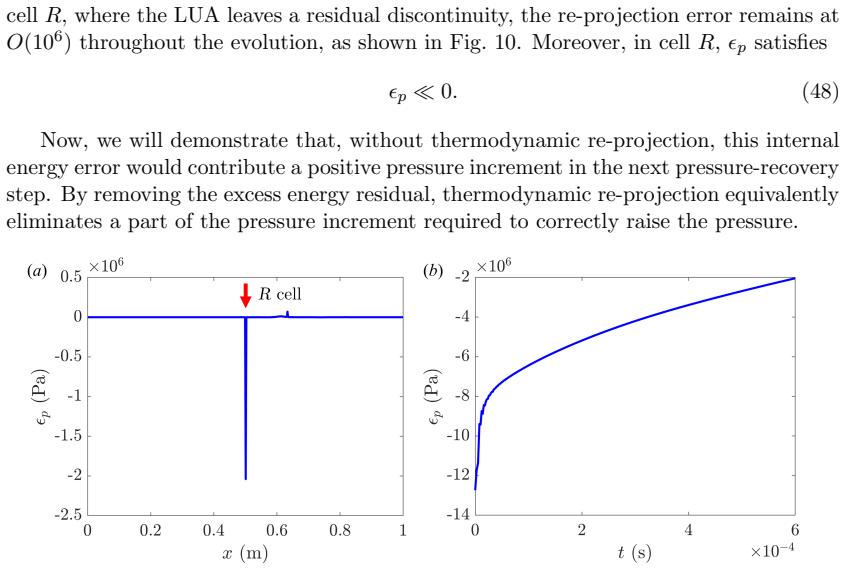
The central object is the isentropic affine relation rho e = xi p + E0, with xi = h/c^2 the isentropic slope and E0 the zero-pressure internal-energy intercept. The RFQC method advects (xi, E0) along pathlines instead of solving their isentropic source-term equations, reconstructs pressure as p = (rho e - E0)/xi, and re-projects the thermodynamic state each step; the re-projection converts the off-isentropic drift into an internal-energy error. The analysis of the anomaly is carried by a single-step pressure-increment equation (Eq. 37), whose terms Yb, Ys, YK, YH, plus the re-projection loss Yp, show that Yb is small and Yp removes the needed positive increment.
What would settle it
Add the removed re-projection increment Yp back into the pressure update, or disable the re-projection step, for the n-dodecane flash-evaporation case with u = 150 m/s and check whether the downstream cell's pressure rises to about 1.9 MPa and the rarefaction fan develops; if it does not, the Yb/Yp feedback mechanism is not the cause. Alternatively, run the same case with an equation of state for which xi is nearly constant across phase change and see whether the anomaly disappears.
Extended reading notes
Core claim
The central claim is that the Liquid-upwind Anomaly is not a random instability but a start-up singularity caused by the affine slope jump xi_R >> xi_L at a fully upwind phase-change interface. Under fully upwind conditions, the dominant positive pressure-increment term Yb = b xi_L (p_L - p) / xi_tilde^+ shrinks because the denominator is dominated by the large two-phase xi, and the thermodynamic re-projection, which is supposed to keep the method thermodynamically consistent, removes a positive increment Yp = -(1-a) epsilon_p / xi_tilde^+. With both contributions suppressed, the downstream cell's pressure rises far more slowly than the exact rarefaction solution requires, and the persistent
Load-bearing premise
The mechanism analysis assumes that both interfaces of the anomalous cell are fully upwind, so the upstream liquid cell stays constant and the downstream cell is updated only from its own state and the liquid state; if this degeneracy, or the closure q = xi p + E0 after re-projection, fails for other equations of state, higher-order reconstruction, or non-supersonic liquid velocities, the derived pressure-increment equation need not describe the failure.
Editorial extensions
If this is right
- If correct, RFQC's pressure recovery is mechanical-equilibrium recovery, and pressure oscillations in real fluids are a conflict between thermodynamic-equilibrium averaging and mechanical equilibrium, not an energy-equation closure issue.
- The LUA is a start-up anomaly tied to initial discontinuities, so practical real-fluid simulations with liquid-upwind phase-change starts should regularize initial data rather than modify the flux or time integrator.
- The regularized RFQC method reproduces the exact flash-evaporation Riemann solution and restores first-order convergence rates consistent with a Godunov method.
- The method remains stable and accurate for two-dimensional sonic phase-change jets, whereas the double-flux method shows severe oscillations even at first order.
- Because the mechanism depends on xi_R >> xi_L and full upwind, phase-change flows with lower advection speeds or supersonic liquid states may not exhibit LUA, explaining the observed threshold behavior.
Reading between the lines
- The paper leaves implicit that any quasi-conservative scheme that advects affine thermodynamic parameters and re-projects may show a similar failure; the Yb/Yp decomposition could generalize to other real-fluid methods.
- The tanh regularization is empirical (gamma = 0.2 to 1); a predictive threshold criterion based on the xi ratio and upwind Mach number could be derived and tested, turning the anomaly into a design rule.
- The paper's physical interpretation suggests re-projection error should be a controlled energy residual; a more fundamental fix might limit or redistribute the re-projection correction where isentrope curvature is extreme rather than smoothing initial data.
- Because the speed-of-sound drop in the two-phase region is physical, the same xi jump could affect any homogeneous-equilibrium-model scheme using a similar affine closure, so the LUA may appear in cavitation or flashing flows beyond n-dodecane.
Editorial analysis
A structured set of objections, weighed in public.
Referee Report
Summary. The paper revisits pressure oscillations in finite-volume methods for real fluids and interprets the Real Fluid Quasi-Conservative (RFQC) method as recovering a mechanical-equilibrium pressure by evolving the affine coefficients (ξ,E0) of the internal-energy–pressure relation along pathlines, with thermodynamic re-projection absorbing the deviation from the isentropic trajectory. The authors then identify a Liquid-Upwind Anomaly (LUA) in phase-change Riemann problems when a liquid-upwind velocity is superimposed on a high-pressure-liquid/low-pressure-vapor initial discontinuity. They derive a single-step pressure-update equation under a fully upwind assumption (Eq. 37), decompose it into four terms, and argue that the orders-of-magnitude jump in ξ during phase change makes the flux-induced term Y_b deficient, while thermodynamic re-projection removes the positive increment Y_p, producing a feedback loop that delays pressure rise in the downstream cell. A tanh-based initial-condition regularization is proposed and validated on 1D Riemann problems and 2D sonic phase-change jets.
Significance. If the claims hold, the paper offers a concrete physical/numerical mechanism for a previously unreported failure mode of RFQC and provides a practical remedy. The algebraic derivation in Appendix A is detailed and self-consistent, and the numerical diagnostics in Figs. 8–10 and 13 substantiate the decomposition for the tested cases. The paper's explicit comparison with the double-flux method and its use of exact Riemann solutions strengthen the numerical evidence. The authors are also candid about the empirical nature of the regularization. However, the central mechanism is derived under a restrictive fully upwind assumption whose domain is not established, and some of the conceptual claims in Section 3 are partly restatements of the method's construction rather than independent physical derivations. These issues do not invalidate the reported numerical results, but they limit the generality of the paper's central claim.
major comments (3)
- [§5.1, Eq. (30)] The derivation of the pressure-increment equation assumes that both interfaces of cell R satisfy the fully upwind one-sided flux condition Eq. (30). For the liquid cell L this requires right-going acoustic characteristics, u_L > c_L. The only justification given is 'c_L = 130 m/s; thus the cell L enters a fully upwind state under the condition of u_L = 150 m/s' (§5.1), and all presented test cases are sonic/supersonic (u_L/c_L ≈ 1.02–1.15 in §4 and §7). The abstract's 'exceeds a certain threshold' is never defined. If LUA also occurs for u_L < c_L, then Eq. (30) is violated and Eq. (37) cannot be the operative mechanism; if it does not, the paper's scope is narrower than claimed. Please define the threshold and provide tests for subsonic liquid-upwind starts, including a case with u_L < c_L.
- [§5.1, Eqs. (35)–(36)] The Φ update is written as \tilde ξ^+ = (1-b)ξ + bξ_L and \tilde E0^+ = (1-b)E0 + bE0,L, with b=θu_L. In contrast, the mass and energy updates use a=θu for the outflow weight (Eqs. 33, 62, 65). For the advection equation (25), a standard first-order upwind discretization with right-going flow would give (1-a)ξ + aξ_L. The choice of b in Eqs. (35)–(36) is not justified and directly enters Eq. (37), the decomposition (38)–(42), and the subsequent Y_b/Y_p feedback argument. Please state the exact discrete form of Eq. (25) used by RFQC; if the scheme genuinely uses u_L for the outflow coefficient, explain the derivation; if not, correct the analysis.
- [§3, Eqs. (3), (12)–(13)] The 'mechanical-equilibrium recovery' claim is partly a restatement of the construction: p is defined by (ρe−E0)/ξ in Eq. (3), and Eq. (12) simply extracts a common pressure from the affine relation under an assumed pressure-equilibrium average. The paper's physical interpretation of ξ and E0 along pathlines is useful, but it should clearly distinguish (i) the definition of the algorithm, (ii) the assumption that pressure equilibrium holds inside a cell, and (iii) the empirical/predictive content that justifies the method for real fluids. As written, Section 3 may overstate the explanatory power of the derivation.
minor comments (5)
- [Eq. (30)] The notation is ambiguous: F_{L+1/2} and F_{R-1/2} denote the same interface in Fig. 7, yet Eq. (30) writes them as F_L and F_R respectively. Clarify whether the intended statement is that the left interface of cell R has flux F_L and the right interface of cell R has flux F_R.
- [Abstract] The phrase 'exceeds a certain threshold' is never quantified in the body. Please either define the threshold or rephrase to match the actual condition used in §5.1.
- [§6] The regularization introduces γ and N_s as free parameters, but no sensitivity study is reported. The paper later states that the remedy is technical rather than fundamental; please add a brief sensitivity discussion or explicitly state that no predictive criterion is established.
- [§5, §7] The theoretical analysis assumes first-order spatio-temporal discretization, while Section 7 uses third-order WENO, second-order MUSCL, and SSP-RK3. The text acknowledges that high-order analysis is difficult; this limitation should be stated more prominently so the reader does not infer that the Eq. (37) mechanism directly proves the 2D high-order results.
- [§6, last paragraph] Typo: 'Eo' should be 'E0' in the discussion of reconstructed variables.
Circularity Check
No significant circularity: the LUA mechanism is derived from the discrete RFQC update equations and benchmarked against an exact Riemann solution, not assumed in the inputs.
full rationale
The LUA mechanism (Sections 4-5) is derived algebraically from the first-order RFQC update, the affine closure q = xi p + E0, and the fully-upwind assumption Eq. (30). Equation (37) is obtained in Appendix A from mass/momentum/energy and Phi updates; Eqs. (46) and (53) follow by approximation and by the definition of the re-projection error epsilon_p. These are internal derivations from stated algorithm equations, not fitted parameters renamed as predictions. The self-citations to Ref. [1] supply the numerical method under study, and Ref. [34] supplies an exact Riemann solution used as an external benchmark; neither reduces the paper's central claim to a self-citation chain. Section 3's 'mechanical-equilibrium recovery' is a consistency/interpretation restatement of Eq. (3), explicitly presented as construction ('We will construct the pressure recovery formulation from the affine relationship...'), rather than a prediction, so it is not scored as a circular step. The main caveat is a scope gap: Eq. (30) is justified only for the representative case u_L = 150 m/s > c_L = 130 m/s, and no general threshold is proved, so the mechanism's domain is not fully established. The paper itself acknowledges this in the limitation that the regularization is 'a technical remedy rather than a fundamental solution, as it relies on the empirical selection of a regularization parameter.' These are correctness/rigor limitations, not circularity.
Assumptions & free parameters
free parameters (2)
- Regularization parameter gamma =
0.2-1.0 (gamma=1.0 for rho_l=320 kg/m3 jet, gamma=0.8 for rho_l=450 kg/m3 jet)
- Number of transition cells N_s =
2 (all cases)
assumptions (6)
- standard math Isentropic evolution Ds/Dt=0 in smooth regions of the Euler equations
- domain assumption The affine decomposition rho e = xi p + E0 with cell-averaged xi,E0 represents mechanical equilibrium of the cell (Eq. 12)
- domain assumption Thermodynamic re-projection recomputing the state from (rho,p) keeps the method thermodynamically consistent (Sec. 3.2, Eq. 47)
- ad hoc to paper Fully upwind one-sided flux condition at both interfaces of the anomalous cell (Eq. 30)
- domain assumption The exact Riemann solution of Ref. [34] supplies the 'correct' wave structure and the 1.9 MPa pressure increment
- domain assumption Convergence of the regularized initial condition to the original Riemann data as gamma -> 0 and the grid refines
Cite this review
Pith. "Pith review of Real Fluid Quasi-Conservative Method: Mechanical Equilibrium Mechanism and Liquid-Upwind Anomaly." pith.science (2026). https://pith.science/paper/HD7NUI7R
@misc{pith2026260713996,
  author       = {Pith},
  title        = {Pith review of: Real Fluid Quasi-Conservative Method: Mechanical Equilibrium Mechanism and Liquid-Upwind Anomaly},
  year         = {2026},
  howpublished = {\url{https://pith.science/paper/HD7NUI7R}},
  note         = {Machine review of arXiv:2607.13996}
}
read the original abstract
From the perspective of continuum thermodynamics, we revisit the pressure oscillation problem in finite-volume methods for real fluids and clarify the physical counterpart of the Real Fluid Quasi-Conservative (RFQC) method. The RFQC method recovers the mechanical-equilibrium pressure by evolving the affine parameters xi and E0 of the isentropic internal energy-pressure relation along pathlines, while the thermodynamic re-projection converts the deviation from the isentropic trajectory into an internal-energy error, thereby ensuring the thermodynamic consistency and numerical stability of the method. We then investigate the applicability limit of the RFQC method and identify a Liquid-upwind Anomaly (LUA) in extreme phase-change cases. For a Riemann problem involving liquid-vapor phase change, a numerical anomaly may occur if a liquid-upwind translational velocity is initially superimposed and exceeds a certain threshold. Theoretical analysis reveals that this anomaly is initiated by the orders-of-magnitude jump in the affine slope xi during phase change, which subsequently delays the pressure rise in the downstream low-pressure cell. Concurrently, the re-projection equivalently removes the positive pressure increment. As a result, a large re-projection internal-energy error is repeatedly generated in this anomalous cell, and the cell is trapped in a cycle of delayed low-pressure recovery. The analysis indicates that the LUA is a start-up anomaly, which can be resolved by introducing a regularization strategy at the initial discontinuity. With the proposed regularization strategy, the RFQC method is equipped with enhanced accuracy and robustness for extreme thermodynamic flows, such as sonic phase-change jets.
Figures


Figures from the paper (17 more)




Reference graph
Works this paper leans on
-
[1]
H. Bai, W. Xie, Y. Yang, P. Yi, M. Sun, An oscillation-free real fluid quasi- conservative finite volume method for transcritical and phase-change flows,J. Com- put. Phys. 564 (2026) 115156
2026
-
[2]
Abgrall, How to prevent pressure oscillations in multicomponent flow calcula- tions: a quasi conservative approach, J
R. Abgrall, How to prevent pressure oscillations in multicomponent flow calcula- tions: a quasi conservative approach, J. Comput. Phys. 125 (1996) 150–160
1996
-
[3]
Karni, Multicomponent flow calculations by a consistent primitive algorithm, J
S. Karni, Multicomponent flow calculations by a consistent primitive algorithm, J. Comput. Phys. 112 (1994) 31–43
1994
-
[4]
Abgrall, S
R. Abgrall, S. Karni, Computations of compressible multifluids, J. Comput. Phys. 169 (2001) 594–623
2001
-
[5]
Baer, J.W
M.R. Baer, J.W. Nunziato, A two-phase mixture theory for the deflagration-to- detonation transition (DDT) in reactive granular materials, Int. J. Multiphase Flow 12 (1986) 861–889
1986
-
[6]
Saurel, R
R. Saurel, R. Abgrall, A multiphase Godunov method for compressible multifluid and multiphase flows, J. Comput. Phys. 150 (1999) 425–467
1999
-
[7]
Saurel, F
R. Saurel, F. Petitpas, R.A. Berry, Simple and efficient relaxation methods for interfaces separating compressible fluids, cavitating flows and shocks in multiphase mixtures, J. Comput. Phys. 228 (2009) 1678–1712
2009
-
[8]
Pelanti, K.M
M. Pelanti, K.M. Shyue, A mixture-energy-consistent six-equation two-phase nu- merical model for fluids with interfaces, cavitation and evaporation waves, J. Com- put. Phys. 259 (2014) 331–357
2014
Show all 39 references
-
[9]
Kapila, R
A.K. Kapila, R. Menikoff, J.B. Bdzil, S.F. Son, D.S. Stewart, Two-phase modeling of deflagration-to-detonation transition in granular materials: reduced equations, Phys. Fluids 13 (2001) 3002–3024. 35
2001
-
[10]
Murrone, H
A. Murrone, H. Guillard, A five equation reduced model for compressible two phase flow problems, J. Comput. Phys. 202 (2005) 664–698
2005
-
[11]
Allaire, S
G. Allaire, S. Clerc, S. Kokh, A five-equation model for the simulation of interfaces between compressible fluids, J. Comput. Phys. 181 (2002) 577–616
2002
-
[12]
Shyue, An efficient shock-capturing algorithm for compressible multicompo- nent problems, J
K.M. Shyue, An efficient shock-capturing algorithm for compressible multicompo- nent problems, J. Comput. Phys. 142 (1998) 208–242
1998
-
[13]
Johnsen, T
E. Johnsen, T. Colonius, Implementation of WENO schemes in compressible mul- ticomponent flow problems, J. Comput. Phys. 219 (2006) 715–732
2006
-
[14]
Shyue, A fluid-mixture type algorithm for compressible multicomponent flow with Mie–Gr¨ uneisen equation of state, J
K.M. Shyue, A fluid-mixture type algorithm for compressible multicomponent flow with Mie–Gr¨ uneisen equation of state, J. Comput. Phys. 171 (2001) 678–707
2001
-
[15]
Shyue, A fluid-mixture type algorithm for compressible multicomponent flow with van der Waals equation of state, J
K.M. Shyue, A fluid-mixture type algorithm for compressible multicomponent flow with van der Waals equation of state, J. Comput. Phys. 156 (1999) 43–88
1999
-
[16]
Pantano, R
C. Pantano, R. Saurel, T. Schmitt, An oscillation free shock-capturing method for compressible van der Waals supercritical fluid flows, J. Comput. Phys. 335 (2017) 780–811
2017
-
[17]
Billet, R
G. Billet, R. Abgrall, An adaptive shock-capturing algorithm for solving unsteady reactive flows, Comput. Fluids 32 (2003) 1473–1495
2003
-
[18]
Karni, Viscous shock profiles and primitive formulations, SIAM J
S. Karni, Viscous shock profiles and primitive formulations, SIAM J. Numer. Anal. 29 (6) (1992) 1592–1609
1992
-
[19]
Karni, Hybrid multifluid algorithms, SIAM J
S. Karni, Hybrid multifluid algorithms, SIAM J. Sci. Comput. 17 (5) (1996) 1019– 1039
1996
-
[20]
Brennen, Fundamentals of Multiphase Flow, Cambridge University Press, 2005
C.E. Brennen, Fundamentals of Multiphase Flow, Cambridge University Press, 2005
2005
-
[21]
D. Peng, D. Robinson, A new two-constant equation of state, Ind. Eng. Chem. Fundam. 15 (1) (1976) 59–64
1976
-
[22]
Redlich, J
O. Redlich, J. Kwong, On the thermodynamics of solutions; An equation of state; Fugacities of gaseous solutions, Chem. Rev. 44 (1) (1949) 233–237
1949
-
[23]
Terashima, M
H. Terashima, M. Koshi, Approach for simulating gas-liquid-like flows under su- percritical pressures using a high-order central differenceencing scheme, J. Comput. Phys. 231 (20) (2012) 6907–6923
2012
-
[24]
Kawai, H
S. Kawai, H. Terashima, H. Negishi, A robust and accurate numerical method for transcritical turbulent flows at supercritical pressure with an arbitrary equation of state, J. Comput. Phys. 300 (2015) 116–135. 36
2015
-
[25]
Kitamura, E
K. Kitamura, E. Shima, Pressure-equation-based SLAU2 for oscillation-free, super- critical flow simulations, Comput. Fluids 163 (2018) 86–96
2018
- [26]
-
[27]
B. Xu, C. Sun, P. Guo, A central differential flux with high-order dissipation for robust simulations of transcritical flows, J. Comput. Phys. 550 (2026) 114653
2026
-
[28]
Lacaze, T
G. Lacaze, T. Schmitt, et al., Comparison of energy-, pressure- and enthalpy-based approaches for modeling supercritical flows, Comput. Fluids 181 (2019) 35–56
2019
-
[29]
Terashima, N
H. Terashima, N. Ly, M. Ihme, Approximately pressure-equilibrium-preserving scheme for fully conservative simulations of compressible multi-species and real- fluid interfacial flows, J. Comput. Phys. 524 (2025) 113701
2025
-
[30]
P.C. Ma, Y. Lv, M. Ihme, An entropy-stable hybrid scheme for simulations of transcritical real-fluid flows, J. Comput. Phys. 340 (2017) 330–357
2017
-
[31]
Rodriguez, A
C. Rodriguez, A. Vidal, P. Koukouvinis, M. Gavaises, M.A. McHugh, Simulation of transcritical fluid jets using the PC-SAFT EOS, J. Comput. Phys. 374 (2018) 444–468
2018
-
[32]
Yatsuyanagi, T
S. Yatsuyanagi, T. Furusawa, S. Yamamoto, Double-flux model for supercritical multicomponent flows at low Mach numbers with preconditioning method, J. Com- put. Phys. 458 (2022) 111091
2022
-
[33]
Zhang, N
H.Y. Zhang, N. Srinivasan, S. Yang, In situ adaptive tabulation of vapor-liquid equi- librium solutions for multi-component high-pressure transcritical flows with phase change, J. Comput. Phys. 500 (2024) 112752
2024
-
[34]
H. Bai, P. Yi, Y. Yang, G. Zhao, W. Xie, M. Sun, Flash evaporation Riemann problem: formulation and its exact solution, J. Fluid Mech. 1038 (2026) A35
2026
-
[35]
Sedov, Mechanics of a Continuous Medium, Nauka, 1973
L.I. Sedov, Mechanics of a Continuous Medium, Nauka, 1973
1973
-
[36]
Toro, Riemann Solvers and Numerical Methods for Fluid Dynamics, 3rd edn., Springer, 2009
E.F. Toro, Riemann Solvers and Numerical Methods for Fluid Dynamics, 3rd edn., Springer, 2009
2009
-
[37]
Shu and S
C.-W. Shu and S. Osher, Efficient implementation of essentially non-oscillatory shock-capturing schemes, J. Comput. Phys. 77 (2) (1988) 439–471
1988
-
[38]
Jiang and C.-W
G.-S. Jiang and C.-W. Shu, Efficient implementation of weighted ENO schemes, J. Comput. Phys. 126 (1) (1996) 202–228
1996
-
[39]
Sweby, High resolution schemes using flux limiters for hyperbolic conservation laws, SIAM J
P.K. Sweby, High resolution schemes using flux limiters for hyperbolic conservation laws, SIAM J. Numer. Anal. 21 (5) (1984) 995–1011. 37
1984
Reviewed August 2, 2026 · model on record in the stance chip above.
Discussion (0). Continue with ORCID to comment.