REVIEW 4 major objections 4 minor 33 references
Industrial Dexterity Benchmark: A Hardware-Software Benchmarking Platform for Industrial Dexterous Manipulation
T0 review · 4 major / 4 minor · reviewed 2026-08-02 · deepseek-v4-flash
Pith's one-line read Multimodal imitation-learning policy reaches 78% on industrial cable insertion.
desk verdict A solid, honest systems paper with a useful new benchmark and a clear ablation study, but the abstract overclaims a head-to-head win over classical methods that the paper never actually ran. read the letter →
The pith
A machine-rendered reading of the paper's core claim, the machinery that carries it, and where it could break.
The reading
What carries the argument
The load-bearing mechanism is the multimodal diffusion policy AG-iDP3: RGB images from one or two cameras are encoded with a fine-tuned R3M ResNet backbone, scene point clouds with PointNet, while joint positions and wrist wrench are concatenated unencoded; all features feed a diffusion U-Net that outputs short action chunks. Modality gating lets the same template disable the wrench input except during the contact-rich insert phase. Output chunks are blended by exponential temporal ensembling and streamed as a smooth command signal through an impedance controller, while a behavior tree pairs each learned phase policy with a classical evaluator that decides when the phase has finished.
What would settle it
Run the best configuration on the same benchmark board without the cropping and pulley workarounds, introducing a modest scene change such as removing a background object or slack in the cable; if the grasp+insert success collapses toward the 36% single-camera baseline, the robustness claim is contradicted. Alternatively, count full-chain trials (grasp, clean, and insert all succeeding on the same trial) and check whether the composite score remains above the classical pipeline's performance.
Extended reading notes
Core claim
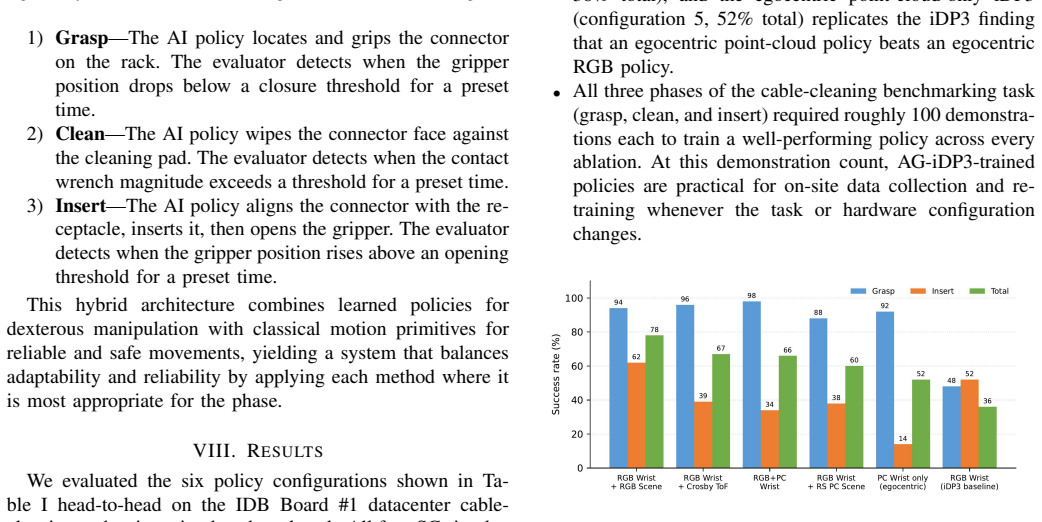
On the paper's own terms, the central claim is that a multimodal expansion of the diffusion-policy architecture—AG-iDP3—fusing wrist and scene RGB images encoded by R3M, point clouds, joint positions, and wrist wrench, can be trained with roughly 100 teleoperated demonstrations per phase and solve a tight-clearance industrial cable-cleaning and re-insertion task on a physical benchmark board. Across 48 trials, the best configuration scores 78% on the combined grasp+insert metric, more than double the 36% of the single-camera RGB baseline, and every tested configuration with 3-D or multi-view context outperforms the RGB-only baseline. The authors argue this demonstrates that learned policies,
Load-bearing premise
The paper's claim that learned policies are more robust and generalizable than classical pipelines rests on the assumption that the visual encoder's tendency to latch onto incidental scene features—which caused failures when a background object was removed or a cable rerouted—can be fixed with cropping and cable-management workarounds rather than being an inherent instability of the approach.
Editorial extensions
If this is right
- If the 78% result holds, a single imitation-learning policy family can handle contact-rich, tight-clearance insertion with far fewer demonstrations than classical perception pipelines require.
- Combining multiple RGB viewpoints, rather than point clouds alone, appears to be the decisive factor for fine insertion when point-cloud resolution cannot resolve receptacle features.
- The six-configuration ablation maps sensor cost against success rate, giving practitioners a concrete trade-off for similar industrial tasks.
- The hybrid behavior tree—learned policy plus classical evaluator plus classical motion primitives—offers a way to deploy per-phase learned policies without building one monolithic end-to-end controller.
- Direct time-of-flight scene sensing matched or beat stereo depth in the head-to-head comparison, suggesting a robustness advantage in industrial lighting conditions.
Reading between the lines
- The reported 78% is a per-phase sum (grasp successes plus insert successes divided by opportunities), not a full grasp-to-clean-to-insert chain completion rate; a chain-success metric would likely be lower and would sharpen the benchmark.
- The acknowledged brittleness to background changes and cable routing suggests the policy's success partly rests on incidental visual features; a stricter test of the robustness claim would run the same configuration on varied clutter and lighting without the cropping and cable-management workarounds.
- Because point-cloud resolution limited insertion, the configuration ranking might shift with a higher-resolution point-cloud encoder, so the headline comparison is more precisely 'multi-view RGB, and to a lesser extent 3-D context, beats single-camera RGB.'
- The 100-demonstrations-per-phase claim invites a scaling test: if performance degrades sharply with 50 or 75 demonstrations, the practical deployment-efficiency advantage narrows.
Signed reviews
Editorial analysis
A structured set of objections, weighed in public.
Referee Report
Summary. The paper introduces three artifacts: IDB benchmark boards for industrial dexterous manipulation, the DAG-ROS imitation-learning infrastructure, and the AG-iDP3 multimodal diffusion policy framework. On the datacenter cable-cleaning task (IDB Board #1), it evaluates six sensor configurations with 48 trials each and reports that the best multimodal configuration (dual RGB with fine-tuned R3M) achieves a 78% combined grasp+insert success rate versus 36% for a single-camera RGB DP baseline, using roughly 100 teleoperated demonstrations per phase. The abstract and conclusion further claim that the correct learned policy outperforms classical vision-and-control pipelines in robustness, generalization, and deployment efficiency.
Significance. If the empirical results are taken at face value, the IDB Board #1 is a useful, low-cost, physical benchmark for contact-rich deformable-object manipulation, and the systematic ablation of camera/wrench modalities with real teleoperated demonstrations is a useful contribution. The open-source board designs and the hybrid behavior-tree deployment pattern are also practical strengths. However, the central comparative claim against classical pipelines is not supported by the experiments as reported: no classical baseline is run on IDB Board #1, and the paper's own Section VIII-D documents clear brittleness of the learned policy to small scene changes. The composite per-phase scoring and the post-hoc selection of gating/cropping further weaken the headline numbers. The paper is better framed as a sensor-ablation study and benchmark introduction than as evidence that learned policies generally outperform classical methods; with appropriate claim-tempering and additional experiments it could become a solid contribution.
major comments (4)
- [Abstract; §IX; §VIII-C] The abstract and conclusion state that the learned policy 'can outperform classical vision and control robotic methods in robustness, generalization, and deployment efficiency.' No classical pipeline is evaluated on IDB Board #1 under the same 48-trial protocol. Section II-B describes the classical pipeline only on NIST ATB4, and Section VIII-C compares deployment effort only qualitatively. Without a same-task classical baseline, the superiority claim is untestable. This is load-bearing for the paper's central conclusion; either add such a baseline or restrict the claims to comparisons among learned configurations.
- [§VIII-D] The paper reports that removing a background object (red polymer block) or changing the routing of a cable along the robot arm caused the learned policy to fail, and that the underlying issue is that 'the visual encoder appears to latch onto incidental scene features rather than task-relevant ones.' This directly contradicts the abstract's robustness and generalization claims. The mitigations (image cropping, pulley-based cable management) are task-specific engineering fixes, not evidence of generalizable robustness. Please either provide a systematic robustness evaluation under controlled perturbations or substantially temper the abstract/conclusion.
- [§VIII-A and scoring definition] The total score is defined as (Grasp Success + Insert Success)/96, with cleaning excluded because it always succeeded. This is a composite of per-phase successes, not an end-to-end task success rate: a trial that grasps but fails to insert still contributes a point. The abstract's '78% grasp and insert combined task success rate' is therefore not a complete-task success rate. Additionally, no confidence intervals or significance tests are reported for the 48-trial rates; statements such as 'significant improvement' (abstract and §VIII-A) are not statistically supported. Please report end-to-end task success and interval estimates.
- [§V-B and §VIII-D] Several configuration decisions appear to have been made after observing results: per-phase wrench gating was chosen because 'wrench input only helped during the insert phase' (§V-B), and image cropping was adopted after failures (§VIII-D). The headline 78% figure therefore does not correspond to a fixed, pre-specified protocol but to a configuration selected with knowledge of the outcome. No validation set, repeated-seed statistics, or pre-registration is reported. Please clarify the protocol and quantify the selection bias, or present results for the pre-specified configuration.
minor comments (4)
- [Table I and §III] The sensor name is inconsistently written as 'EV AL-ADTF3175' and 'EVAL-ADTF3175'; please standardize to the correct product designation.
- [§VIII-A] The claim that each phase required 'roughly 100 demonstrations' is not supported by a table or exact counts; please provide per-phase and per-configuration demonstration counts, plus training details.
- [Fig. 12] The bar chart would benefit from error bars or confidence intervals, and from a per-port breakdown, given the paper's own caveat that ports 2 and 3 had higher success rates than ports 1 and 4.
- [References] Reference [26] has inconsistent capitalization ('Crisp - compliant ros2 controllers for learning-based manipulation policies and teleoperation'); please format it consistently.
Circularity Check
No substantive circularity: results are empirical measurements, not derivations.
full rationale
The paper reports measured task success rates for six policy configurations on a physical benchmark board. There is no derivation chain in which an output is constructed from its own inputs: the 78% vs 36% headline numbers are experimental observations from 48 trials per configuration, not predictions obtained by fitting. The R3M encoder is fine-tuned on task demonstrations and the best configuration is selected from the reported results, but this is standard empirical model selection rather than a definitional or statistical tautology; no equation reduces a claimed result to an assumed input. The only self-referential material is the authors' earlier classical ATB4 proof of concept, which serves as motivation and is not load-bearing for the quantitative comparison. The abstract's broad claim that learned policies outperform classical methods in robustness and generalization is not directly supported by a same-task classical baseline, and Section VIII-D documents brittleness that undercuts that claim; however, these are correctness and evidence concerns, not circularity. No self-citation is invoked to justify a central premise, and no uniqueness theorem or ansatz is imported from the authors' prior work. Accordingly, the appropriate circularity score is low.
Assumptions & free parameters
free parameters (6)
- Temporal ensembling decay k =
0.01
- Committed steps N per action chunk =
3
- Action chunk length T =
15
- Per-phase wrench gating =
grasp: off, clean: off, insert: on
- Image cropping for training/deployment =
cropped to controlled task area
- R3M backbone fine-tuning =
fine-tuned on task demonstrations
assumptions (5)
- domain assumption The IDB boards are faithful representatives of the targeted real-world tasks (datacenter cable management, automotive harnesses, gearbox assembly).
- domain assumption The four tested SC simplex ports are interchangeable samples of task difficulty.
- domain assumption Standard diffusion-policy and imitation-learning assumptions hold (e.g., demonstrations are i.i.d. and the test distribution matches training aside from documented changes).
- domain assumption The classical pipeline of Section II-B is a representative baseline for classical vision-and-control approaches.
- ad hoc to paper The composite scoring metric (Grasp + Insert)/96 is a meaningful measure of task capability.
Cite this review
Pith. "Pith review of Industrial Dexterity Benchmark: A Hardware-Software Benchmarking Platform for Industrial Dexterous Manipulation." pith.science (2026). https://pith.science/paper/MYURH23N
@misc{pith2026260714021,
  author       = {Pith},
  title        = {Pith review of: Industrial Dexterity Benchmark: A Hardware-Software Benchmarking Platform for Industrial Dexterous Manipulation},
  year         = {2026},
  howpublished = {\url{https://pith.science/paper/MYURH23N}},
  note         = {Machine review of arXiv:2607.14021}
}
read the original abstract
Dexterous manipulation remains a critical bottleneck in industrial automation; tasks such as cable routing, connector insertion, and precision assembly still rely heavily on manual labor despite decades of robotics research. This work presents a progression from classical, modular robotics pipelines toward an end-to-end multimodal imitation-learning framework for industrial dexterous manipulation. As a part of this work, we introduce three key contributions: a set of Industrial Dexterity Benchmark (IDB) boards aimed to mimic datacenter cable management, automotive cable harnesses, and gearbox assembly tasks; a scalable imitation learning framework (DAG-ROS); and a multimodal diffusion-based policy framework (AG-iDP3) that creates models fusing RGB images, point clouds, joint positions, and wrist-frame wrench data. Focusing on the datacenter cable manipulation board, we evaluate the performance of a task involving cleaning a single cable over variations of an end-to-end AI policy using 48 trials per configuration. The best performing configuration, a multimodal expansion Diffusion Policy (DP), includes a multi-view RGB image source passed through an R3M encoder and reaches a 78% grasp and insert combined task success rate. This performance marks a significant improvement over the 36% observed from the single-camera RGB DP baseline. Each of the tested configurations requires only approximately 100 teleoperated demonstrations per task phase. These results indicate that the correct learned policy can outperform classical vision and control robotic methods in robustness, generalization, and deployment efficiency, justifying a shift toward scalable robotic automation for high up-time industrial environments.
Figures


Figures from the paper (8 more)


Reference graph
Works this paper leans on
-
[1]
Overview of the state of the art in the production process of automotive wire harnesses, current research and future trends,
J. Trommnau, J. K ¨uhnle, J. Siegert, R. Inderka, and T. Bauernhansl, “Overview of the state of the art in the production process of automotive wire harnesses, current research and future trends,”Procedia CIRP, vol. 81, pp. 387–392, 2019
2019
-
[2]
Wire harness assembly process supported by collaborative robots: Literature review and call for R&D,
G. E. Navas-Reascos, D. Romero, J. Stahre, and A. Caballero-Ruiz, “Wire harness assembly process supported by collaborative robots: Literature review and call for R&D,”Robotics, vol. 11, no. 3, p. 65, 2022
2022
-
[3]
L. A. Barroso, U. H ¨olzle, and P. Ranganathan,The Datacenter as a Computer: Designing Warehouse-Scale Machines. Synthesis Lectures on Computer Architecture, Morgan & Claypool Publishers, 3rd ed., 2018
2018
-
[4]
Physical deployability matters,
J. C. Mogul and J. Wilkes, “Physical deployability matters,” inProceed- ings of the 22nd ACM Workshop on Hot Topics in Networks (HotNets), pp. 46–52, 2023
2023
-
[5]
Min- imal rewiring: Efficient live expansion for Clos data center networks,
S. Zhao, R. Wang, J. Zhou, J. Ong, J. C. Mogul, and A. Vahdat, “Min- imal rewiring: Efficient live expansion for Clos data center networks,” inProceedings of the 16th USENIX Symposium on Networked Systems Design and Implementation (NSDI), pp. 221–236, 2019
2019
-
[6]
Performance measures to benchmark the grasping, manipulation, and assembly of deformable objects typical to manufacturing applications,
K. Kimble, C. Albrecht, M. Zimmerman, and J. Falco, “Performance measures to benchmark the grasping, manipulation, and assembly of deformable objects typical to manufacturing applications,”Frontiers in Robotics and AI, vol. 9, p. 999348, 2022
2022
-
[7]
Benchmarking protocols for evaluating small parts robotic assembly systems,
K. Kimble, K. Van Wyk, J. Falco, E. Messina, Y . Sun, M. Shibata, W. Uemura, and Y . Yokokohji, “Benchmarking protocols for evaluating small parts robotic assembly systems,”IEEE Robotics and Automation Letters, vol. 5, no. 2, pp. 883–889, 2020
2020
-
[8]
Challenges and outlook in robotic manipulation of deformable objects,
J. Zhu, A. Cherubini, C. Dune, D. Navarro-Alarcon, F. Alambeigi, D. Berenson, F. Ficuciello, K. Kondo, X. Li, J. Machado, and J. Main- price, “Challenges and outlook in robotic manipulation of deformable objects,”IEEE Robotics & Automation Magazine, vol. 29, no. 3, pp. 38– 55, 2022
2022
Show all 33 references
-
[9]
Self-maintaining [networked] systems: The rise of datacenter robotics!,
F. Hong, I. Sarantopoulos, E. Hogg, X. Ma, T. Sherwood, and J. C. Mogul, “Self-maintaining [networked] systems: The rise of datacenter robotics!,” inProceedings of the 23rd ACM Workshop on Hot Topics in Networks (HotNets), pp. 115–121, 2024
2024
-
[10]
Ultralytics yolo11,
G. Jocher and J. Qiu, “Ultralytics yolo11,” 2024
2024
-
[11]
FoundationStereo: Zero-shot stereo matching,
B. Wen, M. Trepte, J. Aribido, J. Kautz, O. Gallo, and S. Birchfield, “FoundationStereo: Zero-shot stereo matching,” inProceedings of the IEEE/CVF Conference on Computer Vision and Pattern Recognition (CVPR), 2025
2025
-
[12]
FoundationPose: Unified 6D pose estimation and tracking of novel objects,
B. Wen, W. Yang, J. Kautz, and S. Birchfield, “FoundationPose: Unified 6D pose estimation and tracking of novel objects,” inProceedings of the IEEE/CVF Conference on Computer Vision and Pattern Recognition (CVPR), 2024
2024
-
[13]
Diffusion policy: Visuomotor policy learning via action diffusion,
C. Chi, S. Feng, Y . Du, Z. Xu, E. Cousineau, B. Burchfiel, and S. Song, “Diffusion policy: Visuomotor policy learning via action diffusion,” in Proceedings of Robotics: Science and Systems (RSS), 2023
2023
-
[14]
Denoising diffusion probabilistic models,
J. Ho, A. Jain, and P. Abbeel, “Denoising diffusion probabilistic models,” inAdvances in Neural Information Processing Systems (NeurIPS), vol. 33, pp. 6840–6851, 2020
2020
-
[15]
3D Diffusion Policy: Generalizable visuomotor policy learning via simple 3D representations,
Y . Ze, G. Zhang, K. Zhang, C. Hu, M. Wang, and H. Xu, “3D Diffusion Policy: Generalizable visuomotor policy learning via simple 3D representations,” inProceedings of Robotics: Science and Systems (RSS), 2024
2024
-
[16]
Generalizable humanoid manipulation with improved 3D diffusion policies,
Y . Ze, Z. Chen, W. Wang, T. Chen, X. He, Y . Yuan, X. B. Peng, and J. Wu, “Generalizable humanoid manipulation with improved 3D diffusion policies,” inIEEE/RSJ International Conference on Intelligent Robots and Systems (IROS), 2025
2025
-
[17]
DexDiffuser: Generating dexterous grasps with diffusion models,
Z. Weng, H. Lu, D. Kragic, and J. Lundell, “DexDiffuser: Generating dexterous grasps with diffusion models,”IEEE Robotics and Automation Letters, vol. 9, no. 12, pp. 11459–11466, 2024
2024
-
[18]
Universal manipulation interface: In-the-wild robot teach- ing without in-the-wild robots,
C. Chi, Z. Xu, C. Pan, E. Cousineau, B. Burchfiel, S. Feng, R. Tedrake, and S. Song, “Universal manipulation interface: In-the-wild robot teach- ing without in-the-wild robots,” inProceedings of Robotics: Science and Systems (RSS), 2024
2024
-
[19]
DexHandDiff: Interaction- aware diffusion planning for adaptive dexterous manipulation,
Z. Liang, Y . Mu, Y . Wang, and T. Chen, “DexHandDiff: Interaction- aware diffusion planning for adaptive dexterous manipulation,” inPro- ceedings of the IEEE/CVF Conference on Computer Vision and Pattern Recognition (CVPR), 2025
2025
-
[20]
Dex- Cap: Scalable and portable mocap data collection system for dexterous manipulation,
C. Wang, H. Shi, W. Wang, R. Zhang, L. Fei-Fei, and C. K. Liu, “Dex- Cap: Scalable and portable mocap data collection system for dexterous manipulation,” inProceedings of Robotics: Science and Systems (RSS), 2024
2024
-
[21]
Dexterous functional pre-grasp manipulation with diffusion policy,
T. Wu, Y . Gan, M. Wu, J. Cheng, Y . Yang, Y . Zhu, and H. Dong, “Dexterous functional pre-grasp manipulation with diffusion policy,” arXiv preprint arXiv:2403.12421, 2024
2024 arXiv
-
[22]
R3M: A universal visual representation for robot manipulation,
S. Nair, A. Rajeswaran, V . Kumar, C. Finn, and A. Gupta, “R3M: A universal visual representation for robot manipulation,” inProceedings of the 6th Conference on Robot Learning (CoRL), vol. 205 ofProceedings of Machine Learning Research, pp. 892–909, PMLR, 2022
2022
-
[23]
PointNet: Deep learning on point sets for 3D classification and segmentation,
C. R. Qi, H. Su, K. Mo, and L. J. Guibas, “PointNet: Deep learning on point sets for 3D classification and segmentation,” inProceedings of the IEEE Conference on Computer Vision and Pattern Recognition (CVPR), 2017
2017
-
[24]
Robot operating system 2: Design, architecture, and uses in the wild,
S. Macenski, T. Foote, B. Gerkey, C. Lalancette, and W. Woodall, “Robot operating system 2: Design, architecture, and uses in the wild,”Science Robotics, vol. 7, no. 66, p. eabm6074, 2022
2022
-
[25]
GELLO: A general, low-cost, and intuitive teleoperation framework for robot manipulators,
P. Wu, Y . Shentu, Z. Yi, X. Lin, and P. Abbeel, “GELLO: A general, low-cost, and intuitive teleoperation framework for robot manipulators,” inProceedings of Robotics: Science and Systems (RSS), 2024
2024
-
[26]
Crisp - compliant ros2 controllers for learning-based manipulation policies and teleoperation,
D. S. J. Pro, O. Hausd ¨orfer, R. R ¨omer, M. D ¨osch, M. Schuck, and A. P. Schoellig, “Crisp - compliant ros2 controllers for learning-based manipulation policies and teleoperation,” 2025
2025
-
[27]
Deep residual learning for image recognition,
K. He, X. Zhang, S. Ren, and J. Sun, “Deep residual learning for image recognition,” inProceedings of the IEEE Conference on Computer Vision and Pattern Recognition (CVPR), pp. 770–778, 2016
2016
-
[28]
High-speed high-accuracy spatial curve tracking using motion primitives in industrial robots,
H. He, C.-l. Lu, Y . Wen, G. Saunders, P. Yang, J. Schoonover, J. Wason, A. Julius, and J. T. Wen, “High-speed high-accuracy spatial curve tracking using motion primitives in industrial robots,” in2023 IEEE In- ternational Conference on Robotics and Automation (ICRA), pp. 1228...
2023
-
[29]
Fast and accurate relative motion tracking for dual industrial robots,
H. He, C.-L. Lu, G. Saunders, J. Wason, P. Yang, J. Schoonover, L. Ajdelsztajn, S. Paternain, A. Julius, and J. T. Wen, “Fast and accurate relative motion tracking for dual industrial robots,”IEEE Robotics and Automation Letters, vol. 9, no. 11, pp. 10153–10160, 2024
2024
-
[30]
Learning fine-grained bimanual manipulation with low-cost hardware,
T. Z. Zhao, V . Kumar, S. Levine, and C. Finn, “Learning fine-grained bimanual manipulation with low-cost hardware,” inProceedings of Robotics: Science and Systems (RSS), 2023
2023
-
[31]
Colledanchise and P
M. Colledanchise and P. ¨Ogren,Behavior Trees in Robotics and AI: An Introduction. CRC Press, 2018
2018
-
[32]
Sim ´eoni, H
O. Sim ´eoni, H. V . V o, M. Seitzer, F. Baldassarre, M. Oquab, C. Jose, V . Khalidov, and M. Szafraniec, “DINOv3,”arXiv preprint arXiv:2508.10104, 2025
2025 arXiv
-
[33]
Scalable diffusion models with transformers,
W. Peebles and S. Xie, “Scalable diffusion models with transformers,” inProceedings of the IEEE/CVF International Conference on Computer Vision (ICCV), pp. 4195–4205, 2023
2023
Reviewed August 2, 2026 · model on record in the stance chip above.
Discussion (0). Continue with ORCID to comment.