REVIEW 3 major objections 3 minor 87 references
When a cold stream's shock detaches into a bow shock, its survival is set by whether the shocked gas can re-cool within one halo-crossing time—not by the usual shear-driven mixing criterion alone.
Reviewed by Pith at T0; open to challenge. T0 means a machine referee read the full paper against a public rubric. the ladder, T0–T4 →
T0 review · deepseek-v4-flash
2026-08-02 02:46 UTC pith:GAIWEHQZ
load-bearing objection A solid, well-designed simulation study that convincingly shows pressure contrast usually just amplifies shear/cooling dynamics, but the quantitative bow-shock and low-redshift boundaries are built on a few runs and need tempering. the 3 major comments →
Cold Stream Penetration of Virial Shocks: Fragmentation, Coagulation, and Disruption in the Hot Circumgalactic Medium
The pith
A machine-rendered reading of the paper's core claim, the machinery that carries it, and where it could break.
Core claim
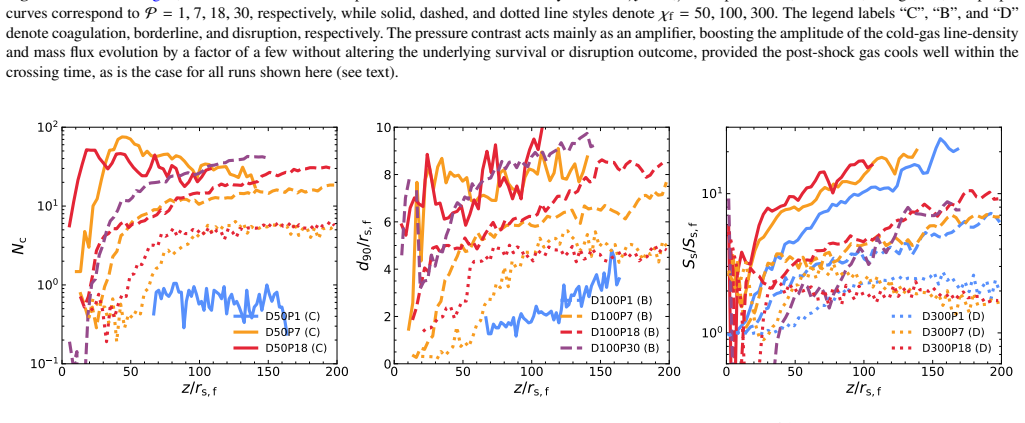
The central claim is that in the early bow-shock regime—when the pressure contrast between the hot CGM and the incoming cold stream exceeds roughly P ≳ 2 χ_f^{1/2} M_s—cold-stream survival is not controlled primarily by the Kelvin–Helmholtz shear criterion. Instead, it is governed by whether the post-shock gas can cool within the virial crossing time, i.e. t_cool,post < t_v. The paper further establishes a three-regime classification (coagulation, fragmentation, disruption, with a borderline case) based on two critical radii: the shear-survival radius and the fragmentation radius. In all surviving runs, post-equilibration evolution follows turbulent radiative entrainment at the stream–CGM in
What carries the argument
The argument is carried by three linked constructs: (1) the two critical radii—the shear-survival radius r_crit,surv and the shattering-based fragmentation radius r_crit,frag—which partition the stream-size/density-contrast plane into coagulation, fragmentation, disruption, and borderline regimes; (2) an empirically calibrated bow-shock transition condition P ≳ 2 χ_f^{1/2} M_s, derived from the requirement that the post-collapse overpressured core's ram pressure exceed the incoming stream's ram pressure; and (3) the post-shock cooling-time gate t_cool,post < t_v, which replaces the shear criterion once the shock detaches and globally heats the stream. These are applied to a galaxy-evolution
Load-bearing premise
The load-bearing simplification is that the injection boundary imposes a fixed pressure contrast P and that the stream re-establishes pressure equilibrium with the hot CGM after a distance z_eq of about one virial radius; if the stream stays significantly underpressurized for most of its infall (as the paper's own estimate z_eq ~ R_v hints), the regime classification built on post-equilibrium radii may not apply.
What would settle it
In a cosmological zoom-in simulation of a massive halo (M_v > 10^12 M_sun) at z ≈ 1, track whether stream gas that is shock-heated to T > 4×10^5 K and has t_cool,post > t_v nevertheless re-forms a cold, coherent stream before reaching the galaxy; if it does, the cooling-time gate fails. Conversely, a high covering fraction of cold gas around a massive halo at z < 0.5 would contradict the prediction that the gate suppresses penetration.
If this is right
- In halos above roughly 6×10^11 M_sun at z>2, cold streams in 2σ and higher density peaks are expected to survive virial-shock penetration and may fragment into multiphase cold structures embedded in the hot CGM.
- At z ≲ 0.5, the post-shock cooling time exceeds the virial crossing time in massive halos, so cold-stream penetration is suppressed—a possible contributor to the decline of efficient star formation in massive halos at low redshift.
- Below the bow-shock threshold (P ≲ 2 χ_f^{1/2} M_s), pressure contrast acts mainly as an amplifier of transient mass and surface-area evolution, while the long-term outcome is set by shear and cooling.
- The approximate conservation of mean streamwise momentum flux implies that the ratio of cold-gas mass flux to cold–hot interfacial area stays nearly constant along surviving streams, connecting observable multiphase structure to interface growth.
- The borderline regime (where the stream core survives but detached fragments are disrupted) predicts observable populations of short-lived clumps that should be absent in coagulation cases and abundant in fragmentation cases.
Where Pith is reading between the lines
- The t_cool,post < t_v gate is a local, falsifiable condition: cosmological simulations of massive halos can directly test whether shocked stream gas that fails to cool within one crossing time actually fails to reach the central galaxy.
- Because the paper's own scalings give z_eq ~ R_v, the pressure contrast likely varies along the infall path; the bow-shock transition may occur deeper inside the halo rather than at the virial radius, shifting the predicted suppression redshift and the orange line in Fig. 17.
- The artificial disabling of cooling in the hot phase (above 0.8 T_h) and the static, unmagnetized, non-turbulent background make the survival predictions at z>2 optimistic; in a turbulent CGM the effective shear-survival criterion may be stricter than the factor-5 adopted here.
- The momentum-flux conservation law offers a simple diagnostic: in zoom-in simulations or observations of coherent cold streams, the cold-gas mass flux per unit interface area should be nearly constant, providing a testable signature of the entrainment picture.
Editorial analysis
A structured set of objections, weighed in public.
Referee Report
Summary. The paper presents idealized 3D AMR simulations of cold cylindrical streams penetrating a virial shock into a hot CGM, varying stream radius, density contrast, pressure contrast, and Mach number. The central results are: (i) at moderate pressure contrast the stream's fate is set by the competition between shear-driven disruption and radiative cooling, giving coagulation, fragmentation, and disruption regimes; (ii) pressure contrast mainly amplifies transients before pressure equilibrium, but does not determine survival; (iii) above an empirically calibrated threshold P ≈ 2 χ_f^{1/2} M_s the oblique shock steepens into a bow shock, and survival is governed by whether post-shock gas cools within the virial crossing time, t_cool,post < t_v; (iv) applying these results to halo evolution, cold streams should survive at z>2 in 2σ and higher peaks, while at z≲0.5 bow shocks and inefficient post-shock cooling suppress cold-stream penetration. The manuscript is careful in its controlled parameter variations, convergence tests, and explicit caveats, but the quantitative boundaries used in the galaxy-evolution applications rest on sparse calibration and phenomenological fits.
Significance. If the qualitative regime picture is correct, the paper advances our understanding of cold-stream penetration by identifying a distinct early bow-shock regime in which the Kelvin–Helmholtz survival criterion is replaced by a cooling-time gate. The simulations are well designed: the injection-boundary setup, the systematic parameter survey, the use of multiple diagnostics (mass flux, clump counts, surface area, momentum flux), and the convergence tests in Appendix A are strengths. The paper is also unusually transparent about its limitations, explicitly stating that Eq. (14) is calibrated on a limited set of runs, that the purple curve in Fig. 17 is a phenomenological correction, and that z_eq ~ R_v undermines the post-equilibrium mapping. However, the quantitative claims in Fig. 17 — particularly the z≲0.5 suppression boundary — are built on criteria that are not robustly calibrated, so the significance is currently more qualitative than quantitative. The work should be publishable after the quantitative fragility is either addressed or substantially softened.
major comments (3)
- [Section 5, Eq. (14)] Eq. (14) is the central new criterion for the early bow-shock transition, but it is explicitly calibrated on only three runs (R1D50P18M1, R1D100P30M1, R10D300P100M1) and the paper acknowledges it is an 'empirically motivated guide' rather than a strict threshold. This criterion is then used in Eq. (38) to draw the orange boundary in Fig. 17, which defines the early bow-shock regime. With only three calibration points and no systematic sweep in P, χ_f, and M_s, the boundary carries order-unity uncertainty, and the yellow region in Fig. 17 is not quantitatively secure. Since the z≲0.5 suppression conclusion depends on this boundary, the paper should either add a denser parameter survey or explicitly present the orange line as a schematic rather than a quantitative boundary.
- [Section 7.2, Eq. (42) / Fig. 17] The red 'inefficient post-shock cooling' region in Fig. 17 is derived from Eq. (42), which scales as M_s^3 and depends sensitively on Λ_post, Θ_s, and Θ_h. The paper itself notes that plausible variations in stream velocity, CGM temperature, and accretion fraction could shift the boundary from z≲0.5 to z~1–2. Moreover, only one simulation (R10D300P100M1) actually demonstrates the failure mode t_cool,post > t_v with disruption; the fiducial case gives t_cool,post ≈ 0.7–1.4 Gyr versus t_v estimates that are comparable, so the marginal cases are not cleanly separated. The qualitative statement that longer post-shock cooling suppresses survival is plausible, but the quantitative redshift boundary is fragile and should be presented with a much larger uncertainty band or as a parameter-dependent illustration.
- [Section 7.3.1, Eq. (36) and Eq. (45)] The paper correctly emphasizes that z_eq ~ R_v (Eq. 36), so the stream may remain underpressurized for most of its infall, and that the local pressure contrast at R_v (Eq. 45) may be a factor ~30 smaller than the mean-contrast estimate used in the simulation setup (Eq. 37). This means the regime classification based on post-equilibrium radii (Fig. 16) and the direct application of the simulated outcomes to cosmological halos are not straightforwardly valid. The paper is transparent about this, but the limitation is load-bearing for the galaxy-evolution conclusions. The authors should either provide a more quantitative assessment of how the regime boundaries shift if the stream does not equilibrate, or restrict the application section to the early bow-shock and cooling-time constraints that do not require the equilibrium assumption.
minor comments (3)
- [Appendix A and Section 4.2] The convergence tests show that clump counts and cold-gas surface area increase with resolution. The paper already cautions against over-interpreting absolute clump statistics, but the statement in Fig. 6 and Fig. 13 that the trends are 'useful diagnostics' should be revisited in light of the fact that the coagulation-to-fragmentation distinction is partly based on these resolution-dependent quantities. A clearer statement of which conclusions are robust to resolution and which are not would strengthen the paper.
- [Section 7.2, Fig. 17] The purple curve is a phenomenological fit with a factor-of-5 multiplier that is 'not separately motivated by our simulations.' The paper is honest about this, but the visual prominence of the purple line in Fig. 17, together with the Daddi et al. (2022a) points, may give readers the impression of validation. Consider moving this curve to a separate panel or explicitly labeling it as 'illustrative context' in the figure itself.
- [General] A few textual issues: the abstract contains a non-expanded command '\ifm{\sigma}' in the arXiv version; Table 1 lists 'R1D100P7M01' for M_s = 0.1 but the text and figures also use 'M01' and 'M05' consistently; Eq. (9) has a missing closing brace; the Daddi et al. (2022b) reference is cited in text as 'Daddi et al. (2022b)' but the reference list has 'Daddi E., Rich R., Valentino F., et al.' and is otherwise incomplete. These should be corrected.
Circularity Check
Partial circularity: the bow-shock threshold in Eq. (14) is calibrated on the same simulations used to define the regime and is then extrapolated as a cosmological prediction; the purple curve in Fig. 17 is a phenomenological fit to the data it is compared with.
specific steps
-
fitted input called prediction
[Section 5, after Eq. (14); applied in Section 7.2 Eq. (38) and Fig. 17; summarized in Section 8(i)]
"We emphasize that Eq. (14) should be interpreted as an empirically motivated guide, calibrated on our limited set of simulations, rather than as a strict analytic threshold. A systematic parameter study would be required to establish a robust quantitative transition criterion, which we leave to future work."
Equation (14), P ≳ 2 χ_f^{1/2} M_s, defines the early bow-shock regime. Its coefficient is explicitly calibrated on the same three runs that exhibit the transition (R1D50P18M1, R1D100P30M1, R10D300P100M1). The same equation is then used in Eq. (38) to draw the orange 'early bow-shock' boundary in Fig. 17, and is restated in Section 8(i) as a result ('at sufficiently large contrasts P > 2 χ_f^{1/2} M_s, this shock steepens into a bow shock'). The cosmological boundary therefore inherits a sparse 3-run fit rather than being an independent first-principles prediction, making this a fitted input called a prediction. The effect is partial, not total: the separate t_cool,post < t_v criterion is derived from shock-jump and cooling-time estimates.
-
fitted input called prediction
[Section 7.2, Fig. 17 (purple curve)]
"Here, we instead adopt a factor of 5 ... We emphasize that this factor is not separately motivated by our simulations and should not be interpreted as a precise theoretical threshold; it is a phenomenological correction, adjusted to match the bending mass of the star-forming main sequence as in Daddi et al. (2022b) ... The broad agreement between the purple curve and the Daddi et al. (2022a) points should be regarded as illustrative context rather than a strict validation of the model."
The purple 'more conservative stream-survival threshold' is constructed using a factor of 5 that is explicitly adjusted to match the Daddi et al. main-sequence bending masses (black points in Fig. 17). Consequently, the agreement between the purple curve and those points is enforced by the choice of the factor, not independently predicted. The paper is transparent about this, so the circularity is mild, but the curve cannot serve as independent confirmation of the model's survival criterion.
full rationale
The core of the paper is not circular: the three-regime classification (coagulation, fragmentation, disruption) is read directly from controlled simulations whose parameters are varied independently (Figs. 4–6), the pre-existing shear-survival criterion Eq. (1) is taken from prior work and used as a benchmark rather than re-derived, and the post-equilibrium entrainment/momentum-flux analysis follows from independently measured profiles and standard mixing-layer scalings. The circularity that exists is confined to the cosmological extrapolation. Equation (14) is an empirically calibrated bow-shock threshold, and the paper itself calls it a calibrated guide rather than a strict analytic result; applying it as the orange boundary in Fig. 17 and as result (i) therefore propagates the calibration into a prediction. Similarly, the purple curve in Fig. 17 is a phenomenological correction fitted to the very data points it is then compared with. Both issues are explicitly acknowledged in the text, which lowers the severity. There is no load-bearing self-citation chain or uniqueness theorem, and the simulation-based regime identification is self-contained. Hence the overall score is a moderate 4: partial circularity in two extrapolation steps, while the central numerical findings retain independent content.
Axiom & Free-Parameter Ledger
free parameters (2)
- factor-of-five shear-survival multiplier (purple curve, Fig. 17) =
5
- early bow-shock criterion coefficient (Eq. 14: P ≈ 2 χ_f^{1/2} M_s) =
2 (calibrated on R1D100P18M1, R1D100P30M1, R1D50P18M1, R10D300P100M1)
axioms (8)
- standard math Oblique-shock θ–β–M relation (Eq. 11) from Ames Research Staff (1953)
- standard math Strong-shock jump conditions and approximately isothermal compression of the radiative post-shock gas (Eqs. 13,15,16)
- standard math Self-similar cylindrical shock scaling v_cyl ∝ r^{-0.19} (Modelevsky & Sari 2021)
- domain assumption Radiative cooling is disabled for T > 0.8 T_h (Section 3.1)
- domain assumption Static, unstratified background CGM; no halo potential, turbulence, or magnetic fields (Section 7.3.2)
- domain assumption Two-zone injection boundary with constant pressure contrast P approximates the virial shock (Section 3.2, Eq. 37)
- domain assumption The stream re-establishes pressure equilibrium after distance z_eq (Eq. 36 gives z_eq ~ R_v)
- ad hoc to paper Imposed initial density and shape perturbations (Eq. 7) seed the instabilities
read the original abstract
Cold streams penetrating virial shocks of massive halos along cosmic web filaments are expected to fuel galaxy growth at high redshift, yet the physical processes governing their penetration remain uncertain. We investigate cylindrical cold streams penetrating a hot circumgalactic medium (CGM) using idealized three-dimensional simulations. We systematically vary the stream radius, Mach number, and initial pressure contrast between the stream and the CGM across three density contrasts, while controlling stream properties after pressure equilibrium is re-established. We identify three evolutionary regimes: coagulation, fragmentation, and disruption, plus a borderline regime in which the stream core marginally survives while detached fragments are disrupted. At modest pressure contrast, survival is governed primarily by the competition between velocity shear and radiative cooling. Increasing pressure contrast produces a transient response during pressure restoration, temporarily enhancing or suppressing the cold-gas mass and cold-hot interfacial area before evolution converges to a shear-dominated state. At larger pressure contrasts, the oblique shock steepens into a bow shock, and the final outcome is determined by the ratio of the post-shock cooling time to the virial crossing time. In all survival cases, post-equilibration evolution is well described by turbulent radiative entrainment at the stream-CGM interface: the cold-gas mass flux increases while the mean streamwise momentum flux remains approximately conserved. Applying these results to a galaxy evolution framework, we find that cold streams in high-\ifm{\sigma} density peaks at $z>2$ are expected to survive and may fragment into multiphase structures embedded in the hot CGM. At $z\lesssim0.5$, stronger bow shocks and longer post-shock cooling suppress cold-stream penetration.
Figures




Reference graph
Works this paper leans on
-
[1]
1953 , number =
Equations, Tables, and Charts for Compressible Flow , institution =. 1953 , number =
1953
-
[2]
Communications on Pure and Applied Mathematics , year=
Taylor instability in shock acceleration of compressible fluids , author=. Communications on Pure and Applied Mathematics , year=
-
[3]
Fluid Dynamics , year=
Instability of the interface of two gases accelerated by a shock wave , author=. Fluid Dynamics , year=
-
[4]
High-Speed Flight Propulsion Systems , series=
Turbulent free shear layer mixing and combustion , author=. High-Speed Flight Propulsion Systems , series=. 1991 , publisher=
1991
-
[5]
On the Hydrodynamic Interaction of Shock Waves with Interstellar Clouds. I. Nonradiative Shocks in Small Clouds. , keywords =. doi:10.1086/173554 , adsurl =
-
[6]
Radiative Transfer in a Clumpy Universe. II. The Ultraviolet Extragalactic Background. , keywords =. doi:10.1086/177035 , archivePrefix =. astro-ph/9509093 , primaryClass =
-
[7]
A new high resolution code called RAMSES
Cosmological hydrodynamics with adaptive mesh refinement. A new high resolution code called RAMSES. , keywords =. doi:10.1051/0004-6361:20011817 , archivePrefix =. astro-ph/0111367 , primaryClass =
-
[8]
Virial shocks in galactic haloes?. , keywords =. doi:10.1046/j.1365-8711.2003.06955.x , archivePrefix =. astro-ph/0302161 , primaryClass =
arXiv 2003
-
[9]
How do galaxies get their gas?. , keywords =. doi:10.1111/j.1365-2966.2005.09451.x , archivePrefix =. astro-ph/0407095 , primaryClass =
arXiv 2005
-
[10]
Galaxy bimodality due to cold flows and shock heating. , keywords =. doi:10.1111/j.1365-2966.2006.10145.x , archivePrefix =. astro-ph/0412300 , primaryClass =
arXiv 2006
-
[11]
Hunter, J. D. , Title =. Computing in Science & Engineering , Volume =
-
[12]
yt: A Multi-code Analysis Toolkit for Astrophysical Simulation Data. , keywords =. doi:10.1088/0067-0049/192/1/9 , archivePrefix =. 1011.3514 , primaryClass =
-
[13]
scikit-image: Image processing in Python. PeerJ , keywords =. doi:10.7717/peerj.453 , archivePrefix =. 1407.6245 , primaryClass =
-
[14]
Rayleigh-Taylor and Richtmyer-Meshkov instability induced flow, turbulence, and mixing. I. , keywords =. doi:10.1016/j.physrep.2017.07.005 , adsurl =
-
[15]
Rayleigh-Taylor and Richtmyer-Meshkov instability induced flow, turbulence, and mixing. II. , keywords =. doi:10.1016/j.physrep.2017.07.008 , adsurl =
-
[16]
Cold streams in early massive hot haloes as the main mode of galaxy formation. , keywords =. doi:10.1038/nature07648 , archivePrefix =. 0808.0553 , primaryClass =
-
[17]
The role of penetrating gas streams in setting the dynamical state of galaxy clusters. , keywords =. doi:10.1093/mnras/stw1283 , archivePrefix =. 1510.05388 , primaryClass =
-
[18]
The Structure and Kinematics of the Circumgalactic Medium from Far-ultraviolet Spectra of z -0.5ex = 2-3 Galaxies. , keywords =. doi:10.1088/0004-637X/717/1/289 , archivePrefix =. 1003.0679 , primaryClass =
-
[20]
The Gaseous Environment of High-z Galaxies: Precision Measurements of Neutral Hydrogen in the Circumgalactic Medium of z -0.5ex 2-3 Galaxies in the Keck Baryonic Structure Survey. , keywords =. doi:10.1088/0004-637X/750/1/67 , archivePrefix =. 1202.6055 , primaryClass =
-
[21]
Sharma, Prateek and McCourt, Michael and Quataert, Eliot and Parrish, Ian J. , year = 2012, journal =. Thermal. doi:10.1111/j.1365-2966.2011.20246.x , archiveprefix =. 1106.4816 , primaryclass =
arXiv 2012
-
[22]
Monthly Notices of the Royal Astronomical Society , volume =
Toy Models for Galaxy Formation versus Simulations , author =. Monthly Notices of the Royal Astronomical Society , volume =. doi:10.1093/mnras/stt1338 , annotation =
-
[23]
Quasars Probing Quasars. VI. Excess H I Absorption within One Proper Mpc of z -0.5ex 2 Quasars. , keywords =. doi:10.1088/0004-637X/776/2/136 , archivePrefix =. 1308.6222 , primaryClass =
-
[24]
scikit-image: image processing in
van der Walt,. scikit-image: image processing in. PeerJ , issn =. 2014 , month =
2014
-
[25]
A cosmic web filament revealed in Lyman- emission around a luminous high-redshift quasar. , keywords =. doi:10.1038/nature12898 , archivePrefix =. 1401.4469 , primaryClass =
-
[26]
Application to structure detection in self-gravitating flows
PHEW: a parallel segmentation algorithm for three-dimensional AMR datasets. Application to structure detection in self-gravitating flows. Computational Astrophysics and Cosmology , keywords =. doi:10.1186/s40668-015-0009-7 , archivePrefix =. 1412.0510 , primaryClass =
-
[27]
Linear Kelvin-Helmholtz instability with body modes
Instability of supersonic cold streams feeding galaxies - I. Linear Kelvin-Helmholtz instability with body modes. , keywords =. doi:10.1093/mnras/stw2267 , archivePrefix =. 1606.06289 , primaryClass =
-
[28]
Extended Lyman haloes around individual high-redshift galaxies revealed by MUSE. , keywords =. doi:10.1051/0004-6361/201527384 , archivePrefix =. 1509.05143 , primaryClass =
-
[29]
The MUSE Hubble Ultra Deep Field Survey. VIII. Extended Lyman- haloes around high-z star-forming galaxies. , keywords =. doi:10.1051/0004-6361/201731480 , archivePrefix =. 1710.10271 , primaryClass =
-
[30]
, archivePrefix = "arXiv", eprint =
GRACKLE: a chemistry and cooling library for astrophysics. , archivePrefix = "arXiv", eprint =. doi:10.1093/mnras/stw3291 , adsurl =
-
[31]
The Circumgalactic Medium. , keywords =. doi:10.1146/annurev-astro-091916-055240 , archivePrefix =. 1709.09180 , primaryClass =
-
[32]
The impact of star formation feedback on the circumgalactic medium. , keywords =. doi:10.1093/mnras/stw3326 , archivePrefix =. 1606.06734 , primaryClass =
-
[33]
Nearly all the sky is covered by Lyman- emission around high-redshift galaxies. , keywords =. doi:10.1038/s41586-018-0564-6 , archivePrefix =. 1810.00843 , primaryClass =
-
[34]
Monthly Notices of the Royal Astronomical Society: Letters , volume =
The Growth and Entrainment of Cold Gas in a Hot Wind , author =. Monthly Notices of the Royal Astronomical Society: Letters , volume =
-
[35]
Non-linear evolution of surface and body modes of Kelvin-Helmholtz instability
Instability of supersonic cold streams feeding galaxies-II. Non-linear evolution of surface and body modes of Kelvin-Helmholtz instability. , keywords =. doi:10.1093/mnras/sty789 , archivePrefix =. 1803.09105 , primaryClass =
-
[36]
A characteristic scale for cold gas. , keywords =. doi:10.1093/mnras/stx2687 , archivePrefix =. 1610.01164 , primaryClass =
-
[37]
COLOSSUS: A Python Toolkit for Cosmology, Large-scale Structure, and Dark Matter Halos. , keywords =. doi:10.3847/1538-4365/aaee8c , archivePrefix =. 1712.04512 , primaryClass =
-
[38]
Astronomy & Astrophysics , volume =
Are Cosmological Gas Accretion Streams Multiphase and Turbulent? , author =. Astronomy & Astrophysics , volume =
-
[39]
Monthly Notices of the Royal Astronomical Society , volume =
Cooling Flow Solutions for the Circumgalactic Medium , author =. Monthly Notices of the Royal Astronomical Society , volume =. doi:10.1093/mnras/stz1859 , annotation =
-
[40]
Kelvin-Helmholtz instability in three dimensions
Instability of supersonic cold streams feeding Galaxies - III. Kelvin-Helmholtz instability in three dimensions. , keywords =. doi:10.1093/mnras/stz012 , archivePrefix =. 1806.05677 , primaryClass =
-
[41]
Monthly Notices of the Royal Astronomical Society , volume =
Simulations of Radiative Turbulent Mixing Layers , author =. Monthly Notices of the Royal Astronomical Society , volume =. doi:10.1093/mnras/stz1248 , archiveprefix =. 1809.09101 , primaryclass =
-
[42]
and Hearin, Andrew P
Behroozi, Peter and Wechsler, Risa H. and Hearin, Andrew P. and Conroy, Charlie , year = 2019, month = sep, journal =
2019
-
[43]
The maximum accretion rate of hot gas in dark matter haloes. , keywords =. doi:10.1093/mnras/staa198 , archivePrefix =. 1909.07402 , primaryClass =
Pith/arXiv arXiv 1909
-
[44]
Interaction of a cold cloud with a hot wind: the regimes of cloud growth and destruction and the impact of magnetic fields. , keywords =. doi:10.1093/mnras/staa3177 , archivePrefix =. 2008.09118 , primaryClass =
Pith/arXiv arXiv 2008
-
[45]
How cold gas continuously entrains mass and momentum from a hot wind. , keywords =. doi:10.1093/mnras/stz3332 , archivePrefix =. 1907.04771 , primaryClass =
Pith/arXiv arXiv 1907
-
[46]
Is multiphase gas cloudy or misty?. , keywords =. doi:10.1093/mnrasl/slaa033 , archivePrefix =. 1912.07808 , primaryClass =
Pith/arXiv arXiv 1912
-
[47]
Multiphase Gas and the Fractal Nature of Radiative Turbulent Mixing Layers. , keywords =. doi:10.3847/2041-8213/ab8d2c , archivePrefix =. 2003.08390 , primaryClass =
Pith/arXiv arXiv 2041
-
[48]
and Haberland, Matt and Reddy, Tyler and Cournapeau, David and Burovski, Evgeni and Peterson, Pearu and Weckesser, Warren and Bright, Jonathan and
Virtanen, Pauli and Gommers, Ralf and Oliphant, Travis E. and Haberland, Matt and Reddy, Tyler and Cournapeau, David and Burovski, Evgeni and Peterson, Pearu and Weckesser, Warren and Bright, Jonathan and. Nature Methods , year =
-
[49]
Resolving small-scale cold circumgalactic gas in TNG50. , keywords =. doi:10.1093/mnras/staa2419 , archivePrefix =. 2005.09654 , primaryClass =
Pith/arXiv arXiv 2005
-
[50]
Charles R. Harris and K. Jarrod Millman and St. Array programming with. 2020 , month = sep, journal =. doi:10.1038/s41586-020-2649-2 , publisher =
-
[51]
Survival of radiatively cooling streams
Instability of supersonic cold streams feeding galaxies - IV. Survival of radiatively cooling streams. , keywords =. doi:10.1093/mnras/staa812 , archivePrefix =. 1910.05344 , primaryClass =
Pith/arXiv arXiv 1910
-
[52]
Ly blobs from cold streams undergoing Kelvin-Helmholtz instabilities. , keywords =. doi:10.1093/mnras/staa2421 , archivePrefix =. 2003.01724 , primaryClass =
Pith/arXiv arXiv 2003
-
[53]
Physics of Fluids , keywords =
Revisiting the strong shock problem: Converging and diverging shocks in different geometries. Physics of Fluids , keywords =. doi:10.1063/5.0047518 , archivePrefix =. 2102.07235 , primaryClass =
-
[54]
Monthly Notices of the Royal Astronomical Society , volume =
Radiative Mixing Layers: Insights from Turbulent Combustion , author =. Monthly Notices of the Royal Astronomical Society , volume =
-
[55]
Unveiling the properties of high redshift filaments
Rivers of gas - I. Unveiling the properties of high redshift filaments. , keywords =. doi:10.1093/mnras/stab015 , archivePrefix =. 2101.00844 , primaryClass =
-
[56]
Virialization of the Inner CGM in the FIRE Simulations and Implications for Galaxy Disks, Star Formation, and Feedback. , keywords =. doi:10.3847/1538-4357/abd776 , archivePrefix =. 2006.13976 , primaryClass =
Pith/arXiv arXiv 2006
-
[57]
Monthly Notices of the Royal Astronomical Society , volume =
Shock--Multicloud Interactions in Galactic Outflows --. Monthly Notices of the Royal Astronomical Society , volume =
-
[58]
Daddi, E. and Rich, R.M. and Valentino, F. and others , year = 2022, month = feb, journal =. Evidence for. doi:10.3847/2041-8213/ac531f , annotation =
-
[59]
The bending of the star-forming main sequence traces the cold- to hot-accretion transition mass over 0 < z < 4. , keywords =. doi:10.1051/0004-6361/202243574 , archivePrefix =. 2203.10880 , primaryClass =
-
[60]
The Astropy Project: Sustaining and Growing a Community-oriented Open-source Project and the Latest Major Release (v5.0) of the Core Package. , keywords =. doi:10.3847/1538-4357/ac7c74 , archivePrefix =. 2206.14220 , primaryClass =
-
[61]
The role of the halo magnetic field on accretion through high-velocity clouds. , keywords =. doi:10.1093/mnras/stab3452 , archivePrefix =. 2111.12733 , primaryClass =
-
[62]
Monthly Notices of the Royal Astronomical Society , volume =
Cosmic Filaments Delay Quenching inside Clusters , author =. Monthly Notices of the Royal Astronomical Society , volume =
-
[63]
Monthly Notices of the Royal Astronomical Society , volume =
Survival and Mass Growth of Cold Gas in a Turbulent, Multiphase Medium , author =. Monthly Notices of the Royal Astronomical Society , volume =
-
[64]
Vurm, I. and Nevalainen, J. and Hong, S.E. and Bah. Cosmic Gas Highways in. Astronomy & Astrophysics , volume =. doi:10.1051/0004-6361/202243904 , archiveprefix =. 2303.03244 , primaryclass =
-
[65]
Pandya, Viraj and Fielding, Drummond B. and Bryan, Greg L. and Carr, Christopher and Somerville, Rachel S. and Stern, Jonathan and. A. The Astrophysical Journal , volume =. doi:10.3847/1538-4357/acf3ea , annotation =
-
[66]
TuRMoiL of Survival: A Unified Survival Criterion for Cloud-Wind Interactions
TuRMoiL of Survival: A Unified Survival Criterion for Cloud-Wind Interactions. arXiv e-prints , keywords =. doi:10.48550/arXiv.2307.03228 , archivePrefix =. 2307.03228 , primaryClass =
work page internal anchor Pith review Pith/arXiv arXiv doi:10.48550/arxiv.2307.03228
-
[67]
Key Physical Processes in the Circumgalactic Medium. , keywords =. doi:10.1146/annurev-astro-052920-125203 , archivePrefix =. 2301.10253 , primaryClass =
-
[68]
The main sequence of star-forming galaxies across cosmic times. , keywords =. doi:10.1093/mnras/stac3214 , archivePrefix =. 2203.10487 , primaryClass =
-
[69]
Ledos, Nicolas and Takasao, Shinsuke and Nagamine, Kentaro , year = 2023, month = dec, journal =. Stability and. doi:10.1093/mnras/stad3814 , annotation =
-
[70]
Better together: the complex interplay between radiative cooling and magnetic draping. , keywords =. doi:10.1093/mnras/stad3069 , archivePrefix =. 2304.09897 , primaryClass =
-
[71]
Magnetic fields in multiphase turbulence: impact on dynamics and structure. , keywords =. doi:10.1093/mnras/stad3125 , archivePrefix =. 2307.06411 , primaryClass =
-
[72]
The topology and draping of magnetic fields around cold clouds
Zooming in on the circumgalactic medium with GIBLE. The topology and draping of magnetic fields around cold clouds. , keywords =. doi:10.1051/0004-6361/202348786 , archivePrefix =. 2404.01370 , primaryClass =
-
[73]
The structure and dynamics of massive high-z cosmic-web filaments: three radial zones in filament cross-sections. , keywords =. doi:10.1093/mnras/stad3779 , archivePrefix =. 2306.03966 , primaryClass =
-
[74]
Kelvin-Helmholtz instability in self-gravitating streams. , keywords =. doi:10.1093/mnras/stz1964 , archivePrefix =. 1903.09666 , primaryClass =
Pith/arXiv arXiv 1903
-
[75]
Entrainment of hot gas into cold streams: the origin of excessive star formation rates at cosmic noon. , keywords =. doi:10.1093/mnras/stae1673 , archivePrefix =. 2403.00912 , primaryClass =
-
[76]
The three hundred project: thermodynamical properties, shocks, and gas dynamics in simulated galaxy cluster filaments and their surroundings. , keywords =. doi:10.1093/mnras/stad3208 , archivePrefix =. 2310.12245 , primaryClass =
-
[77]
Accretion onto Disc Galaxies via Hot and Rotating
Stern, Jonathan and Fielding, Drummond and Hafen, Zachary and Su, Kung-Yi and Naor, Nadav and. Accretion onto Disc Galaxies via Hot and Rotating. Monthly Notices of the Royal Astronomical Society , volume =. doi:10.1093/mnras/stae824 , annotation =
-
[78]
Mark and Pandya, Viraj and Fielding, Drummond B
Voit, G. Mark and Pandya, Viraj and Fielding, Drummond B. and Bryan, Greg L. and Carr, Christopher and Donahue, Megan and Oppenheimer, Benjamin D. and Somerville, Rachel S. , year = 2024, month = dec, journal =. Equilibrium. doi:10.3847/1538-4357/ad81d6 , annotation =
-
[79]
Mark and Carr, Christopher and Fielding, Drummond B
Voit, G. Mark and Carr, Christopher and Fielding, Drummond B. and Pandya, Viraj and Bryan, Greg L. and Donahue, Megan and Oppenheimer, Benjamin D. and Somerville, Rachel S. , year = 2024, month = dec, journal =. Equilibrium. doi:10.3847/1538-4357/ad81d5 , annotation =
-
[80]
Effects of cloud geometry and metallicity on shattering and coagulation of cold gas, and implications for cold streams penetrating virial shocks. , keywords =. doi:10.1093/mnras/stae2771 , archivePrefix =. 2410.12914 , primaryClass =
-
[81]
doi:10.1093/mnras/staf1968 , annotation =
Wang, Chaoran and Oh, S Peng and Jiang, Yan-Fei and Kaul, Ish , year = 2025, month = nov, journal =. doi:10.1093/mnras/staf1968 , annotation =
discussion (0)
Sign in with ORCID, Apple, or X to comment. Anyone can read and Pith papers without signing in.