REVIEW 5 minor 56 references
Development and characterization of a millimeter-wave cold load prototype
T0 review · 0 major / 5 minor · reviewed 2026-08-02 · deepseek-v4-flash
Pith's one-line read This paper identifies Eccorsorb CR-110 and a Stycast 2850FT composite as promising absorbers for a 4–20 K millimeter-wave cold load, using room-temperature reflectance (S11) below –20 dB across 33–110 GHz as the screening criterion.
desk verdict A competent, honestly scoped engineering report on a cryogenic cold-load prototype, where the screening evidence is solid and the final cryogenic proof is explicitly deferred. read the letter →
The pith
A machine-rendered reading of the paper's core claim, the machinery that carries it, and where it could break.
The reading
What carries the argument
The load-bearing piece is the pyramidal absorber array: a periodic tiling of square-based, four-sided pyramids with height-to-base ratio 3. The pyramid geometry grades the impedance from free space into the lossy medium over a short axial distance, and multiple internal reflections lengthen the interaction path, keeping normal-incidence reflectance low over a wide band. The design is built on measured complex permittivity and permeability of each material (from 26.5–40 GHz waveguide measurements), enforced in full-wave simulations with Floquet periodic boundaries, and verified by free-space VNA reflectance measurements with TRL and multi-position calibration. A steady-state heat-transfer sim
What would settle it
Cool the Stycast 2850FT or CR-110 prototype to 4–20 K and measure its reflected power at 90 GHz with a cryogenic radiometer or a calibrated TES; if the reflectance rises above –20 dB or the effective emissivity falls below roughly 0.99, the screening claim would be falsified. A simpler proxy would be measuring the material's complex permittivity at 90 GHz and 4 K to check whether the loss tangent collapses at cryogenic temperatures.
Extended reading notes
Core claim
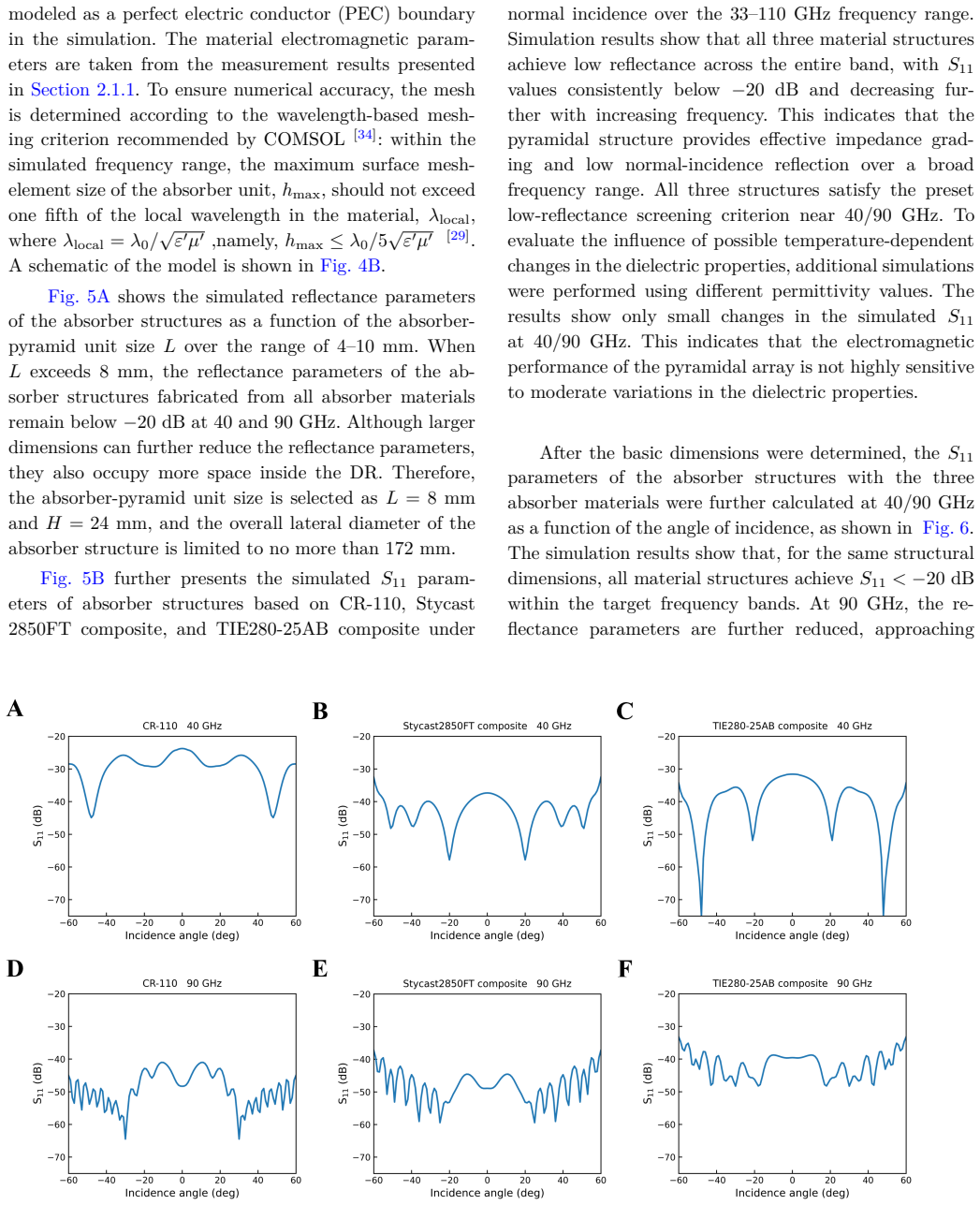
The central claim is that CR-110 and the Stycast 2850FT composite, when molded into 8 mm-base, 24 mm-tall pyramids, meet the low-reflectance screening criterion of S11 < –20 dB across the target 40/90 GHz bands in both full-wave simulation and room-temperature measurement. The Stycast composite's measured reflectance is comparable to that of the commercial absorber TK RAM, with a minimum of –66 dB near 90 GHz. The authors therefore select these two materials for subsequent cryogenic radiometric and TES-based optical-power measurements, while noting that the absolute low-temperature emissivity and effective radiation temperature have not yet been established.
Load-bearing premise
The entire screening depends on room-temperature, normal-incidence reflectance—and simulations using electromagnetic parameters measured only in the 26.5–40 GHz band—being predictive of the absorber's emissivity at 4–20 K and at 90 GHz.
Editorial extensions
If this is right
- A tunable cold load based on these absorbers can deliver picowatt-level optical loads to a TES, letting labs map power versus temperature and extract optical efficiency, responsivity, and saturation power.
- The Stycast 2850FT composite works as a freestanding cast part, not just a coating, after surviving repeated 77 K thermal cycling without cracking.
- TIE280-25AB, if its cryogenic and fabrication properties are later confirmed, provides a cheaper and more accessible alternative with simulated reflectance comparable to the other two materials.
- The reported temperature gradients below 40 mK suggest the cold load can maintain a nearly uniform radiating surface, which is important for calibration accuracy.
- The two free-space reflectance measurement systems (33–50 GHz and 75–110 GHz) offer a reusable screening method for future absorber candidates.
Reading between the lines
- If the room-temperature reflectance holds at 4–20 K, the same physical cold load could cover both the 40 GHz and 90 GHz bands, letting one calibration source serve multi-frequency TES arrays.
- The 26.5–40 GHz measurement band used for extracting permittivity and permeability leaves the 90 GHz behavior inferred from simulation; a direct 90 GHz cryogenic reflectance measurement would confirm whether the –66 dB dip is stable or shifts with temperature.
- Normal-incidence S11 is a necessary but not sufficient screen; a future test comparing the cold load's measured radiation against Planck's law at several temperatures would catch any off-specular or wide-angle leakage that normal-incidence reflectance misses.
- The same pyramid geometry and fabrication pipeline could be used to rapidly screen other absorber formulations, making the develop-and-test loop a standard tool for cold-load development.
Editorial analysis
A structured set of objections, weighed in public.
Referee Report
Summary. This paper reports the design, fabrication, and room-temperature screening of a 4–20 K millimeter-wave cold load prototype for future 40/90 GHz TES calibration. The authors characterize the complex permittivity and permeability of three candidate absorber materials (CR-110, a Stycast 2850FT composite, and a TIE280-25AB composite) using a waveguide method in the 26.5–40 GHz band. These data feed full-wave EM simulations of square pyramidal arrays (Floquet boundaries, PEC backplane) that predict S11 < −20 dB over 33–110 GHz for all three materials. Two prototypes are fabricated by silicone replica molding, and their room-temperature normal-incidence S11 is measured in the 33–50 and 75–110 GHz bands using free-space VNA systems calibrated with TRL and a multi-position method, and validated against a commercial TK RAM sample. Both CR-110 and the Stycast composite satisfy the < −20 dB screening criterion; the Stycast composite shows particularly low reflection near 90 GHz. A steady-state thermal simulation using engineering estimates of cryogenic thermal conductivity predicts <40 mK temperature gradients across the absorber. The paper explicitly concludes that absolute low-temperature emissivity, effective radiation temperature, and TES calibration performance remain to be established in future cryogenic tests.
Significance. The significance of this manuscript is in providing a practical, reproducible path to a 40/90 GHz cold load for CMB detector calibration, with the materials identified as promising candidates for cryogenic evaluation. Its strengths are: (i) the EM simulations use material parameters measured on the same batches rather than fitted values; (ii) the free-space S11 measurement systems are benchmarked against an external TK RAM reference; (iii) the authors carefully restrict the interpretation of room-temperature S11 to a screening metric, not a proxy for cryogenic absorptance; and (iv) the fabrication process includes thermal-cycling validation of the Stycast composite. If the room-temperature performance is indicative of cryogenic behavior, the work provides a low-cost, commercially available absorber option and a fabricated prototype for subsequent radiometric tests. The main limitation—the unmeasured cryogenic EM performance—is acknowledged explicitly in the abstract and conclusions, making the claims appropriately conditional.
minor comments (5)
- [Sec. 2.1.2] The 0.26 W m−1 K−1 value for CR-110 thermal conductivity at 20 K is adopted without a citation or derivation. This input directly affects the heat-transfer simulation in Sec. 2.2.2, which reports ΔTmax < 40 mK. Please either provide a supporting reference, show a derivation based on an extrapolation of the near-4 K value, or add a sensitivity sweep (e.g., k20K = 0.08–0.30 W m−1 K−1) to demonstrate that the thermal-screening conclusion is robust.
- [Sec. 3.2, Fig. 11] The statement that the Stycast 2850FT composite 'is comparable to that of TK RAM' is not directly verifiable from the figures: Fig. 10 shows TK RAM data alone, while Fig. 11 shows only the two prototype absorbers. Please overlay the TK RAM measured curve (or the official range) on Fig. 11B/C, or add a combined panel, so that the claimed equivalence can be judged by the reader.
- [Sec. 2.2.1] The robustness test for temperature-dependent dielectric properties is described only as 'small changes' in S11. Because cryogenic EM parameters are not measured, this qualitative statement carries a lot of weight. Please specify the tested permittivity/permeability perturbations (range and step) and give the resulting S11 values at 40 and 90 GHz (e.g., as a small table or overlaid curves), so the reader can assess the safety margin associated with the −20 dB criterion.
- [Eq. (1)] Equation (1) uses the Rayleigh–Jeans approximation, but for the 90 GHz band at T = 4 K, hν/kBT ≈ 1.1, so the approximation may introduce a few percent error. The authors correctly use Planck's law in Fig. 1; please add a sentence noting the RJ approximation regime or replace Eq. (1) with the full Planck expression for the low-temperature end.
- [General editing] Minor corrections: Table 1 lists 'Catalyst 24L V' while the text uses 'Catalyst 24LV'; the heading 'SUMMARIES' should be singular; reference [13] has 'nASA' instead of 'NASA'; and Eq. (1) has a missing space in the numerator. These do not affect the technical content.
Circularity Check
No significant circularity: S11 predictions derive from independently measured material parameters and are not refit to measured absorber S11.
full rationale
The derivation chain is self-contained. Complex permittivity and permeability of CR-110, the Stycast 2850FT composite, and TIE280-25AB are measured by a rectangular-waveguide method (Sec. 2.1.1) and then used as inputs to full-wave COMSOL simulations of pyramidal absorber arrays (Sec. 2.2.1). The fabricated prototypes are measured at room temperature (Sec. 3.2) and compared with the simulations without tuning any parameter; discrepancies are attributed to fabrication tolerances, assembly gaps, edge diffraction, and calibration errors (Fig. 11). No fitted value from the absorber S11 is used to generate the predicted S11 curves. The free-space measurement system is validated against an external benchmark, commercial TK RAM (Sec. 3.1, Fig. 10). The only self-citation, Ref [39] for a free-space measurement configuration, is peripheral and not load-bearing to the absorptance claim. The paper explicitly limits its claim: room-temperature S11 is used 'only' as a screening metric, and absolute low-temperature emissivity, effective radiation temperature, and TES calibration performance remain to be established (Abstract, Sec. 4). These caveats are honest uncertainty about the unmeasured cryogenic link, not circular reasoning. Therefore score 0.
Assumptions & free parameters
free parameters (5)
- Pyramid aspect ratio H/L =
3
- Pyramid base side length L =
8 mm
- Thermal surface emissivity epsilon =
0.7
- CR-110 thermal conductivity at 20 K =
0.26 W/mK
- Stycast composite thermal conductivity scaling =
kmix = 0.11*k2850
assumptions (5)
- domain assumption Room-temperature EM parameters measured at 26.5-40 GHz remain valid at 33-110 GHz and at cryogenic temperatures
- domain assumption Low normal-incidence S11 with a PEC backplate implies high absorptance (emissivity)
- domain assumption Maxwell-Eucken model with spherical, non-interacting fillers and zero-conductivity carbon black/glass microbeads applies to the Stycast 2850FT composite
- standard math PEC boundary and Floquet periodic conditions accurately model the absorber array and OFHC backplate
- domain assumption The free-space S11 calibration (TRL and multi-position) is accurate as validated against TK RAM official data
Cite this review
Pith. "Pith review of Development and characterization of a millimeter-wave cold load prototype." pith.science (2026). https://pith.science/paper/X3REA3BB
@misc{pith2026260714198,
  author       = {Pith},
  title        = {Pith review of: Development and characterization of a millimeter-wave cold load prototype},
  year         = {2026},
  howpublished = {\url{https://pith.science/paper/X3REA3BB}},
  note         = {Machine review of arXiv:2607.14198}
}
read the original abstract
Superconducting transition-edge sensors (TESs) are crucial detectors for cosmic microwave background (CMB) observations and require stable and tunable millimeter-wave cold loads for optical-efficiency calibration. This work presents the design, fabrication, and preliminary characterization of a 4-20 K millimeter-wave cold load prototype intended for integration into the 1 K stage of a dilution refrigerator and subsequent 40/90 GHz CMB TES calibration experiments. Two absorber prototypes based on commercially available CR-110 and a Stycast 2850FT composite were fabricated and studied. Simulation results show that both absorber structures exhibit small predicted steady-state temperature gradients and low normal-incidence reflectance in the target frequency bands. Room-temperature S11 measurements were used only to screen low-reflectance cold load prototype, and the measured results generally agree with the electromagnetic simulations. The measured S11 of the Stycast 2850FT composite is comparable to that of the commercial absorber TK RAM. Additionally, to explore a more readily obtainable alternative absorber material, TIE280-25AB was preliminarily evaluated by measuring its electromagnetic parameters. Based on the measured parameters, the simulated S11 of the TIE280-25AB pyramidal absorber structure is comparable to those of CR-110 and the Stycast 2850FT composite over 33-110 GHz. These results identify CR-110 and the Stycast 2850FT composite as promising absorbers for subsequent cryogenic evaluation. The absolute low-temperature emissivity, effective radiation temperature, and TES calibration performance remain to be established through future cryogenic radiometric and TES based optical-power measurements.
Figures


Figures from the paper (8 more)




Reference graph
Works this paper leans on
-
[1]
Hu, W., , White, M. 1997. A CMB Polarization Primer. New Astronomy, 2(4), 323–344
1997
-
[2]
Zaldarriaga, M., , Seljak, U. 1997. All-sky analysis of polarization in the microwave background. Physical Review D, 55(4), 1830–1840
1997
-
[3]
Fowler, J. W. 2004. The Atacama Cosmology Telescope Project. In proceedings of Millimeter and Submillimeter Detectors for Astronomy II. DOI: 10.1117/12.553054
-
[4]
Eimer, J. R., Bennett, C. L., Chuss, D. T., et al. 2012. The Cosmology Large Angular Scale Surveyor (CLASS): 40 GHz optical design. In pro- ceedings of Millimeter, Submillimeter, and Far-Infrared Detectors and Instrumentation for Astronomy VI. DOI: 10.1117/12.925464
-
[5]
K., Austermann, J., Beall, J
Choi, S. K., Austermann, J., Beall, J. A., et al
-
[6]
Essinger Hileman, T., Ali, A., Amiri, M., et al. 2014. CLASS: The Cosmology Large Angular Scale Surveyor. In proceedings of Millimeter, Submillimeter, and Far- Infrared Detectors and Instrumentation for Astronomy VII. DOI: 10.1117/12.2056701
-
[7]
Stivoli, F., Baccigalupi, C., Maino, D., et al. 2006. Separating polarized cosmological and galactic emis- sions for cosmic microwave background B-mode po- larization experiments. Monthly Notices of the Royal Astronomical Society, 372(2), 615–629
2006
-
[8]
L., Gullett, I., Anderson, A
King, C. L., Gullett, I., Anderson, A. J., et al
Show all 56 references
-
[9]
W., Bennett, C
Appel, J. W., Bennett, C. L., Brewer, M. K., et al
-
[10]
L., et al
Salatino, M., Austermann, J., Thompson, K. L., et al
-
[11]
Dou, J., Ghosh, S., Santos, L., et al. 2024. Forecast of CMB TB and EB correlations for AliCPT-1. Journal of Cosmology and Astroparticle Physics, 2024(10), 046
2024
-
[12]
M., Groh, J
Dutcher, D., Duff, S. M., Groh, J. C., et al. 2024. The Simons Observatory: Large-Scale Characterization of 90/150 GHz TES Detector Modules. Journal of Low Temperature Physics, 214(3–4), 247–255
2024
-
[13]
W., McLean, J
McCulloch, A. W., McLean, J. T., , Mohr, E. I. 1969, Evaluation and Calibration of Some Energy Sources for the Visible and Near Infrared Regions of the Electromagnetic Spectrum, Tech. Rep. X-622-69-195, Goddard Space Flight Center, Greenbelt, Maryland, nASA Technical Reports S...
1969
-
[14]
G., Beall, J., Brevick, J., et al
Pappas, C. G., Beall, J., Brevick, J., et al. 2014. Optical Efficiency and R(T,I) Measurements of ACTPol TESes Using Time Domain Multiplexing Electronics. Journal of Low Temperature Physics , 176(5–6), 749– 754
2014
-
[15]
W., Appel, J
Henning, J. W., Appel, J. W., Austermann, J. E., et al. 2010. Optical Efficiency of Feedhorn-Coupled TES Polarimeters for Next-Generation CMB Instruments. In proceedings of Millimeter, Submillimeter, and Far- Infrared Detectors and Instrumentation for Astronomy V. DOI: 10.1117...
2010 doi
-
[16]
E., Austermann, J
Walker, S., Sierra, C. E., Austermann, J. E., et al
-
[17]
Hubmayr, J., Ade, P. A. R., Adler, A., et al
-
[18]
Persky, M. J. 1999. Review of black surfaces for space-borne infrared systems. Review of Scientific Instruments, 70(5), 2193–2217
1999
-
[19]
Bock, J. J. 1994, Ph.d. thesis, University of California, Berkeley
1994
-
[20]
A., Emery, W., Gu, D., et al
Houtz, D. A., Emery, W., Gu, D., et al
-
[21]
Journal of Low Temperature Physics, 199(3–4), 891–897
Demonstration of 220/280 GHz Multichroic 14 www.ati.ac.cn Feedhorn-Coupled TES Polarimeter. Journal of Low Temperature Physics, 199(3–4), 891–897
-
[22]
Zivkovic, I., , Murk, A. 2011. Characterization of Magnetically Loaded Microwave Absorbers. Progress In Electromagnetics Research B, 33, 277–289
2011
-
[23]
Journal of Low Temperature Physics, 209(3–4), 396–408
Optical Characterization of OMT-Coupled TES Bolometers for LiteBIRD. Journal of Low Temperature Physics, 209(3–4), 396–408
-
[24]
Valenziano, L., Cuttaia, F., De Rosa, A., et al. 2009. Planck-LFI: Design and Performance of the 4 Kelvin Reference Load Unit. Journal of Instrumentation , 4(12), T12006
2009
-
[25]
2004, Temperature Stability Requirements at the Interface Between the ECCOSORB Sky-Load and Its Support in the LFI Cryofacility, Tech
Terenzi, L., Morgante, G., Lapolla, M., et al. 2004, Temperature Stability Requirements at the Interface Between the ECCOSORB Sky-Load and Its Support in the LFI Cryofacility, Tech. Rep. PL-LFI-PST-TN-059, IASF-CNR / Laben S.p.A., issue/Rev. No. 1.0
2004
-
[26]
Koettig, T., Maciocha, W., Bermudez, S., et al. 2017. Thermal Conductivity Measurements of Impregnated Nb3Sn Coil Samples in the Temperature Range of 3.5 K to 100 K. IOP Conference Series: Materials Science and Engineering, 171(1), 012103
2017
-
[27]
R., et al
Rostem, K., Cimpoiasu, E., Helson, K. R., et al
-
[28]
J., Fixsen, D
Wollack, E. J., Fixsen, D. J., Henry, R., et al
-
[29]
T., Rostem, K., Wollack, E
Chuss, D. T., Rostem, K., Wollack, E. J., et al
-
[30]
Guo, G., Hao, X., Yu, K., et al. 2024. Research on the Influence of Different Pyramid Array Structures on Plane Blackbody Emissivity. Optics and Lasers in Engineering, 183, 108492
2024
-
[31]
A., Zannoni, M., et al
Valenziano, L., Peverini, O. A., Zannoni, M., et al
-
[32]
Terracher, F., , Berginc, G. 2003. A Numerical Study of TM-Type Surface Waves on a Grounded Dielectric Slab Covered by a Doubly Periodic Array of Metallic Patches. Progress In Electromagnetics Research, 43, 75– 100
2003
-
[33]
n.d., Modeling of Pyramidal Absorbers for an Anechoic Chamber, COMSOL Application Gallery, application ID: 12129; accessed 12 April 2026
COMSOL. n.d., Modeling of Pyramidal Absorbers for an Anechoic Chamber, COMSOL Application Gallery, application ID: 12129; accessed 12 April 2026
2026
-
[34]
2014, Automatic Meshing for Electromagnetic Simulations, COMSOL, cOMSOL Blog; accessed 12 April 2026
Griesmer, A. 2014, Automatic Meshing for Electromagnetic Simulations, COMSOL, cOMSOL Blog; accessed 12 April 2026
2014
-
[35]
National Institute of Standards and Technology. 2010, Material Properties: OFHC Copper (UNS C10100/C10200), National Institute of Standards and Technology, nIST Cryogenic Material Properties Database; revised 3 February 2010; accessed 12 April 2026
2010
-
[36]
J., Yao, B
Wu, M. J., Yao, B. Z., Shi, L. L., et al
-
[37]
P., Wishnow, E., et al
Halpern, M., Gush, H. P., Wishnow, E., et al. 1986. Far Infrared Transmission of Dielectrics at Cryogenic and Room Temperatures: Glass, Fluorogold, Eccosorb, Stycast, and Various Plastics. Applied Optics , 25(4), 565–570
1986
-
[38]
Liu, Y., Qiu, T., , Sun, J. 2025. Parametric Study on Effective Thermal Conductivity of Dispersed Disks with Internal Heat Sources. Energies, 18(17), 4719
2025
-
[39]
Lu, X., Li, Z., Liu, C., et al. 2021. Prototype of Meta-Surface Anti-Reflection Coating for a 40GHz HDPE Lens. In proceedings of 10th International Symposium on Advanced Optical Manufacturing and Testing Technologies: Micro- and Nano-Optics, Catenary Optics, and Subwavelength ...
2021 doi
-
[40]
Review of Scientific Instruments , 88(10), 104501
A Cryogenic Thermal Source for Detector Array Characterization. Review of Scientific Instruments , 88(10), 104501
-
[41]
R., Bennett, C
Eimer, J. R., Bennett, C. L., Chuss, D. T., et al
-
[42]
Fallahi, A., , Enayati, A. 2016. Modeling Pyramidal Absorbers Using the Fourier Modal Method and the Mode Matching Technique. IEEE Transactions on Electromagnetic Compatibility, 58(3), 820–827
2016
-
[43]
K., , Chuah, H
Chung, B. K., , Chuah, H. T. 2003. Modeling of RF Absorber for Application in the Design of Anechoic Chamber. Progress In Electromagnetics Research , 43, 273–285. 16 www.ati.ac.cn
2003
-
[48]
Acta Physica Sinica, 71(16), 168702
Cryogenic Blackbody Calibration Source for Superconducting Terahertz Detectors. Acta Physica Sinica, 71(16), 168702
-
[50]
E., Adachi, S., et al
Xu, Z., Chesmore, G. E., Adachi, S., et al. 2021. The Simons Observatory: Metamaterial Microwave Absorber and Its Cryogenic Applications. Applied Optics, 60(4), 864–874
2021
-
[52]
Rolfes, I., , Schiek, B. 2004. Calibration Methods for Microwave Free Space Measurements. Advances in Radio Science, 2, 19–25. Astronomical Techniques and Instruments, 1(1), 1–15, 2026 15
2004
-
[55]
n.d., Tessellating TeraHertz RAM, Thomas Keating Ltd, accessed 12 April 2026
Thomas Keating Ltd. n.d., Tessellating TeraHertz RAM, Thomas Keating Ltd, accessed 12 April 2026
2026
-
[2008]
International Journal of Infrared and Millimeter Waves , 29(1), 51–61
Electromagnetic and Thermal Properties of a Conductively Loaded Epoxy. International Journal of Infrared and Millimeter Waves , 29(1), 51–61
-
[2011]
Review of Scientific Instruments , 82(8), 086101
Note: Vector Reflectometry in a Beam Waveguide. Review of Scientific Instruments , 82(8), 086101
-
[2014]
In proceedings of Millimeter, Submillimeter, and Far- Infrared Detectors and Instrumentation for Astronomy VII
New RF Data on ECCOSORB CR/MF Absorber. In proceedings of Millimeter, Submillimeter, and Far- Infrared Detectors and Instrumentation for Astronomy VII. DOI: 10.1117/12.2056315
-
[2017]
IEEE Transactions on Geoscience and Remote Sensing, 55(8), 4586–4596
Electromagnetic Design and Performance of a Conical Microwave Blackbody Target for Radiometer Calibration. IEEE Transactions on Geoscience and Remote Sensing, 55(8), 4586–4596
-
[2018]
Journal of Low Temperature Physics, 193(3–4), 267–275
Characterization of the Mid-Frequency Arrays for Advanced ACTPol. Journal of Low Temperature Physics, 193(3–4), 267–275
-
[2020]
In proceedings of Millimeter, Submillimeter, and Far-Infrared Detectors and Instrumentation for Astronomy X
The design of the Ali CMB Polarization Telescope receiver. In proceedings of Millimeter, Submillimeter, and Far-Infrared Detectors and Instrumentation for Astronomy X. DOI: 10.1117/12.2560709
-
[2021]
Cryogenics, 118, 103329
Specific Heat of Epoxies and Mixtures Containing Silica, Carbon Lamp Black, and Graphite. Cryogenics, 118, 103329
-
[2022]
The Astrophysical Journal Supplement Series , 262(2), 52
Calibration of Transition-edge Sensor (TES) Bolometer Arrays with Application to CLASS. The Astrophysical Journal Supplement Series , 262(2), 52
-
[2024]
In proceed- ings of Millimeter, Submillimeter, and Far-Infrared Detectors and Instrumentation for Astronomy XII
Design and validation of a cold load for characterization of CMB-S4 detectors. In proceed- ings of Millimeter, Submillimeter, and Far-Infrared Detectors and Instrumentation for Astronomy XII. DOI: 10.1117/12.3018159
Reviewed August 2, 2026 · model on record in the stance chip above.
Discussion (0). Continue with ORCID to comment.