REVIEW 3 major objections 5 minor 71 references
DCVC-MB: Neural B-Frame Video Compression using State Space Models
T0 review · 3 major / 5 minor · reviewed 2026-08-02 · deepseek-v4-flash
Pith's one-line read A neural video codec that codes B-frames with a Mamba state-space fusion model, beating VTM-19.0 by up to 30% BD-rate.
desk verdict The Mamba B-frame fusion and canonical position embedding are real, well-ablated contributions, but the abstract's headline BD-rate numbers mix base and inference-time variants and one figure matches no variant in Table II, so the SOTA claim needs a reconciled table before it stands. read the letter →
The pith
A machine-rendered reading of the paper's core claim, the machinery that carries it, and where it could break.
The reading
What carries the argument
The Bidirectional Mamba Block (BMB) is a selective state-space model with two parameter sets — one for the forward row-major scan and one for the backward scan — whose outputs are summed. Each scan discretizes the continuous ODE h'=Ah+Bx with zero-order hold, producing recurrent updates hm = Ā hm−1 + B̄ xm and output ym = C hm. The BMB fuses the feature pyramids of the past and future reference frames to condition the encoder, decoder, and entropy model. The other essential component is the canonical position embedding, which maps token positions to normalized x,y∈[0,1] before applying sinusoidal basis functions, so that the positional harmonics are resolution-independent; this prevents the
What would settle it
Train or fine-tune the model on Vimeo90k at 256×256, then evaluate on HEVC Class B with standard pixel-coordinate positional embeddings; the paper reports a +55.12 BD-rate degradation versus DCVC-DC, while the canonical embedding gives −7.34. A direct falsification test is to evaluate DCVC-MB on sequences with aspect ratios far from training (e.g., vertical 9:16 or ultrawide 21:9) at high resolution; if BD-rate is no better than DCVC-DC, then the canonical embedding does not generalize as claimed. Alternatively, inspect the positional harmonic frequencies at test resolution; if the sampled har
Extended reading notes
Core claim
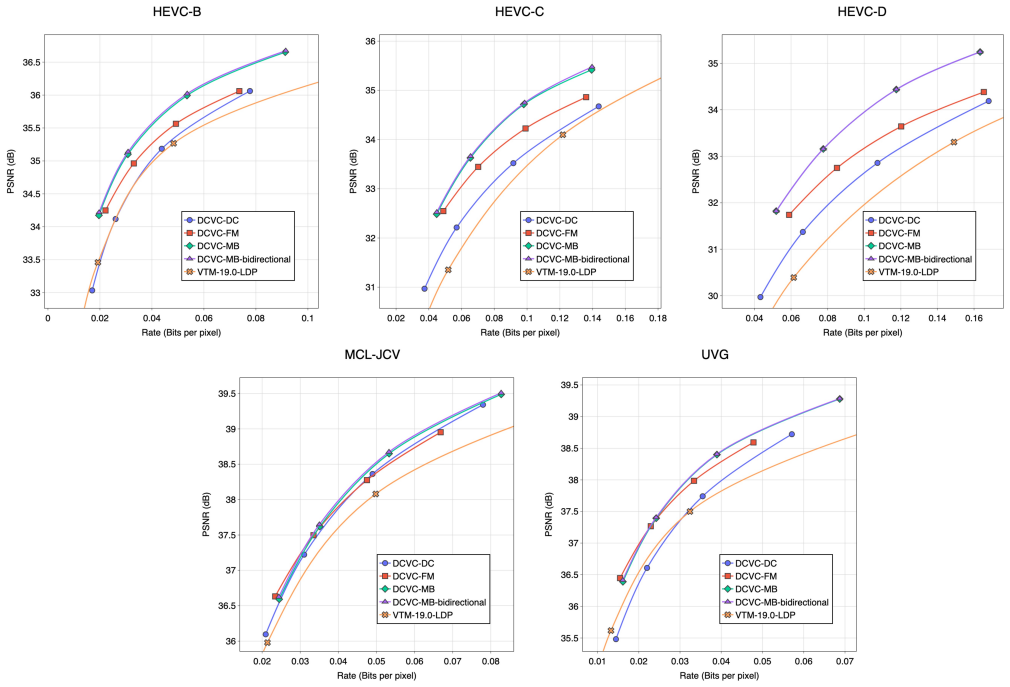
DCVC-MB is a neural B-frame codec built on the DCVC-DC backbone but with two decoded picture buffers (past and future) instead of one. The core discovery is that a bidirectional Mamba-based fusion block, running forward and backward row-major scans over concatenated reference features, can effectively exploit temporal redundancy in both directions at linear O(N) complexity. The paper reports BD-rate reductions of up to 8.98% over prior neural codecs (DCVC-FM) and up to 30.45% over VTM-19.0-LDP, and it is the only neural codec in its comparison to exceed VTM-19.0-RA (Inter-GoP=16) by 1.81%. Two inference-time strategies, open GoP and bidirectional coding, provide additive savings, and the ent
Load-bearing premise
The canonical position embedding must preserve the positional harmonics across unseen resolutions and aspect ratios; if the [0,1] normalization does not keep the harmonics aligned at 4K or nonstandard aspect ratios, the reported BD-rate gains over VTM-19.0, which rely on cross-resolution generalization, would shrink substantially.
Editorial extensions
If this is right
- If the claims hold, neural codecs can now enter the B-frame regime that traditional codecs have exploited for decades, yielding large bitrate savings at comparable quality.
- The Mamba fusion's linear complexity means B-frame coding fits in 13.8GB VRAM at 1080p, a configuration where transformer-based fusion would exceed 40GB, making high-resolution neural B-frame coding practical on current GPUs.
- Adaptive latent skipping reduces entropy coding time by ~9× for P-frames and ~5× for B-frames with minor RD cost, which could enable real-time or near-real-time neural coding.
- The canonical position embedding allows a single checkpoint to be used across resolutions from 256×256 to 4K, eliminating the need for resolution-specific retraining (paper's results show −7.34 BD-rate on HEVC Class B vs DCVC-DC).
- The two inference-time strategies, open GoP and bidirectional coding, provide additive 0.9%–1% BD-rate gains and can be toggled based on complexity needs; bidirectional coding doubles encoding time but is recommended for storage-critical scenarios.
Reading between the lines
- If the canonical position embedding is truly resolution-agnostic, the same model should handle extreme aspect ratios (e.g., 9:16 vertical or 21:9) without retraining; this is a direct testable consequence not explored in the paper.
- The adaptive latent skipping, with its per-frame and per-stage relative threshold, is a generic speedup module that could be dropped into other entropy-coded neural codecs (e.g., image compressors) to reduce coding time.
- The bidirectional Mamba fusion is a generic two-stream context fusion mechanism; it might benefit other tasks requiring past/future context, such as video interpolation or super-resolution, though the paper does not examine these.
- The paper's YUV420 comparison uses a naive RGB-to-YUV conversion; a model trained directly for YUV420 might close the gap to VTM-RA in that color space, but the paper's claim is limited to RGB BT.709.
Editorial analysis
A structured set of objections, weighed in public.
Referee Report
Summary. The paper proposes DCVC-MB, a B-frame neural video codec built on the DCVC-DC framework. The main technical contributions are (i) a bidirectional Mamba-based fusion module that combines past and future reference features with linear complexity, (ii) a canonical position embedding designed to generalize across resolutions, (iii) an adaptive latent-skipping mechanism for faster entropy coding, and (iv) two inference-time strategies (open GoP and bidirectional coding). The authors report BD-rate savings over VTM-19.0 and prior neural codecs on HEVC, UVG, and MCL-JCV, and claim state-of-the-art performance. The paper includes ablation studies showing the benefit of Mamba fusion, canonical position embeddings, and the inference-time add-ons, plus runtime and memory analyses.
Significance. If the reported numbers are correct, the work is a relevant empirical contribution to neural B-frame coding: the Mamba-based fusion offers a practical way to use bidirectional references at high resolutions, the canonical position embedding is a simple and potentially generalizable fix for the train/test resolution gap, and the latent-skipping mechanism gives substantial entropy-coding speedups. The ablation study (Table IV) and memory-scaling experiment (Appendix Fig. 1) are valuable. However, the paper does not release code or checkpoints, and the headline quantitative claims are not consistently tied to a single model variant. The numerical inconsistencies described below must be resolved before the SOTA claim can be accepted.
major comments (3)
- [Section IV, Table II] The claimed average BD-rate gains are not consistently supported by Table II. The text reports '8.21% and 8.98% over DCVC-FM' for Intra-periods 32 and -1, but at Intra-period=32 no row in Table II gives 8.21%: the base model gives 7.95% (-27.39 vs -19.44), DCVC-MB-og gives 9.18%, and DCVC-MB-bdc-og gives 9.19%. The Introduction's '9.21%' is also unmatched in the table. Please correct these numbers and state precisely which configuration (base, og, bdc, bdc-og) supports each average improvement.
- [Section IV.B, Abstract; Section III.G] The headline SOTA claim is misattributed to the base architecture when it actually comes from inference-time variants. The abstract's '1.81% over VTM-19.0-RA' corresponds to DCVC-MB-og (-28.62 vs -26.82); the base model's margin is only 0.57% (-27.39 vs -26.82). Similarly, the '3.43% over DCVC-DC at Intra-period=32' is from DCVC-MB-og (-28.62 vs -25.20), and the '21.86% at Intra-period=-1' is from DCVC-MB-bdc (-30.45 vs -8.59). Since the base model is the architectural contribution and the open-GoP/bidirectional-coding add-ons are separate inference-time choices, every comparison should be labeled with its exact variant.
- [Appendix V, Table II; Section IV.A] The canonical position embedding is a load-bearing component for resolution generalization, since training is at 256×256 and testing includes 720p/1080p/4K. The ablation in Appendix Table II covers only HEVC Classes B/C/D (up to 1080p). The main evaluation also includes UVG (4K) and MCL-JCV, but no ablation is reported at those resolutions. To validate the resolution-generalization contribution at the resolutions where the headline results are claimed, please provide an ablation or analysis on UVG (or a 4K subset), or explicitly state that this mechanism's benefit at 4K is not directly measured.
minor comments (5)
- [Section III.F, Eq. (2)] The notation in Eq. (2) is unclear: the reader must infer that μ_i and σ_i are the predicted mean and scale of the latent distribution, and that 'mean(σ)' is computed over the stage being coded. Please define these quantities and specify the threshold computation more precisely.
- [Appendix II, Table I; Section III.F] The text says the B-frame model is 'approximately 2×' the latency of the P-frame, but the decoder latency in Table I is 492 ms vs 141 ms (≈3.5×), while the encoder is 626 vs 323 (≈1.9×). Please clarify whether the 2× figure refers to encoder only or to a different aggregate.
- [Appendix V, Table II] The header 'DCVC-DC p_s nop_s p_ce' is confusing. Please label the columns explicitly (e.g., 'DCVC-DC', 'no pos. emb.', 'standard 2D pos. emb.', 'canonical pos. emb.').
- [Abstract, Introduction, Section IV] The percentage improvements differ between the abstract ('up to 8.98%'), the Introduction ('8.98%/9.21%'), and Section IV ('8.21% and 8.98%'). Unify these numbers after correcting the variant attribution.
- [General] No code or checkpoints are released. Given the centrality of the SOTA claim and the difficulty of reproducing learned codecs, releasing the trained models and evaluation scripts would substantially increase the credibility of the reported numbers.
Circularity Check
No circularity found: empirical BD-rate comparisons and ablations do not reduce to fitted inputs or self-citations.
full rationale
The paper is an empirical neural codec paper whose central claims are rate-distortion measurements against external baselines (VTM-19.0, DCVC-DC, DCVC-FM). The loss is a standard R-D loss, the fusion/position-embedding/skipping components are evaluated by ablations, and no equation or construction makes a reported prediction equal to a fitted input. The adaptive latent-skipping rule uses the model's own predicted σ, but this is an internal runtime mechanism, not a validation loop for the SOTA claim. The canonical position embedding is a modified standard sinusoidal embedding and its benefit is measured empirically rather than derived by construction. The cited baselines are from other research groups, so there is no load-bearing self-citation chain. Some reported numbers are internally inconsistent or misattributed across model variants (e.g., the 1.81% VTM-RA margin and the 8.21% DCVC-FM cell), but these are reporting/evidence issues, not circularity. Scoring reflects the absence of any step where a 'prediction' reduces to the input by definition.
Assumptions & free parameters
free parameters (4)
- Lambda (rate-distortion weights) =
{85, 170, 380, 840}
- Mamba state dimension N =
Not stated
- Number of BMB layers L =
2
- Latent skip threshold =
mean(σ) per stage
assumptions (4)
- standard math Zero-order hold discretization of the SSM ODE (Eq. 1) yields the discrete update
- domain assumption Vimeo90k training distribution transfers to HEVC/UVG/MCL-JCV test sets
- domain assumption The mask M for latent skipping is available at the decoder without side information because σ is predicted by the entropy model
- domain assumption BD-Rate computed with RGB PSNR is an appropriate metric
Cite this review
Pith. "Pith review of DCVC-MB: Neural B-Frame Video Compression using State Space Models." pith.science (2026). https://pith.science/paper/AETIX3JL
@misc{pith2026260714305,
  author       = {Pith},
  title        = {Pith review of: DCVC-MB: Neural B-Frame Video Compression using State Space Models},
  year         = {2026},
  howpublished = {\url{https://pith.science/paper/AETIX3JL}},
  note         = {Machine review of arXiv:2607.14305}
}
abstract
In this paper we propose DCVC-Mamba (DCVC-MB), a neural video codec framework for B-frame coding. Our approach incorporates an IBP frame strategy for low-delay B-frame coding, a spatio-temporal fusion model based on state-space models for bidirectional temporal prediction, and an entropy-aware skipping mechanism that selectively omits coding certain latents to reduce entropy coding times. In addition to our model contributions we also implement two inference-time strategies that enhance compression performance. Experimental evaluation shows that DCVC-MB compares favorably to existing NVCs and traditional codecs. The method demonstrates BD-rate reductions of up to $8.98\%$ on average compared to prior neural video codecs, and improvements of up to $30.45\%$ and $1.81\%$ over the VTM-19.0-LDP and VTM-19.0-RA(Inter-GoP=16) benchmarks, respectively, contributing to advances in neural video compression.
Figures


Figures from the paper (10 more)




Reference graph
Works this paper leans on
-
[1]
and Ohm, Jens-Rainer , journal=
Bross, Benjamin and Wang, Ye-Kui and Ye, Yan and Liu, Shan and Chen, Jianle and Sullivan, Gary J. and Ohm, Jens-Rainer , journal=. Overview of the Versatile Video Coding (. 2021 , volume=
2021
-
[2]
and Ohm, Jens-Rainer and Han, Woo-Jin and Wiegand, Thomas , journal=
Sullivan, Gary J. and Ohm, Jens-Rainer and Han, Woo-Jin and Wiegand, Thomas , journal=. Overview of the High Efficiency Video Coding (. 2012 , volume=
2012
-
[3]
Optics East , year=
Comparison of the H.263 and H.261 video compression standards , author=. Optics East , year=
-
[4]
Communications of the ACM , volume=
The JPEG still picture compression standard , author=. Communications of the ACM , volume=. 1991 , publisher=
1991
-
[5]
Communications of the ACM , volume=
MPEG: A video compression standard for multimedia applications , author=. Communications of the ACM , volume=. 1991 , publisher=
1991
-
[6]
ITU SG16 Doc
Calculation of average PSNR differences between RD-curves , author=. ITU SG16 Doc. VCEG-M33 , year=
-
[7]
Joint Video Experts Team , title =
-
[8]
2021 , howpublished =
Joint Video Experts Team , title =. 2021 , howpublished =
2021
Show all 71 references
-
[9]
Sullivan and Ye-Kui Wang , journal=
Benjamin Bross and Jianle Chen and Jens-Rainer Ohm and Gary J. Sullivan and Ye-Kui Wang , journal=. Developments in International Video Coding Standardization After AVC, With an Overview of Versatile Video Coding (. 2021 , volume=
2021
-
[10]
Christopoulos, Charilaos and Skodras, Athanassios and Ebrahimi, Touradj , journal=. The. 2000 , publisher=
2000
-
[11]
Advanced Video Coding for Generic Audiovisual Services
H.264 “Advanced Video Coding for Generic Audiovisual Services” , author=
-
[12]
arXiv preprint arXiv:2408.08604 , year=
Bi-Directional Deep Contextual Video Compression , author=. arXiv preprint arXiv:2408.08604 , year=
-
[13]
2024 Data Compression Conference (DCC) , year=
UCVC: A Unified Contextual Video Compression Framework with Joint P-frame and B-frame Coding , author=. 2024 Data Compression Conference (DCC) , year=
2024
-
[14]
Proceedings of the IEEE/CVF Conference on Computer Vision and Pattern Recognition , pages=
Learning for video compression with hierarchical quality and recurrent enhancement , author=. Proceedings of the IEEE/CVF Conference on Computer Vision and Pattern Recognition , pages=
-
[15]
2024 IEEE International Conference on Image Processing (ICIP) , year=
Motion-Adaptive Inference for Flexible Learned B-Frame Compression , author=. 2024 IEEE International Conference on Image Processing (ICIP) , year=
2024
-
[16]
ArXiv , year=
Hierarchical B-frame Video Coding for Long Group of Pictures , author=. ArXiv , year=
-
[17]
1974 , publisher=
Modern Control Theory , author=. 1974 , publisher=
1974
-
[18]
Long Short-Term Memory , year =
Sepp Hochreiter and Jürgen Schmidhuber , journal =. Long Short-Term Memory , year =
-
[19]
arXiv preprint arXiv:2405.15413 , year=
MambaVC: Learned Visual Compression with Selective State Spaces , author=. arXiv preprint arXiv:2405.15413 , year=
-
[20]
HiPPO: Recurrent Memory with Optimal Polynomial Projections , url =
Gu, Albert and Dao, Tri and Ermon, Stefano and Rudra, Atri and R\'. HiPPO: Recurrent Memory with Optimal Polynomial Projections , url =. Advances in Neural Information Processing Systems , editor =
-
[21]
International Conference on Learning Representations , year=
Efficiently Modeling Long Sequences with Structured State Spaces , author=. International Conference on Learning Representations , year=
-
[22]
European Conference on Computer Vision , pages=
Long-term temporal context gathering for neural video compression , author=. European Conference on Computer Vision , pages=. 2025 , organization=
2025
-
[23]
and Dao, Tri and Saab, Khaled Kamal and Thomas, Armin W
Fu, Daniel Y. and Dao, Tri and Saab, Khaled Kamal and Thomas, Armin W. and Rudra, Atri and Ré, Christopher , biburl =. Hungry Hungry Hippos: Towards Language Modeling with State Space Models. , url =. ICLR , crossref =
-
[24]
ArXiv , year=
Mamba: Linear-Time Sequence Modeling with Selective State Spaces , author=. ArXiv , year=
-
[25]
Proceedings of the 41st International Conference on Machine Learning , articleno =
Dao, Tri and Gu, Albert , title =. Proceedings of the 41st International Conference on Machine Learning , articleno =. 2024 , publisher =
2024
-
[26]
European Conference on Computer Vision , year=
VideoMamba: State Space Model for Efficient Video Understanding , author=. European Conference on Computer Vision , year=
-
[27]
ArXiv , year=
VMamba: Visual State Space Model , author=. ArXiv , year=
-
[28]
ArXiv , year=
Vision Mamba: Efficient Visual Representation Learning with Bidirectional State Space Model , author=. ArXiv , year=
-
[29]
arXiv preprint arXiv:2403.15360 , year=
Simba: Simplified mamba-based architecture for vision and multivariate time series , author=. arXiv preprint arXiv:2403.15360 , year=
-
[30]
Advances in Neural Information Processing Systems , volume=
Deep Contextual Video Compression , author=. Advances in Neural Information Processing Systems , volume=
-
[31]
Proceedings of the 30th ACM International Conference on Multimedia , pages=
Hybrid spatial-temporal entropy modelling for neural video compression , author=. Proceedings of the 30th ACM International Conference on Multimedia , pages=
-
[32]
Neural Video Compression with Diverse Contexts , author=
-
[33]
Neural Video Compression with Feature Modulation , author=
-
[34]
Wang, Guo-Hua and Li, Jiahao and Li, Bin and Lu, Yan , booktitle=
-
[35]
2022 , organization=
Ho, Yung-Han and Chang, Chih-Peng and Chen, Peng-Yu and Gnutti, Alessandro and Peng, Wen-Hsiao , booktitle=. 2022 , organization=
2022
-
[36]
European Conference on Computer Vision , pages=
Long-term temporal context gathering for neural video compression , author=. European Conference on Computer Vision , pages=. 2024 , organization=
2024
-
[37]
Bi-Directional Deep Contextual Video Compression , year=
Sheng, Xihua and Li, Li and Liu, Dong and Wang, Shiqi , journal=. Bi-Directional Deep Contextual Video Compression , year=
-
[38]
, title=
Frank Bossen et al. , title=. JCTVC-LL1100 , year =
-
[39]
Mercat, Alexandre and Viitanen, Marko and Vanne, Jarno , booktitle=
-
[40]
2016 , organization=
Wang, Haiqiang and Gan, Weihao and Hu, Sudeng and Lin, Joe Yuchieh and Jin, Lina and Song, Longguang and Wang, Ping and Katsavounidis, Ioannis and Aaron, Anne and Kuo, C-C Jay , booktitle=. 2016 , organization=
2016
-
[41]
International Journal of Computer Vision (IJCV) , volume=
Video Enhancement with Task-Oriented Flow , author=. International Journal of Computer Vision (IJCV) , volume=. 2019 , publisher=
2019
-
[42]
2021 , publisher=
Ma, Di and Zhang, Fan and Bull, David R , journal=. 2021 , publisher=
2021
-
[43]
Lu, Guo and Ouyang, Wanli and Xu, Dong and Zhang, Xiaoyun and Cai, Chunlei and Gao, Zhiyong , booktitle=
-
[44]
Proceedings of the IEEE/CVF international conference on computer vision , pages=
Neural inter-frame compression for video coding , author=. Proceedings of the IEEE/CVF international conference on computer vision , pages=
-
[45]
Scale-Space Flow for End-to-End Optimized Video Compression , year=
Agustsson, Eirikur and Minnen, David and Johnston, Nick and Ballé, Johannes and Hwang, Sung Jin and Toderici, George , booktitle=. Scale-Space Flow for End-to-End Optimized Video Compression , year=
-
[46]
European Conference on Computer Vision , pages=
Alphavc: High-performance and efficient learned video compression , author=. European Conference on Computer Vision , pages=. 2022 , organization=
2022
-
[47]
International Conference on Learning Representations , year=
Transformer-based transform coding , author=. International Conference on Learning Representations , year=
-
[48]
2024 Data Compression Conference (DCC) , pages=
Residual Block Fusion in Low Complexity Neural Network-Based In-loop Filtering for Video Compression , author=. 2024 Data Compression Conference (DCC) , pages=. 2024 , organization=
2024
-
[49]
Proceedings of the IEEE/CVF Conference on Computer Vision and Pattern Recognition , pages=
Unified multivariate gaussian mixture for efficient neural image compression , author=. Proceedings of the IEEE/CVF Conference on Computer Vision and Pattern Recognition , pages=
-
[50]
Proceedings of the IEEE/CVF conference on computer vision and pattern recognition , pages=
Learned image compression with mixed transformer-cnn architectures , author=. Proceedings of the IEEE/CVF conference on computer vision and pattern recognition , pages=
-
[51]
IEEE Transactions on Multimedia , volume=
Temporal context mining for learned video compression , author=. IEEE Transactions on Multimedia , volume=. 2022 , publisher=
2022
-
[52]
International Conference on Learning Representations , year=
End-to-end Optimized Image Compression , author=. International Conference on Learning Representations , year=
-
[53]
arXiv preprint arXiv:1802.01436 , year=
Variational image compression with a scale hyperprior , author=. arXiv preprint arXiv:1802.01436 , year=
-
[54]
2019 IEEE , author=
Generative adversarial networks for extreme learned image compression. 2019 IEEE , author=. CVF International Conference on Computer Vision (ICCV) , volume=
2019
-
[55]
Advances in neural information processing systems , volume=
Joint autoregressive and hierarchical priors for learned image compression , author=. Advances in neural information processing systems , volume=
-
[56]
Advances in Neural Information Processing Systems , volume=
Lossy image compression with conditional diffusion models , author=. Advances in Neural Information Processing Systems , volume=
-
[57]
Proceedings of the IEEE/CVF Conference on Computer Vision and Pattern Recognition , pages=
Image compression with recurrent neural network and generalized divisive normalization , author=. Proceedings of the IEEE/CVF Conference on Computer Vision and Pattern Recognition , pages=
-
[58]
Proceedings of the AAAI conference on artificial intelligence , volume=
Towards end-to-end image compression and analysis with transformers , author=. Proceedings of the AAAI conference on artificial intelligence , volume=
-
[59]
Proceedings of the IEEE conference on Computer Vision and Pattern Recognition , pages=
Full resolution image compression with recurrent neural networks , author=. Proceedings of the IEEE conference on Computer Vision and Pattern Recognition , pages=
-
[60]
arXiv preprint arXiv:1412.6980 , year=
Adam: A method for stochastic optimization , author=. arXiv preprint arXiv:1412.6980 , year=
-
[61]
IEEE transactions on Computers , volume=
Discrete cosine transform , author=. IEEE transactions on Computers , volume=. 1974 , publisher=
1974
-
[62]
Proceedings of the IEEE conference on computer vision and pattern recognition , pages=
Optical flow estimation using a spatial pyramid network , author=. Proceedings of the IEEE conference on computer vision and pattern recognition , pages=
-
[63]
International Journal of Computer Vision , volume=
Video enhancement with task-oriented flow , author=. International Journal of Computer Vision , volume=. 2019 , publisher=
2019
-
[64]
On The Computational Complexity of Self-Attention
Keles, Feyza Duman and Wijewardena, Pruthuvi Mahesakya and Chinmay Hegde. On The Computational Complexity of Self-Attention. Proceedings of Machine Learning Research. 2023
2023
-
[65]
Advances in Neural Information Processing Systems , year=
Attention is all you need , author=. Advances in Neural Information Processing Systems , year=
-
[66]
International Conference on Learning Representations , year=
An Image is Worth 16x16 Words: Transformers for Image Recognition at Scale , author=. International Conference on Learning Representations , year=
-
[67]
ICLR 2023 , url=
Conditional Positional Encodings for Vision Transformers , author=. ICLR 2023 , url=
2023
-
[68]
Vision Transformer with 2D Explicit Position Encoding , year=
Li, Yujie and Ma, Zihang and Wang, Xinghe and Wang, Yifu and Tan, Benying , booktitle=. Vision Transformer with 2D Explicit Position Encoding , year=
-
[69]
Complexity Analysis Of Next-Generation VVC Encoding And Decoding , year=
Pakdaman, Farhad and Adelimanesh, Mohammad Ali and Gabbouj, Moncef and Hashemi, Mahmoud Reza , booktitle=. Complexity Analysis Of Next-Generation VVC Encoding And Decoding , year=
-
[70]
Advances in Neural Information Processing Systems , volume=
Nerv: Neural representations for videos , author=. Advances in Neural Information Processing Systems , volume=
-
[71]
Proceedings of the Computer Vision and Pattern Recognition Conference (CVPR) , month =
Tang, Chuanbo and Li, Zhuoyuan and Bian, Yifan and Li, Li and Liu, Dong , title =. Proceedings of the Computer Vision and Pattern Recognition Conference (CVPR) , month =. 2025 , pages =
2025
Reviewed August 2, 2026 · model on record in the stance chip above.
Discussion (0). Sign in to comment.