REVIEW 4 major objections 5 minor 74 references
One-Shot Generative Design for Disordered Metamaterials via Self-Organizing Neural Cellular Automata
T0 review · 4 major / 5 minor · reviewed 2026-08-02 · deepseek-v4-flash
Pith's one-line read A single local growth rule, learned from one template, can generate and steer disordered microstructures, transferring across domains and discretizations.
desk verdict Convincing grid-based NCA for one-shot microstructure generation and steering, with a strong cloaking demo; the cross-discretization transfer claim is the soft underbelly and needs quantitative evidence before the paper's full generality can be accepted. read the letter →
The pith
A machine-rendered reading of the paper's core claim, the machinery that carries it, and where it could break.
The reading
What carries the argument
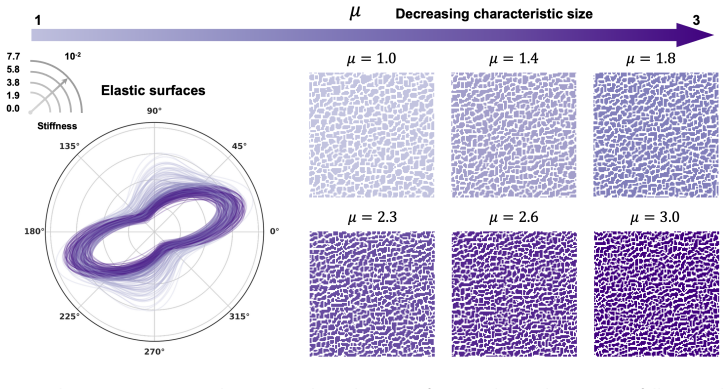
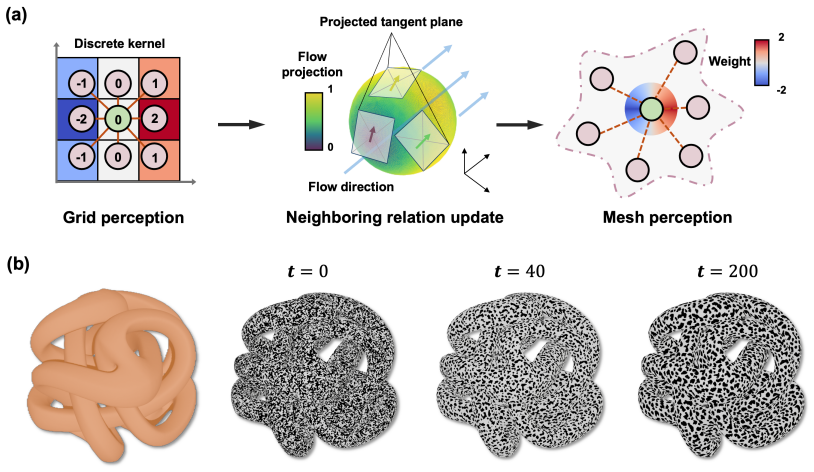
Key machinery: the neural cellular automaton (NCA) — each cell carries a multi-channel state; fixed Sobel/Laplacian kernels gather neighborhood information; a shared network maps the perception to a residual update; a Bernoulli mask breaks symmetry. The pivotal interpretation: the update is a forward-Euler step of a generalized PDE, so the network approximates Fθ(u, ∇u, ∇²u). Controls modify only the perception operators — rotation R(θ), Riemannian metric g(s1,s2)=exp([[s1,s2],[s2,-s1]]), anisotropic Laplacian scaled by μ, boundary speed s_x|∇y u|+s_y|∇x u| — while the network stays frozen. For meshes, grid kernels become angular weights from local-frame neighbor offsets, degenerating to gri
What would settle it
Train an NCA on a regular grid template; run the same frozen network on a moderately irregular triangular mesh using the paper's intrinsic stencil; then compare two-point correlation functions, lineal-path functions, and homogenized stiffness tensors between the grid-grown and mesh-grown samples. If these deviate by more than the sample-to-sample variation observed on the grid, the discretization-transfer claim is refuted.
Extended reading notes
Core claim
Central claim: a neural cellular automaton trained from a single template via a style loss is a generalized PDE — its local perception (state, gradient, Laplacian) mapped by a shared network to an update is a forward-Euler step of ∂u/∂t = Fθ(u, ∇u, ∇²u). Then the fixed perception operators are control handles: rotating gradients rotates the microstructure and stiffness; a Riemannian metric g(s1,s2) with scale μ controls anisotropy and feature size; a signed boundary speed dilates/erodes the solid phase directionally. The same PDE view justifies mesh transfer: replace grid kernels with intrinsic angular stencils in local frames, keep the same frozen weights. End-to-end, the authors optimize a
Load-bearing premise
The claim that the same trained NCA weights work on any mesh rests on the assertion in Section 3.2 that the NCA update approximates a continuous PDE whose solution is independent of domain and discretization; the paper states this without a proof, a convergence study, or quantitative comparison of mesh-grown versus grid-grown morphology and properties.
Editorial extensions
If this is right
- A single trained NCA, one per template, reproduces six morphologically distinct disordered microstructures (leaf vein, vascular tissue, trabecular bone, biofilm, spider silk, metal fracture) without any dataset.
- Post-training steering expands the accessible stiffness space continuously: the anisotropy ratio C11/C22 spans from 0.027 to 19.88 (nearly three orders of magnitude) with only four control parameters and no retraining.
- The learned rule transfers to irregular domains and arbitrary mesh discretizations by adapting only the perception stencil, and its asynchronous growth supports multiple growth sources, parallelizable generation, and in-situ repair of a damaged bone microstructure.
- Coupling the NCA with VAE-latent multiscale optimization yields a mechanical cloak: the same optimized control fields grow the structure at different resolutions, with mean relative displacement error falling from 26.12%±1.71% at 500×500 to 16.86%±0.63% at 1000×1000 across independent samples.
Reading between the lines
- If the PDE-transfer claim holds, the NCA framework effectively decouples the learned growth rule from the computational mesh, so a single training run on a canonical grid could be reused across arbitrary geometries, manufacturing resolutions, and even point clouds — turning microstructure generation into a mesh-agnostic service.
- The steering parameters (s1, s2, sx, sy) form an interpretable, low-dimensional parameterization of the learned dynamics; a natural extension the paper does not pursue is to invert the control-to-stiffness map (e.g., with a surrogate or normalizing flow) for on-demand generation of a target stiffness tensor, eliminating the need for the VAE-optimization round-trip.
- The in-situ repair result suggests a broader principle: because the fixed surrounding tissue acts as a boundary condition, the same asynchronous-growth mechanism could be used for self-healing digital materials or for generating tissue-matching scaffolds around existing bone — a property that follows from the local, PDE-like dynamics rather than from any visual loss engineering.
Editorial analysis
A structured set of objections, weighed in public.
Referee Report
Summary. The paper proposes a Neural Cellular Automata (NCA) framework for generating disordered microstructures. A single NCA update rule is trained from one template using a frozen VGG-16 feature extractor and a sliced optimal transport style loss, then iteratively grows statistically equivalent microstructures. The authors introduce four post-training steering mechanisms — gradient rotation, Riemannian-metric anisotropy/scale, and directional boundary thickness — that modify only the fixed local perception operators, enabling control of orientation, anisotropy, scale, and thickness without retraining. They further claim that the learned rule transfers to irregular domains and arbitrary discretizations by redefining local perception operators on meshes, and demonstrate spatially varying growth, asynchronous growth, and in-situ repair. Finally, they couple the generator with a VAE-latent topology optimization pipeline and apply it to a mechanical cloaking problem, reporting a homogenized relative error of 8.10% and full-scale NCA-generated errors of 26.12%±1.71% at 500×500 and 16.86%±0.63% at 1000×1000 resolution.
Significance. If the claims hold, this is a strong contribution to generative design of disordered metamaterials. The grid-based generation and steering results are well supported: the one-shot training objective is sensible, the morphology is validated with two-point correlation and lineal-path functions, and the property-space exploration (10,000 samples; anisotropy ratio from 0.027 to 19.88) is extensive. The mechanical cloaking demonstration is quantified with full-scale FEA at two resolutions, which is more than most papers in this area provide. The central weakness is that the paper's headline generalizability claims — transfer across arbitrary discretizations and self-repair — rest on visual demonstrations and an unvalidated PDE analogy. The grid-based core of the paper is credible; the transfer claim needs substantially more evidence before the 'arbitrary discretization' contribution can be accepted.
major comments (4)
- [§3.2] The central claim that the learned NCA rule transfers across domains and discretizations rests on the assertion: 'the same PDE can be solved and converge to the same result regardless of the domain or discretization, as long as the local operators are adapted' (Sec. 3.2). No proof, convergence study, or quantitative comparison is provided. The only evidence is a single qualitative image (Fig. 15(b)); mesh-grown morphology is never compared with grid-grown morphology via S2, lineal-path, volume fraction, or homogenized stiffness, and no test at varying mesh irregularity is reported. Since 'arbitrary discretizations' is a headline contribution, this is a load-bearing gap. Please add quantitative mesh-vs-grid validation, or substantially weaken the claim.
- [Eq. (12), §3.2] The adapted stencils in Eq. (12) are not discretization-invariant as claimed. w_x and w_y scale as inverse L1 distance from the center vertex, with no area or edge-length factors, so on a nonuniform mesh they change the effective gradient magnitude and Laplacian normalization relative to the training grid. The statement that these weights 'degenerate exactly to the 2D grid kernels' is not correct even on a uniform grid: for an axis-aligned neighbor at (1,0), Eq. (12) gives w_x=2 and w_lap=2, whereas the standard Sobel x kernel has weight 1 for that neighbor and the standard 4-neighbor Laplacian has weight 1 (and 0 for diagonal neighbors). Feeding such rescaled or differently weighted perception vectors into a network trained on grid-specific filter responses is not guaranteed to reproduce the same dynamics. The stencils must be normalized to preserve the scale and sparsity of the grid ke
- [§2.1.1, Eq. (3)] The interpretation of the NCA update as a PDE is formal: Eq. (3) is a rewrite of Eq. (1) with a stochastic Bernoulli mask, and no well-posedness, consistency, or convergence analysis is given. This may be acceptable as an analogy for steering homogeneous growth, but the paper uses the PDE analogy as the foundation for the discretization-transfer claim. Without at least a numerical consistency check (e.g., grid refinement showing convergence of generated statistics to a limit), the PDE analogy cannot bear the weight placed on it in Sec. 3.2.
- [§3.3, Fig. 17] The asynchronous growth and in-situ repair demonstrations are presented without quantitative evaluation. The repair result is judged visually; there is no measurement of how well the regrown patch matches the surrounding trabecular statistics (e.g., S2, lineal path, volume fraction) or whether the repaired region restores effective stiffness or connectivity. Since 'self-repair' and 'asynchronous growth' are listed as contributions, these claims need quantitative support, or they should be clearly framed as qualitative demonstrations.
minor comments (5)
- [§2.2.2, Eq. (7)-(8)] The Riemannian-metric perception notation is dense. In Eq. (7), the term μ^{-1/2} g^{-1}∇u and the definition of the anisotropic Laplacian in Eq. (8), including the factor √|μI|, are difficult to parse. Please expand the derivation and define each symbol explicitly (e.g., whether μ is a scalar and how √|μI| reduces when μ is scalar).
- [Table 1] The 'Uncloaked reference' and 'Optimized result' rows report no standard deviation or number of samples, while the NCA-generated rows report mean±std over 20 samples. Clarify whether the first two are deterministic single FEA runs, and add the resolution at which the 'Optimized result' was computed.
- [§3.2, Fig. 15] Figure 15(b) is the sole evidence for surface-mesh transfer. The figure lacks information about mesh resolution, number of vertices, and the degree of irregularity. At minimum, add these details and, ideally, side-by-side grid-grown and mesh-grown results at comparable resolution.
- [§5, Conclusion] The conclusion states that 'the learned growth rule can be transferred across different domain geometries and representations' as if this were established. Given the current evidence, this overstates the support; please align the conclusion with the actual validation level.
- [Throughout] There are many minor typos and spacing errors (e.g., 'improves theaverage' and missing spaces around equations in the text). A careful proofreading pass is recommended.
Circularity Check
No significant circularity; the core training, control, and multiscale demonstrations are independently validated rather than reducing to their inputs.
full rationale
The paper's central derivation chain is not circular. The NCA is trained from a single template by matching frozen VGG-16 style statistics (Eq. 4), and the resulting microstructures are validated with different statistical descriptors—two-point correlation and lineal-path functions (Fig. 3)—so the validation is not identical to the training objective by construction. The post-training controls are explicit modifications of the perception operators: gradient rotation (Eq. 5), Riemannian-metric reshaping (Eqs. 7–8), and boundary-speed thickness evolution (Eq. 9). These are direct actuation mechanisms, not fitted predictions, and their morphological and homogenized-stiffness consequences are checked by independent generation and numerical homogenization (Figs. 6, 8, 9, 11). The multiscale optimization is constrained to the property space sampled from the same NCA (Sec. 2.3) via a VAE latent tube (Eqs. 16–18), so the optimized stiffness distribution is admittedly limited to the model's reachable property space; however, the cloaking objective is external, and the final performance is evaluated by full-scale finite-element simulation of separately grown NCA microstructures (Table 1), which yields independent errors (26.12% and 16.86%) rather than recovering the fitted homogenized value (8.10%). Thus no claimed prediction is forced by an input by construction. The paper contains self-citations by the corresponding author (e.g., refs. [13,15,41,44]), but they are contextual references and are not load-bearing evidence for a uniqueness or prediction claim. The main weakness—the discretization-transfer claim resting on an unproved PDE analogy and mesh stencils (Eq. 12) that are not shown to be discretization-invariant—is a matter of evidence and correctness, not circularity.
Assumptions & free parameters
free parameters (5)
- NCA hidden width D =
96
- stochastic update mask probability p =
0.5
- VAE latent dimension d_z =
4
- latent tube radius fraction r_frac =
0.05
- constraint limit gamma =
0.2
assumptions (5)
- domain assumption The learned NCA update (Eq. 3) is a discretization of a continuous PDE, so the same network weights transfer across domains and discretizations once local perception operators are adapted.
- domain assumption A frozen ImageNet VGG-16 with sliced optimal transport style loss is a sufficient statistical descriptor to learn local growth rules that preserve the mechanical properties of the template.
- standard math The angularly-weighted mesh stencil in Eq. (12) yields mesh analogs of the Sobel/Laplacian grid kernels that are compatible with the trained grid perception.
- domain assumption The 10,000-sample generated property space is representative and smooth enough for VAE training and latent-tube optimization.
- domain assumption Homogenized effective stiffness C describes the macroscale FEA response at 50×50 elements and at 500×500/1000×1000 resolutions.
Cite this review
Pith. "Pith review of One-Shot Generative Design for Disordered Metamaterials via Self-Organizing Neural Cellular Automata." pith.science (2026). https://pith.science/paper/KUHWD5TR
@misc{pith2026260714475,
  author       = {Pith},
  title        = {Pith review of: One-Shot Generative Design for Disordered Metamaterials via Self-Organizing Neural Cellular Automata},
  year         = {2026},
  howpublished = {\url{https://pith.science/paper/KUHWD5TR}},
  note         = {Machine review of arXiv:2607.14475}
}
read the original abstract
Disordered metamaterials feature microstructures with inherent randomness and irregularity, enabling them to achieve broader property coverage and superior performance unavailable in their regular counterparts. Despite their promise, designing disordered microstructures is substantially harder than designing regular ones. Their design remains trapped between manual parameterizations with limited expressiveness, and generative AI that is data-hungry and struggles to generalize. To address these limitations, we propose a generative design framework based on Neural Cellular Automata that dynamically grows complex microstructures through learned local interaction rules, inspired by the self-organizing processes in natural materials. This framework requires only a single training template, yet accommodates diverse disordered microstructures and adapts to irregular domains and arbitrary discretizations. By manipulating the learned local rules, we can steer the growth process to generate microstructures unseen during training, providing control over orientation, anisotropy, and directional thickness without retraining. As a dynamic, local growth process, it naturally produces spatially varying microstructures that transition smoothly to enable location-specific mechanical properties. We demonstrate this in a multiscale mechanical cloaking design, where microstructures vary across the space to meet an optimized heterogeneous property distribution. Our design enables excellent cloaking performance without complicated post-processing and incompatible assembly common in existing methods. This data-efficient, generalizable approach opens access to previously intractable disordered materials for biomedical implants and soft robotics.
Figures


Figures from the paper (18 more)






Reference graph
Works this paper leans on
-
[1]
P. Jiao, J. Mueller, J. R. Raney, X. Zheng, A. H. Alavi, Mechanical metamaterials and beyond, Nat. Commun. 14 (2023) 6004
2023
-
[2]
Bertoldi, V
K. Bertoldi, V. Vitelli, J. Christensen, M. van Hecke, Flexible mechanical metamaterials, Nat. Rev. Mater. 2 (2017) 17066
2017
-
[3]
D.Lee,W.Chen,L.Wang,Y.-C.Chan,W.Chen, Data-drivendesignformetamaterialsandmultiscalesystems:areview, AdvancedMaterials 36 (2024) 2305254
2024
-
[4]
Bückmann, M
T. Bückmann, M. Thiel, M. Kadic, R. Schittny, M. Wegener, An elasto-mechanical unfeelability cloak made of pentamode metamaterials, Nat. Commun. 5 (2014) 4130
2014
-
[5]
Boddapati, C
J. Boddapati, C. Daraio, Planar structured materials with extreme elastic anisotropy, Mater. Des. 246 (2024) 113348
2024
-
[6]
Z. Lin, L. S. Novelino, H. Wei, N. A. Alderete, G. H. Paulino, H. D. Espinosa, S. Krishnaswamy, Digital mechanical metamaterial with programmable functionality, Adv. Mater. 36 (2024) 2406263
2024
-
[7]
Zhang, M
J. Zhang, M. Xiao, L. Gao, A. Alù, F. Wang, Self-bridging metamaterials surpassing the theoretical limit of Poisson’s ratios, Nat. Commun. 14 (2023) 4041
2023
-
[8]
A. J. D. Shaikeea, H. Cui, M. O’Masta, X. R. Zheng, V. S. Deshpande, The toughness of mechanical metamaterials, Nat. Mater. 21 (2022) 297–304
2022
Show all 74 references
-
[9]
J. U. Surjadi, B. F. G. Aymon, A. Kumar, L. Wu, J. Lem, K. N. Kamrin, C. M. Portela, Hierarchical granular metamaterials, arXiv (2026) 2606.22795
2026 arXiv
-
[10]
K. Liu, R. Sun, C. Daraio, Growth rules for irregular architected materials with programmable properties, Science 377 (2022) 975–981
2022
-
[11]
C. E. Gregg, D. Catanoso, B. O. Irene, I. Kostitsyna, M. E. Ochalek, T. J. Olatunde, I. W. Park, F. M. Sebastianelli, E. M. Taylor, G. T. Trinh, K. C. Cheung, Ultralight, strong, and self-reprogrammable mechanical metamaterials, Sci. Robot. 9 (2024) eadi2746
2024
-
[12]
S. A. Cummer, J. Christensen, A. Alù, Controlling sound with acoustic metamaterials, Nat. Rev. Mater. 1 (2016) 16001
2016
-
[13]
L. Wang, Z. Liu, D. Da, Y.-C. Chan, W. Chen, P. Zhu, Generalized de-homogenization via sawtooth-function-based mapping and its demonstrationondata-drivenfrequencyresponseoptimization,ComputerMethodsinAppliedMechanicsandEngineering395(2022)114967
2022
-
[14]
Z. Gao, X. Zhang, Y. Wu, Y. Ni, Y. Lu, C. Xia, H. Wang, H. Wang, A metamaterial scaffold beyond modulus limits: enhanced osteogenesis and angiogenesis of critical bone defects, Nat. Commun. 16 (2025) 2094
2025
-
[15]
L. Wang, J. Boddapati, K. Liu, P. Zhu, C. Daraio, W. Chen, Mechanical cloak via data-driven aperiodic metamaterial design, Proc. Natl. Acad. Sci. U.S.A. 119 (2022) e2122185119
2022
-
[16]
Z.Feng,H.Xu, Designingperiodicmetamaterialsinspiredbystochasticmicrostructuresviatexture-synthesis-drivenexplainableAI, J.Mech. Des. 148 (2026) 051703
2026
-
[17]
Pahlavani, K
H. Pahlavani, K. Tsifoutis-Kazolis, M. C. Saldivar, P. Mody, J. Zhou, M. J. Mirzaali, A. A. Zadpoor, Deep learning for size-agnostic inverse design of random-network 3D printed mechanical metamaterials, Adv. Mater. 36 (2024) 2303481
2024
-
[18]
X. Fang, J. Wen, L. Cheng, D. Yu, H. Zhang, P. Gumbsch, Programmable gear-based mechanical metamaterials, Nat. Mater. 21 (2022) 869–876
2022
-
[19]
Zaiser, S
M. Zaiser, S. Zapperi, Disordered mechanical metamaterials, Nat. Rev. Phys. 5 (2023) 679–688
2023
-
[20]
Oftadeh, M
R. Oftadeh, M. Perez-Viloria, J. C. Villa-Camacho, A. Vaziri, A. Nazarian, Biomechanics and mechanobiology of trabecular bone: a review, J. Biomech. Eng. 137 (2015) 0108021
2015
-
[21]
X.Wang,L.Zhu,L.Sun,N.Li,Breakingthetradeoffsbetweendifferentmechanicalpropertiesinbioinspiredhierarchicallatticemetamaterials, Adv. Funct. Mater. 33 (2023) 2305978
2023
-
[22]
M.Shen,K.Liu,S.Mao,C.Daraio, Self-supervisedAIfordecodinganddesigningdisorderedmetamaterials, Sci.Adv.12(2026)eadx7389
2026
-
[23]
J. Gim, N. Schnitzer, L. M. Otter, Y. Cui, S. Motreuil, F. Marin, S. E. Wolf, D. E. Jacob, A. Misra, R. Hovden, Nanoscale deformation mechanics reveal resilience in nacre ofPinna nobilisshell, Nat. Commun. 10 (2019) 4822
2019
-
[24]
S. Luan, E. Chen, J. John, S. Gaitanaros, A data-driven framework for structure-property correlation in ordered and disordered cellular metamaterials, Sci. Adv. 9 (2023) eadi1453
2023
-
[25]
Y.Liu,B.Xia,K.Liu,Y.Zhou,K.Wei, Robustnessanddiversityofdisorderedstructuresonsoundabsorptionanddeformationresistance, J. Mech. Phys. Solids 190 (2024) 105751
2024
-
[26]
S.Fulco,M.K.Budzik,H.Xiao,D.J.Durian,K.T.Turner, Disorderenhancesthefracturetoughnessof2Dmechanicalmetamaterials, PNAS Nexus 4 (2025) pgaf023
2025
-
[27]
Fulco, P
S. Fulco, P. K. Purohit, M. K. Budzik, K. T. Turner, Fracture of disordered and stochastic lattice materials, arXiv (2025) 2508.21187
2025 arXiv
-
[28]
Y.Jia,K.Liu,X.S.Zhang, Modulatestressdistributionwithbio-inspiredirregulararchitectedmaterialstowardsoptimaltissuesupport, Nat. Commun. 15 (2024) 4072
2024
-
[29]
Y. Liu, B. Xia, Y. Zhou, K. Wei, Disordered mechanical metamaterials with programmable properties, Acta Mater. 285 (2025) 120700
2025
-
[30]
D. R. Reid, N. Pashine, J. M. Wozniak, H. M. Jaeger, A. J. Liu, S. R. Nagel, J. J. de Pablo, Auxetic metamaterials from disordered networks, Proc. Natl. Acad. Sci. U.S.A. 115 (2018) E1384–E1390
2018
-
[31]
Hanifpour, C
M. Hanifpour, C. F. Petersen, M. J. Alava, S. Zapperi, Mechanics of disordered auxetic metamaterials, Eur. Phys. J. B 91 (2018) 271
2018
-
[32]
Dhulipala, C
S. Dhulipala, C. M. Portela, Curvature-guided mechanics and design of spinodal and shell-based architected materials, J. Mech. Phys. Solids 204 (2025) 106273
2025
-
[33]
H. Xu, Y. Li, C. Brinson, W. Chen, A descriptor-based design methodology for developing heterogeneous microstructural materials system, J. Mech. Des. 136 (2014) 051007
2014
-
[34]
H. Xu, D. A. Dikin, C. Burkhart, W. Chen, Descriptor-based methodology for statistical characterization and 3D reconstruction of microstructural materials, Comput. Mater. Sci. 85 (2014) 206–216
2014
-
[35]
H.Deng,Q.Zhao,T.Liu,Z.Zhang,Z.Zhu,Y.Zhou,H.-X.Peng,W.Yang,H.Gao,H.Zhou, Beyondunitcells:Programmablemorphogenetic design of irregular architected materials, Proc. Natl. Acad. Sci. U.S.A. 123 (2026) e2606412123
2026
-
[36]
X.Zheng,T.-T.Chen,X.Jiang,M.Naito,I.Watanabe, Deep-learning-basedinversedesignofthree-dimensionalarchitectedcellularmaterials with the target porosity and stiffness using voxelized voronoi lattices, Sci. Technol. Adv. Mater. 24 (2023) 2157682. Page 26 of 28
2023
-
[37]
L. He, M. Zhao, J. P. Y. Cheung, T. Zhang, X. Ren, Gaussian random field-based characterization and reconstruction of cancellous bone microstructure considering the constraint of correlation structure, J. Mech. Behav. Biomed. Mater. 152 (2024) 106443
2024
-
[38]
Kumar, S
S. Kumar, S. Tan, L. Zheng, D. M. Kochmann, Inverse-designed spinodoid metamaterials, npj Comput. Mater. 6 (2020) 73
2020
-
[39]
Zheng, S
L. Zheng, S. Kumar, D. M. Kochmann, Data-driven topology optimization of spinodoid metamaterials with seamlessly tunable anisotropy, Comput. Methods Appl. Mech. Eng. 383 (2021) 113894
2021
-
[40]
F.V.Senhora,E.D.Sanders,G.H.Paulino, Optimally-Tailoredspinodalarchitectedmaterialsformultiscaledesignandmanufacturing, Adv. Mater. 34 (2022) 2109304
2022
-
[41]
S. Deng, D. Lee, A. Chandrasekhar, S. Knapik, L. Wang, H. D. Espinosa, W. Chen, Data-driven topology optimization for multiscale biomimetic spinodal design, arXiv (2025) 2506.23420
2025
-
[42]
C. M. Portela, A. Vidyasagar, S. Krödel, T. Weissenbach, D. W. Yee, J. R. Greer, D. M. Kochmann, Extreme mechanical resilience of self-assembled nanolabyrinthine materials, Proc. Natl. Acad. Sci. U.S.A. 117 (2020) 5686–5693
2020
-
[43]
Y. Jia, K. Liu, X. S. Zhang, Unstructured growth of irregular architectures for optimized metastructures, J. Mech. Phys. Solids 192 (2024) 105787
2024
-
[44]
Methods Appl
L.Wang,Y.-C.Chan,F.Ahmed,Z.Liu,P.Zhu,W.Chen,Deepgenerativemodelingformechanistic-basedlearninganddesignofmetamaterial systems, Comput. Methods Appl. Mech. Eng. 372 (2020) 113377
2020
-
[45]
Xiang, J
Y. Xiang, J. Hou, X. Chen, K. Tang, X. Wang, Decoupled design of hybrid mechanical metamaterials via ensembled deep learning, Int. J. Mech. Sci. 301 (2025) 110514
2025
-
[46]
S. C. Shen, M. J. Buehler, Nature-inspired architected materials using unsupervised deep learning, Commun. Eng. 1 (2022) 37
2022
-
[47]
Y. Mao, Q. He, X. Zhao, Designing complex architectured materials with generative adversarial networks, Sci. Adv. 6 (2020) eaaz4169
2020
-
[48]
5 (2023) 1466–1475
J.-H.Bastek,D.M.Kochmann, Inversedesignofnonlinearmechanicalmetamaterialsviavideodenoisingdiffusionmodels, Nat.Mach.Intell. 5 (2023) 1466–1475
2023
-
[49]
R.Guo,M.Alves,M.Mehdikhani,C.Breite,Y.Swolfs, Synthesisingrealistic2dmicrostructuresofunidirectionalfibre-reinforcedcomposites with a generative adversarial network, Compos. Sci. Technol. 250 (2024) 110539
2024
-
[50]
J. P. Quesada-Molina, H. Mofatteh, A. Akbarzadeh, S. Mariani, Navigating beyond the training set: A deep learning framework for inverse design of architected composite materials, Eng. Appl. Artif. Intell. 150 (2025) 110473
2025
-
[51]
A. M. Turing, The chemical basis of morphogenesis, Philos. Trans. R. Soc. Lond. B Biol. Sci. 237 (1952) 37–72
1952
-
[52]
S.Kondo,T.Miura, Reaction-Diffusionmodelasaframeworkforunderstandingbiologicalpatternformation, Science329(2010)1616–1620
2010
-
[53]
A.Runions,M.Fuhrer,B.Lane,P.Federl,A.-G.Rolland-Lagan,P.Prusinkiewicz, Modelingandvisualizationofleafvenationpatterns, ACM Transactions on Graphics 24 (2005) 702–711
2005
-
[54]
Mordvintsev, E
A. Mordvintsev, E. Randazzo, E. Niklasson, M. Levin, Growing neural cellular automata, Distill 5 (2020) e23
2020
-
[55]
Seibert, A
P. Seibert, A. Raßloff, Y. Zhang, K. Kalina, P. Reck, D. Peterseim, M. Kästner, Reconstructing microstructures from statistical descriptors using neural cellular automata, Integr. Mater. Manuf. Innov. 13 (2024) 272–287
2024
-
[56]
Pajouheshgar, Y
E. Pajouheshgar, Y. Xu, A. Abbasi, A. Mordvintsev, W. Jakob, S. Süsstrunk, Neural cellular automata: From cells to pixels, arXiv (2026) 2506.22899
2026 arXiv
-
[57]
Andreassen, C
E. Andreassen, C. S. Andreasen, How to determine composite material properties using numerical homogenization, Comput. Mater. Sci. 83 (2014) 488–495
2014
-
[58]
103 (2016) 89–102
R.Bostanabad,A.T.Bui,W.Xie,D.W.Apley,W.Chen,Stochasticmicrostructurecharacterizationandreconstructionviasupervisedlearning, Acta Mater. 103 (2016) 89–102
2016
-
[59]
R.Bostanabad,Y.Zhang,X.Li,T.Kearney,L.C.Brinson,D.W.Apley,W.K.Liu,W.Chen, Computationalmicrostructurecharacterization and reconstruction: Review of the state-of-the-art techniques, Prog. Mater. Sci. 95 (2018) 1–41
2018
-
[60]
Simonyan, A
K. Simonyan, A. Zisserman, Very deep convolutional networks for large-scale image recognition, in: Proc. Int. Conf. Learn. Represent., pp. 1–14
-
[61]
Y. Jiao, F. H. Stillinger, S. Torquato, Modeling heterogeneous materials via two-point correlation functions: I. basic principles, Phys. Rev. E 76 (2007) 031110
2007
-
[62]
Loseille, F
A. Loseille, F. Alauzet, Continuous mesh framework. part i: Well-posed continuous interpolation error, SIAM J. Numer. Anal. 49 (2011) 38–60
2011
-
[63]
A. P. McAnena, T. McClennen, H. Zheng, Patient-specific 3-Dimensional-printed orthopedic implants and surgical devices are potential alternatives to conventional technology but require additional characterization, Clin. Orthop. Surg. 17 (2025) 1–15
2025
-
[64]
Knöppel, K
F. Knöppel, K. Crane, U. Pinkall, P. Schröder, Globally optimal direction fields, ACM Transactions on Graphics 32 (2013) 59:1–59:10
2013
-
[65]
Y. Yang, S. Liu, H. Pan, Y. Liu, X. Tong, PFCNN: Convolutional neural networks on 3D surfaces using parallel frames, in: Proceedings of the IEEE/CVF Conference on Computer Vision and Pattern Recognition (CVPR), pp. 13578–13587
-
[66]
J.Masci,D.Boscaini,M.M.Bronstein,P.Vandergheynst, GeodesicconvolutionalneuralnetworksonRiemannianmanifolds, in:Proceedings of the IEEE International Conference on Computer Vision Workshops (ICCVW), pp. 37–45
-
[67]
F. V. Senhora, E. Sanders, G. Paulino, Unbiased mechanical cloaks, Zenodo (2025) 15271218
2025
-
[68]
X.-Y.Zhang,G.Fang,J.Zhou, Additivelymanufacturedscaffoldsforbonetissueengineeringandthepredictionoftheirmechanicalbehavior: A review, Materials 10 (2017) 50
2017
-
[69]
Cheikho, J
K. Cheikho, J. F. Ganghoffer, A. Baldit, E. Labbé, S. Alix, H. Kerdjoudj, C. Mauprivez, A. Lebée, C. Laurent, A flexible design framework to design graded porous bone scaffolds with adjustable anisotropic properties, J. Mech. Behav. Biomed. Mater. 140 (2023) 105727
2023
-
[70]
Babazadeh-Naseri, G
A. Babazadeh-Naseri, G. Li, M. S. Shourijeh, J. E. Akin, C. F. Higgs, B. J. Fregly, N. J. Dunbar, Stress-shielding resistant design of custom pelvic prostheses using lattice-based topology optimization, Med. Eng. Phys. 121 (2023) 104012
2023
-
[71]
P. S. P. Poh, D. Valainis, K. Bhattacharya, M. van Griensven, P. Dondl, Optimization of bone scaffold porosity distributions, Sci. Rep. 9 (2019) 9170. Page 27 of 28
2019
-
[72]
Schaffner, J
M. Schaffner, J. A. Faber, L. Pianegonda, P. A. Rühs, F. Coulter, A. R. Studart, 3d printing of robotic soft actuators with programmable bioinspired architectures, Nat. Commun. 9 (2018) 878
2018
-
[73]
114 (2017) 51–56
F.Connolly,C.J.Walsh,K.Bertoldi, Automaticdesignoffiber-reinforcedsoftactuatorsfortrajectorymatching, Proc.Natl.Acad.Sci.U.S.A. 114 (2017) 51–56
2017
-
[74]
X.Ni,H.Luan,J.-T.Kim,S.I.Rogge,Y.Bai,J.W.Kwak,S.Liu,D.S.Yang,S.Li,S.Li,Z.Li,Y.Zhang,C.Wu,X.Ni,Y.Huang,H.Wang, J. A. Rogers, Soft shape-programmable surfaces by fast electromagnetic actuation of liquid metal networks, Nat. Commun. 13 (2022) 5576. Page 28 of 28
2022
Reviewed August 2, 2026 · model on record in the stance chip above.
Discussion (0). Sign in to comment.