REVIEW 3 major objections 5 minor 12 references
MathCoPilot: An Interactive System for Human-AI Symbiotic Paradigm of Mathematical Research
T0 review · 3 major / 5 minor · reviewed 2026-08-02 · deepseek-v4-flash
Pith's one-line read This paper proposes a human–AI division of labor for theorem proving — mathematician steers, AI formalizes in Lean — and shows it doubles verified pass rates, with statement formalization, not reasoning, deciding research-level success.
desk verdict An honest, well-scoped systems paper whose FormalMATH numbers are believable, but whose PDE 'research-level' claim is weaker than the abstract suggests because the deep analytic content is imported as axioms. read the letter →
The pith
A machine-rendered reading of the paper's core claim, the machinery that carries it, and where it could break.
The reading
What carries the argument
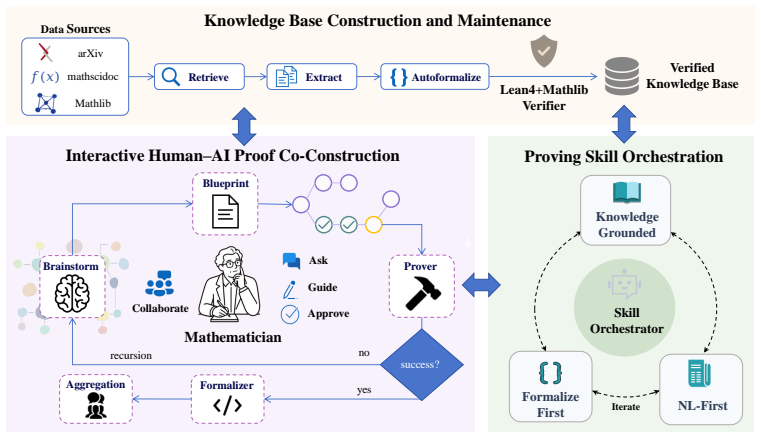
The living proof blueprint: a graph whose nodes are self-contained proof steps — lemmas, cases, intermediate claims — joined by dependency edges, rendered as a flowchart with per-node status. It carries the argument by making proofs pointable: the mathematician clicks a node to inspect, edit, or hand it to the Prover Agent, and can recurse on any node until each leaf is automatically provable. Around it sit three supporting mechanisms: the NL-first skill (write an informal proof, then formalize incrementally), the orchestrator that switches strategies on Lean's error feedback, and a personal knowledge base storing verified Lean code alongside the natural-language reasoning that produced it.
What would settle it
Re-run the FormalMATH comparison on the full benchmark, not a 21-problem sample, under the same strict no-sorry rule: if the NL-over-FF doubling does not persist at scale, the headline result is a sampling artifact. For the PDE claims, take a verified assembly certificate and weaken one analytic axiom — say, replace Gronwall's inequality with a strictly weaker bound that a correct proof would not survive — and check whether Lean still accepts the file; if it does, the certificate is checking the plumbing, not the mathematics. Also, since the paper shows a correct natural-language proof whose a
Extended reading notes
Core claim
The paper's central claim is that LLM provers work best inside a human-in-the-loop workflow, not as autonomous agents, and that this design changes measured results. On a 21-problem FormalMATH subset, the natural-language-first strategy reaches 20/63 strict Lean-verified passes versus 10/63 for formalization-first; the interactive blueprint loop, which recursively formalizes unresolved proof nodes, recovers 10 of 12 cases GPT-5.4 failed. On two research-level PDE theorems, the deciding variable is how the statement is formalized: a well-formed stub yields verified assembly certificates in every attempt, while version-incompatible formalizations mostly fail. These PDE files are assembly certi
Load-bearing premise
The load-bearing premise is that the PDE 'verified proofs' measure research-level proving ability even though the deep analytic content — Galerkin orthogonality, energy stability, Gronwall's inequality, Bramble–Hilbert estimates, Gauss–Radau projection estimates, and affine scaling — is imported as unproved axioms or opaque declarations while Lean verifies only the formal assembly; if those axioms do not faithfully capture the intended theorems, the PDE results overstate what
Editorial extensions
If this is right
- Writing a natural-language proof before attempting Lean formalization exactly doubles the strict verifier pass rate — 20/63 versus 10/63 overall, with consistent gains for all three tested models — so informal scaffolding is a reliable performance lever.
- The interactive proof-blueprint loop, which exposes unresolved proof obligations as nodes and recursively formalizes them, recovers 10 of 12 FormalMATH cases that GPT-5.4 failed (9/12 on the first pass), showing that most hard failures are local formalization gaps rather than missing high-level strategies.
- On research-level PDE theorems, formalization quality and Lean-version compatibility dominate model reasoning: Opus-formalized stubs yield verified assembly certificates in 6/6 attempts, while GPT-formalized stubs fail in 6/8, mostly from declaration-boundary and version incompatibilities.
- The PDE 'verified proofs' are assembly certificates, not end-to-end formalizations: deep analytic ingredients (Galerkin orthogonality, energy stability, Gronwall, Bramble–Hilbert, Gauss–Radau projection, affine scaling) are declared as axioms, and the paper warns these results are not directly comparable to benchmark pass rates.
- Error detection is a separate, currently more robust skill: both models tested on proof review reject all four deliberately flawed PDE proofs and identify the planted mathematical error.
Reading between the lines
- If autoformalization sensitivity is the binding constraint, then holding the model fixed and varying stub quality should move verified pass rates more than swapping models does — a directly testable prediction of the paper's account.
- The hardmath_162 refinement exposes a class of benchmark targets that are literally false as formalized, because rounding an asymptotic exponent and then using it inside an exponential is not asymptotically harmless; auditing how many benchmark statements share this property could reframe 'model failures' as 'misformalized targets.'
- The assembly-certificate standard carries an unexamined risk: a wrong analytic axiom could still assemble into a valid Lean certificate; a planted-axiom experiment would test whether the human-in-the-loop protocol can police the analytic layer rather than only the formal plumbing.
- Because critique outpaced construction in the experiments, adversarial review — asking models to find planted errors in proofs they could not construct — may be a cheaper and more informative probe of mathematical understanding than generation pass rates.
Editorial analysis
A structured set of objections, weighed in public.
Referee Report
Summary. MathCoPilot is a human-in-the-loop system for Lean 4 formalization and proof construction, combining an interactive proof blueprint, automated skill orchestration, and knowledge-base construction. The paper evaluates three or four LLMs on a 21-problem FormalMATH subset and on two PDE theorems, reporting: (i) the NL-first skill roughly doubles the strict Lean pass rate relative to formalization-first (20/63 vs 10/63, §4.2); (ii) the full interactive workflow recovers 10/12 GPT-5.4-unsolved FormalMATH cases (§4.3); and (iii) on PDE theorems, Opus-formalized statements yield 'assembly certificates' for all tested attempts while GPT-formalized statements fail on version/compatibility grounds (§5.2). The paper explicitly disclaims that the PDE results are end-to-end formalizations, stating that deep analytic ingredients are imported as opaque declarations/axioms.
Significance. If the central claims hold, the paper provides a useful systems contribution and a concrete, reproducible evaluation of an interactive proof-blueprint paradigm. The strict no-sorry verification protocol, the external Lean type-checker arbitration, and the case-level failure analysis (e.g., hardmath_162) are clear strengths. The NL-first gain, while based on a small sample, is internally consistent and supported by the domain heatmap and error categories. The paper also makes a valuable methodological point: autoformalization quality and abstraction-boundary choice can dominate raw prover capabilities, especially for domain-specific mathematics. However, the strength of the paper's 'research-level' claim is substantially limited by the PDE assembly-certificate design, and the central recovery example lacks the actual Lean artifact needed for independent verification.
major comments (3)
- [§5.1, Table 5, Appendix A.5] The PDE successes labeled 'Assembly' are verified relative to explicit axioms or opaque declarations for Galerkin orthogonality, the energy estimate, Gronwall's inequality, Bramble–Hilbert, and Gauss–Radau projection estimates. These are not peripheral lemmas; they are the mathematical content of Eqs (1)–(3). The paper's own disclaimers ('not end-to-end formalizations', §5.1) contradict the abstract's framing of these as 'verified Lean 4 proofs' of 'real PDE theorems requiring deep domain expertise.' Lean verification of the remaining norm-inequality/scaling assembly does not measure research-level proving ability. This is load-bearing for the main capability claim. Please either (a) release a complete ledger of assumptions/opaque declarations per certificate and demonstrate that the verified assembly step is unexpectedly difficult, or (b) reframe the PDE results as 'assembly-level certi
- [Appendix A.3] The decisive recovery evidence for hardmath_162—the 'Complete Lean endpoint certificate'—is not actually included. The appendix states 'Lean listing unavailable' and refers to tex/lean/Main.lean without providing the file. Since the 10/12 recovery count and the blueprint-decomposition Table 9 depend on this certificate, the main empirical claim of §4.3 is not independently checkable. The repository or supplementary material must contain the exact Lean file (or a reproducible build script with a checksum) for this case.
- [§4.1–4.2, Table 1] The headline doubling (10/63 vs 20/63) is computed from 21 problems and 9 attempts per model–skill cell. No error bars, confidence intervals, or significance tests are reported, and the domain-level rows show 0/9 for both skills in three domains. Because the claim is central, I ask for a simple permutation or bootstrap test to show that the observed difference is not attributable to sampling noise; alternatively, state clearly that the result is descriptive only for this small curated subset.
minor comments (5)
- [Appendix A.2 / A.3] Table 9 is duplicated: the same proof-blueprint decomposition table appears twice (as Table 7 and Table 9). Renumber and cross-reference once.
- [References] Some references are cited in the text under names that differ from the listed entries (e.g., 'DeepSeek-Prover-V2 [Ren et al., 2025]' vs. the reference entry author list). Please harmonize citation keys.
- [§4.3] The statement 'MATHCOPILOT verifies 10/12' conflates the first-pass 9/12 with the post-hoc refinement of one case. The table is clear, but the prose should more explicitly label the second number as a best-case after targeted lemma refinement, not as a single workflow outcome.
- [§5.2, Table 5] The per-route totals (2/8, 6/6, 4/6) are over 2–4 attempts per cell; the zero 'Syntax' results for the GPT-Formalized route are attributed to Lean version incompatibility, but the specific version differences are never listed. Provide the exact Lean/Mathlib version mismatch (e.g., declaration/namespace changes) so the reader can assess whether this is an artifact of the chosen environment rather than the models.
- [General] The 'human-in-the-loop' claim is never supported by a user study. The paper limits itself to system demonstrations; the conclusion should explicitly state that usability and productivity claims are not empirically validated.
Circularity Check
No significant circularity: the central empirical claims are arbitrated by an external Lean verifier, and the PDE caveat is an explicit scoping disclosure, not a circular derivation.
full rationale
The paper is an empirical evaluation of a human-in-the-loop formalization system, not a mathematical derivation that assumes its own conclusion. The FormalMATH pass rates (10/63 FF vs 20/63 NL; 10/12 recovered cases) are decided by an external Lean 4 type checker under a strict no-sorry rule, so the outcomes are not defined in terms of the quantities they are claimed to predict. The NL-first improvement is a measured comparison between two prompting routes on the same held-out problems, not a parameter fitted to the success rate. The hardmath_162 refinement formalizes the endpoint Laplace argument from explicit derivative, integration-by-parts, remainder, and interval-arithmetic obligations; the paper states that 'the Lean development does not assume the theorem as a black box.' The only near-circular concern is the PDE experiment, where the paper itself discloses that 'successful PDE files often encode the deep analytic ingredients as opaque declarations or axioms and then verify the formal assembly step in Lean' and explicitly labels these as assembly certificates, 'not end-to-end formalizations of PDE analysis from first principles.' That disclosure limits the strength of the PDE capability claim, but it is a scoping caveat rather than a circular step: the analytic ingredients are declared assumptions whose validity is external to the Lean certificate, and the paper does not present the assembly certificate as a first-principles proof. There are no load-bearing self-citations, no imported uniqueness theorems from the authors, and no renamed known result masquerading as a derivation. The empirical benchmark portion is self-contained against an external verifier, so the honest finding is no significant circularity.
Assumptions & free parameters
free parameters (4)
- FormalMATH subset size/composition =
21 problems = 3 per 7 domains
- GPT-unsolved recovery subset =
12 named problems
- Timeout limits =
1200 s (FormalMATH), 600 s (PDE)
- PDE task selection and route definitions =
2 theorems × 3 routes × 4 models
assumptions (3)
- domain assumption The Lean 4.30.0 / Mathlib v4.30.0 type checker is sound and the formal statements faithfully encode the intended mathematics.
- domain assumption PDE analytic ingredients (Galerkin orthogonality, energy stability, Gronwall's inequality, Bramble–Hilbert estimates, Gauss–Radau projection estimates, affine scaling) can be assumed as opaque declarations or axioms and still counted as successful certificates.
- standard math The endpoint Laplace method and its integration-by-parts/remainder estimates are valid standard analysis.
Cite this review
Pith. "Pith review of MathCoPilot: An Interactive System for Human-AI Symbiotic Paradigm of Mathematical Research." pith.science (2026). https://pith.science/paper/323L2RHO
@misc{pith2026260714582,
  author       = {Pith},
  title        = {Pith review of: MathCoPilot: An Interactive System for Human-AI Symbiotic Paradigm of Mathematical Research},
  year         = {2026},
  howpublished = {\url{https://pith.science/paper/323L2RHO}},
  note         = {Machine review of arXiv:2607.14582}
}
read the original abstract
Existing LLM-based theorem provers have achieved impressive results on formal mathematics benchmarks, yet they remain confined to acting as autonomous agents that prove a stated proposition. In this paper, we propose MathCoPilot, a human-in-the-loop system that embodies a new human--AI symbiotic paradigm for mathematical research, in which the mathematician steers the high-level mathematical direction while AI agents carry out the detailed formalization and proof work under continuous human guidance. MathCoPilot unifies three core capabilities: (1) an interactive workbench where the mathematician and AI agents collaborate through a living proof blueprint that decomposes a proof into navigable steps the human can directly inspect, direct, and refine; (2) automated proving skill orchestration with adaptive knowledge base search and Lean-integrated iterative verification; and (3) topic-driven paper retrieval and automated formalization into a verified Lean knowledge base. Using MathCoPilot, we systematically compare four state-of-the-art LLMs, including Gemini~3.1~Pro, GPT-5.4, and Claude~Opus~4.7, on a FormalMATH subset and on two real PDE theorems requiring deep domain expertise, evaluating their ability to produce verified Lean~4 proofs and to identify errors in deliberately incorrect proofs. Our results show that while current models can handle undergraduate-level problems with high success rates under favorable autoformalization conditions, substantial challenges remain for domain-specific theorems requiring genuine mathematical understanding.
Figures
Reference graph
Works this paper leans on
-
[1]
Its minimum on the interval occurs att=−0.8, yielding 1.9 1 + (−0.8)2 = 1.9 1.64 ≈1.1585
The rational term 1.9 1+t2 is positive and monotonically decreasing in magnitude as |t| increases. Its minimum on the interval occurs att=−0.8, yielding 1.9 1 + (−0.8)2 = 1.9 1.64 ≈1.1585
-
[2]
The trigonometric term−4.1 sin(t)is positive and its minimum occurs att=−0.1, yielding −4.1 sin(−0.1)≈ −4.1(−0.0998)≈0.4093
-
[3]
Summing these minimum contributions provides a lower bound for the derivative: g′(t)≥ −1.0240 + 0.4093 + 1.1585 = 0.5438
The polynomial term−2.5t 4 is negative and its minimum occurs att=−0.8, yielding −2.5(−0.8)4 =−2.5(0.4096) =−1.0240. Summing these minimum contributions provides a lower bound for the derivative: g′(t)≥ −1.0240 + 0.4093 + 1.1585 = 0.5438. Because g′(t)≥0.5438>0 for all t∈[−0.8,−0.1] , the function g(t) is strictly increasing on the entire interval. Conseq...
-
[4]
FF” and “NL
Apply Laplace’s Method.For a maximum at the boundary b with f ′(b)>0 , Laplace’s method gives the asymptotic expansion I(x)∼ g(b) xf ′(b) exf(b) asx→ ∞. Substituting the evaluated constants, I(x)∼ −0.744 2.290x e3.89x ≈ −0.32e3.89x x . 5.Conclusion.The asymptotic equivalence implies that the difference I(x)− −0.32 e3.89x x goes to 0 (or is bounded appropr...
-
[5]
all test functions,
Finally, the numerical side conditions are verified by interval estimates: the proof bounds−ϕ′(a), enclosesarctan(0.7)by an alternating-series argument, and derives |ϕ(a)−3.98| ≤0.001, f(a) −ϕ′(a) + 0.10 ≤0.002. More explicitly, the integration-by-parts identity writes I(x) = Q(a)exϕ(a) x − Q(b)exϕ(b) x +R(x), R(x) = 1 x Z b a Q′(t)exϕ(t) dt, whereQ(t) =f...
1986
-
[6]
We first find the maximum off(t)on the interval[−0.8,−0.1]
Analyze the Phase Function f(t).To determine the asymptotic behavior of I(x) as x→ ∞, we use Laplace’s method. We first find the maximum off(t)on the interval[−0.8,−0.1]. The derivative is f ′(t) =−2.5t 4 −4.1 sint+ 1.9 1 +t 2 . For t∈[−0.8,−0.1] , sint <0, so −4.1 sint >0. The term 1.9 1+t2 is also positive and bounded below by 1.9 1.64 ≈1.15 . The negat...
-
[8]
Hence ϕ is strictly decreasing on the interval, so its unique maximum occurs ata=−0.7
First, compute ϕ′(t) = 6.8t3 −0.3 + 0.6 sint− 2 1 +t 2 23 and show that ϕ′(t)≤ −3/4on [a, b]. Hence ϕ is strictly decreasing on the interval, so its unique maximum occurs ata=−0.7. This also gives the quantitative separation ϕ(t)≤ϕ(a)− 3 4 (t−a), t∈[a, b]
-
[9]
Since −ϕ′(t) is bounded away from zero on [a, b], q is differen- tiable andq ′ is bounded by a concrete constant
Define q(t) =f(t)/(−ϕ ′(t)). Since −ϕ′(t) is bounded away from zero on [a, b], q is differen- tiable andq ′ is bounded by a concrete constant
Show all 12 references
-
[10]
Therefore I(x) = q(a)exϕ(a) x − q(b)exϕ(b) x + 1 x Z b a q′(t)exϕ(t) dt
Rewrite the integrand by integration by parts: f(t)e xϕ(t) =− q(t) x d dt exϕ(t). Therefore I(x) = q(a)exϕ(a) x − q(b)exϕ(b) x + 1 x Z b a q′(t)exϕ(t) dt
-
[11]
The same separation bounds the integral remainder by O(exϕ(a)/x2)
The endpoint separation makes the right-endpoint boundary term exponentially smaller than exϕ(a)/x. The same separation bounds the integral remainder by O(exϕ(a)/x2). Dividing by q(a)exϕ(a)/xtherefore gives a quotient tending to1
-
[1970]
Luoxin Chen, Jinming Gu, Liankai Huang, Wenhao Huang, Zhicheng Jiang, Allan Jie, Xiaoran Jin, Xing Jin, Chenggang Li, Kaijing Ma, et al
doi: 10.1137/0707006. Luoxin Chen, Jinming Gu, Liankai Huang, Wenhao Huang, Zhicheng Jiang, Allan Jie, Xiaoran Jin, Xing Jin, Chenggang Li, Kaijing Ma, et al. Seed-prover: Deep and broad reasoning for automated theorem proving.arXiv preprint arXiv:2507.23726, 2025. 11 Philippe...
2025 arXiv
-
[1974]
Yong Lin, Shange Tang, Bohan Lyu, Ziran Yang, Jui-Hui Chung, Haoyu Zhao, Lai Jiang, Yihan Geng, Jiawei Ge, Jingruo Sun, et al
doi: 10.1016/B978-0-12-208350-1.50008-X. Yong Lin, Shange Tang, Bohan Lyu, Ziran Yang, Jui-Hui Chung, Haoyu Zhao, Lai Jiang, Yihan Geng, Jiawei Ge, Jingruo Sun, et al. Goedel-prover-v2: Scaling formal theorem proving with scaffolded data synthesis and self-correction.arXiv pre...
2025 arXiv
Reviewed August 2, 2026 · model on record in the stance chip above.
Discussion (0). Continue with ORCID to comment.