REVIEW 5 major objections 5 minor 20 references
A single simulation-trained reinforcement-learning policy can perform the complete strawberry harvest — clearing occluding fruit, detaching the target berry, and placing it in a tray — with 82 percent success in a real greenhouse, without a
Reviewed by Pith at T0; open to challenge. T0 means a machine referee read the full paper against a public rubric. the ladder, T0–T4 →
T0 review · deepseek-v4-flash
2026-08-02 01:16 UTC pith:XO5VCMIL
load-bearing objection A real full-workflow strawberry-harvesting RL result with 82% real-world success, but the transfer claim is scoped by a simplified plant model and single-site evaluation. the 5 major comments →
Reinforcement Learning for the Full Strawberry Harvesting Process: Obstacle Separation, Detachment, and Placement
The pith
A machine-rendered reading of the paper's core claim, the machinery that carries it, and where it could break.
Core claim
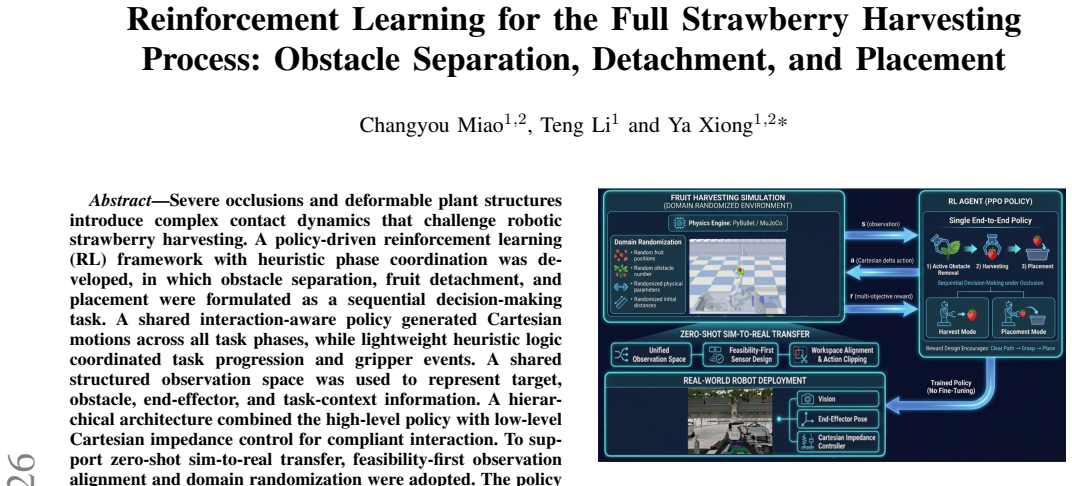
The central claim is that a shared interaction-aware policy, trained once in simulation, generates all Cartesian motions for obstacle separation, fruit detachment, and placement, while lightweight heuristic logic only coordinates phase transitions and gripper events. The policy receives a compact 32-dimensional observation (end-effector pose, target-relative distance and change, the three nearest obstacles with ripeness and distance, and task context) and outputs four-dimensional Cartesian increments. A composite reward with a sequential penalty forces the policy to push nearby obstacles beyond a safe distance before approaching the target, so active clearing behavior emerges from optimizati
What carries the argument
The load-bearing piece is the shared interaction-aware policy: one neural controller that turns a 32-dimensional structured observation into Cartesian increment commands across all task phases. Two supporting mechanisms carry the argument. First, heuristic phase coordination handles the discrete events — deciding when the neighborhood is cleared enough to grasp, when detachment is confirmed, and when to release — leaving all continuous motion to the learned policy. Second, feasibility-first sim-to-real alignment keeps observation and action semantics physically measurable and identical between simulation and deployment, with domain randomization over stem geometry, occlusion levels, and cont
Load-bearing premise
The load-bearing premise is that the simulated spring–damper plant model, with rigid fruit bodies and randomized stiffness bounded to 60 N ±20%, captures the contact dynamics that matter for learning and for transferring harvesting behaviors to real strawberry plants.
What would settle it
If the same policy were deployed on a strawberry cultivar with stems measurably outside the randomized stiffness range (for example, twice as stiff or much more elastic), and the real-world success rate dropped toward the 57% no-separation baseline reported in the ablation, that would indicate the spring–damper model rather than the policy was responsible for the 82% result. A simpler check: record real stem push-and-rebound trajectories and compare them to the simulator's response; a consistent displacement error beyond a few centimeters would falsify the model assumption.
If this is right
- If the claim holds, a full harvest sequence can be automated without collecting real-world training data; simulation alone suffices.
- Because actions are Cartesian increments rather than joint commands, the same policy should run on any manipulator whose workspace covers the target region.
- Occlusion handling becomes an emergent property of the policy, not a separate collision-avoidance module, so adding more obstacles raises time but not the failure rate as steeply.
- The reward structure — a sequential penalty before approach — could be reused for any task where a workspace must be cleared before the main manipulation.
- The moderate sim-to-real gap (89.7% to 82.0%) shows the remaining bottleneck is the plant model, not the policy-learning method.
Where Pith is reading between the lines
- The spring–damper stem model is explicitly acknowledged as incomplete; a richer biomechanical model of stem bending and detachment would likely shrink the 7.7-point sim-to-real gap.
- The same recipe could be tested on other stem-attached crops, such as tomatoes or peppers, where occluding foliage must be displaced before picking.
- Only occlusion levels up to five are evaluated; a stress test with six or more obstacles, or with obstacles that re-enter the path after being pushed, would clarify the limits of the 'feasibility-first' observation alignment.
- Because the policy is trained with a fixed drop-box position, adding a learned or adaptive placement target would be a natural extension for non-stationary harvesting rigs.
Editorial analysis
A structured set of objections, weighed in public.
Referee Report
Summary. This paper proposes an RL framework for the complete strawberry-harvesting workflow—active obstacle separation, fruit detachment, and placement—using a shared PPO policy that outputs Cartesian increments, with heuristic logic for phase transitions and gripper events. The policy is trained in a PyBullet environment with domain randomization and deployed zero-shot on a physically different robotic arm (LingXtend) using Cartesian impedance control. The central claim is that the policy achieves 89.7% success in simulation and 82.0% success in 100 real-world greenhouse trials and that this demonstrates effective transfer of interaction-aware harvesting behaviors. The authors acknowledge in Section VII that the simulation's spring-damper plant model does not fully reproduce real nonlinear plant deformation and contact dynamics, and that only a single platform and single greenhouse environment were evaluated.
Significance. If the results hold, the paper would be a useful step toward closed-loop, interaction-aware agricultural manipulation: it goes beyond isolated reaching and grasping by learning to push away occluders, detach fruit, and place it, all under one policy and with zero-shot transfer. The study is relatively honest about its limitations, which is a strength. However, the evidence is not yet strong enough to support the headline transfer claim: the real-world evaluation has no comparison baseline and no confidence intervals, the main simulation success rate comes from a single training run, and the ablation that attributes a 31-point gain to the obstacle-separation mechanism removes both reward terms and heuristic gating simultaneously. The plant-model simplification is load-bearing because the two real-world failure modes the paper identifies—insufficient stem bending and obstacle rebound due to plant elasticity—are precisely effects a linear spring-damper with a narrow randomized stiffness range would under-represent.
major comments (5)
- [VI-C, Table II] The real-world result rests on a point estimate: 82/100 trials at a single greenhouse, with no baseline condition, no confidence interval, and no comparison against a scripted or non-RL alternative. Without a comparator, the success rate cannot be attributed to the learned policy or the obstacle-separation mechanism. Please report at least a binomial confidence interval and include a baseline (e.g., the same system without separation, or a classical planner). The present evidence does not support the abstract's claim of 'effective transfer' as a general result.
- [V-C1] The obstacle-separation ablation removes separation activation, separation confirmation, the post-separation fruit-detachment gate, and all obstacle-separation-related reward terms together. The 31-percentage-point improvement could be due to the reward shaping alone, the heuristic gating alone, or their combination; the experiment cannot identify the mechanism. Additionally, the ablation uses only 100,000 steps per seed, whereas the main policy trains for 6.03M steps, so the comparison may reflect convergence speed rather than final capability. Please separate the two factors and train to convergence or report learning curves that justify the comparison.
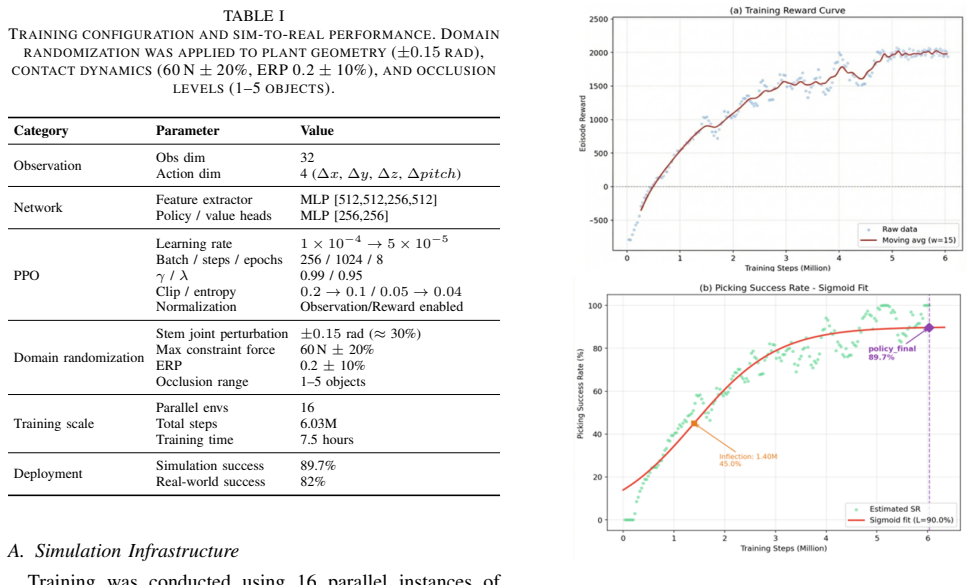
- [III-B, VII, VI-C] The plant model in Eq. (1) and the point-to-point spring-damper with max constraint force 48–72 N and ERP 0.18–0.22 is the only environment the policy sees. Section VII explicitly concedes it 'did not fully reproduce the nonlinear deformation and contact dynamics of real strawberry plants,' and Section VI-C lists 'insufficient stem bending' and rebound of displaced unripe fruit as real failure modes. These are exactly the nonlinearities the model cannot represent. No direct measurement of real stem stiffness/plasticity is given, and there is no second cultivar or greenhouse. The 82% real-world result may therefore be specific to the tested plants and conditions. This limitation is acknowledged, but it weakens the central zero-shot-transfer claim in the abstract and conclusion.
- [VI-A, Eq. (18)] The 'Feasibility-First' objective O = arg max_{O⊆S_real} I(O; π*) is never operationalized. The paper does not compute or estimate this mutual information, solve the optimization, or show that the chosen 32-dimensional observation vector approximates the optimum. In practice, the three alignment mechanisms are manual engineering choices. As written, Eq. (18) is a decorative formalization rather than a design principle with empirical support. Either remove the equation and present the alignment as a heuristic procedure, or provide evidence that the selected subset is near-optimal/decision-sufficient.
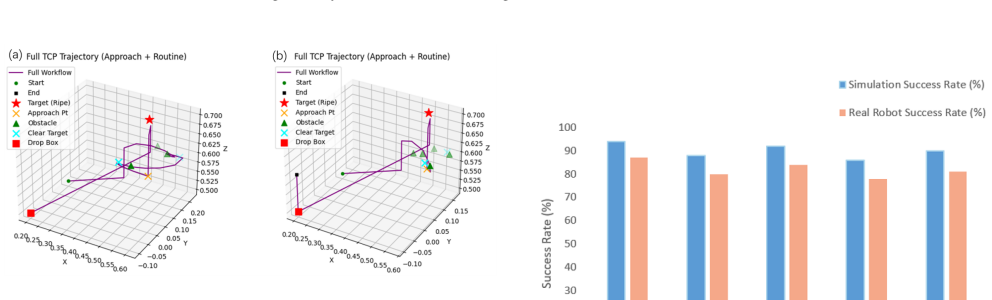
- [V-B, Fig. 2, Table I] The main simulated success rate (89.7%) is reported from a single PPO run. Since the paper's own ablation shows large seed-to-seed variation (e.g., 85–93% across five seeds at 100k steps), a one-run estimate is not sufficient to support the sim-to-real comparison in Figure 5. Please provide mean ± std over at least three seeds for the final training configuration and report the number of evaluation episodes per seed.
minor comments (5)
- [III-C, Eq. (2) and Eq. (6)] The Euclidean distance d_t is defined twice, in Eq. (2) and Eq. (6), with identical meaning. Please remove the duplicate definition and keep the first occurrence.
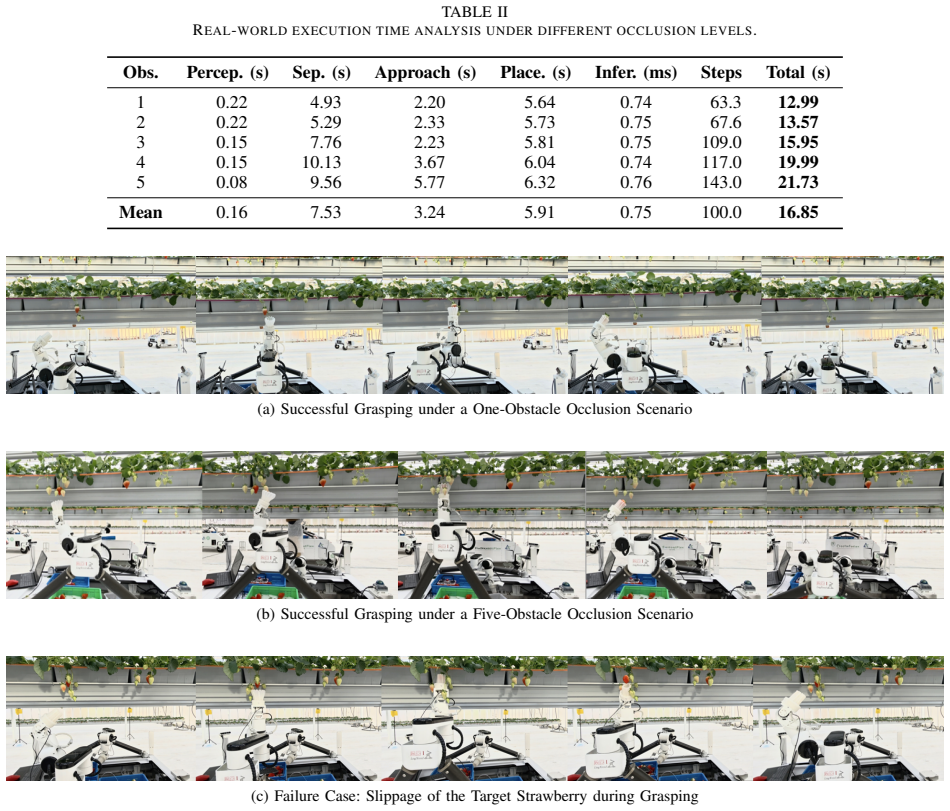
- [Table II] The reported perception time decreases from 0.22 s at occlusion level 1 to 0.08 s at level 5, which is counterintuitive. Please explain the measurement, correct the values, or state why perception time varies inversely with occlusion.
- [V-C1] The phrase 'the obstacle-separation mechanism' conflates the heuristic coordination and the reward terms. Please define precisely which components are included in each ablation arm, e.g., 'heuristic gating only,' 'reward terms only,' and 'both.'
- [IV-B] The mid-state initialization probability is not quantified; the 'predefined probability' is left unspecified. Please provide the value or the schedule used.
- [VI-B] The workspace clipping uses the intersection of the simulated Franka workspace and the real LingXtend workspace, but the paper does not report the resulting workspace size or how often the policy's commands were clipped. A sentence quantifying this would help assess whether clipping is a major intervention.
Circularity Check
No load-bearing circularity: success rates are empirical; Eq. (18) is a decorative self-referential restatement of manual alignment, and the cited self-works are component citations.
specific steps
-
self definitional
[Section VI-A, Equation (18)]
"Formally, let S_real denote the set of physically measurable states. The aligned observation space O is defined as O= arg max_{O⊆S_real} I(O;π*), (18) where I(O;π*) denotes the mutual information between a candidate observation subset O and the optimal policy π*."
The aligned observation space O is defined as the subset maximizing mutual information with the optimal policy π*, yet π* is the policy trained on exactly that observation space O. The definition is therefore a fixed point: O cannot be constructed without already knowing π*, and π* cannot be trained without choosing O. This is a formal restatement of the manual feasibility-first alignment decision rather than a constructive derivation. No simulation or real-world success rate is computed from Eq. (18), so the circularity is decorative and does not propagate into the central empirical claim.
full rationale
The central claim is the empirical 89.7% simulation and 82.0% real-world success of a PPO policy trained in PyBullet with domain randomization and transferred zero-shot. These numbers are measurements from training and from 100 real trials, not quantities derived by fitting constants to themselves. Reward shaping and observation selection are hand-designed, but the paper does not report tuning them against the final success rates. The self-citations ([15], [20]) support the illumination-normalization module and the LingXtend manipulator respectively, but the zero-shot transfer claim rests on the independent trial protocol in Section VI-C, not on those citations. Section VII's admitted limitation that the spring-damper plant model 'did not fully reproduce the nonlinear deformation and contact dynamics of real strawberry plants,' together with the real-world failures from insufficient stem bending and obstacle rebound, is an external-validity risk rather than a circularity: the 82% is measured despite the model gap. The only genuine circularity is the self-referential formal definition in Eq. (18), which is not load-bearing. Overall the derivation chain is self-contained with respect to the reported success rates, so the score is low.
Axiom & Free-Parameter Ledger
free parameters (5)
- Reward shaping coefficients (w_d1, lambda, lambda_app, lambda_ret, delta_tol, beta, C_push, C_seq, R_base, T_max, eta, w =
Not reported
- Action scaling factors alpha_pos, alpha_rot =
Not reported
- Domain randomization ranges (stem +-0.15 rad, max constraint force 48-72 N, ERP 0.18-0.22) =
As listed in Table I
- Curriculum schedule (initial distance 15 cm to 1.0 m, mid-state initialization probability) =
Partially reported
- Heuristic phase thresholds (separation confirmation, d_near, release at 5 cm above drop box) =
Partially reported
axioms (6)
- domain assumption PPO with the stated hyperparameters converges to a stable policy that generalizes within the randomized training distribution.
- domain assumption The PyBullet spring-damper stem model approximates real strawberry plant compliance well enough for zero-shot transfer.
- domain assumption YOLOv11-based SRR-Net perception provides accurate enough fruit position, maturity, and obstacle information for policy inference.
- domain assumption Cartesian impedance control on the real LingXtend arm preserves the action semantics learned on the simulated Franka arm.
- ad hoc to paper The formal observation-alignment objective in Equation (18) is realized by the manual observation matching described in Sections VI-A.
- ad hoc to paper The reward terms induce the intended obstacle-separation behavior without the policy exploiting reward shape or simulation artifacts.
Cite this review
Pith. "Pith review of Reinforcement Learning for the Full Strawberry Harvesting Process: Obstacle Separation, Detachment, and Placement." pith.science (2026). https://pith.science/paper/XO5VCMIL
@misc{pith2026260714708,
  author       = {Pith},
  title        = {Pith review of: Reinforcement Learning for the Full Strawberry Harvesting Process: Obstacle Separation, Detachment, and Placement},
  year         = {2026},
  howpublished = {\url{https://pith.science/paper/XO5VCMIL}},
  note         = {Machine review of arXiv:2607.14708}
}
read the original abstract
Severe occlusions and deformable plant structures introduce complex contact dynamics that challenge robotic strawberry harvesting. A policy-driven reinforcement learning (RL) framework with heuristic phase coordination was developed, in which obstacle separation, fruit detachment, and placement were formulated as a sequential decision-making task. A shared interaction-aware policy generated Cartesian motions across all task phases, while lightweight heuristic logic coordinated task progression and gripper events. A shared structured observation space was used to represent target, obstacle, end-effector, and task-context information. A hierarchical architecture combined the high-level policy with low-level Cartesian impedance control for compliant interaction. To support zero-shot sim-to-real transfer, feasibility-first observation alignment and domain randomization were adopted. The policy achieved success rates of 89.7% in simulation and 82.0% in real-world experiments. As the occlusion level increased from 1 to 5, the average execution time increased from 12.99 s to 21.73 s, reflecting greater interaction complexity. These results demonstrated effective transfer of interaction-aware harvesting behaviors to a structurally different robotic platform.
Figures
Reference graph
Works this paper leans on
-
[1]
An autonomous strawberry-harvesting robot: Design, development, integration, and field evaluation,
Y . Xiong, Y . Ge, L. Grimstad, and P. J. From, “An autonomous strawberry-harvesting robot: Design, development, integration, and field evaluation,”Journal of Field Robotics, vol. 37, no. 2, pp. 202–224, 2020. [Online]. Available: https://onlinelibrary.wiley.com/do i/abs/10.1002/rob.21889
-
[2]
Develop- ment of a sweet pepper harvesting robot,
B. Arad, J. Balendonck, R. Barth, O. Ben-Shahar, Y . Edan, T. Hell- ström, J. Hemming, P. Kurtser, O. Ringdahl, and T. Tielen, “Develop- ment of a sweet pepper harvesting robot,”Journal of Field Robotics, vol. 37, no. 6, pp. 1027–1039, 2020
2020
-
[3]
Towards an efficient tomato harvesting robot: 3d perception, manipulation, and end-effector,
J. Jun, J. Kim, J. Seol, and H. I. Son, “Towards an efficient tomato harvesting robot: 3d perception, manipulation, and end-effector,”IEEE Access, vol. 9, pp. 17 631–17 640, 2021
2021
-
[4]
Overcoming the sim-to-real gap: Leveraging simulation to learn to explore for real-world rl,
A. Wagenmaker, K. Huang, L. Ke, K. Jamieson, and A. Gupta, “Overcoming the sim-to-real gap: Leveraging simulation to learn to explore for real-world rl,” inAdvances in Neural Information Processing Systems (NeurIPS), 2024
2024
-
[5]
Domain randomization for transferring deep neural networks from simulation to the real world,
J. Tobin, R. Fong, A. Ray, J. Schneider, W. Zaremba, and P. Abbeel, “Domain randomization for transferring deep neural networks from simulation to the real world,” inProc. IEEE/RSJ Int. Conf. Intelligent Robots and Systems (IROS), 2017, pp. 23–30
2017
-
[6]
Zero-shot sim-to-real reinforcement learning for fruit harvesting,
E. Williams and A. Polydoros, “Zero-shot sim-to-real reinforcement learning for fruit harvesting,”arXiv preprint arXiv:2505.08458, 2025
Pith/arXiv arXiv 2025
-
[7]
Drm: Master- ing visual reinforcement learning through dormant ratio minimization,
G. Xu, R. Zheng, Y . Liang, X. Wang, Z. Yuan, and T. Ji, “Drm: Master- ing visual reinforcement learning through dormant ratio minimization,” arXiv preprint arXiv:2310.19668, 2023
Pith/arXiv arXiv 2023
-
[8]
Reaching pruning locations in a vine using a deep reinforcement learning policy,
F. Yandun, T. Parhar, A. Silwal, D. Clifford, Z. Yuan, G. Levine, S. Yaroshenko, and G. Kantor, “Reaching pruning locations in a vine using a deep reinforcement learning policy,” inProc. IEEE Int. Conf. Robotics and Automation (ICRA), 2021, pp. 2400–2406
2021
-
[9]
An inverse kinematics solution for a series-parallel hybrid banana-harvesting robot based on deep reinforcement learning,
G. Lin, P. Huang, M. Wang, Y . Xu, R. Zhang, and L. Zhu, “An inverse kinematics solution for a series-parallel hybrid banana-harvesting robot based on deep reinforcement learning,”Agronomy, vol. 12, no. 9, p. 2157, 2022
2022
-
[10]
Mujoco: A physics engine for model-based control,
E. Todorov, T. Erez, and Y . Tassa, “Mujoco: A physics engine for model-based control,” inProc. IEEE/RSJ Int. Conf. Intelligent Robots and Systems (IROS), 2012, pp. 5026–5033
2012
-
[11]
Deep reinforcement learning for robotic pushing and picking in cluttered environment,
Y . Deng, X. Guo, Y . Wei, K. Lu, B. Fang, D. Guo, H. Liu, and F. Sun, “Deep reinforcement learning for robotic pushing and picking in cluttered environment,” inProc. IEEE/RSJ Int. Conf. Intelligent Robots and Systems (IROS), 2019, pp. 619–626
2019
-
[12]
Sim-to-real reinforcement learning for deformable object manipulation,
J. Matas, S. James, and A. J. Davison, “Sim-to-real reinforcement learning for deformable object manipulation,” inProc. Conf. Robot Learning (CoRL), 2018, pp. 734–743
2018
-
[13]
Softgym: Benchmarking deep reinforcement learning for deformable object manipulation,
X. Lin, Y . Wang, J. Olkin, and D. Held, “Softgym: Benchmarking deep reinforcement learning for deformable object manipulation,” inProc. Conf. Robot Learning (CoRL), 2021, pp. 432–448
2021
-
[14]
Serl: A software suite for sample-efficient robotic reinforcement learning,
J. Luo, Z. Hu, C. Xu, Y . L. Tan, J. Berg, A. Sharma, S. Schaal, C. Finn, A. Gupta, and S. Levine, “Serl: A software suite for sample-efficient robotic reinforcement learning,” inProc. IEEE Int. Conf. Robotics and Automation (ICRA), 2024, pp. 16 961–16 969
2024
-
[15]
Light-resilient visual regres- sion of strawberry ripeness for robotic harvesting,
M. Sun, S. Hu, C. Zhao, and Y . Xiong, “Light-resilient visual regres- sion of strawberry ripeness for robotic harvesting,”Computers and Electronics in Agriculture, vol. 241, p. 111169, 2026
2026
-
[16]
Find the fruit: Zero-shot sim2real rl for occlusion-aware plant manipulation,
N. Subedi, H.-J. Yang, D. K. Jha, and S. Sarkar, “Find the fruit: Zero-shot sim2real rl for occlusion-aware plant manipulation,”arXiv preprint arXiv:2505.16547, 2026
arXiv 2026
-
[17]
Orbit: A unified simulation frame- work for interactive robot learning environments,
M. Mittal, C. Yu, Q. Yu, J. Liu, N. Rudin, D. Hoeller, J. L. Yuan, R. Singh, Y . Guo, and A. Garg, “Orbit: A unified simulation frame- work for interactive robot learning environments,”IEEE Robotics and Automation Letters, vol. 8, no. 6, pp. 3740–3747, 2023
2023
-
[18]
Proximal policy optimization algorithms,
J. Schulman, F. Wolski, P. Dhariwal, A. Radford, and O. Klimov, “Proximal policy optimization algorithms,”arXiv preprint arXiv:1707.06347, 2017
Pith/arXiv arXiv 2017
-
[19]
Push past green: Learning to look behind plant foliage by moving it,
X. Zhang and S. Gupta, “Push past green: Learning to look behind plant foliage by moving it,” inRobotics: Science and Systems (RSS), 2024
2024
-
[20]
Design and control of a novel six-degree-of-freedom hybrid robotic arm,
Y . Chen, Z. Miao, Y . Ge, S. Lin, L. Chen, and Y . Xiong, “Design and control of a novel six-degree-of-freedom hybrid robotic arm,” in2024 IEEE/RSJ International Conference on Intelligent Robots and Systems (IROS), Abu Dhabi, United Arab Emirates, 2024, pp. 3597–3604
2024
discussion (0)
Sign in with ORCID, Apple, or X to comment. Anyone can read and Pith papers without signing in.