REVIEW 4 major objections 5 minor 276 references
Kinematically misaligned gas accretion can sustain main-sequence star formation only in galaxies with stellar mass below about 10^10 solar masses; in more massive galaxies the fresh gas is diluted by the pre-existing stellar population.
Reviewed by Pith at T0; open to challenge. T0 means a machine referee read the full paper against a public rubric. the ladder, T0–T4 →
T0 review · deepseek-v4-flash
2026-08-02 00:56 UTC pith:3SQZDEKR
load-bearing objection A careful MaNGA study with a real mass-dependent result; abstract overstates it, and the kinematic classification deserves a robustness test. the 4 major comments →
Fuelling the central region of galaxies with misaligned gas accretion
The pith
A machine-rendered reading of the paper's core claim, the machinery that carries it, and where it could break.
Core claim
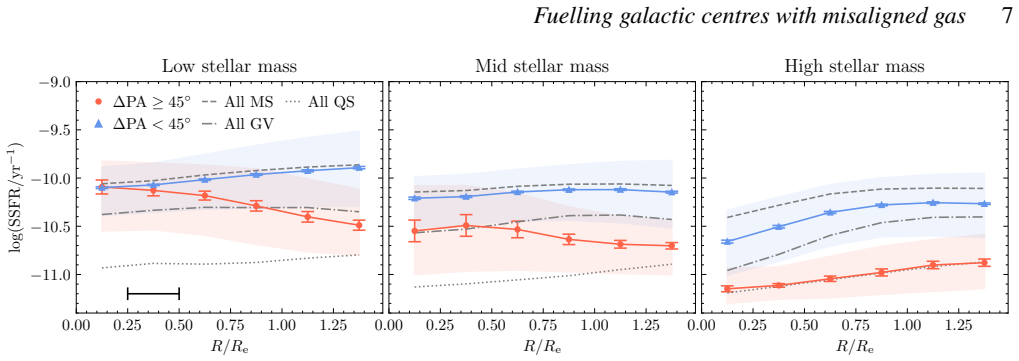
The paper's central claim is that kinematically misaligned gas accretion is a viable channel for nuclear star formation, but only up to a stellar mass of about 10^10 solar masses. In low-mass misaligned galaxies, the specific star formation rate in the centre reaches main-sequence levels; at intermediate masses (10^10-10^10.6 solar masses) the central density of ionized gas peaks, and above about 10^10.6 solar masses misaligned galaxies largely avoid the star-forming main sequence. The authors attribute this mass dependence to compactness: massive misaligned galaxies have central stellar surface densities above about 10^9.2 solar masses per square kiloparsec, so the stellar mass already pres
What carries the argument
The central measurement is the kinematic misalignment angle ΔPA, the difference between the position angle of the stellar velocity field and the H-alpha gas velocity field, computed from maps that maximize the velocity gradient; ΔPA ≥ 45° defines the misaligned sample. The analysis then compares misaligned and aligned galaxies in three stellar mass bins, using radial profiles of specific star formation rate and ionized gas mass surface density, with the central stellar mass surface density within 0.25 R_e serving as a proxy for compactness. The mass-dependence argument hinges on a distinctive 'knee' in the SSFR-versus-compactness plane for misaligned galaxies, where SSFR drops sharply once c
Load-bearing premise
The classification of every galaxy as misaligned or aligned rests on the assumption that the measured gas velocity-field position angle traces pure rotation of a settled gas disk; if AGN outflows, non-circular motions, or low signal-to-noise bias the gas position angle, the split between the two samples is contaminated and every mass-dependent conclusion in the paper is affected.
What would settle it
A spatially resolved integral-field survey that re-derives ΔPA for the same galaxies using a second kinematic tracer, such as CO emission, would settle whether the misaligned/aligned split is robust; a large population of massive (above 10^10.6 solar masses) misaligned galaxies with main-sequence-level specific star formation rates would directly contradict the paper's central claim.
If this is right
- Misaligned accretion is a viable rejuvenation mechanism only below roughly 10^10 solar masses; above that, external gas cannot push a galaxy back onto the main sequence.
- The intermediate-mass range (10^10-10^10.6 solar masses) is where misaligned gas most effectively builds a central reservoir, coinciding with the halo mass above which supernova feedback ceases to be effective at quenching.
- Misaligned galaxies, whether or not they host an AGN, carry comparable central ionized gas reservoirs, implying that most have the fuel to power a supermassive black hole; the absence of AGN in many such systems likely reflects duty cycles far shorter than the misalignment lifetime.
- The low specific star formation rates of massive misaligned galaxies stem from central stellar compactness rather than an absence of star formation.
- At low stellar masses, kinematic misalignment itself drives the enhanced central gas concentration; at higher masses, the host galaxy's gravitational potential becomes the dominant factor.
Where Pith is reading between the lines
- If misaligned accretion commonly supplies a long-lived fuel reservoir, intermediate-mass misaligned galaxies should host preferentially low-luminosity, accretion-rate-limited AGN; comparing Eddington ratios of aligned and misaligned AGN at fixed mass would test this directly.
- The sharp SSFR drop at high central stellar density makes misaligned galaxies plausible local analogues of the high-redshift compaction events that precede inside-out quenching; age-gradient measurements of their stellar populations could check that sequence.
- The ΔPA-based selection may miss counter-rotating gas that projects as aligned; deprojecting the intrinsic misalignment distribution from the observed axis ratios would quantify how much the mass-dependent trends are affected by projection.
- Ionized gas is only a small fraction of the fuel supply; CO or dust-continuum mapping of a subset of misaligned galaxies would reveal whether the molecular reservoir shows the same central concentration and mass dependence.
Editorial analysis
A structured set of objections, weighed in public.
Referee Report
Summary. The manuscript uses MaNGA IFS data to compare 201 galaxies with kinematically misaligned gas (ΔPA ≥ 45°, measured from the difference between stellar and Hα velocity-field position angles) with 3689 aligned galaxies. It analyses global stellar mass and specific star formation rate, central Hα concentration, total ionized gas mass, and radial profiles of SSFR and ionized gas surface density, splitting the sample into three stellar-mass bins. The authors report that misaligned galaxies are less massive, have lower SSFRs, and show more centrally concentrated ionized gas, with the central ionized-gas density peaking at intermediate masses (10^10–10^10.6 M☉). They argue that in low-mass systems misaligned accretion can sustain main-sequence-level star formation, while in more massive, compact systems the newly accreted gas is diluted by the pre-existing stellar mass and mainly replenishes the nuclear reservoir, with implications for AGN fuelling. Appendices provide additional controls based on light concentration (C95), SFR surface density, and morphology.
Significance. If the central conclusions hold, this is a valuable population-level constraint on how externally accreted, kinematically misaligned gas fuels nuclear star formation and AGN reservoirs across mass. The paper's strengths include a large homogeneous MaNGA sample, bootstrap-based uncertainties, KS tests, and a thoughtful C95-matched control analysis in Appendix A that attempts to separate kinematic-misalignment effects from the host galaxy's structural concentration. The interpretation in terms of compactness and dilution of the accreted gas is physically plausible. However, the paper's headline claim is phrased more categorically than the data support, the kinematic classification purity is not quantitatively tested, and there are internal inconsistencies in reported sample sizes. These issues are fixable, but they need to be addressed before the paper is accepted.
major comments (4)
- [Section 2 / Section 1] The entire sample definition rests on ΔPA, derived from the PA that maximizes the velocity gradient in the Hα velocity field. The paper notes in Section 1 that powerful outflows may affect gas kinematics, but it does not quantify what fraction of the 201 'misaligned' galaxies have non-rotating, disturbed, or outflow-dominated Hα velocity fields. Given that the misaligned subsample has a 21% AGN fraction versus 6% among aligned galaxies, and AGN incidence is mass-dependent, a mass-dependent contamination could produce the central trend (low SSFR and quiescence at high mass) without any causal link to misaligned accretion. I request robustness tests: fit rotating-disc models or use a kinematic asymmetry metric, exclude or separately flag galaxies with clear outflow signatures, and rerun the key analyses on the clean subsample.
- [Section 3.2, Figs. 4 and 5] The sample numbers are internally inconsistent. The abstract and Section 2 state 201 misaligned and 3689 aligned galaxies; after excluding 3+37 galaxies with offset maps, Section 3.2 reports 172 misaligned and 4016 aligned galaxies with adequate coverage. The AGN/non-AGN classification then gives 142+30 misaligned and 3798+218 aligned, again implying 4016 aligned galaxies. This exceeds the total aligned sample of 3689. Please reconcile these numbers and verify that the KS tests and fractions are computed with the correct sample sizes.
- [Abstract / Section 5, Fig. 3] The phrase 'this specific accretion channel can only sustain main-sequence levels of star formation in galaxies with M* ≲ 1e10 M☉' is too categorical. Figure 3 shows that only ~65% of low-mass misaligned galaxies are on the main sequence, with ~35% in the green valley or quiescent regimes, and that ~30% of intermediate-mass misaligned galaxies are still on the main sequence. The data support a statistical statement like 'typically' or 'on average', not 'can only'. Please rephrase the claim to a distributional statement and include the actual numbers and bootstrap uncertainties, especially for the high-mass bin where the 5.5% main-sequence fraction is based on a small sample.
- [Appendix A, Fig. A2 vs abstract] The claim of a 'strongest enhancement at intermediate masses' is not robust to structural matching. After matching on C95, the difference in central Hα concentration between misaligned and aligned galaxies is significant only at low mass (p=0.01); at intermediate and high mass the p-values are 0.40 and 0.49 (Fig. A2, top row). The absolute peak in central ΣHII at intermediate mass (Fig. 7) may therefore reflect the compactness of those hosts rather than an enhanced effect of kinematic misalignment. Please add a formal significance test for the mass dependence of the enhancement, and align the abstract and Section 5 with the matched-control results.
minor comments (5)
- [Section 3.1] The definition of the MS/GV/QS regimes is stated as 'if log(SSFR_MS) is...'; this should be the offset 'log SSFR − log SSFR_MS' from the Renzini & Peng main sequence, not the main-sequence value itself. Please clarify the notation.
- [Appendices A2/A3 captions] The notation (r_m, n_0) = (279:58, 1) is confusing. As defined, r_m is the average number of controls per misaligned galaxy, but the parenthetical values appear to be a ratio of total controls to misaligned galaxies plus n_0. Please define the notation explicitly and make it consistent.
- [Appendix C caption] Typo: 'witin' should be 'within'.
- [Section 5] The concluding paragraph cites 'Raimundo et al. 2013' among references supporting misaligned accretion fuelling the centre and nuclear activity. Please check whether 'Raimundo et al. 2023' or another appropriate work is intended.
- [Eq. (1)–(3)] The Balmer-decrement correction uses the Cardelli et al. (1989) extinction curve with R_V = 3.1. It would be helpful to note whether a starburst attenuation curve would change any conclusions, though this is unlikely to affect the relative comparisons.
Circularity Check
No significant circularity: the analysis is an empirical comparison built on external calibrations, not a derivation that reduces to its inputs.
full rationale
The paper's central claims are observational comparisons, not predictions derived from fitted parameters. Kinematic misalignment is defined in Section 2 via ΔPA = |PA_stars − PA_gas|, and this is an explicit sample-selection criterion, not a quantity predicted from the later star-formation results. Stellar masses and SFRs are taken from Salim et al. (2018), emission-line/SFR maps from Riffel et al. (2023), main-sequence/green-valley/quiescent boundaries from Renzini & Peng (2015) and Tous et al. (2024), and ionized-gas masses from Kim (1989) with electron densities from Sanders et al. (2016). None of these calibrations are adjusted to reproduce the paper's conclusions. The main findings—that misaligned galaxies have more centrally concentrated ionized gas, avoid the high-SSFR region at high stellar mass, and show central gas density peaking at intermediate masses—are obtained by comparing binned distributions with KS tests and bootstrap uncertainties. Self-citations to Raimundo et al. (2023, 2025) provide the ΔPA measurement method and prior AGN-excess context, but the method is described in the text and the conclusions do not rest on an unverified uniqueness theorem or ansatz imported from those papers. The mass bins used in Figs. 3, 6, and 7 are fixed before the profile analysis and are not optimized to produce the reported peak, so the binned 'peak' is a data description rather than a construction-level circularity. Potential measurement concerns, such as outflow contamination of gas PAs, are correctness/robustness risks and are not circularity: the paper does not define its outcome in terms of its input by construction.
Axiom & Free-Parameter Ledger
free parameters (2)
- Mass bin boundaries =
1e10 and 1e10.6 Msun
- Kinematic misalignment threshold =
ΔPA = 45° (with uncertainty <30°)
axioms (5)
- domain assumption Hα emission traces ionized gas and recent star formation; Balmer decrement correction with intrinsic Hα/Hβ=2.86 and Cardelli extinction curve are valid.
- domain assumption The velocity-gradient PA difference ΔPA between Hα gas and stars robustly identifies externally accreted misaligned gas; gas kinematics are dominated by rotation and not by AGN outflows.
- domain assumption The Renzini & Peng (2015) main-sequence relation and the adopted MS/GV/QS offsets (-0.5 and -1.1 dex) are applicable to the local MaNGA sample.
- domain assumption Stellar masses and SFRs from Salim et al. (2018) SED fits are unbiased for both misaligned and aligned galaxies.
- ad hoc to paper Mass-bin boundaries are physically meaningful / chosen independently of the result.
read the original abstract
Recent studies have shown that the accretion of kinematically misaligned gas fuels the central reservoir of galaxies, triggering nuclear activity and star formation. In this work, we show that this specific accretion channel can only sustain main-sequence levels of star formation in galaxies with $M_* \lesssim 10^{10} {\rm M_\odot}$. Using a sample of 201 kinematically misaligned galaxies, and a comparison sample of 3689 aligned galaxies, from the Mapping Nearby Galaxies at Apache Point Observatory survey, we investigate the impact of kinematically misaligned gas on star formation across stellar mass. We characterise the global specific star formation rate, central concentration and mass of ionized gas of our samples, and derive radial profiles of specific star formation rate and ionized gas mass surface density. We find that misaligned galaxies exhibit more centrally concentrated ionized gas than their aligned counterparts, with the strongest enhancement occurring at intermediate masses ($10^{10}$-$10^{10.6} {\rm M_\odot}$), where the central ionized gas density peaks. In galaxies less massive than $10^{10} {\rm M_\odot}$, misaligned gas fuels nuclear star formation at rates typical of star-forming systems. At higher masses, however, the impact of this newly accreted gas is diluted by the larger pre-existing stellar mass in the central regions, limiting its ability to rejuvenate the star formation activity in these galaxies. Our results also show that misaligned galaxies with or without nuclear activity exhibit similar central concentrations of ionized gas, suggesting that most have a reservoir capable of fuelling their supermassive black holes over timescales longer than typical nuclear activity episodes.
Figures




Reference graph
Works this paper leans on
-
[1]
Realm of the Nebulae, by E.P
Realm of the Nebulae. Realm of the Nebulae, by E.P. Hubble. New Haven: Yale University Press, 1936. ISBN 9780300025002 , year = 1936, adsurl =
1936
-
[2]
, keywords =
Synthetic absorption line strengths in star forming regions, and the effects on the helium abundance determination. , keywords =
-
[3]
Galaxy Interactions at Low and High Redshift , year = 1999, series =
Dynamics of Mergers Remnants. Galaxy Interactions at Low and High Redshift , year = 1999, series =. astro-ph/9811091 , editor =
Pith/arXiv arXiv 1999
-
[4]
1961 , publisher=
The Hubble atlas of galaxies , author=. 1961 , publisher=
1961
-
[7]
The structure of clusters of galaxies observed with Einstein. , keywords =. doi:10.1086/161591 , adsurl =
-
[8]
No. 324. Extra-galactic nebulae. Contributions from the Mount Wilson Observatory / Carnegie Institution of Washington , year = 1926, volume = 324, pages =
1926
-
[9]
The H i Content of Spirals. I. Field Galaxy H i Mass Functions and H i Mass--Optical Size Regressions. , keywords =. 1996. doi:10.1086/177089 , archivePrefix =. astro-ph/9511003 , primaryClass =
Pith/arXiv arXiv 1996
-
[10]
Clusters of Galaxies: Volume 3, Carnegie Observatories Astrophysics Series: Probes of Cosmological Structure and Galaxy , volume=
cluster galaxies , author=. Clusters of Galaxies: Volume 3, Carnegie Observatories Astrophysics Series: Probes of Cosmological Structure and Galaxy , volume=. 2004 , publisher=
2004
-
[11]
Ho and John P
David Burstein and Luis C. Ho and John P. Huchra and Lucas M. Macri , title=. The Astrophysical Journal , volume=
-
[12]
Structure and origin of S0 galaxies. III. The luminosity distribution perpendicular to the plane of the disks in S0's. , keywords =. 1979. doi:10.1086/157563 , adsurl =
doi:10.1086/157563 1979
-
[13]
, year = 1959, month = apr, volume = 71, pages =
The Spectra of Galaxies. , year = 1959, month = apr, volume = 71, pages =. doi:10.1086/127344 , adsurl =
doi:10.1086/127344 1959
-
[14]
Astronomy & Astrophysics , volume=
The influence of the cluster environment on the star formation efficiency of 12 Virgo spiral galaxies , author=. Astronomy & Astrophysics , volume=. 2012 , publisher=
2012
-
[15]
, volume=
Can early-type galaxies evolve from the fading of the disks of late-type galaxies? , author=. , volume=. 2004 , publisher=
2004
-
[16]
Improving galaxy morphologies for SDSS with Deep Learning. , keywords =. 2018. doi:10.1093/mnras/sty338 , archivePrefix =. 1711.05744 , primaryClass =
Pith/arXiv arXiv 2018
-
[17]
The Environment of Galaxies at Low Redshift. , keywords =. 2008. doi:10.1086/528986 , archivePrefix =. 0801.0312 , primaryClass =
Pith/arXiv arXiv 2008
-
[18]
The luminosity of galactic components and morphological segregation. , keywords =. doi:10.1086/115179 , adsurl =
-
[19]
Evolution since z = 1 of the Morphology-Density Relation for Galaxies. , eprint =. doi:10.1086/426930 , adsurl =
-
[20]
The Morphological Evolution of Galaxies. Science , eprint =. doi:10.1126/science.1060855 , adsurl =
-
[21]
Strauss and David H
Michael A. Strauss and David H. Weinberg and Robert H. Lupton and Vijay K. Narayanan and James Annis and Mariangela Bernardi and Michael Blanton and Scott Burles and A. J. Connolly and Julianne Dalcanton and Mamoru Doi and Daniel Eisenstein and Joshua A. Frieman and Masataka Fukugita and James E. Gunn and Željko Ivezić and Stephen Kent and Rita S. J. Kim ...
-
[22]
The Astrophysical Journal , volume=
Sidney van den Bergh , title=. The Astrophysical Journal , volume=
-
[23]
, archivePrefix = "arXiv", eprint =
The Mean Metal-line Absorption Spectrum of Damped Ly Systems in BOSS. , archivePrefix = "arXiv", eprint =. doi:10.3847/1538-4357/aa81cf , adsurl =
-
[25]
, year = 1998, volume = 36, pages =
Star Formation in Galaxies Along the Hubble Sequence. , year = 1998, volume = 36, pages =. doi:10.1146/annurev.astro.36.1.189 , adsurl =
-
[26]
Annual Review of Astronomy and Astrophysics , keywords =
Star Formation in the Milky Way and Nearby Galaxies. Annual Review of Astronomy and Astrophysics , keywords =. 2012. doi:10.1146/annurev-astro-081811-125610 , archivePrefix =. 1204.3552 , primaryClass =
Pith/arXiv arXiv 2012
-
[27]
Galaxy Mergers in an Evolving Universe , year = 2013, series =
Gas flows in Galaxies: Mergers Versus Bars. Galaxy Mergers in an Evolving Universe , year = 2013, series =
2013
-
[28]
ArXiv e-prints , archivePrefix = "arXiv", eprint =
A Galaxy in Transition: Structure, Globular Clusters, and Distance of the Star-Forming S0 Galaxy NGC 1533 in Dorado. ArXiv e-prints , archivePrefix = "arXiv", eprint =
-
[29]
, volume=
Early-type galaxies in low-density environments , author=. , volume=. 2002 , publisher=
2002
-
[31]
, archivePrefix = "arXiv", eprint =
Ram pressure stripping of the multiphase ISM and star formation in the Virgo spiral galaxy NGC 4330. , archivePrefix = "arXiv", eprint =. doi:10.1051/0004-6361/201117680 , adsurl =
-
[32]
European Astronomical Society Publications Series , volume=
Star formation in galaxy interactions and mergers , author=. European Astronomical Society Publications Series , volume=. 2011 , publisher=
2011
-
[33]
Volumes I, II
The Carnegie Atlas of Galaxies. Volumes I, II. The Carnegie Atlas of Galaxies. Volumes I, II., by Sandage, A.; Bedke, J.. Carnegie Institution of Washington Publ., No. 638, , year = 1994, adsurl =
1994
-
[34]
, archivePrefix = "arXiv", eprint =
Galaxy Zoo 2: detailed morphological classifications for 304 122 galaxies from the Sloan Digital Sky Survey. , archivePrefix = "arXiv", eprint =. doi:10.1093/mnras/stt1458 , adsurl =
-
[35]
, archivePrefix = "arXiv", eprint =
Relationship between Hubble Type and Spectroscopic Class in Local Galaxies. , archivePrefix = "arXiv", eprint =. doi:10.1088/0004-637X/735/2/125 , adsurl =
-
[36]
SDSS-IV MaNGA: the formation sequence of S0 galaxies. , keywords =. 2018. doi:10.1093/mnras/sty2563 , archivePrefix =. 1809.04336 , primaryClass =
Pith/arXiv arXiv 2018
-
[37]
Formation of S0s in extreme environments I: clues from kinematics and stellar populations. , keywords =. doi:10.1093/mnras/stz3592 , archivePrefix =. 1912.08845 , primaryClass =
Pith/arXiv arXiv 1912
-
[38]
A Robust Classification of Galaxy Spectra: Dealing with Noisy and Incomplete Data. , keywords =. 1999. doi:10.1086/300839 , archivePrefix =. astro-ph/9901300 , primaryClass =
Pith/arXiv arXiv 1999
-
[39]
Spectral Classification of Quasars in the Sloan Digital Sky Survey: Eigenspectra, Redshift, and Luminosity Effects. , keywords =. 2004. doi:10.1086/425626 , archivePrefix =. astro-ph/0408578 , primaryClass =
Pith/arXiv arXiv 2004
-
[40]
Distributions of Galaxy Spectral Types in the Sloan Digital Sky Survey. , keywords =. doi:10.1086/422429 , archivePrefix =. astro-ph/0407061 , primaryClass =
-
[41]
Annual Review of Astronomy and Astrophysics , keywords =
Physical Properties and Environments of Nearby Galaxies. Annual Review of Astronomy and Astrophysics , keywords =. 2009. doi:10.1146/annurev-astro-082708-101734 , archivePrefix =. 0908.3017 , primaryClass =
Pith/arXiv arXiv 2009
-
[43]
Theoretical Modeling of Starburst Galaxies. , keywords =. 2001. doi:10.1086/321545 , archivePrefix =. astro-ph/0106324 , primaryClass =
Pith/arXiv arXiv 2001
-
[45]
A Reevaluation of the Excitation Mechanism of LINERs. , keywords =. 1993. doi:10.1086/173291 , adsurl =
doi:10.1086/173291 1993
-
[46]
Terlevich, Roberto and Melnick, Jorge , title = ". , volume =. 1985. doi:10.1093/mnras/213.4.841 , url =
-
[47]
Normal O Stars in Dense Media Generate LINERs. , keywords =. 1992. doi:10.1086/186598 , adsurl =
doi:10.1086/186598 1992
-
[48]
, archivePrefix = "arXiv", eprint =
SDSS-III: Massive Spectroscopic Surveys of the Distant Universe, the Milky Way, and Extra-Solar Planetary Systems. , archivePrefix = "arXiv", eprint =. doi:10.1088/0004-6256/142/3/72 , adsurl =
-
[49]
Galaxy harassment and the evolution of clusters of galaxies. , keywords =. 1996. doi:10.1038/379613a0 , archivePrefix =. astro-ph/9510034 , primaryClass =
Pith/arXiv arXiv 1996
-
[50]
Lenticular Galaxy Formation: Possible Luminosity Dependence. , keywords =. 2007. doi:10.1086/518422 , archivePrefix =. astro-ph/0703657 , primaryClass =
Pith/arXiv arXiv 2007
-
[51]
Age bimodality in the central region of pseudo-bulges in S0 galaxies. , keywords =. 2017. doi:10.1093/mnrasl/slx142 , archivePrefix =. 1709.01283 , primaryClass =
Pith/arXiv arXiv 2017
-
[53]
Molecular gas and a broken Tully-Fisher relation in the most massive early-type galaxies
The MASSIVE survey - III. Molecular gas and a broken Tully-Fisher relation in the most massive early-type galaxies. , keywords =. 2016. doi:10.1093/mnras/stv2313 , archivePrefix =. 1510.00729 , primaryClass =
Pith/arXiv arXiv 2016
-
[54]
The Tully-Fisher Relation in Coma and Virgo Cluster S0 Galaxies. , keywords =. 2003. doi:10.1086/379555 , adsurl =
doi:10.1086/379555 2003
-
[55]
The H I Tully-Fisher relation of early-type galaxies. , keywords =. 2015. doi:10.1051/0004-6361/201526879 , archivePrefix =. 1509.05236 , primaryClass =
Pith/arXiv arXiv 2015
-
[56]
Luminosity-dependent star formation history of S0 galaxies: evidence from GALEX-SDSS-2MASS-WISE colours. , keywords =. 2013. doi:10.1093/mnras/stt478 , archivePrefix =. 1303.4084 , primaryClass =
Pith/arXiv arXiv 2013
-
[57]
The Seventh Data Release of the Sloan Digital Sky Survey. , keywords =. 2009. doi:10.1088/0067-0049/182/2/543 , archivePrefix =. 0812.0649 , primaryClass =
Pith/arXiv arXiv 2009
-
[59]
Realm of the Nebulae. 1936
1936
-
[60]
The Classification of Galaxies: Early History and Ongoing Developments. , year = "2005", month = "Sep", volume =. doi:10.1146/annurev.astro.43.112904.104839 , adsurl =
arXiv 2005
-
[61]
Stellar Populations and Collisions of Galaxies. , year = "1951", month = "Mar", volume =. doi:10.1086/145406 , adsurl =
doi:10.1086/145406 1951
-
[62]
On the Infall of Matter Into Clusters of Galaxies and Some Effects on Their Evolution. , year = "1972", month = "Aug", volume =. doi:10.1086/151605 , adsurl =
doi:10.1086/151605 1972
-
[63]
Galaxy morphology in rich clusters: implications for the formation and evolution of galaxies. , keywords =. 1980. doi:10.1086/157753 , adsurl =
doi:10.1086/157753 1980
-
[64]
Evolution since z = 0.5 of the Morphology-Density Relation for Clusters of Galaxies. , keywords =. 1997. doi:10.1086/304890 , archivePrefix =. astro-ph/9707232 , primaryClass =
Pith/arXiv arXiv 1997
-
[65]
Morphological Studies of the Galaxy Populations in Distant ``Butcher-Oemler'' Clusters with the Hubble Space Telescope. II. AC 103, AC 118, and AC 114 at Z = 0.31. , keywords =. 1998. doi:10.1086/305462 , archivePrefix =. astro-ph/9711019 , primaryClass =
Pith/arXiv arXiv 1998
-
[66]
The Star Formation Histories of Galaxies in Distant Clusters. , keywords =. 1999. doi:10.1086/307322 , archivePrefix =. astro-ph/9901264 , primaryClass =
Pith/arXiv arXiv 1999
-
[67]
The Evolution of the Galactic Morphological Types in Clusters. , keywords =. 2000. doi:10.1086/317047 , archivePrefix =. astro-ph/0005171 , primaryClass =
Pith/arXiv arXiv 2000
-
[68]
Explaining angular momentum and concentration change from spirals to S0s
Formation of S0 galaxies through mergers. Explaining angular momentum and concentration change from spirals to S0s. , keywords =. 2015. doi:10.1051/0004-6361/201526354 , archivePrefix =. 1506.00640 , primaryClass =
Pith/arXiv arXiv 2015
-
[69]
Morphological properties: tidal relics, lenses, ovals, and other inner components
Formation of S0 galaxies through mergers. Morphological properties: tidal relics, lenses, ovals, and other inner components. , keywords =. 2018. doi:10.1051/0004-6361/201832911 , archivePrefix =. 1806.06070 , primaryClass =
Pith/arXiv arXiv 2018
-
[71]
The Sloan Digital Sky Survey: Technical Summary. , keywords =. 2000. doi:10.1086/301513 , archivePrefix =. astro-ph/0006396 , primaryClass =
Pith/arXiv arXiv 2000
-
[72]
The Nuclear Activities of Nearby S0 Galaxies. , keywords =. 2016. doi:10.3847/0004-637X/831/1/63 , archivePrefix =. 1611.00486 , primaryClass =
Pith/arXiv arXiv 2016
-
[73]
Classification parameters for the emission-line spectra of extragalactic objects. , keywords =. 1981. doi:10.1086/130766 , adsurl =
doi:10.1086/130766 1981
-
[74]
Evolution in the Tully-Fisher relation since z 1
Formation of S0 galaxies through mergers. Evolution in the Tully-Fisher relation since z 1. , keywords =. 2017. doi:10.1051/0004-6361/201628821 , archivePrefix =. 1706.03803 , primaryClass =
Pith/arXiv arXiv 2017
-
[75]
Overview of the SDSS-IV MaNGA Survey: Mapping nearby Galaxies at Apache Point Observatory. , keywords =. 2015. doi:10.1088/0004-637X/798/1/7 , archivePrefix =. 1412.1482 , primaryClass =
Pith/arXiv arXiv 2015
-
[76]
Sloan Digital Sky Survey IV: Mapping the Milky Way, Nearby Galaxies, and the Distant Universe. , keywords =. 2017. doi:10.3847/1538-3881/aa7567 , archivePrefix =. 1703.00052 , primaryClass =
Pith/arXiv arXiv 2017
-
[77]
I - ISIT photometry of C1 00241654 and 3C 295
The evolution of galaxies in clusters. I - ISIT photometry of C1 00241654 and 3C 295. , keywords =. doi:10.1086/155751 , adsurl =
-
[78]
IEEE transactions on systems, man, and cybernetics , volume=
A threshold selection method from gray-level histograms , author=. IEEE transactions on systems, man, and cybernetics , volume=. 1979 , publisher=
1979
-
[79]
A Catalog of Detailed Visual Morphological Classifications for 14,034 Galaxies in the Sloan Digital Sky Survey. , keywords =. 2010. doi:10.1088/0067-0049/186/2/427 , archivePrefix =. 1001.2401 , primaryClass =
Pith/arXiv arXiv 2010
-
[80]
Surface Brightness and Evolution of Galaxies. , keywords =. 1976. doi:10.1086/182301 , adsurl =
doi:10.1086/182301 1976
-
[81]
Galaxy Zoo 2: detailed morphological classifications for 304 122 galaxies from the Sloan Digital Sky Survey. , keywords =. 2013. doi:10.1093/mnras/stt1458 , archivePrefix =. 1308.3496 , primaryClass =
Pith/arXiv arXiv 2013
-
[82]
Evolution of Galaxies and Stellar Populations , year = "1977", editor =
Qualitative and Quantitative Classifications of Galaxies. Evolution of Galaxies and Stellar Populations , year = "1977", editor =
1977
-
[83]
Core radius and density measurements in N-body experiments Connections with theoretical and observational definitions. , keywords =. 1985. doi:10.1086/163589 , adsurl =
doi:10.1086/163589 1985
-
[84]
Improved Background Subtraction for the Sloan Digital Sky Survey Images. , keywords =. 2011. doi:10.1088/0004-6256/142/1/31 , archivePrefix =. 1105.1960 , primaryClass =
Pith/arXiv arXiv 2011
-
[85]
The GALEX Ultraviolet Virgo Cluster Survey (GUViCS). I. The UV luminosity function of the central 12 sq. deg. , keywords =. 2011. doi:10.1051/0004-6361/201016389 , archivePrefix =. 1102.1316 , primaryClass =
Pith/arXiv arXiv 2011
-
[86]
The Arecibo Legacy Fast ALFA Survey. I. Science Goals, Survey Design, and Strategy. , keywords =. 2005. doi:10.1086/497431 , archivePrefix =. astro-ph/0508301 , primaryClass =
Pith/arXiv arXiv 2005
-
[87]
The CfA Redshift Survey: Data for the NGP 36 Zone. , keywords =. 1995. doi:10.1086/192191 , adsurl =
doi:10.1086/192191 1995
-
[88]
The 2dF Galaxy Redshift Survey: spectra and redshifts. , keywords =. 2001. doi:10.1046/j.1365-8711.2001.04902.x , archivePrefix =. astro-ph/0106498 , primaryClass =
arXiv 2001
-
[90]
The catalogue of groups and potentially merging systems
Merging groups and clusters of galaxies from the SDSS data. The catalogue of groups and potentially merging systems. , keywords =. 2017. doi:10.1051/0004-6361/201730499 , archivePrefix =. 1704.04477 , primaryClass =
Pith/arXiv arXiv 2017
discussion (0)
Sign in with ORCID, Apple, or X to comment. Anyone can read and Pith papers without signing in.