REVIEW 3 major objections 4 minor 1 cited by
A construction of Kakeya Sets in Arbitrary Dimension
T0 review · 3 major / 4 minor · reviewed 2026-08-02 · deepseek-v4-flash
Pith's one-line read This paper constructs Kakeya sets in R^d whose δ-neighbourhood volume is at most C |log δ|^{-(d-1)}, the conjectured optimal decay.
desk verdict The higher-dimensional Perron tree construction is correct and gives the expected d−1 log-exponent; the reader's main worry about Proposition 5.4 does not land. read the letter →
The pith
A machine-rendered reading of the paper's core claim, the machinery that carries it, and where it could break.
The reading
What carries the argument
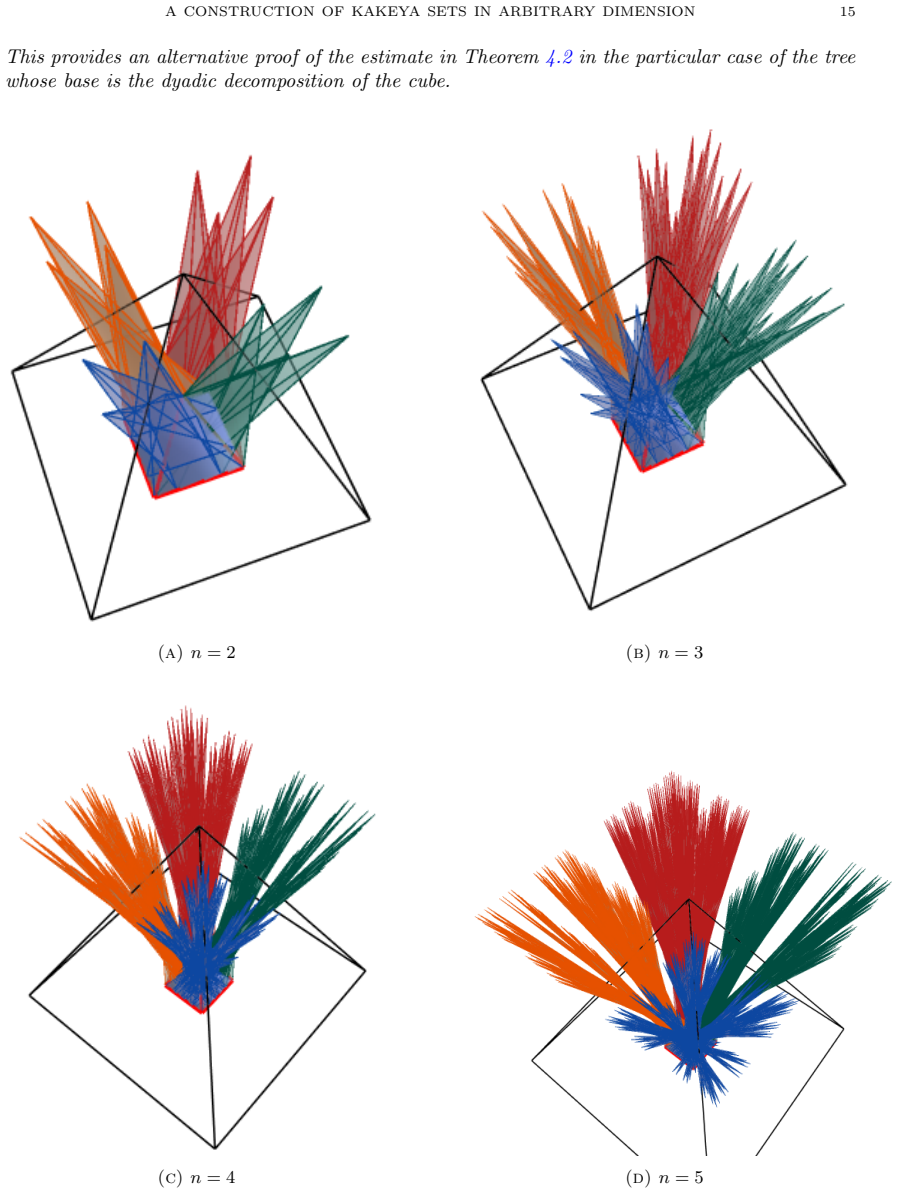
The fair subdivision and the affine-separation condition. A fair partition of the base Σ into N congruent pieces (images of N^{-1/(d−1)}Σ under a compact group) keeps aspect ratios from degenerating, so each pyramid conv(Σ_i,v) contains a δ-tube of width comparable to N^{-1/(d−1)}. Condition (3) says each piece lies in a homothetic copy of Σ centered at a distinguished point x_i; translating the piece toward o then keeps it inside a shrinking copy of Σ. Affine separation of the pairs (Σ_i,x_i) ensures the reflected cones Cone^-(Σ_i,v) have disjoint interiors after translation, which is what makes the tubes' translates disjoint in Theorem 1.4.
What would settle it
Take a specific fair subdivision that does not satisfy the corner-containment condition (3), for instance a barycentric subdivision, which lacks bounded aspect ratios, and compute the volume of the union of the translated pyramids after n iterations; finding it grows faster than n^{-(d-1)} would show the hypothesis is essential. Alternatively, exhibit a fair subdivision whose reflected cones overlap after the prescribed translations, which would destroy the disjointness in Theorem 1.4.
Extended reading notes
Core claim
For every d≥2 there exists a Kakeya set E⊂R^d and a constant C such that for every δ∈(0,1), |N_δ(E)| ≤ C |log δ|^{-(d-1)}. The construction is an iterated Perron tree: starting from a (d−1)-dimensional polytope with a fair subdivision satisfying a corner-containment condition and an affine-separation property, one translates the pyramids conv(Σ_i,v) toward a point o in the base so that after n iterations the union has volume O(n^{-(d-1)}). The bound is conjecturally optimal, as the reverse Littlewood–Paley conjecture would imply a matching lower bound. The paper also proves a tube-disjointness version (Theorem 1.4) and derives that radial Fourier multipliers that are L^p-bounded force the fu
Load-bearing premise
The construction depends on partitioning the base polytope into congruent pieces that can all be pushed toward one point while staying inside a shrinking copy of the whole, with reflected cones that never overlap; if such a partition is unavailable, the volume bound n^{-(d-1)} and the disjointness of tubes both fail.
Editorial extensions
If this is right
- There exist Kakeya sets in R^d whose δ-neighbourhood volume is at most C|log δ|^{-(d-1)}, improving on all previously known explicit constructions for d≥3.
- For every α>0, there are δ-tubes whose α-translates are pairwise disjoint yet whose union volume is at most C_{d,α}|log δ|^{-(d-1)} times the sum of the tube volumes.
- Any radial Fourier multiplier bounded on L^p(R^d) must have symbol satisfying Besov regularity B^{0,(d-1)|1/p-1/2|}_{∞,∞} in logarithmic scale; in particular, logarithmic Bochner–Riesz multipliers with exponent below (d−1)|1/p−1/2| are unbounded.
- Improving the exponent (d−1) in Theorem 1.4 would yield stronger necessary conditions for logarithmic Bochner–Riesz multipliers and would have further consequences for noncommutative L^p approximation properties.
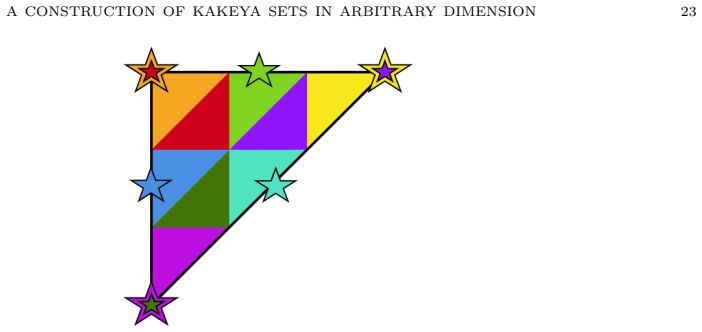
- The construction works for any fair polytopal partition satisfying the two geometric hypotheses; the dyadic cube and the Coxeter–Freudenthal–Kuhn simplex subdivision are concrete instances.
Reading between the lines
- Editorial inference: the construction should extend to any self-similar tiling whose cells are congruent to a scaled copy of the base and whose corner structure permits affine separation; testing other Coxeter-type tessellations could reveal which polytopes yield the same exponent.
- Editorial inference: the disjointness of reflected cones is stronger than needed for the volume bound; a quantitative version measuring how often cones overlap might yield bounds for Kakeya maximal operators rather than just for a single set.
- Editorial inference: if the conjectured lower bound holds, these Kakeya sets are exactly as thin as possible, so the obstruction to proving the Kakeya conjecture is not the existence of very thin sets but the L^p behavior of maximal operators; this reframes where the difficulty lies.
Signed reviews
Editorial analysis
A structured set of objections, weighed in public.
Referee Report
Summary. The paper constructs, for every d≥2, a Kakeya set E⊂R^d whose δ-neighbourhood has volume O(|log δ|^{-(d-1)}), improving on the product constructions that gave |log δ|^{-1} in odd dimensions and |log δ|^{-d/2} in even dimensions. The construction is a higher-dimensional analogue of the Perron tree: starting from a (d−1)-polytope Σ with a fair subdivision satisfying a homothety-containment condition (3) and an affine-separation property, the authors iteratively translate pyramids toward a chosen point o and obtain an n-level tree of volume O(n^{-(d-1)}). They verify the required geometric hypotheses for the dyadic cube (Example 3.2) and for the Coxeter–Freudenthal–Kuhn simplicial subdivision (Proposition B.1). By inserting δ-tubes into the cells (Lemma 2.4), they prove a version with pairwise disjoint α-translates (Theorem 1.4), and by a patching argument (Proposition 5.4) they convert the scale-wise Kakeya sets into a single Kakeya set with the stated bound (Theorem 1.3). Section 6 uses Theorem 1.4, through an external result of de la Salle, to derive Besov-regularity conclusions for radial Fourier multipliers (Corollary 1.5).
Significance. If correct, this is the first quantitative improvement over Cartesian-product Kakeya sets in arbitrary dimension, and the exponent (d−1) is the conjecturally optimal logarithmic decay. The proof is self-contained and elementary, and it introduces a clean general framework—fair subdivisions plus affine separation—that may be of independent use. The explicit verification for the cube and the CFK simplex, together with the accompanying Jupyter notebook, are valuable. I also examined the concern raised in the review about Proposition 5.4: it does not appear to land. With δ_n=2^{-2^n}, one has δ_n/ε_n = √(d−1)δ_{n−1}/(1−δ_{n−1}) ≤ 2√(d−1)δ_{n−1}=O(√δ_n), and the final estimate uses only the monotonicity of f, not any slow-variation assumption. Thus the patching argument is consistent for arbitrary non-decreasing f. The remaining issues are expositional and local, not correctness risks.
major comments (3)
- [§4.1, Proposition 4.1] The induction step applies the induction hypothesis to the (n−1)-iterated partition of a first-level cell Σ_{i_n}, but the affine-separation hypothesis is stated only for the original family (Σ_i,x_i). The proof does not justify that affine separation is inherited by the iterated partitions under the affine maps defining them. This is needed in (ii) for the case i_n≠j_n, and hence for the disjointness conclusion in Theorem 4.2. The fix is short—if φ separates Σ_p and Σ_q, then φ∘A_i^{-1} separates A_i(Σ_p) and A_i(Σ_q) for the affine map A_i defining Σ_{i_n}—but it should be stated explicitly. As written, the induction is incomplete at this point.
- [§2, Lemma 2.5] Lemma 2.5 is a key geometric input for Lemma 5.3, where it converts the Perron-tree volume bound into a Kakeya set containing unit segments in an open set of directions. The proof is dismissed with “proven in an analogous way” and no details. The uniformity of the constant C_{Σ,v} over all fair partitions is not entirely immediate and should be written out. This is a completeness gap, not an apparent correctness issue, but it needs to be filled for the proof of Theorem 1.3 to be self-contained.
- [§5.1, proof of Theorem 1.4] The proof uses the asserted scaling property f_d^α(δ) ≤ (δ'/δ)^{d−1} f_d^α(δ') for 0<δ≤δ' with no proof or reference. This is used to pass from the dyadic sequence δ_n to arbitrary δ. The property is true and easy to justify by subdividing each δ'-tube into (δ'/δ)^{d−1} δ-tubes, whose α-translates lie inside the original α-translates. Please add the argument or a reference, since the assertion is otherwise unsupported.
minor comments (4)
- [Theorems 1.3 and 5.4] The notation “4√δ” (e.g. \(C_d 4\sqrt{\delta}\)) is ambiguous. From the proof in §5.2 it should be the fourth root \(\sqrt[4]{\delta}\), not \(4\sqrt{\delta}\). Please use unambiguous notation throughout.
- [§5.2, Lemma 5.3] The apex notation “v=(0,1)” should be \(v=(0,\dots,0,1)\in\mathbb{R}^d\), and the homothety notation “\(C\operatorname{conv}(\Sigma_i,v)\)” should specify the center (presumably \(v\)) to avoid ambiguity.
- [§5.2, after Lemma 5.3] The set \(G_{2^{-n}}\) constructed as a finite union of translates of open neighborhoods is open, while Kakeya sets are defined as compact. Taking closures preserves the volume bound and the property of containing the required segments; the text should say this explicitly.
- [§5.2, Proposition 5.4] The threshold \(n\ge 1+\log_2\log_2(1+\sqrt{d-1})\) is stated without explanation of where it comes from and without tracking the dimension constants. The phrase “for an appropriate value of \(C_d\)” is vague; a brief sentence explaining how finitely many small \(n\) are absorbed would improve readability.
Circularity Check
No significant circularity: the Kakeya construction is self-contained; the only self-citation [dlS26] supports the multiplier application and is not an input to Theorem 1.3.
full rationale
The core derivation chain is self-contained. Condition (3), Lemma 3.5, Lemma 3.6, Lemma 3.7, Lemma 3.8, and Proposition 3.9 establish the base case purely from convex geometry and the stated containment condition on the partition. Proposition 4.1 iterates this base case by induction, and the volume bound in Theorem 4.2 follows from the explicit choice t_i = 1/(n-i+(1-c)^{-1}) together with the identity P_m = t_1/t_{m+1} and a Hölder optimization; no fitted parameter or target quantity is reused as an input. The required fair partitions are constructed explicitly for the dyadic cube (Example 3.2) and for the Coxeter-Freudenthal-Kuhn simplex subdivision with q >= d (Proposition B.1), and the affine-separation property is proved directly. Lemma 5.3 and Proposition 5.4 convert the iterated Perron tree into a Kakeya set via a classical patching argument; even if the breadth of Proposition 5.4 were debated, that would be a correctness/robustness issue, not circularity. The one self-citation, [dlS26], is used only in Section 6 to pass from the new Kakeya/tube-volume estimate f_d(delta) <= |log delta|^{-(d-1)} to Besov-space consequences for radial Fourier multipliers; it does not enter the proof of Theorem 1.3 or Theorem 1.4, and the Kakeya estimate is not assumed by that external theorem. Lemma 2.5 is stated with only a sketch, but it is a direct geometric containment fact and is not a renamed form of the conclusion. Overall, no load-bearing step reduces by construction or by self-citation to its own input.
Assumptions & free parameters
free parameters (1)
- translation schedule t_i =
t_i = 1/(n-i+(1-c)^{-1})
assumptions (6)
- standard math Existence of fair subdivisions of simplices (Coxeter-Freudenthal-Kuhn)
- standard math Compact subgroups of GL(V) preserve a Euclidean structure
- standard math Hahn-Banach separation of convex sets
- domain assumption Dyadic cube and CFK simplex partitions satisfy condition (3) and affine separation uniformly
- domain assumption Keich's bound sup_h |T^2_{n,h}| < 1/n
- domain assumption [dlS26] Theorems 6.2 and 6.4 relating f_d(δ) to Fourier and Schur multiplier bounds
Cite this review
Pith. "Pith review of A construction of Kakeya Sets in Arbitrary Dimension." pith.science (2026). https://pith.science/paper/WYMKEU4D
@misc{pith2026260714824,
  author       = {Pith},
  title        = {Pith review of: A construction of Kakeya Sets in Arbitrary Dimension},
  year         = {2026},
  howpublished = {\url{https://pith.science/paper/WYMKEU4D}},
  note         = {Machine review of arXiv:2607.14824}
}
abstract
We construct Kakeya sets in arbitrary dimension $d\geq 2$, generalizing the classical Perron tree construction beyond dimension $2$. The Kakeya sets we construct have $\delta$-neighbourhood of volume at most $C|\log\delta|^{-(d-1)}$, which improves on previously known constructions, and which is conjecturally optimal. We further derive consequences for the $L^p$-boundedness of radial Fourier multipliers in terms of Besov spaces with logarithmic smoothness.
Figures


Figures from the paper (16 more)






Forward citations
Cited by 1 Pith paper
-
A Study on Kakeya Needle Problem for $(n-1)$-Rectifiable Set
Every (n-1)-rectifiable set of finite H^{n-1} measure is Kakeya-movable under orientation-preserving isometries, and associated Nikodym-type null sets exist in all dimensions.
Reference graph
Works this paper leans on
-
[1]
Anthony Carbery , year=. A. 1507.02515 , archivePrefix=
-
[2]
https://mathoverflow.net/q/491104 , URL =
Good Besicovich/Kakeya sets in high dimension , AUTHOR =. https://mathoverflow.net/q/491104 , URL =
-
[3]
H. S. M. Coxeter , journal =. Discrete Groups Generated by Reflections , urldate =
-
[4]
de Laat, Tim and de la Salle, Mikael , TITLE =. J. Reine Angew. Math. , FJOURNAL =. 2018 , PAGES =. doi:10.1515/crelle-2015-0043 , URL =
-
[5]
Lafforgue, Vincent and de la Salle, Mikael , TITLE =. Duke Math. J. , FJOURNAL =. 2011 , NUMBER =. doi:10.1215/00127094-1443478 , URL =
-
[6]
Kakeya conjecture and High-Rank Lattice von
Mikael de la Salle , year=. Kakeya conjecture and High-Rank Lattice von. 2602.14623 , archivePrefix=
-
[7]
Differentiation of integrals in ^n , publisher=
Miguel de Guzmán , year=. Differentiation of integrals in ^n , publisher=
-
[8]
The Bulletin of the London Mathematical Society , volume=
Uri Keich , year=. The Bulletin of the London Mathematical Society , volume=
Show all 21 references
-
[9]
Sperner's colorings, hypergraph labeling problems and fair division , series=
Maryam Mirzakhani and Jan Vondrák , year=. Sperner's colorings, hypergraph labeling problems and fair division , series=
-
[10]
Remarks on
Jean Bourgain , year=. Remarks on. Geometric Aspects of Functional Analysis , publisher=
-
[11]
The multiplier problem for the ball , journal=
Charles Fefferman , year=. The multiplier problem for the ball , journal=
-
[12]
Isaac Jacob Schoenberg , year=. On the
-
[13]
Volume estimates for unions of convex sets, and the
Hong Wang and Joshua Zahl , year=. Volume estimates for unions of convex sets, and the
-
[14]
Recent work connected with the
Thomas Hartwig Wolff , year=. Recent work connected with the. Lectures on Harmonic Analysis , publisher=
-
[15]
Some remarks on the
Roy Osborne Davies , year=. Some remarks on the. Mathematical Proceedings of the Cambridge Philosophical Society , volume=
-
[16]
2021 , MONTH = Jun, DOI =
Boissonnat, Jean-Daniel and Kachanovich, Siargey and Wintraecken, Mathijs , URL =. 2021 , MONTH = Jun, DOI =
2021
-
[17]
Antonio Cordoba , year=. The. American Journal of Mathematics , volume=
-
[18]
Grayson , year=
Herbert Edelsbrunner and Daniel R. Grayson , year=. Edgewise subdivision of a simplex , journal=
-
[19]
Simplicial mesh generation with applications , abstract=
Douglas William Moore , year=. Simplicial mesh generation with applications , abstract=
-
[20]
Simplizialzerlegungen von
Hans Freudenthal , journal =. Simplizialzerlegungen von
-
[21]
A note on spherical summation multipliers
Charles Fefferman. A note on spherical summation multipliers. Israel Journal of Mathematics. 1973. doi:10.1007/BF02771772
1973 doi
Reviewed August 2, 2026 · model on record in the stance chip above.
Discussion (0). Continue with ORCID to comment.