REVIEW 3 major objections 6 minor 27 references
A joint model of store location and survival finds no detectable preferential sampling in Tokyo mini-supermarket closures, though the estimate is imprecise.
Reviewed by Pith at T0; open to challenge. T0 means a machine referee read the full paper against a public rubric. the ladder, T0–T4 →
In 999 Tokyo mini-supermarkets, a joint LGCP + spatial-probit model estimates the preferential-sampling loading near zero (credible interval spans zero), with supermarket proximity the only robust closure predictor.
T0 review reviewed 2026-08-02 challenge →
load-bearing objection Honest first application of preferential sampling to retail survival; the null δ≈0 is real but imprecise, and the pooled-chain assumption deserves a robustness check. the 3 major comments →
Assing Preferential Sampling in Retail Survival Data: A Bayesian Joint LGCP and Spatial Probit Model for Mini-Supermarket Closure in Tokyo
The pith
A machine-rendered reading of the paper's core claim, the machinery that carries it, and where it could break.
The reading
Core claim
The central claim is that preferential sampling—dependence between the latent spatial field that influences store locations and the latent spatial field that influences store survival—can be tested directly by jointly fitting a log-Gaussian Cox process for store locations and a probit model for binary survival, both sharing a single Gaussian process with a loading parameter δ. In the Tokyo mini-supermarket analysis, δ is estimated near zero (credible interval spanning zero), indicating no detectable preferential sampling. The paper also reports that the regression coefficients are stable across specifications with and without the shared field, and that proximity to a full-scale supermarket i
What carries the argument
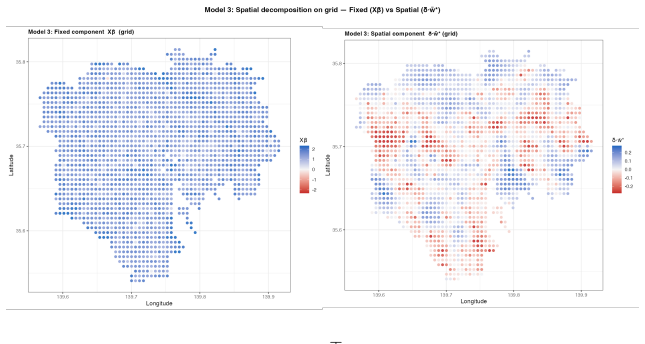
The shared Gaussian process w*(s) defined on an integration grid, which enters the LGCP location intensity as exp(α0 + γᵀxg(s) + w*(s)) and the probit survival latent variable as xᵀβ + δ w*(nearest grid point) + ε. The loading δ quantifies whether the latent field governing placement also shapes survival; the nearest-neighbor Gaussian process (NNGP) approximation makes the field scalable, and a Metropolis-within-Gibbs sampler performs exact Gibbs draws for many blocks.
Load-bearing premise
The model assumes that any dependence between where stores open and whether they survive runs entirely through a single latent spatial field that enters the location intensity at a fixed unit loading and the survival equation through the loading δ; if the true selection mechanism works through covariates not in the model, through chain-specific effects, or through a non-Gaussian field, the estimate of δ could be near zero even when preferential sampling is present.
What would settle it
Reanalyzing the Tokyo data with chain-specific fixed effects or with a non-Gaussian latent process; if the loading estimate moved far from zero, the near-zero result would be an artifact of the single-shared-GP assumption rather than evidence against preferential sampling.
If this is right
- If the near-zero estimate holds, standard spatial survival models that ignore preferential sampling are not seriously biased for these data.
- The joint model provides a template for testing preferential sampling in any binary spatial outcome where locations are informative.
- Proximity to full-scale supermarkets as a consistent closure predictor suggests that large-format competitors exert local substitution pressure on mini-supermarkets.
- The NNGP-based computation extends the approach to datasets with several thousand points, beyond the full-GP limit.
- The reported simulations separate no-PS (δ=0) from strong-PS (δ=1) at the real-data sample size, but weak-to-moderate loadings remain unresolved.
Where Pith is reading between the lines
- The near-zero estimate may reflect that store placement in this market is driven largely by observed covariates (station proximity, daytime population) already in the model, so the residual shared field carries little survival signal; applying the same framework to independent retailers or other cities could detect stronger selection.
- The wide credible intervals leave open the possibility of moderate preferential sampling; a time-to-event version using closure timing rather than a binary cross-section could have more power to detect it.
- The paper's in-sample fit gains come primarily from a store-level spatial field estimated independently of the location process, suggesting that spatial survival models for retail may benefit more from residual spatial random effects than from correcting for preferential sampling.
- The assumption that all dependence runs through a single shared Gaussian process at unit loading in the intensity could be relaxed to allow chain-specific selection mechanisms, which might change the δ estimate.
Editorial analysis
A structured set of objections, weighed in public.
Referee Report
Summary. This paper proposes a Bayesian joint model for retail store locations and binary survival outcomes, coupling a log-Gaussian Cox process (LGCP) for store locations with a spatial probit for store closure via a shared nearest-neighbor Gaussian process (NNGP) random field, with a scalar loading δ quantifying preferential sampling. The authors fit four nested specifications to 999 mini-supermarkets in Tokyo (897 operating, 102 closed), report δ̂ near zero with wide credible intervals (Model 3: 0.26 [-0.78, 1.05]; Model 4: -0.12 [-0.95, 0.75]), and conclude there is no clear evidence of residual preferential sampling, while noting limited power due to only 102 closures. A simulation study, using the same Model 4 data-generating process, shows that the estimator separates δ=0 from δ=1 in the eight reported single runs. The regression coefficient for distance to the nearest full supermarket is the only consistently significant survival covariate.
Significance. If taken at face value, the paper extends the preferential-sampling framework to binary survival outcomes in a retail setting and demonstrates a scalable NNGP implementation of a joint LGCP/probit model estimated with a custom Metropolis-within-Gibbs sampler. The MCMC details are explicit enough to reproduce, and the paper is unusually candid about its limitations: the simulation is acknowledged as a self-consistency check, the MCMC is a single chain, and the real-data intervals are wide. The main value is a template for interval-based assessment of preferential sampling in economic survival data. However, the usefulness of the empirical null depends on the adequacy of the shared-GP coupling and on the interpretation of the wide intervals; both need strengthening.
major comments (3)
- [§3.3, Eqs. (6) and (9); §4.1; §6.2] The model restricts all dependence between store location and survival to a single grid GP w* that enters the LGCP intensity with unit loading and the probit through δ. The analysis pools three chains (Maibasuketto, Maruetsu Petit, Rico's) whose location strategies and survival rates may differ. If selection operates at the chain level, or through a non-Gaussian/nonlinear latent factor, the pooled δ can be attenuated toward zero even when locations are strongly informative about survival. The real-data CrIs (Model 3: [-0.78,1.05]; Model 4: [-0.95,0.75]) are consistent with substantial preferential sampling, so the 'no clear evidence' conclusion is only as strong as this single-factor restriction. Please add a sensitivity analysis with chain-specific intercepts or random effects in the probit and/or LGCP, or a chain-stratified analysis, and report whether δ remains near zero.
- [Abstract; §6.2, Table 5] The abstract and Highlights state that the loading is 'near zero' / 'close to zero'. The posterior means are 0.26 (Model 3) and -0.12 (Model 4), with 95% CrIs [-0.78,1.05] and [-0.95,0.75]. These intervals include loadings of substantial positive and negative magnitude; the data are essentially uninformative about δ except against very large values. 'No clear evidence of preferential sampling' is the appropriate conclusion, but 'near zero' is not supported and overstates the precision of the estimate. Please revise the wording in the abstract, highlights, and conclusion to say the loading is imprecisely estimated and consistent with a range of values around zero.
- [§5.2, Table 2] The simulation is a single run per scenario from the Model 4 DGP, which is the same specification later fitted to the real data. The paper correctly calls this an implementation check, but the abstract's claim that 'simulations show the method can distinguish absent from strong preferential sampling' is supported only by eight runs. Because the real-data conclusion is a null result, the reader needs repeated-simulation summaries (coverage, false-positive rate) and, more importantly, a misspecification scenario (e.g., chain-level heterogeneity or omitted covariates) to see whether δ can be attenuated toward zero when preferential sampling is present. Without that, the simulation does not address the main threat to the empirical null.
minor comments (6)
- [Title] The word 'Assing' in the title should be 'Assessing'.
- [Table 2, row n=1000/30%/δ=0] The posterior mean is 0.41 with upper bound 0.97; while the interval includes zero, the posterior is not concentrated near zero. This should be acknowledged when comparing with the real-data operating point.
- [§5.4, Table 4] The predictive evaluation uses a plug-in kriging mean for w_obs and fixes covariance parameters at posterior means; a fully posterior predictive comparison would integrate over the store-level GP. This may affect the reported comparisons among models.
- [Appendix A, Table 6] ESS for several β coefficients is low (e.g., 114 and 190) and the paper uses a single chain. Since Table 5's stability claim rests on these estimates, include multi-chain checks or at least trace plots for the β parameters.
- [§3.2, m=15] The choice m=15 is standard but no sensitivity analysis is reported; given the NNGP approximation is central to the computational claims, a brief robustness check on m would strengthen the paper.
- [References] The Karamshuk et al. reference has a missing space before doi; please correct the formatting.
Circularity Check
No significant circularity: the Tokyo PS finding is an empirical estimate with explicit caveats; the same-DGP simulation is a disclosed self-consistency check, not a load-bearing derivation.
full rationale
I walked the paper's claimed derivation chain. The central claim is that the loading parameter δ is estimated near zero (Model 3: 0.26 [-0.78, 1.05]; Model 4: -0.12 [-0.95, 0.75]), providing no clear evidence of residual preferential sampling in the Tokyo data. This is an empirical posterior estimate from Eqs. (9)/(13), not a quantity derived from its own definition. The definitional statement that δ=0 corresponds to no preferential sampling is explicit and standard, and the conclusion is carefully hedged in the paper itself: 'The real-data credible intervals therefore leave weak-to-moderate loadings unresolved' (Section 7). The only potentially self-referential element is the simulation study: 'Data are simulated from the Model 4 specification (13)' and 'Each scenario is fitted with the same Metropolis-within-Gibbs sampler used for the real data' (Section 5.1). But the paper explicitly labels these 'scenario-specific implementation checks' and states they are 'not a repeated-simulation assessment of frequentist coverage or false-positive rates' (Section 5.2). Fitting the model to data generated from the same model is a self-consistency test, not a reduction of the real-data inference to its own inputs. The self-citations (Gelfand & Shirota 2019; Shirota & Gelfand 2022) appear only in the literature review and are not load-bearing for the Tokyo result. No uniqueness theorem, ansatz smuggled in via citation, or renamed empirical regularity is invoked as a derivation. The skeptical concern about chain-level heterogeneity or a non-Gaussian shared mechanism is a misspecification risk, not a circularity; the paper's own limitations ('the analysis is confined to three retail chains') acknowledge scope without claiming the model rules out all mechanisms. Therefore no circular step is present.
Axiom & Free-Parameter Ledger
free parameters (5)
- NNGP number of neighbors m =
15
- Decay parameter prior bounds φ ∈ [0.3, 2.0] =
0.3–2.0
- Integration grid K and cell exclusions =
3,471 cells; airport/bay cells removed
- Prior shape on GP variances InvGamma(2,1)
- Vague priors N(0, 10²) on β, δ, α0, γ
axioms (8)
- domain assumption Store locations follow an LGCP with intensity exp{α0 + γᵀx_g(s) + w*(s)}
- domain assumption Survival outcome follows a probit model conditional on covariates and the shared GP
- domain assumption The single shared GP w* captures all residual spatial dependence between location and survival
- standard math NNGP with m=15 provides an accurate approximation to the full GP
- standard math Berman–Turner quadrature over K=3,471 cells approximates the LGCP integral
- ad hoc to paper Sum-to-zero constraint on w* identifies intercepts
- ad hoc to paper Exclusion of airport and bay cells is ignorable
- domain assumption Contemporaneous covariates proxy historical conditions
Cite this review
Pith. "Pith review of Assing Preferential Sampling in Retail Survival Data: A Bayesian Joint LGCP and Spatial Probit Model for Mini-Supermarket Closure in Tokyo." pith.science (2026). https://pith.science/paper/KITIMN2J
@misc{pith2026260714860,
  author       = {Pith},
  title        = {Pith review of: Assing Preferential Sampling in Retail Survival Data: A Bayesian Joint LGCP and Spatial Probit Model for Mini-Supermarket Closure in Tokyo},
  year         = {2026},
  howpublished = {\url{https://pith.science/paper/KITIMN2J}},
  note         = {Machine review of arXiv:2607.14860}
}
read the original abstract
Retail store locations are strategically selected rather than randomly distributed, potentially inducing preferential sampling when the latent spatial factors governing placement also affect store survival. We propose a Bayesian hierarchical model that jointly combines a log-Gaussian Cox process for store locations with a probit regression for binary survival outcomes. The two components share a Gaussian process spatial effect, with a loading parameter measuring the association between the latent drivers of store placement and survival. To enable efficient inference for approximately 1,000 observations, we use a nearest-neighbor Gaussian process approximation and a Metropolis-within-Gibbs algorithm. We apply the model to 999 mini-supermarkets in Tokyo's 23 special wards, including 897 operating and 102 closed stores, using seven spatial covariates and a 3,471-point integration grid. The estimated loading is close to zero, with its credible interval including zero, providing no clear evidence of residual preferential sampling. Regression estimates are also stable across models with and without preferential sampling. Simulations show that the method can distinguish absent from strong preferential sampling. Proximity to full-scale supermarkets is the most robust predictor of closure risk, consistent with competitive substitution.
Figures




Reference graph
Works this paper leans on
-
[9]
Journal of the American Statistical Association 111, 800–812
Hierarchical nearest-neighbor Gaus- sian process models for large geostatistical datasets. Journal of the American Statistical Association 111, 800–812. doi:10.1080/01621459.2015.1044091. Davis, J., Goadrich, M.,
arXiv 2015
-
[15]
Ecological Monographs 89, e01372
Preferential sampling for presence/absence data and for fu- sion of presence/absence data with presence-only data. Ecological Monographs 89, e01372. doi:10.1002/ecm.1372. Holmes, T.J.,
-
[19]
Geo-Spotting: Mining online location-based services for optimal retail store placement. Proceedings of the 19th ACM SIGKDD International Conference on Knowledge Discovery and Data Mining , 793– 801doi:10.1145/2487575.2487616. Kuo, R.J., Chi, S.C., Kao, S.S.,
-
[23]
Bayesian geostatistical modelling with informative sampling locations. Biometrika 98, 35–48. doi:10.1093/biomet/asq067. 34 Pennino, M.G., Paradinas, I., Illian, J.B., Muñoz, F., Bellido, J.M., López-Quílez, A., Conesa, D.,
-
[24]
Ecology and Evolution 9, 653–663
Accounting for preferential sampling in species distribution models. Ecology and Evolution 9, 653–663. doi:10.1002/ece3.4789. Saito, T., Rehmsmeier, M.,
-
[25]
The precision-recall plot is more informative than the ROC plot when evaluating binary classifiers on imbalanced datasets. PLOS ONE 10, e0118432. doi:10.1371/journal.pone.0118432. Shirota, S., Gelfand, A.E.,
-
[1950]
Monthly Weather Review 78, 1–3
Verification of forecasts expressed in terms of probability. Monthly Weather Review 78, 1–3. doi:10.1175/1520-0493(1950)078<0001:VOFEIT>2.0.CO;2. Calhoun, Z.D., Black, M.S., Bergin, M., Carlson, D.,
-
[1963]
A probabilistic analysis of shopping center trade areas. Land Economics 39, 81–90. doi:10.2307/3144521. Jia, P.,
-
[1992]
Approximating point process likelihoods with GLIM. Applied Statistics 41, 31–38. doi:10.2307/2347614. 32 Brier, G.W.,
-
[1993]
Journal of the American Statistical Association 88, 669–679
Bayesian analysis of binary and polychotomous response data. Journal of the American Statistical Association 88, 669–679. doi:10.1080/01621459. 1993.10476321. Applebaum, W.,
arXiv 1993
-
[1998]
Scan- dinavian Journal of Statistics 25, 451–482
Log Gaussian Cox processes. Scan- dinavian Journal of Statistics 25, 451–482. doi:10.1111/1467-9469.00115. Pati, D., Reich, B.J., Dunson, D.B.,
-
[2002]
Computers in Industry 47, 199–214
A decision support system for selecting convenience store location through integration of fuzzy AHP and artificial neural network. Computers in Industry 47, 199–214. doi:10.1016/S0166-3615(01)00147-6. Lee, A., Szpiro, A., Kim, S.Y ., Sheppard, L.,
-
[2006]
The relationship between Precision-Recall and ROC curves, in: Proceedings of the 23rd International Conference on Machine Learning, pp. 233–240. doi:10.1145/1143844.1143874. Diggle, P.J., Menezes, R., Su, T.l.,
-
[2008]
What happens when Wal-Mart comes to town: An empirical analysis of the discount retailing industry. Econometrica 76, 1263–1316. doi:10.3982/ECTA6649. Karamshuk, D., Noulas, A., Scellato, S., Nicosia, V ., Mascolo, C.,
-
[2009]
Access to affordable and nutritious food: Measuring and understanding food deserts and their consequences: Report to Congress. Technical Report AP-036. U.S. Department of Agriculture, Economic Research Service. Washington, DC. A MCMC Convergence Diagnostics Table 6 reports the effective sample size (ESS) for key parameters of the PS Model. Inference is ba...
arXiv 1920
-
[2010]
Journal of the Royal Statistical Society: Series C (Applied Statistics) 59, 191–232
Geostatistical inference under preferential sampling. Journal of the Royal Statistical Society: Series C (Applied Statistics) 59, 191–232. doi:10. 1111/j.1467-9876.2009.00701.x. Ellickson, P.B., Grieco, P.L.E.,
arXiv 2009
-
[2011]
The diffusion of Wal-Mart and economies of density. Econometrica 79, 253–302. doi:10.3982/ECTA7699. Huff, D.L.,
-
[2012]
On the effect of preferential sampling in spatial prediction. Environmetrics 23, 565–578. doi:10.1002/env.2169. Gelfand, A.E., Shirota, S.,
-
[2013]
Journal of Urban Economics 75, 1–14
Wal-Mart and the geography of grocery retailing. Journal of Urban Economics 75, 1–14. doi:10.1016/j.jue.2012.09.005. Finley, A.O., Datta, A., Cook, B.D., Morton, D.C., Andersen, H.E., Banerjee, S.,
-
[2014]
2nd ed., CRC Press, Boca Raton, FL
Hierarchical Modeling and Analysis for Spatial Data. 2nd ed., CRC Press, Boca Raton, FL. doi:10.1201/b17115. Berman, M., Turner, T.R.,
-
[2015]
Impact of preferential sampling on ex- posure prediction and health effect inference in the context of air pollution epidemiology. Environmetrics 26, 255–267. doi:10.1002/env.2334. Møller, J., Syversveen, A.R., Waagepetersen, R.P.,
-
[2016]
Statistical Methods in Medical Research 25, 1224–1243
Preferential sampling and Bayesian geostatistics: Statistical modeling and examples. Statistical Methods in Medical Research 25, 1224–1243. doi:10.1177/0962280216660409. Conn, P.B., Thorson, J.T., Johnson, D.S.,
-
[2017]
Methods in Ecology and Evolution 8, 1535–1546
Confronting preferential sampling when analysing population distributions: diagnosis and model-based triage. Methods in Ecology and Evolution 8, 1535–1546. doi:10.1111/2041-210X.12803. Datta, A., Banerjee, S., Finley, A.O., Gelfand, A.E.,
-
[2018]
Papers in Applied Geography 4, 390–408
Big data analytics: The new boundaries of re- tail location decision making. Papers in Applied Geography 4, 390–408. doi:10.1080/ 23754931.2018.1527720. Banerjee, S., Carlin, B.P., Gelfand, A.E.,
arXiv 2018
-
[2019]
Journal of Computa- tional and Graphical Statistics 28, 401–414
Ef- ficient algorithms for Bayesian nearest neighbor Gaussian processes. Journal of Computa- tional and Graphical Statistics 28, 401–414. doi:10.1080/10618600.2018.1537924. 33 Gelfand, A.E., Sahu, S.K., Holland, D.M.,
arXiv 2018
-
[2022]
Spatial Statis- tics 51, 100674
Preferential sampling for bivariate spatial data. Spatial Statis- tics 51, 100674. doi:10.1016/j.spasta.2022.100674. Ver Ploeg, M., Breneman, V ., Farrigan, T., Hamrick, K., Hopkins, D., Kaufman, P., Lin, B.H., Nord, M., Smith, T.A., Williams, R., Kinnison, K., Olander, C., Singh, A., Tuckermanty, E.,
arXiv 2022
-
[2024]
Environmental Sci- ence & Technology Letters 11, 845–850
Refining citizen climate science: Addressing preferential sampling for improved estimates of urban heat. Environmental Sci- ence & Technology Letters 11, 845–850. doi:10.1021/acs.estlett.4c00296. Cecconi, L., Grisotto, L., Catelan, D., Lagazio, C., Berrocal, V ., Biggeri, A.,
This paper was first reviewed by deepseek-v4-flash on August 2, 2026.
discussion (0)
Sign in with ORCID, Apple, or X to comment. Anyone can read and Pith papers without signing in.