REVIEW 4 major objections 5 minor 19 references
Quasi-Pfaffian Solutions to Integrable Systems via Sylvester-Moutard Transformations
T0 review · 4 major / 5 minor · reviewed 2026-08-02 · deepseek-v4-flash
Pith's one-line read Quasi-Pfaffians provide a Sylvester-identity mechanism that reproduces all Moutard-transformed solutions of 2D integrable systems and extends to noncommutative settings.
desk verdict A careful commutative reformulation of the Moutard transform in quasi-Pfaffian notation, whose noncommutative compatibility claim is asserted rather than proven. read the letter →
The pith
A machine-rendered reading of the paper's core claim, the machinery that carries it, and where it could break.
The reading
What carries the argument
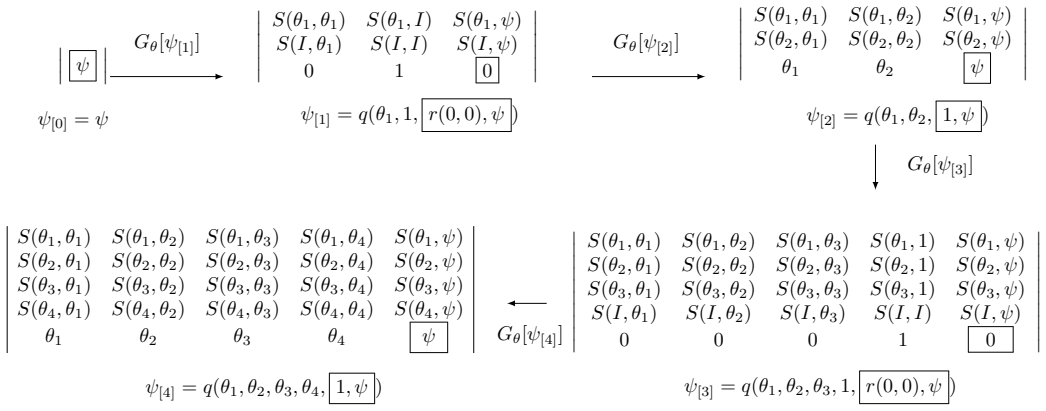
The quasi-Pfaffian q(θ1,...,θ2m,a,b) = S(a,b) − (S(a,θ1)...S(a,θ2m)) A^{-1} (S(θ1,b)...S(θ2m,b))^T, where A is the skew-symmetric block S(θi,θj), is the central object. It generalizes the quasi-determinant to skew-symmetric matrices with noncommuting entries, allowing diagonal entries S(a,a) to be nonzero. The load-bearing identity is the 3×3 Sylvester identity for quasi-Pfaffians, which expresses a quasi-Pfaffian of index n into a 3×3 quasi-Pfaffian whose entries are quasi-Pfaffians of index n−2. The transform uses this identity to recursively expand ψ[n] in terms of smaller ψ and S entries, yielding Transform A (even→even) and Transform B (even→odd) without solving the Moutard equation dir
What would settle it
Find a concrete noncommutative analog of the Novikov–Veselov or 2D sine-Gordon equation and check whether the quasi-Pfaffian derivative formulas yield the generalization (26)–(27) with H = H^T and vanishing commutator; if the equality fails or the block A is not invertible for a specific choice of eigenfunctions, the claimed noncommutative extension collapses. In the commutative case, the recursion can be falsified by checking whether ψ[4] computed by Transform A equals the Pfaffian ratio p(θ1,θ2,θ3,θ4,ψ)/p(θ1,θ2,θ3,θ4) for arbitrary functions θ.
Extended reading notes
Core claim
The central claim is that the Sylvester–Moutard transform, built on the quasi-Pfaffian, generates the full sequence of Moutard-transformed solutions for Moutard-transformable integrable systems. In the commutative case the quasi-Pfaffian representation of Moutard solutions ψ[n]=G/F reduces to the known Pfaffian ratio, and the potential u[n] = u[0] + 2(ln F)_xy remains a solution. The transform comes in two steps: Transform A takes an even-indexed quasi-Pfaffian solution to the next even-indexed one, and Transform B takes it to the next odd-indexed one, using the 3×3 Sylvester identity to express the larger quasi-Pfaffian in terms of smaller blocks. Because every step is algebraic and does no
Load-bearing premise
The entire noncommutative generalization rests on two unsupported assumptions: that the central matrix block is invertible in the noncommutative ring, and that H = H^T and the commutator [q[...], ψ] = 0 hold for a genuine noncommutative version of the system; if either fails, the Sylvester–Moutard recursion does not produce solutions of a noncommutative analogue.
Editorial extensions
If this is right
- All Moutard-generated solutions of Novikov–Veselov and 2D sine-Gordon can be produced by the same Sylvester-identity recursion, so the Moutard equation itself becomes optional for constructing them.
- The recursion gives a compact, explicit formula for u[n] = 2(log F)_xy from the quasi-Pfaffian denominator, with F expressible directly as a Pfaffian of the eigenfunctions.
- Because the Sylvester identity holds in noncommutative rings, the same recursion plausibly defines Moutard-type solutions for noncommutative versions of these integrable systems.
- The even/odd split of the transform organizes the solution hierarchy in a regular two-step pattern, which may simplify computations of higher-order solutions.
- Higher-order derivatives of quasi-Pfaffians, computed in the paper, give a direct differential calculus that attaches to the transform.
Reading between the lines
- If the noncommutative compatibility holds, the quasi-Pfaffian could play the same role for Moutard-type systems that quasi-determinants already play for Darboux-type systems, uniting the two solution-generating frameworks.
- The explicit derivative rules for quasi-Pfaffians may be reusable for other Pfaffian-based integrable systems beyond the two named examples, such as discrete sine-Gordon or multicomponent versions.
- A natural test is to construct a genuine noncommutative Novikov–Veselov or sine-Gordon system and check whether the derived equation (26)–(27) with H=H^T and vanishing commutator is satisfied; the paper does not supply such a system.
Editorial analysis
A structured set of objections, weighed in public.
Referee Report
Summary. The paper introduces a quasi-Pfaffian, defined as a quasi-determinant whose principal block is skew-symmetric, and proposes a Sylvester–Moutard transform based on a 3×3 Sylvester identity for such objects. The classical Moutard transform is reviewed, and solutions ψ[n] of the auxiliary system are written as quasi-Pfaffians. The paper then uses the Sylvester identity to express ψ[n+2] and ψ[n+1] recursively in terms of smaller quasi-Pfaffians (Transforms A and B), claims that this generates the same solution class as the Moutard transform, and derives a formal noncommutative generalization (Eqs. (26)–(27)) of the Moutard equation. The central advertised claims are that the transform works for Novikov–Veselov and two-dimensional sine-Gordon systems and that the construction is structurally compatible with noncommutative algebra.
Significance. If fully established, a quasi-Pfaffian framework would give a uniform algebraic notation for Moutard-type solutions and a candidate route to noncommutative two-dimensional integrable systems. The paper is useful in that it explicitly works out derivative rules for quasi-Pfaffians and shows how the known Moutard solutions can be encoded in this notation. The commutative identification with Pfaffian ratios is a useful check. However, the genuinely new claims—the noncommutative compatibility and the status of the Sylvester–Moutard transform as an independent solution-generating mechanism—are not proved. The paper is best read as a promising research announcement or technical reformulation, not as a completed derivation of the advertised results.
major comments (4)
- [§2.2, Eq. (7)] The 3×3 Sylvester identity for quasi-Pfaffians is the engine of Transforms A and B, yet it is not proved in this paper: the text only says that 'further details and proofs' are in [GLY25]. Since the manuscript claims to introduce the quasi-Pfaffian and build a new transform on it, the identity should be stated with precise hypotheses and proved or supplied in an appendix. In particular, no conditions are given for invertibility of the skew-symmetric block A in Eqs. (5)–(6) or of the auxiliary blocks appearing in (22), which is especially delicate in the noncommutative setting. This is load-bearing because without (7) the recursive formulas (22)–(25) are unsupported.
- [§4, Eqs. (26)–(27)] The claim that the construction is 'structurally compatible with non-commutative algebra' is not established. The generalized Moutard equation (26)–(27) is derived under assumptions that are asserted rather than proved: H = H^T, q[r(1,1),ψ] = 0 'if we are dealing with separable θ', and invertibility of 1±H. The condition 'separable θ' is never defined; for the standard separable exponentials θ = e^{ax+by} one has θ_xy = abθ, so q[r(1,1),ψ] is not automatically zero. Moreover, no concrete noncommutative Novikov–Veselov or sine-Gordon system is shown to satisfy these assumptions. The noncommutative conclusion is therefore a formal calculation conditional on unverified hypotheses, not a theorem.
- [§3–§4, Eqs. (8), (14), (22)] In the commutative case, the Sylvester–Moutard transform appears to be a reformulation of the classical Moutard recursion rather than a new solution-generating mechanism. The paper itself states in Eq. (14) that ψ[n] = G[n]/F[n], a ratio of Pfaffians, and Eq. (22) is the Sylvester identity applied to that same ratio. The proof that the constructed ψ[n] and u[n] satisfy the auxiliary system (11) still relies on the classical Moutard theorem and the Pfaffian expressions (14)–(15); the transform alone neither proves the solutions nor expands the solution class. The abstract's claim that the transform generates new solutions 'without directly employing the Moutard transformation' is therefore overstated unless an independent verification is supplied.
- [Abstract; §3; §5] The abstract advertises applications to the Novikov–Veselov and two-dimensional sine-Gordon equations. Only Novikov–Veselov is explicitly treated; two-dimensional sine-Gordon is mentioned as 'expected' in §1 and again in the conclusion, but its auxiliary system and the corresponding transformed solution are never written down. If the result is meant to cover sine-Gordon, this missing case should be supplied; if not, the abstract should be limited to the equations actually discussed.
minor comments (5)
- [§3, Eqs. (10)–(11)] In the standard Novikov–Veselov system the potential terms are usually written with Φ_x and Φ_y, e.g. (Φ_x u)_x and Φ_x ψ_x. The manuscript writes Φ_xx and Φ_yy. Please verify the equations and correct the notation if these are typos.
- [§2, §3] The notation for odd Pfaffians is inconsistent: Section 2 defines p(..., I) with a sign, while Eq. (14) uses p(θ1,...,θn) without specifying how odd n is handled. Please state the convention clearly before using it.
- [Figure 2] The caption says Transforms A and B take the quasi-Pfaffians 'from even to even, even to odd, and odd to odd, respectively', which is garbled. The text defines Transform B only from even to odd.
- [Throughout] There are numerous typographical issues: 'quasiPfaffian' in the Abstract, inconsistent 'Pf'/'pf', 'skewsymmetric' vs 'skew-symmetric', and several malformed displayed matrices (e.g. Eq. (5)). These should be cleaned up.
- [References] Reference [GLY25] is cited as an arXiv preprint. Since a key identity is deferred to that work, please provide the full version/date or, preferably, include the proof in this paper.
Circularity Check
The 'new' Sylvester–Moutard transform is the classical Moutard transform in quasi-Pfaffian notation, and the key identity is deferred to a same-author preprint.
-
renaming known result
[Introduction; §3 Eqs. (14)–(15); §4 Eq. (22)]
"This transformation, which we call the Sylvester–Moutard transform, generates the same class of solutions as the traditional Moutard transform, but does so without explicitly invoking it."
Equation (14) already identifies the transformed wavefunction with the classical Pfaffian ratio, ψ[n] = p(θ1,...,θn,ψ)/p(θ1,...,θn) = G[n]/F[n]. Equation (22) then rebuilds ψ[n+2] from ψ[n] by the Sylvester identity; in the commutative limit the paper itself converts the quasi-Pfaffian back to Pf(θ1,...,θn,ψ,I)/Pf(θ1,...,θn) = G/F and sets u[n] = 2(log F)xy, which is (15), the classical Moutard output. Thus the 'new' transform's output is the traditional Moutard transform written in quasi-Pfaffian notation; the claimed novelty is a renaming, not a construction independent of [AN91].
-
self citation load bearing
[Section 2.2, after Eq. (7)]
"Further details and proofs concerning this version of Sylvester identity in the context of quasi-Pfaffians can be found in [GLY25]."
The 3×3 Sylvester identity (7) is used as the engine of the recursive construction (22)–(25). The paper states the identity but provides no proof, deferring 'further details and proofs' to [GLY25], a companion preprint whose first author is the same as the present first author. The central algebraic step therefore rests on a self-citation whose contents are not included or verified here; the paper's derivation chain depends on that citation for the key noncommutative identity.
full rationale
The paper's commutative chain is internally consistent: the derivative formulas are calculations, and the Sylvester identity is a genuine identity. The circularity is in the packaging: Eq. (14) defines ψ[n] as the same Pfaffian ratio used in the classical Moutard transform, and Eq. (22) simply applies the Sylvester identity to that ratio. The Introduction concedes that the new transform 'generates the same class of solutions as the traditional Moutard transform.' Thus the claimed new solution-generating mechanism is a renaming/reformulation, not an independent derivation; the commutative 'prediction' reduces by construction to [AN91]. The quasi-Pfaffian notation and the noncommutative derivative calculus are additional mathematical content, but the central novelty claim is equivalent to the known transform. The only proof of the 3×3 Sylvester identity for the new object is deferred to a same-first-author companion [GLY25], making that step load-bearing self-citation. The §4 noncommutative compatibility claim is not established because it relies on unproven assumptions (H=H^T, q[r(1,1),ψ]=0 for 'separable θ', invertibility of 1±H); this is a correctness gap rather than a circular step, but it prevents the noncommutative conclusion from adding independent support.
Assumptions & free parameters
assumptions (5)
- standard math Pfaffian/determinant relation det(A) = Pf(A)^2 for skew-symmetric matrices (Eq. (1))
- standard math Quasi-determinant Sylvester identity in 3x3 block form (Eq. (7))
- domain assumption Moutard transformation invariance of the auxiliary system (11) and of the Novikov–Veselov equation (10)
- domain assumption Representation ψ[n] = G[n]/F[n] with F[n] = Pf(θ1,...,θn) and u[n] = u[0] + 2(log F[n])_xy
- ad hoc to paper Noncommutative generalized Moutard equation (26)–(27) with H = H^T and q[r(1,1),ψ] = 0 for separable θ
invented entities (1)
-
Quasi-Pfaffian q(θ1,...,θ2m,a,b)
Cite this review
Pith. "Pith review of Quasi-Pfaffian Solutions to Integrable Systems via Sylvester-Moutard Transformations." pith.science (2026). https://pith.science/paper/XRFC3GFS
@misc{pith2026260715013,
  author       = {Pith},
  title        = {Pith review of: Quasi-Pfaffian Solutions to Integrable Systems via Sylvester-Moutard Transformations},
  year         = {2026},
  howpublished = {\url{https://pith.science/paper/XRFC3GFS}},
  note         = {Machine review of arXiv:2607.15013}
}
read the original abstract
In this paper, we introduce a mathematical structure called the quasiPfaffian. The quasiPfaffian is analogous to the quasideterminant, a structure used instead of a determinant in noncommutative settings. Building on the Sylvester identity for the quasiPfaffian, we develop a novel transformation, named the Sylvester Moutard transform, this generates new solutions for Moutard transformable integrable systems, such as the Novikov Veselov equation and the two dimensional sine Gordon equation. We also briefly review the classical Moutard transformation in the context of quasiPfaffians and discuss several additional properties of this new object.
Figures

Reference graph
Works this paper leans on
-
[1]
1998 , school=
Applications of pfaffians to soliton theory , author=. 1998 , school=
1998
-
[2]
Proceedings of the Royal Society of London
Superposition principles associated with the Moutard transformation: an integrable discretization of a (2+ 1)--dimensional sine--Gordon system , author=. Proceedings of the Royal Society of London. Series A: Mathematical, Physical and Engineering Sciences , volume=. 1997 , publisher=
1997
-
[3]
Journal of Physics A: Mathematical and Theoretical , volume=
On a direct approach to quasideterminant solutions of a noncommutative modified KP equation , author=. Journal of Physics A: Mathematical and Theoretical , volume=. 2008 , publisher=
2008
-
[4]
arXiv preprint nlin/0111021 , year=
Darboux transformation for the modified Veselov-Novikov equation , author=. arXiv preprint nlin/0111021 , year=
-
[5]
Inverse problems , volume=
On the Moutard transformation for integrable partial differential equations , author=. Inverse problems , volume=. 1991 , publisher=
1991
-
[6]
Theoretical and Mathematical Physics , volume=
Blowing up solutions of the modified Novikov-Veselov equation and minimal surfaces , author=. Theoretical and Mathematical Physics , volume=. 2015 , publisher=
2015
-
[7]
Journal of Physics A: Mathematical and Theoretical , volume=
On a direct approach to quasideterminant solutions of a noncommutative KP equation , author=. Journal of Physics A: Mathematical and Theoretical , volume=. 2007 , publisher=
2007
-
[8]
Journal of Physics A: Mathematical and Theoretical , volume=
Dromion solutions of noncommutative Davey--Stewartson equations , author=. Journal of Physics A: Mathematical and Theoretical , volume=. 2009 , publisher=
2009
Show all 19 references
-
[9]
Advances in Mathematics , volume=
Quasideterminants , author=. Advances in Mathematics , volume=. 2005 , publisher=
2005
-
[10]
arXiv preprint arXiv:2404.11391 , year=
The extended versions of the noncommutative KP and mKP equations and Miura transformation , author=. arXiv preprint arXiv:2404.11391 , year=
-
[11]
Finite-zone, two-dimensional, potential Schr
Veselov, AP and Novikov, SP , booktitle=. Finite-zone, two-dimensional, potential Schr
-
[12]
on the relation between the minor determinants of linearly equivalent quadratic functions , author=
Xxxvii. on the relation between the minor determinants of linearly equivalent quadratic functions , author=. The London, Edinburgh, and Dublin Philosophical Magazine and Journal of Science , volume=. 1851 , publisher=
-
[13]
Linear Differential Equations in the Complex Domain: From Classical Theory to Forefront , pages=
Linear Pfaffian Systems and Integrability Condition , author=. Linear Differential Equations in the Complex Domain: From Classical Theory to Forefront , pages=. 2020 , publisher=
2020
-
[14]
, title =
Moutard, T. , title =. Journal de l'École Polytechnique , volume =. 1878 , language =
-
[15]
Functional Analysis and Its Applications , volume=
Determinants of matrices over noncommutative rings , author=. Functional Analysis and Its Applications , volume=. 1991 , publisher=
1991
-
[16]
Journal of Physics A: Mathematical and Theoretical , volume=
Quasideterminant solutions of a non-Abelian Hirota--Miwa equation , author=. Journal of Physics A: Mathematical and Theoretical , volume=. 2007 , publisher=
2007
-
[17]
Non-commutative Hermite--Pad
Doliwa, Adam , journal=. Non-commutative Hermite--Pad. 2022 , publisher=
2022
-
[18]
Journal of Physics A: Mathematical and Theoretical , volume=
Soliton solutions of noncommutative anti-self-dual Yang--Mills equations , author=. Journal of Physics A: Mathematical and Theoretical , volume=. 2020 , publisher=
2020
-
[19]
arXiv preprint arXiv:2511.19857 , year=
Quasi-Pfaffians and applications , author=. arXiv preprint arXiv:2511.19857 , year=
Reviewed August 2, 2026 · model on record in the stance chip above.
Discussion (0). Continue with ORCID to comment.