REVIEW 4 major objections 4 minor 33 references
LLM-enhanced residual links stop distortion from piling up across wireless image hops.
Reviewed by Pith at T0; open to challenge. T0 means a machine referee read the full paper against a public rubric. the ladder, T0–T4 →
T0 review · deepseek-v4-flash
2026-08-02 09:01 UTC pith:K6RGAOWH
load-bearing objection LLM-based residual entropy coding for multi-hop image transmission is a clever combo, but the reported gains depend on an unstated transmitter-side oracle that knows the channel output. the 4 major comments →
Large Language Model-Enhanced Multi-hop Parallel Image Semantic Communication
The pith
A machine-rendered reading of the paper's core claim, the machinery that carries it, and where it could break.
Core claim
The paper claims that distortion accumulation across N hops can be systematically countered by inserting a per-hop residual link whose rate is controlled by an LLM-based transmission optimizer. At each hop the transmitter emulates the receiver-side reconstruction through a modeled channel, forms the residual r_n = s_n − š_n, compresses it in a coarse-to-fine manner with adaptive arithmetic coding (AAC), and sends those bits over a separate channel. The LLM (Qwen3-1.7B, partially fine-tuned) fuses reference-image, residual-image, and channel/hop embeddings to predict residual distributions for AAC and to select a masking edge that sets the residual rate per hop. A lightweight gate network dec
What carries the argument
The central mechanism is the residual compensation link with an emulated transmission process: at each hop, the transmitter's own reconstruction ˇs_n (obtained by passing the codeword through a modeled channel W̃n) serves as the reference, and the residual r_n = s_n − ˇs_n is compressed and sent in parallel. The load-bearing identity is that the final image at hop n is a convex fusion of the semantic reconstruction and the residual-corrected version, ˉs_n = (1 − T_n)ˆs_n + T_n R_n(ˆs_n, ˆr_n), where T_n is a binary activation. The LLM-RTO (LLM-based Residual Transmission Optimizer) is the second key object: it jointly embeds visual and side-information tokens, estimates the distribution of c
Load-bearing premise
The transmitter must know what the receiver will reconstruct at each hop, which it obtains by emulating the channel with W̃n; if the real channel's instantaneous noise and fading deviate from that emulation, the residual will not cancel actual distortion and the reported gains may shrink.
What would settle it
Run the same architecture over real Rayleigh fading with actual channel realizations (not a modeled W̃n) and compute the residual from the true received symbols at each hop; if the PSNR gain over WITT drops below roughly 0.5 dB at SNR = 4 dB and N = 20, the emulation assumption is the limiting factor. Alternatively, compute the bit rate of the residual link when the LLM is frozen vs fine-tuned; if the fine-tuned LLM does not reduce extra CBR by at least 20% at the same PSNR, the LLM-RTO's claimed compression gain would be contradicted.
If this is right
- If the paper is right, multi-hop semantic transmission no longer requires retraining the underlying codec; a residual link can be bolted onto existing single-hop JSCC systems to recover most of the accumulated loss.
- A fixed average CBR budget can be reallocated across hops, so that critical hops (deep fading, heavy accumulated distortion) get more residual bits while easy hops transmit almost nothing extra.
- Early-hop compensation matters more than late-hop compensation, so a hop-selection policy that favors the first few hops can deliver most of the gain with a fraction of the residual-link overhead.
- LLM-based residual distribution modeling is what makes the residual link cheap enough to be practical: it reduces the extra CBR by a large margin relative to a CNN-based residual estimator, with comparable or better final PSNR.
Where Pith is reading between the lines
- The residual-correction identity suggests an even stronger use: if the emulated channel were replaced by an on-line feedback of the actual received symbols at each hop (or a low-rate side channel), the residual link could also handle channel noise itself, not just semantic loss, because r_n would then cancel real distortions.
- A testable extension: in a dual-radio or time-division setting, the same LLM-RTO masking mechanism could be reused for other modalities (video frames, point clouds), since it only assumes residual statistics that depend on image content, channel, and hop index.
- If the residual link's extra CBR were to be counted against the main semantic link's CBR, the reported PSNR gain per total CBR might shrink, so the practical benefit depends on treating the semantic link as a baseline and the residual overhead as a separately managed budget.
- The hop-selection gate's λ weights learned from simulation may need recalibration on real hardware, where the runtime cost of activating the LLM per hop is not symmetric to the paper's GPU-based measurement.
Editorial analysis
A structured set of objections, weighed in public.
Referee Report
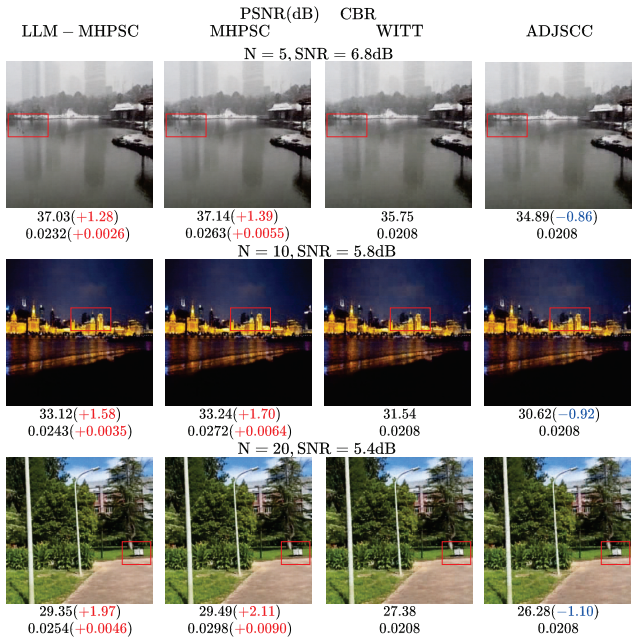
Summary. The paper proposes LLM-MHPSC, a dual-link multi-hop image semantic communication framework. At each hop, alongside a conventional JSCC semantic link, a residual compensation link computes r_n = s_n − ˇs_n using an emulated receiver-side reconstruction, compresses it with a DL-based codec and adaptive arithmetic coding, and uses a partially fine-tuned LLM (Qwen3-1.7B) to estimate residual distributions and to adjust the residual rate from CSI and hop-related side information. An adaptive gate selects which hops activate the residual link. Experiments on UDIS-D compare with WITT, ADJSCC, ViTSC, MHPSC, and BPG-based schemes over Rayleigh fading, reporting PSNR/MS-SSIM/LPIPS gains and CBR/runtime results.
Significance. If the reported gains hold under realistic channel constraints, the paper offers a useful plug-in mechanism for mitigating distortion accumulation in multi-hop semantic communication. The ablation study is extensive and internally consistent, and the adaptive-hop-selection idea is sensible. The main contribution of the LLM is as a contextual residual-distribution estimator and rate controller; relative to the CNN-based estimator from [1], the LLM mainly reduces the residual-link CBR rather than improving PSNR. There is no code release, and the evidence rests on a single dataset. As it stands, the manuscript is promising but not yet convincing because the residual-emulation assumption is underspecified and oracle-like, and because the residual link is compared under unequal error-protection assumptions.
major comments (4)
- [Sec. II-A and Algorithm 3, Stage 2] The transmitter-side 'emulated semantic transmission process with channel W̃n(·)' is never defined. In the actual channel model of Eq. (1)–(2), the receiver-side reconstruction depends on the instantaneous fading realization h_n and the specific noise sample n_n. The transmitter may know h_n, but generally not n_n. If W̃n(·) is noiseless or statistical, the residual r_n = s_n − ˇs_n computed in Sec. II-A cannot cancel the actual channel-induced distortion in Eq. (5), so the reported multi-hop gains are oracle-dependent. Please specify W̃n(·) precisely, explain how the transmitter obtains the receiver-side reference, or evaluate the system under a mismatch between the emulated and actual channels. Without this, the central claim is not supported for real multi-hop channels.
- [Sec. V-A and Sec. II-A] Sec. II-A states that the encoded residual bitstream is processed by LDPC+QAM, but Sec. V-A states that 'the capacity achieving code is adopted for the compensated residual link' for LLM-MHPSC and MHPSC, while DL baselines use practical 5G LDPC. This gives the residual link effectively error-free delivery, which is not available to the baselines, and makes the comparison favorable. Please implement the same practical LDPC/QAM on the residual link, or provide a finite-length analysis, and reconcile the contradiction between Sec. II-A and Sec. V-A.
- [Sec. V-B, Table I and Figs. 6–8] The quantitative claims are based on one dataset (UDIS-D) and no error bars or multi-seed statistics are reported. The PSNR differences among ablations in Table I are often fractions of a percent (e.g., 30.98 dB vs. 31.03 dB), which may be within run-to-run variation. At minimum, report means and standard deviations over multiple random seeds, and ideally add a second dataset, to support the 'consistently superior' wording used in the conclusion.
- [Sec. V-A, Table III and Sec. VI] The abstract/conclusion claim of only 'modest increase in ... computational overhead' should be qualified. LLM-MHPSC has 1,741.86M parameters versus 13.99M for WITT and 20.24M for MHPSC, and FLOPs of 14.01G versus 6.62G. The runtime is indeed comparable (0.103 s vs. 0.074 s), but the parameter and memory footprint is two orders of magnitude larger. Please report memory footprint or energy consumption, or temper the claim.
minor comments (4)
- [Sec. III-D, Eq. (21)] Equation (21) divides by Nc, but Table II reports the case Nc=0. Please clarify how the hop-selection probability is computed when the compensation budget is zero, or state that Eq. (21) is only invoked for Nc>0.
- [Table I] The column headings in Table I are hard to parse: after 'LLM Internal Mechanism' there are repeated 'LLM-MHPSC' entries. Please use distinct labels for the full model and for each ablation so that the percentage changes are unambiguous.
- [General] The acronym 'AAC' is used for adaptive arithmetic coding, but in the multimedia literature AAC usually denotes Advanced Audio Coding. Please define it at first use and consider spelling out 'arithmetic coding' to avoid confusion.
- [General] No code or trained model is provided. Given the complexity of reproducing a 1.7B-parameter LLM-based system, a public release or detailed pseudocode with hyperparameter settings would substantially improve reproducibility.
Circularity Check
No significant circularity: the central LLM-RTO result is benchmarked against external baselines and ablations, not defined into existence; the only mild issue is reliance on the authors' own prior framework and an undefined emulated-channel assumption that is a validity risk rather than a circular reduction.
full rationale
The derivation chain is not circular in the sense of the seven enumerated patterns. The headline claim—that LLM-RTO improves residual compression efficiency and multi-hop reconstruction quality—is established by comparing against external baselines (WITT, ViTSC, ADJSCC, BPG) and by ablations that replace LLM-RTO with the CNN-based estimator from [1]. The reported PSNR/MS-SSIM/LPIPS values and measured CBR are empirical outputs, not quantities defined to equal the inputs. Self-citations [1], [3], [5], and [26] supply the dual-link residual-compensation architecture and the residual codec, but the LLM-specific contribution is independently evaluated, so these self-citations are not load-bearing for the central claim. The one substantive concern is the undefined emulated channel W̃n(·) in Sec. II-A and Algorithm 3: the residual r_n = s_n − ˇs_n only cancels actual channel-induced distortion if ˇs_n tracks the receiver's true reconstruction; the paper neither defines W̃n(·) nor flags that the transmitter generally does not know the noise realization. This is an oracle-dependence / missing-assumption issue rather than an in-paper equivalence, so it does not raise the circularity score beyond the minor-self-citation level.
Axiom & Free-Parameter Ledger
free parameters (6)
- λ_init =
(0.2, 0.2, 0.1)
- P′ =
0.5
- C_th =
0.5
- γ =
1.15
- α =
0.1
- N_c (compensation budget) =
varies (2-20 in Table II)
axioms (5)
- ad hoc to paper Transmitter can emulate the receiver-side reconstruction ˇs_n before actual transmission (perfect CSI/noise knowledge)
- domain assumption All hops share identical network structures and parameters
- domain assumption Rayleigh fading with MMSE equalization models the wireless channel
- domain assumption Capacity-achieving channel code exists for the residual link
- ad hoc to paper A pretrained LLM fine-tuned on single-hop residuals provides accurate residual distributions in multi-hop deployment
read the original abstract
This paper proposes a large language model-enhanced multi-hop parallel image semantic communication (LLM-MHPSC) framework to mitigate distortion accumulation in multi-hop wireless image transmission. Unlike conventional single-hop semantic communication schemes, LLM-MHPSC deploys an extra residual compensation link at each hop to counteract accumulated distortions. To minimize additional bandwidth overhead, a coarse-to-fine residual compression scheme is designed by integrating a deep learning-based compressor with adaptive arithmetic coding (AAC). Furthermore, a large language model-based residual transmission optimizer (LLM-RTO) is developed to accurately estimate residual distributions and enable channel state and hop-aware rate adjustment, thereby improving residual compression efficiency under varying channel and hop conditions. An adaptive hop selection strategy is also proposed to activate the residual link on demand, striking a balance between transmission performance and computational cost. Experimental results show that LLM-MHPSC outperforms state-of-the-art semantic communication and traditional schemes, realizing robust image transmission with a marginal increase in bandwidth. This framework provides a flexible and effective solution for extending semantic communication to practical multi-hop application scenarios.
Figures


Reference graph
Works this paper leans on
-
[1]
Multi-hop Parallel Image Semantic Communication for Distortion Accumulation Mitiga- tion
B. Xie, J. Park, Y. Wu, et al. “Multi-hop Parallel Image Semantic Communication for Distortion Accumulation Mitiga- tion”, arxiv:2510.26844, Dec. 2025. [Online]. A vailable: https: //arxiv.org/abs/2510.26844v2
arXiv 2025
-
[2]
Wireless image transmission using deep source channel coding with attention modules
J. Xu, B. Ai, W. Chen, et al. “Wireless image transmission using deep source channel coding with attention modules”, IEEE Trans. Circuits Syst. Video Technol., vol. 32, no. 4, pp. 2315-2328, Apr. 2022
2022
-
[3]
Robust image semantic coding with learnable CSI fusion masking over MIMO fading channels
B. Xie, Y. Wu, Y. Shi, W. Z, S. Cui, and M. Debbah, “Robust image semantic coding with learnable CSI fusion masking over MIMO fading channels”, IEEE Trans. Wireless Commun., vol. 23, no. 10, pp. 14155-14170, Oct. 2024
2024
-
[4]
Robust semantic communications with masked VQ-V AE enabled code- book,
Q. Hu, G. Zhang, Z. Qin, Y. Cai, G. Yu, and G. Li, “Robust semantic communications with masked VQ-V AE enabled code- book,” IEEE Trans. Wireless Commun., vol. 22, no. 12, pp. 8707-8722, Dec. 2023
2023
-
[5]
B. Xie, Y. Wu, Y. Shi, D. W. K. Ng and W. Zhang, ”Communication-Efficient Framework for Distributed Image Semantic Wireless Transmission,” IEEE Internet Things J., vol. 10, no. 24, pp. 22555-22568, 15 Dec.15, 2023
2023
-
[6]
Retrieval-Augmented Generation for GenAI- Enabled Semantic Communications,
S. Tang et al., “Retrieval-Augmented Generation for GenAI- Enabled Semantic Communications,” IEEE Wireless Commun., vol. 33, no. 1, pp. 259-268, Jan. 2026
2026
-
[7]
Contrastive Learning-Based Semantic Commu- nications,
S. Tang, Q. Yang, L. Fan, X. Lei, A. Nallanathan and G. K. Karagiannidis, “Contrastive Learning-Based Semantic Commu- nications,” IEEE Trans. Commun., vol. 72, no. 10, pp. 6328- 6343, Oct. 2024
2024
-
[8]
A Relay System for Semantic Image Transmission Based on Shared Feature Extraction and Hyperprior Entropy Compression
W. An, Z. Bao, H. Liang, C. Dong and X. Xu, “A Relay System for Semantic Image Transmission Based on Shared Feature Extraction and Hyperprior Entropy Compression”, IEEE Int. Things J., vol. 11, no. 9, pp. 16158-16170, May, 2024
2024
-
[9]
Performance Optimization for Multicell Multihop Semantic 6G Cloudified Networks Considering Compression, Transmission, and Com- putation
H. Niu, L. Wang, Z. Lu, X. Wen and P. Marques, “Performance Optimization for Multicell Multihop Semantic 6G Cloudified Networks Considering Compression, Transmission, and Com- putation”, IEEE Int. Things J., vol. 12, no. 19, pp. 41197-41214, Oct., 2025
2025
-
[10]
Alleviating Distortion Accumulation in Multi-Hop Semantic Communication
G. Zhang, Q. Hu, Y. Cai and G. Yu, “Alleviating Distortion Accumulation in Multi-Hop Semantic Communication”, IEEE Commun. Lett., vol. 28, no. 2, pp. 308-312, Feb. 2024
2024
-
[11]
Semantic-aided Parallel Image Transmission Compatible with Practical System,
M. Xu et al., “Semantic-aided Parallel Image Transmission Compatible with Practical System,” IEEE Trans. Wireless Commun. (early access), May 2025
2025
-
[12]
Hybrid Semantic- Complementary Transmission for High-Fidelity Image Recon- struction
H. Nam, J. Park, J. Choi, et al., “Hybrid Semantic- Complementary Transmission for High-Fidelity Image Recon- struction”, arxiv:2507.17196, Jul. 2025. [Online]. A vailable: https://arxiv.org/abs/2507.17196
Pith/arXiv arXiv 2025
-
[13]
LLM4CP: Adapting large language models for channel prediction
Liu B, Liu X, Gao S, et al., “LLM4CP: Adapting large language models for channel prediction”, J. Commun. Inf. Netw., vol. 9, no. 2, pp. 113-125, Jun. 2024
2024
-
[14]
An LLM-Based Framework for Beamforming Optimization
W. Guo et al., “An LLM-Based Framework for Beamforming Optimization”, IEEE Commun. Mag., early access, Feb. 2026
2026
-
[15]
WirelessGPT: A Genera- tive Foundation Model for Multi-Task Integrated Sensing and Communication
Yang T, Zhang P, Zheng M, et al., “WirelessGPT: A Genera- tive Foundation Model for Multi-Task Integrated Sensing and Communication”, IEEE J. Select. Areas Commun., vol. 44, pp. 2259-2273, Dec. 2025
2025
-
[16]
Sensing- Assisted Channel Prediction in Complex Wireless Environ- ments: An LLM-Based Approach
J. He, Z. Ren, J. Yao, H. Hu, T. X. Han and J. Xu, “Sensing- Assisted Channel Prediction in Complex Wireless Environ- ments: An LLM-Based Approach”, IEEE Wireless Commun. Lett., vol. 14, no. 12, pp. 3857-3861, Dec. 2025
2025
-
[17]
LLM-Empowered Near-Field Communications for Low-Altitude Economy
Z. Xu, T. Zheng and L. Dai, “LLM-Empowered Near-Field Communications for Low-Altitude Economy”, IEEE Trans. Commun., vol. 73, no. 11, pp. 11186-11196, Nov. 2025
2025
-
[18]
WITT: A wireless image transmission transformer for semantic communications
K. Yang, S. Wang, J. Dai, et al., “WITT: A wireless image transmission transformer for semantic communications”, in IEEE Int. Conf. Acoust. Speech Signal Process. (ICASSP), Rhodes Island, Greece, Jun. 2023, pp. 1-5
2023
-
[19]
Language mod- eling is compression
G. Delétang, A. Ruoss, P. Duquenne, et al., “Language mod- eling is compression”, arxiv:2309.10668, Mar. 2024. [Online]. A vailable: https://arxiv.org/abs/2309.10668
Pith/arXiv arXiv 2024
-
[20]
Large language model for lossless image compression with visual prompts
J. Du, C. Zhou, N. Cao, et al., “Large language model for lossless image compression with visual prompts”, arxiv:2502.16163, Feb. 2025. [Online]. A vailable: https://arxiv.org/abs/2502. 16163
Pith/arXiv arXiv 2025
-
[21]
K. Chen, P. Zhang, H. Liu, et al., “Large language models for lossless image compression: Next-pixel prediction in language space is all you need”, arxiv:2411.12448, Nov. 2024. [Online]. A vailable: https://arxiv.org/abs/2411.12448
Pith/arXiv arXiv 2024
-
[22]
Lossless data compression by large models
Z. Li, C. Huang, X. Wang, et al, “Lossless data compression by large models”, Nat. Mach. Intell., vol. 7, no. 5, pp. 794-799, May 2025
2025
-
[23]
Learning better lossless compression using lossy compression
F. Mentzer, L. Gool, M. Tschannen, “Learning better lossless compression using lossy compression”, in IEEE Conf. Comput. Vis. Pattern Recognit. (CVPR), online, Oct. 2020, pp. 6638- 6647
2020
-
[24]
LoRA: Low-rank adaptation of large language models
E. Hu, Y. Shen, P. Wallis, et al, “LoRA: Low-rank adaptation of large language models”, arxiv:2106.09685, Oct. 2021. [Online]. A vailable: https://arxiv.org/abs/2106.09685
Pith/arXiv arXiv 2021
-
[25]
Qlora: Efficient finetuning of quantized llms
T. Dettmers, A. Pagnoni, A. Holtzman, et al, “Qlora: Efficient finetuning of quantized llms”, Adv. Neural Inform. Process. Syst., New Orleans, USA, Dec. 2023, pp. 10088-10115
2023
-
[26]
WVSC: Wireless Video Semantic Communication with Multi- frame Compensation
B. Xie, Y. Wu, Y. Shi, B. Feng, W. Zhang, J. Park, and T. Quek, “WVSC: Wireless Video Semantic Communication with Multi- frame Compensation”, arxiv:2503.21197, Mar. 2025. [Online]. A vailable: https://arxiv.org/abs/2503.21197
arXiv 2025
-
[27]
A. Yang, A. Li, B. Yang, et al, “Qwen3 technical report”, arxiv:2505.09388, May 2025. [Online]. A vailable: https://arxiv. org/abs/2505.09388
Pith/arXiv arXiv 2025
-
[28]
Unsupervised deep image stitching: Reconstructing stitched features to images
L. Nie, C. Lin, K. Liao, et al. “Unsupervised deep image stitching: Reconstructing stitched features to images”, IEEE Trans. Image Process., vol. 30, pp. 6184–6197, Jul. 2021
2021
-
[29]
Adam: A method for stochastic optimization
D. Kingma and J. Ba, “Adam: A method for stochastic optimization”, arxiv:1412.6980, Dec. 2014. [Online]. A vailable: https://arxiv.org/abs/1412.6980
Pith/arXiv arXiv 2014
-
[30]
BPG Image Format
F. Bellard, “BPG Image Format. ”, Accessed: Apr. 2018. [On- line]. A vailable: https://bellard.org/bpg/
2018
-
[31]
Sionna: An open-source library for next- generation physical layer research
H., Jakob, et al. “Sionna: An open-source library for next- generation physical layer research”, Mar. 2022. [Online]. A vail- able: https://arxiv.org/abs/2203.11854
Pith/arXiv arXiv 2022
-
[32]
Deep joint source-channel coding for wireless image transmission
E. Bourtsoulatze, D. Burth Kurka, and D. Gündüz, “Deep joint source-channel coding for wireless image transmission”, IEEE Trans. Cogn. Commun. Netw., vol. 5, no. 3, pp. 567–579, Sep. 2019
2019
-
[33]
Attention is all you need,
A. Vaswani, N. Shazeer, N. Parmar, J. Uszkoreit, L. Jones, A. N. Gomez, Ł. Kaiser, and I. Polosukhin, “Attention is all you need,” in Proc. Adv. Neural Inf. Process. Syst. (NIPS), Long Beach, California, USA, Dec. 2017, vol. 30, p. 6000–6010
2017
discussion (0)
Sign in with ORCID, Apple, or X to comment. Anyone can read and Pith papers without signing in.