REVIEW 3 major objections 5 minor 52 references
A single slope parameter can encode the conditions under which a star's heavy elements formed.
Reviewed by Pith at T0; open to challenge. T0 means a machine referee read the full paper against a public rubric. the ladder, T0–T4 →
T0 review · deepseek-v4-flash
2026-08-01 23:31 UTC pith:EAAQNZQB
load-bearing objection A useful descriptive slope index for heavy-element abundance patterns, but the physical interpretation tied to freeze-out parameters rests on an admitted working hypothesis that is only defensible for the negative-slope stars. the 3 major comments →
Stellar heavy-element slope index
The pith
A machine-rendered reading of the paper's core claim, the machinery that carries it, and where it could break.
Core claim
The paper's central claim is that the observed heavy-element differential abundance, [Z/H], is well described, to first order, by a straight line in atomic number Z, [Z/H]=c_Z(Z_0)+d_Z(Z−Z_0), and that the slope d_Z is a meaningful stellar index rather than a fitting artifact. Within the HEFO (heavy-element freeze-out) model, the initial abundance pattern is fixed when expanding hot dense matter falls out of equilibrium, with the distribution governed by Lagrange parameters λ_T, λ_n, and λ_p. Numerical variations show that the relative shift of the initial mass-fraction distribution with respect to the Sun is controlled mostly by λ_T for overall normalization and by λ_p for the tilt—i.e., th
What carries the argument
The slope parameter d_Z, defined by [Z/H] = c_Z(Z_0) + d_Z (Z−Z_0) for heavy elements, is the central object. Working alongside it is the HEFO (heavy-element freeze-out) concept, in which the initial heavy-nucleus distribution is described by a generalized Gibbs distribution controlled by three Lagrange parameters—λ_T (a generalized temperature), λ_n (neutron chemical potential), and λ_p (proton chemical potential). The argument operates by relating the observed elemental slope d_Z to the mass-fraction slope d_A of the initial distribution under the approximation that the mapping mirrors the solar configuration, and by assuming the initial-to-final slope is nearly invariant for heavy nuclei
Load-bearing premise
The load-bearing premise, stated by the authors as a working hypothesis, is that the slope of the heavy-element mass distribution at freeze-out is essentially the same as the final observed slope (below the lead region), so late-stage neutron evaporation, alpha decay, and fission do not systematically distort the relative pattern differently from star to star.
What would settle it
If a high-precision abundance pattern for any individual star over 38≤Z≤80 cannot be represented by a single straight line in [Z/H]—for example, the slope changes between the strontium-zirconium region and the barium-europium region—then the central single-slope claim collapses for that object. A second decisive test is computational: starting from a HEFO initial distribution, evolve through neutron evaporation, alpha decay, and fission; if the final slope differs measurably from the initial slope even with the lead region excluded, the working hypothesis connecting d_Z to freeze-out condition
If this is right
- A measurement of d_Z from stellar spectra yields a physical constraint on the proton chemical potential and temperature at the epoch of heavy-element freeze-out, not just a descriptive fit.
- Observed deviations from r-process universality need not imply multiple distinct nucleosynthesis sites; a continuous range of freeze-out conditions can reproduce them.
- Differential abundance analysis between two stars isolates the slope and removes systematic offsets, making the slope a cleaner observable than absolute abundances for comparing stellar populations.
- The slope parameter can be used to chemically tag kinematically associated stars, e.g., members of a stellar stream, identifying common formation environments even when absolute abundances differ.
- Late-stage decay of superheavy nuclei must be accounted for when extracting d_Z, because alpha decay and fission feed the lead and rare-earth regions and would otherwise bias the fitted slope.
Where Pith is reading between the lines
- I would extend the logic to a testable correlation: if d_Z tracks the proton chemical potential, then among stars of fixed [Fe/H], d_Z should correlate with neutron-capture element ratios that are sensitive to neutron richness (e.g., Eu/Ba, or actinide-to-lanthanide ratios). The paper does not make this prediction explicitly.
- The slope concept could be imported into Galactic chemical evolution models as a continuous observable that replaces discrete site classes such as 'light' and 'heavy' r-process components; this would let abundance surveys map the distribution of freeze-out conditions across the Galaxy, an application the paper gestures at but does not develop.
- A concrete numerical check: initialize a reaction network with the HEFO freeze-out distribution for a chosen (λ_T, λ_n, λ_p) and compute the final abundance slope; a systematic mismatch with d_Z from linear fits to observed stars would show where the slope-invariance approximation fails.
Editorial analysis
A structured set of objections, weighed in public.
Referee Report
Summary. This paper introduces a phenomenological 'heavy-element slope index' d_Z, defined as the least-squares slope of [Z/H] against atomic number Z (Eq. 2), and applies it to a series of published stellar abundance datasets: HD 222925, Honda stars, r-I/r-II differential pairs, limited-r stars, the lead/actinide-boost object EC 22536–5304, CS 31082-001, halo dwarf/giant samples, and members of stellar streams. The slope is interpreted through the heavy-element freeze-out (HEFO) framework, in which the initial abundance pattern is set by three Lagrange parameters (λ_T, λ_n, λ_p); the paper argues that d_Z varies between stars and is particularly sensitive to λ_p. It explicitly acknowledges that the connection between the observed final slope and the initial freeze-out slope is a working hypothesis and that the astrophysical sites remain unidentified.
Significance. If robust, the slope index offers a compact continuous descriptor of heavy-element abundance patterns, potentially useful for chemical tagging of stellar populations and for comparison with nucleosynthesis models. The empirical fits are straightforward and reproducible from the cited data. The paper is also unusually transparent: it labels its main interpretive assumption as a working hypothesis, discusses excluded data points, and does not oversell site identification. However, the physical interpretation is not yet quantitatively supported, and the empirical slopes are presented without uncertainties. The significance of the central claim is therefore conditional on additional analysis.
major comments (3)
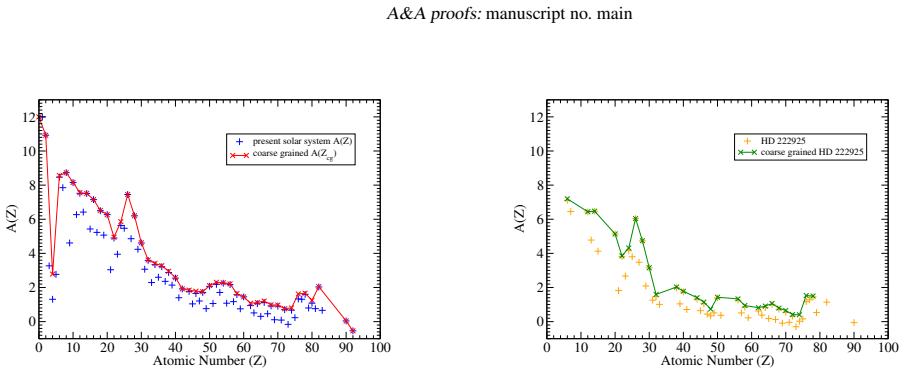
- [§2.5, Fig. 5] The central link between observation and theory is the assumption that the observed elemental slope d_Z (Eq. 2, final abundances) can be identified with the initial HEFO mass-fraction slope d_A^ini (Eq. 3). Figure 5 demonstrates λ_p sensitivity only for initial distributions. Section 3.1 states that α-decay and fission contributions remain an open problem, and §3.3 says branching ratios are broadly unconstrained. For stars with large superheavy tails (HD 222925, EC 22536–5304, actinide-boost objects), the assumption is not justified. A quantitative estimate of how post-freeze-out processes distort the slope—or a restatement of the claim that d_Z is a purely empirical index—is required.
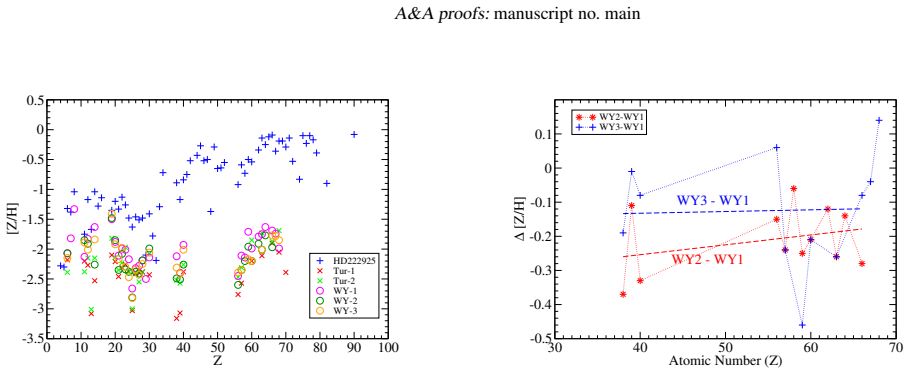
- [§3 (Figs. 4, 6, 8, 10, 11, 12, 14)] The fitted slopes are quoted to several significant figures without standard errors or goodness-of-fit measures. The text notes 'large error bars' in Fig. 3, but no uncertainty accompanies any d_Z value. Because the paper's empirical message is that slopes differ between stars (e.g., +0.0201 vs −0.030 vs ~0.003), the reader cannot assess significance without σ_dZ. Please report regression uncertainties and, ideally, a bootstrap or leave-one-out sensitivity check, and state how element-to-element systematic errors are treated.
- [§2.3 and §3.3 (Figs. 3, 11)] The fits exclude data points (Zcg=82 in Fig. 3; Ce and Pb/Bi in Fig. 11) on physical grounds, but no analysis shows how sensitive the slope is to those choices. The fitted atomic-number ranges also vary from 38–63 (Fig. 12) to 38–81 (Fig. 11), making slopes across figures not directly comparable. Please provide fits with and without excluded points, or a quantitative justification based on residuals, and state the Z range used in each slope comparison.
minor comments (5)
- [§2.1] Typos: 'at at freeze-out' and 'therprocess' appear in this section; they should read 'at freeze-out' and 'the r-process'.
- [§3.3 / Fig. 11] The figure caption writes 'EC 22563–5304' while the text uses 'EC 22536–5304'; please unify the spelling.
- [§2.5 / §3.3] After introducing the working hypothesis, the paper occasionally refers to the slope as defined with respect to the initial distribution (e.g., §3.3), even though the numerical fits are to final observed abundances. Consistent terminology would avoid confusion.
- [§2.2] The solar Lagrange parameters are taken from Blaschke et al. (2025), which calibrates the same HEFO model against solar abundances. This is an internal calibration rather than an independent anchor; state this explicitly when using solar-relative slopes to infer physical conditions.
- [§4.3] The IBBN discussion is speculative and not needed for the main result; please mark it clearly as an outlook paragraph or move it to a dedicated subsection.
Circularity Check
The empirical slope d_Z is a direct linear fit to observed [Z/H]; the HEFO link is an explicitly labeled working hypothesis, not a construction-level reduction. Only minor self-citational framing.
full rationale
No step in the derivation reduces by construction to its own input. The central quantity d_Z is defined in Eq. (2) as the least-squares slope of observed [Z/H] versus Z and is evaluated directly from externally published abundances (Roederer et al. 2022b; Honda et al. 2007; Saraf et al. 2025; Xylakis-Dornbusch et al. 2024), independent of the HEFO model. The HEFO relation (Eq. 1) and the solar/Honda Lagrange parameters are inherited from the authors' prior work (Blaschke et al. 2025; Röpke et al. 2025), and Fig. 5 is a model calculation illustrating that λ_p tilts the initial relative mass-fraction distribution; it is not a fit to the stellar d_Z values reported here. The paper explicitly postpones the quantitative inversion ('leaving the exact multi-dimensional inversion to pinpoint definite values for the Lagrange parameters to future studies'). The connection between observed d_Z and the freeze-out slope d_A is made through a stated 'working hypothesis' and a 'first-order approximation' that the element-to-mass mapping mirrors the solar configuration; the paper also concedes that superheavy decay branching ratios are 'broadly unconstrained'. These are acknowledged limitations in the physical interpretation, not circular reductions. The only mild concern is that the HEFO framework is justified partly through same-author citations, but those citations are not used to manufacture the observed slope values, so the central empirical content remains independent. This is a normal, non-circular phenomenological paper with a modest score.
Axiom & Free-Parameter Ledger
free parameters (4)
- Solar Lagrange temperature λ_T^⊙ =
5.2904 MeV
- Solar neutron chemical potential λ_n^⊙ =
940.2941 MeV
- Solar proton chemical potential λ_p^⊙ =
845.0553 MeV
- Honda star Lagrange parameters (λ_T, λ_n, λ_p) =
4.555 MeV, 940.944 MeV, 842.349 MeV
axioms (4)
- ad hoc to paper HEFO concept: heavy elements freeze out at high temperature (~5 MeV) with a distribution governed by Lagrange parameters λ_T, λ_n, λ_p (Eq. 1).
- domain assumption Linear initial distribution: the coarse-grained initial mass fraction X̂_A^ini is approximately linear in A over 76≤A≤208 (Eq. 3).
- domain assumption Slope invariance under decay: the slope of the A-metallicity is nearly invariant under post-freeze-out decays; 'the differential initial slope d_A^ini ... is essentially identical to the final observed differential slope d_A^fin' (Sect. 2.5).
- domain assumption Solar-mirror mapping between X_A and Y_Z: 'we assume that the structural mapping between these two quantities mirrors the solar configuration' (Sect. 2.5).
read the original abstract
The distribution of heavy elements in stars is described using a phenomenological approach, in which Lagrange parameters related to temperature and the chemical potentials of protons and neutrons are introduced within a freeze-out concept. Slope parameters are considered which describe the gross behavior of the distribution of the heavy elements. Universality and deviations from universality are discussed, and various examples are provided. These slope parameters may be of interest for characterizing the conditions under which heavy elements form, but the astrophysical sites where heavy elements are produced remain to be determined.
Figures


Reference graph
Works this paper leans on
-
[1]
J., et al
Alencastro Puls, A., Kuske, J., Hansen, C. J., et al. 2025, A&A, 693, A294
2025
-
[2]
J., & Scott, P
Asplund, M., Grevesse, N., Sauval, A. J., & Scott, P. 2009, ARA&A, 47, 481
2009
-
[3]
R., Usman, S
Atzberger, K. R., Usman, S. A., Ji, A. P., et al. 2025, The Open Journal of Astro- physics, 8, 68
2025
-
[4]
2011, A&A, 534, A60
Barbuy, B., Spite, M., Hill, V ., et al. 2011, A&A, 534, A60
2011
-
[5]
Beers, T. C. & Christlieb, N. 2005, ARA&A, 43, 531
2005
-
[6]
K., & Röpke, G
Blaschke, D., Röpke, F. K., & Röpke, G. 2025, Frontiers in Astronomy and Space Sciences, 12, 1733496
2025
-
[7]
& Price-Whelan, A
Bonaca, A. & Price-Whelan, A. M. 2025, New A Rev., 100, 101713
2025
-
[8]
E., Burbidge, G
Burbidge, M. E., Burbidge, G. R., Fowler, W. A., & Hoyle, F. 1957, Rev. Mod. Phys., 29, 547
1957
-
[9]
2025, A&A, 704, A238
Caffau, E., Steffen, M., Molaro, P., et al. 2025, A&A, 704, A238
2025
-
[10]
2024, A&A, 690, A97
Contursi, G., de Laverny, P., Recio-Blanco, A., et al. 2024, A&A, 690, A97
2024
-
[11]
J., Sneden, C., Lawler, J
Cowan, J. J., Sneden, C., Lawler, J. E., et al. 2021, Reviews of Modern Physics, 93, 015002
2021
-
[12]
& Wiescher, M
Diehl, R. & Wiescher, M. 2026, European Physical Journal A, 62, 45
2026
-
[13]
Dorsch, M., Jeffery, C. S., Deprince, J., et al. 2026, arXiv e-prints, arXiv:2605.21772
Pith/arXiv arXiv 2026
-
[14]
2022, MNRAS, 510, 5362
Ernandes, H., Barbuy, B., Friaça, A., et al. 2022, MNRAS, 510, 5362
2022
-
[15]
H., et al
Geha, M., Mao, Y .-Y ., Wechsler, R. H., et al. 2024, ApJ, 976, 118
2024
-
[16]
2025, Eur
Gonin, M., Hasinger, G., Blaschke, D., Ivanytskyi, O., & Röpke, G. 2025, Eur. Phys. J. A, 61, 170
2025
-
[17]
C., et al
Gudin, D., Shank, D., Beers, T. C., et al. 2021, ApJ, 908, 79
2021
-
[18]
2021, ApJ, 912, 52
Gull, M., Frebel, A., Hinojosa, K., et al. 2021, ApJ, 912, 52
2021
-
[19]
2018, ApJ, 856, 58
Han, W., Zhang, L., Yang, G., Niu, P., & Zhang, B. 2018, ApJ, 856, 58
2018
-
[20]
J., Montes, F., & Arcones, A
Hansen, C. J., Montes, F., & Arcones, A. 2014, ApJ, 797, 123
2014
-
[21]
J., Primas, F., Hartman, H., et al
Hansen, C. J., Primas, F., Hartman, H., et al. 2012, A&A, 545, A31
2012
-
[22]
2002, A&A, 387, 560
Hill, V ., Plez, B., Cayrel, R., et al. 2002, A&A, 387, 560
2002
-
[23]
M., Surman, R., Roederer, I
Holmbeck, E. M., Surman, R., Roederer, I. U., McLaughlin, G. C., & Frebel, A. 2023, ApJ, 951, 30
2023
-
[24]
2007, ApJ, 666, 1189
Honda, S., Aoki, W., Ishimaru, Y ., & Wanajo, S. 2007, ApJ, 666, 1189
2007
-
[25]
Honda, S., Aoki, W., Ishimaru, Y ., Wanajo, S., & Ryan, S. G. 2006, ApJ, 643, 1180
2006
-
[26]
Jeong, M., Lee, Y . S., Placco, V . M., et al. 2026, arXiv e-prints, arXiv:2603.29246
arXiv 2026
-
[27]
2025, ApJ, 990, 37
Kuske, J., Arcones, A., & Reichert, M. 2025, ApJ, 990, 37
2025
-
[28]
2025, ApJ, 984, L43
Lin, Y ., Li, H., Jiang, R., et al. 2025, ApJ, 984, L43
2025
-
[29]
& Roberts, L
Lippuner, J. & Roberts, L. F. 2017, Astrophys. J. Suppl., 233, 18
2017
-
[30]
2003, ApJ, 591, 1220
Lodders, K. 2003, ApJ, 591, 1220
2003
-
[31]
2021, Space Sci
Lodders, K. 2021, Space Sci. Rev., 217, 44
2021
-
[32]
2023, Annual Review of Nuclear and Particle Science, 73, 315
Lugaro, M., Pignatari, M., Reifarth, R., & Wiescher, M. 2023, Annual Review of Nuclear and Particle Science, 73, 315
2023
-
[33]
Molero, M., Arcones, A., Montes, F., & Hansen, C. J. 2025, arXiv e-prints, arXiv:2511.13372
Pith/arXiv arXiv 2025
-
[34]
2023, ApJ, 947, L24 National Nuclear Data Center
Morishita, T., Roberts-Borsani, G., Treu, T., et al. 2023, ApJ, 947, L24 National Nuclear Data Center. 2024, NuDat 3.0,https://www.nndc.bnl. gov/nudat/, accessed: 2024-07-28
2023
-
[35]
B., Pais, H., & Röpke, G
Natowitz, J. B., Pais, H., & Röpke, G. 2023, Phys. Rev. C, 107, 014618
2023
-
[36]
& Wasserburg, G
Qian, Y .-Z. & Wasserburg, G. J. 2000, Phys. Rep., 333, 77
2000
-
[37]
& Wasserburg, G
Qian, Y .-Z. & Wasserburg, G. J. 2001, ApJ, 552, L55
2001
-
[38]
T., Roederer, I
Racca, M., Hansen, T. T., Roederer, I. U., et al. 2025, A&A, 704, A282
2025
-
[39]
E., & Lambert, D
Ramya, P., Reddy, B. E., & Lambert, D. L. 2012, MNRAS, 425, 3188
2012
-
[40]
H., Cowan, J
Rauscher, T., Applegate, J. H., Cowan, J. J., Thielemann, F.-K., & Wiescher, M. 1994, ApJ, 429, 499
1994
-
[41]
2023, ApJS, 268, 66
Reichert, M., Winteler, C., Korobkin, O., et al. 2023, ApJS, 268, 66
2023
-
[42]
U., Cowan, J
Roederer, I. U., Cowan, J. J., Karakas, A. I., et al. 2010, ApJ, 724, 975
2010
-
[43]
U., Placco, V
Roederer, I. U., Placco, V . M., Karakas, A. I., Den Hartog, E. A., & Beers, T. C. 2025, ApJ, 995, 2
2025
-
[44]
U., Vassh, N., Holmbeck, E
Roederer, I. U., Vassh, N., Holmbeck, E. M., et al. 2023, Science, 382, 1177 Röpke, G. 1987, Physics Letters B, 185, 281 Röpke, G., Blaschke, D., & Röpke, F. K. 2025, Universe, 11, 323
2023
-
[45]
C., et al
Saraf, P., Sivarani, T., Beers, T. C., et al. 2025, ApJ, 994, 78 Siqueira Mello, C., Spite, M., Barbuy, B., et al. 2013, A&A, 550, A122
2025
-
[46]
J., & Gallino, R
Sneden, C., Cowan, J. J., & Gallino, R. 2008, ARA&A, 46, 241
2008
-
[47]
Stoiber, J., Valenzuela, L. M., Remus, R.-S., & Dolag, K. 2026, arXiv e-prints, arXiv:2604.14280
Pith/arXiv arXiv 2026
-
[48]
Thielemann, F.-K. & Cowan, J. J. 2026, arXiv e-prints, arXiv:2601.17246 Van Eck, S., Goriely, S., Jorissen, A., & Plez, B. 2001, Nature, 412, 793
Pith/arXiv arXiv 2026
-
[49]
J., Selsing, J., et al
Watson, D., Hansen, C. J., Selsing, J., et al. 2019, Nature, 574, 497
2019
-
[50]
B., Hansen, T
Webber, K. B., Hansen, T. T., Marshall, J. L., et al. 2026, ApJ, 998, 114
2026
-
[51]
Wehmeyer, B., Pignatari, M., & Thielemann, F. K. 2015, Mon. Not. Roy. Astron. Soc., 452, 1970
2015
-
[52]
T., Beers, T
Xylakis-Dornbusch, T., Hansen, T. T., Beers, T. C., et al. 2024, A&A, 688, A123 Article number, page 12
2024
discussion (0)
Sign in with ORCID, Apple, or X to comment. Anyone can read and Pith papers without signing in.