REVIEW 4 major objections 5 minor 274 references
A third radio flare appears when a TDE's jet catches its wind, on schedule
Reviewed by Pith at T0; open to challenge. T0 means a machine referee read the full paper against a public rubric. the ladder, T0–T4 →
T0 review · deepseek-v4-flash
2026-08-01 23:22 UTC pith:JYMHXDES
load-bearing objection Genuinely new result — a third TDE radio flare predicted from the dynamics of the first two flares and apparently seen — but the timing prediction is broad and rests on idealized density profiles, so the confirmation is suggestive rather than airtight. the 4 major comments →
Triple radio flares from tidal disruption events: jet-wind collisions and the discovery of a third radio flare from AT2020vwl
The pith
A machine-rendered reading of the paper's core claim, the machinery that carries it, and where it could break.
Core claim
The paper's central claim is that a TDE that launches both a super-Eddington wind and a delayed, slightly faster state-transition jet will inevitably produce a third radio flare when the jet overtakes the wind, with the collision time fixed kinematically by the first two flares. For AT2020vwl, forward modeling of the first two flares gives posterior shock-front radii that cross at tcoll=1138+275−126 d (P=0.97), and new radio monitoring reveals a third flare starting at 1334 d. The observed synchrotron self-absorption frequency ratio νa,coll/νa,jet=1.7±0.2 is in line with the simplest collision estimate (density contrast of the strongly shocked wind shell, partially suppressed by the reduced
What carries the argument
The central mechanism is the jet-wind collision, defined by the kinematic crossing R_wind(tcoll)=R_jet(tcoll). Each shock radius comes from a forward model of a continuously mass-loaded, decelerating outflow whose energy balance interpolates between the standard Newtonian and relativistic blast-wave limits, expanding into a steady spherically-symmetric accretion profile for the wind and a power-law wake for the jet. The observable signature is the synchrotron self-absorption frequency νa, whose jump across the collision factorizes as νa,coll/νa,jet ≃ D^{(p+6)/2(p+4)} (βrel/βjet)^{(p+2)/(p+4)} (ΔRcoll/ΔRjet)^{2/(p+4)}, where D is the density contrast, βrel the jet speed relative to the wind,
Load-bearing premise
The predicted collision time assumes the wind decelerates in a smooth, spherically symmetric accretion profile and the jet in a smooth power-law wake; if the real circumnuclear gas is clumpy or asymmetric, the inferred crossing time can shift by hundreds of days and the 1334-day coincidence could be fortuitous.
What would settle it
Continue regular radio observations of AT2024tvd: the framework predicts a prominent third flare, with the largest νa enhancement of the three modeled sources, beginning near day ~216 after optical peak with O(100)-day systematic uncertainty. If no third flare appears within roughly twice that horizon, or if an observed rebrightening shows a discontinuous drop in inferred equipartition radius (indicating a new outflow rather than a density jump), the jet-wind collision explanation for AT2020vwl would also be weakened.
If this is right
- Any TDE that shows both a prompt and a delayed radio flare should, if this picture is right, show a third flare whose timing is set by the deceleration histories of the first two outflows.
- The third flare for AT2020vwl was predictable in advance; the same machinery turns two other double-flare sources into scheduled events—ASASSN-15oi weak and late, AT2024tvd imminent.
- The re-brightening is frequency-dependent: bands near or above the post-collision self-absorption frequency brighten by a common factor, while bands well below it barely change, so multi-frequency monitoring can identify the collision spectrally.
- The third flare carries no new central-engine activity; it is a density probe of the swept-up wind shell, so its light curve and νa evolution map the circumnuclear density structure carved by the first outflow.
- The equipartition-radius continuity criterion provides a way to distinguish a density-jump flare from a freshly launched outflow in any multiply-flaring TDE.
Where Pith is reading between the lines
- If third flares prove common, archived light curves of older double-flare TDEs may already contain late rebrightenings that were not recognized; a systematic re-scan of published radio monitoring at late times would be a cheap test.
- The framework gives a radio-based clock for the disk state transition: measuring the second-flare launch time in radio pins when the accretion rate crossed the critical Eddington ratio, which can be compared with independent X-ray state changes.
- One could invert the measured νa jump and timing to constrain the clumpiness and asphericity of the circumnuclear medium; the model's assumption of a smooth spherically-symmetric density profile is the part most likely to need revision.
- A natural extension is to apply the same collision calculus to the other known double-flare sources with weaker second flares; for those, the framework still predicts collision windows even if the observable signatures are faint.
Editorial analysis
A structured set of objections, weighed in public.
Referee Report
Summary. The paper develops a forward model in which TDE radio flares are produced by two distinct outflows: an early super-Eddington wind and a later, faster state-transition jet. The model predicts that the jet will eventually overtake the wind, producing a third radio flare at a time t_coll set by the condition R_wind(t_coll)=R_jet(t_coll). Fitting the first two radio flares of AT2020vwl yields t_coll = 1138^{+275}_{-126} d (P_coll=0.97). New VLA/GMRT observations presented here show a third radio flare beginning at ~1334 d, and the self-absorption frequency rises by a factor 1.7±0.2, consistent with the simplest jet–wind collision estimate of ~2.5. The same modelling is applied to ASASSN-15oi, predicted to show at most weak late-time evolution, and AT2024tvd, predicted to undergo an imminent third flare. Alternatives such as clumpy CNM encounters, new outflows, partial TDEs and off-axis jets are discussed and disfavoured qualitatively.
Significance. If the interpretation is correct, this is an important and unusual result: a radio flare predicted in advance from the dynamics of earlier flares, and a testable, falsifiable consequence of the wind-plus-jet framework for TDE outflows. The paper is honest about its limitations, and it makes concrete predictions for two other sources, which is a genuine strength. The third-flare data were not used in the fit, so the timing coincidence is out-of-sample. However, the central claim currently rests on idealized, mutually decoupled density profiles for the wind and jet, with the paper itself estimating O(100) d systematic shifts in t_coll — a scale comparable to the quoted 68% interval. The observed ν_a enhancement is a lower limit, and the alternative clumpy-CNM explanation is explicitly conceded to be unexcludable from radio data. The result is therefore promising and significant but not yet a clean confirmation.
major comments (4)
- [§5.2, §2.1] The collision time is not a parameter-free prediction: the wind propagates through a fixed Bondi profile and the jet through a free power-law wake, and the two density profiles are not derived from a single self-consistent outflow history. Section 5.2 states that numerical experimentation with density-profile variations shifts t_coll by O(100) d. This is comparable to the quoted 68% interval (1012–1413 d) and to the placement of the observed 1334 d flare. As written, the paper does not propagate these density systematics into a combined uncertainty on t_coll, nor does it show that the observed flare remains probable under plausible clumpy or aspherical CNM profiles. This is load-bearing for the headline claim that the third flare's timing is set by the dynamics of the first two flares. Please provide either a systematic-error estimate for t_coll or a sensitivity study over a range of phy
- [§5.1.2] The paper concedes that a clumpy/aspherical CNM model cannot be ruled out from radio data and that any density jump can raise ν_a. Given that the observed ν_a enhancement (1.7±0.2, formally a lower limit) only requires a density increase, the main discriminator must be the timing coincidence and the continuity of the inferred shock radius (Fig. 7). These arguments are qualitative. A quantitative treatment — for example, generating clumpy/aspherical CNM realizations and testing whether they can reproduce the light curve, ν_a rise, and radius continuity as well as the collision model — would substantially strengthen the paper. Without this, a late-time density encounter remains a viable alternative explanation for the third flare.
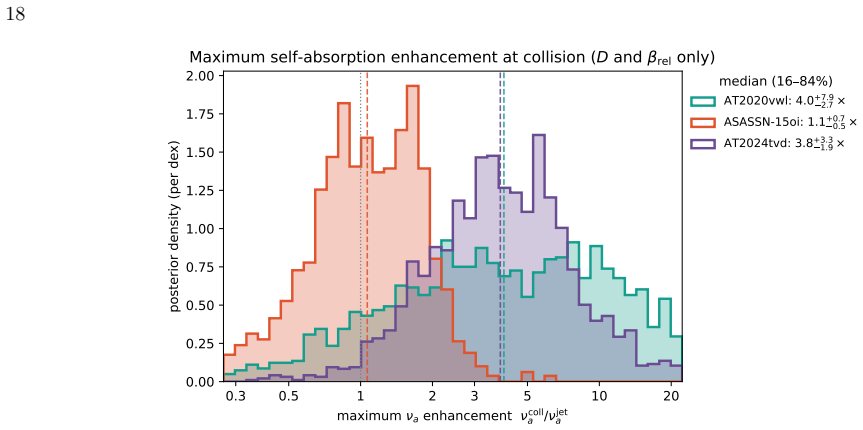
- [§3.3, Eqs. (12)–(14)] The observed ν_a ratio is reported as 1.7±0.2, but this is explicitly a lower limit because ν_a was still decaying before the flare and the sampling may have missed the peak. The simple prediction ~2.5 in Eq. (14) assumes Γ≈1, β_rel≈β_jet, and comparable shell widths; the full expression Eq. (12) contains suppression factors from relative velocity and shell compression. Figure 8 shows a broad posterior for the maximum enhancement, with AT2020vwl's median 4.0^{+7.9}_{-2.7}. The current measurement therefore does not strongly discriminate the collision model from other density-jump mechanisms. Please provide a posterior predictive comparison: what fraction of fitted models predict ν_a^coll/ν_a^jet ≤ 1.7, and what does the light-curve amplitude at the observed frequencies predict?
- [§2.4, Appendix C] The full derivation of the forward model and numerical implementation is deferred to a companion paper, and the inference procedure fixes several microphysical/geometric parameters after an initial wide run based on weak or degenerate constraints. The collision-time posterior is conditioned on these choices. Given that t_coll is a derived quantity, the reader needs a sensitivity table (e.g., alternative injection profiles q, different fixed ε_e/ε_B, varying Ω_1) showing how t_coll and P_coll change. This is especially important for the AT2024tvd prediction, where §5.2 notes that systematics are O(1) corrections and that start-time ambiguities propagate directly into t_coll.
minor comments (5)
- [Abstract/§3.1] The text says '5 new epochs' between 2024-07-13 and 2025-12-02 (1334–1718 d), but Table 2 contains additional later epochs (1841 d and 1977 d). Please clarify the count and the quoted time range.
- [§3.3] Typos: 'the self-absorption break is is not always well-constrained' and 'due it’s location'. Also 'it’s' should be 'its'.
- [§5.3] Typo: 'cahnged' should be 'change'.
- [Fig. 4] The left panel label 'Light curves (no-collision model)' is slightly confusing because the model was fit to the first two flares; consider labeling it 'extrapolated two-flare model' or similar.
- [Eq. (12) and (13)] The notation n'_wind vs n_jet is introduced with different primed conventions; make the density-contrast definition D ≡ n'_wind/n_jet explicit in the text before Eq. (12) to avoid confusion with the unshocked ambient density.
Circularity Check
No significant circularity: the third-flare timing is a genuine out-of-sample prediction from a model fit only to the first two flares.
full rationale
The central claim—that AT2020vwl's third radio flare occurs at the predicted jet–wind collision time—is not circular. The collision time is defined by Eq. (10), R_wind(t_coll)=R_jet(t_coll), and the two radius histories are obtained from a forward model whose parameters are fit to the pre-existing first-two-flare data (through t=1225 d; Goodwin et al. 2025b). The paper explicitly separates the fitting data from the newly presented epochs and states the prediction before showing follow-up: "The final data point fitted (i.e., the last data point presented in Goodwin et al. 2025b) was taken at t = 1225 days from optical peak. This clearly motivates follow up observations." The new 1334–1718 d observations are then compared, not used in the fit. Likewise, the reported νa ratio (νa,coll/νa,jet = 1.7±0.2) is an ex post comparison to a model prediction (Eq. 14 gives ~2.5 in the simplest limit), not a fitted input. The paper's reliance on the authors' earlier wind-jet framework (Goodwin & Mummery 2026b) is the hypothesis being tested, not an imported uniqueness theorem; alternative explanations (Bondi-radius passage, molecular-cloud encounters, new outflows, partial TDEs, off-axis jets) are discussed and explicitly not fully ruled out (§5.1.2). The §5.2 caveat that density-profile idealizations shift t_coll by O(100) days is a real robustness concern and weakens the strength of the confirmation, but it is a sensitivity of the prediction, not a retro-fitting of the observed flare time. The deferred derivation of the numerical machinery is a completeness gap, not circularity. In short, no prediction reduces by construction to its inputs.
Axiom & Free-Parameter Ledger
free parameters (12)
- vinj,1 (wind launch speed) =
~0.1c (log10 = -1.00+0.11/−0.15, AT2020vwl)
- vinj,2 (jet launch speed) =
0.20+0.08/−0.06 c (Table 1)
- Minj,1 (wind ejected mass) =
~7×10^-3 M_sun (log10 ≈ -2.2)
- Minj,2 (jet ejected mass) =
2.7+3.7/−2.1 × 10^-2 M_sun (Table 1)
- q1, q2 (injection power-law slopes) =
q1=0.34±0.06, q2=0.25±0.40
- tstart,1, tstart,2 (outflow launch times) =
tstart,1≈9 d, tstart,2≈741 d (AT2020vwl)
- tend,2 (jet shutoff time) =
≈1124 d (AT2020vwl)
- n0,2, k2 (jet ambient density power law) =
log10 n0,2 ≈ -3.4 (cgs); k2≈1.5
- fEdd (Bondi density normalization for wind) =
log10 fEdd ≈ -3.4
- Ω2 (jet solid angle) =
≈4.2 sr (AT2020vwl)
- p1, p2 (electron power-law indices) =
p1≈2.7, p2≈3.7
- fsys (systematic flux floor) =
≈0.25 (fraction)
axioms (6)
- domain assumption The first radio flare is produced by a super-Eddington disk wind and the second by a compact jet launched at a disk state transition (Goodwin & Mummery 2026b).
- domain assumption The wind propagates through a steady, spherically-symmetric Bondi atmosphere; the jet propagates through a smooth power-law wake.
- standard math Shock dynamics follow the Pe'er (2012) energy-conserving forward+internal-shock solution (Eq. 5).
- domain assumption Synchrotron self-absorption frequency νa ∝ [n'e B'^(p+2)/2 ΔR]^(2/(p+4)) and the flux scalings of Eqs. (7),(15)-(17).
- domain assumption The collision's observable is a rise in νa from the density contrast D, with γad=5/3 strong-shock compression (~4).
- domain assumption The two synchrotron components can be summed when νjet,a > νwind,a.
read the original abstract
Radio flares from tidal disruption events (TDEs) are observed on two distinct timescales: prompt (around the time of optical peak) and delayed (hundreds to thousands of days after optical peak). A recent framework put forward to explain this diversity suggests that super-Eddington winds produce prompt flares while jets launched during a disk state transition at low accretion rates produce delayed flares. A unique observational prediction of this framework is that individual sources showing both types of flares may be expected to show a third flare. This third flare will occur when the (faster) jet catches up with the (slower) wind. The observational appearance of the third flare depends on the system parameters. As the two shock fronts collide the (brighter) jet encounters a change in density, modifying its synchrotron-self-absorption frequency and observed flux. Here we discuss the observational appearance of such a scenario, and then show, in new long-term monitoring radio observations of the TDE AT2020vwl, the discovery of a third radio flare. This flare is coincident with the time at which forward modeling of the first two flares in a wind-jet framework predicts a collision between the two shock fronts. We make predictions for the long-term radio evolution of two other TDEs showing double radio flares: ASASSN-15oi (which may show a weak flare or flattening of the lightcurve) and AT2024tvd (which is predicted to imminently undergo a third flare).
Figures




Reference graph
Works this paper leans on
-
[1]
D., Berger , E., Guillochon , J., Zauderer , B
Alexander , K. D., Berger , E., Guillochon , J., Zauderer , B. A., & Williams , P. K. G. 2016, , 819, L25, 10.3847/2041-8205/819/2/L25
-
[2]
D., van Velzen , S., Horesh , A., & Zauderer , B
Alexander , K. D., van Velzen , S., Horesh , A., & Zauderer , B. A. 2020, , 216, 81, 10.1007/s11214-020-00702-w
-
[3]
D., Margutti , R., Gomez , S., et al
Alexander , K. D., Margutti , R., Gomez , S., et al. 2026, , 1000, 139, 10.3847/1538-4357/ae40ab
-
[4]
2013, , 772, 78, 10.1088/0004-637X/772/1/78
Barniol Duran , R., Nakar , E., & Piran , T. 2013, , 772, 78, 10.1088/0004-637X/772/1/78
-
[6]
2005, , 440, 207, 10.1051/0004-6361:20042457
Belloni , T., Homan , J., Casella , P., et al. 2005, , 440, 207, 10.1051/0004-6361:20042457
-
[8]
Berger , E., Zauderer , A., Pooley , G. G., et al. 2012, , 748, 36, 10.1088/0004-637X/748/1/36
-
[9]
2025, , 221, 120, 10.1007/s11214-025-01245-8
Blaes , O., Jiang , Y.-F., Lasota , J.-P., & Lipunova , G. 2025, , 221, 120, 10.1007/s11214-025-01245-8
-
[12]
2022, , 134, 114501, 10.1088/1538-3873/ac9642
CASA Team , Bean , B., Bhatnagar , S., et al. 2022, , 134, 114501, 10.1088/1538-3873/ac9642
-
[13]
Cendes , Y., Alexander , K. D., Berger , E., et al. 2021, , 919, 127, 10.3847/1538-4357/ac110a
-
[14]
Cendes , Y., Berger , E., Alexander , K. D., et al. 2023, arXiv e-prints, arXiv:2308.13595, 10.48550/arXiv.2308.13595
-
[15]
2024, , 971, 185, 10.3847/1538-4357/ad5541
---. 2024, , 971, 185, 10.3847/1538-4357/ad5541
-
[16]
2026, , 1000, 95, 10.3847/1538-4357/ae4876
Chakraborty , J., Masterson , M., Mummery , A., et al. 2026, , 1000, 95, 10.3847/1538-4357/ae4876
-
[19]
Christy , C. T., Alexander , K. D., Margutti , R., et al. 2024, , 974, 18, 10.3847/1538-4357/ad675b
-
[20]
Christy , C. T., Alexander , K. D., Laskar , T., et al. 2026, , 1001, 211, 10.3847/1538-4357/ae5249
-
[21]
2007, , 15, 1, 10.1007/s00159-007-0006-1
Done , C., Gierli \'n ski , M., & Kubota , A. 2007, , 15, 1, 10.1007/s00159-007-0006-1
-
[24]
Foreman-Mackey , D., Hogg , D. W., Lang , D., & Goodman , J. 2013, , 125, 306, 10.1086/670067
doi:10.1086/670067 2013
-
[25]
Franz , N., Alexander , K. D., Gomez , S., et al. 2026, , 999, 243, 10.3847/1538-4357/ae346e
-
[26]
Generozov , A., Mimica , P., Metzger , B. D., et al. 2017, , 464, 2481, 10.1093/mnras/stw2439
-
[27]
Generozov , A., Stone , N. C., & Metzger , B. D. 2015, , 453, 775, 10.1093/mnras/stv1607
-
[32]
J., van Velzen , S., Miller-Jones , J
Goodwin , A. J., van Velzen , S., Miller-Jones , J. C. A., et al. 2022, , 511, 5328, 10.1093/mnras/stac333
-
[33]
Goodwin , A. J., Miller-Jones , J. C. A., van Velzen , S., et al. 2023 a , , 518, 847, 10.1093/mnras/stac3127
-
[34]
Goodwin , A. J., Alexander , K. D., Miller-Jones , J. C. A., et al. 2023 b , , 522, 5084, 10.1093/mnras/stad1258
-
[35]
Goodwin , A. J., Burn , M., Anderson , G. E., et al. 2025 a , , 278, 36, 10.3847/1538-4365/adbe80
-
[37]
2025 c , , 981, 122, 10.3847/1538-4357/adb0b1
---. 2025 c , , 981, 122, 10.3847/1538-4357/adb0b1
-
[38]
2002, , 568, 820, 10.1086/338966
Granot , J., & Sari , R. 2002, , 568, 820, 10.1086/338966
doi:10.1086/338966 2002
-
[39]
2024 a , , 966, 160, 10.3847/1538-4357/ad2f9f
Guolo , M., Gezari , S., Yao , Y., et al. 2024 a , , 966, 160, 10.3847/1538-4357/ad2f9f
-
[40]
Guolo , M., Pasham , D. R., Zaja c ek , M., et al. 2024 b , Nature Astronomy, 10.1038/s41550-023-02178-4
-
[43]
Hajela , A., Alexander , K. D., Margutti , R., et al. 2025, , 983, 29, 10.3847/1538-4357/adb620
-
[44]
Holoien , T. W. S., Kochanek , C. S., Prieto , J. L., et al. 2016, , 463, 3813, 10.1093/mnras/stw2272
-
[45]
Horesh , A., Cenko , S. B., & Arcavi , I. 2021, Nature Astronomy, 5, 491, 10.1038/s41550-021-01300-8
-
[46]
2015, , 814, 1, 10.1088/0004-637X/814/1/1
Laskar , T., Berger , E., Margutti , R., et al. 2015, , 814, 1, 10.1088/0004-637X/814/1/1
-
[49]
2023, , 669, A75, 10.1051/0004-6361/202244805
Liu , Z., Malyali , A., Krumpe , M., et al. 2023, , 669, A75, 10.1051/0004-6361/202244805
-
[50]
Liu , Z., Ryu , T., Goodwin , A. J., et al. 2024, , 683, L13, 10.1051/0004-6361/202348682
-
[51]
Lu , W., Matsumoto , T., & Matzner , C. D. 2024, , 533, 979, 10.1093/mnras/stae1770
-
[52]
2023, , 522, 4565, 10.1093/mnras/stad1269
Matsumoto , T., & Piran , T. 2023, , 522, 4565, 10.1093/mnras/stad1269
-
[53]
2024, , 971, 49, 10.3847/1538-4357/ad58ba
---. 2024, , 971, 49, 10.3847/1538-4357/ad58ba
-
[54]
2025, , 544, 1627, 10.1093/mnras/staf1742
Mummery , A. 2025, , 544, 1627, 10.1093/mnras/staf1742
-
[55]
Mummery , A., & Turner , S. G. D. 2024, , 530, 4730, 10.1093/mnras/stae1014
-
[57]
Panaitescu , A., M \'e sz \'a ros , P., & Rees , M. J. 1998, , 503, 314, 10.1086/305995
doi:10.1086/305995 1998
-
[58]
2012, , 752, L8, 10.1088/2041-8205/752/1/L8
Pe'er , A. 2012, , 752, L8, 10.1088/2041-8205/752/1/L8
-
[59]
Piro , A. L., & Mockler , B. 2025, , 985, 77, 10.3847/1538-4357/adc729
-
[60]
2004, , 613, 322, 10.1086/422973
Quataert , E. 2004, , 613, 322, 10.1086/422973
doi:10.1086/422973 2004
-
[62]
Rees , M. J., & M \'e sz \'a ros , P. 1998, , 496, L1, 10.1086/311244
doi:10.1086/311244 1998
-
[64]
2025, , 992, L18, 10.3847/2041-8213/ae0a26
Sfaradi , I., Margutti , R., Chornock , R., et al. 2025, , 992, L18, 10.3847/2041-8213/ae0a26
-
[65]
I., & Sunyaev , R
Shakura , N. I., & Sunyaev , R. A. 1973, , 24, 337
1973
-
[66]
2013, , 778, 107, 10.1088/0004-637X/778/2/107
Sironi , L., & Giannios , D. 2013, , 778, 107, 10.1088/0004-637X/778/2/107
-
[67]
Teboul , O., & Metzger , B. D. 2023, , 957, L9, 10.3847/2041-8213/ad0037
-
[69]
C., Tsuna , D., Mockler , B., & Piro , A
Wu , S. C., Tsuna , D., Mockler , B., & Piro , A. L. 2026, , 998, 199, 10.3847/1538-4357/ae36a3
-
[70]
Yalinewich , A., Sari , R., Generozov , A., Stone , N. C., & Metzger , B. D. 2018, , 479, 4778, 10.1093/mnras/sty1781
-
[71]
2025, , 985, L48, 10.3847/2041-8213/add7de
Yao , Y., Chornock , R., Ward , C., et al. 2025, , 985, L48, 10.3847/2041-8213/add7de
-
[72]
A., Berger , E., Soderberg , A
Zauderer , B. A., Berger , E., Soderberg , A. M., et al. 2011, , 476, 425, 10.1038/nature10366
-
[74]
Zhang , L., Stone , J. M., Mullen , P. D., et al. 2025, , 995, 26, 10.3847/1538-4357/ae0f91
-
[75]
Zhang , L., Stone , J. M., White , C. J., et al. 2026 b , , 1001, 138, 10.3847/1538-4357/ae5521
-
[76]
2025, , 979, 109, 10.3847/1538-4357/ad9b98
Zhuang , J., Shen , R.-F., Mou , G., & Lu , W. 2025, , 979, 109, 10.3847/1538-4357/ad9b98
-
[77]
, year = 1952, month = jan, volume =
On spherically symmetrical accretion. , year = 1952, month = jan, volume =. doi:10.1093/mnras/112.2.195 , adsurl =
-
[78]
Late-time Evolution and Instabilities of Tidal Disruption Disks. , keywords =. doi:10.3847/1538-4357/adc729 , archivePrefix =. 2412.01922 , primaryClass =
-
[79]
Smooth light curves from a bumpy ride: relativistic blast wave encounters a density jump. , keywords =. doi:10.1111/j.1365-2966.2007.12245.x , archivePrefix =. astro-ph/0606011 , primaryClass =
arXiv 2007
-
[80]
Energy Injection in Gamma-Ray Burst Afterglows. , keywords =. doi:10.1088/0004-637X/814/1/1 , archivePrefix =. 1504.03702 , primaryClass =
-
[81]
Multiwavelength Afterglows in Gamma-Ray Bursts: Refreshed Shock and Jet Effects. , keywords =. doi:10.1086/305995 , archivePrefix =. astro-ph/9801258 , primaryClass =
-
[82]
Refreshed Shocks and Afterglow Longevity in Gamma-Ray Bursts. , keywords =. doi:10.1086/311244 , archivePrefix =. astro-ph/9712252 , primaryClass =
-
[83]
Dichotomy in Long-lived Radio Emission from Tidal Disruption Events AT 2020zso and AT 2021sdu: Multicomponent Outflows versus Host Contamination. , keywords =. doi:10.3847/1538-4357/ae5249 , archivePrefix =. 2509.14317 , primaryClass =
-
[84]
The Peculiar Radio Evolution of the Tidal Disruption Event ASASSN-19bt. , keywords =. doi:10.3847/1538-4357/ad675b , archivePrefix =. 2404.12431 , primaryClass =
-
[85]
The Open mulTiwavelength Transient Event Repository (OTTER): Infrastructure Release and Tidal Disruption Event Catalog. , keywords =. doi:10.3847/1538-4357/ae346e , archivePrefix =. 2509.05405 , primaryClass =
-
[86]
Rapid evolution of the recurrence time in the repeating partial tidal disruption event eRASSt J045650.3‒203750. , keywords =. doi:10.1051/0004-6361/202348682 , archivePrefix =. 2401.14091 , primaryClass =
-
[87]
A likely repeating partial tidal disruption event
Deciphering the extreme X-ray variability of the nuclear transient eRASSt J045650.3‒203750. A likely repeating partial tidal disruption event. , keywords =. doi:10.1051/0004-6361/202244805 , archivePrefix =. 2208.12452 , primaryClass =
-
[88]
A model-independent analysis of the variability of GRS 1915+105. , keywords =. doi:10.48550/arXiv.astro-ph/0001103 , archivePrefix =. astro-ph/0001103 , primaryClass =
-
[89]
Radiation GRMHD Models of Accretion onto Stellar-mass Black Holes. I. Survey of Eddington Ratios. , keywords =. doi:10.3847/1538-4357/ae0f91 , archivePrefix =. 2506.02289 , primaryClass =
-
[90]
Radiation GRMHD Models of Accretion onto Stellar-mass Black Holes. II. Super-Eddington Accretion. , keywords =. doi:10.3847/1538-4357/ae5521 , archivePrefix =. 2509.10638 , primaryClass =
-
[91]
Radiation GRMHD Models of Accretion onto Stellar-Mass Black Holes: III. Near-Eddington Accretion. arXiv e-prints , keywords =. doi:10.48550/arXiv.2603.05588 , archivePrefix =. 2603.05588 , primaryClass =
-
[92]
Non-Stationary Discs and Instabilities. , keywords =. doi:10.1007/s11214-025-01245-8 , archivePrefix =. 2505.04402 , primaryClass =
-
[93]
The evolution of the timing properties of the black-hole transient GX 339-4 during its 2002/2003 outburst. , keywords =. doi:10.1051/0004-6361:20042457 , archivePrefix =. astro-ph/0504577 , primaryClass =
Pith/arXiv arXiv 2002
-
[94]
The X-ray variability of tidal disruption events. , keywords =. doi:10.1093/mnras/staf1742 , archivePrefix =. 2505.09238 , primaryClass =
-
[95]
X-Ray Spectral-timing Properties of Tidal Disruption Events. , keywords =. doi:10.3847/1538-4357/ae4876 , archivePrefix =. 2602.16868 , primaryClass =
-
[96]
UV and Optical Signatures of Late-time Disk Instabilities in Tidal Disruption Events. arXiv e-prints , keywords =. doi:10.48550/arXiv.2602.15103 , archivePrefix =. 2602.15103 , primaryClass =
-
[97]
The Multiwavelength Context of Delayed Radio Emission in Tidal Disruption Events: Evidence for Accretion-driven Outflows. , keywords =. doi:10.3847/1538-4357/ae40ab , archivePrefix =. 2506.12729 , primaryClass =
-
[99]
Delayed Radio Emission in Tidal Disruption Events from Collisions of Outflows Driven by Disk Instabilities. , keywords =. doi:10.3847/1538-4357/ae36a3 , archivePrefix =. 2511.14008 , primaryClass =
-
[100]
A Massive Black Hole 0.8 kpc from the Host Nucleus Revealed by the Offset Tidal Disruption Event AT2024tvd. , keywords =. doi:10.3847/2041-8213/add7de , archivePrefix =. 2502.17661 , primaryClass =
Pith/arXiv arXiv 2041
-
[101]
Radio Emission from the Infrared Tidal Disruption Event WTP14adeqka: The First Directly Resolved Delayed Outflow from a TDE. arXiv e-prints , keywords =. doi:10.48550/arXiv.2508.16756 , archivePrefix =. 2508.16756 , primaryClass =
-
[102]
Misaligned precessing jets are choked by the accretion disc wind. , keywords =. doi:10.1093/mnras/stae1770 , archivePrefix =. 2310.15336 , primaryClass =
-
[103]
Late-time Radio Flares in Tidal Disruption Events. , keywords =. doi:10.3847/1538-4357/ad58ba , archivePrefix =. 2404.15966 , primaryClass =
discussion (0)
Sign in with ORCID, Apple, or X to comment. Anyone can read and Pith papers without signing in.