REVIEW 3 major objections 5 minor 65 references
Sequential epidemics on random graphs are solved exactly for any finite number of strains, in both cross-immunity and coinfection regimes.
Reviewed by Pith at T0; open to challenge. T0 means a machine referee read the full paper against a public rubric. the ladder, T0–T4 →
T0 review · deepseek-v4-flash
2026-08-01 23:06 UTC pith:UX2F2J6Y
load-bearing objection The collaborative N-strain binary-tree construction is the real contribution; the competitive extension is expected. But the printed threshold equations have several load-bearing algebraic errors, especially Eq 56, so the paper needs a careful revision before the critical-point claims can be trusted. the 3 major comments →
An exact N-strain epidemic model using bond percolation
The pith
A machine-rendered reading of the paper's core claim, the machinery that carries it, and where it could break.
Core claim
On the paper's own terms, the central discovery is that repeated bond percolation — performed N times on the residual graph (competitive) or on the giant component (collaborative) — can be described exactly by cascades of generating functions. For competitive strains, the probability g_i that an edge fails to connect to the i-th giant component obeys a one-dimensional recursion whose fixed points yield outbreak size A_i = ∏_{j<i} G0(g_j) − G0(g_i) and threshold T_{i,c} = 1/G'_1(g_{i-1}); thresholds provably increase with strain index. For collaborative strains, the required per-neighbour probabilities multiply as a perfect binary tree of 'infection histories' (2^{i−1} histories for strain i)
What carries the argument
The load-bearing object is the excess-degree generating function G_1(x) = G'_0(x)/G'_0(1) together with the cavity-method assumption that neighbour infection states are iid. In the competitive process the machinery is the recursive edge-failure probability g_i = u_{i−1} ar g_i + (1−u_{i−1})(1−T_{i−1}) and the self-consistent hierarchy u_i = G_1(g_i)/∏_{j<i} u_j. In the collaborative process the machinery is a perfect binary tree of infection histories: each generation doubles the number of distinct neighbour states, and the common factor C_i = ar C_{i−1}(ar f_i) multiplies history probabilities H_{i_h} and priors Q_{i_h} to form P_{i_h}=C_i H_{i_h}. These objects convert the percolation prob
Load-bearing premise
The generating-function construction assumes that the infection states of a node's neighbours are independent and identically distributed along every edge (the cavity method), which is exact only on locally tree-like random graphs with negligible clustering and no degree correlations; on real clustered networks the formulas are approximations and the paper does not test the size of the error.
What would settle it
On a random-graph ensemble with tunable clustering (e.g., a configuration model augmented with triangles), run the N=3 competitive and collaborative percolation processes by Monte Carlo. Measure A_1, A_2, A_3 and the thresholds and compare them with Eqs 11, 16, 37 and 49. If the deviations exceed finite-size error, the cavity/iid assumption is the cause. More directly, sample the joint infection states of pairs of neighbours of a focal node after the process: if the joint distribution differs from the product of the marginal u-values, the independence assumption is violated.
If this is right
- For N sequential cross-immune strains, each later strain needs a larger transmission probability than the previous one to trigger a macroscopic outbreak; the size of that outbreak is nevertheless smaller, so seasonal transmissibility must rise while attack sizes fall.
- For collaborative (coinfection) strains, the i-th outbreak is strictly bounded by the (i−1)-th and can never exceed it, so coinfection-limited spread eventually burns out.
- On scale-free networks, a cross-immune first strain destroys the power-law degree distribution of the residual graph, so the second strain's threshold can be nonzero even though the first strain has threshold zero; cooperative strains, by contrast, retain a self-similar high-degree core and can theoretically spread at arbitrarily low transmissibility in the infinite-size limit.
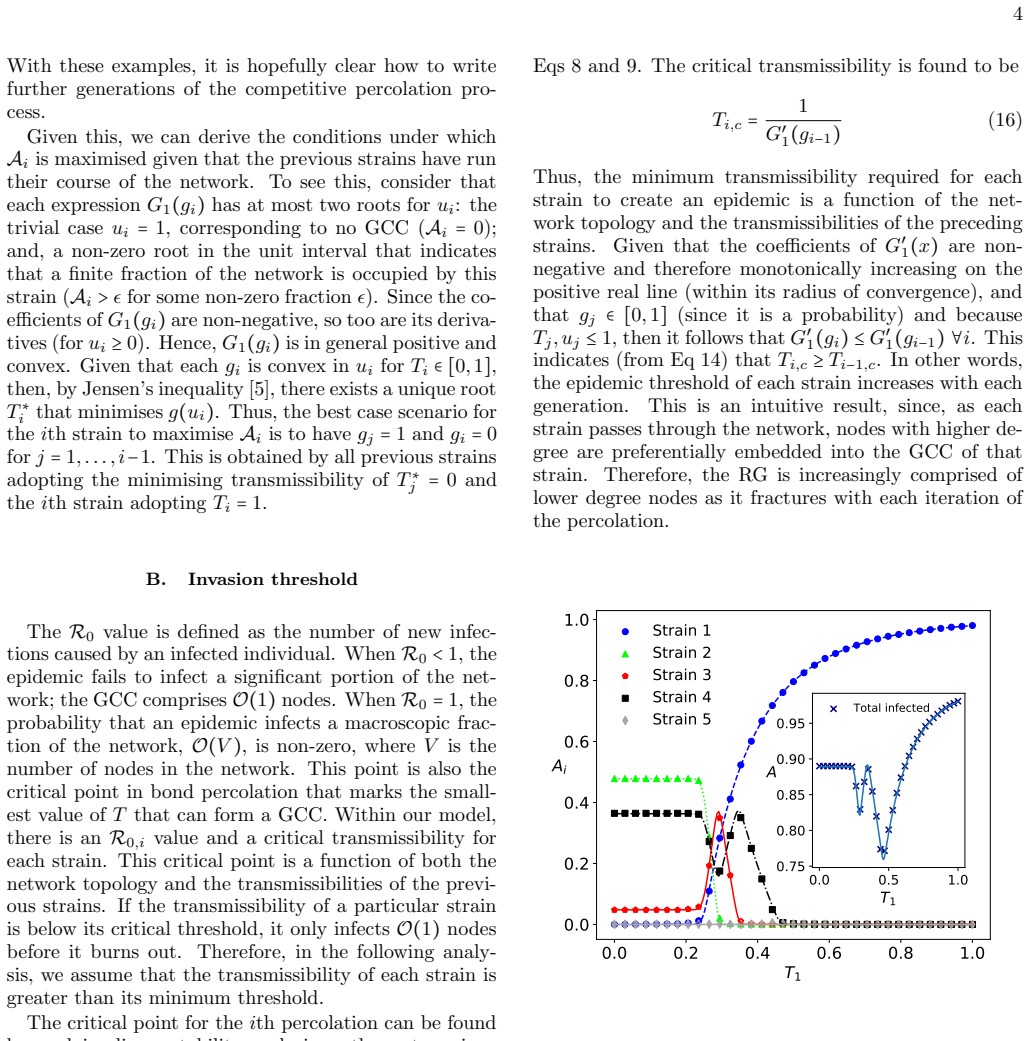
- The total fraction infected across all strains is not monotonic in the first strain's transmissibility; there is a local minimum near the coexistence threshold where the first strain fractures the residual graph enough to prevent later strains.
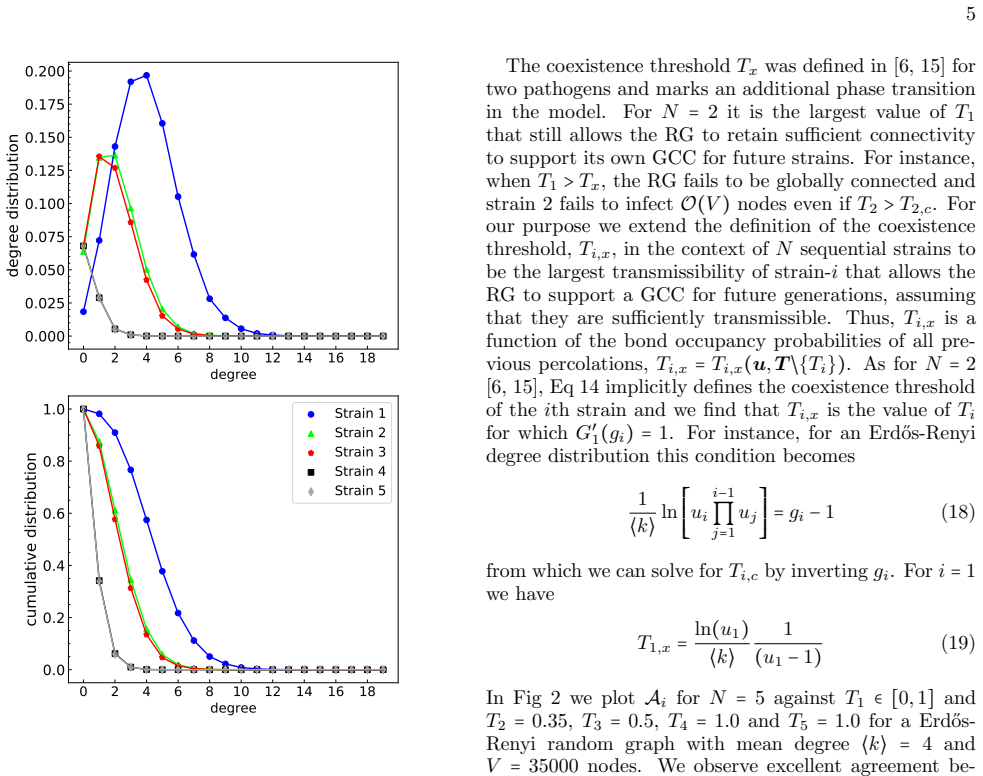
- The degree distribution and cumulative degree distribution of each generation's residual graph and giant component follow from the same generating functions, giving a complete topological description of the layered percolation structure.
Where Pith is reading between the lines
- If the competitive threshold-ordering result carries to real seasonal pathogens, it predicts that any circulating strain that does not evolve upward transmissibility will fail to exceed threshold after the first season; this yields a concrete null model for interpreting observed transmissibility increases in influenza-like data.
- The collaborative model's binary-tree structure suggests a computational short-cut: the 2^{i−1} coupled equations can be generated recursively from the tree, so an N-strain solver requires only tree traversal rather than hand-derived equations for each N.
- A natural testable extension would be partial cross-immunity, interpolating between the competitive and collaborative extremes for N>2; the paper notes that such a model would not burn out, and one could check whether the competitive model's non-monotonic total-infection curve persists.
Editorial analysis
A structured set of objections, weighed in public.
Referee Report
Summary. The paper claims to extend two-strain bond-percolation epidemic models to an arbitrary finite number N of sequential strains. Two branching processes are treated: a competitive process, in which each strain percolates on the residual graph left by previous strains (perfect cross-immunity), and a collaborative process, in which each strain percolates on the giant component formed by all previous strains (perfect coinfection). Generating functions are used to write self-consistent equations for the probabilities that edges fail to transmit each strain, from which outbreak sizes and critical transmissibilities are derived. Results are given for Erdős–Rényi and power-law (scale-free) networks and compared with Monte Carlo simulations for N=4–5. The authors also study degree and cumulative degree distributions of the residual graphs and GCC substructures.
Significance. The paper has a clear and useful goal: generalizing the well-known N=2 results of Karrer–Newman and Newman–Ferrario to arbitrary N, with explicit recursive formulas and binary-infection-history bookkeeping. The Monte Carlo validation of the main ER outbreak-size recursions (Fig. 2 for N=5) and the collaborative outbreak sizes (Fig. 6) is a genuine strength, as is the explicit reduction to known N=2 limits. If the algebraic problems in the printed general recursions and critical-point formulas are corrected, this would be a valuable reference for multi-season epidemic modelling on locally tree-like networks. However, several printed equations that are load-bearing for the critical-point and scale-free claims are internally inconsistent, so the manuscript in its present form cannot be used as a reliable recipe by readers.
major comments (3)
- [Section III, Eq. (9)] The printed recursion does not reproduce the nested expressions in Eqs. (12)–(13). For i=3, Eq. (9) gives g_3 = u_2[u_3+(1-u_3)(1-T_3)] + (1-u_2)(1-T_2), whereas Eq. (13) contains an additional factor u_1 multiplying the whole bracket. The later statement that G'_1(g_i) becomes G'_1(g_{i-1}) at u_i=1, which underlies Eq. (16), is true only for the nested form. The general recursion must be corrected, and the derivation of Eq. (16) re-verified.
- [Section III, Eq. (18)] The ER coexistence condition G'_1(g_i)=1 is not equivalent to the printed equation. Since G_1(x)=e^{<k>(x-1)} for Erdős–Rényi graphs, G'_1(g_i)=1 gives g_i=1 - ln<k>/<k>. Equation (18), with its ratio u_i / \prod_{j<i} u_j and right-hand side g_{i-1}, does not follow from that condition; for i=1 it would imply u_1=e^{<k>}. Consequently Eq. (19) and the coexistence-threshold curves in Fig. 5(right) need to be re-derived and re-plotted.
- [Section V, Eq. (56)] The scale-free critical-point formula is algebraically wrong. Using dLi_s(z)/dz = Li_{s-1}(z)/z, Eq. (16) applied to Eq. (55) gives T_{i,c} = g_{i-1}^2 Li_{α-1}(e^{-1/κ}) / [Li_{α-2}(g_{i-1}e^{-1/κ}) - Li_{α-1}(g_{i-1}e^{-1/κ})], not Eq. (56). The printed denominator g_{i-1}Li_{α-2}(g_{i-1}e^{-1/κ}) - Li_{α-1}(g_{i-1}e^{-1/κ}) can be negative for g_{i-1}<1 (e.g. α=2, large κ, g≈1/2), leading to negative thresholds. Therefore Eq. (58) and the associated 'rapid fracture' claims for scale-free networks are not justified as stated.
minor comments (5)
- [Abstract / Section II.A] The abstract and introduction use 'exact' without qualification. The cavity method at Eq. (7) assumes iid neighbour states along each edge, which is exact only in the locally tree-like, configuration-model limit. Please state that qualification explicitly in the abstract or introduction.
- [Fig. 1 caption] Typo: 'competative' should be 'competitive'.
- [Eqs. (24), (30c)] The general definition \bar C_i = f_1(f_2(... f_i()))) is notationally incomplete; the explicit examples (Eqs. 25–27) are much clearer. Please make the general notation precise.
- [Section V, around Eq. (56)] The polylogarithm derivative identity dLi_s(z)/dz = Li_{s-1}(z)/z should be stated explicitly before the scale-free derivation; this would have prevented the algebra error in Eq. (56).
- [Fig. 5(right)] The caption says the coexistence threshold is obtained by 'numerically solving Eq. 18'. If Eq. 18 is corrected, please state the corrected equation used to generate the figure, or the figure will need regeneration.
Circularity Check
No significant circularity: the N-strain derivation is self-contained, starts from the standard generating-function formalism, and is benchmarked against independent Monte Carlo simulations; self-citations are contextual.
full rationale
The paper's central derivation is not circular. It builds on the standard Newman-Strogatz-Watts generating-function formalism (Eqs 1-7) and extends it to N sequential strains via recursive self-consistency equations (Eqs 9-11 for the competitive process, Eqs 21-37 and A1-A25 for the collaborative process). The N=2 limits are attributed to external papers by Karrer and Newman [6], Newman [15], and Newman and Ferrario [16], not to the present authors. No fitted parameters are used to force agreement; the analytical outbreak sizes are verified against independent Monte Carlo simulations of bond percolation (Figs 2, 6, 7, 8). Self-citations to the authors' prior work [8,10,11,12] appear only as background or future-work pointers and are not load-bearing for the derivations. The cavity-method iid assumption stated around Eq. 7 is an explicit modeling assumption (valid in the locally tree-like configuration-model limit), not a circular step. Any algebraic inconsistencies in the scale-free critical-point formulas (e.g., Eq. 56 or Eq. 18) would be correctness risks, not instances of the derivation reducing to its own inputs. The derivation chain is therefore self-contained; no prediction is equivalent to an input by construction.
Axiom & Free-Parameter Ledger
axioms (5)
- domain assumption Configuration-model / locally tree-like random graph approximation.
- domain assumption Cavity-method iid neighbour-state assumption.
- domain assumption SIR–bond-percolation equivalence with fixed infectious period.
- domain assumption Temporal separation of the N strains.
- standard math Thermodynamic-limit exactness of the generating-function solutions.
read the original abstract
In this paper we examine the emergent structures of random networks that have undergone bond percolation an arbitrary, but finite, number of times. We define two types of sequential branching processes: a competitive branching process - in which each iteration performs bond percolation on the residual graph (RG) resulting from previous generations; and, a collaborative branching process - where percolation is performed on the giant connected component (GCC) instead. We investigate the behaviour of these models, including the expected size of the GCC for a given generation, the critical percolation probability and other topological properties of the resulting graph structures using the analytically exact method of generating functions. We explore this model for Erdos-Renyi and scale free random graphs. This model can be interpreted as a seasonal N-strain model of disease spreading.
Figures



Reference graph
Works this paper leans on
-
[1]
Epidemic Spreading in Scale-Free Networks , author =. Phys. Rev. Lett. , volume =. 2001 , month =. doi:10.1103/PhysRevLett.86.3200 , url =
-
[2]
The shifting demographic landscape of pandemic influenza , volume=. PLoS ONE , author=. doi:10.1371/journal.pone.0009360 , number=
-
[3]
Journal of Statistical Mechanics: Theory and Experiment , author=
Multivariate generating functions for information spread on multi-type random graphs , volume=. Journal of Statistical Mechanics: Theory and Experiment , author=. 2022 , pages=. doi:10.1088/1742-5468/ac57b8 , number=
-
[4]
Journal of Physics: Complexity , abstract =
Shogo Mizutaka and Takehisa Hasegawa , title =. Journal of Physics: Complexity , abstract =. doi:10.1088/2632-072x/abb4c5 , url =
-
[5]
Symbiotic and antagonistic disease dynamics on networks using bond percolation , author =. Phys. Rev. E , volume =. 2021 , month =. doi:10.1103/PhysRevE.104.024303 , url =
-
[6]
Disassortativity of percolating clusters in random networks , author =. Phys. Rev. E , volume =. 2018 , month =. doi:10.1103/PhysRevE.98.062314 , url =
-
[7]
Structure of percolating clusters in random clustered networks , author =. Phys. Rev. E , volume =. 2020 , month =. doi:10.1103/PhysRevE.101.062310 , url =
-
[8]
D. Rybski and H. D. Rozenfeld and J. P. Kropp , title =. doi:10.1209/0295-5075/90/28002 , url =
-
[9]
The impact of past epidemics on future disease dynamics , journal =
Shweta Bansal and Lauren Ancel Meyers , keywords =. The impact of past epidemics on future disease dynamics , journal =. 2012 , issn =. doi:https://doi.org/10.1016/j.jtbi.2012.06.012 , url =
-
[10]
Wilf, Herbert S. , year=. Generatingfunctionology , publisher=
-
[11]
Networks , publisher=
Newman, Mark E.J , year=. Networks , publisher=
-
[12]
The unreasonable effectiveness of tree-based theory for networks with clustering , author =. Phys. Rev. E , volume =. 2011 , month =. doi:10.1103/PhysRevE.83.036112 , url =
-
[13]
General formulation of long-range degree correlations in complex networks , author =. Phys. Rev. E , volume =. 2018 , month =. doi:10.1103/PhysRevE.97.062308 , url =
-
[14]
Finding community structure in networks using the eigenvectors of matrices , author =. Phys. Rev. E , volume =. 2006 , month =. doi:10.1103/PhysRevE.74.036104 , url =
-
[15]
Dynamical and Correlation Properties of the Internet , author =. Phys. Rev. Lett. , volume =. 2001 , month =. doi:10.1103/PhysRevLett.87.258701 , url =
-
[16]
arXiv e-prints , keywords =
Network clique cover approximation to analyze complex contagions through group interactions. arXiv e-prints , keywords =
-
[17]
Self-similarity of complex networks , volume=. Nature , author=. 2005 , pages=. doi:10.1038/nature03248 , number=
-
[18]
Observability transitions in clustered networks , journal =
Takehisa Hasegawa and Yuta Iwase , abstract =. Observability transitions in clustered networks , journal =. 2021 , issn =. doi:https://doi.org/10.1016/j.physa.2021.125970 , url =
arXiv 2021
-
[19]
Random graphs with arbitrary clustering and their applications , author =. Phys. Rev. E , volume =. 2021 , month =. doi:10.1103/PhysRevE.103.012309 , url =
-
[20]
Exact formula for bond percolation on cliques , author =. Phys. Rev. E , volume =. 2021 , month =. doi:10.1103/PhysRevE.104.024304 , url =
-
[21]
Percolation in random graphs with higher-order clustering , author =. Phys. Rev. E , volume =. 2021 , month =. doi:10.1103/PhysRevE.103.012313 , url =
-
[22]
Two-pathogen model with competition on clustered networks , author =. Phys. Rev. E , volume =. 2021 , month =. doi:10.1103/PhysRevE.103.062308 , url =
-
[23]
Jensen, J. L. W. V. , year=. Sur les fonctions convexes et les inégalités entre les valeurs moyennes , volume=. doi:10.1007/bf02418571 , journal=
-
[24]
Cooperative coinfection dynamics on clustered networks , author =. Phys. Rev. E , volume =. 2021 , month =. doi:10.1103/PhysRevE.103.042307 , url =
-
[25]
Contemporary Physics , author=
Power laws, Pareto distributions and Zipfs law , volume=. Contemporary Physics , author=. 2005 , pages=. doi:10.1080/00107510500052444 , number=
-
[26]
Competing epidemics on complex networks , author =. Phys. Rev. E , volume =. 2011 , month =. doi:10.1103/PhysRevE.84.036106 , url =
-
[27]
Interacting Epidemics and Coinfection on Contact Networks , volume=. PLoS ONE , author=. doi:10.1371/journal.pone.0071321 , number=
-
[28]
Physical Review Letters , author=
Threshold Effects for Two Pathogens Spreading on a Network , volume=. Physical Review Letters , author=. 2005 , month=. doi:10.1103/physrevlett.95.108701 , number=
-
[29]
Random Graphs with Clustering , author =. Phys. Rev. Lett. , volume =. 2009 , month =. doi:10.1103/PhysRevLett.103.058701 , url =
-
[30]
Arxiv preprint cond-mat/0007235 , keywords =
Newman, MEJ and Strogatz, SH and Watts, DJ , biburl =. Arxiv preprint cond-mat/0007235 , keywords =
-
[31]
Avalanche outbreaks emerging in cooperative contagions , volume=. Nature Physics , author=. 2015 , pages=. doi:10.1038/nphys3457 , number=
-
[32]
Interacting epidemics on overlay networks , author =. Phys. Rev. E , volume =. 2010 , month =. doi:10.1103/PhysRevE.81.036118 , url =
-
[33]
Percolation and epidemics in random clustered networks , author =. Phys. Rev. E , volume =. 2009 , month =. doi:10.1103/PhysRevE.80.020901 , url =
-
[34]
, author=
Spread of epidemic disease on networks. , author=. Physical review. E, Statistical, nonlinear, and soft matter physics , year=
-
[35]
Epidemic size and probability in populations with heterogeneous infectivity and susceptibility , author =. Phys. Rev. E , volume =. 2007 , month =. doi:10.1103/PhysRevE.76.010101 , url =
-
[36]
Second look at the spread of epidemics on networks , author =. Phys. Rev. E , volume =. 2007 , month =. doi:10.1103/PhysRevE.76.036113 , url =
-
[37]
Percolation and Epidemic Thresholds in Clustered Networks , author =. Phys. Rev. Lett. , volume =. 2006 , month =. doi:10.1103/PhysRevLett.97.088701 , url =
-
[38]
Properties of highly clustered networks , author =. Phys. Rev. E , volume =. 2003 , month =. doi:10.1103/PhysRevE.68.026121 , url =
-
[39]
Double Percolation Phase Transition in Clustered Complex Networks , author =. Phys. Rev. X , volume =. 2014 , month =. doi:10.1103/PhysRevX.4.041020 , url =
-
[40]
and Zdeborová, Lenka , year=
Karrer, Brian and Newman, M.E.J. and Zdeborová, Lenka , year=. Percolation on sparse networks , journal=
-
[41]
Spread of infectious disease through clustered populations , url=
Miller, Joel C , year=. Spread of infectious disease through clustered populations , url=. Journal of the Royal Society, Interface , publisher=
-
[42]
Random graphs with arbitrary degree distributions and their applications , volume=. Physical Review E , author=. doi:10.1103/physreve.64.026118 , number=
-
[43]
Random Structures & Algorithms , author=
A critical point for random graphs with a given degree sequence , volume=. Random Structures & Algorithms , author=. 1995 , pages=. doi:10.1002/rsa.3240060204 , number=
-
[44]
Bond percolation on a class of clustered random networks , volume=. Physical Review E , author=. 2009 , month=. doi:10.1103/physreve.80.036107 , number=
-
[45]
Higher-order organization of complex networks , volume=. Science , author=. 2016 , month=. doi:10.1126/science.aad9029 , number=
-
[46]
Physica A: Statistical Mechanics and its Applications , author=
Higher order clustering coefficients in. Physica A: Statistical Mechanics and its Applications , author=. 2002 , pages=. doi:10.1016/s0378-4371(02)01336-5 , number=
-
[47]
Propagation dynamics on networks featuring complex topologies , volume=. Physical Review E , author=. doi:10.1103/physreve.82.036115 , number=
-
[48]
Higher-order clustering in networks , author =. Phys. Rev. E , volume =. 2018 , month =. doi:10.1103/PhysRevE.97.052306 , url =
-
[49]
Correlations in connected random graphs , author =. Phys. Rev. E , volume =. 2008 , month =. doi:10.1103/PhysRevE.77.036124 , url =
-
[50]
Component sizes in networks with arbitrary degree distributions , author =. Phys. Rev. E , volume =. 2007 , month =. doi:10.1103/PhysRevE.76.045101 , url =
-
[51]
Motif-based communities in complex networks , journal =
A Arenas and A Fern. Motif-based communities in complex networks , journal =. doi:10.1088/1751-8113/41/22/224001 , url =
-
[52]
General and exact approach to percolation on random graphs , volume=. Physical Review E , author=. 2015 , month=. doi:10.1103/physreve.92.062807 , number=
-
[53]
Tuning clustering in random networks with arbitrary degree distributions , author =. Phys. Rev. E , volume =. 2005 , month =. doi:10.1103/PhysRevE.72.036133 , url =
-
[54]
Random graphs containing arbitrary distributions of subgraphs , volume=. Physical Review E , author=. doi:10.1103/physreve.82.066118 , number=
-
[55]
Cascades on a class of clustered random networks , author =. Phys. Rev. E , volume =. 2011 , month =. doi:10.1103/PhysRevE.83.056107 , url =
-
[56]
How clustering affects the bond percolation threshold in complex networks , author =. Phys. Rev. E , volume =. 2010 , month =. doi:10.1103/PhysRevE.81.066114 , url =
-
[57]
Beyond the locally treelike approximation for percolation on real networks , author =. Phys. Rev. E , volume =. 2016 , month =. doi:10.1103/PhysRevE.93.030302 , url =
-
[58]
Revealing the microstructure of the giant component in random graph ensembles , author =. Phys. Rev. E , volume =. 2018 , month =. doi:10.1103/PhysRevE.97.042318 , url =
-
[59]
Ritchie, Martin and Berthouze, Luc and Kiss, Istvan Z. , title = ". Journal of Complex Networks , volume =. 2016 , month =. doi:10.1093/comnet/cnw011 , url =
-
[60]
Generating random networks that consist of a single connected component with a given degree distribution , author =. Phys. Rev. E , volume =. 2019 , month =. doi:10.1103/PhysRevE.99.042308 , url =
-
[61]
Clustering determines the dynamics of complex contagions in multiplex networks , author =. Phys. Rev. E , volume =. 2017 , month =. doi:10.1103/PhysRevE.95.012312 , url =
-
[62]
Proceedings of the National Academy of Sciences , author=
Message passing on networks with loops , volume=. Proceedings of the National Academy of Sciences , author=. 2019 , month=. doi:10.1073/pnas.1914893116 , number=
-
[63]
Spectra of networks containing short loops , volume=. Physical Review E , author=. doi:10.1103/physreve.100.012314 , number=
-
[64]
Proceedings of the National Academy of Sciences , author=
Spectral redemption in clustering sparse networks , volume=. Proceedings of the National Academy of Sciences , author=. 2013 , pages=. doi:10.1073/pnas.1312486110 , number=
-
[65]
Localization and centrality in networks , volume=. Physical Review E , author=. 2014 , month=. doi:10.1103/physreve.90.052808 , number=
discussion (0)
Sign in with ORCID, Apple, or X to comment. Anyone can read and Pith papers without signing in.