REVIEW 3 major objections 5 minor 53 references
The paper establishes from ab initio DFT that the two top moiré valence bands of twisted bilayer WSe2 carry Chern number +1 each in the 3.5°–5° twist range, and decomposes them into a compact molecular orbital plus a topological orbital.
Reviewed by Pith at T0; open to challenge. T0 means a machine referee read the full paper against a public rubric. the ladder, T0–T4 →
T0 review · deepseek-v4-flash
2026-08-01 22:49 UTC pith:EW2RYPCK
load-bearing objection Useful ab initio parameters for the tWSe2 Kondo-lattice model, but the C=+1 claim outruns the C3-eigenvalue analysis — no Berry-curvature integral is shown. the 3 major comments →
Topology and compact molecular orbitals in twisted bilayer WSe₂
The pith
A machine-rendered reading of the paper's core claim, the machinery that carries it, and where it could break.
Core claim
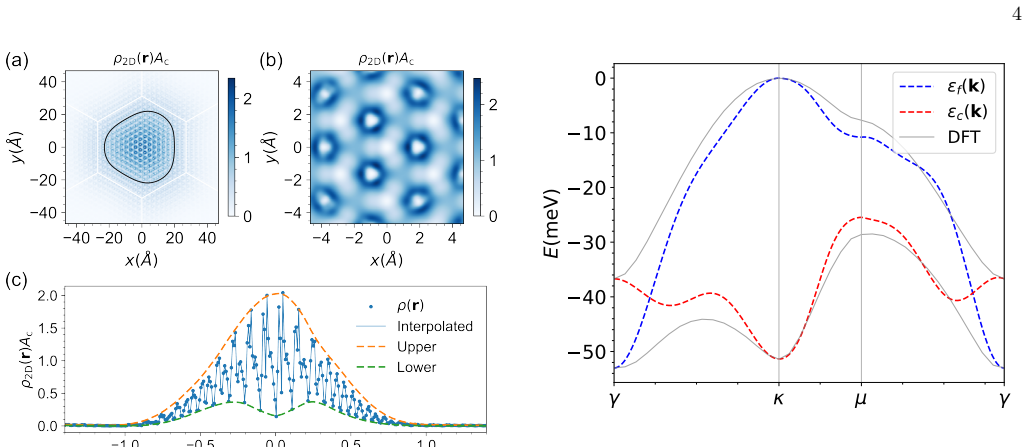
In the spin-up K-valley sector, the C3z rotation eigenvalues at the moiré γ, κ, and κ′ points are (ξ*, −1, −1) for the top band and (−1, ξ, ξ) for the second band; these determine C=+1 modulo 3 through the standard rotation-eigenvalue formula. This eigenvalue set signals a band inversion near the moiré γ point. The paper therefore constructs a maximally localized orbital with eigenvalue −1 at all three momenta, centered at the 1a Wyckoff position, which captures the compact part of the wavefunctions; the orthogonal complement is the topological c orbital. The resulting two-orbital model reproduces the DFT bands and gives |t_f|=4.03 meV, max|V_hyb|≈10 meV, and U≈640 meV. The conclusion is tha
What carries the argument
The spinful C3z eigenvalue formula for Chern numbers modulo 3, used to read off band topology at the three high-symmetry moiré momenta; the partial Wannierization procedure that constructs a compact maximally localized f orbital from the DFT wave functions while leaving the topological obstruction in an extended c orbital; and the symmetry-adapted trial orbital centered at the 1a Wyckoff position that encodes the required rotation eigenvalues. The f–c hybridization V_hyb(k), which is largest near the moiré γ point, is the mechanism that produces the band inversion and avoided crossing.
Load-bearing premise
The load-bearing premise is that the classical-force-field-relaxed moiré geometry reproduces the true relaxed stacking energetics well enough that the C3z eigenvalue ordering of the top two bands is unchanged; if the band ordering near the γ point flips under a full DFT relaxation, the Chern assignment and all extracted parameters would change.
What would settle it
Recompute the two top moiré valence bands with the superlattice geometry relaxed at the DFT level rather than with classical force fields, and re-read the C3z eigenvalues at γ, κ, and κ′; if the top band's eigenvalue set is no longer (ξ*, −1, −1) or the second band no longer (−1, ξ, ξ), the C=(+1,+1) assignment is overturned.
If this is right
- Both top K-valley bands individually carry Chern number +1, so no exponentially localized, C3z-symmetric Wannier function can describe them; the compact f plus topological c split is a minimal local description.
- The extracted parameters (|t_f|=4.03 meV, |V_hyb|_max≈10 meV, U≈640 meV) provide an ab initio benchmark for the effective Kondo-lattice and t-J models of tWSe2 superconductivity.
- The f–c hybridization, concentrated near the moiré γ point, is the origin of the band inversion and avoided crossing visible in the DFT bands, so the topological orbital is not a perturbative addition.
- Because U/t_f is large, the compact f orbital sits deep in the strongly correlated regime near integer filling.
- The opposite-spin bands carry Chern numbers −1, so the two-spin description remains time-reversal symmetric while each spin sector is chiral, matching the d+id pairing scenario.
Where Pith is reading between the lines
- Inference: the same symmetry-guided partial Wannierization could be run at other twist angles or in other TMD homobilayers with matching C3z eigenvalue patterns, giving a quick first-principles check of whether those systems are also topological Kondo lattices.
- Inference: if the f–c hybridization near γ is the dominant energy scale beyond hopping, angle-dependent transport or tunneling should show a hybridization gap that tracks V_hyb(k) rather than a simple band-folding effect.
- Inference: because the superlattice relaxation used here is based on classical force fields rather than DFT-level relaxation, a full DFT relaxation is the sharpest numerical test of the C=(+1,+1) assignment; the paper does not report such a test.
Editorial analysis
A structured set of objections, weighed in public.
Referee Report
Summary. The manuscript reports density functional theory (DFT) calculations for twisted bilayer WSe2 in the range 3.5–5 degrees, claims that the two topmost moiré valence bands carry Chern numbers C=(+1,+1) at the K valley, and constructs compact molecular orbitals through a partial Wannierization procedure guided by spinful C3z symmetry. The resulting effective model contains a localized f orbital and a topological c orbital, with parameters |t_f|=4.03 meV, max|V_hyb(k)|≈10 meV, and on-site U≈640 meV. The authors argue that this provides an ab initio foundation for a topological Kondo-lattice description of superconductivity in tWSe2.
Significance. If the reported Chern numbers and Wannier construction are correct, this is a significant step: it would place the topological Kondo-lattice description of twisted WSe2 on a first-principles footing and would strengthen the case for d+id pairing in the superconductivity-relevant twist-angle range. The work has clear strengths: the DFT calculation is an independent first-principles input; the hopping, hybridization, and interaction parameters are extracted from DFT wavefunctions rather than fitted to the continuum model; and the partial Wannierization procedure is described in enough detail to be followed. However, the central Chern-number claim is not directly established in the manuscript (only Chern mod 3 is fixed), and the robustness of the result against classical relaxation assumptions is not tested. The significance is therefore conditional on these points being resolved.
major comments (3)
- [SM A.3; Fig. 1; main text after Eq.] The formula exp(i2pi C/3)=-theta_gamma theta_kappa theta_kappa' fixes the Chern number only modulo 3, as stated in SM A.3. For the eigenvalue sets shown for V1 (xi*, -1, -1) and V2 (-1, xi, xi), this gives C=1 mod 3, so the integer could be -2, +1, or +4. The abstract and Summary state C=+1 without any direct Berry-curvature integration, Wilson loop, or equivalent computation that selects +1 over -2. This is load-bearing because the sign and magnitude of the Chern number determine whether the proposed d+id pairing channel is physically realized. The authors should either compute the Chern number directly or explicitly present the result as C=1 mod 3 and discuss the possible values.
- [SM A.1; Introduction] The moiré supercells are relaxed using classical Stillinger–Weber and Kolmogorov–Crespi force fields parameterized against DFT data, but the Introduction itself warns that TMD moiré band topology can depend sensitively on lattice relaxation. The band ordering near the moiré gamma point fixes the C3z eigenvalue labels from which the Chern number modulo 3 is inferred and drives the f–c band inversion. A different relaxation potential could change that ordering and hence the topological assignment and all extracted Wannier parameters. No sensitivity test is reported (e.g., variation of force-field parameters, comparison with a DFT-level relaxation for a smaller system, or a test of how much the gamma-point eigenvalue labels change). This is needed to support the claim over the entire 3.5–5 degree range.
- [SM B] The complementary c orbital is assigned a total Chern number C=+2 in a Gram–Schmidt construction, citing Ref. [8]. However, this value is not independently computed. Since the total Chern number of the two bands is the sum C_f + C_c, the c-orbital Chern number follows only if the f orbital has C_f=0. The f orbital's C3 eigenvalues (-1 at all three high-symmetry points) are consistent with C_f=0 mod 3 but do not exclude C_f=±3. The manuscript should provide a direct computation of C_f and C_c, or at least a clear argument fixing C_f modulo 3 beyond the current assertion.
minor comments (5)
- [Eq. (3)] The dielectric constant epsilon in the double-gate-screened interaction is not given a numerical value in the main text or SM. Since U=640 meV is a central parameter, the calculation is not reproducible without this value.
- [Main text, 'Our conclusion is supported...'] The statement that recent calculations at related twist angles [23] support the C=+1 result should specify which angles and whether that work computed Chern numbers directly or only modulo 3.
- [SM Eqs. (S1)-(S2)] The trial Gaussian width sigma_k, radius |K0|, and angular momentum l are chosen without reporting convergence tests. Since the Wannier orbital and extracted hoppings depend on the trial function, a short convergence study would strengthen the results.
- [Fig. 1 and abstract] The claim covers 3.5–5 degrees, but Fig. 1 shows only 3.5 and 5.0 degrees. It would be helpful to state explicitly how intermediate angles were treated, especially since the effective model parameters are computed only at 3.5 degrees.
- [General notation] The notation epsilon U for the on-site interaction is unusual; U is used both for the interaction and for the potential in Eq. (3). Please clarify notation for the reader.
Circularity Check
No significant circularity: DFT-derived Wannier parameters are computed, not fitted; self-citations are motivational, not load-bearing.
full rationale
The central derivation is self-contained. The two-band model parameters (|t_f| = 4.03 meV, max|V_hyb(k)| ≈ 10 meV, U ≈ 640 meV) are obtained by projecting the DFT Hamiltonian onto the Wannier90-constructed f orbital and its orthogonal complement c, so they are computed from Kohn-Sham wavefunctions rather than tuned to reproduce a target. The only external numeric inputs are the continuum-model parameters from Ref. [19] (SM C) and the general C3z eigenvalue formula from Ref. [44]; these do not encode the paper's conclusions. Self-citations [8,9] supply the f/TPLO ansatz and the Kondo-lattice interpretation, but the DFT numerics and Wannier construction stand independently of those papers, so the self-citations are not load-bearing. The main weakness is underdetermination, not circularity: SM A.3 states the C3z-eigenvalue formula 'fixes C modulo 3', yet the Abstract and Fig. 1 report C=+1 without showing a Berry-curvature integral that selects +1 over −2 or +4; this is a missing proof/correctness risk. Likewise, the classical force-field relaxation is an external input whose effect on band ordering is untested, which is a robustness concern rather than a circular step.
Axiom & Free-Parameter Ledger
free parameters (7)
- Trial Gaussian width σ_k =
0.6 Å⁻¹
- Trial Gaussian momentum radius |K0| =
1.2 Å⁻¹
- Trial angular momentum l =
1
- Gate distance d_s =
100 Å
- Dielectric constant ε =
not stated
- Zeeman field magnitude =
not stated
- Continuum model parameters (m*, ṽ, ψ, w) =
(0.43 m_e, 9 meV, 128°, 18 meV)
axioms (5)
- domain assumption PBE + SOC DFT bands capture the physical moiré band ordering and topology
- domain assumption Classical force fields (Stillinger–Weber, Kolmogorov–Crespi) reproduce the moiré reconstruction accurately
- standard math C3z rotation eigenvalues at γ, κ, κ′ determine C mod 3 and the bands remain isolated so C is constant
- domain assumption A small Zeeman field / σ_z projection cleanly separates spin sectors without changing orbital character
- domain assumption Double-gate screened Coulomb form for U(q)
invented entities (2)
-
f orbital (compact molecular / maximally localized Wannier orbital)
no independent evidence
-
c orbital (topological power-law orbital, TPLO)
no independent evidence
read the original abstract
Recent observations of superconductivity in twisted bilayer WSe$_2$ (tWSe$_2$) have motivated theoretical proposals for unconventional pairing mechanisms. A central question is whether band topology plays an essential role in the system's correlation physics. In this letter, we develop a first-principles-based description of the top moir\'e valence bands in tWSe$_2$. Using density functional theory (DFT) calculations, we identify the bands in the relevant range of twist angles to be topologically non-trivial, with the top valence bands carrying Chern numbers $C=(+1,+1)$ for the $K$ valley. In order to treat the strong correlation physics, we construct compact molecular orbitals directly from the DFT wave functions through a partial Wannierization procedure and with the guidance of spinful $C_{3z}$ symmetry representations. This yields a localized $f$ orbital together with a complementary topological $c$ orbital, allowing us to extract hopping and hybridization amplitudes from first principles. The resulting parameters provide an ab initio benchmark for the effective Hamiltonian. Our work establishes a foundation for understanding superconductivity in moir\'e TMDs and highlights tWSe$_2$ as a promising platform for exploring topological superconductivity.
Figures

Reference graph
Works this paper leans on
-
[1]
Wang, E.-M
L. Wang, E.-M. Shih, A. Ghiotto, L. Xian, D. A. Rhodes, C. Tan, M. Claassen, D. M. Kennes, Y. Bai, B. Kim, K. Watanabe, T. Taniguchi, X. Zhu, J. Hone, A. Rubio, A. N. Pasupathy, and C. R. Dean, Nature Materials19, 861 (2020)
2020
-
[2]
Ghiotto, E.-M
A. Ghiotto, E.-M. Shih, G. S. S. G. Pereira, D. A. Rhodes, B. Kim, J. Zang, A. J. Millis, K. Watanabe, T. Taniguchi, J. C. Hone, L. Wang, C. R. Dean, and A. N. Pasupathy, Nature597, 345 (2021)
2021
-
[3]
Y. Xia, Z. Han, K. Watanabe, T. Taniguchi, J. Shan, and K. F. Mak, Nature637, 833 (2025)
2025
-
[4]
Y. Guo, J. Pack, J. Swann, L. Holtzman, M. Cothrine, K. Watanabe, T. Taniguchi, D. G. Mandrus, K. Barmak, J. Hone, A. J. Millis, A. Pasupathy, and C. R. Dean, Nature637, 839 (2025)
2025
-
[5]
Y. Guo, J. Cenker, A. Fischer, D. Mu˜ noz-Segovia, J. Pack, L. Holtzman, L. Klebl, K. Watanabe, T. Taniguchi, K. Barmak, J. Hone, A. Rubio, D. M. Kennes, A. J. Millis, A. Pasupathy, and C. R. Dean, Na- ture652, 622–627 (2026)
2026
-
[6]
Y. Xia, Z. Han, J. Zhu, Y. Zhang, P. Kn¨ uppel, K. Watan- abe, T. Taniguchi, K. F. Mak, and J. Shan, Nature650, 585 (2026)
2026
-
[7]
F. Xie, L. Chen, S. Sur, Y. Fang, J. Cano, and Q. Si, Phys. Rev. Lett.134, 136503 (2025)
2025
-
[8]
F. Xie, C. Li, J. Cano, and Q. Si, arXiv e-prints , arXiv:2503.21769 (2025), arXiv:2503.21769 [cond- mat.str-el]
Pith/arXiv arXiv 2025
-
[9]
C. Li, F. Xie, J. Cano, and Q. Si, arXiv e-prints , arXiv:2507.21043 (2025), arXiv:2507.21043 [cond- mat.supr-con]
Pith/arXiv arXiv 2025
-
[10]
Tuo, M.-R
C. Tuo, M.-R. Li, Z. Wu, W. Sun, and H. Yao, Nature Communications16, 9525 (2025)
2025
-
[11]
Qin, W.-X
W. Qin, W.-X. Qiu, and F. Wu, Phys. Rev. Lett.135, 246002 (2025)
2025
-
[12]
D. Guerci, D. Kaplan, J. Ingham, J. H. Pixley, and A. J. Millis, arXiv e-prints , arXiv:2408.16075 (2024), arXiv:2408.16075 [cond-mat.supr-con]
Pith/arXiv arXiv 2024
-
[13]
Christos, P
M. Christos, P. M. Bonetti, and M. S. Scheurer, Phys. Rev. Lett.135, 046503 (2025)
2025
-
[14]
Y.-M. Wu, Z. Wu, and H. Yao, Phys. Rev. Lett.130, 126001 (2023)
2023
-
[15]
F. Chen, W. O. Wang, J.-X. Zhang, L. Balents, and D. N. Sheng, Topological chiral superconductivity in the triangular-lattice hofstadter-hubbard model (2025), arXiv:2509.02757 [cond-mat.str-el]
Pith/arXiv arXiv 2025
-
[16]
C. Kuhlenkamp, S. Divic, M. P. Zaletel, T. Soe- jima, and A. Vishwanath, Robust superconductivity upon doping chiral spin liquid and chern insulators in a hubbard-hofstadter model (2025), arXiv:2509.02675 [cond-mat.str-el]
Pith/arXiv arXiv 2025
-
[17]
F. Wu, T. Lovorn, E. Tutuc, I. Martin, and A. H. Mac- Donald, Phys. Rev. Lett.122, 086402 (2019)
2019
-
[18]
H. Pan, F. Wu, and S. Das Sarma, Phys. Rev. Res.2, 033087 (2020)
2020
-
[19]
Devakul, V
T. Devakul, V. Cr´ epel, Y. Zhang, and L. Fu, Nature Communications12, 6730 (2021)
2021
-
[20]
Zhang, K
X.-W. Zhang, K. Yang, C. Wang, X. Liu, T. Cao, and 6 D. Xiao, npj Quantum Materials10, 110 (2025)
2025
-
[21]
Y. Zhang, H. Pi, J. Liu, W. Miao, Z. Qi, N. Reg- nault, H. Weng, X. Dai, B. A. Bernevig, Q. Wu, and J. Yu, Universal moir´ e-model-building method without fitting: Application to twisted mote 2 and wse 2 (2024), arXiv:2411.08108 [cond-mat.mes-hall]
Pith/arXiv arXiv 2024
-
[22]
Kundu, M
S. Kundu, M. H. Naik, H. R. Krishnamurthy, and M. Jain, Phys. Rev. B105, L081108 (2022)
2022
-
[23]
Zhang, C
X.-W. Zhang, C. Wang, X. Liu, Y. Fan, T. Cao, and D. Xiao, Nature Communications15, 4223 (2024)
2024
-
[24]
L. Chen, F. Xie, S. Sur, H. Hu, S. Paschen, J. Cano, and Q. Si, arXiv e-prints , arXiv:2307.09431 (2023), arXiv:2307.09431 [cond-mat.str-el]
Pith/arXiv arXiv 2023
-
[25]
Hu and Q
H. Hu and Q. Si, Science Advances9, eadg0028 (2023)
2023
-
[26]
L. Chen, F. Xie, S. Sur, H. Hu, S. Paschen, J. Cano, and Q. Si, Nature Communications15, 5242 (2024)
2024
-
[27]
J. C. Souza, M. Haim, A. Gupta, M. Mahankali, F. Xie, Y. Fang, L. Chen, S. Fang, H. Tan, M. Han,et al., Nature Physics22, 541 (2026)
2026
-
[28]
Zhang, Y
Z. Zhang, Y. Wang, K. Watanabe, T. Taniguchi, K. Ueno, E. Tutuc, and B. J. LeRoy, Nature Physics16, 1093 (2020)
2020
-
[29]
Cano and B
J. Cano and B. Bradlyn, Annu. Rev. Condens. Matter Phys.12, 225 (2021)
2021
-
[30]
Marzari and D
N. Marzari and D. Vanderbilt, Phys. Rev. B56, 12847 (1997)
1997
-
[31]
Souza, N
I. Souza, N. Marzari, and D. Vanderbilt, Phys. Rev. B 65, 035109 (2001)
2001
-
[32]
Marzari, A
N. Marzari, A. A. Mostofi, J. R. Yates, I. Souza, and D. Vanderbilt, Rev. Mod. Phys.84, 1419 (2012)
2012
-
[33]
Pizzi, V
G. Pizzi, V. Vitale, R. Arita, S. Bl¨ ugel, F. Freimuth, G. G´ eranton, M. Gibertini, D. Gresch, C. Johnson, T. Koretsune, J. Iba˜ nez-Azpiroz, H. Lee, J.-M. Lihm, D. Marchand, A. Marrazzo, Y. Mokrousov, J. I. Mustafa, Y. Nohara, Y. Nomura, L. Paulatto, S. Ponc´ e, T. Pon- weiser, J. Qiao, F. Th¨ ole, S. S. Tsirkin, M. Wierzbowska, N. Marzari, D. Vanderbi...
2020
-
[34]
S. Naik, M. H. Naik, I. Maity, and M. Jain, Computer Physics Communications271, 108184 (2022)
2022
-
[35]
F. H. Stillinger and T. A. Weber, Physical review B31, 5262 (1985)
1985
-
[36]
A. N. Kolmogorov and V. H. Crespi, Physical Review B—Condensed Matter and Materials Physics71, 235415 (2005)
2005
-
[37]
M. H. Naik, I. Maity, P. K. Maiti, and M. Jain, The Journal of Physical Chemistry C123, 9770 (2019)
2019
-
[38]
A. P. Thompson, H. M. Aktulga, R. Berger, D. S. Bolin- tineanu, W. M. Brown, P. S. Crozier, P. J. In’t Veld, A. Kohlmeyer, S. G. Moore, T. D. Nguyen,et al., Com- puter physics communications271, 108171 (2022)
2022
-
[39]
Kohn and L
W. Kohn and L. J. Sham, Physical review140, A1133 (1965)
1965
-
[40]
J. M. Soler, E. Artacho, J. D. Gale, A. Garc ´ ıa, J. Jun- quera, P. Ordej´ on, and D. S´ anchez-Portal, Journal of physics: Condensed matter14, 2745 (2002)
2002
-
[41]
M. J. Van Setten, M. Giantomassi, E. Bousquet, M. J. Verstraete, D. R. Hamann, X. Gonze, and G.-M. Rig- nanese, Computer Physics Communications226, 39 (2018)
2018
-
[42]
D. R. Hamann, Physical Review B—Condensed Matter and Materials Physics88, 085117 (2013)
2013
-
[43]
J. P. Perdew, K. Burke, and M. Ernzerhof, Physical re- view letters77, 3865 (1996)
1996
-
[44]
C. Fang, M. J. Gilbert, and B. A. Bernevig, Phys. Rev. B86, 115112 (2012)
2012
-
[45]
N. Mao, C. Xu, J. Li, T. Bao, P. Liu, Y. Xu, C. Felser, L. Fu, and Y. Zhang, Communications Physics7, 262 (2024)
2024
-
[46]
F. Xu, Z. Sun, J. Li, C. Zheng, C. Xu, J. Gao, T. Jia, K. Watanabe, T. Taniguchi, B. Tong, L. Lu, J. Jia, Z. Shi, S. Jiang, Y. Zhang, Y. Zhang, S. Lei, X. Liu, and T. Li, arXiv e-prints , arXiv:2504.06972 (2025), arXiv:2504.06972 [cond-mat.mes-hall]
Pith/arXiv arXiv 2025
-
[47]
C. Xu, N. Zou, N. Peshcherenko, A. Jahin, T. Li, S.- Z. Lin, and Y. Zhang, arXiv e-prints , arXiv:2504.07082 (2025), arXiv:2504.07082 [cond-mat.supr-con]. 7 SUPPLEMENT AL MA TERIAL CONTENTS Acknowledgments 5 References 5 Supplemental Material 7 A. Computational details of theab initocalculations 7
arXiv 2025
-
[48]
Structural reconstructions of the relaxed moir´ e superlattices. 7
-
[49]
Density functional theory calculations 7
-
[50]
Wannierization from DFT bands 7 C
Chern numbers 7 B. Wannierization from DFT bands 7 C. Continuum model and Wannierization 9 A. COMPUT A TIONAL DET AILS OF THEAB INITOCALCULA TIONS
-
[51]
The superlattices were generated using the TWISTER code [34] and relaxed using classical force fields parameterized against van der Waals corrected DFT data
Structural reconstructions of the relaxed moir´ e superlattices. The superlattices were generated using the TWISTER code [34] and relaxed using classical force fields parameterized against van der Waals corrected DFT data. Intralayer and interlayer interactions were described with Stillinger– Weber [35] and Kolmogorov–Crespi [36, 37] potentials, respectiv...
-
[52]
Density functional theory calculations The single-particle electronic structure of the moir´ e superlattices was investigated within density functional theory (DFT) [39] using the SIESTA code [40]. The calculations employed fully relativistic norm-conserving pseudopo- tentials [41, 42] with spin-orbit coupling, and the Perdew-Burke-Ernzerhof generalized-g...
-
[53]
The four topmost moir´ e valence bands form two twofold-degenerate, time-reversed groupsv 1 andv 2
Chern numbers The Kohn-Sham wavefunctions from SIESTA are converted from the numerical atomic-orbital basis to a plane-wave basis with a 40 Ry energy cutoff. The four topmost moir´ e valence bands form two twofold-degenerate, time-reversed groupsv 1 andv 2. Because spin-orbit coupling mixes↑and↓, we diagonalize the spin operatorσ z projected onto each deg...
discussion (0)
Sign in with ORCID, Apple, or X to comment. Anyone can read and Pith papers without signing in.