REVIEW 4 major objections 7 minor 28 references
This paper claims that an HVAC controller trained in a digital twin and fine-tuned on a few days of biased sensor data can match or beat PID, OSLN, and DDQN on comfort and setpoint stability, and can transfer between similar real offices in
Reviewed by Pith at T0; open to challenge. T0 means a machine referee read the full paper against a public rubric. the ladder, T0–T4 →
T0 review · deepseek-v4-flash
2026-08-01 22:38 UTC pith:USBYOZKA
load-bearing objection Worth peer review on the strength of its real-building transfer results, but the marquee control margins over OSLN/PID/DDQN are measured in a one-step-validated surrogate, so they should not be taken at face value. the 4 major comments →
Adaptive Model-Based Transfer Learning for Dynamic HVAC Control
The pith
A machine-rendered reading of the paper's core claim, the machinery that carries it, and where it could break.
Core claim
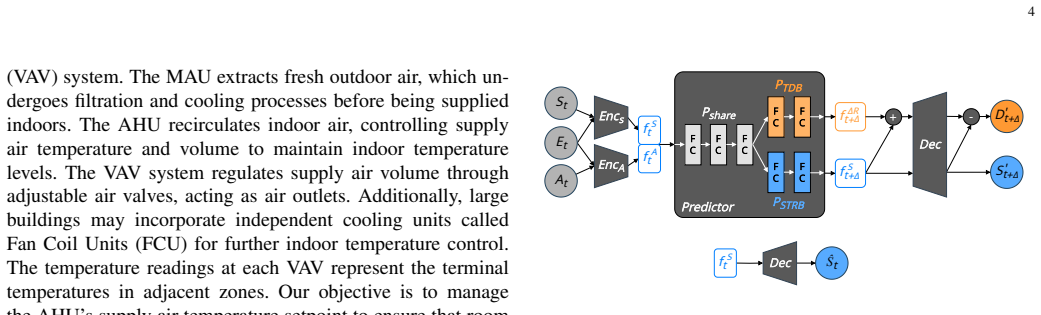
The paper proposes an adaptive model-based transfer learning framework for dynamic HVAC control. The agent is dynamically pretrained in an EnergyPlus digital twin of the target building — actively deciding setpoints and observing thermal responses rather than learning from fixed schedules — then transferred to the real building, fine-tuned on a small amount of biased sensor data, and updated online during operation. Two mechanisms are claimed to be essential: embedding physics rules as constraint losses (gradient constraint and residual constraint) keeps predictions physically consistent, and a long-term-aware setpoint selection strategy scores candidate setpoints by the predicted long-term
What carries the argument
The dynamic model is an encoder-decoder network with two prediction branches: the short-term regression branch (STRB) predicts next-step temperature S'_{t+Δ}, and the temperature difference branch (TDB) predicts the gap D'_{t+Δ} between the long-term stable temperature and the short-term prediction, trained against a temporal-difference-style bootstrap target Y = γ( F_TDB(·) + F_STRB(·) − S_{t+Δ} ) computed with a frozen target network. The control loop scores each candidate setpoint via Score = |S_t − T_exp| − α|S'_long − T_exp| − β|S'_long − S_t|, then fuses the best-scoring setpoint with an expert-defined schedule using a time-varying confidence driven by the model's prediction error. Phy
Load-bearing premise
The headline control comparisons against PID, OSLN, and DDQN are evaluated inside a learned neural-network surrogate of Room 301, not in real rooms — if that surrogate does not reproduce true closed-loop HVAC dynamics, especially oscillation and long-horizon behavior, the reported DAE/DARV margins and the tuned hyperparameters (α=1.0, β=0.9, γ=0.5) may not transfer to real buildings.
What would settle it
Run the identical agent and the three baselines for two weeks in the real Room 701 or 702, logging actual VAV temperatures and setpoint changes every 18 minutes, and compare daily average error (DAE) and daily average regret (DARV). If the proposed method does not stay below OSLN's real-room DAE (around 0.17°C) while keeping comparable or lower DARV, the central claim collapses. A quicker check: verify on real sensor data that the sign of the gradient of predicted temperature with respect to the AHU setpoint matches the +1 label assumed by the gradient constraint loss.
If this is right
- If the reported margins hold, similar buildings no longer need their own digital twins: a stable controller from one room can be fine-tuned on about five days of biased data and reach below 0.15°C error within a week.
- The long-term-aware setpoint selection (using predicted stable temperature rather than next-step error) is claimed to cut setpoint regret from 0.498 (OSLN) to 0.373 and reduce energy waste from oscillation without an explicit energy term in the objective.
- Online adaptation lets the model follow seasonal and occupancy drift, so the controller does not need manual retuning after transfer.
- The 18-minute control cycle is presented as the best balance: 6- and 12-minute cycles oscillate, and the 24-minute cycle loses accuracy, with DAE rising from 0.07 to 0.10.
- Ablations show that the physics constraint losses reduce prediction error when training data is biased, and that removing TDB, online learning, or confidence fusion degrades both accuracy and smoothness.
Where Pith is reading between the lines
- The decisive experiment is still missing: a head-to-head real-room comparison of the same policies rather than a surrogate. Until that runs, the 0.032°C vs 0.172°C margin over OSLN should be read as a simulated result, not a field result.
- The TD-style bootstrap for long-term temperature (TDB with a target network) is a transferable idea: any slow thermal process with sparse actuation could use the same trick to learn a 'final stable value' head without waiting for physical convergence.
- The confidence-based fusion with the expert schedule acts as a safety net; a natural extension is to replace the fixed expert schedule with a learnable or constraint-based limit on setpoint rate, which could remove the need for a domain expert.
- The transfer claim is explicitly for similar buildings (same layout and sensor set); testing on more diverse geometries and climates would map the boundary of the 'one-week deployment' promise.
Editorial analysis
A structured set of objections, weighed in public.
Referee Report
Summary. The paper proposes an adaptive model-based transfer learning framework for AHU setpoint control in HVAC systems. A neural dynamic model with a short-term regression branch and a long-term temperature-difference branch is pretrained by interacting with an EnergyPlus digital twin, transferred to target buildings, fine-tuned with limited biased real data, and updated online. The controller selects setpoints by scoring candidate actions using a predicted long-term stable temperature and a smoothness penalty, then fuses the winner with an expert schedule through a confidence mechanism. Physics-based gradient and residual constraints are added to the training loss. Experiments compare the method against OSLN, PID, and DDQN in a learned surrogate environment built from Room 301 data, provide ablation studies, and report transfer results between real offices (Room 301 as source; Rooms 401/402 as targets) and from virtual to real rooms (701/702). The paper claims superior occupant comfort, lower setpoint regret, smoother transitions, and deployment within one week.
Significance. If the main claims hold, the framework is practically valuable: it addresses real-data scarcity, avoids unsafe exploration, and demonstrates week-scale deployment between similar buildings. The real-building transfer evidence (Table III, Fig. 13) and the comparison against transfer-learning baselines FDTDM and DAF are genuine strengths, as are the detailed architectural and hyperparameter disclosures in Appendix A. The long-term-aware setpoint selection idea is interesting and the ablation studies are informative. However, the headline superiority over OSLN, PID, and DDQN rests on a learned surrogate that is validated only for one-step-ahead prediction, while hyperparameters are tuned on that same surrogate. The real transfer experiments do not include these baselines. Thus the practical significance of the central control claim is not yet established, although the direction is promising.
major comments (4)
- [Sec. V.A, Fig. 7, Tables IV–V] The central comparison against OSLN, PID, and DDQN is evaluated entirely inside a learned 'environmental simulation model' built from Room 301 data. The only validation reported is one-step-ahead test error (0.0347°C); no multi-step or closed-loop validation is given. Since DARV and setpoint oscillation are inherently multi-step dynamic phenomena, the surrogate may not reproduce them. The data were collected under OSLN control, so the surrogate's action distribution is centered on the very baseline it is used to outperform. To support the headline claim, either validate the surrogate's closed-loop rollouts against real Room 301 trajectories (e.g., compare predicted vs actual temperature responses under identical setpoint series) or report real-world comparisons against at least OSLN and PID.
- [Sec. V.E.1, Table IV] The hyperparameters α, β, and γ are selected by ablating on the same surrogate that produces the headline results. The final choice (α=1.0, β=0.9, γ=0.5) may therefore be overfit to surrogate artifacts. No error bars, repeated trials, or statistical tests are reported for the DAE/DARV values in Fig. 7, Tables IV, or Table V. Because the surrogate is not validated in closed loop, the reported margins could change materially in real buildings. Please report sensitivity of the real transfer results (Table III) to these hyperparameters, or at least explicitly acknowledge this limitation and avoid presenting the tuned values as globally optimal.
- [Eqs. (14), (23)] The long-term stability target Y is computed from the network's own F_TDB and F_STRB predictions, and S'_long = S'_{t+Δ} + D'_{t+Δ} is never compared with measured long-term temperatures. This is legitimate TD-style bootstrapping, but it means the 'long-term stability' claim is internally consistent rather than externally validated. The authors should evaluate D' against actual future temperatures (e.g., using recorded room temperatures following held setpoints), or temper the claims about 'long-term stability' and 'final stable temperature' accordingly.
- [Sec. V.D.2, Table III] The real-building transfer experiments compare only against FDTDM and DAF; OSLN, PID, and DDQN are not run in real rooms. Consequently, the conclusion 'Compared with OSLN, PID, and DDQN, our method consistently delivers superior occupant comfort, stable control, and smooth setpoint transitions' is not directly supported by real data. The authors should either deploy the key baselines in the real transfer setting or restrict the conclusion to comparisons inside the surrogate and against the transfer-learning baselines.
minor comments (7)
- [Eq. (7)] The first displayed expression for S_long appears malformed/duplicated; please fix the typesetting. Also, the accompanying text says a larger γ emphasizes temperatures closer to the present, but a larger γ actually assigns more weight to more distant future temperatures; the wording is misleading.
- [Algorithm 1] The equation references in Algorithm 1 are off: Loss_GC is Eq. (18), Loss_RC is Eq. (19), and Loss_recons is Eq. (21), not (15)/(17)/(18).
- [Table III and Sec. V.D.2] The baseline name is written 'FDTDM' in the text and 'FATDM' in Table III. Please harmonize the notation.
- [Table I] The relation label for 'VAV on/off' is +1, which is counterintuitive if VAV on corresponds to active cooling (which should reduce room temperature). Please clarify the encoding or verify the sign, since the gradient constraint loss enforces these labels as physical rules.
- [Eq. (24)] The first term |S_t − T_exp| is constant across all candidate setpoints a and therefore does not affect the arg max in Eq. (25). If this is intentional, please say so; otherwise it may be a leftover from the OSLN formulation.
- [Eq. (26)] The confidence fusion uses parameters β and σ, while Eq. (24) also uses α and β with different meanings. Consider renaming the fusion parameters to avoid ambiguity.
- [Sec. V.C and Fig. 11] Energy use is quantified via CDH/HDH areas and setpoint-curve areas rather than measured energy consumption, even though power sensors are listed in Table II. Please label these as proxies or indirect indicators, not measured energy savings.
Circularity Check
No significant circularity: the long-term TDB target is explicit temporal-difference bootstrapping, and the central control and transfer claims are evaluated on an independently fitted surrogate and on real-building deployments.
full rationale
I walked the derivation chain and found no step where a claimed prediction or first-principles result reduces by construction to its own input. The most potentially self-referential point is the long-term branch (Sec. IV-A, Eqs. 7-15): the target Y for D'_t+Δ is computed from the model's own F_TDB and F_STRB predictions after replacing the unavailable future temperature S_t+2Δ with the short-term model output. However, the paper explicitly states this is temporal-difference bootstrapping ('This formulation is inspired by temporal difference learning, where predictions are updated through bootstrapping using future estimated states'), and the short-term branch F_STRB is independently supervised against measured S_t+Δ via Loss_STRB in Eq. 6. Thus the TDB loss enforces a Bellman-style consistency condition anchored to real sensor data, not a fit of a parameter to the same quantity it later predicts as novel. The pre-trained/transferred model is also evaluated on real buildings (Table III, Fig. 12-13), which provides external support for the transfer-learning claim. The control-comparison headline margins (Fig. 7, Tables IV-V) are obtained inside a learned environmental simulation model built from Room 301 data (Sec. V-A), which is a validation-risk concern—especially because that surrogate was trained on OSLN-controlled data—but it is not a circularity: the proposed controller and baselines are all evaluated in the same fitted environment, and winning in that environment is an empirical outcome, not a definitional consequence. The only self-citation is to the authors' prior OSLN work [6], used as a baseline and as the source of the confidence-fusion heuristic (Eq. 26). This is a design component, not a load-bearing proof or uniqueness theorem, and the central transfer-learning and physics-embedding contributions do not rest on it. I therefore find no circular step and assign a score of 0.
Axiom & Free-Parameter Ledger
free parameters (6)
- alpha (long-term target weight in scoring function) =
1.0
- beta (change penalty in scoring function) =
0.9
- gamma (long-term decay) =
0.5
- beta and sigma in confidence fusion (Eq. 26) =
not reported
- control cycle Delta =
18 minutes
- environmental simulation model weights =
not reported (test error ≈0.0347°C)
axioms (5)
- domain assumption The Room-301 neural model is a valid closed-loop surrogate for real HVAC dynamics
- domain assumption The EnergyPlus digital twin with 0.4-1.6°C calibration error is a useful source domain
- ad hoc to paper The relation labels in Table I encode correct physical signs
- ad hoc to paper The exponentially weighted S_long is the correct long-term stability objective
- standard math Temporal-difference bootstrapping with a target network converges to a stable F_TDB
read the original abstract
In this paper, we aim to automate the adjustment of air handling unit (AHU) setpoints within heating, ventilation, and air conditioning (HVAC) systems to maintain indoor temperatures at user-specified levels. A key challenge lies in obtaining sufficient high-quality sensor data from real buildings. To address this, we explore transfer learning and leverage simulation software to generate training data. We propose an adaptive model-based transfer learning approach for dynamic HVAC control, where the agent directly controls the source domain under conditions identical to the target domain. This eliminates the need for extensive target-specific knowledge to define data generation schedules and reduces the risk of collecting irrelevant samples, while also providing greater flexibility during learning. At the control level, we enhance performance through physics rule embedding, which ensures physical consistency, and long-term-aware setpoint selection strategy, which mitigates abrupt setpoint changes. Finally, to accelerate and stabilize deployment in new buildings, we enable knowledge transfer directly between similar real-world buildings, reducing the need to construct virtual source domains repeatedly.
Figures




Reference graph
Works this paper leans on
-
[1]
On performance and tuning of pid controllers in hvac systems,
G. Geng and G. Geary, “On performance and tuning of pid controllers in hvac systems,” inProceedings of IEEE International Conference on Control and Applications, 1993, pp. 819–824 vol.2
1993
-
[2]
Deep reinforcement learning for building HV AC control,
T. Wei, Y . Wang, and Q. Zhu, “Deep reinforcement learning for building HV AC control,” inProceedings of the 54th Annual Design Automation Conference, DAC 2017, Austin, TX, USA, June 18-22, 2017. ACM, 2017, pp. 22:1–22:6. [Online]. Available: https://doi.org/10.1145/3061639.3062224
arXiv 2017
-
[3]
Deep reinforcement learning for smart home energy management,
L. Yu, W. Xie, D. Xie, Y . Zou, D. Zhang, Z. Sun, L. Zhang, Y . Zhang, and T. Jiang, “Deep reinforcement learning for smart home energy management,”IEEE Internet Things J., vol. 7, no. 4, pp. 2751–2762,
-
[4]
An hybrid model-free reinforcement learning approach for hvac control,
F. M. Solinas, A. Bellagarda, E. Macii, E. Patti, and L. Bottaccioli, “An hybrid model-free reinforcement learning approach for hvac control,” in2021 IEEE International Conference on Environment and Electrical Engineering and 2021 IEEE Industrial and Commercial Power Systems Europe (EEEIC / I&CPS Europe), 2021, pp. 1–6
2021
-
[5]
Hvac room temperature prediction control based on neural network model,
S. Li, S. Ren, and X. Wang, “Hvac room temperature prediction control based on neural network model,” in2013 Fifth International Conference on Measuring Technology and Mechatronics Automation, 2013, pp. 606– 609
2013
-
[6]
Online self-learning for smart HV AC control,
T. Chao, M. Nguyen, C. Huang, C. Liang, and C. Chung, “Online self-learning for smart HV AC control,” in2019 IEEE International Conference on Systems, Man and Cybernetics, SMC 2019, Bari, Italy, October 6-9, 2019. IEEE, 2019, pp. 4324–4330. [Online]. Available: https://doi.org/10.1109/SMC.2019.8914027
arXiv 2019
-
[7]
Effectiveness of neural networks and transfer learning for indoor air-temperature forecasting,
A. Bellagarda, S. Cesari, A. Aliberti, F. Ugliotti, L. Bottaccioli, E. Macii, and E. Patti, “Effectiveness of neural networks and transfer learning for indoor air-temperature forecasting,”Automation in Construction, vol. 140, p. 104314, 2022. [Online]. Available: https://www.sciencedirect.com/science/article/pii/S092658052200187X
2022
-
[8]
Cosmos world foundation model platform for physical AI,
N. Agarwal, A. Ali, M. Bala, Y . Balaji, E. Barker, T. Cai, P. Chattopadhyay, Y . Chen, Y . Cui, Y . Ding, D. Dworakowski, J. Fan, M. Fenzi, F. Ferroni, S. Fidler, D. Fox, S. Ge, Y . Ge, J. Gu, S. Gururani, E. He, J. Huang, J. S. Huffman, P. Jannaty, J. Jin, S. W. Kim, G. Kl ´ar, G. Lam, S. Lan, L. Leal-Taix ´e, A. Li, Z. Li, C. Lin, T. Lin, H. Ling, M. L...
-
[9]
Cosmos-drive-dreams: Scalable synthetic driving data generation with world foundation models,
X. Ren, Y . Lu, T. Cao, R. Gao, S. Huang, A. Sabour, T. Shen, T. Pfaff, J. Z. Wu, R. Chen, S. W. Kim, J. Gao, L. Leal-Taix´e, M. Chen, S. Fidler, and H. Ling, “Cosmos-drive-dreams: Scalable synthetic driving data generation with world foundation models,”CoRR, vol. abs/2506.09042,
-
[10]
Cosmos-transfer1: Conditional world generation with adaptive multimodal control,
H. A. Alhaija, J. M. ´Alvarez, M. Bala, T. Cai, T. Cao, L. Cha, J. Chen, M. Chen, F. Ferroni, S. Fidler, D. Fox, Y . Ge, J. Gu, A. Hassani, M. Isaev, P. Jannaty, S. Lan, T. Lasser, H. Ling, M. Liu, X. Liu, Y . Lu, A. Luo, Q. Ma, H. Mao, F. Ramos, X. Ren, T. Shen, X. Sun, S. Tang, T. Wang, J. Z. Wu, J. Xu, S. Xu, K. Xie, Y . Ye, X. Yang, X. Zeng, and Y . Z...
-
[11]
Model predictive control for HV AC systems - A review,
R. Kwadzogah, M. Zhou, and S. Li, “Model predictive control for HV AC systems - A review,” in2013 IEEE International Conference on Automation Science and Engineering, CASE 2013, Madison, WI, USA, August 17-20, 2013. IEEE, 2013, pp. 442–447. [Online]. Available: https://doi.org/10.1109/CoASE.2013.6654072
arXiv 2013
-
[12]
Model predictive control for the operation of building cooling systems,
Y . Ma, F. Borrelli, B. Hencey, B. Coffey, S. C. Bengea, and P. Haves, “Model predictive control for the operation of building cooling systems,” IEEE Trans. Control. Syst. Technol., vol. 20, no. 3, pp. 796–803, 2012. [Online]. Available: https://doi.org/10.1109/TCST.2011.2124461 [13]Model-Based Hierarchical Optimal Control Design for HVAC Systems, ser. Dy...
arXiv 2012
-
[14]
Modeling and optimization of complex building energy systems with deep neural networks,
Y . Chen, Y . Shi, and B. Zhang, “Modeling and optimization of complex building energy systems with deep neural networks,” in51st Asilomar Conference on Signals, Systems, and Computers, ACSSC 2017, Pacific Grove, CA, USA, October 29 - November 1, 2017, M. B. Matthews, Ed. IEEE, 2017, pp. 1368–1373. [Online]. Available: https://doi.org/10.1109/ACSSC.2017.8335578
arXiv 2017
-
[15]
Towards optimal control of air handling units using deep reinforcement learning and recurrent neural network,
Z. Zou, X. Yu, and S. Ergan, “Towards optimal control of air handling units using deep reinforcement learning and recurrent neural network,”Building and Environment, vol. 168, p. 106535, 2020. [Online]. Available: https://www.sciencedirect.com/science/article/pii/ S0360132319307474
2020
-
[16]
Forecasting customers’ re- sponse to incentives during peak periods: A transfer learning approach,
L. Cai, H. Wen, J. Gu, J. Ma, and Z. Jin, “Forecasting customers’ re- sponse to incentives during peak periods: A transfer learning approach,” International Transactions on Electrical Energy Systems, vol. 30, no. 7, p. e12251, 2020, e12251 ITEES-19-1069.R1. [Online]. Available: https://onlinelibrary.wiley.com/doi/abs/10.1002/2050-7038.12251
arXiv 2020
-
[17]
T. Huang and F. Jiao, “Study on data transfer in meteorological forecast of small and medium-sized cities and its application in zhaoqing city,” Comput. J., vol. 63, no. 7, pp. 1076–1083, 2020. [Online]. Available: https://doi.org/10.1093/comjnl/bxz087
-
[18]
Domain adaptation for time series forecasting via attention sharing,
X. Jin, Y . Park, D. C. Maddix, H. Wang, and Y . Wang, “Domain adaptation for time series forecasting via attention sharing,” in International Conference on Machine Learning, ICML 2022, 17-23 July 2022, Baltimore, Maryland, USA, ser. Proceedings of Machine Learning Research, K. Chaudhuri, S. Jegelka, L. Song, C. Szepesv ´ari, G. Niu, and S. Sabato, Eds., ...
2022
-
[19]
The building adapter: Towards quickly applying building analytics at scale,
D. Hong, H. Wang, J. Ortiz, and K. Whitehouse, “The building adapter: Towards quickly applying building analytics at scale,” in Proceedings of the 2nd ACM International Conference on Embedded Systems for Energy-Efficient Built Environments, BuildSys 2015, Seoul, South Korea, November 4-5, 2015, D. E. Culler, Y . Agarwal, and R. Mangharam, Eds. ACM, 2015, ...
arXiv 2015
-
[20]
Transfer learning for smart buildings: A critical review of algorithms, applications, and future perspectives,
G. Pinto, Z. Wang, A. Roy, T. Hong, and A. Capozzoli, “Transfer learning for smart buildings: A critical review of algorithms, applications, and future perspectives,”Advances in Applied Energy, vol. 5, p. 100084, 2022. [Online]. Available: https://www.sciencedirect. com/science/article/pii/S2666792422000026 17
2022
-
[21]
Y . Chen, Y . Zheng, and H. Samuelson, “Fast adaptation of thermal dynamics model for predictive control of HV AC and natural ventilation using transfer learning with deep neural networks,” in 2020 American Control Conference, ACC 2020, Denver, CO, USA, July 1-3, 2020. IEEE, 2020, pp. 2345–2350. [Online]. Available: https://doi.org/10.23919/ACC45564.2020.9147321
arXiv 2020
-
[22]
A. Li, F. Xiao, C. Fan, and M. Hu, “Development of an ann-based building energy model for information-poor buildings using transfer learning,”Building Simulation, vol. 14, no. 1, pp. 89–101, Feb 2021. [Online]. Available: https://doi.org/10.1007/s12273-020-0711-5
-
[23]
One for many: Transfer learning for building HV AC control,
S. Xu, Y . Wang, Y . Wang, Z. O’Neill, and Q. Zhu, “One for many: Transfer learning for building HV AC control,” inBuildSys ’20: The 7th ACM International Conference on Systems for Energy- Efficient Buildings, Cities, and Transportation, Virtual Event, Japan, November 18-20, 2020. ACM, 2020, pp. 230–239. [Online]. Available: https://doi.org/10.1145/340830...
arXiv 2020
-
[24]
Deep transfer learning for thermal dynamics modeling in smart buildings,
Z. Jiang and Y . M. Lee, “Deep transfer learning for thermal dynamics modeling in smart buildings,” in2019 IEEE International Conference on Big Data (IEEE BigData), Los Angeles, CA, USA, December 9-12, 2019, C. K. Baru, J. Huan, L. Khan, X. Hu, R. Ak, Y . Tian, R. S. Barga, C. Zaniolo, K. Lee, and Y . F. Ye, Eds. IEEE, 2019, pp. 2033–2037. [Online]. Avail...
arXiv 2019
-
[25]
Human-level control through deep reinforcement learning,
V . Mnih, K. Kavukcuoglu, D. Silver, A. A. Rusu, J. Veness, M. G. Bellemare, A. Graves, M. A. Riedmiller, A. Fidjeland, G. Ostrovski, S. Petersen, C. Beattie, A. Sadik, I. Antonoglou, H. King, D. Kumaran, D. Wierstra, S. Legg, and D. Hassabis, “Human-level control through deep reinforcement learning,”Nat., vol. 518, no. 7540, pp. 529–533,
-
[26]
virtualpulse/EnergyPlus-7-1-0/DataSets at master · joshwentz/virtualpulse
Joshwentz, “virtualpulse/EnergyPlus-7-1-0/DataSets at master · joshwentz/virtualpulse.” [Online]. Available: https://github.com/ joshwentz/virtualpulse/tree/master/EnergyPlus-7-1-0/DataSets APPENDIXA HYPERPARAMETERS FORMODEL ANDTRAINING SETTINGS We provide a table to summarize the hyperparameters used in our work, including both model and training setting...
-
[2015]
Available: https://doi.org/10.1038/nature14236
[Online]. Available: https://doi.org/10.1038/nature14236
-
[2020]
Available: https://doi.org/10.1109/JIOT.2019.2957289
[Online]. Available: https://doi.org/10.1109/JIOT.2019.2957289
arXiv 2019
-
[2025]
Available: https://doi.org/10.48550/arXiv.2506.09042
[Online]. Available: https://doi.org/10.48550/arXiv.2506.09042
discussion (0)
Sign in with ORCID, Apple, or X to comment. Anyone can read and Pith papers without signing in.