REVIEW 4 major objections 5 minor 14 references
Interface-Engineered Giant Multistate Resistance Switching in Altermagnetic CrSb Multiferroic Tunnel Junctions
T0 review · 4 major / 5 minor · reviewed 2026-08-01 · deepseek-v4-flash
Pith's one-line read The paper claims that the termination symmetry of CrSb/α-In2Se3 interfaces, not the bulk altermagnetic splitting alone, selects the tunneling spin channels, reverses the parallel/antiparallel resistance hierarchy, and yields four or eight n
desk verdict A well-converged computational parameter sweep of CrSb/In2Se3 multiferroic tunnel junctions whose headline 'termination reverses P/AP hierarchy' rule is contradicted by the paper's own transmission tables — needs revision, but deserves peer review. read the letter →
The pith
A machine-rendered reading of the paper's core claim, the machinery that carries it, and where it could break.
The reading
What carries the argument
The carrying mechanism is spin-channel matching between the two electrode/barrier interfaces: Cr/Sb termination and h-BN or graphene insertion layers set which spin channel has continuous spectral weight through the tunneling barrier, while ferroelectric α-In2Se3 polarization reshapes the electrostatic barrier and redistributes the k‖-resolved transmission. The calculations combine density functional theory with nonequilibrium Green's function transport, evaluating spin-resolved transmission and current through Landauer expressions; the termination-dependent reversal of the P/AP resistance hierarchy is the central discriminating prediction.
What would settle it
A noncollinear or spin-orbit-inclusive calculation of the same junctions—or an epitaxial sample with controlled termination—that fails to show the termination-dependent reversal of the P/AP resistance hierarchy would refute the central claim.
Extended reading notes
Core claim
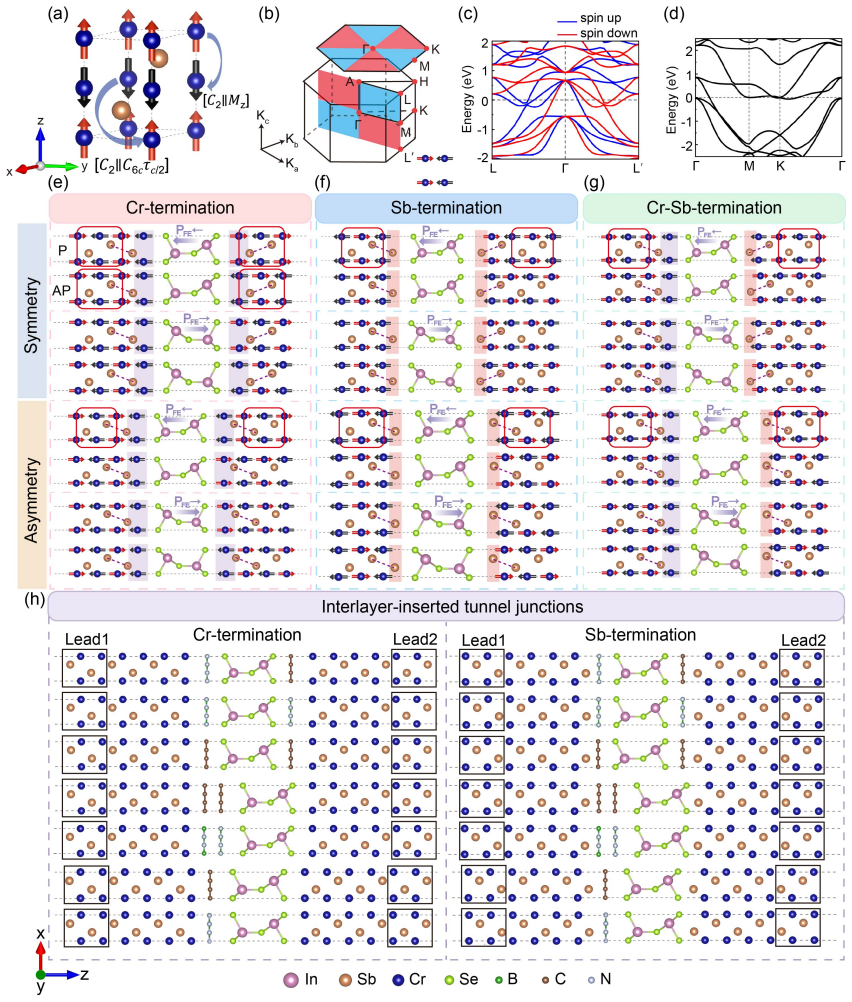
The central claim is that the resistance state is fixed by the actual alignment of the interfacial Cr moments and the spin-channel matching it permits, not by the nominal parallel/antiparallel label of the electrode Néel vectors. Symmetric interfaces make the P configuration high-resistance and AP low-resistance; asymmetric interfaces reverse this, for both ferroelectric polarizations. Spin-resolved transmission maps locate conductance hot spots in a single spin channel near the Fermi level, and ferroelectric polarization redistributes these hot spots, producing both tunneling magnetoresistance and tunneling electroresistance. Extending the barrier to bilayer In2Se3 introduces up/down/head-t
Load-bearing premise
The numerical predictions assume the idealized, perfectly ordered epitaxial interfaces used in the calculations are the actual device structures; if the real CrSb surface relaxes, reconstructs, or intermixes with In2Se3, the enormous resistance ratios degrade first, even if the qualitative termination dependence survives.
Editorial extensions
If this is right
- Cr-terminated CrSb interfaces support stronger spin-selective tunneling than Sb-terminated ones, making termination a first-order performance knob.
- Switching between symmetric and asymmetric terminations toggles the sign of TMR, adding a structural degree of freedom for nonvolatile memory without changing the magnetic order.
- Monolayer α-In2Se3 barriers give four resistance states, with maximum TMR 1626% and TER 2206%, and shifting the transport window can raise these to 9576% and 4144%.
- Bilayer In2Se3 barriers give eight resistance states, with maximum TMR 3.77×10^4% and TER 4.18×10^5%.
- Finite-bias transport retains robust spin filtering and spin-polarized currents, so the multistate response is not only an equilibrium feature.
Reading between the lines
- The hierarchy-reversal rule likely extends to other altermagnet/barrier combinations, but the sign and magnitude will be set by which k‖ regions a specific interface couples, so it must be recomputed for each material pair.
- The off-Fermi-level TMR/TER boosts assume a controllable shift of the transport window in a metallic electrode; practical routes such as doping or bias protocols are not modeled in the paper.
- A direct experimental check is to grow junctions with symmetric and asymmetric terminations and compare the sign of TMR; observing the predicted reversal would confirm spin-channel matching as the controlling variable.
- The computed four-to-five-order-of-magnitude transmission contrasts depend on atomically perfect interfaces; roughness, reconstruction, or intermixing will shrink the ratios before altering the qualitative hierarchy.
Signed reviews
Editorial analysis
A structured set of objections, weighed in public.
Referee Report
Summary. The manuscript reports first-principles NEGF-DFT calculations of CrSb/α-In2Se3 altermagnetic multiferroic tunnel junctions, with h-BN/graphene insertion layers, claiming that the symmetry of the interface terminations (symmetric vs. asymmetric) reverses the TMR resistance hierarchy between parallel and antiparallel Néel-vector configurations. The authors report giant TMR (up to 1626% at equilibrium, 9576% with Fermi-level shifting) and TER (up to 2206%, 4144%) for monolayer barriers, and up to eight resistance states using bilayer In2Se3 with TMR and TER reaching 3.77×10^4% and 4.18×10^5%. The underlying microscopic mechanism is argued to be interface-selected spin-channel matching controlled by actual interfacial Cr-moment alignment, not the bulk altermagnetic splitting alone.
Significance. If correct, the proposed interface-symmetry-controlled spin-channel matching would establish a new design principle for altermagnetic multiferroic tunnel junctions and expand the multistate memory concept. The work uses standard, carefully parameterized DFT and NEGF calculations (500 eV cutoff, 13×13×1 and 100×100×1 k-meshes, DZP basis), and the transmission data are provided in raw form, which is commendable for reproducibility. However, the central claim of a universal termination-induced inversion of the P/AP resistance hierarchy is directly contradicted by the paper's own Tables 1 and 2, as detailed below. Because this rule is the main conceptual advance advertised in the abstract and Fig. 2(b), the paper's core conclusion is not supported.
major comments (4)
- [Fig. 2(b) vs Tables 1 and 2] The claimed universal rule—symmetric terminations make the P configuration high-resistance and AP low-resistance, with the reverse for asymmetric terminations—is internally contradicted by the reported transmissions. For the symmetric Cr-S interface in Table 1, PFE← gives T_P=1.02×10^-1 > T_AP=6.89×10^-2, i.e., P is the low-resistance state, the opposite of the rule. Similarly, Table 1 Sb-S with PFE← has T_P=4.58×10^-2 > T_AP=4.37×10^-2. For asymmetric Sb-A, PFE← gives T_P=3.05×10^-2 < T_AP=4.00×10^-2 (P high), also opposite to the expected reversed hierarchy. Table 2, which all use the symmetric Cr-S interface, shows the rule only intermittently: Gr/In2Se3 gives P low for both polarizations (T_P=1.24×10^-2 vs T_AP=4.74×10^-3 for PFE→), and 2·Gr/In2Se3 likewise (T_P=3.26×10^-3 vs T_AP=2.12×10^-3). These examples are not isolated; the hierarchy is not controlled by termination symmetry al
- [Eq. (5) and raw transmission columns] The TMR definition uses an absolute value, which discards the sign of the resistance hierarchy. The raw T_tot columns in Tables 1 and 2 are therefore essential, and they reveal the above contradictions. The authors should report the actual high/low-resistance assignment (e.g., whether P or AP has higher conductance) for each state, rather than only the absolute TMR. Without this, the paper's interpretation cannot be checked from the TMR numbers alone.
- [Fig. 5 and Fermi-level shifting] The claim that TMR reaches 9576% at E−E_F = −0.37 eV and TER 4144% at −0.06 eV is presented as 'Fermi-level shifting' enabling even larger ratios. However, no physical mechanism for shifting the Fermi level in a metallic CrSb electrode is given—electrostatic gating of a metal is not straightforward, and no gated calculation is performed. These off-E_F values are therefore not device predictions but simply evaluations of an energy-dependent transmission function. If these numbers are to be advertised in the abstract, a concrete gating/doping model is required.
- [Structural idealization] The giant TMR/TER values rely on transmission contrasts of several orders of magnitude (e.g., Table 2 2·h-BN/In2Se3: T~10^-5 vs 10^-4). These predictions assume idealized coherent interfaces: the h-BN and graphene supercells are strained by ~4–6% to match CrSb, and the energetically preferred stackings from Fig. S2 are taken as the device geometry. No account is made of possible surface reconstruction, intermixing, or relaxation of the CrSb surface in contact with the insertion layers. Since the proposed microscopic mechanism operates at the interface, the quantitative predictions—and even the qualitative hierarchy—could change under more realistic interfacial structures. This is a limitation that should be stated and ideally tested with at least one alternative stacking or a short molecular-dynamics relaxation.
minor comments (5)
- [General] The paper contains several typographical and formatting issues, including inconsistent use of 'Néel' vs 'N√©el' in the extracted text, and the figure captions are sometimes terse. Please proofread carefully.
- [Fig. 2(b)] The schematic in Fig. 2(b) is difficult to interpret, especially the petal-like symbols and the meaning of 'favorable spin-channel matching'. A clearer graphical definition of the resistance hierarchy (and its dependence on termination) would help readers.
- [Table 1 and Table 2] The tables list TMR and TER to one decimal place, but some entries (e.g., TER 0.3%, 0.2%) appear marginally different from rounding. It would be useful to give the raw transmission values with more significant figures or at least the conductance ratio explicitly.
- [Methods] The choice of U=0 for CrSb is justified by comparison to ARPES, but the effect of possible U on the interfacial transmission is not discussed. A sentence on the sensitivity of transport coefficients to U would be informative.
- [References] Several references are self-citations of the authors' previous work (e.g., Refs. 5, 6, 11, 40, 42, 43). While these are relevant, the paper would benefit from citing more independent experimental and theoretical studies of CrSb-based tunnel junctions beyond the current group.
Circularity Check
No load-bearing circularity: TMR/TER are computed, not fitted; self-citations are routine inputs only.
full rationale
The central transport ratios are direct outputs of NEGF-DFT Landauer calculations (Eqs. 1-8): spin-resolved transmissions are tabulated in Tables 1 and 2 and the TMR/TER percentages follow by inserting those tabulated T_tot values into the defining formulas. No parameter is fitted to the reported percentages, and the P/AP high/low hierarchy is read from the raw T_tot columns rather than imposed by the TMR definition, whose absolute value (Eq. 5) contains no sign information. The cited prior work by the same group (Refs 5, 6, 10, 11, 40, 42, 43) supplies standard inputs such as alpha-In2Se3 ferroelectricity, h-BN/Gr lattice constants and interfacial stacking preferences; these are also supported by independent references (Refs 39, 41, 44) and are not tuned to force the central termination-reversal claim. The proposed mechanism is inferred from computed PDOS and k_parallel-resolved transmission, so it is an interpretation of the data rather than a construction used to generate the data. I note a separate internal-consistency concern outside the circularity definition: for the headline Cr-S/2-h-BN/In2Se3 junction, Table 2 lists T_P=4.97e-5 and T_AP=8.58e-4 at PFE-> (and similarly at PFE<-), making P the low-resistance state, which contradicts Fig. 2(b)'s stated rule that symmetric terminations make P high-resistance. This is a correctness/falsification issue, not a reduction of a prediction to an input. The off-Fermi-level TMR/TER values are energy scans, not fitted targets. Hence the derivation is not circular; the low score reflects only routine non-load-bearing self-citation.
Assumptions & free parameters
free parameters (3)
- Hubbard U on Cr (set to 0) =
0 eV
- Energy points for 'Fermi-level shifting' maxima =
-0.37 eV (TMR), -0.06 eV (TER)
- In-plane lattice constant / insertion-layer strain =
a = 4.101 Å (CrSb); ~4-6% compressive strain on √3×√3 h-BN/Gr
assumptions (5)
- domain assumption PBE-GGA at U=0 with DFT-D3 captures the exchange-driven g-wave spin splitting of CrSb accurately enough for quantitative transport ratios
- domain assumption Spin channels remain independent: no spin-orbit coupling anywhere, including the Sb-heavy interfaces
- domain assumption CrSb retains A-AFM order and the P/AP Néel configurations are energetically accessible and switchable in the junction
- domain assumption Bilayer In2Se3 hosts four stable polarization configurations (up/down/head-to-head/tail-to-tail)
- domain assumption Atomically coherent, defect-free interfaces with the preferred stackings (Cr/Sb-hollow Gr, Cr/Sb-N h-BN) are the physically realized structures
Cite this review
Pith. "Pith review of Interface-Engineered Giant Multistate Resistance Switching in Altermagnetic CrSb Multiferroic Tunnel Junctions." pith.science (2026). https://pith.science/paper/I7FOXBRY
@misc{pith2026260715728,
  author       = {Pith},
  title        = {Pith review of: Interface-Engineered Giant Multistate Resistance Switching in Altermagnetic CrSb Multiferroic Tunnel Junctions},
  year         = {2026},
  howpublished = {\url{https://pith.science/paper/I7FOXBRY}},
  note         = {Machine review of arXiv:2607.15728}
}
abstract
Altermagnets enable spin-split transport without stray magnetic fields, yet converting their momentum-dependent spin splitting into a strong tunnel-junction response requires interface-selected tunneling channels. Here, using density functional theory combined with nonequilibrium Green's function calculations, we demonstrate giant multistate resistance switching in CrSb/$\alpha$-In$_2$Se$_3$ altermagnetic multiferroic tunnel junctions. The response is governed not by the bulk spin splitting of CrSb alone, but by a symmetry-selected interfacial mechanism in which Cr/Sb terminations and \textit{h}-BN or graphene insertion layers determine spin-channel matching, while ferroelectric polarization reshapes the electrostatic barrier. Symmetric and asymmetric terminations reverse the correspondence between parallel/antiparallel N\'eel-vector configurations and high-/low-resistance states, showing that the actual alignment of interfacial Cr moments selects the dominant tunneling channels. Monolayer-In$_2$Se$_3$ junctions exhibit four nonvolatile resistance states, with tunneling magnetoresistance (TMR) and tunneling electroresistance (TER) reaching 1626\% and 2206\%, respectively, and increasing to 9576\% and 4144\% upon Fermi-level shifting. Finite-bias calculations further reveal robust spin filtering and tunable spin-polarized currents. Extending the barrier to bilayer In$_2$Se$_3$ introduces interlayer polarization coupling, enabling eight resistance states with maximum TMR and TER values of $3.77\times10^{4}\%$ and $4.18\times10^{5}\%$, respectively. These results establish interface symmetry, spin-channel matching, and ferroelectric barrier reconstruction as design principles for stray-field-free multistate spintronic tunnel devices.
Figures


Figures from the paper (6 more)


Reference graph
Works this paper leans on
-
[1]
Spin injection and magnetoresistance in MoS2-based tunnel junctions using Fe 3Si Heusler alloy electrodes.Sci
(1) Rotjanapittayakul, W.; Pijitrojana, W.; Archer, T.; Sanvito, S.; Prasongkit, J. Spin injection and magnetoresistance in MoS2-based tunnel junctions using Fe 3Si Heusler alloy electrodes.Sci. Rep.2018, 8,
2018
-
[2]
Phys. Rev. B2024,109, 094413. (26) Badura, A. et al. Observation of the anomalous Nernst effect in altermagnetic candidate Mn 5Si3.Nat. Commun.2025, 16,
2025
-
[13]
Full angular dependence of the spin Hall and ordinary magnetoresistance in epitaxial antiferromagnetic NiO(001)/Pt thin films
(15) Baldrati, L.; Ross, A.; Niizeki, T.; Schneider, C.; Ramos, R.; Cramer, J.; Gomonay, O.; Filianina, M.; Savchenko, T.; Heinze, D.; Kleibert, A.; Saitoh, E.; Sinova, J.; Kl¨ aui, M. Full angular dependence of the spin Hall and ordinary magnetoresistance in epitaxial antiferromagnetic NiO(001)/Pt thin films. Phys. Rev. B2018,98, 024422. (16) Fischer, J....
2019
-
[91]
Y.; Maekawa, S.; Tsym- bal, E
(4) Zhuravlev, M. Y.; Maekawa, S.; Tsym- bal, E. Y. Effect of spin-dependent screen- ing on tunneling electroresistance and tun- neling magnetoresistance in multiferroic tunnel junctions.Phys. Rev. B2010,81, 104419. (5) Yan, Z.; Zhang, X.; Xiao, J.; Fang, C.; Xu, X. Giant Nonvolatile Multistate Re- sistance with Fully Magnetically Con- trolled van der Waa...
2025
-
[813]
Magnetoelectric Devices for Spintronics.Annu
(3) Fusil, S.; Garcia, V.; Barthelemy, A.; Bibes, M. Magnetoelectric Devices for Spintronics.Annu. Rev. Mater. Res. 2014,44,
2014
-
[868]
L.; Wang, J
(54) Tao, L. L.; Wang, J. Ferroelectricity and tunneling electroresistance effect driven by asymmetric polar interfaces in all-oxide ferroelectric tunnel junctions.Appl. Phys. Lett.2016,108, 062903. (55) Kang, L.; Jiang, P.; Hao, H.; Zhou, Y.; Zheng, X.; Zhang, L.; Zeng, Z. Giant tun- nel electroresistance in ferroelectric tun- nel junctions with metal co...
2016
-
[1442]
G.; Smejkal, L.; Kang, C.- J.; Kim, C
(35) Lee, S.; Lee, S.; Jung, S.; Jung, J.; Kim, D.; Lee, Y.; Seok, B.; Kim, J.; Park, B. G.; Smejkal, L.; Kang, C.- J.; Kim, C. Broken Kramers Degeneracy in Altermagnetic MnTe.Phys. Rev. Lett. 2024,132, 036702. (36) Jiang, B. et al. A metallic room- temperature d-wave altermagnet.Nat. Phys.2025,21, 754–759. (37) Ding, J. et al. Large Band Splitting ing- W...
2024
-
[1995]
Giant room- temperature magnetoresistance in single- crystal Fe/MgO/Fe magnetic tunnel junc- tions.Nat
(53) Yuasa, S.; Nagahama, T.; Fukushima, A.; Suzuki, Y.; Ando, K. Giant room- temperature magnetoresistance in single- crystal Fe/MgO/Fe magnetic tunnel junc- tions.Nat. Mater.2004,3,
2004
Show all 14 references
-
[2745]
(51) Meir, Y.; Wingreen, N. S. Landauer for- mula for the current through an interact- ing electron region.Phys. Rev. Lett.1992, 68,
1992
-
[4289]
R.; Guan, X.; Wang, L.; Yan, S.; Wu, T.; Wang, X
(8) Cao, Q.; L¨ u, W.; Wang, X. R.; Guan, X.; Wang, L.; Yan, S.; Wu, T.; Wang, X. Non- volatile Multistates Memories for High- Density Data Storage.ACS Appl. Mater. Interfaces2020,12, 42449. (9) Wu, Y.; Zhang, D.; Zhang, Y.-N.; Deng, L.; Peng, B. Nonreciprocal and Nonvolatile ...
2024
-
[4305]
Be- yond Conventional Ferromagnetism and Antiferromagnetism: A Phase with Non- relativistic Spin and Crystal Rotation Symmetry.Phys
(18) ˇSmejkal, L.; Sinova, J.; Jungwirth, T. Be- yond Conventional Ferromagnetism and Antiferromagnetism: A Phase with Non- relativistic Spin and Crystal Rotation Symmetry.Phys. Rev. X2022,12, 031042. (19) Fernandes, R. M.; de Carvalho, V. S.; Birol, T.; Pereira, R. G. Topolog...
2024
-
[4779]
(2) Chappert, C.; Fert, A.; Van Dau, F. N. The emergence of spin electronics in data storage.Nature Mater.2007,6,
2007
-
[7111]
(27) Han, L. et al. Nonvolatile anomalous Nernst effect in Mn 5Si3 with a collinear 18 N´ eel vector.Phys. Rev. Appl.2025,23, 044066. (28) Karube, S.; Tanaka, T.; Sugawara, D.; Kadoguchi, N.; Kohda, M.; Nitta, J. Observation of Spin-Splitter Torque in Collinear Antiferromagnet...
2025
-
[8473]
Magnetic order dependent gi- ant tunneling magnetoresistance and electroresistance in van der Waals antiferromagnetic-multiferroic tunnel junctions.Phys
(6) Yan, Z.; Qiao, D.; Lu, W.; Dong, X.; Xu, X. Magnetic order dependent gi- ant tunneling magnetoresistance and electroresistance in van der Waals antiferromagnetic-multiferroic tunnel junctions.Phys. Rev. B2025,111, 045404. (7) Garcia, V.; Bibes, M. Ferroelectric tunnel junc...
2014
Reviewed August 1, 2026 · model on record in the stance chip above.
Discussion (0). Continue with ORCID to comment.