REVIEW 4 major objections 5 minor 62 references
Growing Hypergraphs with Homophily
T0 review · 4 major / 5 minor · reviewed 2026-08-01 · deepseek-v4-flash
Pith's one-line read A label-aware copying model for growing hypergraphs predicts a power-law degree distribution with an exponent computable in closed form from six parameters.
desk verdict The CHILI model and inference pipeline are worth engaging, but the central analytic claims rest on a transition matrix that is not the actual transition law of the model. read the letter →
The pith
A machine-rendered reading of the paper's core claim, the machinery that carries it, and where it could break.
The reading
What carries the argument
The central object is the transition matrix T(k0′,k1′|k0,k1), the probability that a copied edge with k0 label-0 and k1 label-1 nodes yields a new edge with k0′ and k1′ labels. Conditional on the focal node's label, the counts of the two labels evolve independently as a binomial (copy step) plus a Poisson (addition step), so each entry factors into two tractable convolutions. The stationary label-count distribution is the leading eigenvector of T, and its moments are fed into a mean-field balance equation that produces the degree power law.
What would settle it
Simulate the model with parameters that create strong degree-label correlation (e.g., high same-label copying probability and a large imbalance in novel-node addition rates), fit the tail of the empirical degree distribution over millions of edges, and compare the fitted exponent to the closed-form value from the paper's equation; a systematic mismatch would falsify the mean-field assumption. A second check: diagonalize the transition matrix over the full parameter grid to confirm that the leading eigenvalue is 1 and simple; if it is not in some regime, the Perron-eigenvector statement for the
Extended reading notes
Core claim
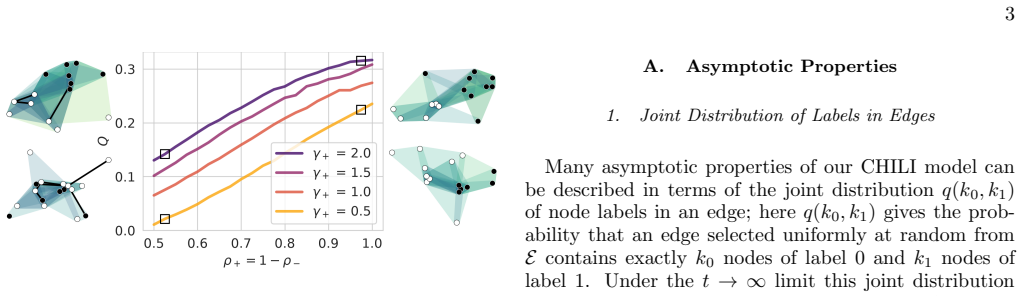
At the heart of the paper is the claim that a simple mechanistic rule — every new edge copies an old one, with label-aware probabilities for copying, adding extant nodes, and adding novel nodes — is enough to reproduce two signature properties of real-world hypergraphs: a heavy-tailed degree distribution and tunable assortative mixing. The stationary joint distribution q(k0,k1) of label counts in a random edge is shown to be the Perron eigenvector of a doubly-indexed matrix T whose entries are binomial-Poisson convolutions. From q, the paper computes the moments that enter the power-law exponent ζ = 1 + (⟨k0⟩+⟨k1⟩)/(1+ρ+(µ00+µ11−1)+2ρ−µ01), so both the label-mixing asymptotics and the degree
Load-bearing premise
The power-law degree exponent rests on the mean-field assumption that a node's degree is independent of the ratio of label-0 to label-1 nodes in the edge that copied it (Appendix A, Eq. A8), an assumption the paper states but does not validate.
Editorial extensions
If this is right
- If the eigenvector and power-law claims hold, the model gives a closed-form benchmark: simulators and empirical data sets can be checked against the predicted exponent with no free parameters.
- The likelihood formulation enables parameter inference via stochastic expectation-maximization with per-step cost linear in the number of edges, making the six homophily parameters estimable on real hypergraphs.
- Community detection by simulated annealing on the approximate CHILI likelihood can outperform edge-independent baselines (spectral clustering, modularity maximization) on data sets like legislative cosponsorship networks, showing that edge dependence is a recoverable signal.
- The spectral decomposition of the transition matrix predicts slow transients along the second eigenvector when same-label copying is strong, offering a natural explanation for persistent label imbalance in finite observation windows.
Reading between the lines
- A testable diagnostic follows: measure the degree-tail exponent of a real hypergraph and invert the closed-form formula to infer an effective homophily strength, without fitting the full generative process.
- The same eigenvector machinery plausibly extends to k-ary labels, turning the transition matrix into a higher-order tensor; the corresponding Perron eigenvector could support a spectral algorithm for multiway community detection.
- Because the mean-field independence assumption is untested, a corrected joint degree-label balance equation would likely be needed for regimes where hubs concentrate in one label; this is a natural next step, not taken in the paper.
- The transient regime dominated by the antisymmetric second eigenvector suggests the model can mimic systems with unequal group sizes even though the stationary state is symmetric — a feature worth exploiting in generative data augmentation.
Editorial analysis
A structured set of objections, weighed in public.
Referee Report
Summary. The paper introduces CHILI, a generative model for growing labeled hypergraphs in which each new edge is a noisy copy of a randomly sampled previous edge, with label-dependent probabilities for copying, extant-node addition, and novel-node addition. The authors derive two analytic signatures: the stationary joint distribution q(k0,k1) of label counts in a uniformly random edge is claimed to be the leading eigenvector of a transition matrix T (Section II A 1), and the asymptotic degree distribution is claimed to be a power law with exponent ζ = 1 + (⟨k0⟩+⟨k1⟩)/(1+ρ+(μ00+μ11−1)+2ρ−μ01) (Eq. 2, Appendix A). For inference, the paper proposes stochastic expectation-maximization for parameter estimation and a simulated-annealing algorithm for community detection, with experiments on synthetic and six empirical hypergraphs. The central difficulty is that the factorized transition matrix T is not the exact transition law of the generative process because the focal node's label couples the two count coordinates; the claimed stationary distribution and all moments entering the degree exponent are therefore computed from the wrong object.
Significance. If the analytic derivations were correct, the paper would provide a valuable bridge between edge-dependent generative hypergraph models and statistically principled inference, with a closed-form degree exponent and a tractable stationary distribution that could guide model interpretation. The SEM algorithm is clearly specified and the empirical case studies (e.g., the coauthorship gender interpretation, Enron core-fringe disassortativity) are plausible and interesting. The public code and reproducible experimental setup are strengths. However, the analytic centerpiece is not the model's true stationary distribution, which undermines both the theoretical claims and the interpretive use of the moments in Eq. (2). The simulation and inference contributions are partially independent of that derivation, but the paper's stated central claims rest on the incorrect transition matrix.
major comments (4)
- [II A 1, Eqs. (3)-(5)] The transition matrix T is defined as a product of marginals after marginalizing over the focal node's label: T(k'_0,k'_1|k0,k1) = t(k'_0|k0,k1)t(k'_1|k0,k1). This is not the transition law of CHILI. Given seed counts (k0,k1), the focal node's label is a single latent variable; the exact kernel mixes the two labels before drawing the two count coordinates. The product T includes unphysical cross terms such as focal label 0 for k'_0 simultaneously with focal label 1 for k'_1. Example: with ρ=γ=η=0, every edge has size exactly 1, yet T gives positive probability to (1,1) and (0,0). Thus the Perron eigenvector of T is not q(k0,k1), and the moments μij used in Eq. (2) and Appendix A are not the CHILI moments. The central analytic claims are unsupported as stated.
- [Appendix A, Eq. (A8)] The degree power-law derivation explicitly assumes independence of the degree d of a node and the label ratio k0/k in the sampled seed edge. This is acknowledged as a mean-field assumption but is neither tested numerically nor qualified with a parameter regime. Given that the degree exponent in Eq. (2) is sold as a closed-form signature, some validation (e.g., comparing the theoretical exponent to simulated degree distributions across a parameter grid, not just one curve in Fig. 7) is needed. Moreover, this issue is downstream of the incorrect stationary distribution; even if the mean-field assumption held, the moments μij would still be computed from the wrong T.
- [II A 1, stationarity and Perron eigenvector] No conditions are stated for the existence of a Perron eigenvector with eigenvalue 1 or for convergence of q_t to q. The matrix T is substochastic for some parameters because an edge copy can fail and the available-node caps can alter the Poisson rates; the paper does not discuss whether T is stochastic, primitive, or even nonnegative with spectral radius 1 across the parameter range. The spectral plots in Fig. 2 assume these properties. This is secondary to the incorrect factorization, but it is load-bearing for the claimed stationary distribution and for the use of λ2 as a convergence rate.
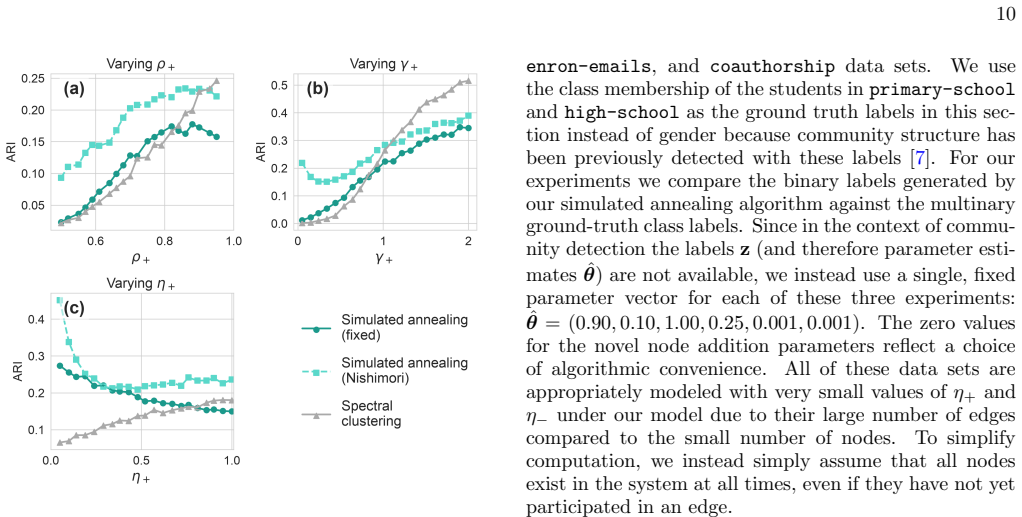
- [IV C, Fig. 6] The empirical community detection comparison against reported values from prior work is not apples-to-apples: the authors use a fixed parameter vector with zero novel-node addition and an approximate likelihood (Appendix D), and they concede that belief-propagation spectral clustering achieves higher ARI on senate-bills than CHILI. The claim that CHILI 'outperforms' competitors should be framed as proof-of-concept; this is consistent with the paper's own wording but the abstract and introduction overstate it.
minor comments (5)
- [Eq. (2)] The relation between the exponent ζ and the slope of the degree density or complementary CDF in Fig. 7 should be stated explicitly; the current phrasing invites a factor-of-one confusion.
- [Algorithm 1] The entrywise division s′ ← x ⊘ y is unclear when y contains zero entries; a brief statement on numerical handling (e.g., zero-belief edges) would improve reproducibility.
- [Appendix D] The intersection-based approximation is justified for large n, but several empirical data sets have m much larger than n (Table I). A small sensitivity analysis on one empirical data set would help gauge the approximation error.
- [Fig. 7 caption] The caption contains a likely typo: 'γ− = η−3' should probably read 'γ− = η− = 3'. Please clarify.
- [Abstract / Introduction] The abstract overstates the derivations by not flagging the mean-field assumption or the likelihood approximation used in community detection.
Circularity Check
No significant circularity: the analytic predictions are derived self-consistently from model parameters and checked against independent simulations; the flagged issues are acknowledged assumptions or correctness risks, not circular reductions.
full rationale
The derivation chain is self-contained. The stationary joint distribution q(k0,k1) is defined as the leading eigenvector of a transition matrix T whose entries are built from the model's parametric copy/extant/novel-node probabilities (Section II A 1); it is not fitted to simulation data, and Figure 2 compares the eigenvector against independently simulated CHILI runs. The degree exponent in Eq. (2) is derived in Appendix A from the model parameters and the moments mu_ij of q via a mean-field master equation, and Figure 7 compares the closed-form line with an independent model simulation. There is no step in which a predicted quantity is set equal to a fitted value by construction. The paper's self-citations are not load-bearing: the HCM power-law argument of [24] is re-derived in Appendix A rather than merely imported, and the community-detection baselines [7,12] are used only as comparison points. The manuscript explicitly flags its one approximation: 'The argument requires a mean-field assumption: when a node u is selected from edge f in the edge-sampling step, the degree d of u is independent of the ratio k0/k of label-0 nodes in the edge f sampled to form the new edge e' (Appendix A, around Eq. A8). An additional concern raised in review is that T in Section II A 1 is formed as a product of focal-label-marginalized distributions t(k'_0|k0,k1)t(k'_1|k0,k1), which is not algebraically identical to the exact joint transition law that conditions on a single shared focal node label. That is a mathematical correctness/fidelity issue about whether the leading eigenvector of T is the true CHILI stationary distribution, not a circularity: the paper does not define q to be the eigenvector and then reimport it as data. No circular step meets the evidentiary bar; therefore the circularity score is 0.
Assumptions & free parameters
free parameters (7)
- ρ+ =
estimated per dataset; fixed at 0.90 in empirical CD vector
- ρ− =
estimated per dataset; fixed at 0.10 in empirical CD vector
- γ+ =
estimated per dataset; fixed at 1.00 in empirical CD vector
- γ− =
estimated per dataset; fixed at 0.25 in empirical CD vector
- η+ =
estimated per dataset; fixed at 0.001 in empirical CD vector
- η− =
estimated per dataset; fixed at 0.001 in empirical CD vector
- c* in KL error metric =
1
assumptions (5)
- domain assumption Mean-field independence between node degree and label ratio of seed edge
- domain assumption Existence, uniqueness, and convergence of stationary edge-label count distribution q as Perron eigenvector of T
- domain assumption Uniform sampling of seed edge f from all previous edges at each step
- ad hoc to paper All nodes exist at all times in the empirical community detection experiments
- ad hoc to paper Intersection-based approximation to the likelihood for simulated annealing
Cite this review
Pith. "Pith review of Growing Hypergraphs with Homophily." pith.science (2026). https://pith.science/paper/C7MOBLAS
@misc{pith2026260716046,
  author       = {Pith},
  title        = {Pith review of: Growing Hypergraphs with Homophily},
  year         = {2026},
  howpublished = {\url{https://pith.science/paper/C7MOBLAS}},
  note         = {Machine review of arXiv:2607.16046}
}
read the original abstract
There are many extant models of hypergraphs with interactions governed by attribute-based homophily between nodes, but most assume independence between edges conditional on node parameters. Relaxing this assumption, we study a mechanistic model of growing hypergraphs in which edge formation is influenced by both previous edges and binary node labels. Edges form in this model as noisy copies of previous edges, where the transmission of nodes from one edge to the next depends on multiple homophilic mechanisms between labels. These homophilic mechanisms give rise to tunable assortative structure in the hypergraph. We derive a power law for the degree distribution in this model and describe the long-term dynamics of the joint distribution of labels contained in edges. Our model defines a likelihood over a labeled hypergraph, allowing us to use standard maximum-likelihood techniques to structure algorithms. We estimate the model parameters on synthetic and real data via (stochastic) expectation maximization. These estimates give statistically-principled descriptions of the operation of homophily in empirical polyadic systems. We also demonstrate an approach to community detection via simulated annealing which, though computationally expensive, achieves competitive results on both synthetic data and certain empirical data sets known to be challenging to community detection techniques based on the edge-independence assumption. Our findings highlight the benefits of incorporating edge- and label-dependence in higher-order modeling and data analysis, and point to several directions for future work.
Figures


Figures from the paper (6 more)



Reference graph
Works this paper leans on
-
[1]
Under thet→ ∞limit this joint distribution can be obtained as the leading eigenvector of a linear map
Joint Distribution of Labels in Edges Many asymptotic properties of our CHILI model can be described in terms of the joint distributionq(k 0, k1) of node labels in an edge; hereq(k 0, k1) gives the prob- ability that an edge selected uniformly at random from Econtains exactlyk 0 nodes of label 0 andk 1 nodes of label 1. Under thet→ ∞limit this joint distr...
-
[2]
of realizing an edge with k′ 0 nodes of label 0 andk ′ 1 nodes of label 1 in timestep t+ 1 is given by r(k′ 0, k′
-
[3]
At sta- tionarity, we must haver(k′ 0, k′
= X k0,k1 T(k ′ 0, k′ 1|k0, k1)qt(k0, k1), whereT(k ′ 0, k′ 1|k0, k1) gives the probability that the edge erealized in stept+ 1 hask ′ 0 nodes of label 0 andk ′ 1 nodes of label 1 given that the edgefsampled to forme hask 0 nodes of label 0 andk 1 nodes of label 1. At sta- tionarity, we must haver(k′ 0, k′
-
[4]
=q(k ′ 0, k′ 1), so the stationarity condition can be obtained by solving the linear system q(k ′ 0, k′
-
[5]
instantaneous
= X k0,k1 T(k ′ 0, k′ 1|k0, k1)q(k 0, k1). The stationary joint distributionq(k 0, k1) is therefore given by the leading eigenvector of the doubly-indexed matrixTwith entriesT(k ′ 0, k′ 1|k0, k1). The entries of this matrix follow from the parametric probability de- scriptions used to define the CHILI model. Conditional on choosing an edgefwithk 0 nodes o...
-
[6]
flipping
Degree Distribution One model feature we can obtain from the station- ary joint distributionq(k 0, k1) is the asymptotic degree distribution generated from CHILI. This asymptotic dis- tribution follows a power law with an exponent which can be computed in closed form from the model parame- ters and the stationary joint distributionq(k 0, k1). Our derivati...
2000
-
[7]
Battiston, G
F. Battiston, G. Cencetti, I. Iacopini, V. Latora, M. Lu- cas, A. Patania, J.-G. Young, and G. Petri, Physics Re- ports874, 1 (2020)
2020
-
[8]
C. Bick, E. Gross, H. A. Harrington, and M. T. Schaub, SIAM Review65, 686 (2023)
2023
Show all 62 references
-
[9]
Mastrandrea, J
R. Mastrandrea, J. Fournet, and A. Barrat, PloS One10, e0136497 (2015)
2015
-
[10]
A. R. Benson, R. Abebe, M. T. Schaub, A. Jadbabaie, and J. Kleinberg, Proceedings of the National Academy of Sciences115, E11221 (2018)
2018
-
[11]
H. Wu, Y. Yan, and M. K.-P. Ng, IEEE Transactions on Pattern Analysis and Machine Intelligence45, 3245 (2022)
2022
-
[12]
J. M. Levine, J. Bascompte, P. B. Adler, and S. Allesina, Nature546, 56 (2017)
2017
-
[13]
P. S. Chodrow, N. Veldt, and A. R. Benson, Science Ad- vances7, eabh1303 (2021)
2021
-
[14]
Ruggeri, M
N. Ruggeri, M. Contisciani, F. Battiston, and C. De Bacco, Science Advances9, eadg9159 (2023)
2023
-
[15]
C. Kim, A. S. Bandeira, and M. X. Goemans, arXiv preprint arXiv:1807.02884 (2018)
2018 arXiv
-
[16]
Badalyan, N
A. Badalyan, N. Ruggeri, and C. De Bacco, Nature Com- munications15, 7073 (2024)
2024
-
[17]
J. Hood, C. De Bacco, and A. Schein, Nature Communi- cations (2026)
2026
-
[18]
P. S. Chodrow, N. Eikmeier, and J. L. Haddock, SIAM Journal on Mathematics of Data Science5, 251 (2023)
2023
-
[19]
Fernandez V, L
M. Fernandez V, L. Stephan, and Y. Zhu, arXiv preprint arXiv:2604.20907 (2026)
2026 arXiv
-
[20]
J. Li, M. T. Schaub, and L. Peel, arXiv preprint arXiv:2601.10502 (2026)
2026 arXiv
-
[21]
Ruggeri, A
N. Ruggeri, A. Lonardi, and C. De Bacco, Journal of Statistical Mechanics: Theory and Experiment2024, 043403 (2024)
2024
-
[22]
Kritschgau, D
J. Kritschgau, D. Kaiser, O. Alvarado Rodriguez, I. Am- burg, J. Bolkema, T. Grubb, F. Lan, S. Maleki, P. S. Chodrow, and B. Kay, Scientific Reports14, 6933 (2024)
2024
-
[23]
Yu and J
X. Yu and J. Zhu, Journal of the American Statistical Association120, 1491 (2025)
2025
-
[24]
N. W. Landry, J.-G. Young, and N. Eikmeier, EPJ Data Science13, 17 (2024)
2024
-
[25]
G. Lee, M. Choe, and K. Shin, inProceedings of the Web Conference 2021(ACM, Ljubljana Slovenia, 2021) pp. 3396–3407
2021
-
[26]
Malizia, S
F. Malizia, S. Lamata-Ot ´ ın, M. Frasca, V. Latora, and J. G´ omez-Garde˜ nes, Nature Communications16, 555 (2025)
2025
-
[27]
Lamata-Ot ´ ın, F
S. Lamata-Ot ´ ın, F. Malizia, V. Latora, M. Frasca, and J. G´ omez-Garde˜ nes, Physical Review E111, 034302 (2025)
2025
-
[28]
A. R. Benson, R. Kumar, and A. Tomkins, inProceed- ings of the 24th ACM SIGKDD International Conference on Knowledge Discovery & Data Mining(ACM, London United Kingdom, 2018) pp. 1148–1157
2018
-
[29]
C. Avin, Z. Lotker, Y. Nahum, and D. Peleg, inPro- ceedings of the 2019 IEEE/ACM International Confer- ence on Advances in Social Networks Analysis and Min- ing(ACM, Vancouver British Columbia Canada, 2019) pp. 398–405
2019
-
[30]
X. He, P. S. Chodrow, and P. J. Mucha, Physical Review E112, 024305 (2025)
2025
-
[31]
Lee and K
G. Lee and K. Shin, in2021 IEEE International Con- ference on Data Mining (ICDM)(IEEE, Auckland, New Zealand, 2021) pp. 310–319
2021
-
[32]
Lee and K
G. Lee and K. Shin, Knowledge and Information Systems 65, 1549 (2023)
2023
-
[33]
Giroire, N
F. Giroire, N. Nisse, T. Trolliet, and M. Sulkowska, Net- work Science10, 400 (2022)
2022
-
[34]
Giroire, N
F. Giroire, N. Nisse, K. Ohulchanskyi, M. Sulkowska, and T. Trolliet, Preferential attachment hypergraph with vertex deactivation (2022), arXiv:2205.00071 [cs]
2022 arXiv
-
[35]
Kami´ nski, P
B. Kami´ nski, P. Pra lat, and F. Th´ eberge, Journal of Complex Networks11, cnad028 (2023)
2023
- [36]
-
[37]
T. P. Peixoto, L. Peel, T. Gross, and M. De Domenico, arXiv preprint arXiv:2602.16937 (2026)
2026
-
[38]
N. W. Landry, M. Lucas, I. Iacopini, G. Petri, A. Schwarze, A. Patania, and L. Torres, Journal of Open Source Software8, 5162 (2023)
2023
-
[39]
M. E. Newman and M. Girvan, Physical review E69, 026113 (2004)
2004
-
[40]
Mitzenmacher, Internet Mathematics1, 226 (2004)
M. Mitzenmacher, Internet Mathematics1, 226 (2004)
2004
-
[41]
A. P. Dempster, N. M. Laird, and D. B. Rubin, Journal of the Royal Statistical Society: Series B (Methodological) 39, 1 (1977)
1977
-
[42]
Capp´ e and E
O. Capp´ e and E. Moulines, Journal of the Royal Statis- tical Society Series B: Statistical Methodology71, 593 (2009)
2009
-
[43]
M. E. Newman, Physical Review E94, 052315 (2016)
2016
-
[44]
Kirkpatrick, C
S. Kirkpatrick, C. D. Gelatt Jr, and M. P. Vecchi, Science 220, 671 (1983)
1983
-
[45]
J. H. Fowler, Political analysis14, 456 (2006)
2006
-
[46]
J. H. Fowler, Social networks28, 454 (2006)
2006
-
[47]
Gemmetto, A
V. Gemmetto, A. Barrat, and C. Cattuto, BMC infec- tious diseases14, 695 (2014)
2014
-
[48]
Stehl´ e, N
J. Stehl´ e, N. Voirin, A. Barrat, C. Cattuto, L. Isella, J.- F. Pinton, M. Quaggiotto, W. Van den Broeck, C. R´ egis, B. Lina,et al., PloS One6, e23176 (2011)
2011
-
[49]
Agarwal, N
S. Agarwal, N. Mittal, R. Katyal, A. Sureka, and D. Cor- rea, ACM SIGCAS Computers and Society46, 7 (2016)
2016
-
[50]
Klimt and Y
B. Klimt and Y. Yang, inEuropean Conference on Ma- chine Learning(Springer, 2004) pp. 217–226
2004
-
[51]
L. P. Schwartz, J. F. Li´ enard, and S. V. David, PLoS Biology20, e3001771 (2022)
2022
-
[52]
Harbridge-Yong, C
L. Harbridge-Yong, C. Volden, and A. E. Wiseman, The Journal of Politics85, 1048 (2023)
2023
-
[53]
M. R. Dobson, State Politics & Policy Quarterly26, 139 (2026)
2026
-
[54]
Decelle, F
A. Decelle, F. Krzakala, C. Moore, and L. Zdeborov´ a, Physical Review E—Statistical, Nonlinear, and Soft Mat- ter Physics84, 066106 (2011)
2011
-
[55]
Von Luxburg, Statistics and Computing17, 395 (2007)
U. Von Luxburg, Statistics and Computing17, 395 (2007)
2007
-
[56]
Hubert and P
L. Hubert and P. Arabie, Journal of classification2, 193 (1985). 13
1985
-
[57]
Clauset, M
A. Clauset, M. E. J. Newman, and C. Moore, Physical Review E70, 066111 (2004)
2004
-
[58]
Lei and A
J. Lei and A. Rinaldo, The Annals of Statistics , 215 (2015)
2015
-
[59]
M. H. DeGroot and M. J. Schervish,Probability and Statistics, 4th ed. (Addison-Wesley, Boston, 2012)
2012
-
[60]
A. A. Hagberg, D. A. Schult, and P. J. Swart, inPro- ceedings of the 7th Python in Science Conference, edited by G. Varoquaux, T. Vaught, and J. Millman (Pasadena, CA USA, 2008) pp. 11–15. Appendix A: Power-Law Degree Distribution We now derive the asymptotic power law degree ...
2008
-
[61]
Letz=z u be the label of the seed nodeu
Sufficient Statistics We describe the functionψfrom Section III A which computes the conditional sufficient statistics for the pa- rametersθ= (ρ +, ρ−, γ+, γ−, η+, η−) given an observed edgee, a candidate parent edgef, a candidate seed node u, and the node labelsz. Letz=z u be...
-
[62]
The initial learning rate is set toα [0] = 0.01, and the decay ratec= 0.001
Learning Rate We use an exponentially decaying learning rate for SEM with formα [ℓ] =α [0] ·e −cℓ. The initial learning rate is set toα [0] = 0.01, and the decay ratec= 0.001. We initialized the vector of sufficient statisticss [0] = (1,2,1,2,0.5,0.5,0.5,0.5). Other reasonable...
Reviewed August 1, 2026 · model on record in the stance chip above.
Discussion (0). Continue with ORCID to comment.