REVIEW 3 major objections 5 minor 40 references
DS@GT ARC at AnimalCLEF 2026: Species-Aware Graph Construction for Multi-Species Animal Re-Identification
T0 review · 3 major / 5 minor · reviewed 2026-08-01 · deepseek-v4-flash
Pith's one-line read The paper argues that in clustering-based animal re-identification, the deciding factor is not which visual descriptor is strongest but which image pairs are admitted as edges in a per-species similarity graph. It builds a pipeline that pro
desk verdict Honest, clearly written competition paper with a useful graph-construction framing; the main claim is not yet separated from threshold tuning, but it deserves refereeing for its venue. read the letter →
The pith
A machine-rendered reading of the paper's core claim, the machinery that carries it, and where it could break.
The reading
What carries the argument
The central object is a species-aware candidate-pair graph. Test images are nodes; proposed same-individual pairs are edges. For each species, a global embedding (chosen per species) retrieves a shortlist; every shortlisted pair receives local-verification features from LightGlue with SuperPoint, SIFT, ALIKED, and DISK keypoints; a LightGBM scorer combines global similarity, retrieval-rank features, neighborhood-context features (shared neighbors, Jaccard overlap), and local match summaries into an edge-strength proposal. A conservative edge-admission stage then applies per-species thresholds (core/expand edge floors, rank caps, local-support gates, shared-neighbor and Jaccard gates, compone
What would settle it
Re-run the pipeline exactly as described, but choose every per-species threshold exclusively from identity-grouped cross-validation on the training split (never touching the leaderboard). If the resulting private ARI falls below the reported 0.674 by more than the cross-validation variance, or if a coarse sweep of thresholds produces an equally good private ARI for very different settings, then the observed performance is not attributable to the edge-admission design as such.
Extended reading notes
Core claim
On the paper's own terms, the central discovery is that reliable individual re-identification across four species emerges from species-aware graph construction rather than from any single descriptor or nearest-neighbor ranking. The authors show that a pair of images becomes a useful identity link only after surviving multiple independent checks — global embedding similarity, retrieval rank and neighborhood overlap, LightGlue local verification across four keypoint families, and a LightGBM pair-scoring model. The selected submission kept three species at their frozen baseline configurations and promoted only a more selective salamander block, which reduced fragmentation while keeping the larg
Load-bearing premise
The load-bearing premise is that the per-species retrieval budgets, edge thresholds, and Leiden resolutions reported in Table 2 were not effectively overfit to the public/private leaderboard, so the measured ARI reflects the graph-construction architecture rather than threshold selection on the test set.
Editorial extensions
If this is right
- If edge admission is the lever, then improving global descriptors or retrieval recall alone will not fix clustering-based re-identification; matching gains must be paired with calibrated per-species edge gates.
- Per-species operating points are necessary: species with many singleton identities (salamanders) punish false bridges most, while species with consistent framing and low-resolution imagery (sea turtles) reward stable global retrieval over aggressive local verification.
- Local feature support is valuable evidence but not a sufficient condition; the pair scorer relied most on retrieval-rank features, with DISK keypoint matches second, so a single cue is not enough.
- Stronger retrieval does not automatically transfer to better clustering: in sea turtles the fused retrieval curve was strongest, yet the downstream graph controls favored a single backbone, so retrieval and clustering should be optimized jointly.
- Clustering shape diagnostics — cluster count, singleton count, largest component, same-cluster pairs — should accompany ARI reporting, because two pipelines with similar ARI can have very different over-merge and fragmentation behavior.
Reading between the lines
- The reported public/private ARI gap (0.733 vs 0.674) and the paper's own emphasis on operating-point sensitivity suggest that a meaningful fraction of the result may come from leaderboard-informed threshold choices; a fully threshold-free cross-validated variant is the obvious test of how much is architecture and how much is tuning.
- The bridge-edge failure mode is a general phenomenon: any clustering pipeline that forms edges from pairwise scores and then takes transitive closure will amplify false positives. The paper's neighborhood-consistency gates can be seen as a general recipe — require reciprocal-neighbor or shared-neighbor support before trusting a high-scoring pair.
- The exploratory 3D/UV and scale-detection directions, though not deployed, suggest a testable extension: canonicalizing pose or extracting stable local landmarks (belly scales, fur spots) could improve the local-verification stage for species with deformable bodies, if a shared canonical space across individuals can be learned.
- One could test whether a single meta-model that predicts per-species edge thresholds from dataset statistics (singleton rate, image resolution, domain shift, embedding AP) reproduces the manually tuned operating points; if yes, the per-species tuning can be automated.
Editorial analysis
A structured set of objections, weighed in public.
Referee Report
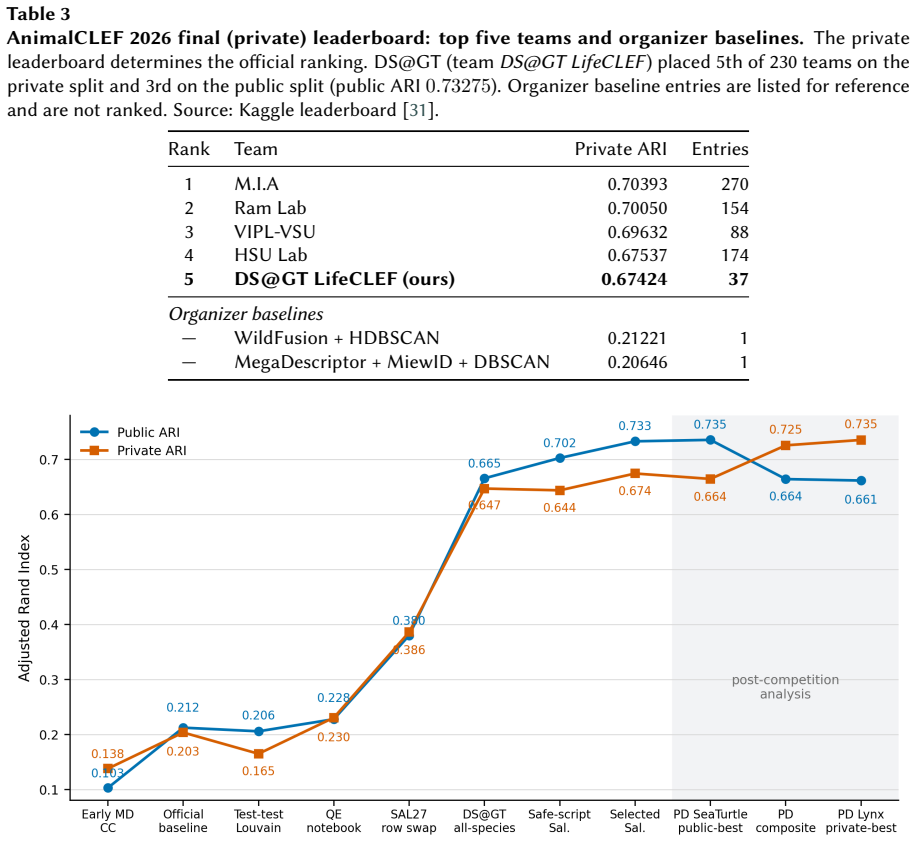
Summary. The paper describes the DS@GT ARC submission to the AnimalCLEF 2026 individual-animal clustering challenge. The system pipelines species-specific preprocessing, global retrieval with MegaDescriptor/MiewID, LightGlue local verification, LightGBM pair scoring, conservative edge-admission gates, and Leiden clustering for four species. The selected submission scored 0.733 public and 0.674 private ARI, ranking 5th of 230 teams. The paper's central claim is that treating re-identification as species-aware graph construction with strong edge-admission gates—rather than relying on any single descriptor—was the key to performance. Ablations and sensitivity studies support this claim only partially; the paper is honest that ablations are not controlled and that the highest-priority future work is controlled operating-point validation.
Significance. If the central claim is correct, the paper is a useful demonstration that clustering-based re-ID benefits from explicit graph-level constraints and conservative edge admission, not only from better embeddings. The system is documented in detail, code is released, and results are anchored to an external Kaggle leaderboard. The paper also reports exploratory negative results (3D unwrapping, UV projections, scale detection) and explicitly distinguishes sensitivity studies from controlled ablations, which is commendable. However, the evidence does not yet separate the architecture's contribution from the per-species operating-point tuning; this limits the strength of the claim until the proposed controlled validation is performed.
major comments (3)
- [§4.6, Table 2] The promoted Salamander replacement bundles at least six changes: MiewID retrieval, SAM3 mask-square-pad, vertical-flip TTA, LightGlue features, raw LightGBM scores, and evidence-gated Leiden. The reported improvement over the frozen baseline cannot be attributed to 'edge admission' or graph construction alone. Please provide a component-level decomposition, e.g., apply only the graph gates to the frozen baseline's candidate set, or swap each other component in isolation while keeping the graph stage fixed.
- [§4.7 and §7] Table 7 ablations change one component but explicitly do not retrain the pair scorer or retune graph thresholds, and the paper correctly labels these as sensitivity studies. Under these conditions, removing SAM3 or MiewID may lower ARI because the remaining pipeline is mismatched to thresholds tuned for the full configuration, not because those components are intrinsically required. The paper's own §7 identifies controlled operating-point validation as the top future work. Without such sweeps under a frozen retrieval cache and pair scorer, the central conclusion that edge admission—rather than the particular operating points selected across 37 leaderboard submissions—drove the 0.674 private ARI is not yet established.
- [§5.1, Table 3] All reported public/private values are full-submission ARI; hidden per-species ARI is not reported. Because the paper argues for species-aware design and because only Salamander was promoted while three species retained the baseline, per-species ARI (or per-species local CV with variance) is needed to support the species-aware claims and to assess whether the Salamander-specific tuning dominated the aggregate score. Additionally, no error bars or repeated-run variance are given for local CV, so it is unclear whether small differences in Table 7 (e.g., 0.650 vs 0.660 public after removing MiewID) are meaningful.
minor comments (5)
- [Author block] The corresponding-author email '/envel⌢pe-⌢penesmith446@gatech.edu' contains corrupted characters; please replace with a readable address such as 'evansmith446@gatech.edu'.
- [§3, Table 1] The column labeled 'Median' is not defined in the text; specify that it is the median number of images per identity.
- [§5.4, Figure 6] Figure 6 is referenced but not visible in the manuscript; include the figure or remove the reference.
- [§5.3, Table 6] The table caption states 'Mean averages the three species,' but TexasHornedLizards is excluded because it has no labeled identities. State this explicitly in the caption.
- [§5.1, Eq. (1)] The ARI denominator typesetting '1/2 [ ... ]' is ambiguous; use a clear fraction or bracket notation, e.g., \frac{1}{2}\left[\sum_i \binom{a_i}{2}+\sum_j \binom{b_j}{2}\right].
Circularity Check
No significant circularity: the central graph-construction claim rests on external leaderboard scores and ablation comparisons, not on fitted inputs or a self-citation chain.
full rationale
The paper contains no derivational step in which an output is defined in terms of an input, nor any fitted parameter relabeled as a prediction. The central quantitative result (public ARI 0.733 / private ARI 0.674, §5.1) is an externally evaluated leaderboard score, not a value generated by the paper's own constants. The species-specific operating points in Table 2 are explicitly selected through local validation and leaderboard submissions ('selected the species-specific operating point with the strongest full-system behavior'), and §7 candidly identifies controlled operating-point validation as the highest-priority future work because threshold changes 'changed whether candidate pairs became useful identity links or false bridge edges.' That is an acknowledged threat to external validity, not circularity: the conclusion that edge admission matters is supported by comparing different edge configurations against an external ARI, not by construction. Ablations in Table 7 are labeled sensitivity studies ('change one component ... without retraining the pair scorer or retuning graph thresholds'), so their confounds are disclosed; they do not fit a target and then re-display it. The only self-citation ([14], the team's 2025 working note) is used for context about triplet learning in the earlier pipeline and is not load-bearing; the current system's backbones, local matchers, scorer, and clustering method are independently cited ([10,17,18,20,24,30]), and the paper's own edge-admission claim is not derived from that self-citation. No circular step can be exhibited from the paper's equations or construction, so the appropriate finding is no significant circularity.
Assumptions & free parameters
free parameters (9)
- Per-species retrieval budgets (retrieved/scored candidate pairs) =
Lynx 40/20; Salamander test 224/128, graph 60/30; SeaTurtle 50/25; TexasHornedLizards 60/30
- Lynx core/expand edge thresholds =
0.93 / 0.88
- Salamander core/expand/very-core and singleton/merge thresholds =
0.9618 / 0.9255 / 0.9811; singleton/merge 0.9829 / 0.9546
- SeaTurtle core/expand edge thresholds =
0.92 / 0.85
- TexasHornedLizards core/expand edge thresholds =
0.95 / 0.90
- Leiden resolution =
0.02 (Lynx, SeaTurtle); 0.03 (Salamander)
- Edge floor and shared-neighbor gates =
Edge floor 0.82/0.80/0.81; shared neighbors >=2 (Lynx, SeaTurtle), >=3 (TexasHornedLizards)
- Known-identity attachment threshold/margin/support (Lynx) =
0.94 / 0.04 / 2
- LightGBM pair scorer hyperparameters =
250 trees, learning rate 0.06, 63 leaves, row/column subsampling 0.8, L2 0.5
assumptions (5)
- standard math ARI is a valid evaluation metric for individual identity clustering.
- domain assumption Ground-truth identity labels in the competition test set are correct and complete.
- domain assumption LightGlue match counts/confidences and LightGBM pair scores carry signal about same-individual identity.
- domain assumption Leiden community detection with chosen resolutions recovers true identity clusters from retained edges.
- ad hoc to paper Per-species operating points tuned on local CV and leaderboard scores transfer to the hidden test set.
Cite this review
Pith. "Pith review of DS@GT ARC at AnimalCLEF 2026: Species-Aware Graph Construction for Multi-Species Animal Re-Identification." pith.science (2026). https://pith.science/paper/675KG5JO
@misc{pith2026260716453,
  author       = {Pith},
  title        = {Pith review of: DS@GT ARC at AnimalCLEF 2026: Species-Aware Graph Construction for Multi-Species Animal Re-Identification},
  year         = {2026},
  howpublished = {\url{https://pith.science/paper/675KG5JO}},
  note         = {Machine review of arXiv:2607.16453}
}
read the original abstract
Automated individual animal re-identification is essential for large-scale biodiversity monitoring; however, field imagery complicates separating identity cues from nuisance variation in pose, illumination, background, resolution, and species-specific morphology. The DS@GT ARC submission to AnimalCLEF 2026 introduces a multi-species image-clustering system for re-identifying Eurasian lynx, fire salamanders, loggerhead sea turtles, and Texas horned lizards. Instead of relying on a single descriptor or nearest-neighbor retrieval, this approach formulates re-identification as species-aware graph construction over candidate image pairs. The pipeline integrates tailored preprocessing, global candidate retrieval, LightGlue-based local verification with multiple keypoint families, LightGBM pair scoring, conservative edge admission, and Leiden community detection. This design directly addresses a primary failure mode of clustering-based re-identification: high-scoring false pairs that act as bridge edges and merge distinct individuals through transitive closure. Across species, ablation studies demonstrate that local feature support, foreground-aware preprocessing, and species-specific backbone selection enhance pair evidence, while graph operating points determine the trade-off between fragmentation and over-merging. The selected submission achieved a public ARI of 0.733 and a private ARI of 0.674, ranking fifth among 230 teams. These results indicate that robust wildlife re-identification requires not only strong visual representations but also calibrated integration of global similarity, local identity markings, neighborhood context, and graph-level constraints. The code can be found at https://github.com/dsgt-arc/animalclef-2026.
Figures


Figures from the paper (5 more)


Reference graph
Works this paper leans on
-
[1]
URL: https://www
Kaggle, LifeCLEF, AnimalCLEF26 @ CVPR & CLEF, Kaggle competition, 2026. URL: https://www. kaggle.com/competitions/animal-clef-2026, accessed: 2026-05-15; companion challenge page: https://www.imageclef.org/AnimalCLEF2026
2026
-
[2]
L. Adam, K. Papafitsoros, D. A. Williams, D. Biffi, L. Picek, Overview of AnimalCLEF 2026: Discovery and re-identification of individual animals, in: Working Notes of CLEF 2026 - Conference and Labs of the Evaluation Forum, 2026
2026
-
[3]
Picek, J
L. Picek, J. Straka, M. Jirik, E. Belotti, M. Dul’a, J. Krausová, M. Bojda, V. Cermak, L. Bufka, R. Dvořák, et al., Czechlynx: A dataset for individual identification and pose estimation of the eurasian lynx, Scientific Data 13 (2026) 511
2026
-
[4]
L. Adam, V. Čermák, K. Papafitsoros, L. Picek, SeaTurtleID2022: A long-span dataset for reliable sea turtle re-identification, in: 2024 IEEE/CVF Winter Conference on Applications of Computer Vision (WACV), 2024, pp. 7146–7156
2024
-
[5]
D. Biffi, M. R. Tucker, A. Ackel, D. A. Williams, Identification of individual Texas horned lizards (Phrynosoma cornutum) using genotypes and ventral spot patterns, Ecology and Evolution 15 (2025) e71167. URL: https://onlinelibrary.wiley.com/doi/full/10.1002/ece3.71167. doi: 10.1002/ ece3.71167
-
[6]
Hubert, P
L. Hubert, P. Arabie, Comparing partitions, Journal of Classification 2 (1985) 193–218. doi: 10. 1007/BF01908075
1985
-
[7]
Picek, L
L. Picek, L. Adam, S. Kahl, R. Bossy, L. Chrobak, H. Goëau, K. Papafitsoros, H. Klinck, W.-P. Vellinga, R. Planqué, T. Denton, K. Barnard, C. Nédellec, L. Deléger, M. Courtin, G. Martellucci, I. Moummad, F. Vinatier, P. Bonnet, A. Joly, Overview of LifeCLEF 2026: AI Challenges for Biodiversity Understanding and Ecosystem Management, in: International Conf...
2026
-
[8]
CLEF Initiative, CLEF 2026: Conference and labs of the evaluation forum, Conference website,
2026
Show all 40 references
-
[9]
URL: https://www.imageclef.org/AnimalCLEF2025, accessed: 2026-05-15
LifeCLEF, AnimalCLEF 2025: Individual animal identification, LifeCLEF challenge page, 2025. URL: https://www.imageclef.org/AnimalCLEF2025, accessed: 2026-05-15
2025
-
[10]
Čermák, L
V. Čermák, L. Picek, L. Adam, K. Papafitsoros, WildlifeDatasets: An open-source toolkit for animal re-identification, in: 2024 IEEE/CVF Winter Conference on Applications of Computer Vision (WACV), 2024, pp. 5941–5951. URL: https://doi.org/10.1109/WACV57701.2024.00585. doi:10.1...
2024
-
[11]
L. Adam, V. Čermák, K. Papafitsoros, L. Picek, WildlifeReID-10k: Wildlife re-identification dataset with 10k individual animals, in: 2025 IEEE/CVF Conference on Computer Vision and Pattern Recognition Workshops (CVPRW), 2025, pp. 2090–2100. URL: https://doi.org/10.1109/CVPRW67...
2025
-
[12]
Pakhomov, G
R. Pakhomov, G. Demidov, K. Bogdan, S. Lanskikh, D. Dinmuhametov, A. Khlopotnykh, In- dividual wildlife recognition via hybrid global-local matching and segmentation-aware filter- ing, in: Working Notes of the Conference and Labs of the Evaluation Forum (CLEF 2025), volume 403...
2025
-
[13]
D. Kim, B. Park, H. Bae, S. Lee, C. Lee, Fusion of global and local descriptors with feature calibration for multi-species animal re-identification: AnimalCLEF 2025, in: Working Notes of the Conference and Labs of the Evaluation Forum (CLEF 2025), volume 4038 ofCEUR Workshop P...
2025
-
[14]
Miyaguchi, C
A. Miyaguchi, C. Maruthaiyannan, C. R. Clark, DS@GT AnimalCLEF: Triplet learning over ViT manifolds with nearest neighbor classification for animal re-identification, in: Working Notes of the Conference and Labs of the Evaluation Forum (CLEF 2025), volume 4038 ofCEUR Workshop ...
2025
-
[15]
N. Semenova, Meta-algorithm for open-set animal re-ID: WildFusion, XGBoost, and dual-backbone ArcFace, in: Working Notes of the Conference and Labs of the Evaluation Forum (CLEF 2025), volume 4038 ofCEUR Workshop Proceedings, Madrid, Spain, 2025, pp. 3154–3165. URL: https: //c...
2025
-
[16]
Oquab, T
M. Oquab, T. Darcet, T. Moutakanni, H. V. Vo, M. Szafraniec, V. Khalidov, P. Fernandez, D. Haziza, F. Massa, A. El-Nouby, M. Assran, N. Ballas, W. Galuba, R. Howes, P.-Y. Huang, S.-W. Li, I. Misra, M. Rabbat, V. Sharma, G. Synnaeve, H. Xu, H. Jégou, J. Mairal, P. Labatut, A. J...
2024
- [17]
-
[18]
URL: https://huggingface
Conservation X Labs, MiewID-msv3, Hugging Face model card, 2024. URL: https://huggingface. co/conservationxlabs/miewid-msv3, wildlife re-identification feature extractor; model created 2024-10-15 and last modified 2025-02-13; accessed: 2026-05-15
2024
- [19]
-
[21]
J. Sun, Z. Shen, Y. Wang, H. Bao, X. Zhou, LoFTR: Detector-free local feature matching with transformers, in: 2021 IEEE/CVF Conference on Computer Vision and Pattern Recognition (CVPR), 2021, pp. 8918–8927. URL: https://doi.org/10.1109/CVPR46437.2021.00881. doi:10.1109/ CVPR46...
2021
-
[22]
J. Tan, A. Wang, Open-set animal re-identification via multilevel feature fusion, in: Working Notes of the Conference and Labs of the Evaluation Forum (CLEF 2025), volume 4038 ofCEUR Workshop Proceedings, Madrid, Spain, 2025, pp. 3242–3247. URL: https://ceur-ws.org/Vol-4038/pa...
2025
-
[23]
Fedorchenko, S
S. Fedorchenko, S. Arefiev, Gradient boosting similarity in entity matching, in: Working Notes of the Conference and Labs of the Evaluation Forum (CLEF 2025), volume 4038 ofCEUR Workshop Proceedings, Madrid, Spain, 2025, pp. 3011–3018. URL: https://ceur-ws.org/Vol-4038/paper_240.pdf
2025
-
[24]
G. Ke, Q. Meng, T. Finley, T. Wang, W. Chen, W. Ma, Q. Ye, T.-Y. Liu, LightGBM: A highly efficient gradient boosting decision tree, in: Advances in Neural Information Processing Systems, volume 30, Curran Associates, Inc., 2017, pp. 3146–3154. URL: https://proceedings.neurips....
2017
-
[25]
Carion, L
N. Carion, L. Gustafson, Y.-T. Hu, S. Debnath, R. Hu, D. Suris, C. Ryali, K. V. Alwala, H. Khedr, A. Huang, J. Lei, T. Ma, B. Guo, A. Kalla, M. Marks, J. Greer, M. Wang, P. Sun, R. Rädle, T. Afouras, E. Mavroudi, K. Xu, T.-H. Wu, Y. Zhou, L. Momeni, R. Hazra, S. Ding, S. Vaze,...
-
[26]
DeTone, T
D. DeTone, T. Malisiewicz, A. Rabinovich, SuperPoint: Self-supervised interest point detection and description, in: Proceedings of the IEEE Conference on Computer Vision and Pattern Recognition (CVPR) Workshops, 2018, pp. 224–236. URL: https://openaccess.thecvf.com/content_cvp...
2018
-
[27]
D. G. Lowe, Distinctive image features from scale-invariant keypoints, International Journal of Computer Vision 60 (2004) 91–110. doi:10.1023/B:VISI.0000029664.99615.94
2004
-
[28]
X. Zhao, X. Wu, W. Chen, P. C. Y. Chen, Q. Xu, Z. Li, ALIKED: A lighter keypoint and descriptor extraction network via deformable transformation, IEEE Transactions on Instrumentation and Measurement 72 (2023) 1–16. doi:10.1109/TIM.2023.3271000
2023
-
[29]
Tyszkiewicz, P
M. Tyszkiewicz, P. Fua, E. Trulls, DISK: Learning local features with policy gradient, in: Advances in Neural Information Processing Systems, volume 33, Curran Associates, Inc., 2020, pp. 14254–14265. URL: https://proceedings.neurips.cc/paper_files/paper/2020/file/ a42a596fc71...
2020
-
[30]
V. A. Traag, L. Waltman, N. J. van Eck, From louvain to leiden: Guaranteeing well-connected communities, Scientific Reports 9 (2019) 5233. doi:10.1038/s41598-019-41695-z
2019 doi
-
[31]
Kaggle, AnimalCLEF26 @ CVPR & CLEF: Leaderboard, Kaggle leaderboard export and private leaderboard API output, 2026. URL: https://www.kaggle.com/competitions/animal-clef-2026/ leaderboard, accessed with Kaggle API on 2026-05-15; public export showed DS@GT LifeCLEF score 0.7327...
2026
-
[32]
S. M. Lundberg, S.-I. Lee, A unified approach to interpreting model predictions, in: Advances in Neural Information Processing Systems, volume 30, Curran Associates, Inc., 2017, pp. 4765–4774. URL: https://proceedings.neurips.cc/paper_files/paper/2017/file/ 8a20a8621978632d76c...
2017
-
[33]
Zhong, L
Z. Zhong, L. Zheng, D. Cao, S. Li, Re-ranking person re-identification with k-reciprocal encoding, in: Proceedings of the IEEE Conference on Computer Vision and Pattern Recognition (CVPR), 2017, pp. 3652–3661. URL: https://openaccess.thecvf.com/content_cvpr_2017/html/Zhong_Re-...
2017 doi
- [34]
-
[35]
Z. Li, D. Litvak, R. Li, Y. Zhang, T. Jakab, C. Rupprecht, S. Wu, A. Vedaldi, J. Wu, Learning the 3D fauna of the web, in: Proceedings of the IEEE/CVF Conference on Computer Vision and Pattern Recognition (CVPR), 2024, pp. 9752–9762. URL: https://openaccess.thecvf.com/content/...
2024
-
[36]
Siméoni, H
O. Siméoni, H. V. Vo, M. Seitzer, F. Baldassarre, M. Oquab, C. Jose, V. Khalidov, M. Szafraniec, S. Yi, M. Ramamonjisoa, F. Massa, D. Haziza, L. Wehrstedt, J. Wang, T. Darcet, T. Moutakanni, L. Sentana, C. Roberts, A. Vedaldi, J. Tolan, J. Brandt, C. Couprie, J. Mairal, H. Jég...
-
[37]
J. P. Crall, C. V. Stewart, T. Y. Berger-Wolf, D. I. Rubenstein, S. R. Sundaresan, HotSpotter — patterned species instance recognition, in: 2013 IEEE Workshop on Applications of Computer Vision (WACV), 2013, pp. 230–237. doi:10.1109/WACV.2013.6475023
2013
-
[38]
X. Wen, B. Zhao, X. Qi, Parametric classification for generalized category discovery: A base- line study, in: 2023 IEEE/CVF International Conference on Computer Vision (ICCV), 2023, pp. 16544–16554. URL: https://doi.org/10.1109/ICCV51070.2023.01521. doi:10.1109/ICCV51070. 2023.01521
2023
-
[39]
Zhang, B
W. Zhang, B. Zhang, Z. Teng, W. Luo, J. Zou, J. Fan, Less attention is more: Prompt transformer for generalized category discovery, in: Proceedings of the IEEE/CVF Con- ference on Computer Vision and Pattern Recognition (CVPR), 2025, pp. 30322–30331. URL: https://openaccess.th...
2025
-
[40]
URL: http://www
PACE, Partnership for an Advanced Computing Environment (PACE), 2017. URL: http://www. pace.gatech.edu
2017
-
[2026]
URL: https://clef2026.clef-initiative.eu/, accessed: 2026-05-15
2026
Reviewed August 1, 2026 · model on record in the stance chip above.
Discussion (0). Continue with ORCID to comment.