REVIEW 4 major objections 6 minor 37 references
Digital measurement of droplet flame diameter in microgravity combustion images using Segment Anything Model 2 with automatic prompt selection
T0 review · 4 major / 6 minor · reviewed 2026-08-01 · deepseek-v4-flash
Pith's one-line read The paper claims that an automatic prompt-point SAM2 workflow, with RANSAC circle fitting, can replace manual measurement of droplet flame diameter in microgravity combustion images, reaching 96.9% mean relative agreement to the manual refe
desk verdict Solid SAM2-based measurement pipeline for microgravity droplet flames, but the headline accuracy is only agreement with the same group's manual reference, not independent truth. read the letter →
The pith
A machine-rendered reading of the paper's core claim, the machinery that carries it, and where it could break.
The reading
What carries the argument
The load-bearing machinery is the automatic prompt-point generator coupled to SAM2's video memory. From a coarse HSV/brightness mask, the algorithm extracts the largest contour, estimates the flame centroid, places four symmetric boundary points (retracted by a fixed shrink factor), and adds a centroid point as positive prompts, plus two negative background points. These prompts remove the need for human point selection and suppress chamber-reflection artifacts, while SAM2's memory attention module keeps the segmentation temporally consistent as the droplet drifts. The final circle parameters come from RANSAC, which counts inliers with geometric residual below a pixel threshold and refits on
What would settle it
Resegment a subset of these videos with several independent human annotators and measure inter-annotator agreement; if annotators differ from each other by more than the reported 3.1% MAPE, part of the 'agreement' is an artifact of matching one particular reference. Alternatively, compare the SAM2 diameters against an independent, crisper-boundary measurement (e.g., UV or schlieren imaging of the same flames); if the independent reference deviates from both SAM2 and the manual reference by more than 8.5%, the claimed accuracy is not absolute.
Extended reading notes
Core claim
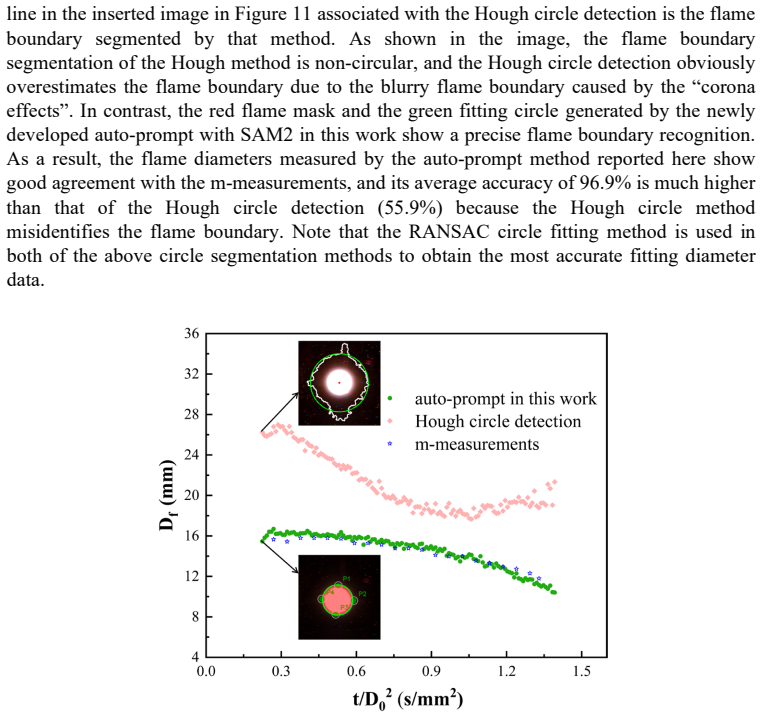
The central claim is that a general-purpose segmentation model can be turned into a trustworthy digital measurement instrument for flame diameter without retraining. The authors combine an HSV-based contour estimate to generate five symmetric prompt points automatically, feed those prompts to SAM2's video model for frame-consistent segmentation of the flame, and then apply RANSAC-based circle fitting so that pixels belonging to a soot tail are rejected as geometric outliers rather than biasing the diameter. Against manual-reference measurements, the method achieves a mean relative agreement of 96.9% and a mean absolute percentage error of 3.1%, and it outperforms conventional Hough circle de
Load-bearing premise
The load-bearing premise is that the manual-reference diameters—carrying a stated 8.5% uncertainty—are the correct ground truth; the reported 96.9% agreement is agreement with hand-drawn measurements, not with an independently established physical flame diameter.
Editorial extensions
If this is right
- Flame diameter data from archived microgravity experiments can be regenerated automatically with documented agreement to earlier manual values, enabling comparisons across fuels and initial droplet diameters.
- The workflow reduces a roughly 20,000-minute manual analysis load to about 90 minutes on the tested set, making full-video, high-throughput combustion diagnostics practical.
- Accuracy rising with droplet size implies small-droplet flames are the hardest cases; for those, the method still reports around 96–97% agreement.
- The reported combined uncertainty of 8.54% is dominated by the manual-reference uncertainty, so the automated pipeline itself adds little beyond the reference.
- Because SAM2 is used without fine-tuning, the authors argue the same recipe can be applied to other fuels and other combustion-imaging tasks without per-dataset training.
Reading between the lines
- The 96.9% figure is agreement with a manual reference carrying 8.5% stated uncertainty; a fair reading is that the workflow reproduces human judgment at human-level uncertainty, not that it measures an absolute ground truth more accurately than a human can.
- A natural extension, not tested here, is applying the same auto-prompt-plus-RANSAC recipe to other blurry-boundary circular measurements—bubbles in flow, weld pool shapes, or biological colonies—where a threshold-based contour can initialize prompts.
- The dependence of accuracy on droplet size hints that pixel resolution, not segmentation quality, is the limiting factor for small droplets; higher-resolution imaging or super-resolution preprocessing would likely push small-droplet agreement toward the large-droplet level.
- One could benchmark the auto-prompt strategy against a fully learned circle-regression baseline on the same 19,537 images; if a lightweight network matched or exceeded 96.9% at lower latency, the SAM2 dependency would be optional rather than necessary.
Signed reviews
Editorial analysis
A structured set of objections, weighed in public.
Referee Report
Summary. The paper presents a fully automated image-analysis workflow for measuring droplet flame diameter in microgravity combustion videos. The pipeline combines automatic prompt-point generation with SAM2 video segmentation, RANSAC-based circle fitting, and temporal tracking via SAM2's memory mechanism. The authors validate the method on 19,537 flame images from ISS FLEX-2 experiments covering n-heptane, n-decane, and n-octane, reporting a mean relative agreement of 96.9% with manual-reference measurements, an 8.54% combined standard uncertainty, and an approximately 229x speed-up over manual measurement. The central claim is that this workflow provides a reproducible, fully automated, and metrologically characterized replacement for manual flame-diameter extraction.
Significance. If the claims are substantiated, this is a useful contribution to combustion diagnostics and to the broader use of foundation segmentation models in quantitative image metrology. The work draws on a large publicly available dataset, avoids fine-tuning SAM2, and tackles real challenges (soot tails, corona effects, droplet drift) with domain-aware strategies. The reported efficiency gain is substantial, and the method appears to generalize across three fuels. However, the significance is conditional: the headline accuracy is measured only against a manual reference produced by the same research group, and several key parameters were selected using that same reference. The paper does not yet provide independent evidence that the method measures the true flame diameter rather than reproducing the biases of the manual reference.
major comments (4)
- [Section 3.1, 3.7; Eqs. (8)] The validation ground truth is not independent. The manual-reference measurements m-measurements from Ref. [5] are generated by the same group and carry a stated 8.5% uncertainty. Eq. (8) adds u_ref=0.085 directly into the combined uncertainty, so the reported 8.54% is dominated by the reference uncertainty and does not characterize the automated method itself. Because the HSV thresholds, shrink factor, RANSAC parameters, and prompt-point count were selected by comparing to these same m-measurements in Sections 3.2–3.4, the 96.9% agreement is plausibly tuned to reproduce that specific manual interpretation. Please provide an independent validation—for example, on synthetic images with known flame diameters, or against multi-annotator manual measurements with inter-observer variability—and/or reframe the claim as 'agreement with manual reference' rather than absolute accuracy. The abstrac
- [Sections 3.1, 3.3, 3.4, 3.6, 4] The reported accuracy numbers are inconsistent. Section 3.1 reports 98.19% for RANSAC in a subset; Section 3.3 reports 98.05%/98.17% for 5/7 manual p-points; Section 3.4 reports 98.95% for auto prompts; Section 3.6 states the overall 'average accuracy' is 96.9%; Section 4 reports 98.1%. It is unclear which metric is used for the headline claim, for which runs, and with what variation across fuels or droplet sizes. Please report the full per-run breakdown, the sample sizes for each percentage, and confidence intervals or standard deviations for the 96.9% headline value. Without these, the reader cannot assess whether the differences reflect genuine variation or artifacts of the evaluation protocol.
- [Section 3.4, Eq. (IoU/Dice definitions)] The definitions of IoU and Dice are incorrect as stated. The text defines IoU = |A∩B|/|A∪B| and Dice = 2|A∩B|/(|A|+|B|), where A is the segmentation mask and B is 'the manual-reference measurements value'. The manual-reference 'value' is a scalar flame diameter, not a binary mask, so set intersection and union are not defined. The IoU/Dice results in Figure 8 are therefore not interpretable as stated. Please either provide the actual manual segmentation masks used for these overlap metrics or define a proper mask-level ground truth. This is a load-bearing issue for the claim that auto-prompt segmentation has IoU>0.93.
- [Section 3.7, Eq. (8)] The uncertainty budget conflates reference uncertainty with the method's own uncertainty. u_ref=0.085 is the uncertainty of the manual reference, not of the automated workflow; adding it to u_fit and u_cal yields a combined uncertainty that reflects agreement with a noisy reference rather than the repeatability or trueness of the automated method. Please separate the method's own uncertainty (e.g., repeatability from multiple runs, sensitivity to prompt placement, RANSAC fitting variability) from the validation comparison uncertainty. Also justify the assumed calibration standard deviations σL=0.5 mm and σP=1 pixel; these appear arbitrary but enter the final uncertainty directly.
minor comments (6)
- [Abstract/Introduction] The abstract says 'metrologically characterized' but the current uncertainty budget is dominated by the reference term; consider aligning the wording with the actual validation.
- [Section 3.1, Eq. (3)] The parentheses in the indicator function are unbalanced: '1(ε_i(θ) ≤ τ)' should be '1(ε_i(θ) ≤ τ)' with closing parenthesis; also the sum index notation should be cleaned up.
- [Section 3.4] The text says 'B is the manual-reference measurements value'; please clarify whether a diameter value or a binary mask is used for the overlap metrics. If a mask is available, describe how it was obtained.
- [Section 2] The claim 'approximately 229-fold improvement' is based on manual measurement times from a previous study (Ref. [5]) and the authors' own workflow time. Please state clearly the hardware/software used for the timing comparison, since wall-clock time depends heavily on GPU vs CPU and on the manual measurement protocol.
- [Section 4, Figure 12d] The increasing accuracy with initial droplet diameter is an interesting empirical observation, but the three explanatory factors are somewhat speculative. Consider quantifying the pixel-level boundary uncertainty as a function of droplet size instead of listing qualitative factors.
- [References] Some references are to arXiv preprints (e.g., Ref. [27]) and to a thesis (Ref. [29,34]) for the manual-reference uncertainty. If journal versions are available, cite them; otherwise, specify the exact source of u_ref=0.085 more precisely.
Circularity Check
Validation is not fully independent: prompt-count selection and the reference itself come from the same manual-reference measurements used to compute the reported accuracy.
-
fitted input called prediction
[Section 3.3 (Effects of prompt-point selection) and Section 4/Abstract (headline accuracy)]
"The measured flame diameter results for 5 and 7 manual p-points overlap almost exactly, and the results are highly accurate, with average accuracy percentages of 98.05% and 98.17%, respectively. These results indicate that five manual p-points ... are sufficient to obtain accurate measurements of flame diameter. Therefore, the deployment of the five manual prompts is used for the rest of the paper to achieve accurate flame segmentation. ... Compared with manual-reference measurements, the proposed workflow achieves a mean relative agreement of 96.9%."
The number of prompt points (a key design parameter) was selected on n-heptane runs by maximizing agreement with the manual-reference (m-measurement) diameters, and the same m-measurements are then used to compute the headline 96.9% agreement, including those runs. The reported accuracy is therefore partly an in-sample measure of how well the chosen configuration reproduces the specific manual reference, rather than an out-of-sample validation. It is not a full identity because the automated diameters are computed from images, not from the manual values; the leak is statistical/selection-based, not equation-based.
full rationale
The paper is an empirical measurement pipeline rather than a formal derivation, so most of the derivation-chain circularity patterns do not apply. The automatic workflow (SAM2 segmentation from HSV-initialized prompts, RANSAC circle fitting) does not take the manual-reference diameters as an input; its outputs are image-derived. However, the validation protocol has a real selection leak: Section 3.3 chooses the five-prompt configuration by comparing to the m-measurements, and Sections 3.6/4 report accuracy against the same m-measurements, including the development runs. Additionally, the manual reference comes from the same research group's earlier work ([5], [29], [34]) and carries a stated 8.5% uncertainty that dominates the combined 8.54% uncertainty budget. These concerns compromise the independence of the headline numbers but do not reduce the measurement to its inputs by construction; the n-decane/n-octane data and the Hough baseline provide partially independent content. Score 4 reflects partial circularity from tuning/selecting on the evaluation reference, not a fully forced result.
Assumptions & free parameters
free parameters (7)
- HSV brightness threshold =
V > 25
- HSV saturation threshold =
S > 15
- RGB color-sum threshold =
R+G+B > 40
- Morphological kernel sizes =
closing 5x5, opening 3x3
- Shrink factor =
0.9
- Number of p-points =
5 (1 centroid + 4 annulus)
- RANSAC inlier threshold tau and confidence p =
not specified
assumptions (4)
- domain assumption Manual-reference measurements from [5] are unbiased ground truth for flame diameter.
- domain assumption Flame boundary is approximately circular (Eq. 1).
- domain assumption SAM2's pretrained weights generalize to self-illuminated combustion images without fine-tuning.
- domain assumption The HSV/color masks provide a reliable coarse contour for prompt initialization.
Cite this review
Pith. "Pith review of Digital measurement of droplet flame diameter in microgravity combustion images using Segment Anything Model 2 with automatic prompt selection." pith.science (2026). https://pith.science/paper/CLJ6OBSP
@misc{pith2026260716587,
  author       = {Pith},
  title        = {Pith review of: Digital measurement of droplet flame diameter in microgravity combustion images using Segment Anything Model 2 with automatic prompt selection},
  year         = {2026},
  howpublished = {\url{https://pith.science/paper/CLJ6OBSP}},
  note         = {Machine review of arXiv:2607.16587}
}
read the original abstract
Flame diameter is a key measurable parameter in microgravity droplet combustion, but its extraction from self-illuminated frames remains difficult because soot tails, blurred luminous boundaries, chamber reflections, and droplet drift introduce substantial measurement bias and operator dependence. This work presents an AI-enabled digital measurement workflow for automated flame diameter from combustion images. The workflow integrates automatic prompt-point generation into Segment Anything Model 2, employing Random Sample Consensus (RANSAC)-based circle fitting. The automatic prompt strategy removes subjective manual point selection, while the video memory mechanism maintains temporal consistency for drifting droplets, and the RANSAC fitting rejects soot-tail pixels as geometric outliers. The method is validated by 19,537 flame images of n-heptane, n-decane, and n-octane droplets with varying initial diameters. Compared with manual-reference measurements, the proposed workflow achieves a mean relative agreement of 96.9%, a mean absolute percentage error of 3.1%, and substantially outperforms conventional Hough circle detection, which performed worse under the same evaluation conditions. The results also show that the measurement accuracy improves with increasing droplet size. The proposed workflow has a combined standard uncertainty of 8.54% and achieves approximately a 229-fold improvement in efficiency over manual measurement. These results demonstrate that the proposed SAM2-based workflow provides a reproducible, fully automated, and metrologically characterized digital measurement system for extracting flame diameter from challenging combustion images. The approach supports high-throughput combustion diagnostics and illustrates that AI-based segmentation can be integrated into quantitative measurement workflows for digitalized image-based metrology.
Figures


Figures from the paper (7 more)


Reference graph
Works this paper leans on
-
[5]
Y.C. Liu, Y. Xu, M.C. Hicks, C.T. Avedisian, Comprehensive study of initial diameter effects and other observations on convection-free droplet combustion in the standard atmosphere for n -heptane, n-octane, and n- decane, Combust. Flame 171 (2016) 27-41. https://doi.org/10.1016/j.combustflame.2016.05.013
-
[1]
S. Guo, Y. Xu, A. Scaboro, R. Rasul, Y. Wang, A. Reeves, A. Cuoci, A. Frassoldati, M.C. Hicks, C.T. Avedisian, Combustion of n -propylbenzene: experiments and numerical modeling, Proc. Combust. Inst. 40 (2024) 105543. https://doi.org/10.1016/j.proci.2024.105543
arXiv 2024
-
[2]
Y. Xu, Y. Shen, C.T. Avedisian, M.C. Hicks, M.Y. Choi, Quantitative investigation of sooting dynamics in droplet combustion using an automated image analysis algorithm, Fuel 354 (2023) 129313. https://doi.org/10.1016/j.fuel.2023.129313
arXiv 2023
-
[3]
Y. Xu, T.I. Farouk, M.C. Hicks, C.T. Avedisian, Initial diameter effects on combustion of unsupported equi - volume n -heptane/iso-octane mixture droplets and the transition to cool flame behavior: experimental 20 observations and detailed numerical modeling, Combust. Flame 220 (2020) 82 -91. https://doi.org/10.1016/j.combustflame.2020.06.012
-
[4]
Y. Xu, M.C. Hicks, C.T. Avedisian, The combustion of iso -octane droplets with initial diameters from 0.5 to 5 mm: effects on burning rate and flame extinction, Proc. Combust. Inst. 36 (2017) 2541 -2548. https://doi.org/10.1016/j.proci.2016.07.096
-
[6]
Y.C. Liu, Y. Xu, C.T. Avedisian, M.C. Hicks, The effect of support fibers on micro -convection in droplet combustion experiments, Proc. Combust. Inst. 35 (2015) 1709 -1716. https://doi.org/10.1016/j.proci.2014.07.022
-
[7]
Y. Xu, J.D. Brunson, C.T. Avedisian, Y. Shen, I. Keresztes, A.M. Condo, D. Phillips, Burning of algae- derived biofuel droplets and their mixtures with jet fuel, Energy Fuels 34 (2020) 929 -935. https://doi.org/10.1021/acs.energyfuels.9b03238
-
[8]
Y. Xu, I. Keresztes, M. Condo, D. Phillips, P. Pepiot, C.T. Avedisian, Droplet combustion characteristics of algae-derived renewable diesel, conventional# 2 diesel, and their mixtures, Fuel 167 (2016) 295 -305. https://doi.org/10.1016/j.fuel.2015.11.036
Show all 37 references
-
[9]
Liu, F.E
Y.C. Liu, F.E. Alam, Y. Xu, F.L. Dryer, C.T. Avedisian, T.I. Farouk, Combustion characteristics of butanol isomers in multiphase droplet configurations, Combust. Flame 169 (2016) 216 -228. https://doi.org/10.1016/j.combustflame.2016.04.018
2016 doi
-
[10]
Y. Xu, C.T. Avedisian, Combustion of iso-butanol, gasoline, and iso-butanol/gasoline mixture droplets, Energy Fuels 29 (2015) 3467-3475. https://doi.org/10.1021/acs.energyfuels.5b00158
2015 doi
-
[11]
Dietrich, V
D.L. Dietrich, V. Nayagam, M.C. Hicks, P.V. Ferkul, F.L. Dryer, T. Farouk, B.D. Shaw, H.K. Suh, M.Y. Choi, Y.C. Liu, C.T. Avedisian, F.A. Williams, Droplet combustion experiments aboard the International Space Station, Microgravity Sci. Tec. 26 (2014) 65-76. https://doi.org/10...
2014 doi
-
[12]
Turns, Introduction to Combustion, 3rd ed., McGraw-Hill Companies, New York, NY, USA, 2012
S.R. Turns, Introduction to Combustion, 3rd ed., McGraw-Hill Companies, New York, NY, USA, 2012
2012
-
[13]
Investigations / Physical Sciences Informatics (PSI) -68
NASA, 2025. Investigations / Physical Sciences Informatics (PSI) -68. https://psi.nasa.gov/physci/repo/data/investigations/PSI-68 (accessed 14 October 2025)
2025
-
[14]
Ioannou, W
D. Ioannou, W. Huda, A.F. Laine, Circle recognition through a 2D Hough transform and radius histogramming, Image Vision Comput. 17 (1999) 15-26. https://doi.org/10.1016/S0262-8856(98)00090-0
1999 doi
-
[15]
H.K. Yuen, J. Princen, J. Illingworth, J. Kittler, Comparative- study of Hough transform methods for circle finding, Image Vision Comput. 8 (1990) 71-77. https://doi.org/10.1016/0262-8856(90)90059-E
1990 doi
-
[16]
C. More, A. Patil, Circular hough transform for detecting and measuring circles of object, Int. J. Recent Innov. Trends Comput. Commun. 3 (2015) 563-566. https://doi.org/10.17762/ijritcc.v3i2.3862
2015 doi
-
[17]
Lee, S.K
Y. Lee, S.K. Panda, W. Wang, M.K. Jawed, Measure Anything: Real -time, Multi- stage Vision -based Dimensional Measurement using Segment Anything, arXiv preprint arXiv:2412.03472 (2024)
2024 arXiv
-
[18]
Heo, G.E
Y. Heo, G.E. Lee, J. Cho, S.I. Choi, Deep learning-based aortic diameter measurement in traumatic hemorrhage using shallow attention network: a path forward, Diagnostics 15 (2025) 1312. https://doi.org/10.3390/diagnostics15111312
2025 doi
-
[19]
Rasul, C.T
R.B. Rasul, C.T. Avedisian, Y. Xu, M.C. Hicks, A.P. Reeves, Dynamic differential image circle diameter measurement precision assessment: application to burning droplets, IEEE Trans. Pattern Anal. Mach. Intell. 45 (2023) 1668-1681. https://doi.org/10.1109/Tpami.2022.3170926
2023
-
[20]
M. Xu, X. Liu, M.C. Hicks, C.T. Avedisian, Y. Xu, On the use of a sensitivity -enhanced algorithm to quantify sooting dynamics in droplet combustion of highly sooty fuels, Combust. Flame 284 (2026) 114668. https://doi.org/10.1016/j.combustflame.2025.114668
2026
-
[21]
Jackson, C.T
G. Jackson, C.T. Avedisian, The effect of initial diameter in spherically symmetric droplet combustion of sooting fuels, Proceedings of the Royal Society of London. Series A: Mathematical and Physical Sciences 446 (1994) 255-276. https://doi.org/10.1098/rspa.1994.0103
1994
-
[22]
Liu, C.T
Y.C. Liu, C.T. Avedisian, A comparison of the spherical flame characteristics of sub -millimeter droplets of binary mixtures of n-heptane/iso-octane and n-heptane/toluene with a commercial unleaded gasoline, Combust. Flame 159 (2012) 770-783. https://doi.org/10.1016/j.combustf...
2012 doi
-
[23]
X. Liu, M. Xu, M.C. Hicks, C.T. Avedisian, Y. Xu, On burning rate and flame extinction for toluene droplets in low gravity, Energy Fuels 40 (2026) 3372-3381. https://doi.org/10.1021/acs.energyfuels.5c05103
2026 doi
-
[24]
cool flame
T.I. Farouk, Y. Xu, C.T. Avedisian, F.L. Dryer, Combustion characteristics of primary reference fuel (PRF) droplets: single stage high temperature combustion to multistage "cool flame" behavior, Proc. Combust. Inst. 36 (2017) 2585-2594. https://doi.org/10.1016/j.proci.2016.07.066
2017 doi
-
[25]
Banu, Fluids and combustion facility (FCF) and combustion integrated rack (CIR), Payload Accomodations Handbook CIR-DOC-4064, NASA John H
B. Banu, Fluids and combustion facility (FCF) and combustion integrated rack (CIR), Payload Accomodations Handbook CIR-DOC-4064, NASA John H. Glenn Research Center, Cleveland, Ohio (2008)
2008
-
[26]
Robbins, C
J. Robbins, C. Shinn, Multi -user droplet combustion apparatus FLEX -2, Reflight Safety Data Package MDC - DOC-1790A, NASA John H. Glenn Research Center, Cleveland, Ohio (2010). 21
2010
- [27]
-
[28]
Y.M. Wu, H. Zhang, P. Vandewalle, P. Slaets, E. Demeester, A comprehensive review on advances in instance- level 6D object pose tracking, Comput. Vis. Image Underst. 264 (2026) 104667. https://doi.org/10.1016/j.cviu.2026.104667
2026
-
[29]
Liu, Droplet combustion of surrogate and real fuel systems in a low convection condition: ground -based and space-based experiments, Cornell University, 2013
Y.C. Liu, Droplet combustion of surrogate and real fuel systems in a low convection condition: ground -based and space-based experiments, Cornell University, 2013
2013
-
[30]
Fischler, R.C
M.A. Fischler, R.C. Bolles, Random sample consensus: a paradigm for model fitting with applications to image analysis and automated cartography, Commun. ACM 24 (1981) 381 -395. https://doi.org/10.1016/B978-0-08- 051581-6.50070-2
1981 doi
-
[31]
Zhang, Y
M. Zhang, Y. Liu, C. Sun, X. Wang, J. Tan, Precision measurement and evaluation of flatness error for the aero-engine rotor connection surface based on convex hull theory and an improved PSO algorithm, Meas. Sci. Technol. 31 (2020) 085006. https://doi.org/10.1088/1361-6501/ab8170
2020 doi
-
[32]
Umbach, K.N
D. Umbach, K.N. Jones, A few methods for fitting circles to data, IEEE Trans. Instrum. Meas. 52 (2003) 1881 -
2003
-
[33]
Kåsa, A circle fitting procedure and its error analysis, IEEE Trans
I. Kåsa, A circle fitting procedure and its error analysis, IEEE Trans. Instrum. Meas. 1 (2012) 8 -14. https://doi.org/10.1109/TIM.1976.6312298
2012
-
[34]
Xu, Combustion dynamics of bio -derived, surrogate, and transportation fuel systems, Cornell University, 2017
Y. Xu, Combustion dynamics of bio -derived, surrogate, and transportation fuel systems, Cornell University, 2017
2017
-
[35]
Jaccard, Distribution de la flore alpine dans le bassin des Dranses et dans quelques régions voisines, Bull
P. Jaccard, Distribution de la flore alpine dans le bassin des Dranses et dans quelques régions voisines, Bull. Soc. Vaudoise Sci. Nat. 37 (1901) 241-272. https://doi.org/10.5169/seals-266440
1901 doi
-
[36]
Dice, Measures of the amount of ecologic association between species, Ecology 26 (1945) 297 -302
L.R. Dice, Measures of the amount of ecologic association between species, Ecology 26 (1945) 297 -302. https://doi.org/10.2307/1932409
1945 doi
-
[1885]
https://doi.org/10.1109/TIM.2003.820472
2003
Reviewed August 1, 2026 · model on record in the stance chip above.
Discussion (0). Continue with ORCID to comment.