REVIEW 4 major objections 5 minor 95 references
The semileptonic decays of $\mathcal{B}_{Q_{1}Q_{2}}(\frac{1}{2}^{+})\rightarrow\mathcal{B}_{Q_{1}}^{*}(\frac{3}{2}^{+})$ in QCD sum rules
T0 review · 4 major / 5 minor · reviewed 2026-08-01 · deepseek-v4-flash
Pith's one-line read By solving 16 Dirac-structure equations in three-point QCD sum rules, this paper extracts the eight vector and axial transition form factors for B_{Q1Q2}(1/2+)→B*_{Q1}(3/2+) and uses them to predict semileptonic partial widths, branching fr
desk verdict Useful first QCDSR pass at 1/2→3/2 doubly-heavy baryon semileptonic decays, but the contamination-free claim needs a robustness check before the numbers are benchmarks. read the letter →
The pith
A machine-rendered reading of the paper's core claim, the machinery that carries it, and where it could break.
The reading
What carries the argument
The three-point correlation function Π_μν(p,p') built from interpolating currents for the mother and daughter baryons, decomposed into 16 Dirac structures (e^{V}_{iμν} for the vector part and e^{A}_{iμν} for the axial part). After a double Borel transformation, the phenomenological side and the QCD side are matched structure by structure, giving 16 linear equations whose solution isolates the F_i and G_i form factors and eliminates spin-1/2 and negative-parity contamination. The extracted space-like form factors are fitted with a z-series expansion to continue them into the time-like q² region, and helicity amplitudes constructed from these form factors drive all the semileptonic observables
What would settle it
Measure the masses of Ξ_bc, Ω_bc, Ξ_bb, and Ω_bb; if they deviate from the quark-model inputs by more than about 10 percent, the extracted form factors and all derived observables will shift with the thresholds and Borel windows. Alternatively, one independent nonperturbative calculation of F1(0) for Ξ_bc→Σ*_c would settle the sign of the leading form factor, which this paper predicts to be negative (-0.11) while comparable sum-rule treatments give positive values.
Extended reading notes
Core claim
The central claim is that the transition form factors F_i(Q²) and G_i(Q²) for B_{Q1Q2}(1/2+)→B*_{Q1}(3/2+) can be extracted from three-point QCD sum rules without pollution from 1/2± or 3/2- intermediate states, by using 16 Dirac structures to form 16 linear equations for the vector current and another 16 for the axial current. The paper then argues that these form factors, continued to time-like q² through a z-series expansion, give reliable predictions for the semileptonic observables. Concrete outputs include the Q²=0 values of the form factors and, from them, partial widths, branching fractions, Γ_L/Γ_T, A_FB^l, P_z^F, and P_z^l for the Ξ_bc, Ω_bc, Ξ_bb, and Ω_bb decays. A distinctive fe
Load-bearing premise
The calculation takes the masses of the unobserved mother baryons (Ξ_bc, Ω_bc, Ξ_bb, Ω_bb) from quark-model calculations; those masses set the continuum thresholds, the Borel windows, and the phase-space factor, so every quoted width, branching fraction, and asymmetry inherits any error in them.
Editorial extensions
If this is right
- The largest predicted branching fractions among c→q modes, such as Ω_bc→Ω*_b e+ν_e at about 2.1×10^-3, point to the most promising channels for experimental searches of bottom-charm and doubly bottom baryons.
- The sign of the lepton forward-backward asymmetry cleanly separates c→q transitions (positive, 0.21–0.31) from b→u transitions (negative, -0.35 to -0.56), giving a testable diagnostic of the underlying weak transition.
- Tau modes stand out from electron and muon modes in Γ_L/Γ_T and lepton polarization, with ⟨P_z^l⟩≈-0.69 to -0.72; measuring the τ channel would provide a sensitive check of the form-factor input.
- The computed SU(3) flavor relations among widths are explicitly broken, e.g., Γ(Ξ_bc→Σ*_b) differs from Γ(Ω_bc→Ξ*'_b), which quantifies the symmetry breaking induced by the strange-quark mass and the resulting baryon mass differences.
- If the form factors are reliable, they provide an independent route to extract CKM matrix elements from doubly heavy baryon semileptonic decays once those decays are measured.
Reading between the lines
- Because the mother-baryon masses are borrowed from quark-model calculations and are not yet measured, the absolute widths and branching fractions should be read as conditional on those masses; a shift of order 100 MeV in m_{Ξ_bc} or m_{Ω_bc} would move the continuum thresholds and Borel windows, and the widths scale approximately with the phase-space factor Q+Q-.
- The 16-structure elimination scheme is a transferable template for other 1/2→3/2 weak or strong transition calculations where lower-spin and negative-parity contaminations are a known obstacle.
- The sign discrepancy at Q²=0 for F1(0) of Ξ_bc→Σ*_c — negative here but positive in comparable sum-rule treatments — is more informative than a size discrepancy; a single future independent calculation of that one form factor would discriminate sharply between the methods.
- The angular observables A_FB^l and P_z^l depend only on the form factors and Standard Model inputs, not on the unmeasured lifetimes, so they offer a cleaner test of the sum-rule predictions than the absolute widths.
Editorial analysis
A structured set of objections, weighed in public.
Referee Report
Summary. The manuscript presents a QCD sum-rule calculation of the semileptonic transition between doubly heavy baryons B_{Q1Q2}(1/2^+) and a charmed or bottom baryon B_{Q1}^*(3/2^+). The authors write a three-point correlation function, decompose both the phenomenological and OPE sides into 16 Dirac structures for the vector and axial currents, and solve the resulting 16 linear equations to extract the form factors F_i(Q^2) and G_i(Q^2). The OPE includes the perturbative part and condensates up to dimension 6. The form factors are fitted with a z-series and extrapolated to the time-like region, after which the authors compute partial widths, branching fractions, Γ_L/Γ_T, lepton forward-backward asymmetry, daughter-baryon polarization, and lepton longitudinal polarization for the c→d/s and b→u driven decays of Ξ_bc, Ω_bc, Ξ_bb and Ω_bb baryons. Numerical results are compared with quark-model and light-cone sum-rule predictions.
Significance. If the extraction is reliable, this is the first systematic QCD sum-rule study of these 1/2^+ → 3/2^+ doubly heavy baryon semileptonic decays and would provide useful benchmarks for LHCb and future facilities. The 16-structure inversion is a creative attempt to remove spin-1/2 and negative-parity contaminations, and the inclusion of dimension-6 condensates is standard and appropriate. The paper also produces a rich set of observables, not only widths, which is valuable. However, the central claim is not yet fully demonstrated: the OPE spectral densities are not shown, one of the 16 structures is admitted to violate the pole-dominance criterion, and several unmeasured input masses enter without propagated uncertainty. These are load-bearing issues for the quoted form factors and decay observables.
major comments (4)
- [Sec. III, Fig. 3 and Eq. (19)] The paper concedes that the spectral density ρ2 has a pole contribution 'apparently lower than 40%'. Because Eq. (19) is a single 16×16 linear system coupling the four form factors to the contamination amplitudes, an equation dominated by excited/continuum states does not leave the solution unaffected; it enters the matrix inversion. The statement that 'most of the structures satisfy this condition' is not a quantitative argument. Please either remove or re-weight the ρ2 equation and demonstrate that the extracted Fi/Gi and the final widths are insensitive, or provide a sensitivity study in which the ρ2 equation is excluded and the Borel/threshold windows are varied.
- [Sec. II, after Eq. (19)] The OPE spectral densities ρ_i^{QCD-V/A}(s,u,Q^2) are never displayed ('too complex to be shown here'), and no ancillary file is provided. This is not merely a presentation issue: the central claim that the 16-structure inversion is free of spin-1/2 and negative-parity contamination can only be checked if the coefficient matrix is available. Please provide explicit expressions, at least for the perturbative and dominant condensate contributions, or include an ancillary file with the full numerical implementation.
- [Sec. III, Table I and Eq. (25)] The masses of Ξ_bc, Ω_bc, Ξ_bb and Ω_bb are not experimentally measured; they are taken from quark-model calculations (refs. [4,6,7]). These masses set the thresholds s0,u0, the Borel windows, the z-series endpoints t±, and the phase-space factor Q+Q−. No uncertainty from this source is quoted. The errors in Tabs. II–V therefore cover only a subset of the input uncertainties. Please repeat the analysis with the mother-baryon masses varied over the quark-model spread, or over a conservative range, and quote the resulting shifts in Γ, Γ_L/Γ_T, and the asymmetries.
- [Sec. III, Fig. 8 and Tabs. IV–V] The z-series and double-pole fits produce visibly different Q^2 dependence, and the text states that the two methods extrapolate differently into the time-like region. The final widths and branching fractions are obtained from the z-series choice, but the quoted uncertainties do not include the fit-function systematic. Please quantify the spread between fit-Z, fit-D and fit-S on the integrated observables and include it in the error budget, or give a criterion for preferring the z-series extrapolation.
minor comments (5)
- [Fig. 13 caption] The caption says 'Same as Fig. 13 but...'; it should refer to Fig. 12.
- [Throughout] Typos and wording: 'Wo f f −shell' should be 'W-off-shell' (several places); 'the the forward-backward' in Sec. IV; 'paramter' in Sec. V; 'semi-leptonic' is used inconsistently with 'semileptonic'.
- [Eqs. (2) and (11)] The symbol q′ is used both for the final-state quark and for the momentum transfer. Please distinguish these, for example by using q_f for the quark flavor.
- [Eq. (23)] The definition t± = (m_{B_{Q1Q2}} ± m_{B*2})^2 appears to contain a typo; the final-state baryon mass should presumably be m_{B^*_{Q1}}. Please correct and clarify.
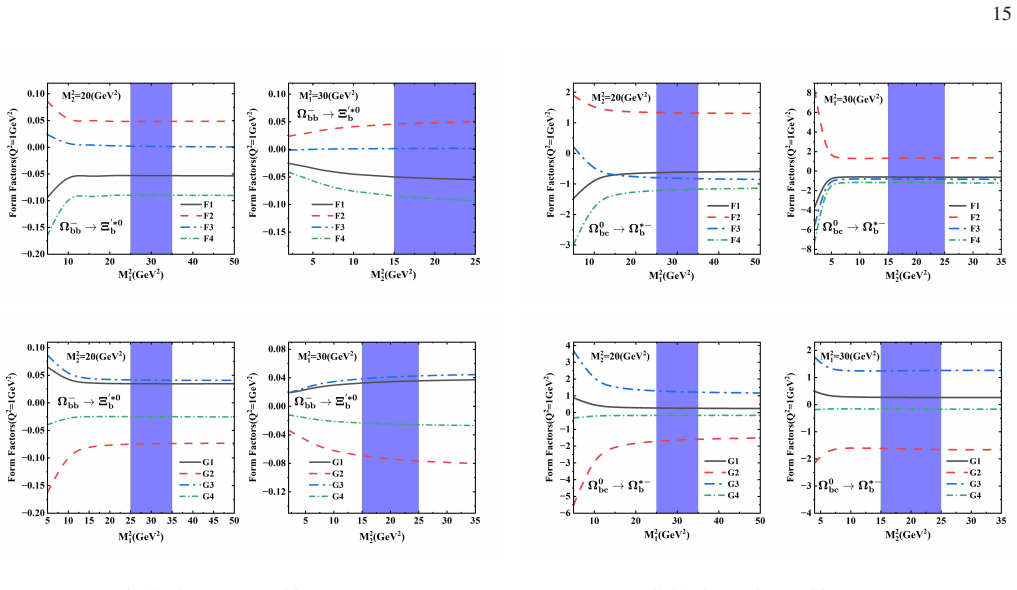
- [Sec. III] Borel windows are quoted only for the Ξ_bc → Σ*_b example. Since Figs. 15–22 show the windows for other channels, a compact table listing the selected M1^2, M2^2, s0 and u0 for every channel would improve reproducibility.
Circularity Check
No circular reduction found: the QCDSR form factors are computed from an independent OPE matching, and self-citations supply inputs rather than the target predictions.
full rationale
The paper's central outputs are the form factors Fi(Q2)/Gi(Q2), obtained by matching a hadronic decomposition (Eqs. 5-9) with an independent OPE calculation (Eqs. 11-19), and the semileptonic observables of Sec. IV, which are integrals over helicity amplitudes built from those form factors. No output is fed back as an input to the sum rule. The z-series coefficients in Tables II-III are explicitly fitting parameters for the QCDSR points, so the time-like extrapolation is an interpolation of the computed form factors, not a fit to the decay data being predicted. The self-citations for input quantities (mother baryon masses from refs. [4,6,7], pole residues from refs. [12,71,72], and the threshold Δ=0.6 GeV from ref. [12]) introduce model dependence and inherited uncertainty, but they do not make the target result equal to an input by construction. The admitted failure of pole dominance for ρ2 (Sec. III, Fig. 3) is a genuine reliability concern for the claimed contamination-free extraction, but it is a correctness gap rather than a circular reduction: the quoted equations do not define the output in terms of itself. No circular step satisfying the required evidence standard can be exhibited.
Assumptions & free parameters
free parameters (6)
- Borel windows M1^2, M2^2 =
M2^2 = 15–25 GeV^2 (example for Ξ_bc→Σ_b^*); M1^2 window not explicitly stated
- Threshold parameters Δ1, Δ2 =
Δ1 = Δ2 = 0.6 GeV
- z-series coefficients b_k, b_tilde_k =
Tables II and III
- Pole residues λ of initial/final baryons =
e.g., λΞbc = √2(0.125±0.016) GeV^3 [71]
- Hadron masses of unobserved states =
mΞbc=6.952, mΩbc=7.053, mΩbb=10.285, mΞbb=10.192 GeV, etc.
- Vacuum condensate values =
⟨q̄q⟩=-(0.23±0.01)^3 GeV^3, ⟨g^2G^2⟩=0.47±0.15 GeV^4, m0^2=0.8±0.1 GeV^2
assumptions (5)
- domain assumption Quark-hadron duality: the integrated QCD spectral density up to continuum thresholds s0,u0 equals the hadronic pole contribution.
- domain assumption The interpolating currents in Eq. (10) couple dominantly to the physical baryon states with known residues λ.
- domain assumption The OPE converges after including condensates up to dimension 6.
- ad hoc to paper Masses and residues of the doubly heavy baryon ground states can be taken from quark models (refs [4,6,7]) and prior QCDSR works.
- ad hoc to paper A Borel window where 'most' (not all) Dirac structures satisfy pole dominance >40% is adequate for extracting the form factors.
Cite this review
Pith. "Pith review of The semileptonic decays of $\mathcal{B}_{Q_{1}Q_{2}}(\frac{1}{2}^{+})\rightarrow\mathcal{B}_{Q_{1}}^{*}(\frac{3}{2}^{+})$ in QCD sum rules." pith.science (2026). https://pith.science/paper/3F74PGHA
@misc{pith2026260716697,
  author       = {Pith},
  title        = {Pith review of: The semileptonic decays of $\mathcalB_Q_1Q_2(\frac12^+)\rightarrow\mathcalB_Q_1^*(\frac32^+)$ in QCD sum rules},
  year         = {2026},
  howpublished = {\url{https://pith.science/paper/3F74PGHA}},
  note         = {Machine review of arXiv:2607.16697}
}
abstract
In the framework of QCD sum rules, we systematically analyze the weak transition process $\mathcal{B}_{Q_{1}Q_{2}}(\frac{1}{2}^{+})\rightarrow\mathcal{B}_{Q_{1}}^{*}(\frac{3}{2}^{+})$. When doing the operator product expansion in the QCD side, we consider the contributions of perturbative part and vacuum condensate terms up to dimension 6. In the phenomenological side, we eliminate the interferences of the low spin states and negative parity states by employing 16 different dirac structures. As an application, these form factors are finally used to analyze the semileptonic decays of $\mathcal{B}_{Q_{1}Q_{2}}(\frac{1}{2}^{+})\rightarrow\mathcal{B}_{Q_{1}}^{*}(\frac{3}{2}^{+})l\nu$, where these decays are driven by the transition processes $c\rightarrow d/s+l^{+}+\nu_{l}$ and $b\rightarrow u+l^{-}+\overline{\nu}_{l}$. The predicted physical quantities include not only the partial widths, ratios of $\Gamma_{L}/\Gamma_{T}$ and the branching fractions, but also some observables such as the forward-backward asymmetry parameter $A_{FB}^{l}$ of lepton, the $P_z^{F}$ component of the polarization vector for daughter baryon and the longitudinal polarization of the lepton $P_z^{l}$. We hope all of these theoretical predictions about the weak decays will be helpful for studying the properties of doubly heavy baryons in experiments in the future.
Figures


Figures from the paper (13 more)



Reference graph
Works this paper leans on
-
[1]
These two phase-space-like integral can be evaluated as, A(k2 1, m2 1, m2
Its contribution can be written as, ΠQCD−V µν,pert (p, p′) = − 12 √ 2 (2π)8 ∫ d4k1d4k2d4k3d4k4 ∫ d4q′ × [ δ4(q′ − k1 − k4)δ4(p′ − q′ − k3)δ4(q − k2 + k3) (k2 1 − m2 1)(k2 2 − m2 2)(k2 3 − m2 3)(k2 4 − m2 4) × (/k1 + m1)γα(/k2 − m2)γν(/k3 − m3)γµ(/k4 + m4)γ5γα ] (14) By setting all quark lines on-shell with the Cutkosky’s rule [ 77], its QCD spectral densi...
-
[2]
The pole contributions of some spectral densiti es (ρ1 ∼ ρ10) with respect to M2 2 are plotted in Fig
From this figure, we can see that main contributions come from quark condensate and purturbative part, and the larger the values of the Borel parameters, the smaller the contributions of vacuum conden - sate terms. The pole contributions of some spectral densiti es (ρ1 ∼ ρ10) with respect to M2 2 are plotted in Fig
-
[3]
After performing the integral of these above two phase space, the momentum k1µ and k3µ can also be substituted by p and p′
=∫ d4k3δ(k2 3 − m2 3)δ[(k3 + p − p′)2 − m2 2]δ[(p′ − k3)2 − r′] = π 2 √ λ(s, u, q2) (17) with the following constraint on the second phase space, ⏐ ⏐ ⏐ ⏐ (u − q2 + m2 2 − r′)(s + u − q2) + 2s(r′ − u − m2 3) √ (u − q2 + m2 2 − r′)2 − 4sm2 3 √ λ(s, u, q2) ⏐ ⏐ ⏐ ⏐≤ 1 where λ(a, b, c) = a2 + b2 + c2 − 2(ab + ac + bc) is the triangle function. After performing...
-
[4]
= ∫ d4k1δ(k2 1 − m2 1)δ[(q′ − k1)2 − m2 4] = π √ λ(r′, m2 1, m2 4) 2r′ (16) B(k2 3, m2 2, m2
-
[5]
can be parameterized as four vector /axialvector form factors similar as Eq. ( 3). As for the hadron vacuum matrix elements, they are defined as, ⟨0| J B∗ Q1 µ (0) ⏐ ⏐ ⏐B∗+ Q1 (p′, s′) ⟩ = λB∗+ Q1 uµ(p′, s′) ⟨0| J B∗ Q1 µ (0) ⏐ ⏐ ⏐B∗− Q1 (p′, s′) ⟩ = λB∗− Q1 iγ5uµ(p′, s′) ⟨0| J B∗ Q1 µ (0) ⏐ ⏐ ⏐B+ Q1 (p′, s′) ⟩ = λB+ Q1 iγ5 ( αγµ − 4α m p′ µ ) u(p′, s′) ⟨0...
-
[6]
Z. Y . Li, G. L. Y u, Z. G. Wang, J. Z. Gu and H. T. Shen, Mod. Phys. Lett. A 38, 2350052 (2023)
2023
-
[7]
and ( 13) that there are both 16 dirac structures at the phe- nomenological and QCD sides. Thus, we can establish 16 linear equations for the vector and axial vector form factor s, 5 respectively, BBi ( F P1P2 1 , F P1P2 2 , F P1P2 3 , F P1P2 4 ) × exp[− m2 BP1 Q1 Q2 M2 1 − m2 B∗P2 Q1 M2 2 ]eV iµν = s0∫ smin ds u0∫ umin du [ ρQCD−V i (s, u, Q2) × exp[− s ...
-
[8]
The scalar invariant amplitudes in QCD side ΠQCD−V/A i (i = 1, 2 · · ·16) include perturbative part and di fferent vacuum condensate terms ⟨¯qq⟩, ⟨g2 sGG⟩, ⟨¯qgsσGq⟩and g2 s⟨¯qq⟩2
and ( 9) for ΠQCD−V µν and ΠQCD−A µν , respectively. The scalar invariant amplitudes in QCD side ΠQCD−V/A i (i = 1, 2 · · ·16) include perturbative part and di fferent vacuum condensate terms ⟨¯qq⟩, ⟨g2 sGG⟩, ⟨¯qgsσGq⟩and g2 s⟨¯qq⟩2. FIG. 1: Feynman diagram of semileptonic decay process of per tur- bative term, where q = p − p′. For the contribution of per...
Show all 95 references
-
[9]
After repeated trial and contrast, the Borel platform for M2 2 is taken to be 15 ∼ 25 GeV 2 marked as blue area in Figs. 2 and 3. We can see that contributions of high dimension condensate terms (D6) in the Borel platform are very small, which means the convergence of OPE is s...
-
[10]
Ebert, R
D. Ebert, R. N. Faustov, V . O. Galkin and A. P . Martynenko, Phys. Rev. D 66, 014008 (2002)
2002
-
[11]
Roberts and M
W. Roberts and M. Pervin, Int. J. Mod. Phys. A 23, 2817-2860 (2008)
2008
-
[12]
G. L. Y u, Z. Y . Li, Z. G. Wang, J. Lu and M. Yan, Eur. Phys. J. A 59, 126 (2023)
2023
-
[13]
Z. Y . Li, G. L. Y u, Z. G. Wang, J. Z. Gu and H. T. Shen, Int. J. Mod. Phys. A 38, 2350095 (2023)
2023
-
[14]
G. L. Y u, Z. Y . Li, Z. G. Wang, J. Lu and M. Yan, Nucl. Phys. B 990, 116183 (2023)
2023
-
[15]
T. M. Aliev, K. Azizi and M. Savci, Nucl. Phys. A 895, 59 (2012)
2012
-
[16]
Z. Y . Li, G. L. Y u, Z. G. Wang, J. Z. Gu, J. Lu and H. T. Shen, Chin. Phys. C 47, 073105 (2023)
2023
-
[17]
Karliner and J
M. Karliner and J. L. Rosner, Phys. Rev. D 90, 094007 (2014)
2014
-
[18]
V alcarce, H
A. V alcarce, H. Garcilazo and J. Vijande, Eur. Phys. J. A 37, 217 (2008)
2008
-
[19]
Bagan, M
E. Bagan, M. Chabab and S. Narison, 17 Phys. Lett. B 306, 350 (1993)
1993
-
[20]
Z. G. Wang, Eur. Phys. J. A 45, 267 (2010)
2010
-
[21]
Z. G. Wang, Eur. Phys. J. C 68, 459 (2010)
2010
-
[22]
V . V . Kiselev and A. K. Likhoded, Phys. Usp. 45, 455 (2002)
2002
-
[23]
J. R. Zhang and M. Q. Huang, Phys. Rev. D 78, 094007 (2008)
2008
-
[24]
Aaij et al
R. Aaij et al. [LHCb], JHEP 02, 049 (2020)
2020
-
[25]
and ( 26), several physical observables in the semileptonic decay process can be evaluated such as the forward-backward asymmetry Al FB of the lepton, the compo- nent PF z of the polarization vector of final state baryons B∗ Q1 and the longitudinal polarization of the lepton Pl...
-
[26]
D. H. He, K. Qian, Y . B. Ding, X. Q. Li and P . N. Shen, Phys. Rev. D 70, 094004 (2004)
2004
-
[27]
H. Y . Cheng and C. W. Liu, arXiv:2604.10939 [hep-ph]
-
[28]
Lewis, N
R. Lewis, N. Mathur and R. M. Woloshyn, Phys. Rev. D 64, 094509 (2001)
2001
-
[29]
J. M. Flynn et al. [UKQCD], JHEP 07, 066 (2003)
2003
-
[30]
L. Liu, H. W. Lin, K. Orginos and A. Walker-Loud, Phys. Rev. D 81, 094505 (2010)
2010
-
[31]
Meinel and G
S. Meinel and G. Rendon, Phys. Rev. D 105, 054511 (2022)
2022
-
[32]
Aaij et al
R. Aaij et al. [LHCb], Phys. Rev. Lett. 119, 112001 (2017)
2017
-
[33]
Aaij et al
R. Aaij et al. [LHCb], Phys. Rev. Lett. 121, 162002 (2018)
2018
-
[34]
Aaij et al
R. Aaij et al. [LHCb], JHEP 11, 095 (2020)
2020
-
[35]
Aaij et al
R. Aaij et al. [LHCb], Chin. Phys. C 45, 093002 (2021)
2021
-
[36]
R. N. Faustov and V . O. Galkin, Phys. Rev. D 98, 093006 (2018)
2018
-
[37]
C. Q. Geng, C. W. Liu and T. H. Tsai, Phys. Rev. D 102, 034033 (2020)
2020
-
[38]
Albertus, E
C. Albertus, E. Hernandez and J. Nieves, Phys. Rev. D 71, 014012 (2005)
2005
-
[39]
Ebert, R
D. Ebert, R. N. Faustov and V . O. Galkin, Phys. Rev. D 73, 094002 (2006)
2006
-
[40]
H. Y . Cheng, Phys. Rev. D 56, 2799 (1997)
1997
-
[41]
M. A. Ivanov, J. G. Korner, V . E. Lyubovitskij and A. G. Ruset- sky, Mod. Phys. Lett. A 13, 181 (1998)
1998
-
[42]
M. A. Ivanov, J. G. Korner, V . E. Lyubovitskij and A. G. Ruset- sky, Phys. Rev. D 57, 5632 (1998)
1998
-
[43]
Faessler, T
A. Faessler, T. Gutsche, M. A. Ivanov, J. G. Korner and V . E. Lyubovitskij,Phys. Rev. D 80, 034025 (2009)
2009
-
[44]
Gutsche, M
T. Gutsche, M. A. Ivanov, J. G. K¨ orner and V . E. Lyubovitskij, Phys. Rev. D 98, 074011 (2018)
2018
-
[45]
Gutsche, M
T. Gutsche, M. A. Ivanov, J. G. K¨ orner, V . E. Lyubovitskij and Z. Tyulemissov, Phys. Rev. D 100, 114037 (2019)
2019
-
[46]
W. Wang, Z. P . Xing and J. Xu, Eur. Phys. J. C 77, 800 (2017)
2017
-
[47]
Albertus, E
C. Albertus, E. Hernandez and J. Nieves, Few Body Syst. 55, 767 (2014)
2014
-
[48]
Z. X. Zhao, Eur. Phys. J. C 78, 756 (2018)
2018
-
[49]
Z. X. Zhao, Chin. Phys. C 42, 093101 (2018)
2018
-
[50]
C. K. Chua, Phys. Rev. D 99, 014023 (2019)
2019
-
[51]
C. K. Chua, Phys. Rev. D 100, 034025 (2019)
2019
-
[52]
H. W. Ke, N. Hao and X. Q. Li, Eur. Phys. J. C 79 (2019), 540
2019
-
[53]
J. Zhu, Z. T. Wei and H. W. Ke, Phys. Rev. D 99, 054020 (2019)
2019
-
[54]
Y . S. Li, X. Liu and F. S. Y u,Phys. Rev. D 104, 013005 (2021)
2021
-
[55]
X. H. Hu, R. H. Li and Z. P . Xing, Eur. Phys. J. C 80, 320 (2020)
2020
-
[56]
Y . S. Li and X. Liu, Phys. Rev. D 105, 013003 (2022)
2022
-
[57]
F. Lu, H. W. Ke, X. H. Liu and Y . L. Shi, Eur. Phys. J. C 83, 412 (2023)
2023
-
[58]
H. Liu, Z. P . Xing and C. Yang, Eur. Phys. J. C 83, 123 (2023)
2023
-
[59]
T. M. Aliev, K. Azizi and M. Savci, Phys. Rev. D 81, 056006 (2010)
2010
-
[60]
T. M. Aliev, S. Bilmis and M. Savci, Phys. Lett. B 847, 138287 (2023)
2023
-
[61]
Azizi, Y
K. Azizi, Y . Sarac and H. Sundu, Eur. Phys. J. A 48, 2 (2012)
2012
-
[62]
Y . m. Wang, Y . Li and C. D. Lu,Eur. Phys. J. C 59, 861 (2009)
2009
-
[63]
Y . M. Wang and Y . L. Shen,JHEP 02, 179 (2016)
2016
-
[64]
Khodjamirian, C
A. Khodjamirian, C. Klein, T. Mannel and Y . M. Wang, JHEP 09, 106 (2011)
2011
-
[65]
Z. X. Zhao, R. H. Li, Y . L. Shen, Y . J. Shi and Y . S. Yang, Eur. Phys. J. C 80, 1181 (2020)
2020
-
[66]
Y . J. Shi, W. Wang and Z. X. Zhao, Eur. Phys. J. C 80, 568 (2020)
2020
-
[67]
Khajouei and K
L. Khajouei and K. Azizi, Phys. Rev. D 111, 074018 (2025)
2025
-
[68]
Y . Miao, H. Deng, K. S. Huang, J. Gao and Y . L. Shen, Chin. Phys. C 46, 113107 (2022)
2022
-
[69]
Z. P . Xing and Z. X. Zhao, Eur. Phys. J. C 81, 1111 (2021)
2021
-
[70]
Z. X. Zhao, X. Y . Sun, F. W. Zhang, Y . P . Xing and Y . T. Yang, Phys. Rev. D 108, 116008 (2023)
2023
-
[71]
J. Lu, G. L. Y u, D. Y . Chen, Z. G. Wang and B. Wu, Eur. Phys. J. C 86, 685 (2026)
2026
-
[72]
S. Q. Zhang and C. F. Qiao, Phys. Rev. D 108, 074017 (2023)
2023
-
[73]
Neishabouri, K
Z. Neishabouri, K. Azizi and H. R. Moshfegh, Phys. Rev. D 110, 014010 (2024)
2024
-
[74]
M. S. Tousi, K. Azizi and H. R. Moshfegh, Phys. Rev. D 110, 114001 (2024)
2024
-
[75]
G. L. Y u, Z. G. Wang, J. Lu, B. Wu, P . Yang and Z. Zhou, Phys. Rev. D 113, 7 (2026)
2026
-
[76]
M. A. Shifman, A. I. V ainshtein and V . I. Zakharov, Nucl. Phys. B 147, 385 (1979)
1979
-
[77]
M. A. Shifman, A. I. V ainshtein and V . I. Zakharov, Nucl. Phys. B 147, 448 (1979)
1979
- [78]
-
[79]
Z. G. Wang, Front. Phys. (Beijing) 21, 016300 (2026)
2026
-
[80]
Z. G. Wang and Q. Xin, Int. J. Mod. Phys. A 37, 2250074 (2022)
2022
-
[81]
Z. G. Wang, Eur. Phys. J. C 78, 826 (2018)
2018
-
[82]
Z. G. Wang, Nucl. Phys. B 926, 467 (2018)
2018
-
[83]
S. Q. Zhang and C. F. Qiao, AAPPS Bull. 36, 12 (2026)
2026
-
[84]
J. Lu, D. Y . Chen, G. L. Y u, Z. G. Wang and Z. Zhou, Eur. Phys. J. C 85, 1061 (2025)
2025
-
[85]
J. Lu, G. L. Y u, D. Y . Chen, Z. G. Wang and B. Wu, Eur. Phys. J. C 85, 1382 (2025)
2025
-
[86]
Cutkosky, J
R.E. Cutkosky, J. Math. Phys. 1, 429 (1960)
1960
-
[87]
Navas et al
S. Navas et al. [Particle Data Group], Phys. Rev. D 110, 030001 (2024)
2024
-
[88]
194 (1984)
P .Pascual,R.Tarrach, QCD:Renormalization for the Pr acti- tioner, vol. 194 (1984)
1984
-
[89]
Reinders, H
L.J. Reinders, H. Rubinstein, S. Yazaki, Phys. Rep. 127 , 1 (1985)
1985
-
[90]
C. G. Boyd, B. Grinstein and R. F. Lebed, Phys. Rev. Lett. 74, 4603 (1995)
1995
-
[91]
Narison, Phys
S. Narison, Phys. Lett. B 693, 559 (2010)
2010
-
[92]
Narison, Phys
S. Narison, Phys. Lett. B 706, 412 (2012)
2012
-
[93]
Narison, Phys
S. Narison, Phys. Lett. B 707, 259 (2012)
2012
-
[94]
X. H. Hu and Y . J. Shi, Phys. Rev. D 107, 036007 (2023)
2023
-
[95]
Kadeer, J
A. Kadeer, J. G. Korner and U. Moosbrugger, Eur. Phys. J. C 59, 27 (2009)
2009
Reviewed August 1, 2026 · model on record in the stance chip above.
Discussion (0). Sign in to comment.