REVIEW 3 major objections 6 minor 16 references
A single language-model interface that reads wireless telemetry can replace task-specific edge models for physical-layer diagnostics and beam control, outperforming them on unseen urban scenarios while emitting human-readable causal rationa
Reviewed by Pith at T0; open to challenge. T0 means a machine referee read the full paper against a public rubric. the ladder, T0–T4 →
T0 review · deepseek-v4-flash
2026-08-01 19:34 UTC pith:EMA2QVON
load-bearing objection A competent transfer of the LLaVA-style projector recipe to wireless CSI, with a plausible but under-evidenced case study; the explainability claim is currently asserted, not shown. the 3 major comments →
PERA: A Perceive-Reason-Act Interface Bridging Sensing, Cognitive Reasoning, and Trustworthy Agentic Response for 6G
The pith
A machine-rendered reading of the paper's core claim, the machinery that carries it, and where it could break.
Core claim
PERA's central claim is that grounding an LLM in wireless telemetry, rather than adapting the LLM to the wireless domain or vice versa, yields a unified edge intelligence that is more accurate and more explainable than task-specific discriminative models. The paper demonstrates this by tokenizing raw CSI with a frozen large wireless model, projecting the resulting embeddings into the LLM's space with a two-layer MLP bridge, and then fine-tuning LoRA adapters with a weighted multi-task objective that combines language modeling, link-state classification, and beam-group prediction. On novel DeepMIMO cities, this interface outperforms a raw-CSI CNN by 7.73% for LoS/NLoS F1 and by 31.17% for bea
What carries the argument
The load-bearing mechanism is the 'modality bridge' (Layer 2), a two-layer MLP projector that maps latent vectors from a frozen wireless perceptual encoder into the embedding space of a frozen LLM, yielding 'network pseudo-tokens' that the LLM reads as text. This is trained in two stages: first a representation-alignment stage that teaches the bridge to map channel states to descriptive captions, then a goal-oriented instruction-tuning stage that trains the bridge together with LoRA adapters in the LLM, augmented by auxiliary LoS and beam-group heads whose losses are weighted 0.3:1.0:0.5 against the language loss to keep outputs physically faithful.
Load-bearing premise
The language model's decisions and explanations are actually grounded in the wireless tokens rather than generated from language priors or hallucination, and this grounding persists in every new deployment environment.
What would settle it
Take the trained PERA model, fix the text prompt, and randomly permute or zero-out the network pseudo-tokens at inference. If the predicted beam group and the generated rationale remain largely unchanged, the system is not reading the channel telemetry and the central explainability claim collapses. Alternatively, test on real measured channels from a city not in the DeepMIMO training set: if the F1 gains over the raw-CSI CNN disappear, the grounding does not transfer.
If this is right
- A single PERA-style core could replace hundreds of task-specific edge diagnostic models, because new tasks or environments are handled by swapping LoRA adapters or editing prompts rather than retraining.
- Because the interface outputs control parameters alongside natural-language rationales, it provides operator-visible audit trails for physical-layer decisions, which is a step toward trusted autonomous network control.
- The same three-tier architecture is layer-agnostic: routing, slicing, and intent-negotiation tasks could in principle reuse the same perceptual encoder and LLM core with different heads or instructions.
- Zero-shot adaptation to previously unseen environments is demonstrated: the model trained on five cities classifies and predicts beams in six new cities without gradient updates, suggesting that prompt-based adaptation at inference time is possible for novel scenarios.
Where Pith is reading between the lines
- If the grounding holds, the PERA recipe generalizes beyond wireless: any high-dimensional sensor stream (radar, optical, audio) could be projected into an LLM's embedding space and reasoned over with the same pseudo-token mechanism, turning LLMs into a universal reasoning layer over physical modalities.
- The paper does not ablate the auxiliary physical-fidelity heads, so the exact source of the accuracy gain — the LLM's reasoning versus the shared LWM features — remains untested. A version without the heads, or with a frozen bridge, would isolate the contribution of language modeling to the F1 improvements.
- The trustworthiness claim hinges on explanation faithfulness, which the paper does not quantitatively measure. A natural next step is to corrupt or mask the wireless pseudo-tokens while holding the text prompt fixed; if the output beam or rationale does not change, the rationales are not causally grounded in the channel state.
- Since the experiments use the simulated DeepMIMO dataset, the decisive test for real 6G deployment is whether the demonstrated grounding survives real over-the-air channel measurements, hardware impairments, and distribution drift beyond the six test cities.
Editorial analysis
A structured set of objections, weighed in public.
Referee Report
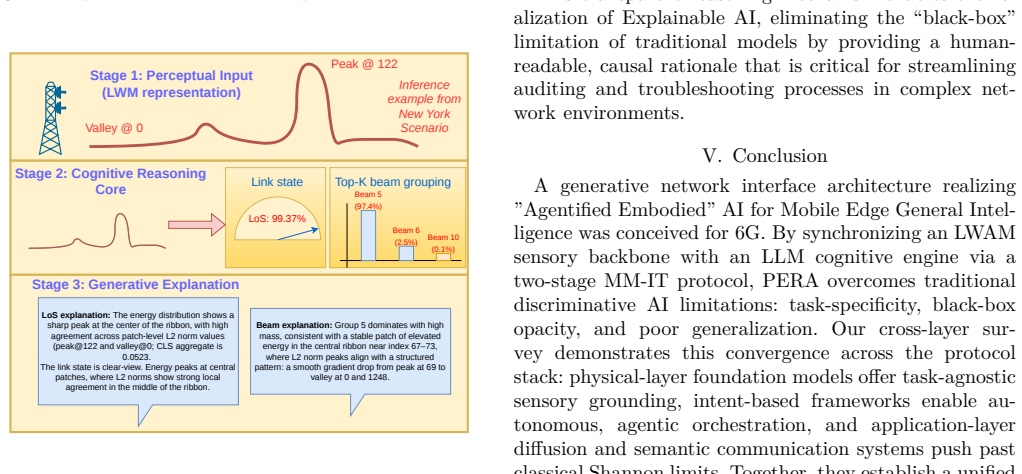
Summary. The paper proposes PERA, a three-tier architecture that connects a pretrained Large Wireless AI Model (LWAM) sensory backbone to a pretrained LLM cognitive core through a trainable modality bridge. The architecture is motivated by a survey of physical-, network-, and application-layer AI techniques, and a two-stage multi-modal instruction-tuning protocol is introduced to align wireless feature representations with LLM token space. The empirical case study uses the DeepMIMO dataset for LoS/NLoS classification and beam-group prediction, reporting F1 gains over raw-CSI CNN and LWAM-token baselines across six unseen scenarios, and a single inference example is presented as evidence of human-readable, causally grounded rationales. The paper concludes that PERA replaces task-specific edge models while providing trust and explainability.
Significance. If fully supported, the paper would make a timely contribution to the emerging area of LLM-based wireless systems: the idea of feeding LWAM representations into a LoRA-adapted LLM via a lightweight projector, with auxiliary physical-label heads, is plausible and worth exploring. The two-stage training protocol and the evaluation on unseen DeepMIMO scenarios are concrete steps beyond pure position papers. However, the current evidence does not yet substantiate the central claims: the explainability/trust argument rests on a single hand-picked example, no faithfulness metric is defined, and the reported performance numbers are not clearly reconciled with the figures. The paper would be strengthened significantly by a rigorous ablation study, a quantitative faithfulness evaluation, and a complete per-scenario results table.
major comments (3)
- [§IV-B, §IV-C, Fig. 5] The paper's stated differentiator is 'human-readable, causal explanations' (Abstract, §III-D, Conclusion). The only support is the single illustrative example in Fig. 5. Section IV-B states that auxiliary heads are included 'to preserve physical fidelity and prevent generative hallucinations,' but no ablation compares the 0.3:1.0:0.5 weighted objective against variants without the auxiliary heads or without the language loss, and no protocol is given for measuring whether a generated rationale is factually faithful to the channel state. This is load-bearing: the trust/explainability claim is a core contribution, not a peripheral feature. I recommend adding (i) an ablation over the auxiliary heads and loss weights; (ii) a quantitative faithfulness metric, e.g., agreement between rationale-cited token positions and actual L2-norm peaks/valleys over the test set, or a counterfactual test wh
- [§IV-C, Fig. 3, Fig. 4] The claimed margins (+7.73%, +11.77%, +31.17%, +9.90%) are not traceable to the displayed data. The figures show only bars with approximate F1 values around 0.78–0.93, with no error bars, no per-scenario table, and no statement of whether the percentages are absolute or relative improvements. For example, a mean F1 of 0.93 versus 0.86 could be reported as '+7 percentage points' or '+8.1% relative', and Fig. 3 alone does not disambiguate this. Please provide exact per-scenario and mean±std values, define the percentage convention, and report significance tests. Without this, the central performance claim cannot be independently verified.
- [§IV-A, §IV-B] The experimental protocol is underspecified in ways that affect fairness and reproducibility. It is unclear what 'MLP (LWM)' and 'Seq-CNN on LWM tokens' exactly are, whether they use the same auxiliary heads and training epochs, and how the 16 beam groups are defined. The five training and six inference scenarios are named, but key DeepMIMO parameters (scenario identifiers, numbers of users/BS antennas, SNR, sample counts) are missing. 'Zero-shot environmental adaptability' is used for held-out generalization; since the projector and LoRA adapters are trained on the five training scenarios, the LLM's contribution to adaptation is not isolated. Please clarify these points and, ideally, add an ablation that removes the LLM (keeping projector + auxiliary heads) to isolate the LLM's contribution to the reported F1 gains.
minor comments (6)
- [Throughout] Notation is inconsistent: 'L WM' (Ref. [6]) versus 'L W AM' elsewhere; please unify and use a consistent non-breaking space.
- [Fig. 3, Fig. 4, Fig. 2] Labels contain typos/artifacts: 'LoS/NLoS F1 by Scenari', 'Beam Predic(ion F1 by Scenario', 'MLP n L WM t k ens', and 'Casaule Rationale' in Fig. 2. Please correct.
- [§IV-B] Hyperparameters (LoRA rank 16, alpha 32, MLP width 1024, loss weights 0.3:1.0:0.5) are given without any sensitivity analysis or selection rationale; one or two sentences explaining the choice would help.
- [Fig. 5] The units and source of 'peak@122', 'valley@0', and 'CLS aggregate is 0.0523' are not defined. Please define the token indexing and the L2-norm aggregation so the example can be checked by readers.
- [References] Some references appear very recent or hard to verify (e.g., [12] arXiv:2602.14833, [2] IEEE Wireless Communications 2026). Please confirm bibliographic details and provide DOIs where available.
- [Reproducibility] No code, trained checkpoints, or dataset-generation scripts are provided. Given the novelty of the pipeline, a reproducibility statement or an anonymous code release would substantially increase confidence.
Circularity Check
No significant circularity: the empirical benchmark is external and the central performance claims do not reduce to the paper's own assumptions or fitted parameters.
full rationale
The paper's main derivation chain is the PERA architecture and its DeepMIMO case study. The claimed F1 gains (+7.73% LoS/NLoS over raw-CSI CNN, +9.90% beam over Seq-CNN on LWM tokens) are obtained by training on five scenarios and testing on six unseen scenarios; the test labels are external to the design, and no parameter is fitted to the test outcome and then relabeled as a prediction. The auxiliary heads and LoRA adapters are trained jointly on the task labels, which is ordinary supervised learning, not circularity. The 'trustworthy, human-readable rationales' claim is methodologically under-supported: Section IV-B asserts auxiliary pathways are included 'to preserve physical fidelity and prevent generative hallucinations,' and Fig. 5 provides a single illustrative rationale, but no faithfulness protocol, no grounding ablation, and no systematic evaluation of explanation correctness are provided. That is a soundness/evidence gap, not a circularity: the generated text is not equated with the supervision labels by construction, and the label predictions are measured independently. Self-citations [2], [5], [13] appear in the survey sections, but the load-bearing components cite external, independently checkable sources: LWM [6], Qwen-3, LLaVA MM-IT [14], and DeepMIMO [15]. No uniqueness theorem or prior self-result is used to force the architecture choice. The empirical benchmark is self-contained against external baselines, so no circular step can be exhibited under the required standard.
Axiom & Free-Parameter Ledger
free parameters (3)
- Loss weighting (lambda_LM, lambda_LoS, lambda_Beam) = 0.3:1.0:0.5 =
0.3, 1.0, 0.5
- Curriculum: three stages of two epochs each, LR decaying 1e-3 to 1e-4 =
3x2 epochs
- LoRA rank 16, alpha 32 on QKVO projections =
rank=16, alpha=32
axioms (3)
- domain assumption DeepMIMO ray-tracing channels plus its LoS/NLoS and beam labels are a valid proxy for real 6G wireless environments.
- domain assumption The pretrained LWAM backbone (frozen) produces representations that preserve the physical information needed for LoS and beam prediction.
- domain assumption A pretrained LLM (Qwen-3 Instruct), after LoRA tuning on paired channel-text samples, will ground its generated rationales in the wireless tokens rather than hallucinating.
invented entities (2)
-
Network Pseudo-Tokens
no independent evidence
-
PERA Architecture (Perceive-Reason-Act)
no independent evidence
read the original abstract
The realization of next-generation (NG) networks hinges on a fundamental departure from preprogrammed protocol engineering towards a paradigm of self-consciously evolving, autonomous and trusted intelligence. While conventional machine learning (ML) has introduced localized automation, it remains inherently bounded by single-task processing pipelines incapable of handling complex cross-layer dynamics. As a partial remedy, large language models (LLMs) excel at generalized cognitive reasoning, but to a degree they remain detached from the rich modalities of wireless telemetry. As a solution, we unveil Generative Network Intelligence conceptualized via the Perceive-Reason-Act (PERA) paradigm. This paradigm treats the wireless channel and the underlying network states as a continuous, multimodal narrative. By synchronizing the perceptual grounding of Large Wireless AI Models (LWAMs) with the cognitive reasoning of LLMs, PERA heralds the era of native NG intelligence. Crucially, this unified intelligence replaces fragmented, task-specific edge models by an efficient multi-task architecture delivering the real-time control needed for supporting dynamic physical applications while reducing both the complexity and energy dissipation. Moreover, we contrast the structural limitations of traditional ML to generative paradigms, conceive agentic reasoning across a NG protocol stack, and detail a practical three-tier design specifically engineered for the resource-constrained wireless edge. This architectural paradigm serves as a foundational framework for realizing fully autonomous, embodied agentic AI in NG networks. To validate this vision, our case study evaluates link-state classification and beam prediction, demonstrating how grounding wireless telemetry within a cognitive engine delivers the transparent, human-readable rationales required for trusted physical-layer diagnostics and beam control.
Figures


Reference graph
Works this paper leans on
-
[1]
Wireless large AI model: Shaping the AI-native future of 6G and beyond,
F. Zhu, X. Wang, S. Jiang, X. Li, M. Zhang, Y. Chen, C. Huang, Z. Yang, X. Chen, Z. Zhang et al., “Wireless large AI model: Shaping the AI-native future of 6G and beyond,” arXiv preprint arXiv:2504.14653, 2025
Pith/arXiv arXiv 2025
-
[2]
Generative AI for Intent- Driven Network Management in 6G RAN: A Case Study on the Mamba Model,
M. A. Habib, M. Elsayed, Y. Ozcan, P. E. Iturria-Rivera, M. Bavand, and M. Erol-Kantarci, “Generative AI for Intent- Driven Network Management in 6G RAN: A Case Study on the Mamba Model,” IEEE Wireless Communications, pp. 1–8, 2026
2026
-
[3]
NetGPT: An AI-native network architecture for provisioning beyond personalized generative services,
Y. Chen, R. Li, Z. Zhao, C. Peng, J. Wu, E. Hossain, and H. Zhang, “NetGPT: An AI-native network architecture for provisioning beyond personalized generative services,” IEEE Network, vol. 38, no. 6, pp. 404–413, 2024. 9
2024
-
[4]
Large Language Models for Wireless Net- works: An Overview from the Prompt Engineering Perspective,
H. Zhou, C. Hu, D. Yuan, Y. Yuan, D. Wu, X. Chen, H. Tabas- sum, and X. Liu, “Large Language Models for Wireless Net- works: An Overview from the Prompt Engineering Perspective,” IEEE Wireless Communications, vol. 32, no. 4, pp. 98–106, 2025
2025
-
[5]
M. Farzanullah, H. Zhang, A. B. Sediq, A. Afana, and M. Erol- Kantarci, “Wireless Multimodal Foundation Model (WMFM): Integrating Vision and Communication Modalities for 6G ISAC Systems,” arXiv preprint arXiv:2512.23897, 2025
arXiv 2025
-
[6]
Large wireless model (L WM): A foundation model for wireless channels,
S. Alikhani, G. Charan, and A. Alkhateeb, “Large wireless model (L WM): A foundation model for wireless channels,” arXiv preprint arXiv:2411.08872, 2024
Pith/arXiv arXiv 2024
-
[7]
IQFM—A Wireless Foundation Model for I/Q Streams in AI-Native 6G,
O. Mashaal and H. Abou-Zeid, “IQFM—A Wireless Foundation Model for I/Q Streams in AI-Native 6G,” IEEE Open Journal of the Communications Society, vol. 7, pp. 1426–1441, 2026
2026
-
[8]
Advanced end-to-end intent-driven dynamic network slicing: Challenges, solutions, and implementation,
L. Liu, A. Rajkumar, and Y. Jiang, “Advanced end-to-end intent-driven dynamic network slicing: Challenges, solutions, and implementation,” IEEE Communications Standards Mag- azine, pp. 1–8, 2025
2025
-
[9]
Generative diffusion models for wireless networks: Fundamen- tal, architecture, and state-of-the-art,
D. Fan, R. Meng, X. Xu, Y. Liu, G. Nan, C. Feng, S. Han, S. Gao, B. Xu, D. Niyato, T. Q. S. Quek, and P. Zhang, “Generative diffusion models for wireless networks: Fundamen- tal, architecture, and state-of-the-art,” IEEE Communications Surveys & Tutorials, vol. 28, pp. 5632–5677, 2026
2026
-
[10]
Edge large ai model empowered cognitive multimodal semantic communication system,
Y. Sun, S. Guo, X. Qiu, J. Chen, Y. Liu, R. Xin, and F. Qi, “Edge large ai model empowered cognitive multimodal semantic communication system,” in ICC 2025 - IEEE International Conference on Communications, 2025, pp. 3406–3411
2025
-
[11]
6g-bench: An open benchmark for semantic communication and network-level reasoning with foundation models in ai-native 6g networks,
M. A. Ferrag, A. Lakas, and M. Debbah, “6g-bench: An open benchmark for semantic communication and network-level reasoning with foundation models in ai-native 6g networks,” IEEE Open Journal of the Communications Society, vol. 7, pp. 3305–3330, 2026
2026
-
[12]
RF-GPT: Teaching AI to See the Wireless World,
H. Zou, Y. Tian, B. Wang, L. Bariah, S. Lasaulce, C. Huang, and M. Debbah, “RF-GPT: Teaching AI to See the Wireless World,” arXiv preprint arXiv:2602.14833, 2026
arXiv 2026
-
[13]
Chain-of-Thought Reasoning Enhances In- Context Learning for LLM-Based Mobile Traffic Prediction,
M. Ghadaksaz, M. Farzanullah, A. B. Sediq, A. Afana, and M. Erol-Kantarci, “Chain-of-Thought Reasoning Enhances In- Context Learning for LLM-Based Mobile Traffic Prediction,”
-
[14]
Visual instruction tuning,
H. Liu, C. Li, Q. Wu, and Y. J. Lee, “Visual instruction tuning,” Advances in neural information processing systems, vol. 36, pp. 34 892–34 916, 2023
2023
-
[15]
DeepMIMO: A generic deep learning dataset for millimeter wave and massive MIMO applications,
A. Alkhateeb, “DeepMIMO: A generic deep learning dataset for millimeter wave and massive MIMO applications,” in Proc. of Information Theory and Applications Workshop (ITA), San Diego, CA, Feb 2019, pp. 1–8
2019
-
[2026]
A vailable: https://arxiv.org/abs/2605.09260
[Online]. A vailable: https://arxiv.org/abs/2605.09260
discussion (0)
Sign in with ORCID, Apple, or X to comment. Anyone can read and Pith papers without signing in.