REVIEW 4 major objections 6 minor 41 references
PREFAIL: Identifying Precursors to Failures in Robotic Lift-and-Place Tasks to Improve Task Execution Performance
T0 review · 4 major / 6 minor · reviewed 2026-08-01 · deepseek-v4-flash
Pith's one-line read Object drift predicts robot failures before the point of no return.
desk verdict The t_stop dataset and η metric are genuinely useful; the headline results are real but the baseline is degenerate and the real-world t_stop boundary needs reproducibility evidence. read the letter →
The pith
A machine-rendered reading of the paper's core claim, the machinery that carries it, and where it could break.
The reading
What carries the argument
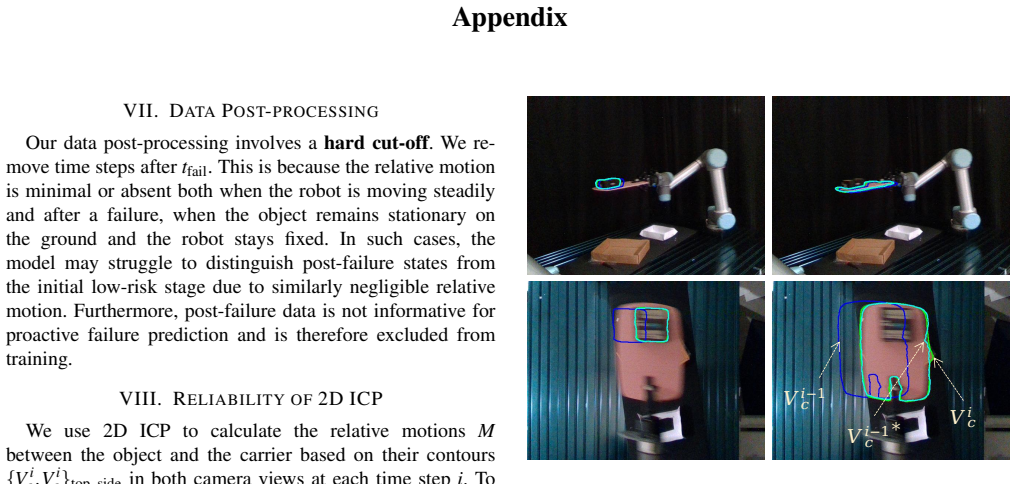
Three components carry the argument. First, historical backtracking: a binary-search procedure that replays a trajectory with emergency stops at candidate times to label t_stop, the last moment a stop prevents failure. Second, relative motion features: 2D ICP alignment of object and carrier contours in two camera views, producing a rotation and translation that quantifies the drift preceding a drop. Third, a two-branch network that fuses visual features, relative motion, and proprioceptive state (joint angles, joint speeds, end-effector position, and past risk values) into a risk score in [0,1]. The score is trained with both a classification loss (safe vs. past-threshold, calibrated so 0.5
What would settle it
Replay a set of real-world trajectories multiple times, applying the emergency stop at times around the labeled t_stop (e.g., t_stop-1, t_stop, t_stop+1) and record the fraction of drops. If the transition is not sharp — a stop at t_stop fails 30% of the time, or t_stop+1 succeeds 30% of the time — then the ground-truth labeling and the η metric are not measuring what they claim. A second test: train the network with an alternative boundary one time step earlier and check whether reported η changes systematically.
Extended reading notes
Core claim
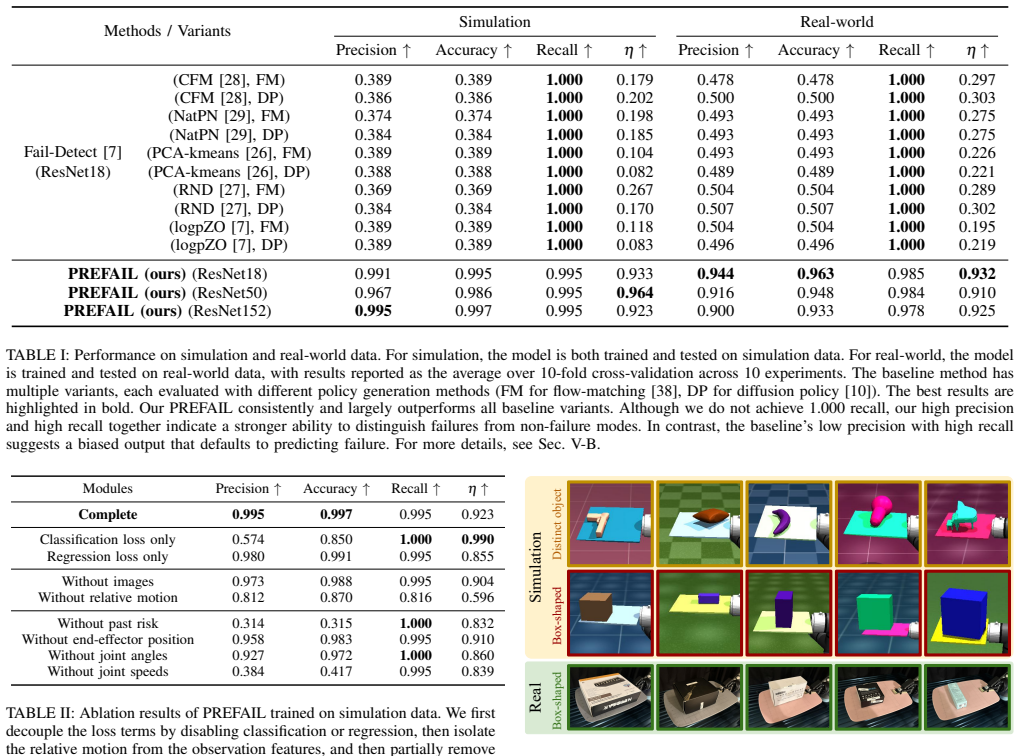
The central claim is that the relative motion between the target object and the carrier — captured as rotation and translation differences via 2D iterative closest point on segmented contours — is the key precursor signal for failure in high-speed non-prehensile lift-and-place. The paper defines a precise ground truth: t_stop, the latest time at which an emergency stop prevents failure. PREFAIL is trained to output a continuous risk value where 0.5 marks t_stop. On simulation data it reaches precision 0.995, accuracy 0.997, recall 0.995, and intervention timeliness η=0.964; on real-world data the best average is precision 0.944, accuracy 0.963, recall 0.985, and η=0.932. The authors argue th
Load-bearing premise
The whole evaluation depends on t_stop being a clean, repeatable line: an emergency stop at that exact moment always prevents failure and one step later always fails, in both simulation and the real world, with no random variation in object placement or contact.
Editorial extensions
If this is right
- If the relative-motion signal is as reliable as the experiments indicate, high-speed material handling can run near maximum speed and slow down only when risk rises, cutting cycle time without sacrificing safety.
- The t_stop labeling protocol gives the field a concrete definition of an actionable prediction: a true positive is counted only if the alarm fires before t_stop, so future systems can be compared on timeliness as well as accuracy.
- Because the predictor is fed from images and robot states rather than from a policy's action distribution, it should transfer across different control policies without retraining.
- The same approach could extend to other non-prehensile operations such as pushing, tilting, or sweeping, as long as the moved object and carrier can be segmented.
Reading between the lines
- The η metric rewards predicting exactly at t_stop; in deployment, any uncertainty would argue for firing a safety margin earlier, so the reported η≈0.93–0.96 should be read as an upper bound for a cautious system.
- The method's reliance on clean contour segmentation invites a stress test: degrade segmentation quality (occlusion, lighting, motion blur) and measure how precision and η degrade; the paper lists this as a known limitation.
- The t_stop concept could serve as a safety oracle for other time-critical robot actions, such as grasp aborts or collision-avoidance stops, wherever dynamics are deterministic enough for counterfactual replay.
- A natural extension is sim-to-real transfer of the t_stop label: if a dynamics model can predict the boundary, the labor-intensive physical binary search could be replaced or augmented, enabling larger real-world datasets.
Signed reviews
Editorial analysis
A structured set of objections, weighed in public.
Referee Report
Summary. The paper proposes PREFAIL, a policy-agnostic framework for predicting failure precursors in rapid lift-and-place manipulation. The method uses a two-branch network: one branch processes multi-view images and relative object-carrier motion from 2D ICP on segmented contours, while the other processes robot state and past risk values; the fused features are trained with a combination of classification and regression losses to output a continuous risk value in [0,1]. The main novel contribution is a data labeling pipeline, historical backtracking, that identifies t_stop, the latest time at which an emergency stop prevents failure, and t_fail, the failure time, with intermediate risk values assigned by Hermite spline interpolation. The paper evaluates PREFAIL on MuJoCo simulation (5,775 trajectories) and a real-world dataset (254 trajectories), reporting high precision, accuracy, recall, and an intervention timeliness ratio η. Results are compared against Fail-Detect, an OOD-based baseline with multiple variants, and extensive ablations are provided. The paper also includes a real-world deployment where risk-based velocity scaling prevents failure with small cycle-time overhead.
Significance. If the t_stop boundary is reproducible and the labeling scheme is sound, the paper makes a useful contribution: it is one of the first to attach a precise intervention deadline to each failure trajectory, enabling evaluation of not just whether a failure is detected but whether the detection is actionable. The relative-motion representation is simple, physically motivated, and policy-agnostic, and the real-world deployment demonstrates a concrete mechanism for trading cycle time against risk. The paper is unusually transparent in reporting full per-fold cross-validation tables and ablation studies, and the real-world dataset with t_stop labels is a potentially valuable resource. However, the significance is currently tempered by two concerns: the real-world t_stop boundary is treated as deterministic without repeatability evidence, and the only baseline is a degenerate OOD detector that, by the paper's own account, predicts every trajectory as failure. These issues do not invalidate the method, but they do mean that the headline claims of 'precision' and 'timeliness' are not yet fully supported.
major comments (4)
- [IV-A and Eq. (7)] The real-world t_stop boundary is load-bearing for the evaluation, since TP/FP-2 classification and η are all defined relative to t_stop. In Sec. IV-A, t_stop is found by physically replaying a rollout with e-stops at different times, but no repeatability statistics are reported. The outcome of an e-stop depends on precise resetting of the object and carrier state, and on the e-stop latency/timing jitter. If the binary search produces different t_stop on different replays, then Eq. (7) and the FP-2 'too late' classification are computed against a noisy reference. The paper should report, for a subset of real-world trajectories, repeated determinations of t_stop (e.g., 5–10 repetitions) with the resulting distribution and agreement at the t_stop vs t_stop+1 boundary. Without this, the claim that the dataset provides 'precise' intervention deadlines is not established.
- [IV-A, V-G, XII and Table III] The risk labels are constructed by anchoring 0 at t0, 0.5 at t_stop, and 1 at t_fail and interpolating with a Hermite spline. The network is then trained with a classification loss whose decision boundary is exactly the 0.5 level, and the evaluation uses the same 0.5 threshold to decide whether a prediction is before or after t_stop. This is not fully circular because t_stop is physically grounded, but the intermediate risk curve is an unverified supervisory signal. Table III shows that the choice of interpolation drastically changes the results (step interpolation collapses to precision 0.314, recall 1.0), so the reported η and precision/recall are partly properties of the chosen label scheme. The paper should provide a sensitivity analysis (e.g., varying the anchor values or using a label-free threshold selection) and, if possible, validate the interpolated risk curve against independe
- [V-B, Table I] The comparison to Fail-Detect is not yet convincing. As the paper itself notes, all Fail-Detect variants have precision equal to accuracy (0.37–0.51) and recall 1.0, which means they are equivalent to always predicting failure. The large margin in Table I is therefore against a degenerate baseline that provides no discrimination between failure and non-failure trajectories. The claim that PREFAIL 'substantially improves' accuracy and timeliness would be stronger if the paper included at least one non-degenerate baseline, such as a straightforward binary classifier trained on the same robot-state and image features, or a tuned version of Fail-Detect that trades recall for precision. Without such a baseline, it is unclear how much of the improvement comes from the proposed representations versus simply training a supervised classifier on well-balanced labels.
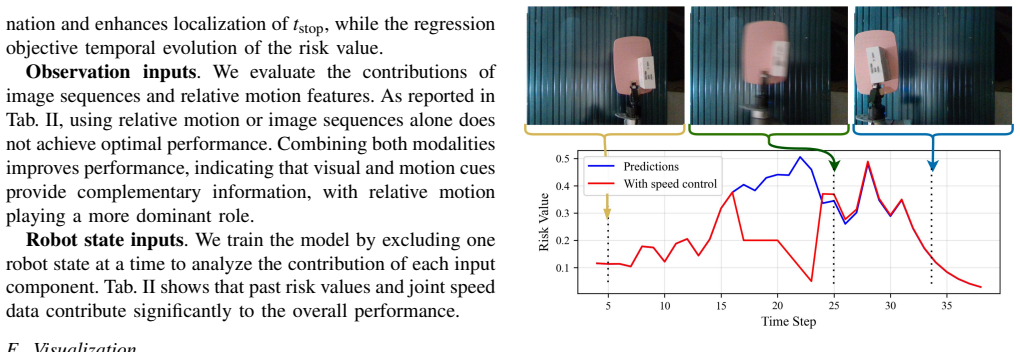
- [Table II] The ablation shows that removing past risk values causes the model to collapse to predicting every trajectory as failure (precision 0.314, accuracy 0.315, recall 1.0). This is concerning because past risk values are ground-truth during training and predicted during inference. If the model primarily propagates its previous risk estimates, then the high performance may be an artifact of autoregressive smoothing rather than genuine perception of failure precursors. The paper should report inference performance when the past-risk channel is fed only with the model's own predictions from a cold start, and also evaluate the model's first decision within a trajectory (where no past prediction exists). This would clarify whether the relative-motion and state features alone can support the claimed accuracy.
minor comments (6)
- [IV-A] The text describes the binary search as finding 'the earliest, safe intervention point,' but t_stop is the latest time at which an e-stop prevents failure. Please correct the wording to avoid confusion.
- [Eq. (2)] The symbol R is used both for rotation estimates R_o-c and for the risk value R_i. This is confusing in Eq. (2) and in the surrounding text. Use a distinct symbol (e.g., ρ) for the rotation component.
- [Eq. (7)] The definition η = t_pred_stop / t_stop can exceed 1.0 if the prediction occurs after t_stop, yet the text says the optimal η is 1.0 and that higher η is desirable. Please clarify whether η is defined only for true positives, capped at 1.0, or whether late predictions are excluded.
- [V-C] The description of the real-world evaluation is ambiguous: 'ten-fold cross-validation by constructing three different splits' could mean three different 10-fold splits, or something else. Please clarify the exact protocol and how the reported average in Table I is computed.
- [V-E] The caption of Fig. 5 says results are obtained under 'Sim&Real training and evaluation,' but Section V reports separate simulation and real-world experiments. Please clarify whether this refers to a mixed training condition or is a typo.
- [V-A] The paper says the real-world dataset contains 'two boxes with shifting contents,' which adds variability, but it does not report whether the t_stop annotation procedure was any different for these boxes. A brief note on how shifting contents affect the physical binary search would be helpful.
Circularity Check
No significant circularity: t_stop is grounded by physical counterfactual replay, and PREFAIL is evaluated on held-out trajectories.
full rationale
The central labeling quantity t_stop is produced by an independent physical procedure—historical backtracking—in which trajectories are replayed with emergency stops at different times and the outcome is directly observed (Sec. IV-A). The model's risk predictions are trained against labels derived from t_stop and t_fail, but the evaluation is on held-out splits (simulation 8:1:1; real-world 10-fold cross-validation), so the reported precision/recall/η measure generalization rather than a fit to the training labels. The overlap between the classification loss (which uses labels 'after t_stop' vs 'before t_stop') and the η metric (t_pred_stop/t_stop) is standard supervised calibration, not a definitional reduction: t_stop is not defined by the model, and the model is not used to set t_stop. The paper explicitly acknowledges that intermediate risk values are interpolated rather than physically measured (Sec. V-G), which is a label-design choice and does not make the evaluation circular. The only self-citation ([40], used for box-shaped industrial objects) is not load-bearing for the main claims. The real-world t_stop reproducibility concern is a measurement-validity issue, not a circularity issue, and falls outside this pass's scope.
Assumptions & free parameters
free parameters (3)
- temporal window length m =
5
- loss weight α =
not reported
- risk label anchors and threshold =
0.0, 0.5, 1.0
assumptions (5)
- domain assumption MuJoCo contact and friction dynamics accurately model failure and e-stop outcomes for historical backtracking
- domain assumption Real-world rollouts are repeatable enough for physical binary search of t_stop
- domain assumption 2D ICP over segmented contours accurately estimates relative object-carrier motion
- ad hoc to paper Hermite-spline interpolated risk values are a valid supervisory signal
- ad hoc to paper A fixed risk threshold of 0.5 consistently represents t_stop across object types and speeds
Cite this review
Pith. "Pith review of PREFAIL: Identifying Precursors to Failures in Robotic Lift-and-Place Tasks to Improve Task Execution Performance." pith.science (2026). https://pith.science/paper/HECEXUA4
@misc{pith2026260716921,
  author       = {Pith},
  title        = {Pith review of: PREFAIL: Identifying Precursors to Failures in Robotic Lift-and-Place Tasks to Improve Task Execution Performance},
  year         = {2026},
  howpublished = {\url{https://pith.science/paper/HECEXUA4}},
  note         = {Machine review of arXiv:2607.16921}
}
read the original abstract
Non-prehensile manipulation enables flexible material handling with part carriers, but friction-based support makes high-speed motions failure-prone, while slower operation increases cycle time. Proactive failure prediction is therefore essential for efficient and reliable performance, yet existing approaches remain limited by key constraints, including sensitivity to dynamic actions and high dependence on known policy structures. Furthermore, existing methods and datasets lack a precise characterization of the latest intervention time, leaving it unclear whether a detected failure can still be prevented through timely intervention. In this paper, we investigate lift-and-place tasks for non-prehensile material handling manipulation and propose a more effective approach to predicting precursors to failures (PREFAIL) by analyzing the relative motion of target objects with respect to the carrier. We further introduce a dataset that precisely identifies the latest intervention time for risky manipulations, enabling rigorous evaluation of whether a failure prediction is actionable. We validate our approach on both simulation and real-world datasets. Our experimental results demonstrate that PREFAIL substantially improves both the accuracy and timeliness of responses to failure precursors.
Figures


Figures from the paper (4 more)

Reference graph
Works this paper leans on
-
[1]
Mechanics and planning of manipulator pushing operations,
M. T. Mason, “Mechanics and planning of manipulator pushing operations,”The International Journal of Robotics Research, 1986
1986
-
[2]
Stable pushing: Mechanics, controllability, and planning,
K. M. Lynch and M. T. Mason, “Stable pushing: Mechanics, controllability, and planning,”The international journal of robotics research, 1996
1996
-
[3]
Nonprehensile dynamic manipula- tion: A survey,
F. Ruggiero, V . Lippiello, and B. Siciliano, “Nonprehensile dynamic manipula- tion: A survey,”IEEE Robotics and Automation Letters (RA-L), 2018
2018
-
[4]
Aha: A vision-language-model for detecting and reasoning over failures in robotic manipulation,
J. Duan, W. Pumacay, N. Kumar, Y . R. Wang, S. Tian, W. Yuan, R. Krishna, D. Fox, A. Mandlekar, and Y . Guo, “Aha: A vision-language-model for detecting and reasoning over failures in robotic manipulation,” inInternational Conference on Learning Representations (ICLR), 2025
2025
-
[5]
A multimodal han- dover failure detection dataset and baselines,
S. Thoduka, N. Hochgeschwender, J. Gall, and P. G. Pl ¨oger, “A multimodal han- dover failure detection dataset and baselines,” inIEEE International Conference on Robotics and Automation (ICRA), 2024
2024
-
[6]
Reactive or proactive? how robots should explain failures,
G. LeMasurier, A. Gautam, Z. Han, J. W. Crandall, and H. A. Yanco, “Reactive or proactive? how robots should explain failures,” inInternational Conference on Human-Robot Interaction (HRI), 2024
2024
-
[7]
Can We Detect Failures Without Failure Data? Uncertainty-Aware Runtime Failure Detection for Imitation Learning Policies,
C. Xu, T. K. Nguyen, E. Dixon, C. Rodriguez, P. Miller, R. Lee, P. Shah, R. A. Ambrus, H. Nishimura, and M. Itkina, “Can We Detect Failures Without Failure Data? Uncertainty-Aware Runtime Failure Detection for Imitation Learning Policies,” inRobotics: Science and Systems (RSS), 2025
2025
-
[8]
What matters in learning from offline human demonstrations for robot manipulation,
A. Mandlekar, D. Xu, J. Wong, S. Nasiriany, C. Wang, R. Kulkarni, L. Fei- Fei, S. Savarese, Y . Zhu, and R. Mart´ın-Mart´ın, “What matters in learning from offline human demonstrations for robot manipulation,” inConference on Robot Learning (CoRL), 2022
2022
Show all 41 references
-
[9]
Towards diverse behaviors: A benchmark for imitation learning with human demonstrations,
X. Jia, D. Blessing, X. Jiang, M. Reuss, A. Donat, R. Lioutikov, and G. Neu- mann, “Towards diverse behaviors: A benchmark for imitation learning with human demonstrations,” inInternational Conference on Learning Representa- tions (ICLR), 2024
2024
-
[10]
Diffusion policy: Visuomotor policy learning via action diffusion,
C. Chi, Z. Xu, S. Feng, E. Cousineau, Y . Du, B. Burchfiel, R. Tedrake, and S. Song, “Diffusion policy: Visuomotor policy learning via action diffusion,” International Journal of Robotics Research (IJRR), 2025
2025
-
[11]
Un- packing failure modes of generative policies: Runtime monitoring of consistency and progress,
C. Agia, R. Sinha, J. Yang, Z. Cao, R. Antonova, M. Pavone, and J. Bohg, “Un- packing failure modes of generative policies: Runtime monitoring of consistency and progress,” inConference on Robot Learning (CoRL), 2025
2025
-
[12]
Evaluating uncertainty-based failure detection for closed-loop llm planners,
Z. Zheng, Q. Feng, H. Li, A. Knoll, and J. Feng, “Evaluating uncertainty-based failure detection for closed-loop llm planners,” inIEEE International Conference on Robotics and Automation (ICRA), 2024
2024
-
[13]
Multimodal detection and classification of robot manipulation failures,
A. Inceoglu, E. E. Aksoy, and S. Sariel, “Multimodal detection and classification of robot manipulation failures,”IEEE Robotics and Automation Letters (RA-L), 2024
2024
-
[14]
Multimodal failure prediction for vision-based manipulation tasks with camera faults,
Y . Ma, J. Liu, I. Mamaev, and A. Morozov, “Multimodal failure prediction for vision-based manipulation tasks with camera faults,” inIEEE/RSJ International Conference on Intelligent Robots and Systems (IROS), 2024
2024
-
[15]
Reflect: Summarizing robot experiences for failure explanation and correction,
Z. Liu, A. Bahety, and S. Song, “Reflect: Summarizing robot experiences for failure explanation and correction,” inConference on Robot Learning (CoRL), 2023
2023
-
[16]
Using large language models to generate and apply contingency handling procedures in collaborative assembly applications,
J. H. Kang, N. Dhanaraj, S. Wadaskar, and S. K. Gupta, “Using large language models to generate and apply contingency handling procedures in collaborative assembly applications,” inIEEE International Conference on Robotics and Automation (ICRA), 2024
2024
-
[17]
Multimodal coherent explanation generation of robot failures,
P. Pramanick and S. Rossi, “Multimodal coherent explanation generation of robot failures,” inIEEE/RSJ International Conference on Intelligent Robots and Systems (IROS), 2024
2024
-
[18]
Racer: Rich language-guided failure recovery policies for imitation learning,
Y . Dai, J. Lee, N. Fazeli, and J. Chai, “Racer: Rich language-guided failure recovery policies for imitation learning,” inIEEE International Conference on Robotics and Automation (ICRA), 2025
2025
-
[19]
Real- Time Anomaly Detection and Reactive Planning with Large Language Models,
R. Sinha, A. Elhafsi, C. Agia, M. Foutter, E. Schmerling, and M. Pavone, “Real- Time Anomaly Detection and Reactive Planning with Large Language Models,” inRobotics: Science and Systems (RSS), 2024
2024
-
[20]
Future predictive success- or-failure classification for long-horizon robotic tasks,
N. Sogi, H. Oyama, T. Shibata, and M. Terao, “Future predictive success- or-failure classification for long-horizon robotic tasks,” inInternational Joint Conference on Neural Networks (IJCNN), 2024
2024
-
[21]
Code-as-monitor: Constraint-aware visual programming for reactive and proactive robotic failure detection,
E. Zhou, Q. Su, C. Chi, Z. Zhang, Z. Wang, T. Huang, L. Sheng, and H. Wang, “Code-as-monitor: Constraint-aware visual programming for reactive and proactive robotic failure detection,” inIEEE Conference on Computer Vision and Pattern Recognition (CVPR), 2025
2025
-
[22]
Task failure prediction for wafer-handling robotic arms by using various machine learning algorithms,
P. W. Huang and K.-J. Chung, “Task failure prediction for wafer-handling robotic arms by using various machine learning algorithms,”Measurement and Control, 2021
2021
-
[23]
Failure prediction from limited hardware demonstrations,
A. Parashar, K. Garg, J. Zhang, and C. Fan, “Failure prediction from limited hardware demonstrations,” in2025 61st Allerton Conference on Communication, Control, and Computing Proceedings, 2025
2025
-
[24]
Grasp failure constraints for fast and reliable pick-and-place using multi-suction-cup grippers,
J.-e. Lee, R. Sun, A. Bylard, and L. Sentis, “Grasp failure constraints for fast and reliable pick-and-place using multi-suction-cup grippers,”IEEE Transactions on Automation Science and Engineering, 2025
2025
-
[25]
Uncovering robot vulnerabilities through semantic potential fields,
S. Sagar, J. Duan, S. Vasudevan, Y . Zhou, H. B. Amor, D. Fox, and R. Senanayake, “Uncovering robot vulnerabilities through semantic potential fields,” inInternational Conference on Learning Representations (ICLR), 2026
2026
-
[26]
Multi- task interactive robot fleet learning with visual world models,
H. Liu, Y . Zhang, V . Betala, E. Zhang, J. Liu, C. Ding, and Y . Zhu, “Multi- task interactive robot fleet learning with visual world models,” inConference on Robot Learning (CoRL), 2025
2025
-
[27]
Rediffuser: reliable decision-making using a diffuser with confidence estimation,
N. He, S. Li, Z. Li, Y . Liu, and Y . He, “Rediffuser: reliable decision-making using a diffuser with confidence estimation,” inInternational Conference on Machine Learning (ICML), 2024
2024
-
[28]
Consistency flow matching: Defining straight flows with velocity consistency,
L. Yang, Z. Zhang, Z. Zhang, X. Liu, M. Xu, W. Zhang, C. Meng, S. Ermon, and B. Cui, “Consistency flow matching: Defining straight flows with velocity consistency,”arXiv preprint arXiv:2407.02398, 2024
2024 arXiv
-
[29]
Natural posterior network: Deep bayesian predictive uncertainty for exponential family distributions,
B. Charpentier, O. Borchert, D. Z ¨ugner, S. Geisler, and S. G ¨unnemann, “Natural posterior network: Deep bayesian predictive uncertainty for exponential family distributions,” inInternational Conference on Learning Representations (ICLR), 2022
2022
-
[30]
Failure prediction at runtime for generative robot policies,
R. R ¨omer, A. Kobras, L. Worbis, and A. P. Schoellig, “Failure prediction at runtime for generative robot policies,” inNeural Information Processing Systems (NeurIPS), 2025
2025
-
[31]
Counterfactual reasoning: an analysis of in-context emergence,
M. Miller, B. Sch ¨olkopf, and S. Guo, “Counterfactual reasoning: an analysis of in-context emergence,” inNeural Information Processing Systems (NeurIPS), 2025
2025
-
[32]
Spline interpolation techniques,
K. Erdogan, “Spline interpolation techniques,”Journal of Technical Science and Technologies, 2013
2013
-
[33]
Method for registration of 3-d shapes,
P. J. Besl and N. D. McKay, “Method for registration of 3-d shapes,” inSensor fusion IV: control paradigms and data structures, 1992
1992
-
[34]
Go-icp: Solving 3d registration efficiently and globally optimally,
J. Yang, H. Li, and Y . Jia, “Go-icp: Solving 3d registration efficiently and globally optimally,” inIEEE/CVF International Conference on Computer Vision (ICCV), 2013
2013
-
[35]
Sam 2: Segment anything in images and videos,
N. Ravi, V . Gabeur, Y .-T. Hu, R. Hu, C. Ryali, T. Ma, H. Khedr, R. R ¨adle, C. Rolland, L. Gustafson, E. Mintun, J. Pan, K. V . Alwala, N. Carion, C.-Y . Wu, R. Girshick, P. Dollar, and C. Feichtenhofer, “Sam 2: Segment anything in images and videos,” inInternational Confere...
2025
-
[36]
Deep residual learning for image recognition,
K. He, X. Zhang, S. Ren, and J. Sun, “Deep residual learning for image recognition,” inIEEE Conference on Computer Vision and Pattern Recognition (CVPR), 2016
2016
-
[37]
Professor forcing: A new algorithm for training recurrent networks,
A. M. Lamb, A. G. Alias Parth Goyal, Y . Zhang, S. Zhang, A. C. Courville, and Y . Bengio, “Professor forcing: A new algorithm for training recurrent networks,” Neural Information Processing Systems (NeurIPS), 2016
2016
-
[38]
Flow matching for generative modeling,
Y . Lipman, R. T. Chen, H. Ben-Hamu, M. Nickel, and M. Le, “Flow matching for generative modeling,” inInternational Conference on Learning Representations (ICLR), 2023
2023
-
[39]
Mujoco: A physics engine for model- based control,
E. Todorov, T. Erez, and Y . Tassa, “Mujoco: A physics engine for model- based control,” inIEEE/RSJ International Conference on Intelligent Robots and Systems (IROS), 2012
2012
-
[40]
Expanding Picking Actions for Time-Efficient Online 3D Bin Packing,
N. Sarawgi, O. M. Manyar, F. Wang, T. H. Nguyen, D. Seita, and S. K. Gupta, “Expanding Picking Actions for Time-Efficient Online 3D Bin Packing,” inIEEE International Conference on Robotics and Automation (ICRA), 2026
2026
-
[41]
Get a grip: Multi-finger grasp evaluation at scale enables robust sim-to-real transfer,
T. G. W. Lum, A. H. Li, P. Culbertson, K. Srinivasan, A. Ames, M. Schwager, and J. Bohg, “Get a grip: Multi-finger grasp evaluation at scale enables robust sim-to-real transfer,” inConference on Robot Learning (CoRL), 2025. Appendix VII. DATAPOST-PROCESSING Our data post-proce...
2025
Reviewed August 1, 2026 · model on record in the stance chip above.
Discussion (0). Continue with ORCID to comment.