REVIEW 3 major objections 5 minor 225 references
The initial mass functions of three nearby open clusters are top-light and show real cluster-to-cluster variation, challenging the universality of the stellar IMF.
Reviewed by Pith at T0; open to challenge. T0 means a machine referee read the full paper against a public rubric. the ladder, T0–T4 →
For Alpha Persei, the Pleiades, and Praesepe, the initial mass function is top-light (α_high ≈ 2.98 ± 0.22) and shows possible cluster-to-cluster scatter, based on Gaia DR3 plus N-body emulator inference.
T0 review reviewed 2026-08-01 challenge →
load-bearing objection Careful, honest forward-modeling of three open clusters' initial IMFs that is only as strong as its gas-free evolution assumption—worth a serious referee, but the top-light headline should be read as conditional. the 3 major comments →
The initial conditions and initial mass functions of Alpha Persei, Pleiades and Praesepe
The pith
A machine-rendered reading of the paper's core claim, the machinery that carries it, and where it could break.
The reading
Core claim
On its own terms, the paper establishes that the present-day mass functions of the three clusters, once binaries are accounted for and the clusters are evolved backward in time, are best reproduced by a three-segment broken power law with average slopes αl=1.24±0.29, αm=1.72±0.09, αh=2.98±0.22 and break masses at 0.25±0.02 and 0.96±0.14 solar masses. This represents a top-light IMF compared with the canonical field IMF, and the dispersion σh=0.29±0.16 in the high-mass slope between clusters is evidence for cluster-to-cluster variation, while the intermediate slope shows none. The authors also derive the most probable initial number of systems, binary fraction, and half-mass radius for each c
What carries the argument
The central object is the three-stage broken power-law mass function, defined by slopes αl, αm, αh and two break masses. The load-bearing machinery is a forward-modelling pipeline: clean membership selection from astrometric and photometric data down to roughly 0.1 solar masses, a Bayesian Monte Carlo procedure that corrects the present-day mass function for unresolved binaries, and a grid of N-body simulations whose outputs are approximated by a Gaussian-process emulator, allowing Hamiltonian Monte Carlo to sample the initial cluster parameters (system number, binary fraction, half-mass radius, IMF slopes) that best match the observations.
Load-bearing premise
The whole inference assumes that early gas removal does not significantly influence the subsequent evolution of the clusters, so they can be modelled as if born gas-free; if gas expulsion removes most of the initial mass, the inferred IMF changes drastically.
What would settle it
Run the same forward-model with primordial gas expulsion (e.g., instantaneous removal of 50-75% of the mass) for at least one cluster, such as Praesepe, and compare its predicted present-day mass function, binary fraction, and half-mass radius to the same astrometric and photometric observations; if the gas-expelled models fit equally well or better, the top-light, gas-free IMF is not uniquely identified.
If this is right
- A top-light IMF in open clusters implies fewer high-mass stars per unit cluster mass than the canonical IMF, lowering predicted supernova and compact-remnant rates for such systems.
- Cluster-to-cluster scatter in the high-mass slope suggests the IMF is not universal; environment (density, metallicity) must shape the relative numbers of massive stars, with consequences for interpreting integrated-light observations of unresolved galaxies.
- The recovered initial conditions provide a self-consistent starting point for simulations of cluster evolution, tidal tails, and mass segregation, matching observed radial distributions and tidal tail counts.
- The consistent intermediate-mass slope near 1.7 indicates that the substellar-to-solar-mass regime may be more universal than the high-mass end, corroborating recent field-star measurements.
- The demonstrated combination of N-body simulations with machine-learning emulators makes full forward-modelling of cluster IMFs computationally feasible for the large samples of clusters in new astrometric catalogues.
Where Pith is reading between the lines
- The gas-free assumption is the critical hinge: if gas expulsion at birth removes a large fraction of the cluster mass, the inferred IMF slopes change considerably, so the top-light conclusion is conditional on this assumption being valid.
- Because the low-mass slope depends on the adopted mass-luminosity conversion, direct mass measurements of binary stars from future astrometry could tighten the low-mass IMF and the position of the first break.
- The emulator-plus-N-body approach can be applied to any cluster with precise astrometry, making it possible to measure IMF variation across a large, homogeneous sample and test environmental dependencies directly.
- A larger sample might reveal whether the observed high-mass scatter is stochastic sampling noise or a true environmental trend, and whether a survivor bias skews the observed average.
Editorial analysis
A structured set of objections, weighed in public.
Referee Report
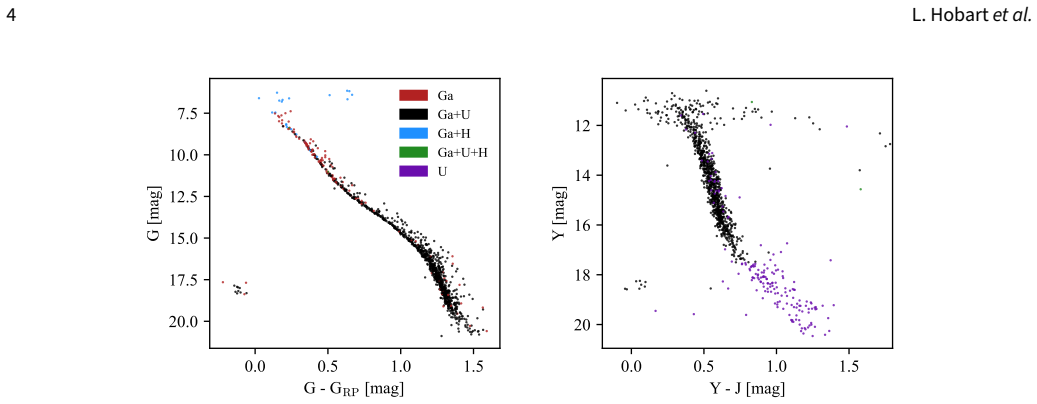
Summary. The paper determines the initial mass functions (IMFs) and initial dynamical conditions of the open clusters Alpha Persei, Pleiades, and Praesepe. Using Gaia DR3 astrometry/photometry supplemented by UKIDSS and Hipparcos, the authors construct membership samples to 0.10–0.17 M_sun, measure unresolved binary fractions via Monte Carlo/Bayesian fits, and then infer initial cluster properties by forward-modelling with N-body simulations whose outputs are emulated with Gaussian processes and sampled with Hamiltonian Monte Carlo. They report a three-stage broken-power-law IMF with average slopes alpha_l = 1.24 ± 0.29, alpha_m = 1.72 ± 0.09, alpha_h = 2.98 ± 0.22, break masses near 0.25 and 0.96 M_sun, and intrinsic scatter in the high-mass slope (sigma_h = 0.29 ± 0.16). They conclude that the IMF in these open clusters is top-light compared with Salpeter/Kroupa and may vary between clusters.
Significance. If the main result holds, it would strengthen the evidence that the IMF is not universal and depends on environmental conditions, and it would provide a novel methodological template for inferring initial cluster conditions by combining N-body simulations, machine-learning emulators, and Bayesian sampling. The paper is transparent about many of its assumptions and makes member catalogues and mass estimates publicly available. It also compares explicitly with the competing gas-expulsion analysis of Weis et al. (2025). The main value of the paper is the demonstration that a fully forward-modelled dynamical-evolution correction is feasible for open clusters; the reliability of the headline IMF slopes, however, depends critically on the gas-free initial-condition assumption and on the treatment of break masses, as detailed below.
major comments (3)
- [Section 5.4, Table 5] The inference is conditional on the assumption that early gas removal does not significantly affect subsequent cluster evolution (abstract; Section 5). The paper itself notes that Weis et al. (2025) find, with instantaneous gas expulsion, a very different Praesepe IMF (alpha_h = 4.1, alpha_l = 0.4) compared with the present alpha_h = 2.86, alpha_l = 1.93. The authors argue that unresolved binaries explain much of the difference, but this is not quantitatively supported: Section 4 and Figure 10 show that binary corrections change the slopes by roughly 0.1–0.5 and have 'little effect at the high mass end.' A ~1.2 dex difference in alpha_h cannot plausibly be absorbed by the binary correction. Because the emulator and HMC posterior are restricted to gas-free initial conditions, the quoted uncertainties in Table 5 cover only statistical and emulator uncertainty under that assumption; they do
- [Sections 5.1–5.2, Table 5] The break masses are not fitted; they are adopted from the observed PDMF. Section 5.1 states: 'We used the same break points m_x1 and m_x2 as the observed clusters rather than leaving them as free parameters.' Consequently, the break masses quoted in the abstract and Section 5.4 (0.24–0.50 M_sun and 0.91–1.20 M_sun) are not independently inferred from the N-body/HMC analysis; they come from the PDMF fits of Table 2. The reported slope values are therefore conditional on these breaks. If dynamical evolution shifts the breaks, the inferred initial slopes could be biased. The paper's assertion that the break points remain stable during evolution is plausible but is not demonstrated. I request a sensitivity test in which the break masses are treated as free parameters (or at least varied over the PDMF uncertainties) and the resulting IMF slope posteriors are shown to be unaffected.
- [Section 3.3, Section 2.1] The PDMF fitting truncates the sample at a magnitude limit chosen for Gaia completeness but does not model the completeness function of the combined Gaia+UKIDSS dataset. Section 3.3 applies a manual lower bound 'due to the completeness of Gaia at fainter magnitudes', but no completeness correction is applied to the inferred mass function. If the UKIDSS-only faint stars (Section 2.1) are not complete, or if the Gaia limit is not actually complete at the cluster distances, the low-mass slope alpha_l and the first break mass m_x1 will be biased. Since alpha_l = 1.24 ± 0.29 is part of the reported average IMF, the paper should either demonstrate that the adopted lower bound lies above any incompleteness or incorporate an explicit completeness model into the fits. This is particularly important because the low-mass slope is already sensitive to the mass–luminosity relation, and an incompleten
minor comments (5)
- [Section 2.2] For Alpha Persei, the initial proper motions and parallax are listed as mu_alpha = 19.997 mas/yr, mu_delta = -45.548 mas/yr, omega = 5.718 mas — identical to the Pleiades starting values. This is inconsistent with Table 1 and with the cluster's actual motion. Please correct this typo and verify that the iterative filtering converged to the values in Table 1.
- [Section 5.4, Figure 15] The reported average slopes and dispersions do not follow trivially from Table 5. For example, alpha_m = 1.72 ± 0.09 equals the inverse-variance weighted mean of the alpha_m,star values in Table 5 (1.64, 1.67, 2.23), but the quoted alpha_h = 2.98 ± 0.22 does not match the weighted mean of the Table 5 alpha_h values (which would be ~3.15 or 3.18). Please state explicitly whether the averages and dispersions are computed from full posterior samples, from the median values, or by a hierarchical model, and give the corresponding formula.
- [Section 5.2] The concentration parameter c is omitted from the emulator because it 'had little significant correlation' with the test statistics. Please report the range of c values sampled and show that setting the initial tidal radius equal to the Jacobi radius does not bias the inferred half-mass radii or the IMF slopes.
- [General] The text switches between alpha_med (abstract) and alpha_m (body and tables) for the intermediate-mass slope. Use one notation throughout for consistency.
- [Figures] In the review copy, several figures contain garbled axis labels (e.g., Figures 1, 2, 4, 5, 11, 12, 16). This may be a rendering artifact, but please ensure the published version has legible labels and legends.
Circularity Check
Forward-modeling chain is self-contained; minor issue: initial IMF break masses are adopted from the observed PDMF and then presented as part of the inferred IMF.
specific steps
-
fitted input called prediction
[Section 5.1 (emulator training), Section 5.4 (average IMF), Abstract]
"We used the same break points m x1 and m x2 as the observed clusters rather than leaving them as free parameters to reduce the complexity of the model. ... we find the average IMF to be given by ... break masses of m x1 = 0.25 ± 0.02 M⊙ and m x2 = 0.96 ± 0.14 M⊙."
The quoted initial break masses are not inferred by the N-body/emulator stage; Section 5.1 fixes them to the present-day PDMF break masses, so the values reported in Section 5.4 and the Abstract are a restatement of the observed PDMF input by construction. However, the central IMF-slope results are genuinely fitted to independent present-day observables (PDMF slopes, half-mass radius, binary fraction, surface density), so this does not force the headline top-light or scatter conclusions.
full rationale
The paper's central derivation is a self-contained forward-modeling analysis: initial system number, binary fraction, half-mass radius, and IMF slopes are fit with an emulator/HMC pipeline to reproduce present-day PDMF slopes, binary fraction, half-mass radius, and surface density profiles. These observables are independent of the fitted initial slopes, and the high-mass slope is additionally constrained by the present-day half-mass radius rather than only by the high-mass PDMF. No equation in the paper reduces an inferred quantity to a fitted input by construction, aside from the break masses, which are explicitly fixed to the observed PDMF break masses and then reported as part of the 'best-fitting initial mass function.' This is a minor conflation of input and output but does not affect the main IMF-slope claims. Self-citations (e.g., Baumgardt et al. 2023, Khalaj & Baumgardt 2013) are used for comparison and methodology, not as unverified load-bearing premises, and the results are checked against external determinations. The gas-free early-evolution assumption and the disagreement with Weis et al. (2025) are explicitly acknowledged systematic limitations, not circularity. Overall, the derivation chain is largely independent and externally falsifiable; the only circularity-adjacent element is the presentational treatment of the adopted break masses.
Axiom & Free-Parameter Ledger
free parameters (30)
- IMF low-mass slope αl (Alpha Persei) =
0.98 ± 0.23
- IMF low-mass slope αl (Pleiades) =
0.80 ± 0.27
- IMF low-mass slope αl (Praesepe) =
1.93 ± 0.24
- IMF intermediate-mass slope αm (Alpha Persei) =
1.64 ± 0.25
- IMF intermediate-mass slope αm (Pleiades) =
1.67 ± 0.09
- IMF intermediate-mass slope αm (Praesepe) =
2.23 ± 0.26
- IMF high-mass slope αh (Alpha Persei) =
2.60 ± 0.19
- IMF high-mass slope αh (Pleiades) =
3.33 ± 0.10
- IMF high-mass slope αh (Praesepe) =
2.86 ± 0.36
- Break mass mx1 (Alpha Persei) =
0.30 ± 0.06 M_sun
- Break mass mx1 (Pleiades) =
0.24 ± 0.02 M_sun
- Break mass mx1 (Praesepe) =
0.50 ± 0.11 M_sun
- Break mass mx2 (Alpha Persei) =
0.95 ± 0.34 M_sun
- Break mass mx2 (Pleiades) =
0.91 ± 0.12 M_sun
- Break mass mx2 (Praesepe) =
1.20 ± 0.33 M_sun
- Present-day binary fraction fbin (Alpha Persei) =
0.238 ± 0.012
- Present-day binary fraction fbin (Pleiades) =
0.200 ± 0.008
- Present-day binary fraction fbin (Praesepe) =
0.221 ± 0.010
- Initial binary fraction fbin_ini (Alpha Persei) =
0.346 ± 0.019
- Initial binary fraction fbin_ini (Pleiades) =
0.303 ± 0.012
- Initial binary fraction fbin_ini (Praesepe) =
0.242 ± 0.015
- Initial number of systems Nsys_ini (Alpha Persei) =
1127
- Initial number of systems Nsys_ini (Pleiades) =
1670
- Initial number of systems Nsys_ini (Praesepe) =
2105
- Initial 3D half-mass radius rh_ini (Alpha Persei) =
5.63 pc
- Initial 3D half-mass radius rh_ini (Pleiades) =
4.45 pc
- Initial 3D half-mass radius rh_ini (Praesepe) =
4.34 pc
- Empirical M-L spline coefficients =
Not tabulated
- Main-sequence polynomial coefficients (each cluster) =
Not given
- Membership filtering thresholds =
σα=σδ=1 mas/yr, σω=0.25 mas, χ²=11.345, P>0.75, radius=15°
axioms (9)
- domain assumption Early gas removal does not significantly influence subsequent cluster evolution.
- domain assumption Newtonian N-body dynamics with NBODY7 accurately models cluster evolution.
- domain assumption IMF break masses mx1 and mx2 are invariant under dynamical evolution.
- domain assumption Gaia DR3, UKIDSS, and HIPPARCOS samples are complete down to applied magnitude limits and member selection is clean.
- ad hoc to paper Flat mass-ratio distribution for binary secondaries; semi-major axes log-uniform between 50 stellar radii and 1000 AU.
- domain assumption All stellar remnants (NS/BH) are ejected immediately.
- domain assumption Adopted PARSEC/MIST isochrones and empirical M-L relation give unbiased stellar masses.
- domain assumption King (1962) density profile with concentration tied to Jacobi radius describes initial cluster structure.
- domain assumption The Gaussian-process emulator trained on a Latin hypercube is sufficiently accurate for inference.
Cite this review
Pith. "Pith review of The initial conditions and initial mass functions of Alpha Persei, Pleiades and Praesepe." pith.science (2026). https://pith.science/paper/ZFCLPOT4
@misc{pith2026260717300,
  author       = {Pith},
  title        = {Pith review of: The initial conditions and initial mass functions of Alpha Persei, Pleiades and Praesepe},
  year         = {2026},
  howpublished = {\url{https://pith.science/paper/ZFCLPOT4}},
  note         = {Machine review of arXiv:2607.17300}
}
abstract
We have determined the initial mass function (IMF) and structural properties of the open clusters Alpha Persei, Pleiades and Praesepe using Gaia DR3 astrometry and photometry. Cluster members were identified using primarily Gaia astrometry, supplemented with near-infrared UKIDSS and optical HIPPARCOS survey data with stellar masses down to $0.10-0.17$ MSun. We measure and correct for unresolved binaries in each cluster using photometry and Monte Carlo simulations in a Bayesian framework, finding present-day fractions between ($20.0\pm0.8$)% and ($23.8\pm1.2$)%. Through a novel approach that combines N-body simulations with machine learning emulators and MCMC algorithms, we have also determined the most probable initial number of stars, binary fraction, half-mass radius and mass function under the assumption that early gas removal does not significantly influence the subsequent cluster evolution. We find a best-fitting initial mass function described by a three-stage broken power-law distribution with break masses in the ranges $0.24-0.50$ MSun and $0.91-1.20$ MSun and average slopes of $\alpha_{\rm med}=1.72\pm0.09$ and $\alpha_{\rm high}=2.98\pm0.22$. While the low-mass slope remains sensitive to the adopted mass-luminosity relation, this IMF reproduces the present-day clusters well once their dynamical evolution is taken into account. We find evidence of scatter in the high mass IMF between the individual clusters, as described by the measured dispersions in mass function slopes of ${\sigma}_{\rm high}=0.29\pm0.16$, whereas the intermediate mass slope shows no significant variation with ${\sigma}_{\rm med}=0.00\pm0.14$. Our findings provide additional evidence for a (compared to a Salpeter MF) top-light IMF and a cluster-to-cluster variation of the IMF. They therefore provide constraints on the universality of the IMF and its dependence on environmental conditions.
Figures



Reference graph
Works this paper leans on
-
[2]
Astronomy and Astrophysics , volume =
Exploring the Consequences of Pairing Algorithms for Binary Stars , author =. Astronomy and Astrophysics , volume =. doi:10.1051/0004-6361:200810234 , urldate =
-
[3]
Monthly Notices of the Royal Astronomical Society , volume =
On the Initial Binary Population for Star Cluster Simulations , author =. Monthly Notices of the Royal Astronomical Society , volume =. doi:10.1093/mnras/stx1763 , urldate =
-
[5]
Astronomy & Astrophysics , volume =
Impact of Metallicity and Star Formation Rate on the Time-Dependent, Galaxy-Wide Stellar Initial Mass Function , author =. Astronomy & Astrophysics , volume =. doi:10.1051/0004-6361/201833055 , urldate =
-
[6]
Astronomy and Astrophysics , volume =
The Effect of the Environment-Dependent Stellar Initial Mass Function on the Photometric Properties of Star-Forming Galaxies , author =. Astronomy and Astrophysics , volume =. doi:10.1051/0004-6361/202347928 , urldate =
-
[7]
Stellar Population Synthesis Models with a Physically Varying
Zonoozi, Akram Hasani and Haghi, Hosein and Kroupa, Pavel , year = 2025, month = mar, journal =. Stellar Population Synthesis Models with a Physically Varying. doi:10.1093/mnras/staf091 , urldate =
-
[8]
Dabringhausen, J. Low-Mass. The Astrophysical Journal , volume =. doi:10.1088/0004-637X/747/1/72 , urldate =
-
[9]
Astronomy & Astrophysics , author =
Painting a portrait of the. Astronomy & Astrophysics , author =. 2020 , pages =. doi:10.1051/0004-6361/202038192 , abstract =
-
[10]
Astronomy & Astrophysics , author =
Binary masses and luminosities with. Astronomy & Astrophysics , author =. 2023 , pages =. doi:10.1051/0004-6361/202347111 , abstract =
-
[11]
Longmore, S. N. and Kruijssen, J. M. D. and Bastian, N. and Bally, J. and Rathborne, J. and Testi, L. and Stolte, A. and Dale, J. and Bressert, E. and Alves, J. , year =. The. Protostars and. doi:10.2458/azu_uapress_9780816531240-ch013 , urldate =
-
[12]
Astronomy & Astrophysics , author =
Gas expulsion in massive star clusters?:. Astronomy & Astrophysics , author =. 2016 , pages =. doi:10.1051/0004-6361/201526685 , urldate =
-
[13]
The Astrophysical Journal , author =
Why. The Astrophysical Journal , author =. 2007 , pages =. doi:10.1086/512856 , language =
-
[14]
Kruijssen, J. M. Diederik and Maschberger, Thomas and Moeckel, Nickolas and Clarke, Cathie J. and Bastian, Nate and Bonnell, Ian A. , month = jan, year =. The dynamical state of stellar structure in star-forming regions , volume =. Monthly Notices of the Royal Astronomical Society , publisher =. doi:10.1111/j.1365-2966.2011.19748.x , abstract =
arXiv 2011
-
[15]
Gennaro, Mario and Goodwin, Simon P. and Parker, Richard J. and Allison, Richard J. and Brandner, Wolfgang , month = dec, year =. Hierarchical formation of. Monthly Notices of the Royal Astronomical Society , publisher =. doi:10.1093/mnras/stx2098 , abstract =
-
[17]
Nielsen, Emma W. and Steinhardt, Charles L. and Harper, Mathieux and McPartland, Conor and Sedgewick, Aidan , month = aug, year =. Evidence for multiple types of post-starburst galaxies , volume =. Astronomy and Astrophysics , publisher =. doi:10.1051/0004-6361/202554507 , abstract =
-
[18]
Steinhardt, Charles L. , month = apr, year =. Do. The Astrophysical Journal , publisher =. doi:10.3847/1538-4357/adb95b , abstract =
-
[19]
Astronomy & Astrophysics , author =. 2023 , pages =. doi:10.1051/0004-6361/202243797 , abstract =
-
[20]
Annual Review of Astronomy and Astrophysics , author =
Star. Annual Review of Astronomy and Astrophysics , author =. 1998 , note =. doi:10.1146/annurev.astro.36.1.189 , abstract =
-
[21]
Annual Review of Astronomy and Astrophysics , author =
Modeling the. Annual Review of Astronomy and Astrophysics , author =. 2013 , note =. doi:10.1146/annurev-astro-082812-141017 , abstract =
-
[22]
The initial mass function of stars , copyright =
Kroupa, Pavel and Gjergo, Eda and Jerabkova, Tereza and Yan, Zhiqiang , year =. The initial mass function of stars , copyright =. Encyclopedia of. doi:10.1016/B978-0-443-21439-4.00035-3 , language =
-
[23]
Annual Review of Astronomy and Astrophysics , author =
Nucleosynthesis in. Annual Review of Astronomy and Astrophysics , author =. 2013 , note =. doi:10.1146/annurev-astro-082812-140956 , abstract =
-
[24]
Woosley, S. E. and Weaver, Thomas A. , month = nov, year =. The. The Astrophysical Journal Supplement Series , publisher =. doi:10.1086/192237 , abstract =
-
[25]
van Leeuwen, F. , month = nov, year =. Validation of the new. Astronomy and Astrophysics , publisher =. doi:10.1051/0004-6361:20078357 , abstract =
-
[27]
Annual Review of Astronomy and Astrophysics , author =
Stellar. Annual Review of Astronomy and Astrophysics , author =. 2013 , note =. doi:10.1146/annurev-astro-081710-102602 , abstract =
-
[28]
Astronomy & Astrophysics , author =
Towards absolute scales for the radii and masses of open clusters , volume =. Astronomy & Astrophysics , author =. 2007 , pages =. doi:10.1051/0004-6361:20077073 , number =
-
[29]
Gratton, Raffaele and Bragaglia, Angela and Carretta, Eugenio and D'Orazi, Valentina and Lucatello, Sara and Sollima, Antonio , month = nov, year =. What is a globular cluster?. Astronomy and Astrophysics Review , publisher =. doi:10.1007/s00159-019-0119-3 , abstract =
-
[30]
Plummer, H. C. , month = mar, year =. On the problem of distribution in globular star clusters , volume =. Monthly Notices of the Royal Astronomical Society , publisher =. doi:10.1093/mnras/71.5.460 , urldate =
-
[31]
Astronomy & Astrophysics , author =
Tidal radii and masses of open clusters , volume =. Astronomy & Astrophysics , author =. 2008 , pages =. doi:10.1051/0004-6361:20078525 , number =
-
[32]
Astronomy & Astrophysics , author =
Photometric binaries, mass functions, and structural parameters of 78. Astronomy & Astrophysics , author =. 2023 , pages =. doi:10.1051/0004-6361/202245457 , abstract =
-
[34]
A minimum column density of 1gcm-2 for massive star formation , volume =. Nature , author =. 2008 , note =. doi:10.1038/nature06620 , abstract =
-
[36]
Monthly Notices of the Royal Astronomical Society , author =
Star formation through gravitational collapse and competitive accretion , volume =. Monthly Notices of the Royal Astronomical Society , author =. 2006 , pages =. doi:10.1111/j.1365-2966.2006.10495.x , language =
arXiv 2006
-
[38]
Astronomy & Astrophysics , author =
The. Astronomy & Astrophysics , author =. 2025 , pages =. doi:10.1051/0004-6361/202556239 , abstract =
-
[40]
The Astrophysical Journal , author =. 2005 , pages =. doi:10.1086/432680 , language =
-
[41]
Astronomy & Astrophysics , author =
The 0.4-\. Astronomy & Astrophysics , author =. 2003 , pages =. doi:10.1051/0004-6361:20021609 , number =
-
[42]
, month = jan, year =
Leinert, Christoph and Allard, France and Richichi, Andrea and Hauschildt, Peter H. , month = jan, year =. The multiple system. Astronomy and Astrophysics , publisher =
-
[43]
Publications of the Astronomical Society of the Pacific , author =. 2006 , pages =. doi:10.1086/504881 , language =
-
[44]
and Delfosse, X
Ségransan, D. and Delfosse, X. and Forveille, T. and Beuzit, J.-L. and Udry, S. and Perrier, C. and Mayor, M. , month = dec, year =. Accurate masses of very low mass stars. Astronomy and Astrophysics , abstract =
-
[45]
The Astrophysical Journal , author =. 2009 , pages =. doi:10.1088/0004-637X/691/2/1400 , number =
-
[46]
Accurate masses of very low mass stars
Forveille, Thierry and Beuzit, Jean-Luc and Delfosse, Xavier and Segransan, Damien and Beck, Francoise and Mayor, Michel and Perrier, Christian and Tokovinin, Andrei and Udry, Stéphane , month = nov, year =. Accurate masses of very low mass stars. Astronomy & Astrophysics , abstract =
-
[47]
The Astrophysical Journal , author =
Absolute. The Astrophysical Journal , author =. 2002 , pages =. doi:10.1086/338587 , language =
-
[48]
Henry, Todd J. and Franz, Otto G. and Wasserman, Lawrence H. and Benedict, G. Fritz and Shelus, Peter J. and Ianna, Philip A. and Kirkpatrick, J. Davy and McCarthy, Jr., Donald W. , month = feb, year =. The. The Astrophysical Journal , publisher =. doi:10.1086/306793 , abstract =
-
[49]
The Astronomical Journal , author =. 2012 , pages =. doi:10.1088/0004-6256/143/3/68 , number =
-
[50]
Flower, Phillip J. , month = sep, year =. Transformations from. The Astrophysical Journal , publisher =. doi:10.1086/177785 , abstract =
-
[51]
Wahba, Grace , month = jan, year =. Spline. doi:10.1137/1.9781611970128 , language =
-
[52]
Astronomy & Astrophysics , author =. 2021 , pages =. doi:10.1051/0004-6361/202039587 , abstract =
-
[53]
Kharchenko, N. V. and Piskunov, A. E. and Schilbach, E. and Röser, S. and Scholz, R.-D. , month = jul, year =. Global survey of star clusters in the. Astronomy and Astrophysics , publisher =. doi:10.1051/0004-6361/201118708 , abstract =
-
[54]
Frasca, A. and Zhang, J. Y. and Alonso-Santiago, J. and Fu, J. N. and Molenda-Żakowicz, J. and De Cat, P. and Catanzaro, G. , month = jun, year =. Astronomy and Astrophysics , publisher =. doi:10.1051/0004-6361/202553673 , abstract =
-
[55]
Chemical abundances for a sample of
Grilo, Vinicius and Souto, Diogo and Cunha, Katia and Guerço, Rafael and Vieira, Rodrigo and Smith, Verne and Vilar, Deusalete and Silva-Andrade, Anderson and Wanderley, Fábio and Daflon, Simone and Silva, João Victor Sales , month = nov, year =. Chemical abundances for a sample of. Monthly Notices of the Royal Astronomical Society , publisher =. doi:10.1...
-
[56]
and Laskar, Tanmoy and Valenti, Jeff A
Soderblom, David R. and Laskar, Tanmoy and Valenti, Jeff A. and Stauffer, John R. and Rebull, Luisa M. , month = nov, year =. The. The Astronomical Journal , publisher =. doi:10.1088/0004-6256/138/5/1292 , abstract =
-
[57]
Prosser, Charles F. , month = feb, year =. Membership of. The Astronomical Journal , publisher =. doi:10.1086/116077 , abstract =
-
[58]
Danner, Christopher A. and Sandquist, Eric L. and Schaefer, Gail H. and Bedin, Luigi R. and Farrington, Christopher D. and Lanthermann, Cyprien and Kraus, Stefan and Klement, Robert and Anugu, Narsireddy and Monnier, John D. and Orosz, Jerome A. and Codron, Isabelle and Gardner, Tyler and Gutierrez, Mayra and Setterholm, Benjamin R. and Jones, Jeremy and ...
-
[59]
and Ramsay, Mary Elizabeth , month = apr, year =
Boesgaard, Ann Merchant and Budge, Kent G. and Ramsay, Mary Elizabeth , month = apr, year =. Lithium in the. The Astrophysical Journal , publisher =. doi:10.1086/166201 , abstract =
-
[60]
Choi, Jieun and Dotter, Aaron and Conroy, Charlie and Cantiello, Matteo and Paxton, Bill and Johnson, Benjamin D. , month = jun, year =. Mesa. The Astrophysical Journal , publisher =. doi:10.3847/0004-637X/823/2/102 , abstract =
-
[61]
The Astronomical Journal , author =
Unresolved. The Astronomical Journal , author =. 2023 , pages =. doi:10.3847/1538-3881/aca666 , abstract =
-
[62]
Astronomy & Astrophysics , author =
A. Astronomy & Astrophysics , author =. 2023 , pages =. doi:10.1051/0004-6361/202346569 , abstract =
-
[63]
Gjergo, Eda and Zhang, Zhiyu and Kroupa, Pavel , month = jan, year =. The. doi:10.48550/arXiv.2601.20998 , abstract =
-
[64]
Allison, Richard J. and Goodwin, Simon P. and Parker, Richard J. and Portegies Zwart, Simon F. and de Grijs, Richard and Kouwenhoven, M. B. N. , month = may, year =. Using the minimum spanning tree to trace mass segregation , volume =. Monthly Notices of the Royal Astronomical Society , publisher =. doi:10.1111/j.1365-2966.2009.14508.x , abstract =
arXiv 2009
-
[65]
The Astrophysical Journal , author =. 2011 , pages =. doi:10.1088/0004-637X/728/1/48 , number =
-
[66]
The Astrophysical Journal Supplement Series , author =. 2013 , pages =. doi:10.1088/0067-0049/208/1/9 , number =
-
[68]
Astronomy & Astrophysics , author =
A refined analysis of the low-mass eclipsing binary system. Astronomy & Astrophysics , author =. 2017 , pages =. doi:10.1051/0004-6361/201527902 , urldate =
-
[69]
Hełminiak, K. G. and Konacki, M. , month = feb, year =. Orbital and physical parameters of eclipsing binaries from the. Astronomy and Astrophysics , publisher =. doi:10.1051/0004-6361/200913336 , abstract =
-
[70]
Hełminiak, K. G. and Konacki, M. and Złoczewski, K. and Ratajczak, M. and Reichart, D. E. and Ivarsen, K. M. and Haislip, J. B. and Crain, J. A. and Foster, A. C. and Nysewander, M. C. and Lacluyze, A. P. , month = mar, year =. Orbital and physical parameters of eclipsing binaries from the. Astronomy and Astrophysics , publisher =. doi:10.1051/0004-6361/2...
-
[71]
and Forveille, T
Delfosse, X. and Forveille, T. and Ségransan, D. and Beuzit, J.-L. and Udry, S. and Perrier, C. and Mayor, M. , month = dec, year =. Accurate masses of very low mass stars. Astronomy and Astrophysics , abstract =
-
[72]
The Astronomical Journal , author =. 2016 , pages =. doi:10.3847/0004-6256/152/5/141 , abstract =
-
[74]
and Gilmore, Gerard , month = jun, year =
Kroupa, Pavel and Tout, Christopher A. and Gilmore, Gerard , month = jun, year =. The. Monthly Notices of the Royal Astronomical Society , publisher =. doi:10.1093/mnras/262.3.545 , abstract =
-
[75]
and Gilmore, Gerard , month = may, year =
Kroupa, Pavel and Tout, Christopher A. and Gilmore, Gerard , month = may, year =. The low-luminosity stellar mass function. , volume =. Monthly Notices of the Royal Astronomical Society , publisher =
-
[76]
Stellar masses. , volume =. Annual Review of Astronomy and Astrophysics , author =. 1980 , note =. doi:10.1146/annurev.aa.18.090180.000555 , abstract =
arXiv 1980
-
[77]
Kroupa, P. and Tout, C. A. and Gilmore, G. , month = jul, year =. The effects of unresolved binary stars on the determination of the stellar mass function. , volume =. Monthly Notices of the Royal Astronomical Society , publisher =. doi:10.1093/mnras/251.2.293 , abstract =
-
[78]
Torres, G. and Andersen, J. and Giménez, A. , month = feb, year =. Accurate masses and radii of normal stars: modern results and applications , volume =. Astronomy and Astrophysics Review , publisher =. doi:10.1007/s00159-009-0025-1 , abstract =
-
[80]
Moe, Maxwell and Di Stefano, Rosanne , month = jun, year =. Mind. The Astrophysical Journal Supplement Series , publisher =. doi:10.3847/1538-4365/aa6fb6 , abstract =
-
[81]
Weis, L. and West, C. and Just, A. and Berczik, P. and Ishchenko, M. and Röser, S. and Schilbach, E. and Shukirgaliyev, B. , month = oct, year =. Dynamical model of. Astronomy and Astrophysics , publisher =. doi:10.1051/0004-6361/202451650 , abstract =
-
[82]
Safaei, Ghasem and Haghi, Hosein and Zonoozi, Akram Hasani and Kroupa, Pavel , month = aug, year =. Are the. Monthly Notices of the Royal Astronomical Society , publisher =. doi:10.1093/mnras/staf941 , abstract =
-
[83]
Haghi, Hosein and Zonoozi, Akram Hasani and Kroupa, Pavel and Banerjee, Sambaran and Baumgardt, Holger , month = dec, year =. Possible smoking-gun evidence for initial mass segregation in re-virialized post-gas expulsion globular clusters , volume =. Monthly Notices of the Royal Astronomical Society , publisher =. doi:10.1093/mnras/stv2207 , abstract =
-
[84]
Contributions of the Astronomical Observatory Skalnate Pleso , author =
Are binary-star populations regionally different?. Contributions of the Astronomical Observatory Skalnate Pleso , author =. 2025 , note =. doi:10.31577/caosp.2025.55.3.217 , abstract =
-
[86]
Dinnbier, František and Kroupa, Pavel and Anderson, Richard I. , month = apr, year =. Do the majority of stars form as gravitationally unbound? , volume =. Astronomy and Astrophysics , publisher =. doi:10.1051/0004-6361/202142082 , abstract =
-
[87]
Do star clusters form in a completely mass-segregated way? , volume =
Pavlík, Václav and Kroupa, Pavel and Šubr, Ladislav , month = jun, year =. Do star clusters form in a completely mass-segregated way? , volume =. Astronomy and Astrophysics , publisher =. doi:10.1051/0004-6361/201834265 , abstract =
-
[88]
Kroupa, Pavel and Pflamm-Altenburg, Jan and Mazurenko, Sergij and Wu, Wenjie and Thies, Ingo and Jadhav, Vikrant and Jerabkova, Tereza , month = jul, year =. Open. The Astrophysical Journal , publisher =. doi:10.3847/1538-4357/ad4c66 , abstract =
-
[89]
Jerabkova, Tereza and Romano, Donatella and Kroupa, Pavel and André, Philippe and Chruślińska, Martyna and Fontanot, Fabio and Hopkins, Andrew and Jadhav, Vikrant and Lahén, Natalia and Lee, Yueh-Ning and Mucciarelli, Alessio and Salvadori, Stefania and Wang, Long and Yan, Zhiqiang and Andersen, Morten and Durrant, Anna and Louvet, Fabien and Lyubenova, M...
-
[90]
Kroupa, Pavel and Tout, Christopher A. , month = may, year =. The theoretical mass-magnitude relation of low mass stars and its metallicity dependence , volume =. Monthly Notices of the Royal Astronomical Society , publisher =. doi:10.1093/mnras/287.2.402 , abstract =
-
[91]
Biochemical Pharmacology , author =
Antidepressant drugs affect dopamine uptake , volume =. Biochemical Pharmacology , author =. 1975 , keywords =. doi:10.1016/0006-2952(75)90412-8 , language =
-
[92]
Astronomy & Astrophysics , author =
The masses of open star clusters and their tidal tails and the stellar initial mass function , volume =. Astronomy & Astrophysics , author =. 2024 , pages =. doi:10.1051/0004-6361/202347839 , abstract =
This paper was first reviewed by deepseek-v4-flash on August 1, 2026.
discussion (0)
Sign in with ORCID, Apple, or X to comment. Anyone can read and Pith papers without signing in.