REVIEW 2 major objections 5 minor 39 references
Taurus: Accelerating Out-of-Core Graph Neural Network Inference on Billion-Scale Graphs
T0 review · 2 major / 5 minor · reviewed 2026-08-01 · deepseek-v4-flash
Pith's one-line read Out-of-core GNN inference can be made sequential: broadcast beats gather on billion-scale graphs.
desk verdict Worth engaging seriously, but the IGB-Full headline numbers (25x/140x) are extrapolations from a baseline that timed out, so treat the upper end of the range as indicative until the artifact ships. read the letter →
The pith
A machine-rendered reading of the paper's core claim, the machinery that carries it, and where it could break.
The reading
What carries the argument
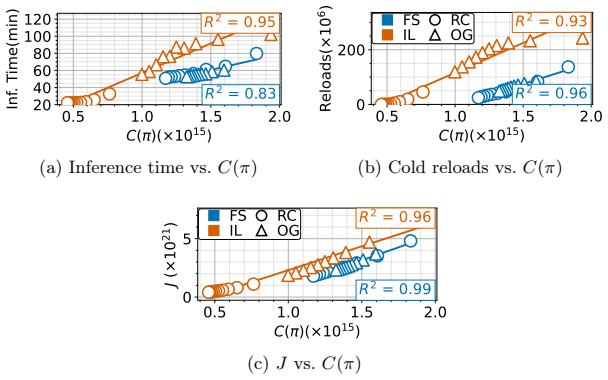
The source-centric broadcast execution model, backed by a three-tier GPU–RAM–SSD partial-state store. Messages flow along out-edges in CSR vertex order, so each embedding is read once; destination partial aggregates live in a pinned GPU store for hubs, a bounded hot store in RAM, and an SSD cold store with merge-on-read run files. Two controls carry the performance argument: topology-aware reordering minimizes the cumulative active-state span C(π) via a differentiable dispersion objective J, and the eviction policy spills the k states with the fewest pending messages, minimizing eviction–reload cycles.
What would settle it
Engineer a graph with many destinations whose in-neighbors are deliberately spread across distant rank intervals after reordering (e.g., a planted-community graph with long-range edges), run Taurus and a layer-wise gather baseline, and measure inference time and reload counts against C(π) and J. If J converges to an ordering that does not reduce span, or if reloads and runtime stop tracking C(π) while sequential reads remain, the central claim is falsified; alternatively, a simple comparison where Taurus's speedup over the layer-wise baseline drops below the reported range on such a topology w
Extended reading notes
Core claim
The paper's central claim is that layer-wise GNN inference can be reformulated as source-centric broadcasts, replacing repeated random gathers with sequential disk access. Taurus implements this by streaming each vertex's embedding once per pass from SSD, buffering partial aggregation states for destinations in a GPU-resident store for high-degree vertices, a hot store in RAM, and an SSD cold store, and writing completed embeddings as sorted run files that are merged on read. To keep partial-state lifetimes short, it reorders vertices by minimizing the total span—the sum over destinations of the distance between the first and last incoming source—using an iterative in-neighborhood dispersion
Load-bearing premise
The performance gains rest on the empirical chain—validated on only two graphs and two starting orderings—that total span C(π) predicts inference time and cold-store reloads, and that the differentiable dispersion objective J tracks C(π); if a graph topology breaks that correlation, the sequential-scan advantage erodes toward gather-based baselines.
Editorial extensions
If this is right
- If correct, exact full-neighborhood inference on a graph with 514 GiB of features finishes in under 30 minutes on a single workstation with 128 GiB RAM, one GPU, and a 2 TiB SSD, making periodic refresh of predictions on evolving graphs practical within hours.
- Sequential broadcast cuts disk traffic by large factors: the paper reports the vertex-wise baselines read up to roughly 50× and 108× more data than Taurus in the evaluated workloads.
- Alternative GNN operators—GraphSAGE, GAT, GIN—can run through additional sequential passes rather than random gathers, preserving semantics without materializing edge features, at a modest runtime cost.
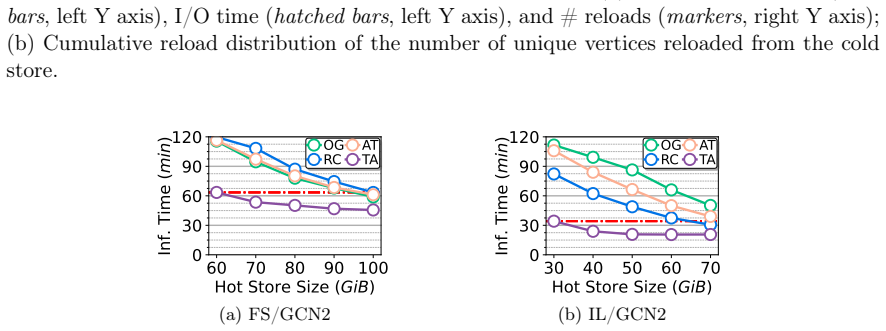
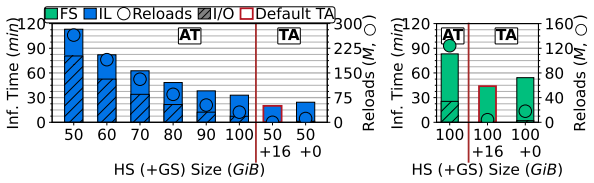
- Topology-aware reordering and pending-message eviction reduce cold-store reloads by up to two orders of magnitude, and Taurus at a 60 GiB hot store matches the performance of other orderings at roughly 90 GiB, decoupling inference speed from RAM scale.
Reading between the lines
- The broadcast-plus-partial-state pattern is general: any vertex-centric iterative computation with commutative aggregation (e.g., PageRank-style scoring or label propagation) could adopt the same sequential-scan, tiered-buffer design for out-of-core graphs, not just GNNs.
- The reordering objective's dependence on static topology means graphs with rapidly changing edge structure could invalidate a cached ordering; an incremental reordering that updates positions under edge insertions would be a natural testable extension.
- If the span-to-runtime correlation holds across topologies, the system's gains should transfer to other power-law and community-structured graphs; a hybrid that gathers over long-range edges only while broadcasting locally could extend the design to graphs where reordering cannot compress span.
Editorial analysis
A structured set of objections, weighed in public.
Referee Report
Summary. Taurus is a single-machine, out-of-core inference engine for GNNs on graphs whose feature/embedding stores exceed RAM. The core idea is to replace the standard destination-centric gather (each vertex pulls its neighbors' embeddings) with a source-centric broadcast that streams each source embedding once in vertex order, using a CSR out-edge layout and a tiered GPU–RAM–SSD aggregation hierarchy. Partial aggregation states are managed under a bounded hot-store budget, with a GPU-resident store for high-degree vertices, a pending-message-count eviction policy, and run-file output to avoid random writes. A topology-aware reordering procedure minimizes a differentiable neighborhood-dispersion objective, which is empirically shown to track total vertex span and hence reload/I/O cost. The paper evaluates exact and fanout-sampled inference on five public datasets (up to 269M vertices, 4B edges, 514 GiB features), reporting 7–25× speedups over the layer-wise DGI baseline and 40–140× over vertex-wise Ginex/DGL baselines, with ablations of reordering, eviction, hot-store/GPU-store capacity, and a comparison to the authors' prior ATLAS system.
Significance. If the reported numbers hold, Taurus makes a strong case that single-node OOC inference can outperform distributed or disk-based gathering systems at billion scale, and the broadcast formulation is a conceptually clean alternative to gather-based execution. The evaluation is generally careful: public datasets, page-cache clearing, a numerical cross-check of exact inference against in-memory DGL (mean per-vertex max abs error 8e-5, mean rel error 2.8e-6), and an honest negative result for in-memory SAGE/GAT on PA (0.6× of DGI). The ablations isolate the effect of reordering, eviction, and memory budgets, which is valuable. The main caveat is that the highest headline speedups on IGB-Full depend on extrapolated baseline runtimes rather than direct measurement.
major comments (2)
- [§4.2, §4.3, Fig. 6] The headline upper bounds on IGB-Full (25× over DGI, 140×/96× over Ginex/DGL) are not measured runtimes. §4.2 caps all runs at 4h and linearly extrapolates incomplete runs from completed vertex ranges/chunks; §4.3 says DGI's first layer on IF exceeded the cap, so its total is an extrapolation plus later layers with dummy inputs. No completed fraction, no extrapolation error, and no validation of the linearity assumption on a dataset where DGI completes is reported. A 30–40% error in the first-layer estimate would move 25× into the low-20s or high-teens. Please either complete the DGI first layer on IF (or a representative subgraph) or validate the extrapolation procedure against full runs on FS/MA/IL, and report the completed fraction and error bars. The same caveat applies to GX/DG bars on IF/MA.
- [§3.8, Fig. 5] The J-to-C(π)-to-time chain is validated only on FS and IL (R²=0.83–0.99). Yet the converged TA ordering is applied to MA and IF and to SAGE/GAT models in Fig. 6; if the correlation breaks on these topologies, the reordering benefit (and the magnitude of the speedup) would shrink. Please report C(π) and runtime for the converged ordering on MA and IF, or explicitly restrict the reordering claims to the validated datasets.
minor comments (5)
- [Abstract and §4.3] The advertised speedup ranges are for fanout-sampled inference only. Exact full-neighborhood inference is benchmarked only against ATLAS and not against DGI/Ginex/DGL; please state this qualification in the abstract or at the start of §4.3.
- [§3.9] The fanout-sampled edge-mask construction is described in one sentence. Since the headline evaluation is sampled, specify how the mask is generated, stored, and applied during the broadcast pass, and its memory/disk cost.
- [§3.8, Algorithm 1] The formula for r*(w) divides by the sum of 1/d⁻(v) over v ∈ N⁺(w); for vertices with no out-neighbors the denominator is zero. Specify the fallback (keep previous position, assign a constant, etc.).
- [§4.1] The numerical cross-check against in-memory DGL is only for exact inference on PA. A sampled-inference cross-check, even on a smaller graph, would increase confidence in the sampled mode used for the headline comparison.
- [General] Use R² notation consistently; the annotation in Fig. 4 ('E VO GC PH SN S') appears garbled; 'MAG-Cites' is once written as 'MA G-Cites'; and no artifact/code availability statement is included.
Circularity Check
No significant circularity; central speedup rests on external baselines and public datasets; minor self-citations (ATLAS) are ablative/provenance, not load-bearing.
full rationale
The paper's central claim — that Taurus outperforms DGI by 7–25× and Ginex/DGL by 40–140× on billion-scale out-of-core graphs — is an empirical comparison against external systems (DGI, Ginex, DGL) on public datasets (OGB, SNAP, IGB). No target result is fed into Taurus to produce its output; the broadcast execution model is shown to be semantically equivalent to gather by construction, and the measured speedups are direct runtime comparisons. The topology-aware reordering objective J is validated by empirical correlations with C(π) and inference time (Fig. 5), and C(π) itself is defined independently from the runtime as cumulative active-state occupancy; this is a validation, not a self-definition. The only notable self-citation is ATLAS [1], which is acknowledged as prior work that introduced broadcast-based layer-wise inference and is used as an ablation baseline in Fig. 13. That self-citation is not load-bearing for the central speedup claim: the main comparisons are against DGI, Ginex, and DGL, and Taurus's design is described self-containedly in §3. The IGB-Full result uses extrapolated baseline runtimes for runs that exceeded the 4h cap, which is a measurement/correctness concern, not a circularity: the extrapolation is not an input to Taurus's derivation. No fitted parameter is renamed as a prediction, and no uniqueness theorem from the authors' prior work is invoked to forbid alternatives. Overall, the derivation chain is self-contained against external benchmarks; residual circularity is limited to minor self-citation that does not affect the central result.
Assumptions & free parameters
free parameters (5)
- hot store size (RAM budget for partial aggregation states) =
50 GiB (PA/MA/IL); 100 GiB (FS/IF)
- GPU store size =
16 GiB
- chunk size / graduation buffer / queue size =
8 MiB / 256 MiB / 20
- reordering iterations =
5
- sampling fanout =
10 per layer
assumptions (5)
- standard math Cumulative active-state occupancy equals total span: M = Σ_t A(t) = Σ_v L(v), with L(v) = max π(u) − min π(u) over in-neighbors of v.
- domain assumption Every vertex aggregates a self message, so d⁻(v) ≥ 1 and the 1/d⁻(v) weighting in the dispersion objective J is well-defined.
- ad hoc to paper Minimizing the differentiable dispersion J empirically tracks minimizing span C(π), and C(π) tracks inference time and cold-store reloads.
- domain assumption Out-of-core GNN inference is I/O-bound and the OS page cache cannot absorb repeated random gathers.
- domain assumption Power-law degree distributions make GPU pinning of the largest in-degree hubs capture a large message share.
Cite this review
Pith. "Pith review of Taurus: Accelerating Out-of-Core Graph Neural Network Inference on Billion-Scale Graphs." pith.science (2026). https://pith.science/paper/3L7AKCY2
@misc{pith2026260717374,
  author       = {Pith},
  title        = {Pith review of: Taurus: Accelerating Out-of-Core Graph Neural Network Inference on Billion-Scale Graphs},
  year         = {2026},
  howpublished = {\url{https://pith.science/paper/3L7AKCY2}},
  note         = {Machine review of arXiv:2607.17374}
}
abstract
Graph Neural Network (GNN) inference on billion-scale graphs is challenging due to the large memory footprint of features and embeddings and high disk I/O costs in out-of-core settings. Existing distributed GNN systems incur high communication times and infrastructure costs, while disk-based GNN systems are primarily tailored to training and experience massive wasted reads during inference on the entire graph. We present Taurus, a single-machine system for GNN inference on graphs that do not fit in RAM, supporting both \textit{exact} full-graph inference and fanout-sampled inference. To avoid random and repeated feature gathers, Taurus reformulates layer-wise inference as source-centric broadcasts over sequential SSD scans, backed by a pipelined GPU-CPU-SSD hierarchy, topology-aware reordering, pending-message eviction, and a GPU-resident store for high-degree vertices. It further uses non-buffered sequential reads and GPU-backed writes to reduce page-cache pollution, host-memory pressure, and write overheads. On out-of-core graphs with up to $269M$ vertices, $4B$ edges, and $514$ GiB of features, Taurus outperforms the strongest layer-wise baseline, DGI, by $7$-$25\times$, and vertex-wise baselines by $40$-$140\times$.
Figures


Figures from the paper (11 more)





Reference graph
Works this paper leans on
-
[1]
Atlas: Efficient out-of-core inference for billion-scale graph neural networks,
P. Naman and Y. Simmhan, “Atlas: Efficient out-of-core inference for billion-scale graph neural networks,” inACM Symposium on High-Performance Parallel and Distributed Computing (HPDC), 2026
2026
-
[2]
Semi-supervised classification with graph convolutional networks,
T. N. Kipf and M. Welling, “Semi-supervised classification with graph convolutional networks,” inInternational Conference on Learning Representations (ICLR), 2017
2017
-
[3]
Inductive representation learning on large graphs,
W. L. Hamilton, R. Ying, and J. Leskovec, “Inductive representation learning on large graphs,” inInternational Conference on Neural Information Processing Systems (NIPS), 2017
2017
-
[4]
Enhancing graph neural network-based fraud detectors against camouflaged fraudsters,
Y. Dou, Z. Liu, L. Sun, Y. Deng, H. Peng, and P. S. Yu, “Enhancing graph neural network-based fraud detectors against camouflaged fraudsters,” inACM International Conference on Information & Knowledge Management (CIKM), 2020
2020
-
[5]
Billion-scale fintech analytics: Scalable data management and anomaly detection at npci,
B. Dasari, T. S. Dhiraj, G. Jambhrunkar, T. Kailasam, C. Vikram, S. Singla, P. Na- man, and Y. Simmhan, “Billion-scale fintech analytics: Scalable data management and anomaly detection at npci,” inIEEE International Conference on Data Engineering (ICDE), 2026
2026
-
[6]
Eta prediction with graph neural networks in google maps,
A. Derrow-Pinion, J. She, D. Wong, O. Lange, T. Hester, L. Perez, M. Nunkesser, S. Lee, X. Guo, B. Wiltshireet al., “Eta prediction with graph neural networks in google maps,” inACM International Conference on Information & Knowledge Management (CIKM), 2021
2021
-
[7]
Scaling real-time traffic analytics on edge- cloud fabrics for city-scale camera networks,
A. Sharma, P. Naman, R. Banerjee, P. Pansari, S. Gawali, M. Arya, S. Chandra, A. Josephraj, R. Ramesh, P. Rathoreet al., “Scaling real-time traffic analytics on edge- cloud fabrics for city-scale camera networks,” inTCSC SCALE Challenge, IEEE CC- GRID Workshops, 2026
2026
-
[8]
Aligraph: A comprehensive graph neural network platform,
H. Yang, “Aligraph: A comprehensive graph neural network platform,” inACM SIGKDD International Conference on Knowledge Discovery and Data Mining (KDD), 2019
2019
Show all 39 references
-
[9]
Inkstream: Instantaneous gnn inference on dynamic graphs via incremental update,
D. Wu, Z. Li, and T. Mitra, “Inkstream: Instantaneous gnn inference on dynamic graphs via incremental update,” inIEEE International Parallel and Distributed Processing Sym- posium (IPDPS), 2025
2025
-
[10]
Ripple: Scalable incremental gnn inferencing on large streaming graphs,
P. Naman and Y. Simmhan, “Ripple: Scalable incremental gnn inferencing on large streaming graphs,” inIEEE International Conference on Distributed Computing Systems (ICDCS), 2025
2025
-
[11]
Igb: Ad- dressing the gaps in labeling, features, heterogeneity, and size of public graph datasets for deep learning research,
A. Khatua, V. S. Mailthody, B. Taleka, T. Ma, X. Song, and W.-m. Hwu, “Igb: Ad- dressing the gaps in labeling, features, heterogeneity, and size of public graph datasets for deep learning research,” inACM SIGKDD International Conference on Knowledge Discovery and Data Mining (...
2023
-
[12]
Communication-efficient graph neural networks with probabilistic neighborhood expan- sionanalysisandcaching,
T. Kaler, A. Iliopoulos, P. Murzynowski, T. Schardl, C. E. Leiserson, and J. Chen, “Communication-efficient graph neural networks with probabilistic neighborhood expan- sionanalysisandcaching,”Proceedings of Machine Learning and Systems (MLSys), 2023
2023
-
[13]
Deal: distributed end-to-end gnn inference for all nodes,
S. Chen, X. Song, V. Theodore, and H. Liu, “Deal: distributed end-to-end gnn inference for all nodes,”arXiv preprint arXiv:2503.02960, 2025
2025 arXiv
-
[14]
Diskgnn: Bridging i/o efficiency and model accuracy for out-of-core gnn training,
R. Liu, Y. Wang, X. Yan, H. Jiang, Z. Cai, M. Wang, B. Tang, and J. Li, “Diskgnn: Bridging i/o efficiency and model accuracy for out-of-core gnn training,” inProceedings of the ACM on Management of Data (SIGMOD), 2025
2025
-
[15]
Caliex: A disk-based large-scale gnn training system with joint design of caching and execution,
C. Su, H. Zhang, H. Zhao, W. Shen, B. Ai, Y. Li, K. Bian, and B. Cui, “Caliex: A disk-based large-scale gnn training system with joint design of caching and execution,” inInternational Conference on Data Engineering (ICDE), 2025
2025
-
[16]
Capsule: an out-of-core training mechanism for colossal gnns,
Y. Xiang, Z. Ding, R. Guo, S. Wang, X. Xie, and S. K. Zhou, “Capsule: an out-of-core training mechanism for colossal gnns,” inProceedings of the ACM on Management of Data (SIGMOD), 2025
2025
-
[17]
Outre: An out-of-core de-redundancy gnn training framework for massive graphs within a single machine,
Z. Sheng, W. Zhang, Y. Tao, and B. Cui, “Outre: An out-of-core de-redundancy gnn training framework for massive graphs within a single machine,” inProceedings of the VLDB Endowment, 2024
2024
-
[18]
Ginex: Ssd-enabled billion-scale graph neural network training on a single machine via provably optimal in-memory caching,
Y. Park, S. Min, and J. W. Lee, “Ginex: Ssd-enabled billion-scale graph neural network training on a single machine via provably optimal in-memory caching,” inProceedings of the VLDB Endowment, 2022
2022
-
[19]
Lumos: Dependency-driven disk-based graph processing,
K. Vora, “Lumos: Dependency-driven disk-based graph processing,” inUSENIX Annual Technical Conference (USENIX ATC), 2019
2019
-
[20]
X-stream: Edge-centric graph processing us- ing streaming partitions,
A. Roy, I. Mihailovic, and W. Zwaenepoel, “X-stream: Edge-centric graph processing us- ing streaming partitions,” inACM Symposium on Operating Systems Principles (SOSP), 2013
2013
-
[21]
Hy- perion: Co-optimizing ssd access and gpu computation for cost-efficient gnn training,
J. Sun, M. Sun, Z. Zhang, Z. Shi, J. Xie, Z. Yang, J. Zhang, Z. Wang, and F. Wu, “Hy- perion: Co-optimizing ssd access and gpu computation for cost-efficient gnn training,” inIEEE International Conference on Data Engineering (ICDE), 2025
2025
-
[22]
Accelerating sampling and aggregation operations in gnn frameworks with gpu initiated direct storage accesses,
J. B. Park, V. S. Mailthody, Z. Qureshi, and W.-m. Hwu, “Accelerating sampling and aggregation operations in gnn frameworks with gpu initiated direct storage accesses,” in Proceedings of the VLDB Endowment, 2024
2024
-
[23]
Open graph benchmark: Datasets for machine learning on graphs,
W. Hu, M. Fey, M. Zitnik, Y. Dong, H. Ren, B. Liu, M. Catasta, and J. Leskovec, “Open graph benchmark: Datasets for machine learning on graphs,” inInternational Conference on Neural Information Processing Systems (NIPS), 2020
2020
-
[24]
Inferturbo: A scalable system for boosting full-graph inference of graph neural network overhugegraphs,
D. Zhang, X. Song, Z. Hu, Y. Li, M. Tao, B. Hu, L. Wang, Z. Zhang, and J. Zhou, “Inferturbo: A scalable system for boosting full-graph inference of graph neural network overhugegraphs,” inIEEE International Conference on Data Engineering (ICDE),2023
2023
-
[25]
Accelerating training and inference of graph neural networks with fast sampling and pipelining,
T. Kaler, N. Stathas, A. Ouyang, A.-S. Iliopoulos, T. Schardl, C. E. Leiserson, and J. Chen, “Accelerating training and inference of graph neural networks with fast sampling and pipelining,”Proceedings of Machine Learning and Systems (MLSys), 2022. 23
2022
-
[26]
A gpu is all you need: Rethinking distributed and out-of- core gnn training,
P. Naman and Y. Simmhan, “A gpu is all you need: Rethinking distributed and out-of- core gnn training,” inIEEE International Conference on High Performance Computing, Data and Analytics Workshop (HiPCW), 2025
2025
-
[27]
Deep graph library: Towards efficient and scalable deep learning on graphs,
M. Y. Wang, “Deep graph library: Towards efficient and scalable deep learning on graphs,” inICLR Workshop on Representation Learning on Graphs and Manifolds, 2019
2019
-
[28]
Dgi: An easy and efficient framework for gnn model evaluation,
P. Yin, X. Yan, J. Zhou, Q. Fu, Z. Cai, J. Cheng, B. Tang, and M. Wang, “Dgi: An easy and efficient framework for gnn model evaluation,” inACM SIGKDD International Conference on Knowledge Discovery and Data Mining (KDD), 2023
2023
-
[29]
How powerful are graph neural networks?
K. Xu, W. Hu, J. Leskovec, and S. Jegelka, “How powerful are graph neural networks?” inInternational Conference on Learning Representations (ICLR), 2019
2019
-
[30]
Graph Attention Networks,
P. Veličković, G. Cucurull, A. Casanova, A. Romero, P. Liò, and Y. Bengio, “Graph Attention Networks,” inInternational Conference on Learning Representations (ICLR), 2018
2018
-
[31]
A linear time implementation of the reverse cuthill-mckee algorithm,
W.-M. Chan and A. George, “A linear time implementation of the reverse cuthill-mckee algorithm,”BIT Numerical Mathematics, 1980
1980
-
[32]
Stanford network analysis project,
J. Leskovec, “Stanford network analysis project,” https://snap.stanford.edu/, 2020
2020
-
[33]
Graph convolutional neural networks for web-scale recommender systems,
R. Ying, R. He, K. Chen, P. Eksombatchai, W. L. Hamilton, and J. Leskovec, “Graph convolutional neural networks for web-scale recommender systems,” inACM SIGKDD International Conference on Knowledge Discovery and Data Mining (KDD), 2018
2018
-
[34]
Temporal graph networks for deep learning on dynamic graphs,
E. Rossi, B. Chamberlain, F. Frasca, D. Eynard, F. Monti, and M. Bronstein, “Temporal graph networks for deep learning on dynamic graphs,”arXiv preprint arXiv:2006.10637, 2020
2006 arXiv
-
[35]
Redundancy-free high- performance dynamic gnn training with hierarchical pipeline parallelism,
Y. Xia, Z. Zhang, H. Wang, D. Yang, X. Zhou, and D. Cheng, “Redundancy-free high- performance dynamic gnn training with hierarchical pipeline parallelism,” inInterna- tional Symposium on High-Performance Parallel and Distributed Computing (HPDC), 2023
2023
-
[36]
P3: Distributed deep graph learning at scale,
S. Gandhi and A. P. Iyer, “P3: Distributed deep graph learning at scale,” inUSENIX Symposium on Operating Systems Design and Implementation (OSDI), 2021
2021
-
[37]
Distdgl: Distributed graph neural network training for billion-scale graphs,
D. Zheng, C. Ma, M. Wang, J. Zhou, Q. Su, X. Song, Q. Gan, Z. Zhang, and G. Karypis, “Distdgl: Distributed graph neural network training for billion-scale graphs,” inIEEE/ACM Workshop on Irregular Applications: Architectures and Algorithms (IA3), 2020
2020
-
[38]
Fast graph representation learning with pytorch geometric,
M. Fey and J. E. Lenssen, “Fast graph representation learning with pytorch geometric,” arXiv preprint arXiv:1903.02428, 2019
1903 arXiv
-
[39]
Mariusgnn: Resource- efficient out-of-core training of graph neural networks,
R. Waleffe, J. Mohoney, T. Rekatsinas, and S. Venkataraman, “Mariusgnn: Resource- efficient out-of-core training of graph neural networks,” inEuropean Conference on Com- puter Systems (EuroSys), 2023. 24
2023
Reviewed August 1, 2026 · model on record in the stance chip above.
Discussion (0). Continue with ORCID to comment.