REVIEW 4 major objections 4 minor
Solver-in-the-loop training of deep learning closures for large-eddy simulation of turbulent premixed jet flames
T0 review · 4 major / 4 minor · reviewed 2026-08-01 · deepseek-v4-flash
Pith's one-line read A neural-network eddy-viscosity closure trained inside the LES solver reduces resolved-field errors by 25–50% and resolved Reynolds-stress and scalar-flux errors by over 60%, while generalizing across Damköhler numbers.
desk verdict A credible proof-of-concept for solver-embedded closure training in reacting LES, with claims running ahead of the evidence. read the letter →
The pith
A machine-rendered reading of the paper's core claim, the machinery that carries it, and where it could break.
The reading
What carries the argument
The machinery is an augmented eddy-viscosity closure: the baseline Smagorinsky eddy viscosity is retained and a multilayer perceptron (four layers, 100 hidden units, GELU activations, about 35,000 parameters) adds a learned correction, with one output channel for momentum/species transport and one for heat flux. The network is evaluated pointwise using Galilean-invariant local gradients of density, velocity, internal energy, product mass fraction, and pressure, together with the baseline eddy viscosity, the chemical source term, and time. Because the network is embedded in the PDE residual, parameter gradients are obtained by integrating an adjoint equation backward over each optimization wi
What would settle it
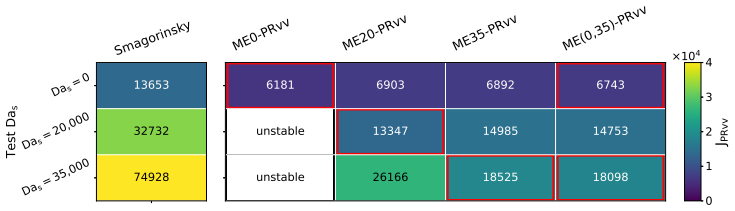
Run the trained ME20-PRvv closure in a posteriori LES of a spatially developing premixed jet at a Damköhler number outside {0, 20,000, 35,000} and at a higher Reynolds number, comparing against filtered DNS or experimental data; if the reported 25–50% and 60% error reductions do not reproduce or the solver becomes unstable, the generalization claim is falsified.
Extended reading notes
Core claim
The central claim is that embedding an untrained neural network into the filtered LES equations and fitting it with adjoint-based gradients yields a closure that recovers both mean fields and resolved turbulence statistics in turbulent premixed jet flames across Damköhler-number regimes. The best model, trained with a primitive-variable objective augmented by the flame-normal resolved Reynolds stress (the PRvv variant), improves primitive-variable errors by 25–50% and resolved Reynolds-stress and scalar-flux errors by more than 60% relative to the Smagorinsky baseline, while staying stable at out-of-sample conditions. The paper also finds that a two-output augmented eddy-viscosity form gener
Load-bearing premise
The central claim rests on a single temporally evolving planar premixed jet with one-step chemistry and one fixed Smagorinsky baseline; if that configuration does not represent practical premixed burners, the reported margins and cross-Damköhler generalization may not carry over.
Editorial extensions
If this is right
- Solver-embedded neural closures can replace or augment constant-coefficient eddy-viscosity models in reacting-flow LES without becoming unstable during deployment.
- Including second-order statistics in the training objective is necessary: models trained only on primitive variables leave resolved Reynolds stresses worse than the baseline.
- The two-output augmented eddy-viscosity formulation is more robust than a high-dimensional direct-closure formulation, which becomes unstable in reacting regimes.
- Serial-window training, where the LES evolves continuously across windows, generalizes better than parallel-window training for long-horizon predictions.
- The learned closure maintains accuracy at out-of-sample Damköhler numbers, including the nonreacting limit and the strongly burning thin-flame regime.
Reading between the lines
- Because the demonstration uses one temporally evolving planar jet with single-step chemistry, the same recipe would need validation on more complex geometries and fuels before it can be called broadly applicable; the paper's framing leaves that step implicit.
- The success of a small pointwise network with gradient inputs suggests a path toward online adaptive closures that update as the flow regime changes, rather than offline per-case tuning.
- The comparison against only one fixed-coefficient Smagorinsky baseline leaves open whether the reported margins would shrink against dynamic or otherwise more advanced subgrid closures; a head-to-head test would be a useful extension.
- The unresolved reaction source is not modeled explicitly but is assumed to be absorbed by the learned species-transport closure, so accuracy may degrade in cases where filtered-chemistry error dominates—an implicit limitation worth testing directly.
Signed reviews
Editorial analysis
A structured set of objections, weighed in public.
Referee Report
Summary. The paper presents a solver-in-the-loop (adjoint/DPM) training framework for neural-network subgrid-scale closures in LES of a temporally evolving planar turbulent premixed jet flame. The closure augments a Smagorinsky baseline with an MLP that predicts an eddy viscosity (and a variant that predicts SGS fluxes directly), with training by adjoint-based gradients matching filtered DNS data over optimization windows. Several objective functions (P, PRvv, PSF), training strategies (serial, parallel-window, parallel-data), and Damköhler-number training conditions are compared. The best model, ME20-PRvv, is reported to improve primitive-variable errors by 25–50% and resolved Reynolds stress and scalar-flux errors by more than 60% relative to the Smagorinsky baseline, including out-of-sample Damköhler-number cases.
Significance. If the quantitative claims hold, this is a useful methodological advance: it demonstrates that PDE-consistent, adjoint-trained neural closures can be extended from non-reacting LES and RANS to LES of premixed flames, and it systematically compares loss formulations and training strategies. The cost analysis and GPU implementation are practical strengths, and the component-wise tables provide more information than a single aggregate metric. However, the broad-applicability conclusion and the headline percentage improvements are not yet fully supported because all results come from a single configuration with a single, possibly weak, comparator and without uncertainty quantification. The core idea is credible and worth publishing after strengthening the evidence and re-scoping the claims.
major comments (4)
- [Sec. 2, Eq. (7); Sec. 6] The only comparator is the constant-coefficient Smagorinsky model with Cs=0.3. This is a particularly dissipative baseline for jet/free-shear flows; standard dynamic or locally adjusted Smagorinsky coefficients are typically lower. Since the ME network is initialized as a small correction to this baseline and trained against filtered DNS, the reported 25–50% and >60% improvements may be dominated by removal of excess baseline dissipation rather than by a genuinely superior closure. The central 'broadly applicable framework' claim therefore requires comparison against a stronger baseline (e.g., dynamic Smagorinsky or a well-tuned constant-Cs model) and, ideally, an established reacting-flow SGS closure.
- [Sec. 6, Table 2; Figs. 2–5] All results are single-realization point estimates from one temporally evolving planar jet over the short interval t = 14.985–16.425 (Sec. 2). No uncertainty quantification, multiple initial conditions, or repeated training runs are reported. Because the optimization and evaluation involve chaotic LES trajectories, the specific percentage improvements are not established as statistically robust. At minimum, the authors should report ensemble/seed sensitivity or otherwise justify that the reported improvements are not within run-to-run variability.
- [Abstract and Table 2] The abstract claims the best model 'improves a posteriori errors in the LES primitive variables by 25–50%', but Table 2 reports JP = -11% for ME20-PRvv at Das = 0, 29% in-sample, and 41% at Das = 35,000. The claim is therefore not accurate as stated; it should be qualified by case and by loss component. This is a load-bearing inconsistency because it directly concerns the headline quantitative result.
- [Secs. 2 and 6.3, Eq. (8)] The out-of-sample Damköhler-number tests are still within the same temporal planar-jet configuration, same Re/Ma, same filter width, and same single-step chemistry; only Das is varied. Moreover, the network receives the absolute time t as an input and is trained on the window t = 14.985–16.425, so it can in principle key onto the specific training interval. This limits the strength of the 'broadly applicable framework' conclusion. I recommend either adding a second configuration/initial condition (or retraining/testing on an interval not containing the training t window) or re-scoping the conclusions to the same configuration across Damköhler numbers.
minor comments (4)
- [Sec. 6.3, Fig. 5] The vertical axis label 'JPRvv ×10^4' is ambiguous; specify whether this is the cumulative objective (13) or a single-window loss and give the normalization used for the percentage-improvement calculations.
- [Sec. 7] CPU inference time is 642 s versus 100.5 s for Smagorinsky, a sixfold overhead, while GPU overhead is modest; the text should avoid implying the overhead is always modest without noting the CPU regime.
- [Eq. (8)] The inclusion of Das and t as inputs is a design choice with potential generalization consequences. An ablation removing t, or at least a discussion of why the model does not simply memorize the training interval, would strengthen the out-of-sample interpretation.
- [Sec. 6.1] The statement that the serial-window strategy is 'the most robust training configuration' is based on one reacting case. A caveat noting the limited evidence would be appropriate.
Circularity Check
No significant circularity: the central prediction step is a genuine held-out forward test against filtered DNS, and the load-bearing equations are derived in the paper rather than assumed from a self-citation.
full rationale
The paper's claimed derivation chain is: define the unclosed SGS terms (Eqs. 1–3), parameterize them with an augmented eddy-viscosity network (Eqs. 4–8), formulate a PDE-constrained adjoint optimization problem (Eqs. 10–18), train against filtered DNS in a series of assimilation windows, and then evaluate the trained closure at Damköhler numbers not used in training (Sec. 6.3). The out-of-sample evaluations at Das = 0 and Das = 35,000 for a model trained at Das = 20,000 are genuine forward tests: the fDNS targets at those conditions are never used in computing gradients, and the network must produce stable, accurate LES fields from its own closure. The inclusion of Das and t as network inputs is a modeling choice that may weaken the generality claim, but it does not make the prediction equal to the target by construction. The self-citations to the authors' own DPM framework [11–16] establish the methodology and supply the DNS configuration, but the paper re-derives the adjoint equations and the central quantitative comparison is to independently evolved Smagorinsky-baseline LES, not to the cited results. The weak constant-Cs baseline and single-planar-jet configuration are correctness/generalizability risks, not circularity; likewise, Table 2 shows JP = −11% at Das = 0 for the favored model, which contradicts the unqualified abstract claim but is an internal inconsistency rather than a circular reduction.
Assumptions & free parameters
free parameters (7)
- Neural network weights θ (ME) =
35,102 parameters
- Neural network weights θ (DC) =
37,415 parameters
- ME output scaling factor =
1e-5
- Smagorinsky coefficient Cs =
0.3
- Turbulent Prandtl/Schmidt numbers =
Prt=0.9, Sct=0.65
- Objective weighting vectors SP, SR, SF =
e.g., (1,1,1,1,0.083,1), (10^4,...,5e3), (100,100,100)
- Optimization window length Nop =
60 steps
assumptions (6)
- domain assumption Favre-filtered compressible Navier-Stokes with single-step global chemistry govern the flow.
- domain assumption Boussinesq eddy-viscosity and gradient-diffusion forms are an adequate closure structure; only μt is augmented.
- domain assumption The DNS dataset at three Damköhler numbers and one geometry spans the regimes of interest.
- ad hoc to paper Das and chemical source are valid regime-indicator inputs.
- domain assumption Checkpointed adjoint with graph-breaking at each step gives usable parameter gradients.
- domain assumption Statistical homogeneity in streamwise/spanwise directions justifies Reynolds averaging over these directions.
Cite this review
Pith. "Pith review of Solver-in-the-loop training of deep learning closures for large-eddy simulation of turbulent premixed jet flames." pith.science (2026). https://pith.science/paper/DIHI74BR
@misc{pith2026260717376,
  author       = {Pith},
  title        = {Pith review of: Solver-in-the-loop training of deep learning closures for large-eddy simulation of turbulent premixed jet flames},
  year         = {2026},
  howpublished = {\url{https://pith.science/paper/DIHI74BR}},
  note         = {Machine review of arXiv:2607.17376}
}
read the original abstract
Large-eddy simulation (LES) turbulence models often fail to capture the effects of chemical heat release and the resulting modulation of turbulence in premixed flames, underscoring the need for a framework that remains accurate across a broad range of physical regimes. We develop an augmented eddy-viscosity closure, based on deep neural networks calibrated jointly with the LES solution using adjoint-based optimization and differentiable programming, ensuring consistency with the governing partial differential equations (PDEs). Several objective functions and training methods are examined, and each model is assessed for its capability to interpolate and extrapolate across a wide range of Damk\"ohler numbers. Relative to the Smagorinsky-model baseline, the best neural network model improves a posteriori errors in the LES primitive variables by 25-50% and in the resolved Reynolds stress and scalar flux by more than 60%. Crucially, the model generalizes across Damk\"ohler number regimes, maintaining stability and accuracy even for out-of-sample conditions. These results demonstrate that PDE-consistent deep learning closures can recover both mean fields and resolved turbulence statistics in LES of turbulent premixed flames and can therefore provide a broadly applicable framework for turbulent combustion modeling.
Figures


Figures from the paper (2 more)

Reviewed August 1, 2026 · model on record in the stance chip above.
Discussion (0). Continue with ORCID to comment.