REVIEW 3 major objections 3 minor 96 references
Sidekick shows that a multimodal feedback layer can lift multitasking performance with computer-use agents beyond text-only interfaces.
Reviewed by Pith at T0; open to challenge. T0 means a machine referee read the full paper against a public rubric. the ladder, T0–T4 →
2026-08-01 17:42 UTC pith:26RI3EFB
load-bearing objection Well-run study of multimodal feedback for CUA multitasking, but the bundled auto-pause undercuts the causal claim that the feedback modality is what helps. the 3 major comments →
Sidekick: Designing Communication for Effective Multitasking with Computer Use Agents
The pith
A machine-rendered reading of the paper's core claim, the machinery that carries it, and where it could break.
Core claim
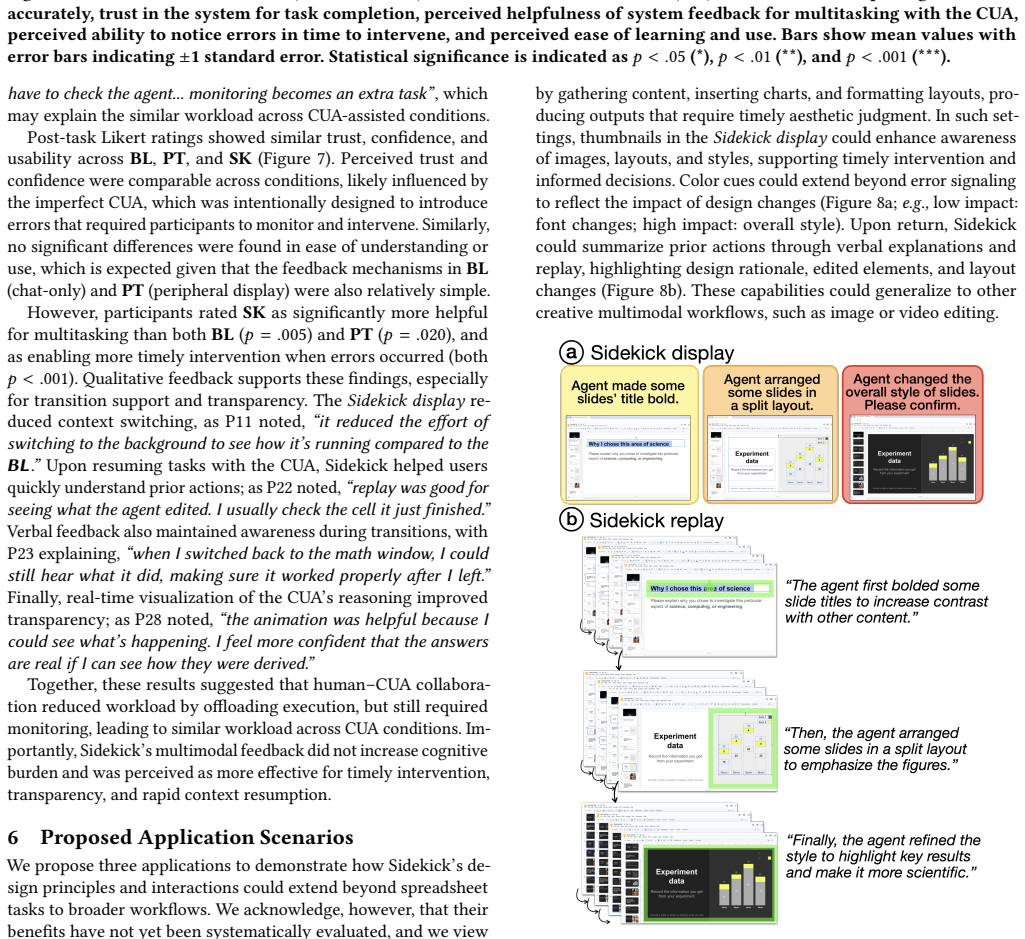
The central claim is that multimodal, stage-adapted communication improves multitasking with computer-use agents. Sidekick condenses raw agent messages into one-sentence summaries, shows thumbnails, and uses color (green/yellow/orange/red) driven by a vision-language-model error detector that counts consecutive failed actions and pauses the agent on red. On returning, it presents replay-like summaries with speech synced to screenshots. In the foreground it verbalizes plans and actions with foley sounds and visual annotations. The controlled study found the biggest gains in the agent-assisted spreadsheet task: higher scores and roughly half the errors of the text baselines, with no significan
What carries the argument
The carry-the-argument object is the stage-based feedback pipeline: (1) a small always-on-top 'Sidekick display' mapping the agent's error count to an ambient color, (2) a VLM-generated multimodal resumption summary that uses SSML timestamps to sync TTS narration with screenshots, and (3) real-time verbalization and bounding-box annotations of agent reasoning in the foreground. The error detector — a VLM comparing before-and-after screenshots to the subgoal — is the gate that sets the color thresholds and the auto-pause on red; it determines when users are alerted. The study's arithmetic task acts as a continuous distractor to measure whether the feedback steals attention.
Load-bearing premise
Sidekick's color warnings and auto-pause are gated by a vision-language model that judges whether the agent's action succeeded; the paper reports no accuracy, false-positive, or false-negative rate for that judge, so the whole benefit rests on that judgment being reliable enough to alert people at the right time.
What would settle it
Run the same 30-participant study with the VLM error detector replaced by perfect ground-truth labels, or with the detector's judgments deliberately corrupted (e.g., random noise), and compare spreadsheet error counts. If corrupting detector reliability does not change Sidekick's advantage over the text baselines, the central claim about the communication layer collapses; if it does change, the mechanism is error detection, not multimodality. A simpler check: log the detector's decisions against the two injected errors per column to see whether it actually fires on real mistakes and stays sile
If this is right
- Delegating work to an agent improves total performance only when feedback is designed for peripheral awareness; poorly designed text displays can erase the benefit.
- Color-coded error thresholds let users catch mistakes without reading logs or increasing monitoring time.
- Spoken and visual resumption summaries reduce the cost of switching back to a long-running agent.
- Real-time verbalization and action annotation increase perceived transparency without raising cognitive load.
- The same communication layer could extend to multi-agent workspaces and post-hoc trajectory analysis.
Where Pith is reading between the lines
- Because the color cues and auto-pause depend on the VLM error detector, Sidekick's measured benefit is bounded by that detector's accuracy; measuring its false-positive and false-negative rates would reveal how much of the effect is communication design versus error-detection quality.
- The three-scope structure (ambient, resumption, foreground) is a testable generalization: any long-horizon autonomous task may benefit from translating raw telemetry this way, even when the underlying agent is far more capable.
- Participants' split preferences (some found rich cues distracting) suggest that adaptive, user-tunable modality selection could amplify the gains; the paper does not test this.
Editorial analysis
A structured set of objections, weighed in public.
Referee Report
Summary. The paper identifies communication gaps in human-CUA interaction through a formative study and introduces Sidekick, a prototype that augments a CUA chat interface with ambient color/text/thumbnails in a peripheral display, multimodal spoken/visual summaries on resumption, and real-time verbal/visual/auditory feedback during foreground operation. The contribution is evaluated in a 30-participant within-subjects study with an arithmetic primary task and a CUA-assisted spreadsheet-filling secondary task, under four conditions: manual (MN), chat baseline (BL), peripheral text (PT), and Sidekick (SK). The reported results show that SK yields significantly higher spreadsheet scores and lower spreadsheet error counts than BL and PT, with no significant increase in monitoring time or task switches and no arithmetic-task disruption, and with higher perceived helpfulness and timeliness of intervention. The authors also present three illustrative application scenarios and discuss design implications for long-horizon human-agent collaboration.
Significance. The topic is timely and the work makes a genuine empirical contribution to CUA feedback design. Strengths include a real prototype running with a current CUA/VLM stack, a counterbalanced within-subjects design, linear mixed-effects models with baseline-ability covariates, Holm-corrected pairwise tests, and mixed-method triangulation. If the central attribution is valid, the paper offers concrete design guidance for peripheral awareness, resumption support, and foreground transparency. However, the central claim that the multimodal communication layer drives the observed improvement is currently weakened by an unaddressed control-policy confound: in SK, the CUA automatically pauses during summary playback, while in BL and PT it does not. This asymmetry alone could account for part or all of the error-count reduction. In addition, the accuracy of the VLM error detector that gates the color/audio-visual signals and the pause is not reported, so the reliability and generalizability of the mechanism remain unclear. The application scenarios are appropriately labeled as unvalidated. Overall, the empirical foundation is promising but the paper needs a substantial experimental or analytic
major comments (3)
- [§4.2, §5.3, §5.6.2] The SK condition conflates feedback modality with agent control policy. Section 4.2 states that "The CUA remains paused during summary playback," and Section 5.3 lists SUMMARY as exclusive to SK. In BL and PT, the CUA continues executing unless the user manually clicks PAUSE. This gives SK users a free, low-cost window to let the agent stop, review completed actions, and intervene before further errors accumulate; BL/PT users must first notice a problem and take an extra action to pause. The reported lower spreadsheet error count for SK (1.31 vs. 2.51 BL and 2.32 PT) could therefore be caused by the pause itself rather than by multimodal feedback. The equal monitoring-time result does not rule this out, because auto-pause time is not counted as user monitoring. The Section 5.1 note that Sidekick "does not perform actions on the computer, but only provides feedback" makes the asymmetry st
- [§4.1, §5.6] The VLM error detector that gates the color states and the summary content is not validated. Section 4.1 states that a VLM (gemini-2.5-flash) assesses whether the post-execution state matches the user's query or the CUA's current subgoal, and that colors change at thresholds x=3, y=6, z=8 "based on error patterns observed during prototype development." No accuracy, false-positive/false-negative rates, or annotated-sample evaluation are reported. If the detector frequently mislabels correct actions as errors (or vice versa), Sidekick could misdirect attention or fail to alert users, undermining the mechanism the study attributes the improvement to. At a minimum, report VLM classification accuracy on a sample of the study's spreadsheet-filling actions, and provide a sensitivity analysis of the thresholds. This is needed for reproducibility and for interpreting the causal path from feedback
- [§5.6.1 / Figure 5] The paper does not separate the effect of the peripheral display from the effect of the modality. In PT, the peripheral display presents only text summaries and (as described in §5.6.1) a static color, while SK adds dynamic color changes, thumbnails, speech, and summary replay. The comparison between PT and SK therefore bundles display content, color dynamics, and modality. If the auto-pause confound is repaired, it would still strengthen the paper to add a PT+ dynamic color/thumbnail condition or to analyze which SK components (color vs. speech vs. summary) contribute to the spreadsheet-score advantage, since the qualitative data indicate that color cues were the most frequently mentioned mechanism.
minor comments (3)
- [§5.6.2 / Figure 5 caption] The panel references are swapped: the text says "number of task switches (Figure 5g)" and "time spent monitoring the spreadsheet task (Figure 5f)", but the Figure 5 caption lists (f) as average number of task switches and (g) as average monitoring time per switch. Please correct the cross-references.
- [§4.4] There is an inconsistency in the VLM model names: Section 4.1 and the beginning of Section 4.4 refer to gemini-2.5-flash, while later in Section 4.4 the object detection VLM is called gemini-3.5-flash. Please confirm which model was used for open-vocabulary detection.
- [§5.1 / §7] The scoring weights and the 12-point penalty for incorrect spreadsheet entries are described as calibrated through pilot studies. The authors note in Limitations that incentives may influence strategies, but the report would benefit from a sentence stating whether the conclusions are robust to alternative penalty values (e.g., a smaller penalty that makes error monitoring less critical).
Circularity Check
No significant circularity: Sidekick's comparative evaluation uses externally scored outcomes; internal thresholds are design parameters, not fits to the reported results.
full rationale
The central claim (Abstract: 'Sidekick significantly improved multitasking performance with CUAs compared to baseline systems') is supported by a between-condition user study with externally scored outcome measures: total/spreadsheet/arithmetic scores, spreadsheet error counts, task switches, monitoring time, and NASA-TLX. None of these are defined in terms of Sidekick's internal VLM detector or color thresholds. Section 4.1 says thresholds were 'set x=3, y=6, and z=8 based on the error patterns observed during prototype development,' but this is a system-design choice rather than a parameter fit to the 30-participant outcomes, and the reported spreadsheet error counts come from the task's ground truth, not from the VLM. The formative study motivates design goals but does not numerically imply the study's results. The strongest issue is an internal-validity confound, not circularity: Section 4.2 states 'The CUA remains paused during summary playback, allowing users to review the completed actions before execution resumes,' and Section 5.3 lists 'SUMMARY' as 'exclusive to SK,' so SK bundles an auto-pause control policy with its feedback channel. No per-session counts of summary plays or auto-pauses are reported, so the magnitude of this confound is unknown; this is a potentially serious correctness/validity risk (the error reduction may be partly caused by the pause rather than the multimodal channel), but it does not reduce the conclusion to its inputs by construction. Self-citation exists (e.g., ref [75], which includes co-author D. Li), but it is used only as background for high-stakes CUA intervention needs and is not load-bearing evidence for Sidekick's effectiveness. The unreported VLM accuracy (Section 4.1) is also a robustness limitation, not circularity. Application scenarios are explicitly acknowledged as not systematically evaluated (Section 6).
Axiom & Free-Parameter Ledger
free parameters (4)
- Error-threshold for yellow state (x) =
3
- Error-threshold for orange state (y) =
6
- Error-threshold for red state (z) =
8
- Spreadsheet scoring weights (correct/incorrect reward-penalty) =
3 / -12 / 0
axioms (3)
- domain assumption CUAs are imperfect and make errors (e.g., about 60% accuracy on basic tasks)
- domain assumption The vision-language model used for error detection is accurate enough to produce useful color cues
- domain assumption The spreadsheet-filling task is representative of CUA multitasking
invented entities (1)
-
Sidekick prototype
independent evidence
Cite this review
Pith. "Pith review of Sidekick: Designing Communication for Effective Multitasking with Computer Use Agents." pith.science (2026). https://pith.science/paper/26RI3EFB
@misc{pith2026260717527,
  author       = {Pith},
  title        = {Pith review of: Sidekick: Designing Communication for Effective Multitasking with Computer Use Agents},
  year         = {2026},
  howpublished = {\url{https://pith.science/paper/26RI3EFB}},
  note         = {Machine review of arXiv:2607.17527}
}
read the original abstract
Computer Use Agents (CUAs) can autonomously execute complex, multi-step tasks within GUIs, enhancing efficiency through parallel multitasking. However, our formative studies with CUA experts and GenAI users indicated that current feedback is primarily text-based, requiring sustained attention to monitor progress and offering limited visibility to trace past GUI interactions. Based on the findings, we developed a prototype system, Sidekick, for communicating CUAs' status with multimodal feedback across different stages of interaction: (i) When CUAs run in the background, Sidekick signals its execution state through ambient cues. (ii) Upon resuming interaction with CUAs, Sidekick provides multimodal summaries of completed actions to support rapid context resumption. (iii) When CUAs operate in the foreground, Sidekick enhances transparency by verbalizing and visualizing the agent's reasoning. A study with 30 participants demonstrated that Sidekick significantly improved multitasking performance with CUAs compared to baseline systems that presented textual feedback either in a typical chat or in an ambient display. Sidekick supported progress awareness, and error and action traceability more effectively. Finally, we demonstrate the promise of Sidekick through several example applications, and discuss implications for long-horizon human-agent collaboration.
Figures



Reference graph
Works this paper leans on
-
[1]
Introducing computer use, a new Claude 3.5 Sonnet, and Claude 3.5 Haiku
2024. Introducing computer use, a new Claude 3.5 Sonnet, and Claude 3.5 Haiku. https://www.anthropic.com/news/3-5-models-and-computer-use
2024
-
[2]
Anthropic
2026. Anthropic. https://www.anthropic.com/
2026
-
[3]
Claude Code
2026. Claude Code. https://claude.com/product/claude-code
2026
-
[4]
Claude Cowork by Anthropic
2026. Claude Cowork by Anthropic. https://www.anthropic.com/product/claude- cowork
2026
-
[5]
Computer use
2026. Computer use. https://platform.openai.com/docs/guides/tools-computer- use
2026
-
[6]
2026. Cua. https://cua.ai/
2026
-
[7]
2026. Cursor. https://cursor.com/
2026
-
[8]
Developing a computer use model
2026. Developing a computer use model. https://www.anthropic.com/news/ developing-computer-use
2026
-
[9]
Foley (sound design)
2026. Foley (sound design). https://en.wikipedia.org/wiki/Foley_(sound_design)
2026
-
[10]
Google Text-to-Speech AI
2026. Google Text-to-Speech AI. https://cloud.google.com/text-to-speech
2026
-
[11]
Introducing Docent
2026. Introducing Docent. https://transluce.org/introducing-docent
2026
-
[12]
Introducing Operator
2026. Introducing Operator. https://openai.com/index/introducing-operator/
2026
-
[13]
Introducing the Gemini 2.5 Computer Use model
2026. Introducing the Gemini 2.5 Computer Use model. https://blog.google/ technology/google-deepmind/gemini-computer-use-model/ UIST ’26, November 02–05, 2026, Detroit, MI, USA Ruei-Che Chang, Wenqian Xu, Dingzeyu Li, Bryan Wang, and Anhong Guo
2026
-
[14]
OSWorld: Benchmarking Multimodal Agents for Open-Ended Tasks in Real Computer Environments
2026. OSWorld: Benchmarking Multimodal Agents for Open-Ended Tasks in Real Computer Environments. https://os-world.github.io/
2026
-
[15]
Speech Synthesis Markup Language (SSML)
2026. Speech Synthesis Markup Language (SSML). https://docs.cloud.google. com/text-to-speech/docs/ssml
2026
-
[16]
2026. Vercept. https://vercept.com/
2026
-
[17]
What is Lume? https://cua.ai/docs/lume/guide/getting-started/ introduction
2026. What is Lume? https://cua.ai/docs/lume/guide/getting-started/ introduction
2026
-
[18]
Reyna Abhyankar, Qi Qi, and Yiying Zhang. 2025. Osworld-human: Bench- marking the efficiency of computer-use agents.arXiv preprint arXiv:2506.16042 (2025)
Pith/arXiv arXiv 2025
-
[19]
Piotr D. Adamczyk and Brian P. Bailey. 2004. If not now, when? the effects of interruption at different moments within task execution. InProceedings of the SIGCHI Conference on Human Factors in Computing Systems(Vienna, Austria) (CHI ’04). Association for Computing Machinery, New York, NY, USA, 271–278. doi:10.1145/985692.985727
arXiv 2004
-
[20]
Drucker, Bongshin Lee, Patrice Simard, and Jina Suh
Saleema Amershi, Max Chickering, Steven M. Drucker, Bongshin Lee, Patrice Simard, and Jina Suh. 2015. ModelTracker: Redesigning Performance Analysis Tools for Machine Learning. InProceedings of the 33rd Annual ACM Conference on Human Factors in Computing Systems(Seoul, Republic of Korea)(CHI ’15). Association for Computing Machinery, New York, NY, USA, 33...
arXiv 2015
-
[21]
Bennett, Kori Inkpen, Jaime Teevan, Ruth Kikin-Gil, and Eric Horvitz
Saleema Amershi, Dan Weld, Mihaela Vorvoreanu, Adam Fourney, Besmira Nushi, Penny Collisson, Jina Suh, Shamsi Iqbal, Paul N. Bennett, Kori Inkpen, Jaime Teevan, Ruth Kikin-Gil, and Eric Horvitz. 2019. Guidelines for Human- AI Interaction. InProceedings of the 2019 CHI Conference on Human Factors in Computing Systems(Glasgow, Scotland Uk)(CHI ’19). Associa...
arXiv 2019
-
[22]
Ernesto Arroyo, Ted Selker, and Alexandre Stouffs. 2002. Interruptions as mul- timodal outputs: Which are the less disruptive?. InProceedings. Fourth IEEE International Conference on Multimodal Interfaces. IEEE, 479–482
2002
-
[24]
Rogerio Bonatti, Dan Zhao, Francesco Bonacci, Dillon Dupont, Sara Abdali, Yinheng Li, Yadong Lu, Justin Wagle, Kazuhito Koishida, Arthur Bucker, et al
-
[25]
Reiss, Suman Karumuri, William Cheung, Joshua Kaplan, Christopher Coleman, Ferdi Adeputra, and Jr
Andrew Bragdon, Robert Zeleznik, Steven P. Reiss, Suman Karumuri, William Cheung, Joshua Kaplan, Christopher Coleman, Ferdi Adeputra, and Jr. LaViola, Joseph J. 2010. Code bubbles: a working set-based interface for code understand- ing and maintenance. InProceedings of the SIGCHI Conference on Human Factors in Computing Systems(Atlanta, Georgia, USA)(CHI ...
arXiv 2010
-
[26]
Stephen A. Brewster, Peter C. Wright, and Alistair D. N. Edwards. 1994. The design and evaluation of an auditory-enhanced scrollbar. InProceedings of the SIGCHI Conference on Human Factors in Computing Systems(Boston, Massachusetts, USA) (CHI ’94). Association for Computing Machinery, New York, NY, USA, 173–179. doi:10.1145/191666.191733
arXiv 1994
-
[27]
Valdimar Briem and Leif R Hedman. 1995. Behavioural effects of mobile telephone use during simulated driving.Ergonomics38, 12 (1995), 2536–2562
1995
-
[28]
J. J. Cadiz, Gina Venolia, Gavin Jancke, and Anoop Gupta. 2002. Designing and deploying an information awareness interface. InProceedings of the 2002 ACM Conference on Computer Supported Cooperative Work(New Orleans, Louisiana, USA)(CSCW ’02). Association for Computing Machinery, New York, NY, USA, 314–323. doi:10.1145/587078.587122
arXiv 2002
-
[29]
Joseph Chee Chang, Yongsung Kim, Victor Miller, Michael Xieyang Liu, Brad A Myers, and Aniket Kittur. 2021. Tabs.do: Task-Centric Browser Tab Management. InThe 34th Annual ACM Symposium on User Interface Software and Technology (Virtual Event, USA)(UIST ’21). Association for Computing Machinery, New York, NY, USA, 663–676. doi:10.1145/3472749.3474777
arXiv 2021
-
[31]
Ruei-Che Chang, Chia-Sheng Hung, Bing-Yu Chen, Dhruv Jain, and Anhong Guo
-
[33]
SoundShift: Exploring Sound Manipulations for Accessible Mixed-Reality Awareness. InProceedings of the 2024 ACM Designing Interactive Systems Confer- ence(Copenhagen, Denmark)(DIS ’24). Association for Computing Machinery, New York, NY, USA, 116–132. doi:10.1145/3643834.3661556
arXiv 2024
-
[34]
Ruei-Che Chang, Rosiana Natalie, Wenqian Xu, Jovan Zheng Feng Yap, Tiange Luo, Venkatesh Potluri, and Anhong Guo. 2026. TouchScribe: Augmenting Non- Visual Hand-Object Interactions with Automated Live Visual Descriptions. In Proceedings of the 2026 CHI Conference on Human Factors in Computing Systems (CHI ’26). Association for Computing Machinery, New Yor...
arXiv 2026
-
[35]
Ruei-Che Chang, Yuxuan Liu, Lotus Zhang, and Anhong Guo. 2024. EditScribe: Non-Visual Image Editing with Natural Language Verification Loops. InPro- ceedings of the 26th International ACM SIGACCESS Conference on Computers and Accessibility(St. John’s, NL, Canada)(ASSETS ’24). Association for Computing Machinery, New York, NY, USA, Article 65, 19 pages. do...
arXiv 2024
-
[36]
Kuan-Wen Chen, Yung-Ju Chang, and Liwei Chan. 2022. Predicting Opportune Moments to Deliver Notifications in Virtual Reality. InProceedings of the 2022 CHI Conference on Human Factors in Computing Systems(New Orleans, LA, USA) (CHI ’22). Association for Computing Machinery, New York, NY, USA, Article 186, 18 pages. doi:10.1145/3491102.3517529
arXiv 2022
-
[37]
Jessie YC Chen, Shan G Lakhmani, Kimberly Stowers, Anthony R Selkowitz, Julia L Wright, and Michael Barnes. 2018. Situation awareness-based agent transparency and human-autonomy teaming effectiveness.Theoretical issues in ergonomics science19, 3 (2018), 259–282
2018
-
[38]
Yi Fei Cheng, Jarod Bloch, Alexander Wang, Andrea Bianchi, Anusha Withana, Anhong Guo, Laurie M. Heller, and David Lindlbauer. 2026. Auditorily Embodied Conversational Agents: Effects of Spatialization and Situated Audio Cues on Presence and Social Perception. InProceedings of the 2026 CHI Conference on Human Factors in Computing Systems (CHI ’26). Associ...
doi:10.1145/3772318 2026
-
[39]
Ruijia Cheng, Jenny T Liang, Eldon Schoop, and Jeffrey Nichols. 2026. Mapping the Design Space of User Experience for Computer Use Agents. InProceedings of the 31st International Conference on Intelligent User Interfaces (IUI ’26). ACM, 646–662. doi:10.1145/3742413.3789132
arXiv 2026
-
[40]
Dennis Collaris and Jarke J Van Wijk. 2020. ExplainExplore: Visual exploration of machine learning explanations. In2020 IEEE Pacific Visualization Symposium (PacificVis). IEEE, 26–35
2020
-
[41]
Yi Fei Cheng, Hirokazu Shirado, and Shunichi Kasahara. 2025. Conversational Agents on Your Behalf: Opportunities and Challenges of Shared Autonomy in Voice Communication for Multitasking. InProceedings of the 2025 CHI Conference on Human Factors in Computing Systems (CHI ’25). Association for Computing Machinery, New York, NY, USA, Article 160, 18 pages. ...
doi:10.1145/3706598 2025
-
[42]
Mary Czerwinski, Edward Cutrell, and Eric Horvitz. 2000. Instant messaging and interruption: Influence of task type on performance. InOZCHI 2000 conference proceedings, Vol. 356. 361–367
2000
-
[43]
Sunny Consolvo and Jeffrey Towle. 2005. Evaluating an ambient display for the home. InCHI ’05 Extended Abstracts on Human Factors in Computing Systems (Portland, OR, USA)(CHI EA ’05). Association for Computing Machinery, New York, NY, USA, 1304–1307. doi:10.1145/1056808.1056902
arXiv 2005
-
[44]
Anindya Das Antar, Somayeh Molaei, Yan-Ying Chen, Matthew L Lee, and Nikola Banovic. 2024. VIME: Visual Interactive Model Explorer for Identifying Capabili- ties and Limitations of Machine Learning Models for Sequential Decision-Making. InProceedings of the 37th Annual ACM Symposium on User Interface Software and Technology(Pittsburgh, PA, USA)(UIST ’24)....
arXiv 2024
-
[46]
Xiang Deng, Yu Gu, Boyuan Zheng, Shijie Chen, Sam Stevens, Boshi Wang, Huan Sun, and Yu Su. 2023. Mind2web: Towards a generalist agent for the web. Advances in Neural Information Processing Systems36 (2023), 28091–28114
2023
-
[47]
De Guzman, Margaret Yau, Anthony Gagliano, Austin Park, and Anind K
Edward S. De Guzman, Margaret Yau, Anthony Gagliano, Austin Park, and Anind K. Dey. 2004. Exploring the design and use of peripheral displays of aware- ness information. InCHI ’04 Extended Abstracts on Human Factors in Computing Systems(Vienna, Austria)(CHI EA ’04). Association for Computing Machinery, New York, NY, USA, 1247–1250. doi:10.1145/985921.986035
arXiv 2004
-
[48]
Jie Gao, Kaiser Sun, Jen tse Huang, Katherine Van Koevering, Sijie Ji, Heyuan Huang, Weiyan Shi, Zhuoran Lu, Ziang Xiao, Daniel Khashabi, and Mark Dredze
-
[49]
Anton N. Dragunov, Thomas G. Dietterich, Kevin Johnsrude, Matthew McLaugh- lin, Lida Li, and Jonathan L. Herlocker. 2005. TaskTracer: a desktop environment to support multi-tasking knowledge workers. InProceedings of the 10th Inter- national Conference on Intelligent User Interfaces(San Diego, California, USA) (IUI ’05). Association for Computing Machiner...
arXiv 2005
-
[50]
Tovi Grossman, Justin Matejka, and George Fitzmaurice. 2010. Chronicle: capture, exploration, and playback of document workflow histories. InProceedings of the 23nd Annual ACM Symposium on User Interface Software and Technology(New York, New York, USA)(UIST ’10). Association for Computing Machinery, New York, NY, USA, 143–152. doi:10.1145/1866029.1866054
arXiv 2010
-
[51]
Sandra G Hart. 2006. NASA-task load index (NASA-TLX); 20 years later. In Proceedings of the human factors and ergonomics society annual meeting, Vol. 50. Sage publications Sage CA: Los Angeles, CA, 904–908
2006
-
[52]
Boyu Gou, Zanming Huang, Yuting Ning, Yu Gu, Michael Lin, Weijian Qi, Andrei Kopanev, Botao Yu, Bernal Jiménez Gutiérrez, Yiheng Shu, et al. 2025. Mind2web 2: Sidekick: Designing Communication for Effective Multitasking with Computer Use Agents UIST ’26, November 02–05, 2026, Detroit, MI, USA Evaluating agentic search with agent-as-a-judge.arXiv preprint ...
Pith/arXiv arXiv 2025
-
[53]
Fred Hohman, Arjun Srinivasan, and Steven M Drucker. 2019. TeleGam: Combin- ing visualization and verbalization for interpretable machine learning. In2019 ieee visualization conference (VIS). IEEE, 151–155
2019
-
[54]
Eric Horvitz. 1999. Principles of mixed-initiative user interfaces. InProceedings of the SIGCHI Conference on Human Factors in Computing Systems(Pittsburgh, Pennsylvania, USA)(CHI ’99). Association for Computing Machinery, New York, NY, USA, 159–166. doi:10.1145/302979.303030
arXiv 1999
-
[55]
Hongliang He, Wenlin Yao, Kaixin Ma, Wenhao Yu, Yong Dai, Hongming Zhang, Zhenzhong Lan, and Dong Yu. 2024. Webvoyager: Building an end-to-end web agent with large multimodal models. InProceedings of the 62nd Annual Meeting of the Association for Computational Linguistics (Volume 1: Long Papers). 6864–6890
2024
-
[56]
Chilana, and Tovi Grossman
Nathaniel Hudson, Benjamin Lafreniere, Parmit K. Chilana, and Tovi Grossman
-
[57]
Shamsi T. Iqbal and Brian P. Bailey. 2008. Effects of intelligent notification management on users and their tasks. InProceedings of the SIGCHI Conference on Human Factors in Computing Systems(Florence, Italy)(CHI ’08). Association for Computing Machinery, New York, NY, USA, 93–102. doi:10.1145/1357054.1357070
arXiv 2008
-
[58]
Eric Horvitz, Paul Koch, and Johnson Apacible. 2004. BusyBody: creating and fielding personalized models of the cost of interruption. InProceedings of the 2004 ACM Conference on Computer Supported Cooperative Work(Chicago, Illinois, USA)(CSCW ’04). Association for Computing Machinery, New York, NY, USA, 507–510. doi:10.1145/1031607.1031690
arXiv 2004
-
[59]
Peiling Jiang and Haijun Xia. 2025. Orca: Browsing at scale through user- driven and ai-facilitated orchestration across malleable webpages.arXiv preprint arXiv:2505.22831(2025)
arXiv 2025
-
[60]
Eser Kandogan and Ben Shneiderman. 1997. Elastic Windows: evaluation of multi- window operations. InProceedings of the ACM SIGCHI Conference on Human factors in computing systems. 250–257
1997
-
[61]
Wonjoong Kim, Sangwu Park, Yeonjun In, Sein Kim, Dongha Lee, and Chanyoung Park. 2026. Beyond the Final Answer: Evaluating the Reasoning Trajectories of Tool-Augmented Agents. arXiv:2510.02837 [cs.AI] https://arxiv.org/abs/2510. 02837
Pith/arXiv arXiv 2026
-
[62]
Shamsi T. Iqbal and Brian P. Bailey. 2011. Oasis: A framework for link- ing notification delivery to the perceptual structure of goal-directed tasks. ACM Trans. Comput.-Hum. Interact.17, 4, Article 15 (Dec. 2011), 28 pages. doi:10.1145/1879831.1879833
arXiv 2011
-
[63]
Ben Lafreniere, Tovi Grossman, Justin Matejka, and George Fitzmaurice. 2014. Investigating the feasibility of extracting tool demonstrations from in-situ video content. InProceedings of the SIGCHI Conference on Human Factors in Comput- ing Systems(Toronto, Ontario, Canada)(CHI ’14). Association for Computing Machinery, New York, NY, USA, 4007–4016. doi:10...
arXiv 2014
-
[64]
Wei Li, Tovi Grossman, and George Fitzmaurice. 2012. GamiCAD: a gamified tutorial system for first time autocad users. InProceedings of the 25th Annual ACM Symposium on User Interface Software and Technology(Cambridge, Massachusetts, USA)(UIST ’12). Association for Computing Machinery, New York, NY, USA, 103–112. doi:10.1145/2380116.2380131
arXiv 2012
-
[65]
Mary J Lindstrom and Douglas M Bates. 1988. Newton—Raphson and EM al- gorithms for linear mixed-effects models for repeated-measures data.J. Amer. Statist. Assoc.83, 404 (1988), 1014–1022
1988
-
[66]
Benjamin Lafreniere, Tovi Grossman, and George Fitzmaurice. 2013. Commu- nity enhanced tutorials: improving tutorials with multiple demonstrations. In Proceedings of the SIGCHI Conference on Human Factors in Computing Systems. 1779–1788
2013
-
[67]
Paul P. Maglio and Christopher S. Campbell. 2000. Tradeoffs in displaying peripheral information. InProceedings of the SIGCHI Conference on Human Factors in Computing Systems(The Hague, The Netherlands)(CHI ’00). Association for Computing Machinery, New York, NY, USA, 241–248. doi:10.1145/332040.332438
arXiv 2000
-
[68]
Justin Matejka, Tovi Grossman, and George Fitzmaurice. 2011. Ambient help. In Proceedings of the SIGCHI Conference on Human Factors in Computing Systems (Vancouver, BC, Canada)(CHI ’11). Association for Computing Machinery, New York, NY, USA, 2751–2760. doi:10.1145/1978942.1979349
arXiv 2011
-
[69]
Justin Matejka, Tovi Grossman, and George Fitzmaurice. 2021. MeetingMate: an Ambient Interface for Improved Meeting Effectiveness and Corporate Knowl- edge Sharing. InGraphics Interface 2021. https://openreview.net/forum?id= ibaCpFUWVb9
2021
-
[70]
Mynatt, Stephen Voida, Klaus M
Blair MacIntyre, Elizabeth D. Mynatt, Stephen Voida, Klaus M. Hansen, Joe Tullio, and Gregory M. Corso. 2001. Support for multitasking and background awareness using interactive peripheral displays. InProceedings of the 14th Annual ACM Symposium on User Interface Software and Technology(Orlando, Florida) (UIST ’01). Association for Computing Machinery, Ne...
arXiv 2001
-
[71]
Daniel C McFarlane and Kara A Latorella. 2002. The scope and importance of human interruption in human-computer interaction design.Human-Computer Interaction17, 1 (2002), 1–61
2002
-
[72]
Ananya Gubbi Mohanbabu, Rosiana Natalie, Brandon Kim, Anhong Guo, and Amy Pavel. 2026. A11y-CUA Dataset: Characterizing the Accessibility Gap in Computer Use Agents.arXiv preprint arXiv:2602.09310(2026)
arXiv 2026
-
[73]
Jakob Nielsen and Rolf Molich. 1990. Heuristic evaluation of user interfaces. InProceedings of the SIGCHI conference on Human factors in computing systems. 249–256
1990
-
[74]
Justin Matejka, Wei Li, Tovi Grossman, and George Fitzmaurice. 2009. Com- munityCommands: command recommendations for software applications. In Proceedings of the 22nd annual ACM symposium on User interface software and technology. 193–202
2009
-
[75]
Yi-Hao Peng, Dingzeyu Li, Jeffrey P Bigham, and Amy Pavel. 2025. Morae: Proactively Pausing UI Agents for User Choices. InProceedings of the 38th Annual ACM Symposium on User Interface Software and Technology (UIST ’25). Association for Computing Machinery, New York, NY, USA, Article 198, 14 pages. doi:10. 1145/3746059.3747797
arXiv 2025
-
[76]
Zachary Pousman and John Stasko. 2006. A taxonomy of ambient information systems: four patterns of design. InProceedings of the Working Conference on Advanced Visual Interfaces(Venezia, Italy)(A VI ’06). Association for Computing Machinery, New York, NY, USA, 67–74. doi:10.1145/1133265.1133277
arXiv 2006
-
[77]
Marco Tulio Ribeiro, Sameer Singh, and Carlos Guestrin. 2016. "Why Should I Trust You?": Explaining the Predictions of Any Classifier. InProceedings of the 22nd ACM SIGKDD International Conference on Knowledge Discovery and Data Mining(San Francisco, California, USA)(KDD ’16). Association for Computing Machinery, New York, NY, USA, 1135–1144. doi:10.1145/...
arXiv 2016
-
[78]
Tianyue Ou, Wanyao Guo, Apurva Gandhi, Graham Neubig, and Xiang Yue. 2025. AgentDiagnose: An Open Toolkit for Diagnosing LLM Agent Trajectories. In Proceedings of the 2025 Conference on Empirical Methods in Natural Language Processing: System Demonstrations, Ivan Habernal, Peter Schulam, and Jörg Tiede- mann (Eds.). Association for Computational Linguisti...
-
[79]
Pascal J Sager, Benjamin Meyer, Peng Yan, Rebekka von Wartburg-Kottler, Layan Etaiwi, Aref Enayati, Gabriel Nobel, Ahmed Abdulkadir, Benjamin F Grewe, and Thilo Stadelmann. 2026. A comprehensive survey of agents for computer use: Foundations, challenges, and future directions.Journal of Artificial Intelligence Research85 (2026)
2026
-
[80]
Nitin Sawhney and Chris Schmandt. 2000. Nomadic radio: speech and audio interaction for contextual messaging in nomadic environments.ACM transactions on Computer-Human interaction (TOCHI)7, 3 (2000), 353–383
2000
-
[81]
Anthony R Selkowitz, Shan G Lakhmani, and Jessie YC Chen. 2017. Using agent transparency to support situation awareness of the Autonomous Squad Member. Cognitive Systems Research46 (2017), 13–25
2017
-
[82]
Joshua S Rubinstein, David E Meyer, and Jeffrey E Evans. 2001. Executive control of cognitive processes in task switching.Journal of experimental psychology: human perception and performance27, 4 (2001), 763
2001
-
[83]
Amanda Swearngin, Jason Wu, Xiaoyi Zhang, Esteban Gomez, Jen Coughenour, Rachel Stukenborg, Bhavya Garg, Greg Hughes, Adriana Hilliard, Jeffrey P. Bigham, and Jeffrey Nichols. 2024. Towards Automated Accessibility Report Generation for Mobile Apps.ACM Trans. Comput.-Hum. Interact.31, 4, Article 54 (Sept. 2024), 44 pages. doi:10.1145/3674967
-
[84]
Maxwell Szymanski, Martijn Millecamp, and Katrien Verbert. 2021. Visual, textual or hybrid: the effect of user expertise on different explanations. InProceedings of the 26th International Conference on Intelligent User Interfaces(College Station, TX, USA)(IUI ’21). Association for Computing Machinery, New York, NY, USA, 109–119. doi:10.1145/3397481.3450662
arXiv 2021
This paper was first reviewed by deepseek-v4-flash on August 1, 2026.
discussion (0)
Sign in with ORCID, Apple, or X to comment. Anyone can read and Pith papers without signing in.