REVIEW 4 major objections 5 minor 56 references
A binary system of two red giants is caught transferring mass, the first ever seen in this short-lived stage.
Reviewed by Pith at T0; open to challenge. T0 means a machine referee read the full paper against a public rubric. the ladder, T0–T4 →
T0 review · deepseek-v4-flash
2026-08-01 17:38 UTC pith:VLCFHKL5
load-bearing objection Solid double red giant binary; the 'active mass transfer' label is plausible but not yet demonstrated, and the paper never tests the detached alternative. the 4 major comments →
First double red giant Algol system with active mass transfer
The pith
A machine-rendered reading of the paper's core claim, the machinery that carries it, and where it could break.
Core claim
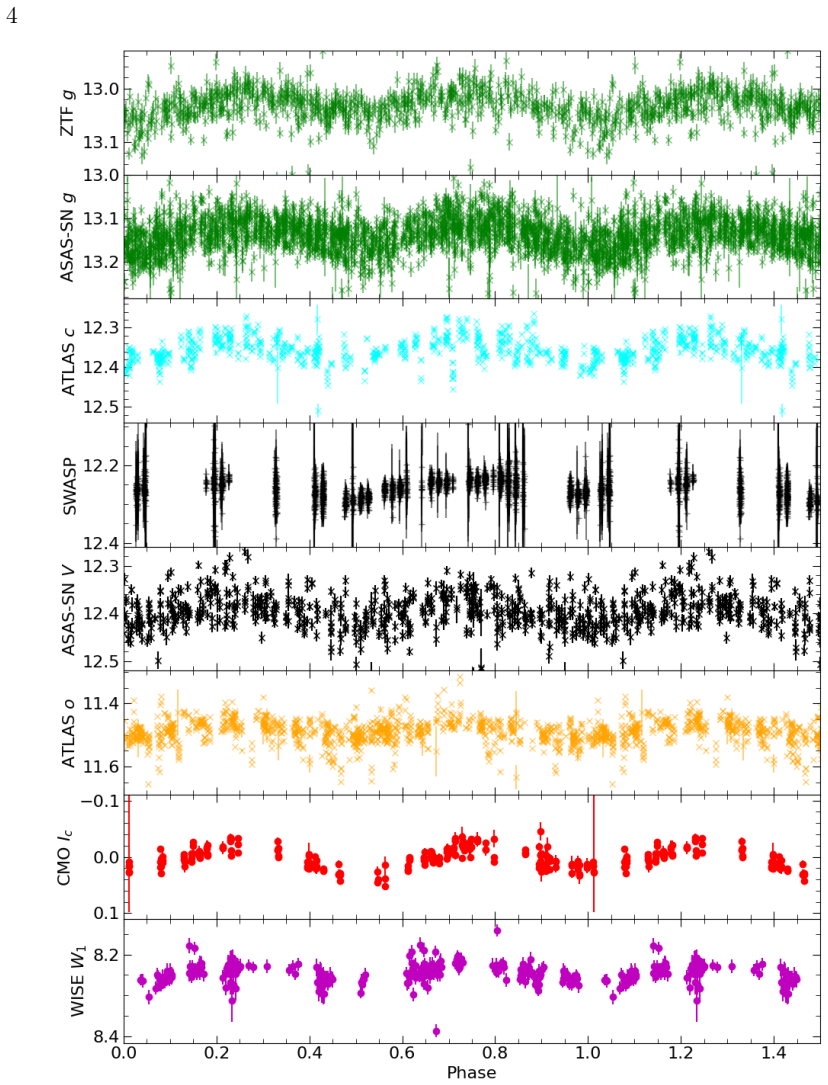
The paper establishes that J05+50 is a close Algol-type binary with two red giant components: a hotter, more massive primary (roughly 8.5 solar masses, 52 solar radii) and a cooler, less massive secondary (about 1.2 solar masses, 30 solar radii) that fills its Roche lobe and transfers mass onto the primary. The orbital period is about 60 days, the orbit is nearly circular, and the light curve shows sine-like ellipsoidal variability without eclipses. Spectroscopic analysis, spectral energy distribution fitting, and PHOEBE light-curve modeling converge on a semi-detached configuration, while H-alpha line variability indicates recently ejected material moving toward us. A MESA binary evolution
What carries the argument
The central object is the binary system J05+50, and the load-bearing mechanism is Roche-lobe overflow: the secondary star fills its Roche lobe and transfers mass to the primary, producing the Algol-type configuration. The paper combines several observational tools: multi-epoch LAMOST spectroscopy to measure radial velocities and temperatures, SED fitting to constrain radii and temperatures, PHOEBE modeling to derive the orbital geometry and confirm the semi-detached state, and MESA binary evolution calculations to reconstruct the system's past and predict its future.
Load-bearing premise
The claim that the secondary fills its Roche lobe and is actively transferring mass rests on a geometric inference—the system is semi-detached—that is not directly observed, since the inclination is poorly constrained and no eclipses are seen.
What would settle it
A precise measurement of the orbital inclination (for example, from future space-based photometry that resolves grazing eclipses) that places the secondary inside its Roche lobe would contradict the active mass transfer claim. Alternatively, measuring the orbital period change and finding it to be zero or negative, rather than the predicted increase of about 5.5 seconds per year, would challenge the mass transfer scenario.
If this is right
- If the interpretation is correct, J05+50 is the first observed example of a double red giant system undergoing mass transfer, filling a long-standing gap in binary evolution theory.
- The system's short remaining lifetime (about 13,000 years) means it provides a direct snapshot of the pre-common-envelope phase, useful for calibrating common-envelope energy prescriptions.
- The predicted merger supports the idea that some long-period double red giant binaries are direct progenitors of single merged stars, potentially explaining certain blue stragglers or unusual red giants.
- The measured orbital parameters and the absence of eclipses imply that many similar systems may exist but are hard to detect because they are single-lined or have unfavorably low inclinations.
- The detection of blueshifted H-alpha emission suggests that mass loss from the system is observable and could be used to trace the mass transfer rate.
Where Pith is reading between the lines
- The rarity of such systems suggests that the double-red-giant mass-transfer phase is extremely short, so finding one implies many more such binaries may exist in a pre-transfer or post-merger state.
- If the system indeed merges, it may produce a rapidly rotating red giant or a peculiar object; searching for similar stars with high mass ratios and two red-giant-like spectra could uncover more examples.
- The poor inclination constraint could be improved by future Gaia light curves; if the true inclination is far from 45 degrees, the derived masses could shift enough to change the evolutionary interpretation.
- A direct measurement of the orbital period change (P-dot) would test the model's prediction of about 5.5 seconds per year, providing an independent confirmation of active mass transfer.
Editorial analysis
A structured set of objections, weighed in public.
Referee Report
Summary. The paper reports the discovery of J050248.40+500610.6 (J05+50) as a double-lined spectroscopic binary composed of two red giants, with an orbital period of ~60 d and a small mass ratio (q ~ 0.12). The authors combine LAMOST medium-resolution spectroscopy, multi-band photometry (ZTF, WISE, TESS, ASAS-SN, ATLAS), SED fitting, PHOEBE light-curve/radial-velocity modeling, and spectral disentangling. They interpret the system as a semi-detached Algol-type binary in which the initially less massive secondary now fills its Roche lobe and is actively transferring mass to the more massive primary (the accretor), which has itself expanded into a red giant. A MESA binary evolution model is used to reproduce the current parameters and to predict that the system will merge into a single star in ~13,000 yr. The central claim is that J05+50 is the first known double-red-giant Algol system with active mass transfer, caught in the short phase immediately before a common-envelope merger.
Significance. If confirmed, this would be a genuinely important object: a double-red-giant semi-detached system in the brief phase before a common-envelope merger, directly relevant to mass-transfer stability, CE evolution, and the formation of short-period double white dwarfs. The paper is strong on the observational side: the spectroscopy, SED, and spectral disentangling mutually support the presence of two red giants with very different masses but comparable radii, and the authors are careful in handling survey systematics (e.g., TESS stray-light anomalies, ZTF saturation). The PHOEBE MCMC and MESA grids are also substantial efforts. However, the defining claim — that the system is semi-detached with active mass transfer — rests on a PHOEBE configuration that is assumed rather than tested against a detached alternative, on an inclination that is prior-dominated, and on a MESA model whose parameters are tuned to match the observations and whose predicted Pdot is not observed. The significance is therefore high conditional on the geometry, but the current evidence does not yet establish the first-in-class claim.
major comments (4)
- [§3.3, Table 1] The semi-detached configuration is assumed a priori. The text says trial runs were made for contact and semi-detached-primary configurations, but these are rejected only qualitatively, and no detached model with R2 allowed to underfill its Roche lobe is fitted or compared. Given the LC shows only ~0.02 mag ellipsoidal variability, no eclipses, and an inclination prior U(40,55) peaking at 45.3° with a sharp upper boundary from the absence of eclipses, a detached model may fit equally well. The hard constraint F1/F2=3.34 from the SED is itself model-dependent. Please fit a detached model with R2/R_L,2 free and report a Bayesian comparison or Δχ², and quote R2/R_L,2 with uncertainties.
- [§4.3 vs §3.3] The MESA model predicts Pdot = +5.54 s/yr, but §3.3 states that the observed Pdot is nearly zero. This discrepancy is not discussed, yet it is directly relevant to the active-mass-transfer claim: Algol-type mass transfer is expected to increase the orbital period. The MESA 'best model' is found by iteratively narrowing grids around a good model and varying α, β; the match to observed masses, radii, and period is therefore partly by construction. The merger prediction also assumes a common-envelope efficiency of 1.0. Please quantify the Pdot tension quantitatively (e.g., an upper limit on |Pdot| from the O–C data), and state whether the model's Pdot falls within that limit.
- [§4.1] The Hα blue-shifted emission is not phase-locked and is attributed to material that 'escaped J05+50 and is now slowly moving toward us.' This is suggestive of recent mass loss, but a stellar wind, a prior mass-ejection episode, or a circumstellar shell could also produce the same signature. The He I 5876 Å detection is explicitly weak. Since the 'active mass transfer' label depends on ongoing Roche-lobe overflow, the paper should either provide quantitative evidence connecting the blue-shifted Hα to a mass-transfer stream (velocity scale, variability timescale, consistency with the expected stream trajectory) or soften the claim to 'possible/ongoing mass loss.'
- [§5, Fig. 14] The authors concede in §5 that 'the derived masses are highly uncertain' because the inclination is poorly constrained. Yet Fig. 14 compares the MESA tracks to observed masses and radii with error bars that do not include the full inclination range (masses scale as sin^-3 i for fixed asini; the 16th–84th percentile i spans 44.4°–52.1°). The 'good agreement' between the MESA model and observations is therefore not strongly constraining. Please propagate the inclination posterior into the observed masses/radii used in Fig. 14, or show model tracks for the extreme allowed inclinations.
minor comments (5)
- [§5] Typo: 'a the spectroscopic binary' should be 'a spectroscopic binary.'
- [§2.2] 'Zwicki Transient Facility' should be 'Zwicky Transient Facility.' Also, the text says 'All photometric observations' in the Fig. 9 caption, but TESS data are explicitly excluded; please clarify.
- [§2.1, Table 2] The period from S. Guo et al. (2025) is 60.855±0.481 d, while the PHOEBE solution gives P=59.957 d. The difference is not discussed; please address the consistency.
- [§3.3] The statement in §5 that 'we cannot exclude the possibility of shallow grazing eclipses' seems inconsistent with using the absence of eclipses as an upper boundary on inclination in §3.3. Please reconcile these statements.
- [§4.3] The MESA version is given as 'version 12115'; please cite the specific MESA release and include the instrument paper version in the reference list (the cited Paxton et al. 2019 paper may not match the version number).
Circularity Check
The 'first semi-detached double red giant' claim restates the PHOEBE model's semi-detached input; the double-red-giant identification itself is independent.
specific steps
-
self definitional
[Section 3.3 (PHOEBE modeling); restated in Abstract and Section 5]
""Thus, we selected a semi-detached configuration for the secondary component, as it is consistent with the sine-like ellipsoidal variability, SED, and spectroscopic solution." (Sec. 3.3) ... "J05+50 is a semi-detached configuration with ongoing mass transfer." (Sec. 5)"
PHOEBE was run with the secondary constrained to fill its Roche lobe (the 'semi-detached configuration'). The paper's novel classification that J05+50 is a semi-detached Algol system is therefore the adopted input, not an output constrained by the data. No detached model with a slightly underfilling secondary was computed or compared, and the observations show no eclipses and Pdot consistent with zero, so the geometry is not independently selected. The claim is true only by construction of the model.
full rationale
The double-red-giant nature and basic orbital parameters are independently grounded: the LAMOST MRS SB2 fits, the SED fit, and FD3 spectral disentangling all point to two cool giants, and the photometric period matches the RV period. Those parts are not circular. However, the headline novelty - the first double-red-giant Algol with active mass transfer - depends on the system being semi-detached. That condition was explicitly put into the PHOEBE model ('we selected a semi-detached configuration for the secondary component'), and the conclusion section restates it as a result. With only ~0.02 mag ellipsoidal variability, no eclipses, a prior-dominated inclination, and measured Pdot consistent with zero, the Roche-filling geometry is not forced by the data; a detached alternative was never fitted. The MESA modeling is also a tuned grid search ('compute several grids ... until we find a model matching the observed parameters'), so its agreement is not independent support, and the merger conclusion is explicitly conditional on CE efficiency 1.0. These issues make the central classification partially circular, though the observational identification of two red giants has independent content. Self-citations here are methodological and not load-bearing.
Axiom & Free-Parameter Ledger
free parameters (8)
- Inclination i =
45.3 deg (best), 47.9 deg median; prior U(40,55)
- Initial primary mass M_p,i =
5.13 Msun
- Initial secondary mass M_s,i =
4.21 Msun
- Initial orbital period P_orb,i =
2.24 d
- Mass-loss fractions alpha, beta =
0.25, 0.25
- Common-envelope ejection efficiency =
1.0
- SED flux ratio constraint F1/F2 =
3.34 in ZTF r band
- MESA tuning parameters =
alpha_MLT=2.0, overshoot f0=0.05, f=0.30, Reimers wind=0.5
axioms (5)
- domain assumption Both components are coeval and initially had the same composition (X=0.70, Y=0.28, Z=0.02).
- domain assumption The orbit is circular and both components are synchronized with the orbit.
- domain assumption PHOENIX, PHOEBE, and MESA models correctly describe red giant atmospheres and binary evolution.
- domain assumption The H-alpha blue-shifted emission arises from material recently lost by the system and moving toward us.
- domain assumption The SED-derived flux ratio F1/F2=3.34 is reliable and can be used to break the PHOEBE degeneracy.
read the original abstract
Double red giant stars are very important for studies of the stability of mass transfer, common-envelope evolution, and the formation of double white dwarfs with short orbital periods. However, no double red giant system undergoing mass transfer has yet been found. We present the discovery of a close Algol-type binary system composed of two red giant stars. This is the first known semi-detached system observed during the very short phase when the accretor has expanded into a red giant just before entering the common envelope phase. The $H_\alpha$ line suggests that the system has recently lost some material, which is now moving toward us. We present a consistent analysis of all the available spectroscopic and photometric observations of this system, constraining its orbital parameters and the fundamental properties of the components. Our findings are supported by a binary evolution model that successfully reproduces the currently observed parameters. The model suggests that the system will eventually merge into a single star.
Figures


Reference graph
Works this paper leans on
-
[1]
Baron, F., Monnier, J. D., Pedretti, E., et al. 2012, ApJ, 752, 20, doi: 10.1088/0004-637X/752/1/20
-
[2]
Shatskii, N. I., et al. 2020, Astronomy Reports, 64, 310, doi: 10.1134/S1063772920040010
-
[3]
E., Kochoska, A., Hey, D., et al
Conroy, K. E., Kochoska, A., Hey, D., et al. 2020, ApJS, 250, 34, doi: 10.3847/1538-4365/abb4e2
-
[4]
2012, Research in Astronomy and Astrophysics, 12, 1197, doi: 10.1088/1674-4527/12/9/003
Cui, X.-Q., Zhao, Y.-H., Chu, Y.-Q., et al. 2012, Research in Astronomy and Astrophysics, 12, 1197, doi: 10.1088/1674-4527/12/9/003
-
[5]
M., Wright, E
Cutri, R. M., Wright, E. L., Conrow, T., et al. 2013, Explanatory Supplement to the AllWISE Data Release Products,, Explanatory Supplement to the AllWISE Data Release Products, by R. M. Cutri et al
2013
-
[6]
2025, The Open Journal of Astrophysics, 8, 62, doi: 10.33232/001c.138448
El-Badry, K. 2025, The Open Journal of Astrophysics, 8, 62, doi: 10.33232/001c.138448
-
[7]
2014, MNRAS, 441, 1166, doi: 10.1093/mnras/stu630
Erdem, A., & ¨Ozt¨ urk, O. 2014, MNRAS, 441, 1166, doi: 10.1093/mnras/stu630
-
[8]
Foreman-Mackey, D., Hogg, D. W., Lang, D., & Goodman, J. 2013, PASP, 125, 306, doi: 10.1086/670067 Gaia Collaboration, Vallenari, A., Brown, A. G. A., et al. 2022, arXiv e-prints, arXiv:2208.00211. https://arxiv.org/abs/2208.00211
Pith/arXiv arXiv 2013
-
[9]
2025, ApJS, 278, 46, doi: 10.3847/1538-4365/adced1
Guo, S., Kovalev, M., Li, J., et al. 2025, ApJS, 278, 46, doi: 10.3847/1538-4365/adced1
-
[10]
Han, T., & Brandt, T. D. 2023, AJ, 165, 71, doi: 10.3847/1538-3881/acaaa7
-
[11]
2020, Research in Astronomy and Astrophysics, 20, 161
Chen, H.-L. 2020, Research in Astronomy and Astrophysics, 20, 161
2020
-
[12]
Heinze, A. N., Tonry, J. L., Denneau, L., et al. 2018, AJ, 156, 241, doi: 10.3847/1538-3881/aae47f
-
[13]
2024, ApJS, 271, 13, doi: 10.3847/1538-4365/ad18b1
Huang, B., Yuan, H., Xiang, M., et al. 2024, ApJS, 271, 13, doi: 10.3847/1538-4365/ad18b1
-
[14]
X., Vanderburg, A., P´ al, A., et al
Huang, C. X., Vanderburg, A., P´ al, A., et al. 2020a, Research Notes of the American Astronomical Society, 4, 204, doi: 10.3847/2515-5172/abca2e 23
-
[15]
X., Vanderburg, A., P´ al, A., et al
Huang, C. X., Vanderburg, A., P´ al, A., et al. 2020b, Research Notes of the American Astronomical Society, 4, 206, doi: 10.3847/2515-5172/abca2d
-
[16]
2013, A&A, 553, A6, doi: 10.1051/0004-6361/201219058 Iliji´ c, S
Dreizler, S., et al. 2013, A&A, 553, A6, doi: 10.1051/0004-6361/201219058 Iliji´ c, S. 2017, fd3: Spectral disentangling of double-lined spectroscopic binary stars,, Astrophysics Source Code Library, record ascl:1705.012 http://ascl.net/1705.012
-
[17]
Freyhammer, L. M. 2004, in Astronomical Society of the Pacific Conference Series, Vol. 318, Spectroscopically and Spatially Resolving the Components of the Close Binary Stars, ed. R. W. Hilditch, H. Hensberge, & K. Pavlovski, 111–113 IRSA. 2022, Zwicky Transient Facility Image Service, IPAC, doi: 10.26131/IRSA539
doi:10.26131/irsa539 2004
-
[18]
Jayasinghe, T., Kochanek, C. S., Stanek, K. Z., et al. 2018, MNRAS, 477, 3145, doi: 10.1093/mnras/sty838
-
[19]
2015, MNRAS, 451, 4150, doi: 10.1093/mnras/stv1261
Kolbas, V., Pavlovski, K., Southworth, J., et al. 2015, MNRAS, 451, 4150, doi: 10.1093/mnras/stv1261
-
[20]
Stassun, K. G., & Sun, M. 2024, MNRAS, 527, 3806, doi: 10.1093/mnras/stad3439
-
[21]
2023, mkounkel/SEDFit: 0.3, 0.3 Zenodo, doi: 10.5281/zenodo.8076501
Kounkel, M. 2023, mkounkel/SEDFit: 0.3, 0.3 Zenodo, doi: 10.5281/zenodo.8076501
-
[22]
2022a, MNRAS, 517, 356, doi: 10.1093/mnras/stac2513
Kovalev, M., Chen, X., & Han, Z. 2022a, MNRAS, 517, 356, doi: 10.1093/mnras/stac2513
-
[23]
2024, MNRAS, 535, 2651, doi: 10.1093/mnras/stae2494
Kovalev, M., Li, Z., Xiong, J., et al. 2024, MNRAS, 535, 2651, doi: 10.1093/mnras/stae2494
-
[24]
2022b, MNRAS, 513, 4295, doi: 10.1093/mnras/stac1177
Kovalev, M., Li, Z., Zhang, X., et al. 2022b, MNRAS, 513, 4295, doi: 10.1093/mnras/stac1177
-
[25]
2023, MNRAS, 523, 3741, doi: 10.1093/mnras/stad1667
Kovalev, M., & Straumit, I. 2023, MNRAS, 523, 3741, doi: 10.1093/mnras/stad1667
-
[26]
2023, MNRAS, 519, 5454, doi: 10.1093/mnras/stac3767
Kovalev, M., Wang, S., Chen, X., & Han, Z. 2023, MNRAS, 519, 5454, doi: 10.1093/mnras/stac3767
-
[27]
Kovalev, M. Y. 2025, Research Notes of the American Astronomical Society, 9, 322, doi: 10.3847/2515-5172/ae2277
-
[28]
2025, A&A, 702, A200, doi: 10.1051/0004-6361/202556201
Kurpas, M., Dorsch, M., Geier, S., et al. 2025, A&A, 702, A200, doi: 10.1051/0004-6361/202556201
-
[29]
D., & Lifshitz, E
Landau, L. D., & Lifshitz, E. M. 1971, The classical theory of fields (Oxford: Pergamon Press)
1971
-
[30]
2020, arXiv e-prints, arXiv:2005.07210
Liu, C., Fu, J., Shi, J., et al. 2020, arXiv e-prints, arXiv:2005.07210. https://arxiv.org/abs/2005.07210 Ma ´ ız Apell´ aniz, J., Holgado, G., Pantaleoni Gonz´ alez, M., & Caballero, J. A. 2023, A&A, 677, A137, doi: 10.1051/0004-6361/202346759
Pith/arXiv arXiv 2020
-
[31]
F., Starkenburg, E., Yuan, Z., et al
Martin, N. F., Starkenburg, E., Yuan, Z., et al. 2024, A&A, 692, A115, doi: 10.1051/0004-6361/202347633
-
[32]
Masci, F. J., Laher, R. R., Rusholme, B., et al. 2019, PASP, 131, 018003, doi: 10.1088/1538-3873/aae8ac
-
[33]
2021, AJ, 162, 131, doi: 10.3847/1538-3881/ac1788
Miller, A., Kounkel, M., Sun, M., et al. 2021, AJ, 162, 131, doi: 10.3847/1538-3881/ac1788
-
[34]
2020, in Stars and their Variability Observed from Space, ed
Engelbrecht, C., et al. 2020, in Stars and their Variability Observed from Space, ed. C. Neiner, W. W. Weiss, D. Baade, R. E. Griffin, C. C. Lovekin, & A. F. J. Moffat, 113–114
2020
-
[35]
Morrissey, P., Conrow, T., Barlow, T. A., et al. 2007, ApJS, 173, 682, doi: 10.1086/520512
doi:10.1086/520512 2007
-
[36]
Murakawa, S., De, K., Ashley, M. C. B., et al. 2024, PASP, 136, 104501, doi: 10.1088/1538-3873/ad7db1
-
[37]
T., Costa, G., Girardi, L., et al
Nguyen, C. T., Costa, G., Girardi, L., et al. 2022, arXiv e-prints, arXiv:2207.08642. https://arxiv.org/abs/2207.08642
Pith/arXiv arXiv 2022
-
[38]
2011, ApJS, 192, 3, doi: 10.1088/0067-0049/192/1/3
Paxton, B., Bildsten, L., Dotter, A., et al. 2011, ApJS, 192, 3, doi: 10.1088/0067-0049/192/1/3
-
[39]
2013, ApJS, 208, 4, doi: 10.1088/0067-0049/208/1/4 24
Paxton, B., Cantiello, M., Arras, P., et al. 2013, ApJS, 208, 4, doi: 10.1088/0067-0049/208/1/4 24
-
[40]
2015, ApJS, 220, 15, doi: 10.1088/0067-0049/220/1/15
Paxton, B., Marchant, P., Schwab, J., et al. 2015, ApJS, 220, 15, doi: 10.1088/0067-0049/220/1/15
-
[41]
Paxton, B., Schwab, J., Bauer, E. B., et al. 2018, ApJS, 234, 34, doi: 10.3847/1538-4365/aaa5a8
-
[42]
2019, ApJS, 243, 10, doi: 10.3847/1538-4365/ab2241
Paxton, B., Smolec, R., Schwab, J., et al. 2019, ApJS, 243, 10, doi: 10.3847/1538-4365/ab2241
-
[43]
2006, PASP, 118, 1407, doi: 10.1086/508556
Cameron, A., et al. 2006, PASP, 118, 1407, doi: 10.1086/508556
doi:10.1086/508556 2006
-
[44]
1975, Memoires of the Societe Royale des Sciences de Liege, 8, 369
Reimers, D. 1975, Memoires of the Societe Royale des Sciences de Liege, 8, 369
1975
-
[45]
R., Winn, J
Ricker, G. R., Winn, J. N., Vanderspek, R., et al. 2015, Journal of Astronomical
2015
-
[46]
Telescopes, Instruments, and Systems, 1, 014003, doi: 10.1117/1.JATIS.1.1.014003
-
[47]
Rowan, D. M., Stanek, K. Z., Kochanek, C. S., et al. 2025, The Open Journal of Astrophysics, 8, 18, doi: 10.33232/001c.129962
-
[48]
1998, ApJ, 500, 525, doi: 10.1086/305772
Davis, M. 1998, ApJ, 500, 525, doi: 10.1086/305772
doi:10.1086/305772 1998
-
[49]
Taylor, M. B. 2005, in Astronomical Society of the Pacific Conference Series, Vol. 347, Astronomical Data Analysis Software and Systems XIV, ed. P. Shopbell, M. Britton, & R. Ebert, 29
2005
-
[50]
Tonry, J. L., Denneau, L., Heinze, A. N., et al. 2018, PASP, 130, 064505, doi: 10.1088/1538-3873/aabadf
-
[51]
Torres, G., Boden, A. F., Monnier, J. D., & van Belle, G. T. 2024, ApJ, 977, 43, doi: 10.3847/1538-4357/ad8dcc
-
[52]
2024, Nature Astronomy, 8, 1583, doi: 10.1038/s41550-024-02359-9
Wang, S., Zhao, X., Feng, F., et al. 2024, Nature Astronomy, 8, 1583, doi: 10.1038/s41550-024-02359-9
-
[53]
Mainzer, A. K., et al. 2010, AJ, 140, 1868, doi: 10.1088/0004-6256/140/6/1868
-
[54]
2021, ApJS, 256, 14, doi: 10.3847/1538-4365/ac0834
Zhang, B., Li, J., Yang, F., et al. 2021, ApJS, 256, 14, doi: 10.3847/1538-4365/ac0834
-
[55]
2012, Research in Astronomy and Astrophysics, 12, 723, doi: 10.1088/1674-4527/12/7/002
Zhao, G., Zhao, Y.-H., Chu, Y.-Q., Jing, Y.-P., & Deng, L.-C. 2012, Research in Astronomy and Astrophysics, 12, 723, doi: 10.1088/1674-4527/12/7/002
-
[56]
2025, The Astrophysical Journal, 986, 34, doi: 10.3847/1538-4357/adcf91
Qi, S. 2025, The Astrophysical Journal, 986, 34, doi: 10.3847/1538-4357/adcf91
discussion (0)
Sign in with ORCID, Apple, or X to comment. Anyone can read and Pith papers without signing in.