REVIEW 4 major objections 4 minor 89 references
CuCrZr heat-sink irradiation performance reveals new challenges for thermonuclear fusion reactors
T0 review · 4 major / 4 minor · reviewed 2026-08-01 · deepseek-v4-flash
Pith's one-line read CuCrZr's hardening precipitates dissolve under fusion-relevant irradiation, so the alloy's engineered strength may not survive long service.
desk verdict New in-situ Kr/He data are solid and the paper deserves refereeing; the two-temperature bracketing extrapolation to the service window is a genuine logical gap, but it is a gap in the extrapolation, not in the experiments. read the letter →
The pith
A machine-rendered reading of the paper's core claim, the machinery that carries it, and where it could break.
The reading
What carries the argument
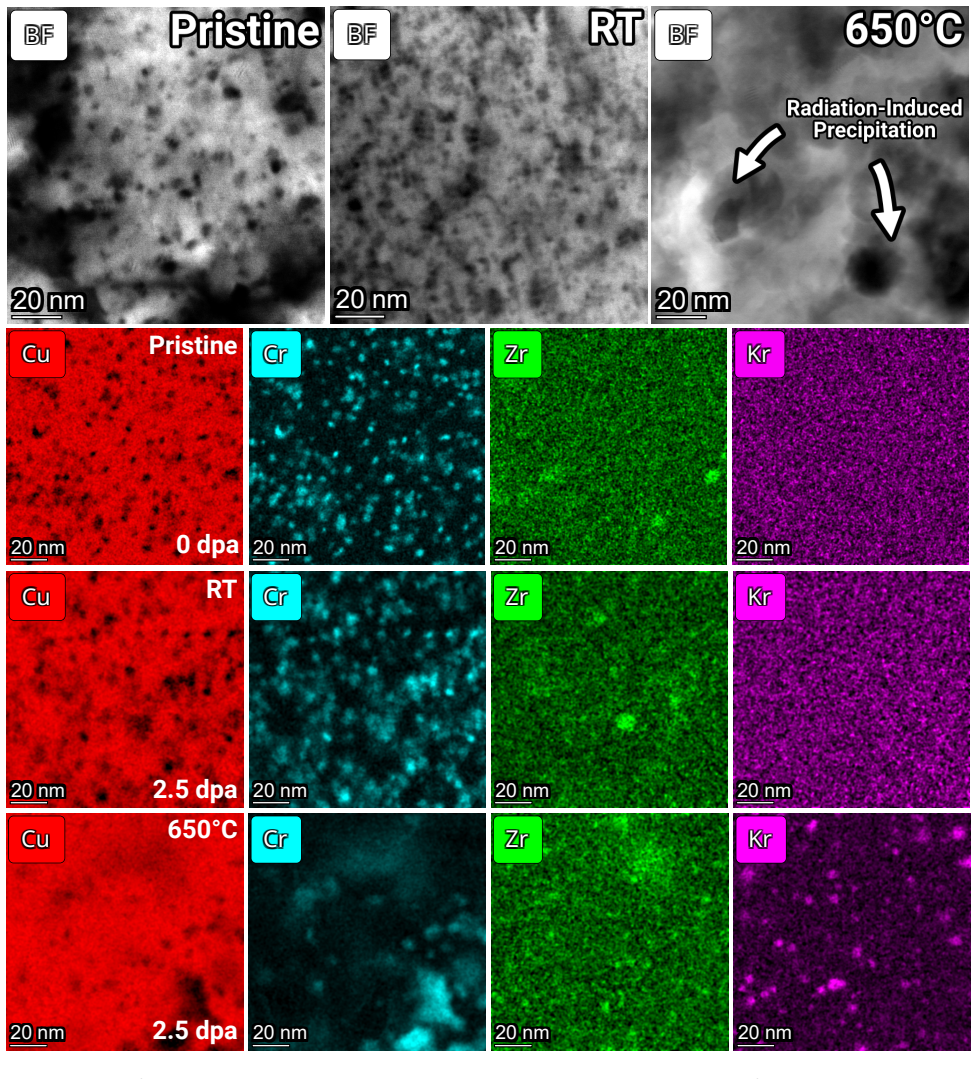
The load-bearing combination is in situ transmission electron microscopy during 600 keV heavy-ion irradiation and helium implantation, which lets the authors watch precipitate dissolution, bubble nucleation, and void formation live; selected-area electron diffraction superlattice reflections track the loss of precipitate order. Thermodynamic equilibrium calculations and transmutation modelling for a deuterium–tritium fusion neutron spectrum predict the chemical drift toward Ni-Zr intermetallics. The two irradiation temperatures bracket the service window, and the diffraction and elemental mapping evidence links the loss of superlattice reflections to the two kinetic regimes.
What would settle it
An in situ ion-irradiation experiment at a service temperature (e.g., 300°C) to about 5 dpa that shows the original Cr- and Zr-rich nanoprecipitate population intact—superlattice reflections still present and precipitate size distributions unchanged—would refute the central claim. Alternatively, re-examination of neutron-irradiated CuCrZr from fission reactors at about 300°C and above 1 dpa, if it retains the prime-aged precipitate dispersion, would undermine the extrapolation.
Extended reading notes
Core claim
The paper's central claim is that the prime-aged CuCrZr microstructure is doubly unstable: the nano-precipitates that provide strength are metastable with respect to temperature alone, and they are destroyed by displacement damage through two distinct temperature-dependent pathways. At room temperature (about 0.22 of the melting temperature), ballistic mixing in collision cascades dissolves the precipitates; at 650°C (about 0.68 of the melting temperature), thermally activated dissolution is followed by radiation-induced precipitation of a coarser, different precipitate population. Because the fusion service window lies between these extremes, where vacancies are already mobile, the authors
Load-bearing premise
The argument assumes that what happens at room temperature and at 650°C brackets what will happen at the real service temperatures of 200–350°C, so that no in-between temperature exists where the original precipitates survive; and that 600 keV heavy-ion irradiation faithfully emulates fusion-neutron damage despite dose rates orders of magnitude higher.
Editorial extensions
If this is right
- If CuCrZr's prime-aged precipitate dispersion dissolves under irradiation at both kinetic extremes, the alloy's strength in service will come from radiation-induced defect clusters rather than precipitation hardening, reproducing the low-ductility, high-strength behaviour seen in earlier neutron data.
- Helium and hydrogen transmutation products, accumulating at roughly 0.06 at.% He and 0.5 at.% H over five years, will nucleate bubbles and voids once vacancies are mobile, promoting embrittlement and swelling.
- The predicted Ni-Zr intermetallic formation means the alloy's chemistry—and hence its equilibrium precipitate phases—changes irreversibly within a fraction of a reactor's design lifetime, so heat-treatment cannot restore the lost hardening.
- New copper-based heat-sink alloys will need strengthening mechanisms that do not depend on a metastable precipitate dispersion, and qualification will require tests that combine displacement damage with helium and hydrogen co-implantation at service temperatures.
- The apparent irradiation hardening reported in earlier CuCrZr neutron studies is reinterpreted as defect-cluster hardening, not retention of the engineered precipitate structure.
Reading between the lines
- The paper's bracketing argument implies a sharp, testable prediction: at intermediate service temperatures around 250–350°C, the precipitate population should still degrade, likely as a mixture of ballistic dissolution and ripening. An ion-irradiation experiment at about 300°C to several dpa would directly test this.
- The transmutation-driven chemistry shift is a generic phenomenon for any copper-based age-hardenable alloy under a fusion neutron spectrum, not just CuCrZr; alloy designs that reduce nickel production or stabilise zirconium against nickel getters would be worth exploring.
- The ion-surrogate issue cuts both ways: while dose-rate differences may shift the balance between ballistic mixing and thermal back-diffusion, the fact that both kinetic extremes degrade the precipitates suggests that even a shifted balance still degrades them—but quantitative lifetime predictions require dose-rate-aware modelling, which the paper does not provide.
- If the three degradation mechanisms are as independent as claimed, then a single mitigation—such as a more thermally stable precipitate—would not suffice: the alloy would still fail by transmutation-driven chemistry drift and gas-driven cavity formation.
Signed reviews
Editorial analysis
A structured set of objections, weighed in public.
Referee Report
Summary. The paper combines in situ transmission electron microscopy (TEM) under 600 keV Kr2+ irradiation and 6 keV He+ implantation at room temperature and 650 °C, with ex situ STEM-EDX, thermodynamic calculations (FactSage), and transmutation calculations (FISPACT-II), to argue that the prime-aged CuCrZr precipitate dispersion is unstable under fusion-relevant irradiation. The authors report two degradation regimes for the Cr- and Zr-rich hardening precipitates: ballistic dissolution at low temperature and dissolution followed by radiation-induced precipitation at high temperature. They further report temperature-dependent He bubble nucleation and the prediction that five full-power years of fusion-neutron exposure transmutes Cu to Ni, Zn, H, and He, with Ni redirecting Zr into Ni-Zr intermetallics. The central claim is that these mechanisms, acting together, challenge the precipitation-hardening strategy on which CuCrZr heat-sink performance depends.
Significance. If fully established, the conclusion would be important for fusion materials: it would call into question the long-term viability of age-hardenable CuCrZr heat sinks under ITER/DEMO-relevant neutron doses and spectra. The paper has clear strengths: a substantial in situ TEM dataset from the MIAMI-2 facility, a standard SRIM methodology following Stoller et al., quantitative STEM-EDX phase analysis using the open-source ESPM package, and FISPACT-II/FactSage modelling with documented nuclear-data choices. These features make the experimental and modelling chain reproducible in principle. However, the manuscript's most load-bearing inference—that degradation at 0.22 Tm and 0.68 Tm brackets degradation in the 0.46–0.53 Tm service window—is not established by the presented endpoints, and the authors' own dose-rate caveat leaves the neutron extrapolation unquantified. The paper therefore currently supports a more limited claim: the prime-aged precipitate dispersion is destabilised under accelerated ion irradiation at the two temperature extremes, and transmutation changes the equilibrium phase landscape.
major comments (4)
- [§4.2] The central inference—'no intermediate temperature window exists in which one mechanism could be suppressed without the other becoming dominant'—does not follow from the two endpoint experiments. At intermediate homologous temperatures (0.46–0.53 Tm) both ballistic dissolution and thermally activated re-precipitation operate simultaneously, and rate-theory models of precipitate stability under irradiation commonly exhibit a steady-state balance between cascade mixing and radiation-enhanced diffusion. The paper provides neither data between RT and 650 °C nor a model that couples ballistic dissolution and thermal back-diffusion as functions of dose rate and temperature. Since the authors state in §5 that 'quantitative transfer of degradation rates to neutron irradiation conditions will require dose-rate-aware modelling', the stronger statement that the prime-aged microstructure is 'unlikel
- [§3.4 / Fig. 10A] The quantitative evidence for precipitate dissolution/coarsening is presented in Fig. 10A without error bars, confidence intervals, or stated sample sizes. The reported mean changes (Cr-rich 5.3→4.3 nm; Zr-rich 2.6→3.8 nm at RT; 3.9 nm at 650 °C) could easily overlap given the broad histograms shown, and the 'faded' qualitative appearance of the EDX maps is not a substitute for a statistical comparison. Because the dissolution/coarsening conclusion is load-bearing for the two-kinetic-regime claim, please provide per-condition N, standard deviations or box plots, and a formal comparison (e.g., a two-sample test or effect-size statement) before drawing mechanistic conclusions from these size shifts.
- [§3.4 / Conclusion 2] The manuscript explicitly concedes in §3.4 that 'amorphisation of the nano-precipitates cannot also be ruled out,' and this caveat reappears in Conclusion 2. This is not merely a minor qualification: the claimed 'ballistic dissolution' mechanism, and the distinction between the low- and high-temperature regimes, depends on whether the precipitates lose crystallinity and dissolve into the matrix or become amorphous while remaining chemically localised. Loss of superlattice reflections in SAED and fading of EDX signal are consistent with both interpretations. To make the mechanistic claim, the authors should either provide high-resolution TEM/FFT or APT evidence for the precipitate state in the RT-irradiated condition, or soften the mechanistic conclusion to 'loss of the crystalline precipitate dispersion'.
- [§4.1 / Table 1] The prediction that transmutation 'irreversibly redirects the alloy chemistry towards Ni-Zr intermetallics' is based on FactSage equilibrium calculations for a homogeneously transmuted bulk composition after five full-power years. As an equilibrium calculation, it indicates the thermodynamically favoured phases, but it does not establish that these intermetallics will actually nucleate within service-relevant times, nor does it account for radiation-induced segregation, ballistic dissolution, or the possibility that Ni remains in solid solution. The word 'irreversibly' is therefore stronger than the calculation supports. Since this is one of the three 'independent mechanisms' in the paper's core argument, the claim should be labelled as a thermodynamic prediction requiring kinetic validation, or supported by precipitation/APT evidence.
minor comments (4)
- [§2.10] The notation 'Kr+2' and 'He+' is inconsistent; use 'Kr2+' and 'He+' throughout.
- [Fig. 10] The histograms in Fig. 10A use 'Count [a.u.]' on the ordinate; use actual counts or normalised probability densities and specify bin widths.
- [§4.2] The service window is stated in terms of homologous temperature (0.46–0.53 Tm) without quoting the corresponding °C values; adding the °C range would help the reader connect to the ITER 200–350 °C and DEMO 450 °C limits cited earlier.
- [§2.12] The FISPACT-II calculation is described clearly, but the specific FactSage database/version settings used for the Cu-Cr-Zr-Ni-Zn equilibrium assessment would be useful in the supplementary material for reproducibility.
Circularity Check
No significant circularity: conclusions rest on new in situ measurements and standard modelling; self-citations are non-load-bearing.
full rationale
The paper's derivation chain is not circular. The central observations—loss of precipitate superlattice reflections and shrinking Cr-rich precipitates at RT, coarsening/RIP at 650°C, He-bubble thresholds, Kr-rich voids—are direct in situ TEM/STEM-EDX measurements, not outputs of a fitted model. SRIM dpa conversions follow the standard Stoller/Kinchin-Pease procedure; FISPACT-II and FactSage are externally developed codes with stated inputs (nominal composition, HCPB-FW spectrum, SGTE database). The transmutation prediction of Ni-Zr intermetallics is a thermodynamic calculation on the calculated post-transmutation composition, not a fit to the experimental outcome. The §4.2 bracketing argument (RT and 650°C bound the 0.46–0.53 Tm service window) is an inductive extrapolation and is explicitly hedged by the conclusion that 'quantitative transfer of degradation rates to neutron irradiation conditions will require dose-rate-aware modelling'; it is an evidentiary weakness, not a definitional reduction. Self-citations [48–50,71,72,78,83] are present but non-load-bearing: the ion-surrogate rationale rests on Gilbert et al.'s PKA spectra and Was's discussion, and the Al-alloy/H-embrittlement analogues are corroborative, not premises. No fitted parameter is renamed as a prediction and no equation reduces to its input; therefore no circular step is identified.
Assumptions & free parameters
assumptions (5)
- domain assumption 600 keV Kr2+ ion irradiations generate collision cascades representative of the 14 MeV fusion-neutron PKA spectrum in Cu
- domain assumption RT and 650°C irradiation bracket the 200–450°C service window, so degradation at both extremes implies degradation in between
- domain assumption FISPACT-II with TENDL-2017 and DECAY-2020 cross-sections correctly predicts the 5-year transmutation inventory under the HCPB-FW spectrum
- domain assumption FactSage/SGTE-2020 equilibrium calculations on the transmuted composition predict the phases that would actually form in service
- domain assumption He implantation at concentrations up to 4.76 at.% can be extrapolated to the 0.06 at.% He predicted after five years
Cite this review
Pith. "Pith review of CuCrZr heat-sink irradiation performance reveals new challenges for thermonuclear fusion reactors." pith.science (2026). https://pith.science/paper/I5O5HJOY
@misc{pith2026260717594,
  author       = {Pith},
  title        = {Pith review of: CuCrZr heat-sink irradiation performance reveals new challenges for thermonuclear fusion reactors},
  year         = {2026},
  howpublished = {\url{https://pith.science/paper/I5O5HJOY}},
  note         = {Machine review of arXiv:2607.17594}
}
read the original abstract
Commercial fusion energy requires materials that survive intense neutron bombardment whilst extracting extreme heat loads for conversion to electricity. The CuCrZr alloy, the leading heat-sink material for fusion reactors, derives its strength from a fine dispersion of nano-precipitates formed during prime-ageing heat-treatment. Whether this precipitation-hardening strategy can withstand fusion-relevant irradiation remains untested. Here we show, combining in situ transmission electron microscopy under heavy-ion irradiation and He implantation with thermodynamic and transmutation modelling, that the hardening precipitates dissolve under two opposing kinetic regimes: ballistic dissolution dominates at low temperatures, whilst dissolution and re-precipitation dominate at high temperatures. Although the accelerated dose rates inherent to ion irradiation shift the balance between ballistic mixing and thermal back-diffusion relative to reactor conditions, precipitate degradation at both kinetic extremes indicates that the prime-aged microstructure is unlikely to remain unaltered under prolonged neutron exposure. He bubbles and Kr-rich voids nucleate once vacancies become mobile, and transmutation over five service years irreversibly redirects the alloy chemistry towards Ni-Zr intermetallics. These three independent mechanisms converge to challenge the strategy on which CuCrZr performance depends, suggesting that the long-term performance of age-hardenable Cu-based heat-sink alloys in fusion reactors warrants further assessment. Our findings reveal a new materials challenge for fusion reactor design and commercialisation: the need for new Cu-based heat-sink alloys able to retain engineered strength whilst their chemistry is irreversibly rewritten - thermodynamically and ballistically - by the fusion neutron spectrum.
Figures


Figures from the paper (8 more)




Reference graph
Works this paper leans on
-
[1]
O. El-Atwani, J. Hinks, G. Greaves, S. Gonderman, T . Qiu, M. Efe, J. P . Allain, In-situ TEM observation of the response of ultrafine-and nanocrystalline-grained tungsten to extreme irradiation environ- ments, Scientific reports 4 (1) (2014) 4716.doi:10.1038/srep04716
-
[2]
O. El-Atwani, S. Gonderman, M. Efe, G. De Temmerman, T . Morgan, K. Bystrov, D. Klenosky, T . Qiu, J. Allain, Ultrafine tungsten as a plasma-facing component in fusion devices: effect of high flux, high fluence low energy helium irradiation, Nuclear Fusion 54 (8) (2014) 083013.doi:10.1088/0029- 5515/54/8/083013
doi:10.1088/0029- 2014
-
[3]
X. Yi, M. L. Jenkins, K. Hattar, P . D. Edmondson, S. G. Roberts, Characterisation of radiation damage in W and W-based alloys from 2 MeV self-ion near-bulk implantations, Acta Materialia 92 (2015) 163–177.doi:10.1016/j.actamat.2015.04.015
-
[4]
X. Yi, M. L. Jenkins, M. A. Kirk, Z. Zhou, S. G. Roberts, In-situ TEM studies of 150 keV W+ ion irradiated W and W-alloys: Damage production and microstructural evolution, Acta Materialia 112 (2016) 105–120.doi:10.1016/j.actamat.2016.03.051
-
[5]
X. Yi, K. Arakawa, D. Nguyen-Manh, F . Ferroni, P . Liu, W. Han, F . Wan, S. G. Roberts, A study of helium bubble production in 10 keV He+ irradiated tungsten, Fusion Engineering and Design 125 (2017) 454–457.doi:10.1016/j.fusengdes.2017.04.126
-
[6]
X. Yi, M. Jenkins, M. Briceno, S. Roberts, Z. Zhou, M. Kirk, In situ study of self-ion irradiation damage in W and W–5Re at 500 C, Philosophical Magazine 93 (14) (2013) 1715–1738.doi:10.1080/1478 6435.2012.754110. 28
arXiv 2013
-
[7]
X. Yi, K. Arakawa, F . Ferroni, M. L. Jenkins, W. Han, P . Liu, F . Wan, High-temperature damage evolution in 10 keV He+ irradiated W and W-5Re, Materials Characterization 145 (2018) 77–86.doi:10.101 6/j.matchar.2018.08.026
2018
-
[8]
X. Yi, K. Arakawa, Y . Du, F . Ferroni, W. Han, P . Liu, F . Wan, High-temperature defect recovery in self- ion irradiated W-5 wt% Ta, Nuclear Materials and Energy 18 (2019) 93–98.doi:10.1016/j.nme. 2018.12.014
doi:10.1016/j.nme 2019
Show all 89 references
-
[9]
El Atwani, K
O. El Atwani, K. Unal, W. S. Cunningham, S. Fensin, J. Hinks, G. Greaves, S. Maloy, In-situ helium implantation and TEM investigation of radiation tolerance to helium bubble damage in equiaxed nanocrystalline tungsten and ultrafine tungsten-TiC alloy, Materials 13 (3) (2020) 79...
2020
-
[10]
El-Atwani, N
O. El-Atwani, N. Li, M. Li, A. Devaraj, J. Baldwin, M. M. Schneider, D. Sobieraj, J. S. Wróbel, D. Nguyen- Manh, S. A. Maloy, et al., Outstanding radiation resistance of tungsten-based high-entropy alloys, Science advances 5 (3) (2019) eaav2002.doi:10.1126/sciadv.aav2002
2019 doi
-
[11]
El-Atwani, A
O. El-Atwani, A. Alvarado, K. Unal, S. Fensin, J. Hinks, G. Greaves, J. Baldwin, S. Maloy, E. Martinez, Helium implantation damage resistance in nanocrystalline W-Ta-V-Cr high entropy alloys, Materials Today Energy 19 (2021) 100599.doi:10.1016/j.mtener.2020.100599
2021
-
[12]
El Atwani, H
O. El Atwani, H. Vo, M. Tunes, C. Lee, A. Alvarado, N. Krienke, J. Poplawsky, A. Kohnert, J. Gigax, W. Chen, M. Li, Y . Wang, J. Wrobel, D. Nguyen-Manh, J. Balwin, Q. Tukac, E. Aydogan, S. Fensin, M. J. Martinez, A quinary WTaCrVHf nanocrystalline refractory high-entropy alloy...
2023 doi
-
[13]
Bochvar, Cr-Cu-Zr (chromium-copper-zirconium), Non-Ferrous Metal Systems 2 (2007) 228–242
N. Bochvar, Cr-Cu-Zr (chromium-copper-zirconium), Non-Ferrous Metal Systems 2 (2007) 228–242. doi:10.1016/b978-0-408-70932-3.50357-0
2007 doi
-
[14]
Edwards, B
D. Edwards, B. N. Singh, S. Tähtinen, Effect of heat treatments on precipitate microstructure and mechanical properties of a CuCrZr alloy, Journal of Nuclear Materials 367 (2007) 904–909.doi: 10.1016/j.jnucmat.2007.03.064
2007 doi
-
[15]
Engel, J
S. Engel, J. Q. da Fonseca, P . Shanthraj, Modelling the thermal strength degradation of CuCrZr for use in plasma facing components, Journal of Nuclear Materials (2025) 155985doi:10.1016/j. jnucmat.2025.155985
2025
-
[16]
Fabritsiev, A
S. Fabritsiev, A. Pokrovsky, Effect of high doses of neutron irradiation on physico-mechanical prop- erties of copper alloys for ITER applications, Fusion engineering and design 73 (1) (2005) 19–34. doi:10.1016/j.fusengdes.2004.12.003
2005 doi
-
[17]
Fabritsiev, A
S. Fabritsiev, A. Pokrovsky, Effect of irradiation temperature on microstructure, radiation hardening and embrittlement of pure copper and copper-based alloy, Journal of Nuclear Materials 367 (2007) 977–983.doi:10.1016/j.jnucmat.2007.03.056. 29
2007 doi
-
[18]
L. Gong, Y . Huang, Z. Han, S. Song, H. Feng, Z. Chen, X. Liu, W. Huang, Texture evolution and strengthening mechanism of CuCrZr alloys during cold rolling, Vacuum 221 (2024) 112908.doi: 10.1016/j.vacuum.2023.112908
2024
-
[19]
Huang, J
Y .-J. Huang, J. Yu, H. Kurotaki, M. Nakajima, T . Nozawa, Corrosion and stress corrosion behavior of CuCrZr alloy in high temperature pure water environment relevant to Japan’s DEMO divertor, Fusion Engineering and Design 202 (2024) 114364.doi:10.1016/j.fusengdes.2024.114364
2024
-
[20]
Kalinin, A
G. Kalinin, A. Ivanov, A. Obushev, B. Rodchenkov, M. Rodin, Y . Strebkov, Ageing effect on the prop- erties of CuCrZr alloy used for the ITER HHF components, Journal of Nuclear Materials 367 (2007) 920–924.doi:10.1016/j.jnucmat.2007.03.256
2007 doi
-
[21]
C. Kwok, P . Wong, H. C. Man, F . Cheng, Effect of pH on corrosion behavior of CuCrZr in solution without and with NaCl, Journal of Nuclear materials 394 (1) (2009) 52–62.doi:10.1016/j.jn ucmat.2009.08.006
2009 doi
-
[22]
Obitz, J
C. Obitz, J. Öijerholm, S. Wikman, E. Bratu, Erosion corrosion of CuCrZr specimens exposed for simulated ITER operational conditions, Nuclear Materials and Energy 9 (2016) 261–266.doi: 10.1016/j.nme.2016.05.001
2016 doi
-
[23]
Park, Y .-I
J.-Y . Park, Y .-I. Jung, B.-K. Choi, J.-S. Lee, Y . H. Jeong, B. G. Hong, Investigation on the microstruc- ture and mechanical properties of CuCrZr after manufacturing thermal cycle for plasma facing com- ponent, Journal of Nuclear Materials 417 (1-3) (2011) 916–919.doi:10.10...
2011 doi
-
[24]
Hirai, S
T . Hirai, S. Panayotis, V . Barabash, C. Amzallag, F . Escourbiac, A. Durocher, M. Merola, J. Linke, T . Loewenhoff, G. Pintsuk, et al., Use of tungsten material for the ITER divertor, Nuclear Materials and Energy 9 (2016) 616–622.doi:10.1016/j.nme.2016.07.003
2016 doi
-
[25]
rep., EUROfusion, accessed: 2025-08-19 (2018).doi:10.3030/633053
EUROfusion Consortium, European Research Roadmap to the Realisation of Fusion Energy, Tech. rep., EUROfusion, accessed: 2025-08-19 (2018).doi:10.3030/633053. URLhttps://euro-fusion.org/wp-content/uploads/2022/10/2018_Research_roadma p_long_version_01.pdf
2025 doi
-
[26]
rep., Henry Royce Institute, interactive PDF; hosted on Royce Institute website (2021).doi:10.1007/978-3-662-62102-8_10
UKAEA, UK Fusion Materials Roadmap 2021–2040, Tech. rep., Henry Royce Institute, interactive PDF; hosted on Royce Institute website (2021).doi:10.1007/978-3-662-62102-8_10. URLhttps://www.royce.ac.uk/wp-content/uploads/2024/11/UK_Fusion_Materials_ Roadmap_Interactive.pdf
2021 doi
-
[27]
Tejado, A
E. Tejado, A. Müller, J. You, J. Pastor, Evolution of mechanical performance with temperature of w/cu and w/cucrzr composites for fusion heat sink applications, Materials Science and Engineering: A 712 (2018) 738–746.doi:10.1016/j.msea.2017.12.054
2018 doi
-
[28]
Terentyev, M
D. Terentyev, M. Rieth, G. Pintsuk, A. Von Müller, S. Antusch, A. Zinovev, A. Bakaev, K. Poleshchuk, G. Aiello, Effect of neutron irradiation on tensile properties of advanced cu-based alloys and 30 composites developed for fusion applications, Journal of Nuclear Materials 584...
2023
-
[29]
Y .-Y . Chen, Z. Liu, S. R. Meka, Y . Huang, Z.-M. Wang, Effect of interface structure on advanced bonding between tungsten-based materials and cu alloys: a review, Tungsten 7 (3) (2025) 479– 496.doi:10.1007/s42864-024-00313-w
2025 doi
-
[30]
M. R. Gilbert, J.-C. Sublet, R. A. Forrest, Handbook of activation, transmutation, and radiation dam- age properties of the elements simulated using FISPACT -II & TENDL-2014; Magnetic Fusion Plants, Culham Centre for Fusion Energy, 2015.doi:10.13182/physor22-37308
2014 doi
-
[31]
Hirai, V
T . Hirai, V . Barabash, F . Escourbiac, A. Durocher, L. Ferrand, V . Komarov, M. Merola, ITER divertor materials and manufacturing challenges, Fusion Engineering and Design 125 (2017) 250–255.doi: 10.1016/j.fusengdes.2017.07.009
2017 doi
-
[32]
Björkbacka, S
Å. Björkbacka, S. Hosseinpour, M. Johnson, C. Leygraf, M. Jonsson, Radiation induced corrosion of copper for spent nuclear fuel storage, Radiation Physics and Chemistry 92 (2013) 80–86.doi: 10.1016/j.radphyschem.2013.06.033
2013 doi
-
[33]
S. S. Raiman, G. S. Was, Accelerated corrosion and oxide dissolution in 316L stainless steel ir- radiated in situ in high temperature water, Journal of Nuclear Materials 493 (2017) 207–218. doi:10.1016/j.jnucmat.2017.05.043
2017 doi
-
[34]
Liu, G.-H
H. Liu, G.-H. Lei, H.-F . Huang, Review on synergistic damage effect of irradiation and corrosion on reactor structural alloys, Nuclear Science and Techniques 35 (3) (2024) 57.doi:10.1007/s413 65-024-01415-3
2024 doi
-
[35]
M. A. Tunes, P . J. Uggowitzer, P . Dumitraschkewitz, P . Willenshofer, S. Samberger, F . C. da Silva, C. G. Schön, T . M. Kremmer, H. Antrekowitsch, M. B. Djukic, et al., Limitations of hydrogen detection after 150 years of research on hydrogen embrittlement, Advanced Enginee...
2024 doi
-
[36]
Reali, M
L. Reali, M. R. Gilbert, D. Cereceda, K. C. Pitike, S. L. Dudarev, P . Edmondson, S. Kajita, J.-M. Kwon, B. Lee, J. Marian, D. R. Mason, S. T . Murphy, D. Nguyen-Manh, T . Oda, P . Olsson, W. Setyawan, S. O. V . Tiedemann, C. Wang, Y . Wang, A. R. Warwick, J. S. Wróbel, H.-B. ...
2026
-
[37]
Z. Y . Zhang, L. X. Sun, N. R. Tao, Nanostructures and nanoprecipitates induce high strength and high electrical conductivity in a cucrzr alloy, Journal of Materials Science & Technology 48 (2020) 18–22.doi:10.1016/J.JMST.2019.12.022
2020 doi
-
[38]
H. Yang, K. Li, Y . Bu, J. Wu, Y . Fang, L. Meng, J. Liu, H. Wang, Nanoprecipitates induced dislocation pinning and multiplication strategy for designing high strength, plasticity and conductivity cu alloys, Scripta Materialia 195 (2021) 113741.doi:10.1016/j.scriptmat.2021.113741. 31
2021
-
[39]
S. Xu, H. Fu, Y . Wang, J. Xie, Effect of ag addition on the microstructure and mechanical properties of cu-cr alloy, Materials Science and Engineering: A 726 (2018) 208–214.doi:10.1016/j.msea .2018.04.077
2018 doi
-
[40]
Y . D. Wang, L. H. Wu, P . Xue, H. Zhang, D. R. Ni, Z. Y . Ma, Improved strength with good conductivity in cu–cr–zr alloys: Determinant effect of under-aging treatment before rolling and aging, Materials Science and Engineering: A 848 (2022) 143395.doi:10.1016/j.msea.2022.143395
2022
-
[41]
J. Hu, Y . Tian, H. Yu, G. Ling, S. Li, M. Jiang, H. Li, G. Qin, Optimizing strength and electrical conductivity of cu-cr-zr alloy by two-stage aging treatment, Materials Letters 315 (2022) 131937. doi:10.1016/j.matlet.2022.131937
2022
-
[42]
Liang, D
X. Liang, D. Liu, Z. Shen, N. Tao, Enhanced precipitation hardening in nanograined cucrzr alloy, Scripta Materialia 247 (2024) 116118.doi:10.1016/j.scriptamat.2024.116118
2024
-
[43]
Zhang, P
B. Zhang, P . Xu, J. Wang, Z. Hong, W. Wang, F . Dai, Overcoming the trade-off between conductivity and strength in copper alloys through undercooling, Nature Communications 16 (1) (2025) 4978. doi:10.1038/s41467-025-60346-8
2025 doi
-
[44]
Teurtrie, N
A. Teurtrie, N. Perraudin, T . Holvoet, H. Chen, D. T . Alexander, G. Obozinski, C. Hébert, espm: A python library for the simulation of stem-edxs datasets, Ultramicroscopy 249 (2023) 113719.doi: 10.1016/j.ultramic.2023.113719
2023
-
[45]
J. F . Ziegler, M. D. Ziegler, J. P . Biersack, SRIM–The stopping and range of ions in matter (2010), Nuclear Instruments and Methods in Physics Research Section B: Beam Interactions with Materials and Atoms 268 (11-12) (2010) 1818–1823.doi:10.1016/j.nimb.2010.02.091
2010 doi
-
[46]
Greaves, A
G. Greaves, A. Mir, R. Harrison, M. Tunes, S. Donnelly, J. Hinks, New microscope and ion accel- erators for materials investigations (MIAMI-2) system at the University of Huddersfield, Nuclear Instruments and Methods in Physics Research Section A: Accelerators, Spectrometers, D...
2019 doi
-
[47]
G. S. Was, Challenges to the use of ion irradiation for emulating reactor irradiation, Journal of Ma- terials Research (2015).doi:10.1557/jmr.2015.73
2015 doi
-
[48]
M. A. Tunes, R. W. Harrison, S. E. Donnelly, P . D. Edmondson, A transmission electron microscopy study of the neutron-irradiation response of ti-based max phases at high temperatures, Acta Mater- ialia 169 (2019) 237–247.doi:10.1016/j.actamat.2019.02.046. URLhttps://linkinghu...
2019 doi
-
[49]
M. A. Tunes, Transmission electron microscopy study of radiation damage in potential nuclear ma- terials, Ph.D. thesis, University of Huddersfield (2020).doi:10.1201/9781420034646.ch1
2020 doi
-
[50]
M. A. Tunes, S. M. Drewry, J. D. Arregui-Mena, S. Picak, G. Greaves, L. B. Cattini, S. Pogatscher, J. A. Valdez, S. Fensin, O. El-Atwani, et al., Accelerated radiation tolerance testing of Ti-based MAX phases, Materials Today Energy 30 (2022) 101186.doi:10.2139/ssrn.4117114. 32
2022 doi
-
[51]
R. E. Stoller, M. B. Toloczko, G. S. Was, A. G. Certain, S. Dwaraknath, F . A. Garner, On the use of SRIM for computing radiation damage exposure, Nuclear instruments and methods in physics research section B: beam interactions with materials and atoms 310 (2013) 75–80.doi:10....
2013 doi
-
[52]
C. W. Bale, P . Chartrand, S. Degterov, G. Eriksson, K. Hack, R. B. Mahfoud, J. Melançon, A. Pelton, S. Petersen, FactSage thermochemical software and databases, Calphad 26 (2) (2002) 189–228. doi:10.1016/s0364-5916(02)00035-4
2002 doi
-
[53]
C. W. Bale, E. Bélisle, P . Chartrand, S. Decterov, G. Eriksson, K. Hack, I.-H. Jung, Y .-B. Kang, J. Melançon, A. Pelton, et al., FactSage thermochemical software and databases—recent devel- opments, Calphad 33 (2) (2009) 295–311.doi:10.1016/j.calphad.2008.09.009
2009 doi
-
[54]
Sublet, J
J.-C. Sublet, J. Eastwood, J. Morgan, M. Gilbert, M. Fleming, W. Arter, Fispact-ii: an advanced simu- lation system for activation, transmutation and material modelling, Nuclear Data Sheets 139 (2017) 77–137.doi:10.1016/j.nds.2017.01.002
2017 doi
-
[55]
org/fispact/nuclear_data, accessed: 2025-12-12 (2026)
UKAEA Atomic Energy Authority, NEA GitLab: FISPACT Nuclear Data,https://git.oecd-nea. org/fispact/nuclear_data, accessed: 2025-12-12 (2026)
2025
-
[56]
UKAEA, FISPACT -II Wiki: Probability Table Self-Shielding,https://fispact.ukaea.uk/wiki/ Probability_table_self-shielding, accessed: 2026-05-12 (2026)
2026
-
[57]
UKAEA, FISPACT -II Wiki: Reference Input Spectra,https://fispact.ukaea.uk/wiki/Refere nce_input_spectra#HCPB-FW, accessed: 2025-12-12 (2026)
2025
-
[58]
J. W. Cahn, The impurity-drag effect in grain boundary motion, Acta Metallurgica 10 (9) (1962) 789– 798.doi:10.1016/0001-6160(62)90092-5
1962 doi
-
[59]
X. Chen, F . Jiang, J. Jiang, P . Xu, M. Tong, Z. Tang, Precipitation, recrystallization, and evolution of annealing twins in a Cu-Cr-Zr alloy, Metals 8 (4) (2018) 227.doi:10.3390/met8040227
2018 doi
-
[60]
C. S. Pande, M. A. Imam, B. B. Rath, Study of annealing twins in FCC metals and alloys, Metallurgical Transactions A 21 (1990) 2891–2896.doi:10.1007/BF02647209
1990 doi
-
[61]
Bozzolo, M
N. Bozzolo, M. Bernacki, Viewpoint on the formation and evolution of annealing twins during ther- momechanical processing of FCC metals and alloys, Metallurgical and Materials Transactions A 51 (2020) 2665–2684.doi:10.1007/s11661-020-05772-7
2020 doi
-
[62]
J. A. Brinkman, On the nature of radiation damage in metals, Journal of Applied Physics 25 (1954) 961–970.doi:10.1063/1.1721810
1954 doi
-
[63]
T . M. Fry, The displacement of atoms in solids by radiation, Il Nuovo Cimento Series 10 4 (1956) 1329–1334.doi:10.1007/BF02744350. 33
1956 doi
-
[64]
Silcox, P
J. Silcox, P . B. Hirsch, Dislocation loops in neutron-irradiated copper, Philosophical Magazine 4 (1959) 1356–1374.doi:10.1080/14786435908233371. URLhttp://www.tandfonline.com/doi/abs/10.1080/14786435908233371
1959 doi
-
[65]
J. B. Gibson, A. N. Goland, M. Milgram, G. H. Vineyard, Dynamics of radiation damage, Physical Review 120 (1960) 1229–1253.doi:10.1103/PhysRev.120.1229
1960 doi
-
[66]
C. A. English, B. L. Eyre, M. L. Jenkins, Heavy-ion damage inα-fe, Nature 263 (1976) 400–401. doi:10.1038/263400a0
1976 doi
-
[67]
Nordlund, R
K. Nordlund, R. S. Averback, Point defect movement and annealing in collision cascades, Physical Review B 56 (1997) 2421–2431.doi:10.1103/PhysRevB.56.2421
1997 doi
-
[68]
Nordlund, M
K. Nordlund, M. Ghaly, R. S. Averback, M. Caturla, T . D. de la Rubia, J. Tarus, Defect production in collision cascades in elemental semiconductors and fcc metals, Physical Review B 57 (1998) 7556–7570.doi:10.1103/PhysRevB.57.7556
1998 doi
-
[69]
Greaves, J
G. Greaves, J. a. Hinks, P . Busby, N. J. Mellors, a. Ilinov, a. Kuronen, K. Nordlund, S. E. Donnelly, Enhanced sputtering yields from single-ion impacts on gold nanorods, Physical Review Letters 111 (2013) 1–5.doi:10.1103/PhysRevLett.111.065504
2013 doi
-
[70]
Lohmann, A
W. Lohmann, A. Ribbens, W. F . Sommer, B. N. Singh, Microstructure and mechanical properties of medium energy (600-800 mev) proton irradiated commercial aluminium alloys, Radiation Effects 101 (1987) 283–299.doi:10.1080/00337578708224754
1987 doi
-
[71]
M. A. Tunes, L. Stemper, G. Greaves, P . J. Uggowitzer, S. Pogatscher, Prototypic Lightweight Alloy Design for Stellar-Radiation Environments, Advanced science 7 (22) (2020) 2002397.doi:10.1 002/advs.202002397
2020
-
[72]
P . D. Willenshofer, M. A. Tunes, H. T . Vo, L. Stemper, M. Alfreider, O. Renk, G. Greaves, D. Kiener, P . J. Uggowitzer, S. Pogatscher, Radiation-resistant aluminum alloy for space missions in the extreme environment of the solar system, Advanced Materials 38 (4 2026).doi:10....
2026 doi
-
[73]
Trinkaus, B
H. Trinkaus, B. Singh, Helium accumulation in metals during irradiation – where do we stand?, Journal of Nuclear Materials 323 (2003) 229–242.doi:10.1016/j.jnucmat.2003.09.001
2003 doi
-
[74]
M. Li, Q. Hou, J. Cui, M. Qiu, Atomistic modeling of helium bubble network formation in copper, Journal of Nuclear Materials 588 (2024) 154792.doi:10.1016/j.jnucmat.2023.154792
2024
-
[75]
González, R
C. González, R. Iglesias, Migration mechanisms of helium in copper and tungsten, Journal of Ma- terials Science 49 (23) (2014) 8127–8139.doi:10.1007/s10853-014-8522-7
2014 doi
-
[76]
Hughes, T
J. Hughes, T . Toyama, M. Gorley, E. Jimenez-Melero, Full-stage precipitation during aging of cu- 0.55cr-0.07zr alloy for high heat flux fusion reactor technology, Journal of Materials Research and Technology 20 (2022) 801–810.doi:https://doi.org/10.1016/j.jmrt.2022.07.113. 34
2022 doi
-
[77]
P . J. Maziasz, Effects of helium content of microstructural development in type 316 stainless steel under neutron irradiation, Tech. Rep. ORNL-6121, Oak Ridge National Laboratory, Oak Ridge, TN, USA (11 1985).doi:10.2172/6441891. URLhttps://www.osti.gov/biblio/6441891
1985
-
[78]
M. A. Tunes, The legacy and future of aluminum alloys: Space exploration and extraterrestrial set- tlement, ACS Materials Au 6 (1) (2026) 1–27.doi:10.1021/acsmaterialsau.5c00139
2026 doi
-
[79]
Ullmaier, Helium in fusion materials: High temperature embrittlement, Journal of Nuclear Mater- ials 133-134 (1985) 100–104.doi:10.1016/0022-3115(85)90118-7
H. Ullmaier, Helium in fusion materials: High temperature embrittlement, Journal of Nuclear Mater- ials 133-134 (1985) 100–104.doi:10.1016/0022-3115(85)90118-7
1985 doi
-
[80]
Marian, T
J. Marian, T . Hoang, M. Fluss, L. L. Hsiung, A review of helium–hydrogen synergistic effects in radi- ation damage observed in fusion energy steels and an interaction model to guide future understand- ing, Journal of Nuclear Materials 462 (2015) 409–421.doi:10.1016/j.jnucmat....
2015 doi
-
[81]
M. Dias, N. Catarino, D. Nunes, E. Fortunato, I. Nogueira, M. Rosinki, J. B. Correia, P . A. Carvalho, E. Alves, Helium and deuterium irradiation effects in w-ta composites produced by pulse plasma compaction, Journal of Nuclear Materials 492 (2017) 105–112.doi:10.1016/j.jnucm...
2017 doi
-
[82]
Zhang, X
X. Zhang, X. Ma, X. Zhang, J. Zhang, Q. Yan, Precipitate evolution and irradiation resistance of CuCrZr(Y) alloys under triple-ion irradiation at 450°C, Journal of Nuclear Materials 627 (2026) 156609.doi:10.1016/j.jnucmat.2026.156609
2026
-
[83]
Borges, R
D. Borges, R. Silva, I. Carneiro, N. Morais, R. Sommer, N. C. Huaman, P . Uggowitzer, E. Kozeschnik, M. Djukic, P . Fichtner, C. Schön, M. Tunes, Low-energy proton implantation reveals the incipience of hydrogen embrittlement in a martensitic steel, Scripta Materialia 277 (202...
2026
-
[84]
M. B. Djukic, G. M. Bakic, V . S. Zeravcic, A. Sedmak, B. Rajicic, Hydrogen embrittlement of industrial components: prediction, prevention, and models, Corrosion 72 (7) (2016) 943–961.doi:10.500 6/1958
2016
-
[85]
M. B. Djukic, V . Sijacki Zeravcic, A. Sedmak, B. Rajicic, Hydrogen damage of steels: A case study and hydrogen embrittlement model, Engineering Failure Analysis 58 (2015).doi:10.1016/j.en gfeilanal.2015.05.017
2015 doi
-
[86]
M. B. Djukic, G. M. Bakic, V . S. Zeravcic, A. Sedmak, B. Rajicic, The synergistic action and interplay of hydrogen embrittlement mechanisms in steels and iron: Localized plasticity and decohesion, Engineering Fracture Mechanics 216 (2019) 106528.doi:10.1016/j.engfracmech.2019.106 528
2019 doi
-
[87]
Koyama, M
M. Koyama, M. Rohwerder, C. C. Tasan, A. Bashir, E. Akiyama, K. Takai, D. Raabe, K. Tsuzaki, Recent progress in microstructural hydrogen mapping in steels: quantification, kinetic analysis, and multi- scale characterisation, Materials Science and Technology 33 (13) (2017) 1481–...
2017
-
[88]
W. R. Wampler, T . Schober, B. Lengeler, Precipitation and trapping of hydrogen in copper, The Philo- sophical Magazine: A Journal of Theoretical Experimental and Applied Physics 34 (1) (1976) 129– 141.doi:10.1080/14786437608228179
1976 doi
-
[89]
T . G. Nieh, W. D. Nix, The formation of water vapor bubbles in copper and their effect on intergranular creep fracture, Acta Metallurgica 28 (5) (1980) 557–566.doi:10.1016/0001-6160(80)90122- 4. 36
1980 doi
Reviewed August 1, 2026 · model on record in the stance chip above.
Discussion (0). Continue with ORCID to comment.