REVIEW 4 major objections 5 minor 15 references
LaT: LLM-as-Trainer for Multi-Task Vehicle Routing Solvers
T0 review · 4 major / 5 minor · reviewed 2026-08-01 · deepseek-v4-flash
Pith's one-line read A frozen LLM acting as a periodic trainer—reading cross-task validation gaps and emitting per-constraint guidance—improves multi-task neural VRP solvers on trained and unseen variants with almost no extra training cost and no inference cost
desk verdict An honest, well-engineered paper whose headline attribution — that the LLM itself is the cause — is not yet established; the evidence supports validation-aware conditioning helps, with the LLM possibly incidental. read the letter →
The pith
A machine-rendered reading of the paper's core claim, the machinery that carries it, and where it could break.
The reading
What carries the argument
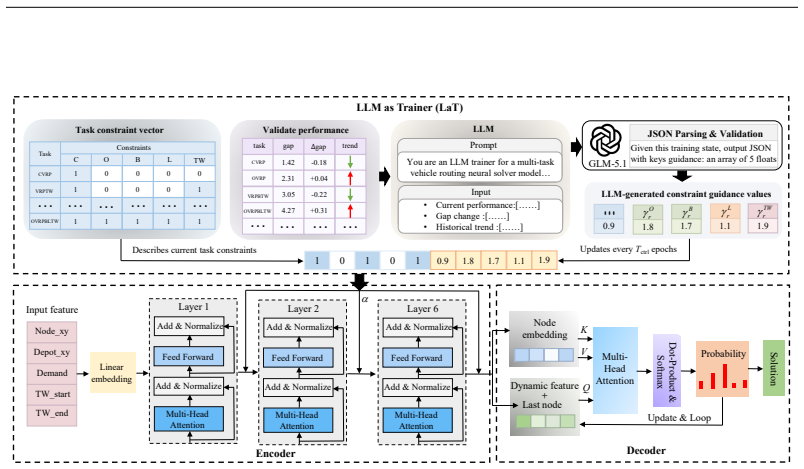
The load-bearing component is the stage-wise guidance vector γ_r ∈ R^5 and the side-branch injection mechanism. At each control round r, the LLM maps a structured training state—current validation objective, relative reference gap, gap change, and up to five historical records for each of the 16 tasks—into one real number per elementary constraint. That vector is concatenated with the binary task constraint vector z_k ∈ {0,1}^5 and injected after every encoder layer via a two-layer MLP side branch with a shared learnable scale α; the decoder then uses the modulated final embeddings as keys and values. This mechanism converts cross-task validation information into a per-layer training signal
What would settle it
Run the identical LaT pipeline with the frozen LLM replaced by a deterministic rule γ_m = clip(mean relative gap of tasks containing constraint m, 0.5, 2.0)—the rule the LLM's outputs approximate (Spearman ≈0.81)—and compare the final mean gap to LaT's reported 4.216%; if the gap matches within run-to-run noise, the LLM as such is not essential and the distinctive claim is false.
Extended reading notes
Core claim
LaT treats training of a multi-task neural VRP solver as a process that should receive explicit stage-wise feedback. At control intervals, the solver is evaluated on fixed validation sets for all 16 tasks; each task's relative gap to a reference solution and its trend are packed into a prompt. A frozen LLM, with temperature zero, returns a guidance vector whose five entries correspond to the five elementary constraints. The current task's constraint vector and this guidance vector are concatenated and fed to a lightweight side branch after each encoder layer, scaled by a shared learnable coefficient, so that the guidance shapes the node representations used by the decoder. The LLM is removed
Load-bearing premise
The load-bearing premise is that the LLM's specific outputs cause the improvement, not just the added side-branch parameters or any other rule fed the same validation gaps—and the paper's only control, an MLP updated once per control round, is too weak to establish that, while no hand-coded rule is tested.
Editorial extensions
If this is right
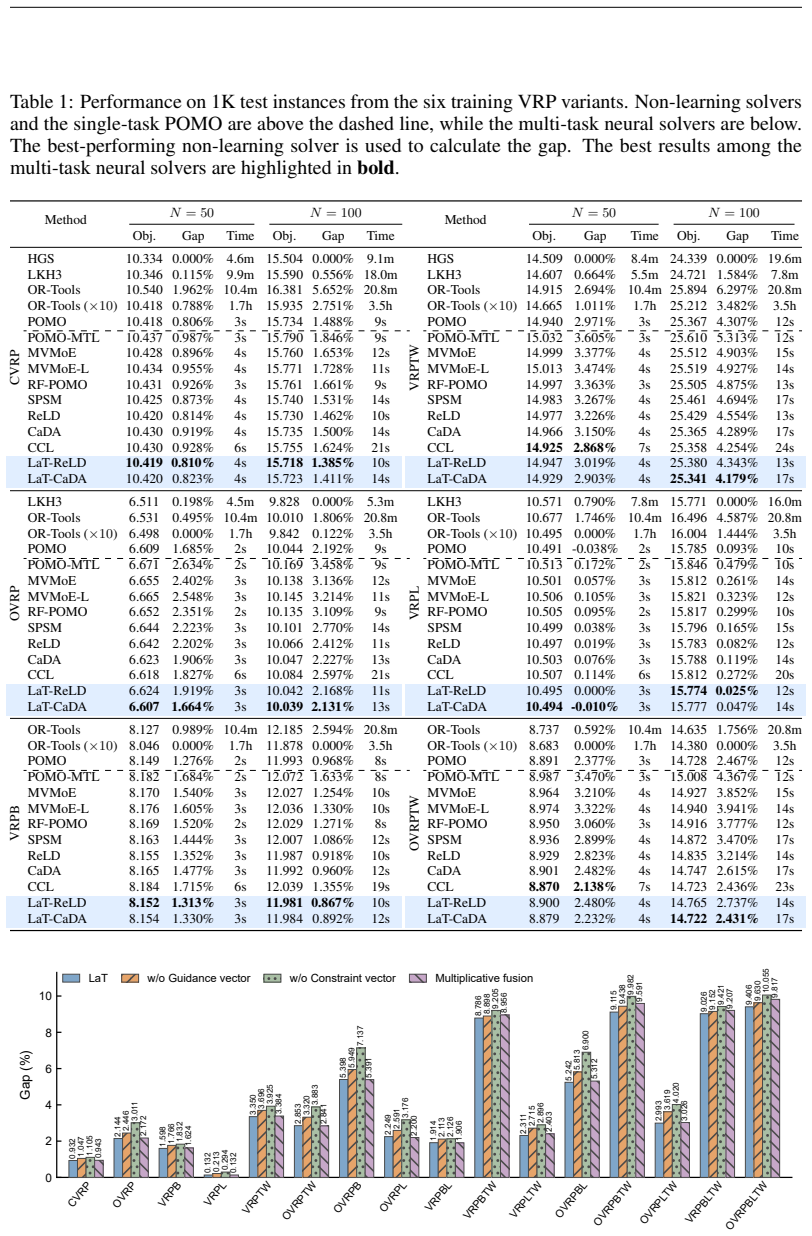
- With one of the evaluated backbones, LaT lowers the mean gap over the six trained variants from 1.810% to 1.669%, and across all twenty unseen-settings comparisons the LaT variant beats the backbone (5.490% to 5.067%).
- LaT adds only 8–22 MiB peak memory and 0.27–1.49% training time across six backbones, and after training the LLM is discarded, so inference cost and latency are essentially unchanged.
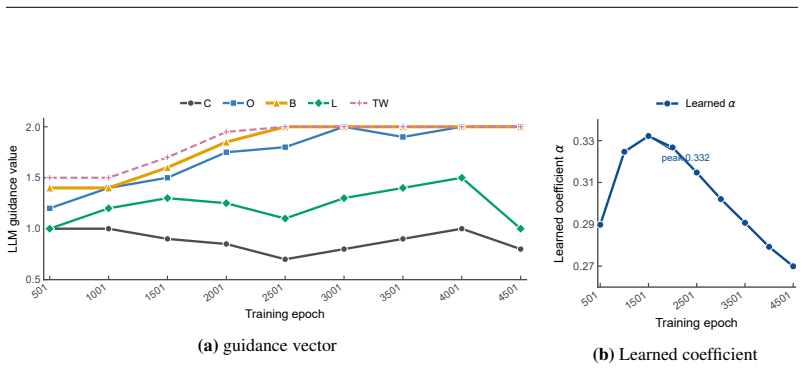
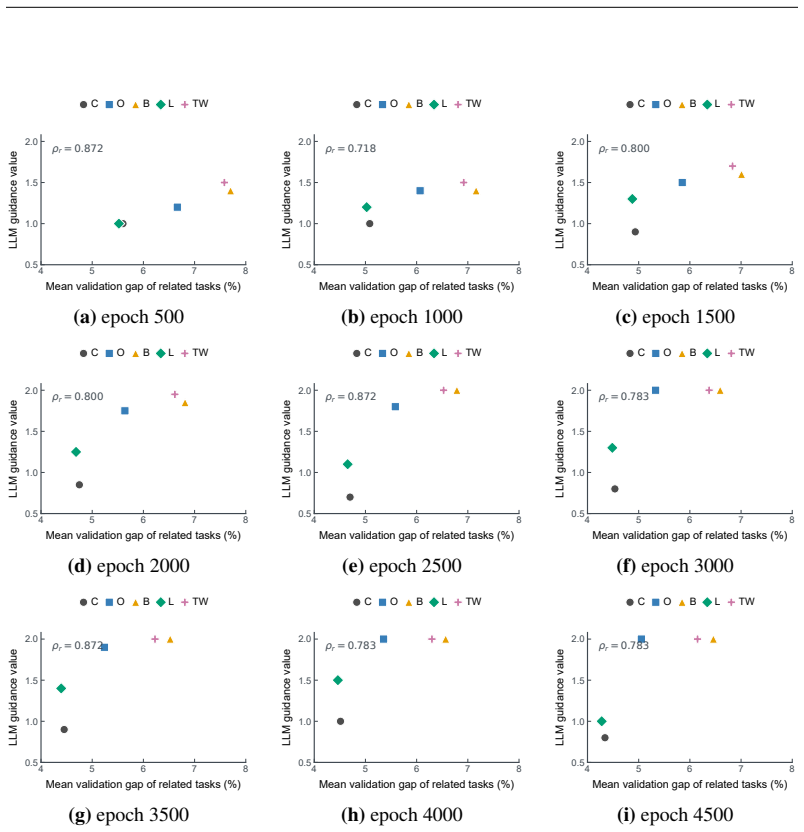
- Guidance values are constraint-specific and stage-dependent: in the recorded runs, backhaul and time-window values climb toward the upper bound while capacity stays low, and the Spearman correlation between mean validation gaps and guidance values is positive in all nine control rounds (mean ≈0.81).
- The component ablation implies that using a fixed guidance vector, dropping the constraint vector, or fusing multiplicatively each degrades the average gap, so both the adaptive guidance and the constraint information contribute.
- The paper explicitly notes that the benefit depends partly on the chosen backbone, with one LaT variant improving more consistently than the other on unseen variants; this is stated as a limitation and future direction.
Reading between the lines
- Editorial inference: The observed Spearman correlation of about 0.81 between the LLM's guidance values and mean constraint-wise validation gaps suggests the LLM may be approximating a simple deterministic rule; if a hand-coded rule such as setting each constraint's guidance to the mean gap of tasks containing it reproduces LaT's results, the distinctive 'LLM-as-Trainer' claim would be weakened eve
- Editorial inference: Because the LLM is only a function from validation metrics to five numbers, LaT could be repurposed as a test-time adaptation loop: re-running the coach on fresh validation metrics after deployment would let a solver track a drifting instance distribution without retraining, a setting the paper does not explore.
- Editorial inference: The guidance vector is low-dimensional and constraint-aligned, so the same protocol might transfer to other families of multi-constraint combinatorial solvers—scheduling, packing, network design—where per-constraint validation gaps are available.
- Editorial inference: The paper's MLP control is updated only once per control round, so it is not a strong test of whether any learnable mapper of the same validation state would match the LLM; a fully trained MLP or a rule-based scheduler is the missing comparison.
Editorial analysis
A structured set of objections, weighed in public.
Referee Report
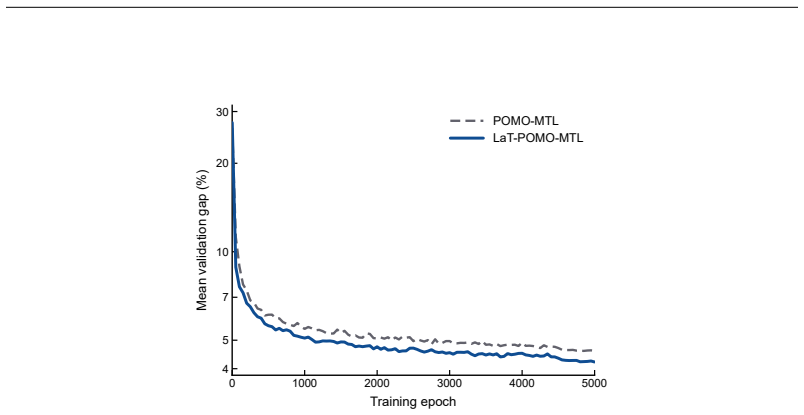
Summary. The paper proposes LLM-as-Trainer (LaT), a training-time wrapper for multi-task vehicle routing solvers. At regular intervals, LaT collects validation metrics over 16 VRP variants, feeds a structured summary of these metrics to a frozen LLM, and obtains a five-dimensional guidance vector, one entry per elementary constraint. This vector is concatenated with the task constraint vector and injected after every encoder layer via lightweight learned side branches. The LLM is removed at inference, leaving only the fixed final guidance vector and side-branch parameters. Experiments on six trained and ten unseen VRP variants, at sizes 50 and 100, report consistent but small gap reductions over several backbones (e.g., CaDA from 1.810% to 1.669% on trained variants; from 5.490% to 5.067% on unseen variants), with roughly 0.7% added training time and essentially no inference overhead. The central claim is that the LLM's stage-wise, validation-derived guidance is the cause of these improvements.
Significance. If the attribution claim is supported, LaT would be a practical and general training-side contribution: it uses a frozen LLM as a cheap external controller, avoids bi-level optimization, adds negligible training cost, and leaves inference unchanged. The paper's strengths include a large evaluation suite (16 variants, two sizes, multiple backbones), zero-shot and benchmark tests, a sensitivity analysis of the update interval, and explicit component ablations. The paper also honestly notes in Appendix C.2 that LLM textual explanations are not causal evidence. However, the key causal claim — that the LLM's specific outputs, rather than any validation-aware mechanism, drive the gains — is not yet established. The evidence is also statistically thin: all headline comparisons appear to come from single runs without variance estimates, while the reported improvements are often fractions of a percentage point.
major comments (4)
- [§4.3 and Appendix C.3] The central attribution claim is under-tested. The manuscript concludes that the improvement is 'attributable to the task-adaptive guidance generated by the LLM,' but the ablations in §4.3 only replace the guidance with a constant or remove the constraint vector. They do not vary the mapping from validation gaps to guidance. Appendix C.3 shows that the LLM's guidance values track mean per-constraint validation gaps with Spearman correlations of 0.718–0.872 (average 0.809), and the prompt in C.1 explicitly asks for 'conservative guidance values based on the current validation state.' This is consistent with the LLM implementing a simple monotone rule. A deterministic control, e.g., gamma_m = clip(c * mean_gap_m, 0.5, 2.0) or a rank-based rule using the same inputs, should be evaluated. Without such a comparison, the data support 'validation-aware conditioning helps' but not 'the LLM is th
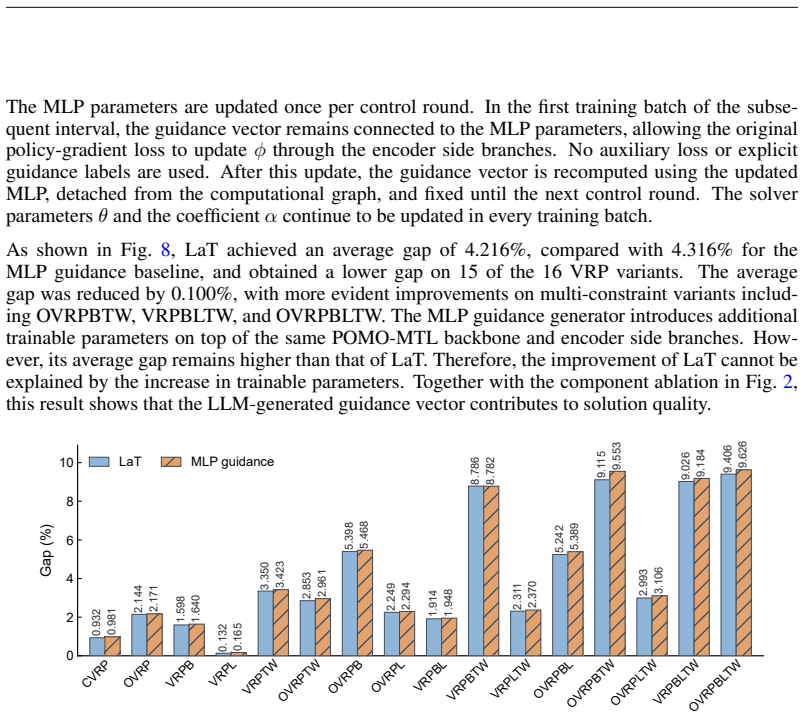
- [Appendix H.1, Eq. (34)] The only non-LLM adaptive baseline is a weak control. The MLP guidance generator receives a single gradient update per control round and is then detached for the rest of the interval, whereas the LLM is never trained and its output is used for the whole interval. The comparison is also a single run: 4.316% vs 4.216%, a 0.100 percentage-point difference with no repeated-seed or bootstrap variability. This is insufficient to conclude that the pretrained LLM outperforms 'some learnable mapping of the same state.' The MLP should be trained with the same effective number of updates (or tuned equivalently) and evaluated over multiple seeds before the claimed superiority of the LLM generator can be accepted.
- [Tables 1–2 and Fig. 8] No estimates of stochasticity are reported for any of the central results. Every table and ablation appears to report a single training run. The key improvements are small: 0.057–0.167 percentage points on trained variants, 0.088–0.423 on unseen variants, and 0.100 in the MLP comparison. With a single run and no error bars, these margins may be within training seed noise. At minimum, the authors should run three seeds for the main comparisons (LaT vs. backbone, at least for CaDA and ReLD) and report mean and standard deviation, or provide paired bootstrap intervals over test instances for the final models.
- [§4.3, fixed-guidance ablation] The fixed-guidance control is not described precisely enough to be a clean test of adaptivity. The text says the LLM-generated vector is replaced with '15' throughout training, which is outside the allowed guidance range [0.5, 2.0] described in Appendix C and is presumably a formatting artifact for '1.5' (or a constant vector of ones). A proper control should fix the guidance at the initial value gamma_0 = 1 (or at the final LLM value) rather than at an arbitrary constant, otherwise the comparison conflates 'adaptivity' with 'different constant value.' Please clarify and, if appropriate, rerun the fixed-guidance ablation with the intended constant.
minor comments (5)
- [Appendix C.1 / Eq. (10)] The notation gamma_0 = 1 in §4.1 is ambiguous: gamma_0 is a vector in R^5 but '1' is written as a scalar. Use gamma_0 = (1,1,1,1,1) or 1_5.
- [Appendix B.2, Eq. (18)] The same symbol mu_i is used both for the lower/upper bounds of the sampling interval and for the sampled window center. This is confusing; use different symbols, e.g., a_i, b_i for the bounds and mu_i for the center.
- [Fig. 2 / Fig. 8] The group bar charts would be easier to read if the LaT bar were visually distinguished by a separate color or hatch pattern in both figures, and if the average-gap values were included in the legend or a caption note.
- [§4.3] In the fixed-guidance ablation, if the intended value is 1.5, it would be helpful to state that this value is within the allowed range and to explain why 1.5 (rather than 1.0 or the final LLM vector) was chosen as the constant.
- [General] Several recent related works are cited in the related work section, but the description of LaT's novelty does not explicitly compare against validation-based loss weighting methods such as GradNorm in the experiments. A sentence explaining why these methods are not applicable or not compared would help position the contribution.
Circularity Check
No significant circularity: reported gains are measured on held-out test instances, and no equation reduces the claimed improvement to its input.
full rationale
LaT's derivation chain is empirical rather than formal, but nothing in it is circular by construction. The guidance vector is generated from cross-task validation metrics (Eq. 8–9), which is an input to training, yet all headline results are reported on disjoint test sets: the paper states 'All validation instances are generated before training and are disjoint from the training and test instances' (§3.2). The final guidance vector is fixed and the LLM removed, so test evaluation is not a restatement of the validation signal. The component ablations (§4.3) replace the LLM output with constants and vary the constraint vector, keeping architecture and parameter count fixed; the MLP control (Appendix H.1) is a weaker comparator, but a weak control is an experimental-validity concern, not circularity. The paper even acknowledges in C.2 that LLM explanations are 'not independent evidence of causality.' Self-citations (e.g., CCL, MVMoE, and the authors' earlier works) are used as baselines or background, not as load-bearing justifications for the main claim. Appendix C.3's Spearman correlation simply shows that the LLM uses the validation state as intended; a deterministic rule might match it, but the absence of that control does not make the reported held-out improvements equal to any fitted quantity. No equation in the paper reduces the claimed benefit to an input by definition, and external benchmarks (CVRPLIB Set-X, Set-Solomon) provide independent evidence. Therefore the paper receives a circularity score of 0.
Assumptions & free parameters
free parameters (7)
- Initial guidance γ0 =
1 for all five dimensions
- Stage-wise guidance trajectory γ_r =
Varies; C ∈ [0.7,1.0], O→2.0, B→2.0, TW→2.0, L∈[1.0,1.5] on POMO-MTL-50 (Fig. 3)
- Guidance response bounds [0.5, 2.0] =
0.5 and 2.0
- Guidance-update interval T_ctrl =
500 epochs
- Validation history length J =
5
- Side-branch coefficient α =
0.270–0.332 during training (Fig. 3b)
- Side-branch hidden width d_side =
not stated
assumptions (5)
- domain assumption Relative reference gap η_{r,k} (Eq. 7) measures how much training attention a task or constraint needs.
- domain assumption GLM-5.1 with temperature 0 returns stable, useful guidance and acts as a reproducible oracle.
- domain assumption Six training variants plus ten unseen combinations of {C,O,B,L,TW} faithfully cover the multi-task VRP setting.
- standard math POMO multi-start rollouts with the mean-return baseline form a valid policy-gradient estimator for all 16 variants.
- domain assumption Validation instances are disjoint from training and test instances and are fixed in advance.
invented entities (1)
-
Stage-wise guidance vector γ_r
Cite this review
Pith. "Pith review of LaT: LLM-as-Trainer for Multi-Task Vehicle Routing Solvers." pith.science (2026). https://pith.science/paper/DHSLNQVR
@misc{pith2026260717708,
  author       = {Pith},
  title        = {Pith review of: LaT: LLM-as-Trainer for Multi-Task Vehicle Routing Solvers},
  year         = {2026},
  howpublished = {\url{https://pith.science/paper/DHSLNQVR}},
  note         = {Machine review of arXiv:2607.17708}
}
read the original abstract
Multi-task neural solvers aim to handle multiple Vehicle Routing Problem (VRP) variants within a unified model, avoiding separate training for each constraint combination. However, VRP variants differ in optimization difficulty, while existing methods lack stage-wise feedback on their training status, making the model biased to some specific variants. Although meta-learning can support adaptive training, it typically requires bi-level optimization and additional gradient updates, increasing computational cost. To address this limitation, we propose LLM-as-Trainer (LaT), a plug-and-play training paradigm that uses a pretrained large language model as an external trainer. LaT periodically analyzes cross-task validation metrics to generate a stage-wise guidance vector. This vector is combined with the current task's constraint vector and injected into each encoder layer, providing the neural solver with additional training information during subsequent policy optimization. Experiments on 16 VRP variants show that LaT improves the solution quality of several state-of-the-art multi-task neural solvers on both trained and unseen variants, supporting the effectiveness and generality of the proposed training paradigm.
Figures
Figures from the paper (5 more)
Reference graph
Works this paper leans on
-
[1]
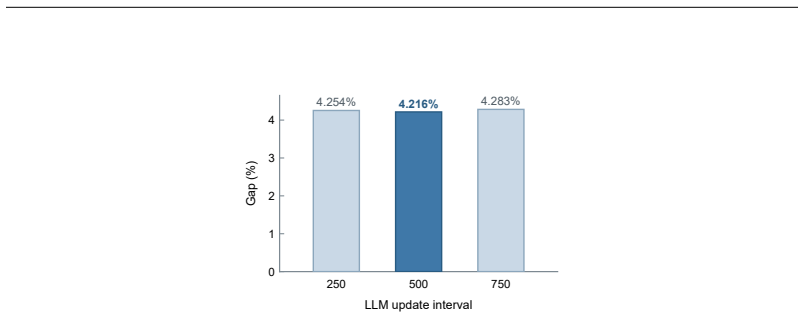
We evaluate intervals of250,500, and750epochs on 50-node multi-task VRPs using the same LaT-POMO-MTL backbone, training configuration, and evaluation protocol
E SENSITIVITY TO THEGUIDANCEUPDATEINTERVAL We examine the effect of the guidance-update interval, defined as the number of training epochs between two consecutive guidance updates. We evaluate intervals of250,500, and750epochs on 50-node multi-task VRPs using the same LaT-POMO-MTL backbone, training configuration, and evaluation protocol. For each setting...
2025
-
[4]
Xia Jiang, Yaoxin Wu, Yuan Wang, and Yingqian Zhang. Unco: Towards unifying neural combina- torial optimization through large language model.arXiv preprint arXiv:2408.12214,
-
[5]
Joshi, Thomas Laurent, and Xavier Bresson
Chaitanya K. Joshi, Thomas Laurent, and Xavier Bresson. An efficient graph convolutional network technique for the travelling salesman problem.arXiv preprint arXiv:1906.01227,
arXiv 1906
-
[7]
Multi-task learning for routing problem with cross-problem zero-shot generalization
Fei Liu, Xi Lin, Zhenkun Wang, Qingfu Zhang, Xialiang Tong, and Mingxuan Yuan. Multi-task learning for routing problem with cross-problem zero-shot generalization. InProceedings of the 30th ACM SIGKDD Conference on Knowledge Discovery and Data Mining, pp. 1898–1908,
1908
-
[11]
13 A RELATEDWORK Neural solvers for single-task VRPs.Early neural solvers usually formulate VRPs as sequential decision-making problems and construct a route autoregressively. Pointer Networks first demon- strated the potential of attention-based sequence models for combinatorial optimization (Vinyals et al., 2015), and subsequent reinforcement learning m...
2015
-
[13]
LaT retains the backbone operations described below and adds a lightweight side branch to the outputh ℓ i of each encoder layer
and POMO (Kwon et al., 2020). LaT retains the backbone operations described below and adds a lightweight side branch to the outputh ℓ i of each encoder layer. D.1 ENCODER Given a task with constraint vectorz k, the static feature of nodev i isf i = [x i, qi, ei, li], where features inactive for the current task are padded to zero. A linear projection prod...
2020
-
[100]
The best results are shown in bold
Blue rows denote our LaT variants. The best results are shown in bold. CVRP VRPTW OVRP VRPL Method Obj. Gap Time Obj. Gap Time Obj. Gap Time Obj. Gap Time HGS 15.504 0.000% 9.1m 24.339 0.000% 19.6m – – – – – –LKH3 15.590 0.556% 18.0m 24.721 1.584% 7.8m 9.828 0.000% 5.3m 15.771 0.000% 16.0mOR-Tools 16.381 5.652% 20.8m 25.894 6.297% 20.8m 10.010 1.806% 20.8...
-
[2018]
On first-order meta-learning algorithms.arXiv preprint arXiv:1803.02999,
Alex Nichol, Joshua Achiam, and John Schulman. On first-order meta-learning algorithms.arXiv preprint arXiv:1803.02999,
Show all 15 references
-
[2019]
Konstantakopoulos, Sotiris P
Grigorios D. Konstantakopoulos, Sotiris P. Gayialis, and Evripidis P. Kechagias. Vehicle routing problem and related algorithms for logistics distribution: A literature review and classification. Operational Research, 22(3):2033–2062,
-
[2021]
Large language models as optimizers
Chengrun Yang, Xuezhi Wang, Yifeng Lu, Hanxiao Liu, Quoc V Le, Denny Zhou, and Xinyun Chen. Large language models as optimizers. InInternational Conference on Learning Representations, volume 2024, pp. 12028–12068,
2024
-
[2022]
Neural large neighborhood search for the capacitated vehicle routing problem
Andr´e Hottung and Kevin Tierney. Neural large neighborhood search for the capacitated vehicle routing problem. InECAI 2020, pp. 443–450. IOS Press,
2020
-
[2024]
Aligning llms with graph neural solvers for combinatorial optimization.arXiv preprint arXiv:2603.27169,
Shaodi Feng, Zhuoyi Lin, Yaoxin Wu, Haiyan Yin, Yan Jin, Senthilnath Jayavelu, and Xun Xu. Aligning llms with graph neural solvers for combinatorial optimization.arXiv preprint arXiv:2603.27169,
-
[2025]
Falkner and Lars Schmidt-Thieme
Jonas K. Falkner and Lars Schmidt-Thieme. Learning to solve vehicle routing problems with time windows through joint attention.arXiv preprint arXiv:2006.09100,
2006 arXiv
-
[2026]
Unico: Towards a unified model for combinatorial optimization problems.arXiv preprint arXiv:2505.06290,
Zefang Zong, Xiaochen Wei, Guozhen Zhang, Chen Gao, Huandong Wang, and Yong Li. Unico: Towards a unified model for combinatorial optimization problems.arXiv preprint arXiv:2505.06290,
-
[4501]
Its variation should therefore not be interpreted as a decision made by the LLM
This coefficient is updated through gradient-based training of the neural solver and is only recorded at the LLM update epochs. Its variation should therefore not be interpreted as a decision made by the LLM. The textual explanations in the update records are also LLM-generate...
2001
Reviewed August 1, 2026 · model on record in the stance chip above.
Discussion (0). Sign in to comment.