REVIEW 5 major objections 5 minor 33 references
Mobile Network Control with a World Model
T0 review · 5 major / 5 minor · reviewed 2026-08-01 · deepseek-v4-flash
Pith's one-line read A world model trained on mobile-network KPIs can plan which cells to sleep and when, beating rule-based and reinforcement-learning controllers on the energy-versus-quality trade-off, and it can switch objectives without retraining.
desk verdict A genuinely useful multi-task world-model architecture for RAN cell-sleep control, but the headline Pareto-dominance claim is conditional on a simulator that omits the fast CSM wake-up the deployed system would rely on. read the letter →
The pith
A machine-rendered reading of the paper's core claim, the machinery that carries it, and where it could break.
The reading
What carries the argument
The key machinery is a multi-task ensemble world model with a transformer sequence backbone, separate embeddings for states and actions, and an activation mask that forces consistency between binary predictions (cell on/off) and semi-continuous predictions (utilization, throughput). The model is trained to predict next-hour KPIs autoregressively, with both deterministic and stochastic variants; stochastic ensembles capture aleatoric and epistemic uncertainty, which is propagated through planning. Control is performed by a receding-horizon cross-entropy method (CEM) that samples action sequences, simulates them through the world model, penalizes constraint violations, and selects the first ac
What would settle it
Deploy the controller on a live network with the CSM threshold mechanism as a safety net, run it for several weeks across a range of sectors, and compare realized sleep hours per day and throughput-violation rates against the simulated trade-off curves; a systematic shortfall in realized performance would falsify the transfer claim.
Extended reading notes
Core claim
The central claim is that a learned world model of radio network dynamics, combined with cross-entropy planning, produces cell sleep decisions that are strictly better on the energy-versus-quality trade-off than both rule-based thresholds and soft actor-critic reinforcement learning. The authors demonstrate this in closed-loop simulation: the WM-based controller achieves more sleep hours per day for the same or lower probability of throughput violation across different QoS constraint levels. They further show on live-network data that the multi-task world model remains sensitive to control actions — predicting zero utilization when a cell is turned off — whereas a standard regression model i
Load-bearing premise
The closed-loop results rest entirely on the proprietary simulator's sleep and throughput dynamics faithfully matching a real network; if the simulator is optimistic about how users offload or how quickly congestion appears after a cell is put to sleep, the Pareto-dominance result may not transfer to the field.
Editorial extensions
If this is right
- Cell sleep policies can be derived directly from historical network data, reducing reliance on hand-tuned thresholds and expert-defined rules.
- Operators can re-optimize for a different throughput constraint — for example, from 50 Mbit/s to 60 Mbit/s — by changing a single number in the planner, with no model retraining.
- The same world model and planning loop can be extended to other configuration parameters such as antenna tilt, transmit power, or other on/off features, since the action-space formulation is generic.
- Uncertainty quantification acts as a safety mechanism: stochastic and ensemble models trade some sleep hours for significantly fewer QoS violations, making the approach more field-viable for conservative operators.
- The reported sleep hours in open-loop live-data evaluation indicate that even a coarse, counterfactual deployment could yield multiple additional hours of cell sleep per day on low-utilization sectors.
Reading between the lines
- A testable step beyond this paper would be a staged field trial where the controller's 'off' actions are implemented as CSM thresholds (so the base station software can abort an unsafe action), measuring realized sleep hours and violation rates against the simulated Pareto frontier.
- The multi-task action-sensitivity design is likely transferable to any RAN control task with binary and semi-continuous observables — e.g., carrier aggregation configuration or beam management — since the core problem of features that switch regime with the action is generic.
- The open-loop evaluation's offload assumption — that all sleeping-cell utilization moves to the coverage cell — biases the congestion estimate upward; real deployments with neighbor offload would likely show even more sleep headroom than the paper's conservative numbers indicate.
- Because the deterministic regression model was nearly action-insensitive on real data, the paper's conclusion suggests that pure point-prediction approaches to network control may quietly learn to ignore the controller's decisions — a warning that future work should verify action sensitivity, not just prediction error.
Editorial analysis
A structured set of objections, weighed in public.
Referee Report
Summary. The paper proposes a world-model-based controller for RAN cell-sleep control. The world model is a transformer sequence model with separate embeddings for states and actions, multi-task heads for continuous, binary, and semi-continuous KPIs, and ensemble-based uncertainty. Planning is performed by CEM over discrete on/off actions. The method is evaluated in a proprietary calibrated simulator against a threshold baseline and SAC, with deterministic/stochastic ensemble variants, and on live network data via prediction accuracy and counterfactual action analysis. The central claims are that the WM-based controller Pareto-dominates the baselines in closed-loop simulation and shows strong potential in open-loop live-data emulation.
Significance. If the closed-loop result transfers to real networks, the contribution is practically significant: it decouples model learning from the control objective, allows constraint changes without retraining, and addresses a real issue in tabular RAN data—regression models that are insensitive to discrete control inputs. The multi-task architecture with explicit binary/semi-continuous masking and the counterfactual evaluation on live data are useful steps. The paper also provides training details, hyperparameters, and CEM pseudocode, which support reproducibility, though no code or dataset is released. However, the headline claims rest on simulator fidelity and on several acknowledged but unvalidated assumptions, so the current evidence supports a conditional rather than unconditional conclusion.
major comments (5)
- [V-A vs. III] Section V-A states that the simulator does not model high-frequency CSM wake-ups and instead forces a cell to remain off for the full hour, measuring eventual violations. Section III, however, describes the deployment mechanism as CSM thresholds that can wake a cell quickly when the coverage cell becomes congested. An 'off' action in the simulator is therefore a hard, hour-long shutdown, not the threshold change the controller would actually send. This can inflate sleep hours and count violations that a real CSM would avoid. The Pareto-dominance claim in Fig. 3 is a property of this modified semantics. Please model the wake-up mechanism or explicitly reframe the results as an upper-bound/hard-off scenario.
- [V-A] The simulator is calibrated to live data only through marginal PRB utilization distributions: a traffic-scaling factor matches the simulated PRB distribution to the real one, and hotzones are generated from a Weibull fit. The closed-loop result requires the simulator's dynamic response to a sleep action—user offloading to L18, throughput degradation, congestion onset—to be realistic. No validation of these transition dynamics against live measurements is shown. Without such validation, transfer of the Fig. 3 trade-off to real deployments is unsupported. Please add a validation of action-response dynamics, or soften the claims to be explicitly conditional on simulator fidelity.
- [V-C, Fig. 3] The closed-loop comparison uses only 10 evaluation episodes and Fig. 3 shows single point estimates with no error bars, confidence intervals, or significance tests. With 10 stochastic scenarios, the apparent Pareto dominance can be driven by a few episodes; the large standard deviations in Table II for the same algorithm family underline this risk. Please report per-method distributions or confidence intervals over episodes and provide pairwise comparisons or effect sizes for the headline CEM-vs-SAC and CEM-vs-baseline results.
- [Eq. (7), Algorithm 1, V-C] The chance constraint in Eq. (7) is stated as P(g(x,u)>0)<δ, but no value of δ is reported and the planner in Algorithm 1 does not enforce it: it minimizes a Lagrangian/penalty objective with CP only. Section V-C states CP=10. The formal safety knob δ is therefore not what is being controlled, and the reported violation probabilities cannot be checked against any specified tolerance. Either report δ and its treatment in the planner, or replace Eq. (7) with the penalty formulation actually solved, and justify the choice of CP.
- [VI-B, Table II] The open-loop live-data performance estimate assumes every recommended 'off' action causes exactly one hour of sleep and that all utilization of the sleeping cell transfers to the L18 coverage cell. Both assumptions are acknowledged, but they drive the sleep-hour and violation-fraction numbers in Table II. The first may overestimate savings, while the second may overestimate congestion; the table is therefore not a performance estimate but a counterfactual scenario. Please present it as such, ideally with a sensitivity range over alternative offload assumptions and wake-up behavior.
minor comments (5)
- [Abstract] The abstract contains an incomplete phrase: 'live network data from,' with the source missing.
- [Conclusion] Typo: 'metworks' should be 'networks'.
- [Fig. 3] The legend/caption should clarify the mapping of plotted points to 'CEM Deterministic', 'CEM Deterministic Ensemble', and 'CEM Stochastic Ensemble'—the current labels are ambiguous, especially for the non-ensemble deterministic variant.
- [Eq. (4)] The summation limits in the loss function (T+H over t=1) do not match the auto-regressive prediction range described in Section IV-A and the appendix; please align the notation.
- [V-C, Table II] 'Probability of constraint violation' and 'Fraction with Util.≥60%' are defined only loosely. Please specify the denominator (per episode-step? per sector? per hour) so the numbers are interpretable.
Circularity Check
Central closed-loop Pareto claim is independently evaluated, but the live-data 'action sensitivity' evidence for the multi-task world model is guaranteed by the model's activation mask, making that supporting claim self-definitional.
-
self definitional
[Section IV-B (Eq. 4, activation mask) and Section VI-A (Fig. 6, counterfactual action)]
"We then encourage the model to learn the dependency between binary and semi-continuous features by applying an activation mask on the semi-continuous prediction based on the binary prediction. ... The multi-task WM is able to correctly predict that given the “off” action, the utilization of the capacity carrier would go to zero."
The multi-task architecture explicitly gates the semi-continuous utilization output by the binary sleep-state prediction, so a predicted 'off' action forces the utilization prediction to zero by construction. The live-data demonstration that the multi-task WM predicts zero utilization under an 'off' action is therefore a property of the architectural mask, not an empirically learned sensitivity. The regression WM, which lacks this mask, is not an equivalent comparator; the contrast shows the imposed constraint rather than a learned difference in action sensitivity. Since the paper's first contribution claims 'improved action sensitivity' and cites this counterfactual experiment as evidence, that supporting claim is partly self-definitional.
full rationale
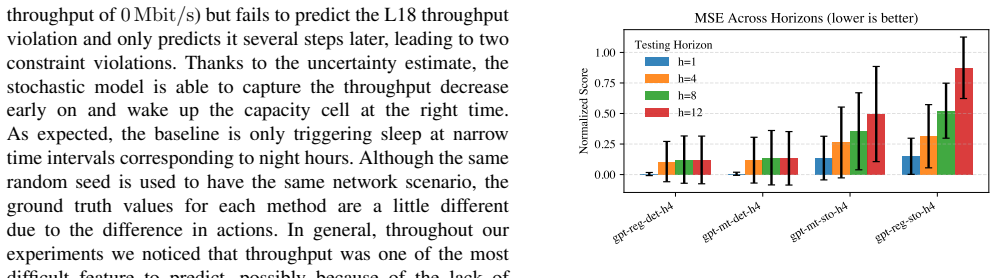
The paper's headline closed-loop result—Pareto dominance over rule-based baseline and SAC—is evaluated against simulator ground truth, not against the world model's own predictions. Both the WM and the RL baseline are trained in the same simulator, and the evaluation metric (sleep hours, measured throughput violations) is external to the WM. That part of the derivation is not circular. The open-loop live-data analysis is explicitly counterfactual: it uses historical data plus an acknowledged worst-case offload assumption to estimate violations, and the paper states that actual consequences cannot be measured. That is a limitation, not a circular reduction. However, the paper's first contribution—improved action sensitivity from multi-task modeling—is supported by a live-data demonstration in which the multi-task model's 'prediction' of zero utilization under an 'off' action is enforced by the activation mask described in Section IV-B. The comparison with a regression model that lacks this mask therefore shows the architectural constraint, not a learned or validated sensitivity. This is a real, but partial, circularity: it affects a supporting contribution, while the central closed-loop control claim retains independent empirical content.
Assumptions & free parameters
free parameters (5)
- Multi-task loss weights λ_c, λ_b, λ_s =
not reported
- Constraint tolerance δ and penalty CP =
CP=10 for CEM; δ not specified
- Throughput/utilization constraint thresholds =
50/60 Mbps in simulation; 60% utilization in live open-loop
- CEM hyperparameters =
L=4 iterations, N=100 samples, top 20%, P=40 particles
- Traffic hotzone Weibull parameters and PRB scaling factor =
fit to live data
assumptions (5)
- domain assumption The binary on/off abstraction is a faithful representation of CSM threshold control.
- domain assumption The learned world model generalizes to planned action sequences and traffic conditions beyond the random-action training data.
- domain assumption The proprietary simulator accurately reproduces real network behavior.
- domain assumption Uncertainty estimated from ensemble disagreement and/or stochastic output captures the risk of constraint violations.
- domain assumption Offloading all sleeping cell utilization to the L18 coverage cell is a meaningful worst-case proxy for constraint violations.
Cite this review
Pith. "Pith review of Mobile Network Control with a World Model." pith.science (2026). https://pith.science/paper/46TZ3IMY
@misc{pith2026260717747,
  author       = {Pith},
  title        = {Pith review of: Mobile Network Control with a World Model},
  year         = {2026},
  howpublished = {\url{https://pith.science/paper/46TZ3IMY}},
  note         = {Machine review of arXiv:2607.17747}
}
read the original abstract
The increasing complexity of mobile networks necessitates intelligent and dynamic control strategies for efficient, energy-conserving management. We propose a world model-based approach for network control that enables adaptive configuration of crucial parameters. The world model is trained from historical data and predicts the impact of its actions on future network states. Our controller leverages the model's uncertainty estimate to robustly find optimal network configuration changes. Furthermore, the optimization objective can be changed dynamically without model retraining. We demonstrate the effectiveness of the approach in simulated closed-loop control of a mobile network energy-saving feature. Our results show improved performance in balancing energy savings with quality of service, compared to traditional methods and reinforcement learning approaches. Finally, we show the world model performance on real network data from, and evaluate counterfactual actions proposed by the controller under various throughput constraints.
Figures


Figures from the paper (6 more)


Reference graph
Works this paper leans on
-
[1]
A survey on sleep mode techniques for ultra-dense networks in 5g and beyond,
F. Salahdine, J. Opadere, Q. Liu, T. Han, N. Zhang, and S. Wu, “A survey on sleep mode techniques for ultra-dense networks in 5g and beyond,”Computer Networks, vol. 201, p. 108 567, 2021,ISSN: 1389- 1286
2021
-
[2]
Multi-agent reinforcement learning with common policy for antenna tilt optimization,
A. Mendo, J. Outes-Carnero, Y . Ng-Molina, and J. Ramiro-Moreno, “Multi-agent reinforcement learning with common policy for antenna tilt optimization,”IAENG International Journal of Computer Science, 2023
2023
-
[3]
Drag: Deep reinforcement learning based base station activation in heterogeneous networks,
J. Ye and Y .-J. A. Zhang, “Drag: Deep reinforcement learning based base station activation in heterogeneous networks,”IEEE Transactions on Mobile Computing, vol. 19, no. 9, pp. 2076–2087, 2019
-
[4]
Telenor: Autonomous AI agent with Ericsson,
“Telenor: Autonomous AI agent with Ericsson,”GSMA use case library, 2025
2025
-
[5]
Deep rein- forcement learning for cell on/off energy saving on wireless networks,
J. S. Pujol-Roigl, S. Wu, Y . Wang, M. Choi, and I. Park, “Deep rein- forcement learning for cell on/off energy saving on wireless networks,” in2021 IEEE Global Communications Conference (GLOBECOM), 2021
2021
-
[6]
Deep rein- forcement learning in a handful of trials using probabilistic dynamics models,
K. Chua, R. Calandra, R. McAllister, and S. Levine, “Deep rein- forcement learning in a handful of trials using probabilistic dynamics models,”Advances in neural information processing systems, vol. 31, 2018
2018
-
[7]
Mastering diverse domains through world models,
D. Hafner, J. Pasukonis, J. Ba, and T. Lillicrap, “Mastering diverse domains through world models,”arXiv preprint arXiv:2301.04104, 2023
arXiv 2023
-
[8]
A survey on 5g radio access network energy efficiency: Massive mimo, lean carrier design, sleep modes, and machine learning,
D. L ´opez-P´erez et al., “A survey on 5g radio access network energy efficiency: Massive mimo, lean carrier design, sleep modes, and machine learning,”IEEE Communications Surveys & Tutorials, vol. 24, no. 1, pp. 653–697, 2022
2022
Show all 33 references
-
[9]
Traffic-aware advanced sleep modes management in 5g networks,
F. E. Salem, T. Chahed, Z. Altman, and A. Gati, “Traffic-aware advanced sleep modes management in 5g networks,” in2019 IEEE Wireless Communications and Networking Conference (WCNC), 2019
2019
-
[10]
Downlink power control in dense 5g radio access networks through deep reinforcement learning,
S. Saeidian, S. Tayamon, and E. Ghadimi, “Downlink power control in dense 5g radio access networks through deep reinforcement learning,” inICC 2020-2020 IEEE International Conference on Communications (ICC), 2020
2020
-
[11]
Energy saving in 6g o-ran using dqn-based xapp,
Q. Wang, S. Chetty, A. Al-Tahmeesschi, X. Liang, Y . Chu, and H. Ahmadi, “Energy saving in 6g o-ran using dqn-based xapp,” in2024 IEEE 29th International Workshop on Computer Aided Modeling and Design of Communication Links and Networks (CAMAD), 2024
2024
-
[12]
Energy efficient sleep mode strategies for communication and computing devices in cellular networks with edge computing,
J. Gui and X. Zhang, “Energy efficient sleep mode strategies for communication and computing devices in cellular networks with edge computing,”Ad Hoc Networks, vol. 179, p. 104 027, 2025,ISSN: 1570- 8705
2025
-
[13]
Energy optimization with multi-sleeping control in 5g heterogeneous networks using reinforcement learning,
A. El Amine, J.-P. Chaiban, H. A. H. Hassan, P. Dini, L. Nuaymi, and R. Achkar, “Energy optimization with multi-sleeping control in 5g heterogeneous networks using reinforcement learning,”IEEE Transactions on Network and Service Management, vol. 19, no. 4, pp. 4310–4322, 2022
2022
-
[14]
An efficient energy saving scheme using reinforcement learning for 5g and beyond in h-cran,
H. Fourati, R. Maaloul, N. Trabelsi, L. Chaari, and M. Jmaiel, “An efficient energy saving scheme using reinforcement learning for 5g and beyond in h-cran,”Ad Hoc Networks, vol. 155, p. 103 406, 2024,ISSN: 1570-8705
2024
-
[15]
Design and evaluation of deep reinforcement learning for energy saving in open ran,
M. Bordin et al., “Design and evaluation of deep reinforcement learning for energy saving in open ran,” in2025 IEEE 22nd Consumer Communications and Networking Conference (CCNC), 2025
2025
-
[16]
Model-based reinforcement learning for energy efficiency optimization in small-cell networks,
T. Pan and X. Wu, “Model-based reinforcement learning for energy efficiency optimization in small-cell networks,” in2025 IEEE Wireless Communications and Networking Conference (WCNC), 2025
2025
-
[17]
Data-driven cell zooming for large-scale mobile networks,
H. Jiang et al., “Data-driven cell zooming for large-scale mobile networks,”IEEE Transactions on Network and Service Management, vol. 15, no. 1, pp. 156–168, 2018
2018
-
[18]
A coalitional model predictive control approach for heterogeneous cellular networks,
E. Masero, L. A. Fletscher, and J. M. Maestre, “A coalitional model predictive control approach for heterogeneous cellular networks,” in 2020 European Control Conference (ECC), 2020
2020
-
[19]
Application-level service assurance with 5g ran slicing,
A. Balasingam, M. Kotaru, and P. Bahl, “Application-level service assurance with 5g ran slicing,” inProceedings of the 21st USENIX Symposium on Networked Systems Design and Implementation, 2024, ISBN: 978-1-939133-39-7
2024
-
[20]
Greener ran operation through machine learning,
G. Vallero, D. Renga, M. Meo, and M. A. Marsan, “Greener ran operation through machine learning,”IEEE Transactions on Network and Service Management, vol. 16, no. 3, pp. 896–908, 2019
2019
-
[21]
A ml-based resource allocation scheme for energy optimization in 5g nr,
X. Yao and A. P ´erez Yuste, “A ml-based resource allocation scheme for energy optimization in 5g nr,”Sensors, vol. 25, no. 16, 2025,ISSN: 1424-8220
2025
-
[22]
World models,
D. Ha and J. Schmidhuber, “World models,”arXiv preprint arXiv:1803.10122, vol. 2, no. 3, 2018
2018 arXiv
-
[23]
Td-mpc2: Scalable, robust world models for continuous control,
N. Hansen, H. Su, and X. Wang, “Td-mpc2: Scalable, robust world models for continuous control,”arXiv preprint arXiv:2310.16828, 2023
2023 arXiv
-
[24]
Potential solutions for energy saving for E-UTRAN,
3rd Generation Partnership Project (3GPP), “Potential solutions for energy saving for E-UTRAN,” 3GPP, Technical Report TR 36.927, 2025, Version 19.0.0
2025
-
[25]
An axiomatic assessment of entropy-and variance-based uncertainty quantification in regression,
C. B ¨ulte, Y . Sale, T. L¨ohr, P. Hofman, G. Kutyniok, and E. H¨ullermeier, “An axiomatic assessment of entropy-and variance-based uncertainty quantification in regression,”arXiv preprint arXiv:2504.18433, 2025
2025 arXiv
-
[26]
Receding horizon control,
J. Mattingley, Y . Wang, and S. Boyd, “Receding horizon control,”IEEE Control Systems Magazine, vol. 31, no. 3, pp. 52–65, 2011
2011
-
[27]
M. J. Kochenderfer and T. A. Wheeler,Algorithms for Optimization. MIT Press, 2019
2019
-
[28]
A set of propagation models for site-specific predictions,
H. Asplund, M. Johansson, M. Lundevall, and N. Jald ´en, “A set of propagation models for site-specific predictions,” in12th European Conference on Antennas and Propagation (EuCAP 2018), 2018
2018
-
[29]
Spatial modeling of the traffic density in cellular networks,
D. Lee, S. Zhou, X. Zhong, Z. Niu, X. Zhou, and H. Zhang, “Spatial modeling of the traffic density in cellular networks,”IEEE Wireless Communications, vol. 21, no. 1, pp. 80–88, 2014
2014
-
[30]
Soft actor-critic: Off- policy maximum entropy deep reinforcement learning with a stochastic actor,
T. Haarnoja, A. Zhou, P. Abbeel, and S. Levine, “Soft actor-critic: Off- policy maximum entropy deep reinforcement learning with a stochastic actor,” inProceedings of the 35th International Conference on Machine Learning, ICML 2018, Stockholmsm ¨assan, Stockholm, Sweden, July ...
2018
-
[31]
A learning algorithm for continually running fully recurrent neural networks,
R. J. Williams and D. Zipser, “A learning algorithm for continually running fully recurrent neural networks,”Neural Computation, vol. 1, no. 2, pp. 270–280, Jun. 1989,ISSN: 0899-7667. eprint: https://direct. mit.edu/neco/article-pdf/1/2/270/811849/neco.1989.1.2.270.pdf
1989
-
[32]
Reversible instance normalization for accurate time-series forecasting against distribution shift,
T. Kim, J. Kim, Y . Tae, C. Park, J. Choi, and J. Choo, “Reversible instance normalization for accurate time-series forecasting against distribution shift,” inInternational Conference on Learning Represen- tations, 2022
2022
-
[33]
J. L. Ba, J. R. Kiros, and G. E. Hinton,Layer normalization, 2016. arXiv: 1607.06450[stat.ML]. APPENDIX In this appendix, we provide further training details on the world model for reproducibility and an extra evaluation of the model ablations. Furthermore, we describe how CEM...
2016 arXiv
Reviewed August 1, 2026 · model on record in the stance chip above.
Discussion (0). Continue with ORCID to comment.