REVIEW 4 major objections 5 minor 16 references
PGN: Design and Implementation of a Vision-Language Navigation System Based on Pangu Multimodal Foundation Model
T0 review · 4 major / 5 minor · reviewed 2026-08-15 · deepseek-v4-flash
Pith's one-line read An offline vision-language navigation system matches 62.29% of expert actions on held-out trajectories, measured as teacher-forced action alignment rather than closed-loop navigation success.
desk verdict An honest, clearly scoped engineering report on adapting OpenPangu-7B to offline VLN action matching, whose headline NAM number is plausible but not independently checkable as written because the extraction rule and baseline are missing. read the letter →
The pith
A machine-rendered reading of the paper's core claim, the machinery that carries it, and where it could break.
The reading
What carries the argument
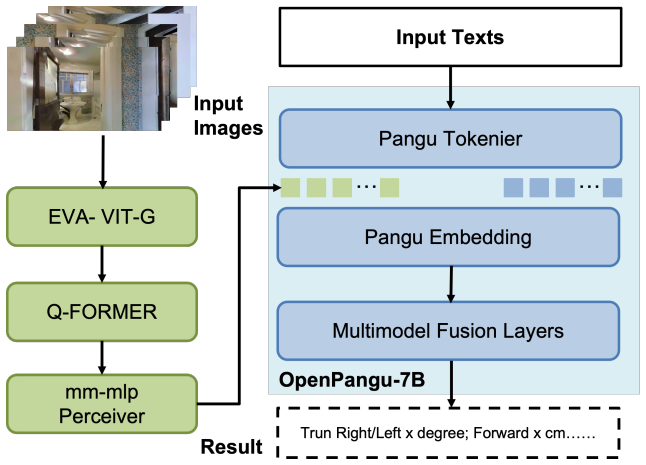
The load-bearing mechanism is a two-stage training scheme that separates visual-language alignment from navigation-task adaptation. In Stage 1, 32 learnable Q-Former queries compress each vision-transformer patch representation into a fixed 768-dimensional vector, which a two-layer MLP projects into the language model's embedding space. In Stage 2, five chronologically ordered observations are packed into one autoregressive context using learned image-start, image-end, and frame-boundary tokens, and the model outputs reasoning text followed by a canonical action from $\mathcal{A}=\{\text{forward},\text{left},\text{right},\text{stop}\}$. The factorization $P(r_t,a_t\mid I,O_t)=P(r_t\mid I,O_t)\,P(a_t\mid r_t,I,O_t)$ fixes the output format, while epoch-dependent starting offsets and an action-aware sampler vary the temporal windows and rebalance forward-dominated action selection. Only the structural-token embeddings and LoRA adapters are updated in Stage 2, keeping the aligned visual pathway and language backbone frozen.
What would settle it
Re-run the V9 model on the same 500 trajectories with the extraction rule made explicit and compare Normalized Action Match against an always-forward baseline and against a random-action baseline; if the gap shrinks to near zero, the claimed alignment is not instruction-following. Alternatively, execute V9's predicted actions in a Habitat environment and measure success rate and SPL, since the paper itself identifies closed-loop evaluation as the test its offline numbers cannot replace.
Extended reading notes
Core claim
The central claim is that PGN, built on a frozen 7B language backbone with a frozen vision encoder, can learn to reproduce expert navigation actions in an offline setting. After Stage 1 trains the Q-Former and MLP projector on image-caption pairs, Stage 2 freezes the visual pathway and trains only three structural-token embeddings and LoRA adapters on expert trajectories. V9 then reports Normalized Action Match of 62.29% and Non-empty Rate of 100.00% across 500 held-out trajectories under teacher forcing, with the per-trajectory distribution concentrated in the 50–80% action-match range. The paper explicitly frames this as evidence for feasible expert-action alignment, not as a closed-loop navigation result; success rate, SPL, navigation error, and error-recovery behavior are explicitly deferred.
Load-bearing premise
The load-bearing premise is that the reported 62.29% Normalized Action Match score reflects genuine action following; the paper never defines how an action is extracted from the model's response or how forward, left, right, and stop expressions are normalized, so the score could be an artifact of extraction rules or of a forward-dominated action distribution.
Editorial extensions
If this is right
- If the teacher-forced numbers hold, a 7B-scale multimodal language model can be adapted to a four-action navigation space with only LoRA and a handful of embeddings, which sharply lowers the cost of exploring vision-language navigation with large backbones.
- The reasoning-then-action format yields zero exact-string match in V8 and V9 because the action is embedded in longer text, so evaluation must use action extraction, and any comparison across model versions must account for output-format changes.
- The per-trajectory shift from the 10–30% action-match band in V5 and V6 to the 50–80% band in V8 and V9 suggests that the combined recipe of identity prompting, temporal sampling, action-aware sampling, and reasoning output drives improvement, though the paper states these components were not ablated separately.
- A 100% Non-empty Rate means every teacher-forced step produced a response, but it says nothing about whether the chosen action is correct; the 62.29% Normalized Action Match is the only content-bearing alignment number.
- Closed-loop evaluation remains the deciding test: the paper's protocol measures local agreement under expert histories, not the ability to recover after mistakes, so success rate and SPL cannot be inferred from Normalized Action Match alone.
Reading between the lines
- A cheap audit would be to compare Normalized Action Match against an always-forward baseline on the same 500 trajectories; because the data are forward-dominated, a high baseline would reveal how much of 62.29% is genuine instruction-following rather than action-distribution bias.
- The sharp Non-empty Rate jump from 33.98% in V5 to 99.17% in V6 while Normalized Action Match stayed roughly flat suggests the model first learned to emit a non-empty action and only later learned to choose it correctly; inspecting retained V6 samples would test this.
- The reported numbers come from one training run with several changes introduced together, so an ablation varying reasoning-then-action output, temporal sampling, action-aware sampling, and identity prompting would identify which component carries the improvement.
- If a closed-loop test later shows low navigation success, the offline alignment could still be useful as an action-prior that narrows the action space for a planner or as a cheap filter before expensive simulation evaluation.
Signed reviews
Editorial analysis
A structured set of objections, weighed in public.
Referee Report
Summary. The paper presents PGN, an offline Vision-Language Navigation action-prediction system built on the OpenPangu-7B multimodal language model. Training proceeds in two stages: first a visual-language alignment stage using a frozen EVA-ViT-G/14 encoder, a Q-Former, and a two-layer MLP projector; then a navigation-adaptation stage on expert trajectories using five-observation windows, epoch-dependent temporal sampling, and LoRA adapters, with all visual and language backbones frozen. The evaluation is teacher-forced and open-loop: on 500 held-out expert trajectories, the V9 iteration reports a Normalized Action Match (NAM) of 62.29% and a Non-empty Rate (NER) of 100.00%. The authors are explicit that these numbers measure offline expert-action alignment and do not constitute closed-loop navigation success, path efficiency, or goal completion. The paper also documents a development history across versions V3 through V9, including raw trajectory-level distributions, and explicitly acknowledges that per-action logs were retained only for V6.
Significance. If the reported evaluation were fully specified and independently reproducible, the paper would provide a useful engineering recipe for adapting a 7B-scale multimodal foundation model to offline VLN action prediction on Ascend NPUs. The authors deserve credit for several strengths: they transparently separate offline teacher-forced alignment from closed-loop navigation success; they report raw per-trajectory counts rather than only aggregate numbers; they retain and reproduce V6 per-action predictions; and they explicitly decline to claim causal attribution for individual design components. The feasibility claim—that OpenPangu-7B can be adapted to produce non-empty actions that align with expert actions on a held-out trajectory split—is modest and largely consistent with the reported NER=100.00%. However, the central metric NAM is underspecified and uncalibrated, which currently prevents an independent reader from verifying whether 62.29% reflects genuine instruction-following. Because the paper is framed as a technical report whose main conclusion rests on this number, closing that gap is necessary before the result can be accepted as a reliable evidence point.
major comments (4)
- [Section 5.1, NAM definition] The definition of Normalized Action Match is not operational. The text says only that "an action is extracted from the response after normalizing forward, left, right, and stop expressions," but it does not specify the extraction grammar, the handling of reasoning text that precedes the action, the treatment of multi-action or ambiguous responses, or the exact normalization rules (e.g., case, synonyms, punctuation). Since V8 and V9 have EM=0.00%, NAM is entirely determined by this unspecified parser. Without a precise parser specification, example inputs and outputs, or released parsing code, the headline 62.29% cannot be verified or falsified. Please provide the full extraction and normalization procedure, including at least three worked examples from V9 responses, and state how the parser behaves when no canonical action is present in the response.
- [Section 5.2 and Section 4.3, baselines] No baseline calibrates the NAM numbers. The action space has only four symbols, and Section 4.3 itself states that action-aware sampling was introduced because of a "forward-dominated selection," indicating strong class imbalance. Under such imbalance, a trivial policy that always predicts the modal action can achieve nontrivial action-match accuracy. Please report on the same 500 held-out trajectories the NAM of (a) always predicting the majority action, (b) a uniform random policy over the four actions, and (c) an instruction-blind policy that always predicts an action based only on the observation window. Also report the per-class distribution of expert actions in the held-out split. This baseline is necessary to interpret whether 62.29% exceeds what can be achieved without language understanding.
- [Section 5.1, validation split construction] The paper does not describe how the 500 held-out trajectories were selected from the 19,699 collected trajectories. Was the split random, stratified by environment, or stratified by instruction length or trajectory length? Are the held-out trajectories drawn from the same environments as the training trajectories, and is there any risk of near-duplicate instructions across the split? Without this information, the generality of the 62.29% figure is unclear, and the possibility of accidental distribution shift between training and held-out sets cannot be assessed. Please specify the exact split procedure and report environment-level overlap statistics.
- [Table 1, V3 row] The V3 row reports action-level percentages but its per-trajectory interval counts sum to 56 rather than 500. The paper acknowledges this in a footnote but does not state the denominator used for V3's Strict, Fuzzy, and Non-blank percentages. If those percentages are computed over a different subset, V3 should be excluded from the version comparison entirely, or its true denominator should be given. As written, the reader cannot determine whether V3's 8.40% is computed over 56 trajectories or over a different set, which undermines its use as a development baseline. Please clarify the V3 denominator and, if necessary, remove V3 from the discussion of version-level trends.
minor comments (5)
- [Section 4.2] The phrase "DAgger-compatible simulation pipeline" is misleading because the recorded configuration fixes beta=1, which makes the procedure expert-only data collection followed by supervised behavior cloning. Suggest renaming this subsection to "Expert Trajectory Collection" and describing the data collection as behavior cloning rather than DAgger.
- [Figure 4 caption and Section 5.1] The sentence "Figure 4 retains the evaluation flow from the prior manuscript" is a leftover from a previous version and should be removed; the figure should be described on its own terms. Similarly, the phrase "Although the Habitat simulator is shown as the source of the recorded trajectory" is confusing because the data collection section does not mention Habitat; please state whether Habitat was used to generate the trajectories or remove the reference.
- [References] Reference [3] is listed as "Pangu Embedded: An Efficient Dual-system LLM Reasoner with Metacognition," but the paper uses "OpenPangu-7B" as the backbone. Please clarify whether this is the correct source for OpenPangu-7B or provide the correct citation, since the current reference appears unrelated to the model name used in the abstract.
- [Section 5.2] The sentence "Their EM is zero because these versions generate reasoning text before the action" is a reasonable explanation, but since EM is defined as whole-response exact match, reporting EM for V8/V9 alongside versions that emit only an action phrase may mislead readers. Consider reporting EM only for versions where the output format is a single action string, or explicitly restating that EM is reported for completeness and is not comparable across formats.
- [Throughout] There are inconsistent spellings of the vision encoder name: "EV A-ViT-G/14" appears in several places and "EVA-ViT-G/14" in others. Please standardize. Also, "LLaV A" in Section 2 should be "LLaVA."
Circularity Check
No significant circularity: the headline NAM is a held-out imitation metric, and the unspecified extraction rules are a reproducibility gap, not a reduction to inputs.
full rationale
The paper's central derivation is a supervised training pipeline evaluated on a held-out split, and no load-bearing step reduces to its own inputs. PGN is trained on expert trajectories and evaluated on 500 held-out expert trajectories under teacher forcing, which is standard supervised behavior-cloning evaluation rather than fitting a parameter to the test set and then predicting it. The paper explicitly limits its claims to offline expert-action alignment: Section 5.1 states the protocol 'measures teacher-forced local action agreement without closed-loop error accumulation,' and Section 5.3 states the numbers 'are not Success Rate, SPL, navigation error, or nDTW.' There is no fitted parameter renamed as a prediction, no invocation of a self-authored uniqueness theorem, and no ansatz smuggled in via citation. The main concerns raised in the skeptical reading are about verifiability, not circularity: NAM's action-extraction rules are not specified in Section 5.1, no majority-action baseline is reported, and per-step logs for V8/V9 were not retained (Section 5.3). These are transparency and reproducibility gaps—a reader cannot independently reconstruct the 62.29% figure from the manuscript—but they do not make the derivation equivalent to its inputs by construction. The evaluation split is genuinely held out from training, and the reported metric is honestly described as an offline imitation score. The absence of an external closed-loop benchmark weakens the practical significance of the result, but that is a correctness or scope limitation, not circularity. Accordingly, the circularity score is 0.
Assumptions & free parameters
free parameters (2)
- Temporal sampling curriculum phases (s, p) =
(4,0.1), (6,0.6), (8,0.2) across three phases
- Five-observation window length and evaluation stride =
window length 5, evaluation stride s=1
assumptions (4)
- domain assumption OpenPangu-7B serves as a capable language backbone for navigation instruction following.
- domain assumption The self-collected expert trajectories are correct, representative, and free of label errors.
- domain assumption Normalized Action Match (NAM) is a meaningful proxy for action alignment under teacher forcing.
- domain assumption The teacher-forced, open-loop protocol is a useful intermediate stage before closed-loop evaluation.
Cite this review
Pith. "Pith review of PGN: Design and Implementation of a Vision-Language Navigation System Based on Pangu Multimodal Foundation Model." pith.science (2026). https://pith.science/paper/7HNYAUZ7
@misc{pith2026260717806,
  author       = {Pith},
  title        = {Pith review of: PGN: Design and Implementation of a Vision-Language Navigation System Based on Pangu Multimodal Foundation Model},
  year         = {2026},
  howpublished = {\url{https://pith.science/paper/7HNYAUZ7}},
  note         = {Machine review of arXiv:2607.17806}
}
read the original abstract
Vision-Language Navigation (VLN) requires an embodied agent to interpret a natural-language instruction and predict actions from temporally ordered visual observations. Adapting a multimodal large language model to VLN requires visual-language alignment, compact temporal inputs, action-space grounding, and stable training on the target hardware. This technical report presents PGN (Pangu Navigator), an offline VLN action-prediction system built on OpenPangu-7B. Training proceeds in two stages. First, PGMM aligns a frozen EVA-ViT-G/14 vision encoder with the frozen language backbone by training a Q-Former and a two-layer MLP projector. Second, PGN adapts the aligned model to expert navigation trajectories using five-observation windows, epoch-dependent temporal sampling, and a reasoning-then-action output format; this stage freezes the aligned visual pathway and updates three structural-token embeddings and LoRA adapters. The implementation combines mixed-precision computation, selective FP32 computation, and DeepSpeed ZeRO-2 on eight Ascend 910B NPUs. Under teacher-forced, open-loop evaluation on 500 held-out expert trajectories, V9 reports a 62.29% Normalized Action Match (NAM) and a 100.00% Non-empty Rate (NER). These metrics quantify offline expert-action alignment rather than closed-loop navigation success; evaluating error accumulation, path efficiency, and goal completion remains future work.
Figures


Figures from the paper (2 more)


Reference graph
Works this paper leans on
-
[1]
Peter Anderson, Qi Wu, Damien Teney, et al. Vision-and-language navigation: Interpreting visually-grounded navigation instructions in real environments. InCVPR, 2018
work page 2018
-
[2]
The revolution of multimodal large language models: A survey.arXiv preprint arXiv:2402.12451, 2024
Davide Caffagni et al. The revolution of multimodal large language models: A survey.arXiv preprint arXiv:2402.12451, 2024
arXiv 2024
-
[3]
Hanting Chen, Yasheng Wang, Kai Han, et al. Pangu Embedded: An Efficient Dual-system LLM Reasoner with Metacognition.arXiv preprint arXiv:2505.22375, 2025
arXiv 2025
-
[4]
History aware multimodal transformer for vision-and-language navi- gation
Shizhe Chen, Pierre-Louis Guhur, Cordelia Schmid, and Ivan Laptev. History aware multimodal transformer for vision-and-language navi- gation. InCVPR, 2022
work page 2022
-
[5]
Airbert: In-domain pretraining for vision-and-language navigation
Pierre-Louis Guhur, Makarand Tapaswi, Shizhe Chen, et al. Airbert: In-domain pretraining for vision-and-language navigation. InICCV, 2021
work page 2021
-
[6]
Hu, Yelong Shen, Phillip Wallis, et al
Edward J. Hu, Yelong Shen, Phillip Wallis, et al. Lora: Low-rank adaptation of large language models. InICLR, 2022
work page 2022
-
[7]
Navillm: Towards generalizable embodied agents via navigation instruction tuning
Fukai Huang et al. Navillm: Towards generalizable embodied agents via navigation instruction tuning. InCVPR, 2024
work page 2024
-
[8]
Beyond the nav- graph: Vision-and-language navigation in continuous environments
Jacob Krantz, Erik Wijmans, Arjun Majumdar, et al. Beyond the nav- graph: Vision-and-language navigation in continuous environments. InCVPR, 2020
work page 2020
Show all 16 references
-
[9]
Visual genome: Connecting language and vision using crowdsourced dense image annotations.International Journal of Computer Vision, 2017
Ranjay Krishna, Yuke Zhu, Oliver Groth, et al. Visual genome: Connecting language and vision using crowdsourced dense image annotations.International Journal of Computer Vision, 2017
2017
-
[10]
Room-across- room: Multilingual vision-and-language navigation with dense spatio- temporal grounding
Alexander Ku, Peter Anderson, Roma Patel, et al. Room-across- room: Multilingual vision-and-language navigation with dense spatio- temporal grounding. InEMNLP, 2020
2020
-
[11]
Blip-2: Boot- strapping language-image pre-training with frozen image encoders and large language models.arXiv preprint arXiv:2301.12597, 2023
Junnan Li, Dongxu Li, Silvio Savarese, and Steven Hoi. Blip-2: Boot- strapping language-image pre-training with frozen image encoders and large language models.arXiv preprint arXiv:2301.12597, 2023
2023 arXiv
-
[12]
Microsoft coco: Common objects in context
Tsung-Yi Lin, Michael Maire, Serge Belongie, et al. Microsoft coco: Common objects in context. InECCV, 2014
2014
-
[13]
Vi- sual instruction tuning.Advances in Neural Information Processing Systems, 2024
Haotian Liu, Chunyuan Li, Qingyang Wu, and Yong Jae Lee. Vi- sual instruction tuning.Advances in Neural Information Processing Systems, 2024
2024
-
[14]
Chain-of-thought prompting elicits reasoning in large language models.Advances in Neural Information Processing Systems, 2022
Jason Wei, Xuezhi Wang, Dale Schuurmans, et al. Chain-of-thought prompting elicits reasoning in large language models.Advances in Neural Information Processing Systems, 2022
2022
-
[15]
Deepseek-vl2: Mixture-of-experts vision-language models for advanced multimodal understanding.arXiv preprint arXiv:2412.10302, 2024
Zhiyu Wu et al. Deepseek-vl2: Mixture-of-experts vision-language models for advanced multimodal understanding.arXiv preprint arXiv:2412.10302, 2024
2024 arXiv
-
[16]
Navgpt: Explicit rea- soning in vision-and-language navigation with large language models
Gengze Zhou, Yicong Hong, Zun Wang, et al. Navgpt: Explicit rea- soning in vision-and-language navigation with large language models. arXiv preprint arXiv:2305.16986, 2023. 6
2023 arXiv
Reviewed August 15, 2026 · model on record in the stance chip above.
Discussion (0). Continue with ORCID to comment.