REVIEW 4 major objections 5 minor 59 references
EvoTune claims that diagnosing per-query bottleneck components and retrieving past cases by predicted long-term gain, not similarity, yields up to 44.5% better final performance in the same tuning budget and 3.9x faster convergence.
Reviewed by Pith at T0; open to challenge. T0 means a machine referee read the full paper against a public rubric. the ladder, T0–T4 →
A memory-aware DBMS tuner that localizes query-specific tuning subspaces via collaborative LLM + pattern-based diagnosis and retrieves observations by learned long-term utility, reporting up to 44.5% latency reduction over baselines.
T0 review reviewed 2026-08-01 challenge →
load-bearing objection A genuinely new learned-retriever architecture for DB tuning, undermined by a 30h pretraining warm start on the same benchmark family as the headline result; worth refereeing, but the budget claim needs fixing. the 4 major comments →
From Blind Search to Memory-Aware Evolution: Efficient DBMS Tuning via Collaborative Diagnosis and Utility-Aware Retrieval
The pith
A machine-rendered reading of the paper's core claim, the machinery that carries it, and where it could break.
The reading
Core claim
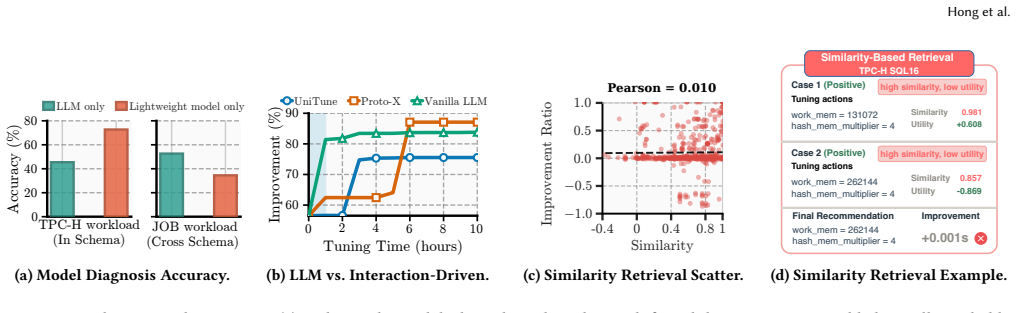
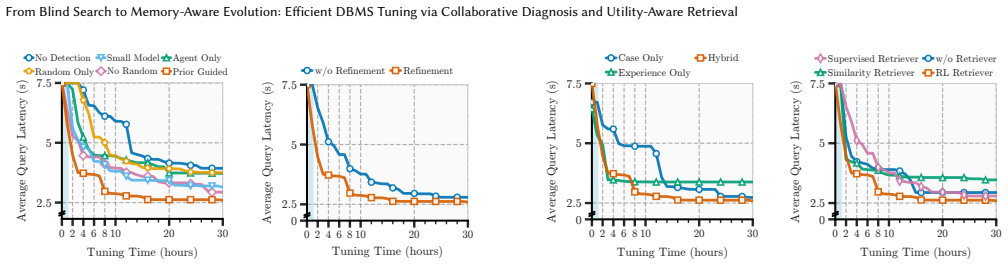
On its own terms, EvoTune claims that the two-stage decomposition of tuning—first identifying a query-specific bottleneck subspace, then optimizing only within it—plus a retrieval policy that selects historical observations by their learned long-term utility, is sufficient to make multi-component DBMS tuning efficient under a fixed budget. The paper models tuning as a sequential decision problem and learns a utility-aware retriever via soft Q-learning, with rewards defined as immediate latency reductions; it contrasts this with similarity-based retrieval, showing near-zero correlation between cosine similarity and observed improvement (Pearson ≈ 0.01) versus a moderate correlation for learne
What carries the argument
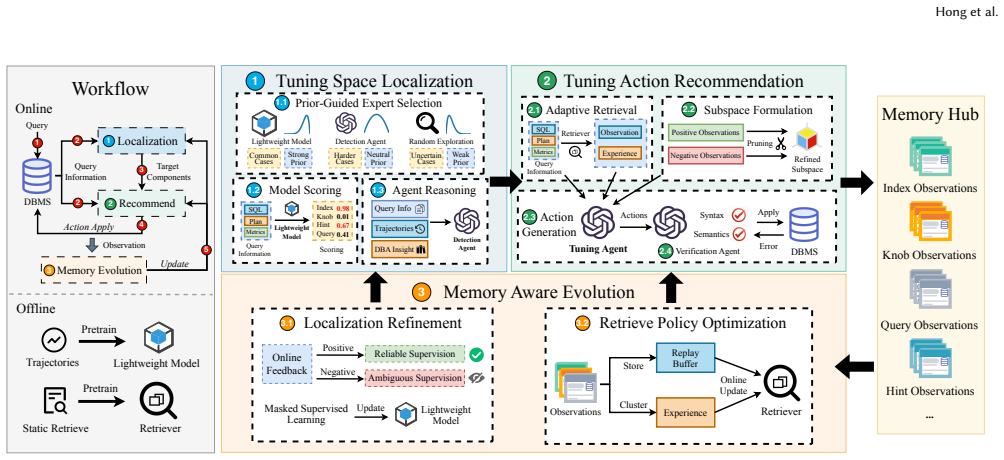
The central mechanism is the memory-aware evolution loop, built on three parts: (1) collaborative subspace localization, where a prior-guided bandit switches between a lightweight component-scoring model, an LLM Detection Agent, and random exploration to find the per-query bottleneck components; (2) utility-aware retrieval, in which a two-layer MLP Q-network, trained by soft Q-learning, scores each historical observation by expected long-term latency improvement and selects top-k observations plus distilled cluster-level 'experiences'; (3) a hierarchical memory hub that stores instance-level observations and cluster-level experiences, refined online via masked BCE for the scorer and TD updat
Load-bearing premise
The headline TPC-H gain comes from a setup where EvoTune's 30-hour offline pretraining, built on TPC-H schemas, is excluded from the same 30-hour tuning budget used for all methods; if that pretraining counts as budget or biases the TPC-H evaluation, the central improvement claim collapses.
What would settle it
Rerun EvoTune and the strongest baseline on a workload whose schema was never seen during pretraining (e.g., a new analytic benchmark), and count the 30-hour pretraining inside EvoTune's budget: if EvoTune no longer reaches the baseline's final performance 1.5–3.9x faster, or if the TPC-H gap narrows when pretraining is included, the central claim is falsified.
If this is right
- If EvoTune is right, multi-component tuners should stop searching the full joint configuration space and instead localize a per-query anomaly subspace before acting.
- Similarity-based retrieval for LLM tuning is replaceable: selecting past cases by predicted long-term utility yields better convergence and avoids premature plateaus.
- Continual improvement is achievable without LLM fine-tuning: lightweight scorer/retriever updates plus memory distillation are enough to adapt across workloads and schemas.
- The framework should transfer across database engines: EvoTune reports working on both PostgreSQL and TiDB, including a cold-start setting with no offline pretraining.
- Tuning time under budget is dominated by query replays, so reducing the number of executions via better localization and retrieval gives large end-to-end speedups even when per-decision algorithm overhead rises.
Where Pith is reading between the lines
- Editorial extension: the strongest untested implication is that the 30-hour offline pretraining could be amortized across many future workloads; if so, the fair comparison for a one-off tuning task may be less favorable than the paper's 'same budget' framing suggests.
- Editorial extension: utility-aware retrieval should transfer beyond DBMS tuning to any iterative LLM agent that reuses episodic memory, such as code repair or automated ML pipelines, where similarity-based case retrieval is also common.
- Editorial extension: a direct test of the memory hypothesis would be to ablate the LLM entirely and keep only the learned subspace localization plus utility-aware retriever; if the gap over baselines narrows, the paper's credit attribution to 'LLM-empowered' tuning would need revision.
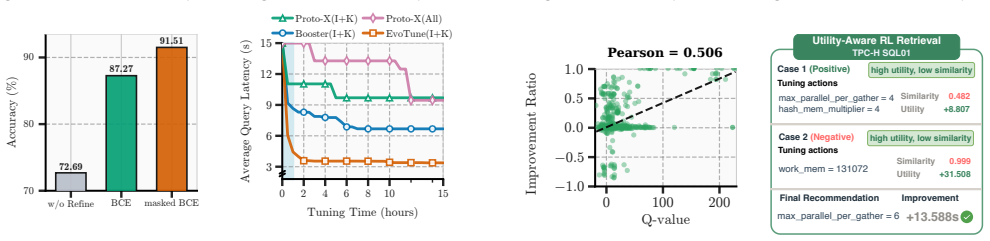
- Editorial extension: the correlation gap (0.01 similarity vs 0.506 Q-value) suggests that retrieval quality, not LLM reasoning, is the main lever; a production system could therefore use a cheaper model for action generation without losing much.
Editorial analysis
A structured set of objections, weighed in public.
Referee Report
Summary. The paper proposes EvoTune, a multi-component DBMS tuning framework that combines collaborative subspace localization (a lightweight scorer plus an LLM Detection Agent coordinated by a Thompson-sampling bandit) with utility-aware retrieval over a hierarchical memory hub to guide LLM-based action generation. The authors claim that EvoTune consistently outperforms state-of-the-art baselines, achieving up to 44.5% performance improvement under the same 30-hour tuning budget and reaching the best baseline's final performance up to 3.9x faster. Experiments are conducted on TPC-H, JOB, and TPC-DS on PostgreSQL, plus a cold-start TiDB setting, with ablations for the localization, memory, and retrieval components.
Significance. If the claims are valid, the paper makes a meaningful contribution to LLM-based DBMS tuning: it addresses two recognized limitations of existing methods—blind search over a huge configuration space and static similarity-based retrieval—with a modular architecture that avoids LLM fine-tuning. The cold-start experiment and the schema-shift results (JOB, TPC-DS) provide some evidence that the framework can bootstrap and generalize. The masked-supervision idea for handling asymmetric tuning feedback is also sensible. However, the central 'same tuning budget' claim is currently undermined by the exclusion of 30 hours of offline pretraining from the reported budget, and the lack of variance reporting makes the headline margins difficult to assess. The contributions are potentially significant, but the evidence as written is not yet sufficient to support the strongest claims.
major comments (4)
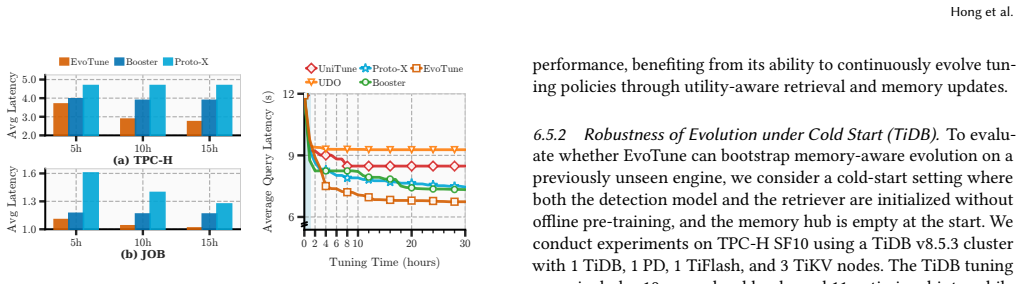
- [§6.1, §6.2] The 'same 30-hour budget' claim is not supported as stated. Section 6.1 (Offline Preparation) states that EvoTune collects 30 hours / 3,385 trajectories on synthetic workloads derived from TPC-H schemas to pretrain the component scoring model and the retriever. Section 6.2 then reports the headline 44.5% TPC-H improvement 'under the same 30-hour tuning budget.' Baselines start with empty memory and no pretraining, so EvoTune consumes an additional 30 hours of data collection plus training before the reported tuning clock starts, and the largest gain is on the same schema family used for pretraining. The cold-start TiDB experiment (Figure 15) partially addresses this concern, but it is on a different engine and still uses TPC-H queries; it does not validate the same-budget TPC-H claim. Please either include pretraining in the budget, provide a no-pretraining TPC-H run, or explicitly re-sc
- [§4.1.1, Eqs. (4)-(5)] The impact labels for component scoring are generated from the system's own diagnosed component set B: Y_b = I[b∈B]·Y. Components not selected are unlabeled, and positive labels only arise for components the system already chose to tune. Training on these labels (Eq. 7) creates a self-confirmation loop: the scorer learns to reinforce its prior localization choices, and components never selected are never verified. Section 6.3.2 reports 'ground-truth labels obtained with a sufficiently large tuning budget' but does not specify how those labels were produced. Without an independent labeling procedure or an explicit analysis of this loop, the localization-accuracy results do not establish that EvoTune identifies the true bottleneck subspace rather than the subspace it started with.
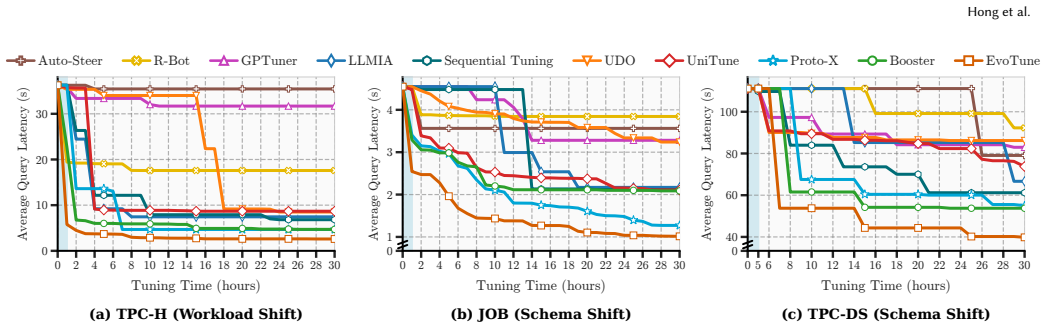
- [§6.2, Overhead Analysis] The time-to-target metric is defined as achieving 80% of EvoTune's best performance, with the justification that 'higher targets are often unattainable for other methods.' This makes the speedup comparison favorable to EvoTune by construction: the threshold is relative to EvoTune's own final performance, and it is unclear how baselines that never reach this threshold are treated. Please report absolute latency thresholds and state explicitly what happens to baselines that do not reach the target. Additionally, all results are averaged over 3 trials with no variance or confidence intervals shown in Figure 4; given the stochasticity of LLM-based tuning, this is insufficient to support the reported margins.
- [§5.2, §6.4.3] The comparison between the RL retriever and the similarity retriever is confounded by offline pretraining. The RL retriever is pretrained on 30 hours of TPC-H trajectories (§6.1), while the similarity retriever is not trained; the memory hub starts empty for both, so the RL retriever's advantage in Figure 11 may reflect warm-start information about TPC-H rather than the utility objective itself. Furthermore, the reward in Eq. (11) is generated by the same LLM policy p_LLM that the retriever conditions on, so the learned Q-values are policy-specific. This is not necessarily a defect, but it limits the generality of the 'utility-aware' claim and should be acknowledged and discussed.
minor comments (5)
- [Eq. (7)] The masked BCE loss equation has a duplicated summation/fraction that appears to be a LaTeX formatting error; please fix the typesetting.
- [§4.1.1] Typo: 'the detection model predicts predicts component-level scores' should be 'predicts component-level scores.'
- [§6.1] The distinction between 'workload shift' and 'schema shift' is confusing: synthetic workloads derived from TPC-H schemas are called a workload shift when evaluated on standard TPC-H, but the schema family is the same. Please clarify what changes between pretraining and evaluation.
- [§6.1, EvoTune Setting] Several hyperparameters (δ, η, HDBSCAN parameters, discount γ, bandit priors) are listed but no sensitivity analysis is provided; a table summarizing the settings and a brief robustness check would strengthen the paper.
- [Figures 2(d), 13] The running example of similarity vs. utility retrieval is hard to read at the current resolution; consider simplifying or enlarging the figure.
Circularity Check
Headline TPC-H gain is partly an artifact of same-schema offline pretraining excluded from the 'same budget' claim; otherwise the derivation is feedback-driven, not circular.
specific steps
-
fitted input called prediction
[Abstract; Section 6.1 (Offline Preparation); Section 6.2 (End-to-end Comparison)]
"EvoTune collects tuning trajectories (30 hours, 3,385 samples), which are used to pre-train the component scoring model (Section 4.1.1) and the retrieve model (Section 5.2) on synthetic workloads derived from TPC-H schemas... we evaluate on the standard TPC-H workload (workload shift)... Under the same 30-hour tuning budget, EvoTune reduces the final average query latency by 20.3%, 44.5%, and 27.7% on JOB, TPC-H, and TPC-DS, respectively."
The 30 hours of offline fitting on synthetic TPC-H-schema workloads is excluded from the 'same 30-hour tuning budget' comparison, yet it pre-warms the detector and retriever on the same schema family as the standard TPC-H evaluation before the reported tuning clock starts. The flagship 44.5% TPC-H improvement is therefore partly a fitted-input warm-start gain rather than an equal-budget online tuning gain. The JOB/TPC-DS schema shifts and TiDB cold-start evaluations remain independent evidence, so the circularity is partial rather than total.
full rationale
Most of EvoTune's machinery is ordinary feedback-driven learning rather than derivation-level circularity: the reward in Eq. (11) is measured query-latency reduction, the final evaluation metric is external, and the paper provides independent schema-shift (JOB, TPC-DS) and cold-start (TiDB) results. The detection-label definition in Eqs. (4)-(5) is a credit-assignment choice rather than a proof that reduces to its own input. The principal circularity concern is empirical: the paper pre-trains for 30 hours on synthetic workloads derived from TPC-H schemas and then reports the TPC-H 44.5% improvement under the 'same 30-hour tuning budget' while baselines start without that warm start. This makes the flagship same-budget claim partially circular, though the independent JOB, TPC-DS, and cold-start results show the central mechanism has content beyond the TPC-H warm start.
Axiom & Free-Parameter Ledger
free parameters (8)
- Bandit prior strengths =
Beta(8,2), Beta(2,2), Beta(2,8)
- Improvement threshold delta =
5%
- Exploration threshold eta
- Retrieval top-k =
4 (max 2 positive, 2 negative)
- Discount factor gamma =
0.99
- HDBSCAN parameters =
min_cluster_size=5, min_samples=5, pending buffer=20
- Time-to-target threshold =
80% of EvoTune's best performance
- Latency exclusion cutoff =
1 second
axioms (6)
- standard math Beta-Bernoulli Thompson sampling is an appropriate and stable expert-selection mechanism in this non-stationary setting.
- standard math Soft Q-learning with a two-layer MLP Q-network and replay buffer converges to a good retrieval policy with limited trajectories.
- domain assumption The DBA insights encoded in prompts are correct across PostgreSQL and TiDB and transfer to unseen schemas.
- domain assumption GPT-4.1 can generate syntactically and semantically valid tuning actions from prompts and retrieved observations.
- ad hoc to paper Offline trajectories collected on TPC-H schemas are representative for pretraining and do not unfairly bias the TPC-H evaluation.
- domain assumption RCRank-style encoders (BERT, QueryFormer, MLP, 2D-CNN) capture query-plan/metric/semantic signals sufficiently for localization.
Cite this review
Pith. "Pith review of From Blind Search to Memory-Aware Evolution: Efficient DBMS Tuning via Collaborative Diagnosis and Utility-Aware Retrieval." pith.science (2026). https://pith.science/paper/ECWHFY4G
@misc{pith2026260717841,
  author       = {Pith},
  title        = {Pith review of: From Blind Search to Memory-Aware Evolution: Efficient DBMS Tuning via Collaborative Diagnosis and Utility-Aware Retrieval},
  year         = {2026},
  howpublished = {\url{https://pith.science/paper/ECWHFY4G}},
  note         = {Machine review of arXiv:2607.17841}
}
read the original abstract
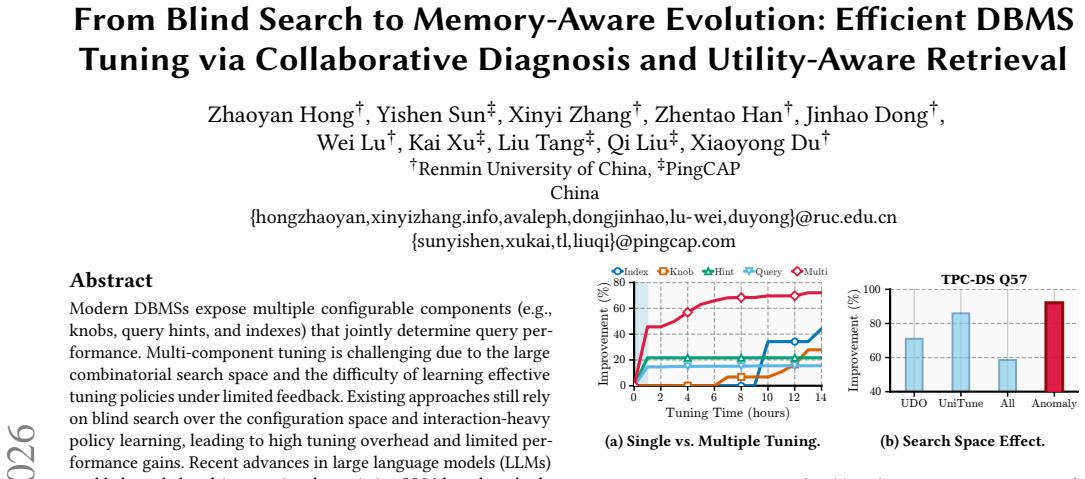
Modern DBMSs expose multiple configurable components (e.g., knobs, query hints, and indexes) that jointly determine query performance. Multi-component tuning is challenging due to the large combinatorial search space and the difficulty of learning effective tuning policies under limited feedback. Existing approaches still rely on blind search over the configuration space and interaction-heavy policy learning, leading to high tuning overhead and limited performance gains. Recent advances in large language models (LLMs) enable knowledge-driven tuning, but existing LLM-based methods fail to effectively exploit online feedback and historical observations, often converging prematurely to suboptimal configurations. In this paper, we present EvoTune, a memory-aware evolution framework for multi-component DBMS tuning. EvoTune first localizes a query-specific high-impact subspace via collaborative diagnosis, which combines lightweight pattern learning with LLM-based reasoning. It further introduces a utility-aware retrieval policy that selects informative observations based on their resulting long-term performance improvement, instead of similarity-based retrieval. To support continual improvement, EvoTune organizes tuning feedback into a hierarchical memory and incrementally refines both subspace localization and tuning policies without requiring LLM fine-tuning. Extensive experiments show that EvoTune consistently outperforms state-of-the-art baselines, achieving up to 44.5% performance improvement under the same tuning budget and reaching the best competing baseline's final performance up to 3.9X faster.
Figures
Reference graph
Works this paper leans on
-
[1]
TPC-DS Benchmark
2015. TPC-DS Benchmark. https://www.tpc.org/tpcds/
2015
-
[2]
TPC-H Benchmark
2015. TPC-H Benchmark. http://www.tpc.org/tpch/
2015
-
[3]
pg_hint_plan
2025. pg_hint_plan. https://github.com/ossc-db/pg_hint_plan
2025
-
[4]
EvoTune Appendix
2026. EvoTune Appendix. https://anonymous.4open.science/r/DREAM-0A30/ appendix.pdf
2026
-
[5]
Christoph Anneser, Nesime Tatbul, David Cohen, Zhenggang Xu, Prithviraj Pandian, Nikolay Laptev, and Ryan Marcus. 2023. AutoSteer: Learned Query Optimization for Any SQL Database.Proc. VLDB Endow.16, 12 (Aug. 2023), 3515–3527. doi:10.14778/3611540.3611544
arXiv 2023
-
[6]
Tom B. Brown, Benjamin Mann, Nick Ryder, Melanie Subbiah, Jared Kaplan, Prafulla Dhariwal, Arvind Neelakantan, Pranav Shyam, Girish Sastry, Amanda Askell, Sandhini Agarwal, Ariel Herbert-Voss, Gretchen Krueger, Tom Henighan, Rewon Child, Aditya Ramesh, Daniel M. Ziegler, Jeffrey Wu, Clemens Winter, Christopher Hesse, Mark Chen, Eric Sigler, Mateusz Litwin...
2020
-
[7]
Sébastien Bubeck and Nicolò Cesa-Bianchi. 2012. Regret Analysis of Stochastic and Nonstochastic Multi-armed Bandit Problems.Found. Trends Mach. Learn.5, 1 (2012), 1–122. doi:10.1561/2200000024
-
[8]
Sibei Chen, Ju Fan, Bin Wu, Nan Tang, Chao Deng, Pengyi Wang, Ye Li, Jian Tan, Feifei Li, Jingren Zhou, and Xiaoyong Du. 2025. Automatic Database Config- uration Debugging using Retrieval-Augmented Language Models.Proc. ACM Manag. Data3, 1, Article 13 (Feb. 2025), 27 pages
2025
-
[9]
Florin Cuconasu, Giovanni Trappolini, Federico Siciliano, Simone Filice, Cesare Campagnano, Yoelle Maarek, Nicola Tonellotto, and Fabrizio Silvestri. 2024. The Power of Noise: Redefining Retrieval for RAG Systems. InProceedings of the 47th International ACM SIGIR Conference on Research and Development in Informa- tion Retrieval(Washington DC, USA)(SIGIR ’...
arXiv 2024
-
[10]
Jacob Devlin, Ming-Wei Chang, Kenton Lee, and Kristina Toutanova. 2019. BERT: Pre-training of Deep Bidirectional Transformers for Language Understanding. InProceedings of the 2019 Conference of the North American Chapter of the Associ- ation for Computational Linguistics: Human Language Technologies, NAACL-HLT 2019, Minneapolis, MN, USA, June 2-7, 2019, V...
2019
-
[11]
Victor Giannakouris and Immanuel Trummer. 2024. DBG-PT: A Large Language Model Assisted Query Performance Regression Debugger.Proc. VLDB Endow.17, 12 (Aug. 2024), 4337–4340
2024
-
[12]
2025.𝜆-Tune: Harnessing Large Language Models for Automated Database System Tuning.Proc
Victor Giannakouris and Immanuel Trummer. 2025.𝜆-Tune: Harnessing Large Language Models for Automated Database System Tuning.Proc. ACM Manag. Data3, 1, Article 2 (Feb. 2025), 26 pages
2025
-
[13]
Tuomas Haarnoja, Aurick Zhou, Kristian Hartikainen, George Tucker, Sehoon Ha, Jie Tan, Vikash Kumar, Henry Zhu, Abhishek Gupta, Pieter Abbeel, and Sergey Levine. 2019. Soft Actor-Critic Algorithms and Applications. doi:10. 48550/arXiv.1812.05905 arXiv:1812.05905 [cs]
-
[14]
Xinmei Huang, Haoyang Li, Jing Zhang, Xinxin Zhao, Zhiming Yao, Yiyan Li, Tieying Zhang, Jianjun Chen, Hong Chen, and Cuiping Li. 2024. E2ETune: End-to-End Knob Tuning via Fine-tuned Generative Language Model.CoRR abs/2404.11581 (2024)
Pith/arXiv arXiv 2024
-
[15]
Konstantinos Kanellis, Ramnatthan Alagappan, and Shivaram Venkataraman
-
[16]
Henne, and Dan Sommerfield
Ron Kohavi, Randal M. Henne, and Dan Sommerfield. 2007. Practical guide to controlled experiments on the web: listen to your customers not to the hippo. InProceedings of the 13th ACM SIGKDD International Conference on Knowledge Discovery and Data Mining(San Jose, California, USA)(KDD ’07). Association for Computing Machinery, New York, NY, USA, 959–967
2007
-
[17]
Jiale Lao, Yibo Wang, Yufei Li, Jianping Wang, Yunjia Zhang, Zhiyuan Cheng, Wanghu Chen, Mingjie Tang, and Jianguo Wang. 2025. GPTuner: An LLM-Based Database Tuning System.SIGMOD Rec.54, 1 (April 2025), 101–110
2025
-
[18]
Boncz, Alfons Kemper, and Thomas Neumann
Viktor Leis, Andrey Gubichev, Atanas Mirchev, Peter A. Boncz, Alfons Kemper, and Thomas Neumann. 2015. How Good Are Query Optimizers, Really?Proc. VLDB Endow.9, 3 (2015), 204–215
2015
-
[19]
Xinzhe Li. 2025. A Review of Prominent Paradigms for LLM-Based Agents: Tool Use, Planning (Including RAG), and Feedback Learning. InProceedings of the 31st International Conference on Computational Linguistics, COLING 2025, Abu Dhabi, UAE, January 19-24, 2025, Owen Rambow, Leo Wanner, Marianna Apidianaki, Hend Al-Khalifa, Barbara Di Eugenio, and Steven Sc...
2025
-
[20]
Yiyan Li, Haoyang Li, Jing Zhang, Renata Borovica-Gajic, Shuai Wang, Tieying Zhang, Jianjun Chen, Rui Shi, Cuiping Li, and Hong Chen. 2025. AgentTune: An Agent-Based Large Language Model Framework for Database Knob Tuning. Proc. ACM Manag. Data3, 6, Article 293 (Dec. 2025), 29 pages
2025
-
[21]
Zhaodonghui Li, Haitao Yuan, Huiming Wang, Gao Cong, and Lidong Bing. 2024. LLM-R2: A Large Language Model Enhanced Rule-Based Rewrite System for Boosting Query Efficiency.Proc. VLDB Endow.18, 1 (Sept. 2024), 53–65
2024
-
[22]
Minghua Ma, Zheng Yin, Shenglin Zhang, Sheng Wang, Christopher Zheng, Xin- hao Jiang, Hanwen Hu, Cheng Luo, Yilin Li, Nengjun Qiu, Feifei Li, Changcheng Chen, and Dan Pei. 2020. Diagnosing Root Causes of Intermittent Slow Queries in Large-Scale Cloud Databases.Proc. VLDB Endow.13, 8 (2020), 1176–1189
2020
-
[23]
Ryan Marcus, Parimarjan Negi, Hongzi Mao, Nesime Tatbul, Mohammad Al- izadeh, and Tim Kraska. 2021. Bao: Making Learned Query Optimization Practical. InProceedings of the 2021 International Conference on Management of Data(Vir- tual Event, China)(SIGMOD ’21). Association for Computing Machinery, New York, NY, USA, 1275–1288
2021
-
[24]
Leland McInnes, John Healy, and Steve Astels. 2017. HDBSCAN: Hierarchical density based clustering.Journal of Open Source Software2, 11 (2017), 205. doi:10.21105/joss.00205
-
[25]
Biao Ouyang, Yingying Zhang, Hanyin Cheng, Yang Shu, Chenjuan Guo, Bin Yang, Qingsong Wen, Lunting Fan, and Christian S. Jensen. 2024. RCRank: Multimodal Ranking of Root Causes of Slow Queries in Cloud Database Systems. Proc. VLDB Endow.18, 4 (2024), 1169–1182
2024
-
[26]
Yu Shen, Beicheng Xu, Yupeng Lu, Donghui Chen, Huaijun Jiang, Zhipeng Xie, Senbo Fu, Nan Zhang, Yuxin Ren, Ning Jia, Xinwei Hu, and Bin Cui. 2025. A- Tune-Online: Efficient and QoS-Aware Online Configuration Tuning for Dynamic Workloads. In2025 IEEE 41st International Conference on Data Engineering (ICDE). 2161–2173. doi:10.1109/ICDE65448.2025.00164
arXiv 2025
-
[27]
Noah Shinn, Federico Cassano, Ashwin Gopinath, Karthik Narasimhan, and Shunyu Yao. 2023. Reflexion: language agents with verbal reinforcement learn- ing. InProceedings of the 37th International Conference on Neural Information Processing Systems(New Orleans, LA, USA)(NIPS ’23). Curran Associates Inc., Red Hook, NY, USA, Article 377, 19 pages
2023
-
[28]
Tarique Siddiqui and Wentao Wu. 2024. ML-Powered Index Tuning: An Overview of Recent Progress and Open Challenges.SIGMOD Rec.52, 4 (Jan. 2024), 19–30
2024
-
[29]
Singh, Kapil Vaidya, Vinayshekhar Bannihatti Kumar, Sopan Khosla, Balakrishnan Narayanaswamy, Rashmi Gangadharaiah, and Tim Kraska
Vikramank Y. Singh, Kapil Vaidya, Vinayshekhar Bannihatti Kumar, Sopan Khosla, Balakrishnan Narayanaswamy, Rashmi Gangadharaiah, and Tim Kraska
-
[30]
Zhaoyan Sun. 2025. R-Bot: An LLM-based Query Rewrite System. https://github.com/curtis-sun/LLM4Rewrite/blob/main/explain_rule/calcite_ rewrite_rules_structured.jsonl Accessed: Dec. 26, 2025
2025
-
[31]
Zhaoyan Sun, Xuanhe Zhou, Guoliang Li, Xiang Yu, Jianhua Feng, and Yong Zhang. 2025. R-Bot: An LLM-based Query Rewrite System.Proc. VLDB Endow. 18, 12 (2025), 5031–5044
2025
-
[32]
Gordon, and Bohan Zhang
Dana Van Aken, Andrew Pavlo, Geoffrey J. Gordon, and Bohan Zhang. 2017. Automatic Database Management System Tuning Through Large-scale Machine Learning. InProceedings of the 2017 ACM International Conference on Manage- ment of Data(Chicago, Illinois, USA)(SIGMOD ’17). Association for Computing Machinery, New York, NY, USA, 1009–1024
2017
-
[33]
Junxiong Wang, Immanuel Trummer, and Debabrota Basu. 2021. UDO: Universal Database Optimization using Reinforcement Learning.Proc. VLDB Endow.14, 13 (2021), 3402–3414
2021
-
[34]
and Jirong Wen
Lei Wang, Chen Ma, Xueyang Feng, Zeyu Zhang, Hao Yang, Jingsen Zhang, Zhiyuan Chen, Jiakai Tang, Xu Chen, Yankai Lin, Wayne Xin Zhao, Zhewei Wei, Hong et al. and Jirong Wen. 2024. A survey on large language model based autonomous agents.Frontiers Comput. Sci.18, 6 (2024), 186345
2024
-
[35]
Shuxian Wang, Sicheng Pan, and Alvin Cheung. 2024. QED: A Powerful Query Equivalence Decider for SQL.Proc. VLDB Endow.17, 11 (July 2024), 3602–3614
2024
-
[36]
Xiaoying Wang, Wentao Wu, Vivek Narasayya, and Surajit Chaudhuri. 2025. Esc: An Early-Stopping Checker for Budget-Aware Index Tuning.Proc. VLDB Endow. 18, 5 (Aug. 2025), 1278–1290
2025
-
[37]
Zijia Wang, Haoran Liu, Chen Lin, Zhifeng Bao, Guoliang Li, and Tianqing Wang. 2024. Leveraging Dynamic and Heterogeneous Workload Knowledge to Boost the Performance of Index Advisors.Proc. VLDB Endow.17, 7 (March 2024), 1642–1654
2024
-
[38]
Lucas Woltmann, Jerome Thiessat, Claudio Hartmann, Dirk Habich, and Wolf- gang Lehner. 2023. FASTgres: Making Learned Query Optimizer Hinting Effective. Proc. VLDB Endow.16, 11 (July 2023), 3310–3322
2023
-
[39]
Xiaokun Wu, Min Chen, Wanyi Li, Rui Wang, Limeng Lu, Jia Liu, Kai Hwang, Yixue Hao, Yanru Pan, Qingguo Meng, Kaibin Huang, Long Hu, Mohsen Guizani, Naipeng Chao, Giancarlo Fortino, Fei Lin, Yonglin Tian, Dusit Niyato, and Fei- Yue Wang. 2025. LLM Fine-Tuning: Concepts, Opportunities, and Challenges. Big Data Cogn. Comput.9, 4 (2025), 87
2025
-
[40]
Zhiheng Xi, Wenxiang Chen, Xin Guo, Wei He, Yiwen Ding, Boyang Hong, Ming Zhang, Junzhe Wang, Senjie Jin, Enyu Zhou, Rui Zheng, Xiaoran Fan, Xiao Wang, Limao Xiong, Yuhao Zhou, Weiran Wang, Changhao Jiang, Yicheng Zou, Xiangyang Liu, Zhangyue Yin, Shihan Dou, Rongxiang Weng, Wenjuan Qin, Yongyan Zheng, Xipeng Qiu, Xuanjing Huang, Qi Zhang, and Tao Gui. 20...
2025
-
[41]
Xianghong Xu, Zhibing Zhao, Tieying Zhang, Rong Kang, Luming Sun, and Jianjun Chen. 2023. COOOL: A Learning-To-Rank Approach for SQL Hint Recommendations. InJoint Proceedings of Workshops at the 49th International Conference on Very Large Data Bases (VLDB 2023), Vancouver, Canada, August 28 - September 1, 2023
2023
-
[42]
Dong Young Yoon, Ning Niu, and Barzan Mozafari. 2016. DBSherlock: A Per- formance Diagnostic Tool for Transactional Databases. InProceedings of the 2016 International Conference on Management of Data(San Francisco, California, USA)(SIGMOD ’16). Association for Computing Machinery, New York, NY, USA, 1599–1614
2016
-
[43]
Tao Yu, Zhaonian Zou, Weihua Sun, and Yu Yan. 2024. Refactoring Index Tun- ing Process with Benefit Estimation.Proc. VLDB Endow.17, 7 (March 2024), 1528–1541
2024
-
[44]
Ji Zhang, Yu Liu, Ke Zhou, Guoliang Li, Zhili Xiao, Bin Cheng, Jiashu Xing, Yangtao Wang, Tianheng Cheng, Li Liu, Minwei Ran, and Zekang Li. 2019. An End-to-End Automatic Cloud Database Tuning System Using Deep Reinforce- ment Learning. InProceedings of the 2019 International Conference on Management of Data. Association for Computing Machinery, 415–432
2019
-
[45]
William Zhang, Wan Shen Lim, Matthew Butrovich, and Andrew Pavlo. 2024. The Holon Approach for Simultaneously Tuning Multiple Components in a Self- Driving Database Management System with Machine Learning via Synthesized Proto-Actions.Proc. VLDB Endow.17, 11 (2024), 3373–3387
2024
-
[46]
William Zhang, Wan Shen Lim, and Andrew Pavlo. 2026. This is Going to Sound Crazy, But What If We Used Large Language Models to Boost Automatic Database Tuning Algorithms By Leveraging Prior History? We Will Find Better Configurations More Quickly Than Retraining From Scratch!Proc. ACM Manag. Data4, 1, Article 90 (April 2026), 29 pages. doi:10.1145/3786704
-
[47]
Xinyi Zhang, Zhuo Chang, Hong Wu, Yang Li, Jia Chen, Jian Tan, Feifei Li, and Bin Cui. 2023. A Unified and Efficient Coordinating Framework for Autonomous DBMS Tuning.Proc. ACM Manag. Data1, 2, Article 186 (June 2023), 26 pages
2023
-
[48]
Xinyi Zhang, Hong Wu, Zhuo Chang, Shuowei Jin, Jian Tan, Feifei Li, Tieying Zhang, and Bin Cui. 2021. ResTune: Resource Oriented Tuning Boosted by Meta- Learning for Cloud Databases. InProceedings of the 2021 International Conference on Management of Data(Virtual Event, China)(SIGMOD ’21). Association for Computing Machinery, New York, NY, USA, 2102–2114
2021
-
[49]
Xinyi Zhang, Hong Wu, Yang Li, Jian Tan, Feifei Li, and Bin Cui. 2022. Towards Dynamic and Safe Configuration Tuning for Cloud Databases. InProceedings of the 2022 International Conference on Management of Data(Philadelphia, PA, USA)(SIGMOD ’22). Association for Computing Machinery, New York, NY, USA, 631–645. doi:10.1145/3514221.3526176
arXiv 2022
-
[50]
Xinxin Zhao, Haoyang Li, Jing Zhang, Xinmei Huang, Tieying Zhang, Jianjun Chen, Rui Shi, Cuiping Li, and Hong Chen. 2025. LLMIdxAdvis: Resource- Efficient Index Advisor Utilizing Large Language Model.CoRRabs/2503.07884 (2025). arXiv:2503.07884
arXiv 2025
-
[51]
Yue Zhao, Gao Cong, Jiachen Shi, and Chunyan Miao. 2022. QueryFormer: A Tree Transformer Model for Query Plan Representation.Proc. VLDB Endow.15, 8 (2022), 1658–1670
2022
-
[52]
Huichi Zhou, Yihang Chen, Siyuan Guo, Xue Yan, Kin Hei Lee, Zihan Wang, Ka Yiu Lee, Guchun Zhang, Kun Shao, Linyi Yang, and Jun Wang. 2025. Memento: Fine-tuning LLM Agents without Fine-tuning LLMs.CoRRabs/2508.16153 (2025)
Pith/arXiv arXiv 2025
-
[53]
Wei Zhou, Chen Lin, Xuanhe Zhou, and Guoliang Li. 2024. Breaking It Down: An In-Depth Study of Index Advisors.Proc. VLDB Endow.17, 10 (June 2024), 2405–2418
2024
-
[54]
Xuanhe Zhou, Lianyuan Jin, Ji Sun, Xinyang Zhao, Xiang Yu, Jianhua Feng, Shifu Li, Tianqing Wang, Kun Li, and Luyang Liu. 2021. DBMind: a self-driving platform in openGauss.Proc. VLDB Endow.14, 12 (July 2021), 2743–2746
2021
-
[55]
Xuanhe Zhou, Guoliang Li, Chengliang Chai, and Jianhua Feng. 2021. A learned query rewrite system using Monte Carlo tree search.Proc. VLDB Endow.15, 1 (Sept. 2021), 46–58
2021
-
[56]
Xuanhe Zhou, Guoliang Li, Zhaoyan Sun, Zhiyuan Liu, Weize Chen, Jianming Wu, Jiesi Liu, Ruohang Feng, and Guoyang Zeng. 2024. D-Bot: Database Diagnosis System using Large Language Models.Proc. VLDB Endow.17, 10 (2024), 2514– 2527
2024
-
[57]
Rong Zhu, Wei Chen, Bolin Ding, Xingguang Chen, Andreas Pfadler, Ziniu Wu, and Jingren Zhou. 2023. Lero: A Learning-to-Rank Query Optimizer.Proc. VLDB Endow.16, 6 (Feb. 2023), 1466–1479
2023
-
[2020]
InHotStorage
Too Many Knobs to Tune? Towards Faster Database Tuning by Pre-selecting Important Knobs. InHotStorage. USENIX Association
-
[2024]
In14th Conference on Innovative Data Systems Research, CIDR 2024, Chaminade, HI, USA, January 14-17, 2024
Panda: Performance Debugging for Databases using LLM Agents. In14th Conference on Innovative Data Systems Research, CIDR 2024, Chaminade, HI, USA, January 14-17, 2024. www.cidrdb.org
2024
This paper was first reviewed by deepseek-v4-flash on August 1, 2026.
discussion (0)
Sign in with ORCID, Apple, or X to comment. Anyone can read and Pith papers without signing in.