REVIEW 3 major objections 5 minor 32 references
This paper establishes that causal mediation analysis, which decomposes a treatment effect into direct and indirect pathways, can run across distributed medical record networks without exchanging patient-level data, and that the federated e
Reviewed by Pith at T0; open to challenge. T0 means a machine referee read the full paper against a public rubric. the ladder, T0–T4 →
T0 review · deepseek-v4-flash
2026-08-01 16:30 UTC pith:LKXFJEMD
load-bearing objection First federated estimator for natural direct/indirect effects, plausible and honestly evaluated, but it quietly assumes no treatment–mediator interaction, which should be stated and tested. the 3 major comments →
Privacy-preserving causal mediation analysis using distributed electronic health record networks
The pith
A machine-rendered reading of the paper's core claim, the machinery that carries it, and where it could break.
Core claim
The proposed federated mediation estimator is, to the authors' knowledge, the first method enabling natural direct and indirect effect estimation in a distributed privacy-preserving setting. It sequentially fits a global outcome model using renewable estimating equations, broadcasts the coefficients to participating sites, lets each site locally construct an expanded dataset with imputed counterfactual outcomes, and then fits the natural effect model through the same renewable procedure. The only quantities shared are updated parameter estimates, cumulative Hessian summaries, and aggregate variance components. The authors show this reproduces pooled performance in simulations and in a real-w
What carries the argument
Renewable estimating equations, a sequential updating scheme in which each site receives the current parameter estimate and cumulative Hessian, updates using its own local score equations, and passes on only the new estimate and Hessian. This is coupled with outcome-regression-based natural effect imputation: each observation is expanded into two counterfactual rows locally, and the imputed outcomes come from the globally fitted outcome model. A sandwich variance estimator that aggregates score contributions within each site propagates uncertainty from the outcome model into final mediation inference.
Load-bearing premise
The whole construction assumes the outcome and natural-effect models are correctly specified and that the true model coefficients are the same at every site; if sites differ in treatment effect magnitude or mediator–outcome relationships, the federated estimates no longer target a meaningful shared quantity.
What would settle it
Run the federated estimator on a simulated network in which site-specific outcome or mediator coefficients are deliberately made heterogeneous, for example with the treatment effect varying strongly across sites. If the federated estimates diverge from a pooled analysis that accounts for site effects, or show systematic bias, the homogeneity assumption fails. Alternatively, a real network with more than 30% patient overlap should show empirical coverage clearly below the nominal 95%.
If this is right
- Multi-institution mediation studies can be run under typical data-governance constraints, giving more statistical power for rare outcomes or treatment subgroups without centralizing patient records.
- The real-data finding implies that most of GLP-1 RA's glycemic benefit in routine care operates through mechanisms other than weight loss, shifting mechanistic attention beyond BMI.
- Cross-site patient overlap does not bias point estimates of direct and indirect effects, but it does understate variance; networks without patient linkage will need to acknowledge wider confidence intervals.
- Because the renewable framework is modular, the same three-step structure can be extended to multiple mediators, survival outcomes, and time-varying treatments.
Where Pith is reading between the lines
- The homogeneity assumption—that model coefficients are the same at every site—could be relaxed with site-specific random effects; a testable extension would compare federated estimates against stratified estimates under strong site heterogeneity.
- Since misspecification of either the outcome model or the natural effect model can cause persistent bias, a doubly robust federated version is a natural next step the paper itself points toward.
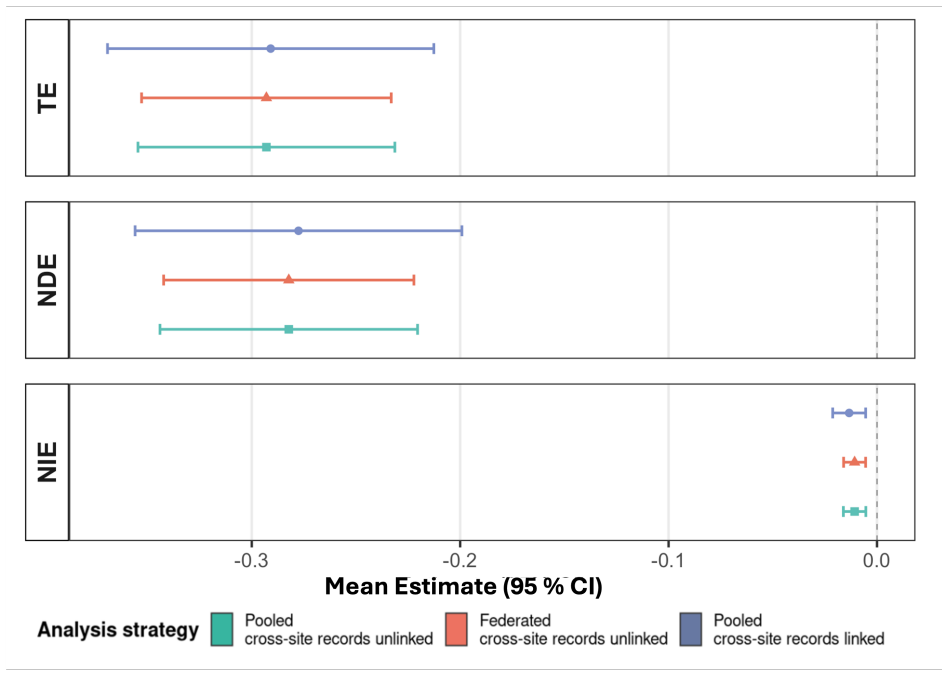
- In the real cohort, roughly one in three patients received care at multiple sites, so the reported confidence intervals are likely too narrow; linking patients across sites would widen them, as the authors' own pooled-linked analysis showed.
Editorial analysis
A structured set of objections, weighed in public.
Referee Report
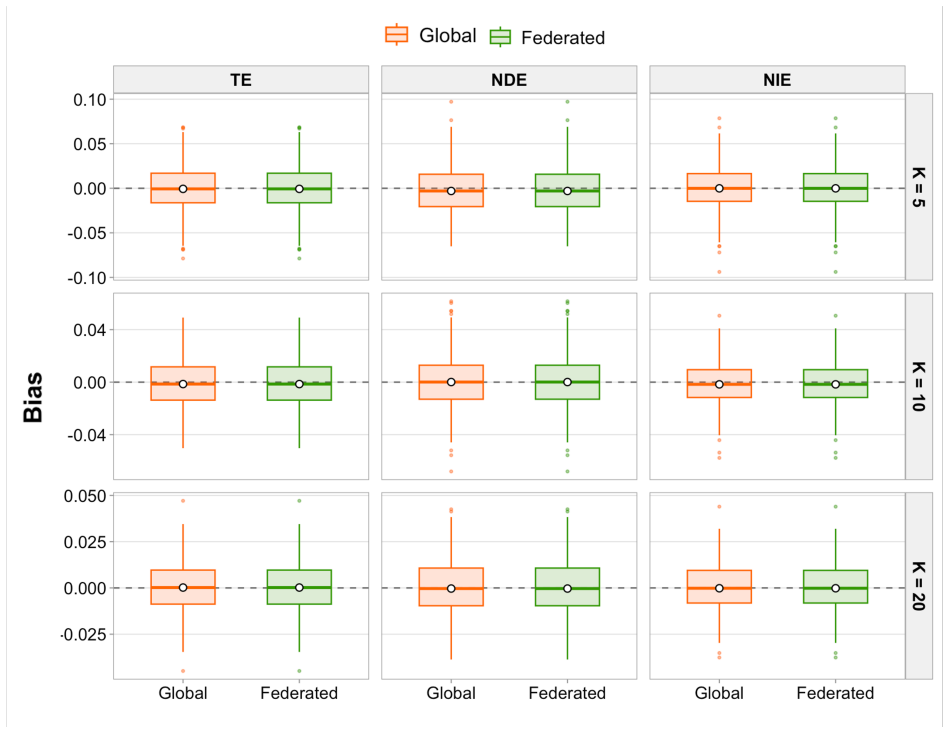
Summary. The paper proposes a federated causal mediation analysis framework for distributed EHR networks. The method estimates natural direct and indirect effects in three steps: (1) fit a global outcome regression E(Y|A,M,C) across sites via renewable estimating equations; (2) each site locally constructs an expanded dataset with counterfactual outcome imputations; (3) fit a global natural effect model to estimate NDE, NIE, and TE. Sites exchange only low-dimensional summaries. The authors evaluate the method via simulations (K=5,10,20 sites) and apply it to INPC data (32,146 patients) to decompose the effect of GLP-1 RA initiation on HbA1c change into BMI-mediated and direct components. They find the federated estimator closely matches pooled analysis and report that BMI mediates only a small portion (3.7%) of the total effect.
Significance. If the method is valid, it fills a genuine gap: no existing federated approach for causal mediation analysis is cited, and the renewable-estimating-equations framework is computationally and communicationally attractive. The real-data comparison between federated and pooled analyses is a useful validation design, and the explicit treatment of cross-site patient overlap is a strength. However, the central identification claim depends on a main-effects natural effect model and on a stacked variance derivation that is not fully available. The simulation evidence cannot be fully assessed because the data-generating process is not specified in the main text. The paper addresses a practically important problem and the overall approach is plausible, but the missing interaction assumption and missing supplement are load-bearing concerns.
major comments (3)
- [Section 4.1, Eq. (2)] The natural effect model g{E(Y†|a,a*,C)} = η0 + ηa a + ηa* a* + ηC^T C is main-effects only. If the outcome regression includes an A×M interaction term β_AM A M, or if E[Y(a,M(a*))|C] otherwise depends on the product a×a*, then the conditional mean contains a cross term: with E[M(a*)|C] = α0 + α_A a* + α_C C, E[Y(a,M(a*))|C] = β0 + β_A a + (β_M + β_AM a)(α0 + α_A a* + α_C C) + β_C C, which has coefficient β_AM α_A on a a*. Fitting Eq. (2) then yields coefficients that are not generally equal to the NDE and NIE. The manuscript does not state a no-interaction assumption, does not specify whether the outcome model includes A×M, and the Discussion (Section 3) claims the framework 'can accommodate ... treatment–mediator interactions', which appears inconsistent with Eq. (2). This is load-bearing because the simulations are the primary evidence for the estimator's validity; if the simulation D
- [Section 4.2, final paragraph] The stacked estimating-equation sandwich variance estimator is essential to the central claim of 'accurate variance estimates' and empirical coverage close to 0.95, but the detailed derivation is relegated to Supplementary Methods, which are not included with the manuscript. Without the derivation, this claim cannot be checked, and the implementation cannot be reproduced. The authors should either include the full derivation in the main text or ensure the supplement is available to reviewers and readers.
- [Section 4.3] The simulation data-generating process is not specified in the main text; the reader is referred to Supplementary Methods, which are not provided. The text does not give equations for the outcome model, the mediator model, or the distribution of repeated measurements, nor does it state whether an A×M interaction is included. This is particularly problematic because the issue in Major Comment 1 depends on the presence or absence of such an interaction. The authors should provide the full DGP in the main text or supplement and, if the current simulations exclude interactions, add a scenario with β_AM ≠ 0 to demonstrate that the estimator is robust or to delineate the conditions under which it is unbiased.
minor comments (5)
- [Section 4.1] The link function g(·) is used before being defined. Please state explicitly that the identity link is used for continuous outcomes and specify the outcome model as a linear regression.
- [Eq. (2)] Please define the coding of a and a* (e.g., 0/1) and clarify how the expanded dataset rows are constructed: one row with (a=A_i, a*=A_i) and one with (a=1−A_i, a*=A_i). This will help readers follow the identification argument.
- [Section 2.1] The phrase 'across all values of K' is used, but K takes three values (5, 10, 20); 'across the considered values of K' would be more precise.
- [Figure 4] The figure caption mentions three analytical strategies, but the figure itself is not shown in the submitted text. Please ensure all figures are embedded and captions are complete.
- [Section 4.2] The claim that only 'low-dimensional aggregate quantities' are shared is reasonable, but sharing cumulative Hessian summaries can still pose residual disclosure risk. A brief discussion of this risk would be appropriate in the privacy section.
Circularity Check
No significant circularity found; federated estimates are validated against an external pooled benchmark and the core identifying equations are taken from independent prior work.
full rationale
The paper's derivation chain is: (1) fit an outcome model using renewable estimating equations from the independent literature [18]; (2) locally impute counterfactual outcomes following the external imputation strategy of Vansteelandt et al. [24]; (3) fit the natural effect model in Eq. (2) to the expanded data; and (4) propagate uncertainty via a sandwich variance estimator. The federated estimator is designed to reproduce the pooled maximum-likelihood estimator, and the paper benchmarks it against separately computed pooled estimates on simulated and real data; the pooled benchmark is not defined in terms of the federated estimator, so the comparison is external rather than a fitted-input-called-prediction. The interpretation of eta_a and eta_a* as NDE and NIE is a standard identification result from the cited mediation literature, not a self-definition. Self-references (e.g., [14], [22], [23]) appear only as related literature and do not carry the load-bearing derivation; no uniqueness theorem is imported. The acknowledged homogeneity and correct-model-specification assumptions are limitations, not circular steps. The possible failure of the main-effects natural effect model under treatment–mediator interaction is a model-specification/identifiability concern, not circularity: the estimator still estimates the NEM parameters even if those parameters do not equal the causal contrasts of interest. No equation is equivalent to its input by construction, and no prediction reduces to a fitted parameter.
Axiom & Free-Parameter Ledger
axioms (5)
- domain assumption Causal identification assumptions for natural direct/indirect effects: consistency, no unmeasured confounding of treatment-outcome, treatment-mediator, and mediator-outcome relationships, and no mediator-outcome confounder affected by treatment (cross-world independence)
- domain assumption Correct specification of the outcome regression model E(Y|A,M,C) and the natural effect model
- domain assumption Homogeneity of regression parameters across sites
- standard math Renewable estimating equations asymptotic equivalence to pooled MLE (Luo & Song 2020)
- domain assumption Cross-site records from the same patient are treated as independent observations in the federated analysis
read the original abstract
Electronic health record (EHR) networks provide unprecedented opportunities to study treatment mechanisms at scale, but mediation analyses across institutions are often hindered by privacy and governance constraints that restrict sharing of patient-level data. We developed a privacy-preserving federated mediation framework that enables estimation of natural direct and indirect effects without exchanging individual-level records across participating sites. The proposed approach integrates renewable learning with counterfactual causal mediation analysis, allowing institutions to collaboratively investigate treatment mechanisms using only low-dimensional summary statistics. Both simulation studies and the real-world application demonstrated that the federated estimator closely reproduced pooled-data results while preserving patient privacy. We applied the method to 32,146 patients in the Indiana Network for Patient Care to evaluate the extent to which body mass index (BMI) mediates the effect of GLP-1 receptor agonist on glycated hemoglobin (HbA1c) reduction. The BMI-mediated pathway accounted for only a small proportion of the overall treatment effect, suggesting that most glycemic improvement occurred through mechanisms other than weight loss.
Figures



Reference graph
Works this paper leans on
-
[1]
Robins, J. M. & Greenland, S. Identifiability and exchangeability for direct and indirect effects.Epidemiology3, 143–155 (1992)
1992
-
[2]
Direct and indirect effects
Pearl, J. Direct and indirect effects. InProceedings of the 17th Conference on Uncertainty in Artificial Intelligence, 411–420 (Morgan Kaufmann, 2001)
2001
-
[3]
VanderWeele, T.Explanation in causal inference: methods for mediation and interaction (Oxford University Press, 2015)
2015
-
[4]
VanderWeele, T. J. Mediation analysis: a practitioner’s guide.Annual Review of Public Health37, 17–32 (2016)
2016
-
[5]
& Vansteelandt, S
Steen, J., Loeys, T., Moerkerke, B. & Vansteelandt, S. Flexible mediation analysis with multiple mediators.American Journal of Epidemiology186, 184–193 (2017)
2017
-
[6]
E.et al.Real-world evidence—what is it and what can it tell us.New England Journal of Medicine375, 2293–2297 (2016)
Sherman, R. E.et al.Real-world evidence—what is it and what can it tell us.New England Journal of Medicine375, 2293–2297 (2016)
2016
-
[7]
& Corrigan-Curay, J
Concato, J. & Corrigan-Curay, J. Real-world evidence—where are we now?New England Journal of Medicine386, 1680–1682 (2022)
2022
-
[8]
Froelicher, D.et al.Truly privacy-preserving federated analytics for precision medicine with multiparty homomorphic encryption.Nature Communications12, 5910 (2021). 24
2021
-
[9]
In Digital Personalized Health and Medicine, 8–12 (IOS Press, 2020)
V ogelsang, L.et al.A secure multi-party computation protocol for time-to-event analyses. In Digital Personalized Health and Medicine, 8–12 (IOS Press, 2020)
2020
-
[10]
& Ohno-Machado, L
Bonomi, L., Jiang, X. & Ohno-Machado, L. Protecting patient privacy in survival analyses. Journal of the American Medical Informatics Association27, 366–375 (2020)
2020
-
[11]
Tong, J.et al.Distributed learning for heterogeneous clinical data with application to inte- grating COVID-19 data across 230 sites.npj Digital Medicine5, 76 (2022)
2022
-
[12]
R., Lu, Z., Hubbard, R
Duan, R., Boland, M. R., Lu, Z., Hubbard, R. A. & Chen, Y . Learning from electronic health records across multiple sites: a communication-efficient and privacy-preserving distributed algorithm.Journal of the American Medical Informatics Association27, 376–385 (2020)
2020
-
[13]
Sp ¨ath, J.et al.Privacy-aware multi-institutional time-to-event studies.PLOS Digital Health 1, e0000101 (2022)
2022
-
[14]
& Shi, X
Luo, L., Risk, M. & Shi, X. Online causal inference with application to near real-time post- market vaccine safety surveillance.Statistics in Medicine43, 2734–2746 (2024)
2024
-
[15]
R., Moore, J
Duan, R., Boland, M. R., Moore, J. H. & Chen, Y . ODAL: a one-shot distributed algorithm to perform logistic regressions on electronic health records data from multiple clinical sites. Pacific Symposium on Biocomputing24, 30–41 (2019)
2019
-
[16]
Duan, R.et al.Learning from local to global: an efficient distributed algorithm for modeling time-to-event data.Journal of the American Medical Informatics Association27, 1028–1036 (2020)
2020
-
[17]
Luo, C.et al.Odach: a one-shot distributed algorithm for cox model with heterogeneous multi-center data.Scientific Reports12, 6627 (2022). 25
2022
-
[18]
& Song, P
Luo, L. & Song, P. X.-K. Renewable estimation and incremental inference in generalized linear models with streaming data sets.Journal of the Royal Statistical Society Series B: Statistical Methodology82, 69–97 (2020)
2020
-
[19]
Lu, C.-L.et al.Webdisco: a web service for distributed cox model learning without patient- level data sharing.Journal of the American Medical Informatics Association22, 1212–1219 (2015)
2015
-
[20]
& Wang, R
Li, D., Lu, W., Shu, D., Toh, S. & Wang, R. Distributed cox proportional hazards regression using summary-level information.Biostatistics24, 776–794 (2023)
2023
-
[21]
Lu, Y ., Tian, Y ., Zhou, T., Zhu, S. & Li, J. Multicenter privacy-preserving cox analysis based on homomorphic encryption.IEEE Journal of Biomedical and Health Informatics25, 3310–3320 (2021)
2021
-
[22]
Manuscript(2025)
Jang, H.et al.Federated survival analysis with site-level heterogeneity adjustment. Manuscript(2025)
2025
-
[23]
& Shi, X
Risk, M., Zhao, L. & Shi, X. Distributed Kaplan–Meier analysis.Manuscript(2025)
2025
-
[24]
& Lange, T
Vansteelandt, S., Bekaert, M. & Lange, T. Imputation strategies for the estimation of natural direct and indirect effects.Epidemiologic Methods1, 131–158 (2012)
2012
-
[25]
D.et al.Glucagon-like peptide 1 (glp-1).Molecular metabolism30, 72–130 (2019)
M ¨uller, T. D.et al.Glucagon-like peptide 1 (glp-1).Molecular metabolism30, 72–130 (2019)
2019
-
[26]
A review of glp-1 receptor agonists in type 2 diabetes: a focus on the mechanism of action of once-weekly agents.Journal of clinical pharmacy and therapeutics45, 17–27 (2020)
Cornell, S. A review of glp-1 receptor agonists in type 2 diabetes: a focus on the mechanism of action of once-weekly agents.Journal of clinical pharmacy and therapeutics45, 17–27 (2020). 26
2020
-
[27]
& Chien, K.-L
Yeh, T.-L., Tsai, M.-C., Tsai, W.-H., Tu, Y .-K. & Chien, K.-L. Effect of glucagon-like peptide-1 receptor agonists on glycemic control, and weight reduction in adults: a multivari- ate meta-analysis.Plos one18, e0278685 (2023)
2023
-
[28]
Yao, H.et al.Comparative effectiveness of glp-1 receptor agonists on glycaemic control, body weight, and lipid profile for type 2 diabetes: systematic review and network meta- analysis.bmj384(2024)
2024
-
[29]
Vilsbøll, T.et al.Hba1c reduction with tirzepatide in people with type 2 diabetes: The con- tribution of weight loss assessed by a mediation analysis.Diabetes, Obesity and Metabolism 27, 5498–5505 (2025)
2025
-
[30]
S., Rahurkar, S., Grannis, S
Williams, K. S., Rahurkar, S., Grannis, S. J., Schleyer, T. K. & Dixon, B. E. Evolution of clinical health information exchanges to population health resources: a case study of the indiana network for patient care.BMC medical informatics and decision making25, 97 (2025)
2025
-
[31]
pharmacologic approaches to glycemic treatment: Standards of care in diabetes—2026
9. pharmacologic approaches to glycemic treatment: Standards of care in diabetes—2026. Diabetes Care49, S183–S215 (2026)
2026
-
[32]
Tchetgen Tchetgen, E. J. & Shpitser, I. Semiparametric theory for causal mediation analysis: efficiency bounds, multiple robustness, and sensitivity analysis.Annals of Statistics40, 1816– 1845 (2012). 27
2012
discussion (0)
Sign in with ORCID, Apple, or X to comment. Anyone can read and Pith papers without signing in.