REVIEW 3 major objections 6 minor 12 references
DiFA: Inference-Time Forward-Process Alignment for Diffusion Models
T0 review · 3 major / 6 minor · reviewed 2026-08-01 · deepseek-v4-flash
Pith's one-line read DiFA claims that diffusion sampling quality can be improved for free by treating each denoiser prediction as a noisy observation of a common clean anchor, fusing recent predictions into a noise-level-weighted consensus, and adding back guid
desk verdict Training-free prediction-refinement wrapper with big reported FID gains at few steps; the Kalman framing overclaims, but the empirical package is new and deserves a serious referee. read the letter →
The pith
A machine-rendered reading of the paper's core claim, the machinery that carries it, and where it could break.
The reading
What carries the argument
The load-bearing object is the forward-aligned temporal consensus: a weighted average of recently produced denoiser predictions, with weights derived from the forward process's inverse-SNR observation covariance (Proposition 4.2 and its recursive Kalman equivalent, Theorem 4.3). In practice the consensus is computed in a causal window of size three, using channel-wise affine alignment, structural similarity after pooling, and logSNR proximity; the deviation between the current prediction and this anchor is then orthogonally projected and split into low- and high-frequency components gated by logSNR before being added back with strength omega. This machinery lets DiFA refine the clean predict
What would settle it
Measure the empirical covariance of clean predictions from consecutive denoiser calls along a real few-step trajectory (e.g., the 3-step window DiFA uses). If the off-diagonal correlation of the prediction errors is large (say above roughly 0.5) or the mean squared distance between consecutive predictions is comparable to the variance DiFA's consensus claims to remove, then the BLUE/Kalman motivation collapses, and the reported FID gains would need a different explanation.
Extended reading notes
Core claim
The central claim is that the clean-signal predictions produced along a reverse diffusion trajectory can be treated as correlated observations of a trajectory-implied clean anchor, with forward-process noise-level structure providing the reliability ordering. Under an idealized independent-view model, the best linear unbiased estimator of the anchor is a precision-weighted average with weights proportional to SNR(t), equivalent to a static-state Kalman filter. DiFA instantiates this as a causal sliding-window consensus over recent predictions, aligned by channel statistics and weighted by structural similarity and logSNR proximity, then adds a modulated anchor-relative deviation to preserve
Load-bearing premise
The whole variance-reduction argument rests on treating recent denoiser predictions as independent, unbiased measurements of one fixed clean image with noise variance c/SNR(t); in reality those predictions come from the same network and solver, so they are correlated, biased, and may point at a moving target.
Editorial extensions
If this is right
- No extra network evaluations are needed: DiFA only maintains a small buffer and computes O(Kd) per step, so it is a plug-and-play wrapper for existing solvers.
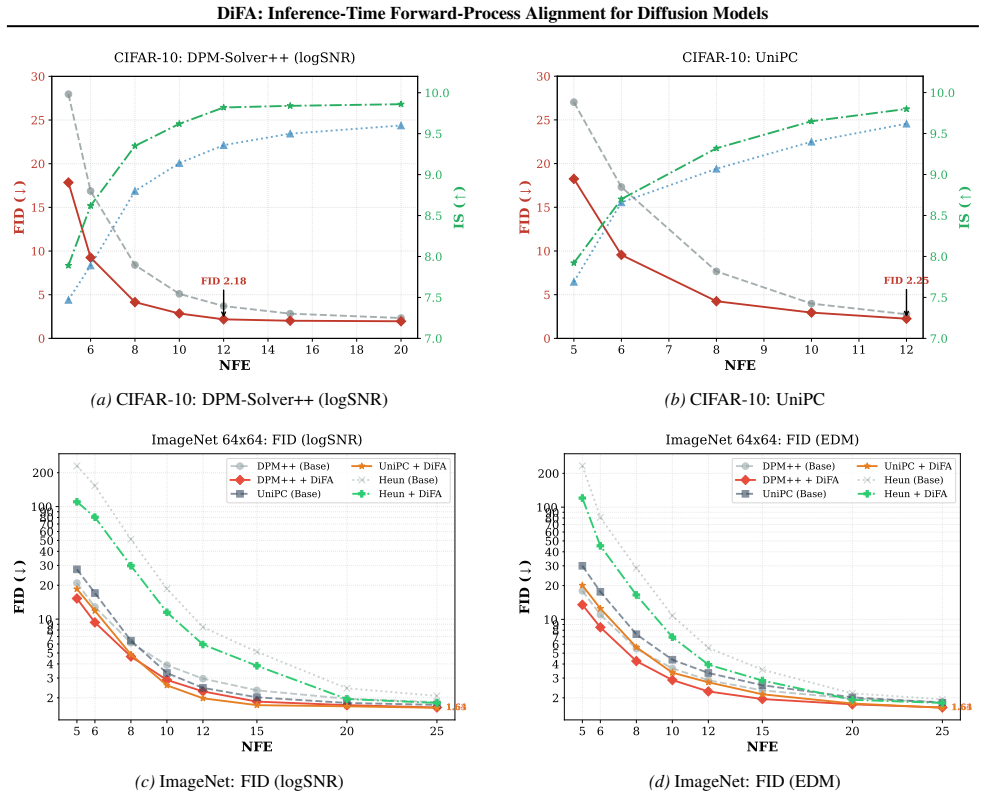
- Largest gains come in the few-step regime: e.g., DPM-Solver++ on CIFAR-10 at 8 NFE improves from FID 8.40 to 4.15, and Heun at 5 NFE on ImageNet-64 improves from 230.05 to 110.20.
- Improvements are consistent across FID, IS, and FD-DINOv2, suggesting the gain is not merely distributional smoothing.
- The principle generalizes beyond pixel-space diffusion: latent diffusion on LSUN Bedroom and flow matching on SiT-XL/2 also improve.
- At higher step counts gains shrink but remain positive: CIFAR-10 at 20 NFE goes from 2.33 to 1.96, and ImageNet-64 at 25 NFE reaches 1.63–1.64 FID.
- DiFA is solver-compatible: it works with DDIM, DPM-Solver++, UniPC, and Heun, and can be adapted to flow-matching trajectories.
Reading between the lines
- If the consensus works because MSE-trained denoisers share a common systematic error across steps, the same filtering could be applied to other iterative generative models whose outputs are noisy estimates of a shared latent, such as autoregressive or energy-based samplers.
- The paper's own idealized model suggests a diagnostic: the size of the FID gain should correlate with the empirical correlation of consecutive prediction errors. Measuring that correlation on a few-step run would reveal whether the gain is true variance reduction or instead implicit smoothing.
- A potential failure mode follows from the model: when the trajectory-implied anchor drifts within the window (high curvature, very low NFE), the consensus averages different targets. In that regime a smaller window or an explicit anchor-motion term should be needed; this is testable and not explored in the paper.
- Because DiFA only changes the clean prediction, it could in principle be combined with distillation or one-step methods, although the paper does not test that combination; the gain might vanish once trajectory predictions are already transported.
Editorial analysis
A structured set of objections, weighed in public.
Referee Report
Summary. The paper proposes DiFA, a training-free, solver-agnostic wrapper that refines each clean-signal prediction during diffusion or flow-matching inference. It maintains a causal buffer of K historical predictions, aligns them channel-wise to the current prediction, forms a consensus anchor using softmax weights over structural similarity and logSNR proximity, and adds a modulated residual (orthogonal projection, low/high-frequency gating) to the current prediction. The paper claims consistent FID/IS/FD-DINOv2 improvements across CIFAR-10, ImageNet-64, LSUN Bedroom, and SiT-XL ImageNet-256, with no additional network evaluations. The theoretical sections (Prop. 4.2, Thm. 4.3) derive BLUE/Kalman optimality under an idealized observation model (Eq. 13), which the paper itself concedes is not an exact description of practical denoiser predictions.
Significance. If the empirical results are reproducible, DiFA would be a valuable, low-cost plug-in for existing samplers, with large margins in the few-step regime (e.g., CIFAR-10 8-NFE DPM-Solver++ FID 8.40 to 4.15; SiT-XL Euler 5-NFE FID 52.64 to 27.61). The method introduces no extra NFEs and has negligible per-step overhead. The paper is commendably explicit about the idealization in its theoretical model and includes extensive ablations. However, the theory as stated does not cover the implemented estimator, and the empirical claims would be substantially strengthened by uncertainty quantification and a fixed hyperparameter-selection protocol. The core idea is promising but currently overstates its principled grounding.
major comments (3)
- [§4.2–§4.4, App. A.3 (Eqs. 13–15, 46–49, 22)] The BLUE/Kalman derivation (Prop. 4.2, Thm. 4.3) applies only to the idealized model Eq. (13): independent observations of a static anchor with covariance c/SNR(t) I. The implemented estimator is structurally different: the consensus weights in Eq. (49) are softmax over τ·m̄_ij − μ|ℓ_i−ℓ_j|, not the precision weights of Eq. (15); the current prediction is excluded from the consensus (Sec. 4.4); and the final refined prediction in Eq. (22) is the current prediction plus a modulated residual, not the BLUE estimate. The paper concedes this in App. A.1 ('practical denoiser predictions are organized according to the resulting anchor-consistency and reliability-ordering principles, rather than being assumed to satisfy the same covariance model exactly'). As a result, Prop. 4.2 and Thm. 4.3 do not certify variance reduction for the actual DiFA output. The theory should be either aligned with th
- [§4.1, Eq. (10); Conclusion] The observation model Eq. (10) treats historical predictions as a locally stable anchor plus bias b_j|i and residual ξ_j|i, but provides no analysis of temporal correlation or anchor drift. In practice, predictions along a reverse trajectory are deterministically coupled through the solver state and the same network, so they are strongly correlated and biased. The paper's own Conclusion states that the framework relies on 'an idealized static-anchor assumption' and defers 'theoretical extensions for temporally correlated errors' to future work. This is an explicit limitation of the central claim that DiFA is 'forward-process aligned.' Please provide either a quantitative drift/correlation analysis for the K=3 window, especially in high-curvature few-step regimes, or soften the claim that the forward geometry is the source of the empirical gains.
- [§5.2, Table 14; App. B.3] Hyperparameters appear to be selected in-sample. Table 14 reports, for each solver and NFE budget, the best FID among four refinement scales (1.25, 1.5, 1.7, 1.75), and the main-text comparisons in Tables 1–2 use the default s=1.7 but the appendix sweeps many parameters (window size, SNR threshold, scale, compatibility). The reported margins at larger NFE are small (e.g., ImageNet-64 25-NFE 1.64 vs 1.83; CIFAR-10 20-NFE 1.96 vs 2.33), where FID variability across seeds can be material. I request error bars or multiple-seed results, and either a single fixed hyperparameter set used across all NFE/solver combinations or an explicit validation-selection protocol that avoids picking the best per cell. Without this, the 'consistently improves' claim is not fully robust.
minor comments (6)
- [General] The code link is given as 'DiFA' with no URL; include a working anonymous link for review.
- [Introduction] Typo: 'V AEs' should be 'VAEs'.
- [Figure 6] The log-scale y-axis makes FID curves difficult to read; consider annotating key values directly on the curves or using a linear scale for the low-FID region.
- [Tables 1–2] The 'Ours' rows list only the DiFA result; including the baseline FID in the same row would make the comparison self-contained.
- [App. B.2, Table 7] The 'w/o History' row sets W=1 and reports identical results to the naive baseline; this is expected but should be stated explicitly in the text for clarity.
- [App. A.3, Eq. (45)] Channel-wise affine alignment is applied before computing similarity; the effect of this alignment on the subsequent softmax weights is not discussed. A brief comment on why alignment does not erase the signal being compared would help.
Circularity Check
No significant circularity: DiFA's BLUE/Kalman derivation is explicitly an idealized motivation, and the headline FID/IS results are external benchmark evaluations rather than consequences of a self-referential definition.
full rationale
The paper separates the ideal forward-aligned observation model (Eq. 13) from the practical consensus (Eq. 19, Appendix A.3 Eq. 49). The BLUE/Kalman variance-reduction results (Prop. 4.2, Thm. 4.3) are presented as motivation, not as a proof about the implemented estimator; Eq. (15) is not defined in terms of Eq. (49), and the practical weights are not claimed to be the precision weights. The main claim—consistent FID/IS/FD-DINOv2 improvement over base samplers—is evaluated on external benchmarks with fixed pretrained checkpoints and reported alongside ablations; this is empirical evidence, not a derivation that reduces to its inputs. Self-citations (e.g., Li & Zeng 2026 for cumulative drift; EVODiff as prior work) are contextual and are not load-bearing for the DiFA update. The acknowledged idealization of independent unbiased observations and the benchmark-tuned hyperparameters are limitations and overfitting risks, not circularity.
Assumptions & free parameters
free parameters (7)
- K (causal temporal window size) =
3
- tau (structural compatibility sharpness) =
4.0
- s (deviation scale, omega=s-1) =
1.7 (omega=0.7)
- k_sim (similarity pooling kernel) =
3
- k_res (residual smoothing kernel) =
5
- mu(logSNR) logSNR compatibility function =
unspecified
- SNR_gating threshold and magnitude alignment phi (EDM/LDM variants) =
SNR_lo=-2.5, phi=0.5 (EDM 10-NFE ablation)
assumptions (4)
- domain assumption Historical denoiser predictions are modeled as conditionally independent observations of a locally static clean anchor with covariance (c/SNR(t)) I (Eq. 13).
- domain assumption The trajectory-implied clean anchor x_0,*^(t_i) is locally stable within the causal window W_K(t_i) (Eq. 10).
- ad hoc to paper Softmax weights over structural cosine similarity minus logSNR distance (Eqs. 46-49) form a valid fusion rule for historical predictions.
- ad hoc to paper Orthogonal residual projection and sigmoid high-frequency gating (Eqs. 52-55) recover useful details without destabilizing sampling.
Cite this review
Pith. "Pith review of DiFA: Inference-Time Forward-Process Alignment for Diffusion Models." pith.science (2026). https://pith.science/paper/6GAEJJJX
@misc{pith2026260717972,
  author       = {Pith},
  title        = {Pith review of: DiFA: Inference-Time Forward-Process Alignment for Diffusion Models},
  year         = {2026},
  howpublished = {\url{https://pith.science/paper/6GAEJJJX}},
  note         = {Machine review of arXiv:2607.17972}
}
read the original abstract
The prevailing inference framework for diffusion models formulates generation fundamentally as a problem of numerical integration. This perspective casts the model as an exact estimator, neglecting the inherent statistical uncertainty of the denoising process. In this work, we propose Forward-Process Aligned Diffusion prediction (\textbf{DiFA}), a training-free framework that reframes inference-time data prediction refinement as a sequential state estimation problem. Rather than reusing past outputs solely for numerical integration, DiFA treats iterative data predictions along the reverse trajectory as correlated observations to build a forward-aligned temporal consensus. Inspired by Kalman filtering, this consensus aggregates historical predictions according to structural consistency and noise-level compatibility. To counteract the over-smoothing tendency of temporal consensus, we introduce a deviation guidance mechanism to adaptively preserve residual details. Empirically, DiFA yields significant improvements on CIFAR-10 and ImageNet across the evaluated metrics, including FID, IS, and FD-DINOv2, demonstrating that aligning inference with the forward statistical structure substantially improves generative fidelity.
Figures


Figures from the paper (4 more)



Reference graph
Works this paper leans on
-
[4]
Fu, S., Wang, Y ., Chen, Y ., Shen, L., and Tao, D
URL https://openreview.net/forum? id=OlzB6LnXcS. Fu, S., Wang, Y ., Chen, Y ., Shen, L., and Tao, D. Self- verification provably prevents model collapse in recur- sive synthetic training. In Belgrave, D., Zhang, C., Lin, H., Pascanu, R., Koniusz, P., Ghassemi, M., and Chen, N. (eds.),Advances in Neural Information Pro- cessing Systems, volume 38, pp. 3610...
arXiv 2025
-
[5]
Karras, T., Aittala, M., Hellsten, J., Laine, S., Lehtinen, J., and Aila, T
URL https://openreview.net/forum? id=ThMQfsBnje. Karras, T., Aittala, M., Hellsten, J., Laine, S., Lehtinen, J., and Aila, T. Training generative adversarial networks with limited data. InAdvances in Neural Information Processing Systems, volume 33, pp. 12104–12114, 2020. Karras, T., Aittala, M., Aila, T., and Laine, S. Elucidating the design space of dif...
arXiv 2020
-
[6]
Li, W., Song, Z., Zhou, H., Yu, J., Zhang, Y ., and Yang, W
URL https://openreview.net/forum? id=UXEo3uNNIX. Li, W., Song, Z., Zhou, H., Yu, J., Zhang, Y ., and Yang, W. LoRA-mixer: Coordinate modular loRA experts through serial attention routing. InThe Fourteenth In- ternational Conference on Learning Representations,
-
[7]
Lin, S., Liu, B., Li, J., and Yang, X
URL https://openreview.net/forum? id=GMP1S4R6Ke. Lin, S., Liu, B., Li, J., and Yang, X. Common diffusion noise schedules and sample steps are flawed. InProceedings of the IEEE/CVF winter conference on applications of computer vision, pp. 5404–5411, 2024. Lipman, Y ., Chen, R. T. Q., Ben-Hamu, H., Nickel, M., and Le, M. Flow matching for generative modelin...
2024
-
[9]
Podell, D., English, Z., Lacey, K., Blattmann, A., Dock- horn, T., M¨uller, J., Penna, J., and Rombach, R
URL https://openreview.net/forum? id=TubfvqZNEr. Podell, D., English, Z., Lacey, K., Blattmann, A., Dock- horn, T., M¨uller, J., Penna, J., and Rombach, R. SDXL: Improving latent diffusion models for high-resolution image synthesis. InThe Twelfth International Confer- ence on Learning Representations, 2024. URL https: //openreview.net/forum?id=di52zR8xgf....
2024
-
[10]
Sabour, A., Fidler, S., and Kreis, K
URL https://openreview.net/forum? id=nBGBzV4It3. Sabour, A., Fidler, S., and Kreis, K. Align your flow: Scal- ing continuous-time flow map distillation. InThe Thirty- ninth Annual Conference on Neural Information Pro- cessing Systems, 2025. URL https://openreview. net/forum?id=pzHuesCvcO. Salimans, T. and Ho, J. Progressive distillation for fast sampling ...
arXiv 2025
-
[11]
Zhang, Q
URL https://openreview.net/forum? id=MtDd7rWok1. Zhang, Q. and Chen, Y . Fast sampling of diffusion mod- els with exponential integrator. InThe Eleventh In- ternational Conference on Learning Representations,
-
[2022]
Liu, X., Gong, C., and qiang liu
URL https://openreview.net/forum? id=PlKWVd2yBkY. Liu, X., Gong, C., and qiang liu. Flow straight and fast: Learning to generate and transfer data with rec- tified flow. InThe Eleventh International Conference on Learning Representations, 2023a. URL https: //openreview.net/forum?id=XVjTT1nw5z. Liu, X., Park, D. H., Azadi, S., Zhang, G., Chopikyan, A., Hu,...
arXiv 2024
Show all 12 references
-
[2023]
Zhao, W., Bai, L., Rao, Y ., Zhou, J., and Lu, J
URL https://openreview.net/forum? id=Loek7hfb46P. Zhao, W., Bai, L., Rao, Y ., Zhou, J., and Lu, J. UniPC: A unified predictor-corrector framework for fast sampling of diffusion models. InThirty-seventh Conference on Neural Information Processing Systems, 2023. URL https: //op...
2023 arXiv
-
[2024]
Bao, F., Li, C., Zhu, J., and Zhang, B
URL https://openreview.net/forum? id=pzpWBbnwiJ. Bao, F., Li, C., Zhu, J., and Zhang, B. Analytic-DPM: an analytic estimate of the optimal reverse variance in diffusion probabilistic models. InInternational Confer- ence on Learning Representations, 2022. URL https: //openrevie...
2022
-
[2025]
Bansal, A., Chu, H.-M., Schwarzschild, A., Sengupta, R., Goldblum, M., Geiping, J., and Goldstein, T
URL https://openreview.net/forum? id=MKvQH1ekeY. Bansal, A., Chu, H.-M., Schwarzschild, A., Sengupta, R., Goldblum, M., Geiping, J., and Goldstein, T. Uni- versal guidance for diffusion models. InThe Twelfth International Conference on Learning Representations,
-
[2026]
doi: https://doi.org/10.1016/j
ISSN 0031-3203. doi: https://doi.org/10.1016/j. patcog.2025.112442. Chen, Z., Li, H., Wang, F., Zhang, O., Xu, H., Jiang, X., Song, Z., and Wang, H. Rethinking the diffusion models for missing data imputation: A gradient flow perspective. Advances in Neural Information Process...
2025
Reviewed August 1, 2026 · model on record in the stance chip above.
Discussion (0). Continue with ORCID to comment.